 | Acta Crystallographica Section E Acta Crystallographica Section E CRYSTALLOGRAPHIC COMMUNICATIONS |


 journal menu


inorganic compounds
| CRYSTALLOGRAPHIC COMMUNICATIONS |
 access
C-type Nd2Se3

aInstitut für Anorganische Chemie, Universität Stuttgart, Pfaffenwaldring 55, D-70569 Stuttgart, Germany
*Correspondence e-mail: [email protected]
The title compound, neodymium sesquiselenide, is isotypic with the other known rare-earth metal(III) M2Se3 (M = La–Pr and Sm–Lu) with the cubic C-type structure. It adopts a cation-defective Th3P4-type arrangement with close to 8/9 of the unique neodymium-cation site occupied, leading to the composition Nd2.667Se4 (Z = 4) or Nd2Se3 (Z = 5.333), respectively. The Nd3+ cations are thus surrounded by eight selenide anions, forming trigonal [NdSe8]13− dodecahedra, whereas the Se2− anions exhibit a sixfold coordination, but due to the under-occupation of neodymium, each one is statistically surrounded by only 5.333 cations. The crystal studied was a twin with a 0.31 (6):0.69 (6) domain ratio.
Related literature
For the structural family with the cation-defective Th3P4-type arrangement, see: Pardo et al. (1963![[Pardo, M. P., Flahaut, J. & Domange, L. (1963). C. R. Acad. Sci., 256, 1793-1796.]](../../../../../../logos/arrows/e_arr.gif "Pardo, M. P., Flahaut, J. & Domange, L. (1963). C. R. Acad. Sci., 256, 1793-1796.") ); Flahaut et al. (1965); Lashkarev & Paderno (1965). For the rare-earth sesquiselenides M2Se3 with M = La–Pr and Sm–Lu, see: Grundmeier & Urland (1995); Folchnandt (1997); Folchnandt & Schleid (2001); Folchnandt et al. (2004).
); Flahaut et al. (1965); Lashkarev & Paderno (1965). For the rare-earth sesquiselenides M2Se3 with M = La–Pr and Sm–Lu, see: Grundmeier & Urland (1995); Folchnandt (1997); Folchnandt & Schleid (2001); Folchnandt et al. (2004).
Experimental
Crystal data
|

| ||||||||
 .
. Data collection: DIF4 (Stoe & Cie, 1992); cell refinement: DIF4; data reduction: REDU4 (Stoe & Cie, 1992); program(s) used to solve structure: SHELXS97 (Sheldrick, 2008); program(s) used to refine structure: SHELXL97 (Sheldrick, 2008); molecular graphics: DIAMOND (Brandenburg, 2006); software used to prepare material for publication: SHELXL97.
Supporting information
contains datablocks I, global. DOI: 10.1107/S1600536809005455/mg2064sup1.cif
Structure factors: contains datablock I. DOI: 10.1107/S1600536809005455/mg2064Isup2.hkl
Ruby-red, multifaceted, transparent crystals of Nd2Se3 were obtained from stoichiometric reaction of the elements in the presence of CsCl as a placed within a torch-sealed evacuated fused-silica vessel. The mixture was heated at 1123 K for seven days, followed by cooling to ambient temperature with 10 K/h.
Data collection: DIF4 (Stoe & Cie, 1992); cell DIF4 (Stoe & Cie, 1992); data reduction: REDU4 (Stoe & Cie, 1992); program(s) used to solve structure: SHELXS97 (Sheldrick, 2008); program(s) used to refine structure: SHELXL97 (Sheldrick, 2008); molecular graphics: DIAMOND (Brandenburg, 2006); software used to prepare material for publication: SHELXL97 (Sheldrick, 2008).
![[Figure 1]](./mg2064fig1thm.gif) | Fig. 1. Crystal structure of C-Type Nd2Se3. |
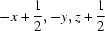
![[Figure 2]](./mg2064fig2thm.gif) | Fig. 2. Coordination sphere of the Nd3+ cation in the shape of a trigonal dodecahedron. Displacement ellipsoids are drawn at 95% probability level. [Symmetry codes: (i) -x + 1/2, -y, z + 1/2; (ii) y + 1/4, x + 1/4, z + 1/4; (iii) y + 1/4, -x - 1/4, -z + 1/4; (iv) -x + 1/2, y, -z; (v) -y + 3/4, -x + 1/4, z + 1/4; (vi) -y + 3/4, x - 1/4, -z + 1/4; (vii) x, -y, -z + 1/2.] |
![[Figure 3]](./mg2064fig3thm.gif) | Fig. 3. Coordination sphere of the Se2- anion. Due to the under-occupation of the neodymium site, each selenium is surrounded by 5.333 Nd3+ cations. Displacement ellipsoids are drawn at 95% probability level. [Symmetry codes: (viii) y, -z, -x + 1/2; (ix) -x + 1/2, -y, z - 1/2; (x) -y - 1/4, x - 1/4, -z + 1/4; (xi) y, z, x; (xii) y + 1/4, -x + 3/4, -z + 1/4.] |
| Nd2.667Se4 | Dx = 6.682 Mg m−3 |
| Mr = 700.48 | Mo Kα radiation, λ = 0.71069 Å |
| Cubic, I43d | Cell parameters from 5000 reflections |
| Hall symbol: I -4bd 2c 3 | θ = 1.0–32.7° |
| a = 8.8632 (6) Å | µ = 40.39 mm−1 |
| V = 696.26 (8) Å3 | T = 293 K |
| Z = 4 | Block, red |
| F(000) = 1184 | 0.03 × 0.03 × 0.03 mm |
| Stoe IPDS-I diffractometer | 220 independent reflections |
| Radiation source: fine-focus sealed tube | 214 reflections with I > 2σ(I) |
| Graphite monochromator | Rint = 0.065 |
| imaging plate detector system scans | θmax = 32.7°, θmin = 5.6° |
| Absorption correction: numerical (X-SHAPE; Stoe & Cie, 1999) | h = −13→13 |
| Tmin = 0.305, Tmax = 0.401 | k = −13→13 |
| 8964 measured reflections | l = −13→13 |
| Refinement on F2 | Secondary atom site location: difference Fourier map |
| Least-squares matrix: full | w = 1/[σ2(Fo2) + (0.0359P)2] where P = (Fo2 + 2Fc2)/3 |
| R[F2 > 2σ(F2)] = 0.026 | (Δ/σ)max = 0.007 |
| wR(F2) = 0.060 | Δρmax = 1.01 e Å−3 |
| S = 1.22 | Δρmin = −2.11 e Å−3 |
| 220 reflections | Extinction correction: SHELXL97 (Sheldrick, 2008), Fc*=kFc[1+0.001xFc2λ3/sin(2θ)]-1/4 |
| 7 parameters | Extinction coefficient: 0.0086 (7) |
| 0 restraints | Absolute structure: Flack (1983), 92 Friedel pairs |
| Primary atom site location: structure-invariant direct methods | Absolute structure parameter: 0.31 (6) |
| Nd2.667Se4 | Z = 4 |
| Mr = 700.48 | Mo Kα radiation |
| Cubic, I43d | µ = 40.39 mm−1 |
| a = 8.8632 (6) Å | T = 293 K |
| V = 696.26 (8) Å3 | 0.03 × 0.03 × 0.03 mm |
| Stoe IPDS-I diffractometer | 220 independent reflections |
| Absorption correction: numerical (X-SHAPE; Stoe & Cie, 1999) | 214 reflections with I > 2σ(I) |
| Tmin = 0.305, Tmax = 0.401 | Rint = 0.065 |
| 8964 measured reflections |
| R[F2 > 2σ(F2)] = 0.026 | 0 restraints |
| wR(F2) = 0.060 | Δρmax = 1.01 e Å−3 |
| S = 1.22 | Δρmin = −2.11 e Å−3 |
| 220 reflections | Absolute structure: Flack (1983), 92 Friedel pairs |
| 7 parameters | Absolute structure parameter: 0.31 (6) |
Geometry. All e.s.d.'s (except the e.s.d. in the dihedral angle between two l.s. planes) are estimated using the full covariance matrix. The cell e.s.d.'s are taken into account individually in the estimation of e.s.d.'s in distances, angles and torsion angles; correlations between e.s.d.'s in cell parameters are only used when they are defined by crystal symmetry. An approximate (isotropic) treatment of cell e.s.d.'s is used for estimating e.s.d.'s involving l.s. planes. |
Refinement. Refinement of F2 against ALL reflections. The weighted R-factor wR and goodness of fit S are based on F2, conventional R-factors R are based on F, with F set to zero for negative F2. The threshold expression of F2 > σ(F2) is used only for calculating R-factors(gt) etc. and is not relevant to the choice of reflections for refinement. R-factors based on F2 are statistically about twice as large as those based on F, and R- factors based on ALL data will be even larger. |
| x | y | z | Uiso*/Ueq | Occ. (<1) | |
| Nd | 0.3750 | 0.0000 | 0.2500 | 0.0053 (2) | 0.89 |
| Se | 0.07261 (5) | 0.07261 (5) | 0.07261 (5) | 0.0028 (3) |
| U11 | U22 | U33 | U12 | U13 | U23 | |
| Nd | 0.0066 (3) | 0.0046 (3) | 0.0046 (3) | 0.000 | 0.000 | 0.000 |
| Se | 0.0028 (3) | 0.0028 (3) | 0.0028 (3) | 0.00063 (16) | 0.00063 (16) | 0.00063 (16) |
| Nd—Sei | 2.9675 (5) | Nd—Se | 3.1732 (6) |
| Nd—Seii | 2.9675 (5) | Se—Ndviii | 2.9675 (5) |
| Nd—Seiii | 2.9675 (5) | Se—Ndix | 2.9675 (5) |
| Nd—Seiv | 2.9675 (5) | Se—Ndx | 2.9675 (5) |
| Nd—Sev | 3.1732 (6) | Se—Ndxi | 3.1732 (6) |
| Nd—Sevi | 3.1732 (6) | Se—Ndxii | 3.1732 (6) |
| Nd—Sevii | 3.1732 (6) | ||
| Sei—Nd—Seii | 91.403 (3) | Seii—Nd—Se | 77.283 (2) |
| Sei—Nd—Seiii | 91.403 (3) | Seiii—Nd—Se | 87.467 (16) |
| Seii—Nd—Seiii | 162.00 (2) | Seiv—Nd—Se | 67.092 (10) |
| Sei—Nd—Seiv | 162.00 (2) | Sev—Nd—Se | 135.510 (1) |
| Seii—Nd—Seiv | 91.403 (3) | Sevi—Nd—Se | 135.510 (1) |
| Seiii—Nd—Seiv | 91.403 (3) | Sevii—Nd—Se | 64.738 (1) |
| Sei—Nd—Sev | 77.284 (2) | Ndviii—Se—Ndix | 88.609 (17) |
| Seii—Nd—Sev | 67.092 (10) | Ndviii—Se—Ndx | 88.609 (17) |
| Seiii—Nd—Sev | 130.811 (11) | Ndix—Se—Ndx | 88.609 (17) |
| Seiv—Nd—Sev | 87.468 (16) | Ndviii—Se—Ndxi | 107.535 (2) |
| Sei—Nd—Sevi | 87.468 (16) | Ndix—Se—Ndxi | 162.372 (6) |
| Seii—Nd—Sevi | 130.811 (11) | Ndx—Se—Ndxi | 84.849 (2) |
| Seiii—Nd—Sevi | 67.092 (10) | Ndviii—Se—Ndxii | 162.372 (6) |
| Seiv—Nd—Sevi | 77.283 (2) | Ndix—Se—Ndxii | 84.849 (2) |
| Sev—Nd—Sevi | 64.739 (1) | Ndx—Se—Ndxii | 107.534 (2) |
| Sei—Nd—Sevii | 67.092 (10) | Ndxi—Se—Ndxii | 81.565 (16) |
| Seii—Nd—Sevii | 87.468 (16) | Ndviii—Se—Nd | 84.849 (2) |
| Seiii—Nd—Sevii | 77.283 (2) | Ndix—Se—Nd | 107.535 (2) |
| Seiv—Nd—Sevii | 130.810 (11) | Ndx—Se—Nd | 162.372 (6) |
| Sev—Nd—Sevii | 135.510 (1) | Ndxi—Se—Nd | 81.565 (16) |
| Sevi—Nd—Sevii | 135.510 (1) | Ndxii—Se—Nd | 81.565 (16) |
| Sei—Nd—Se | 130.811 (11) |
| Symmetry codes: (i) −x+1/2, −y, z+1/2; (ii) y+1/4, x+1/4, z+1/4; (iii) y+1/4, −x−1/4, −z+1/4; (iv) −x+1/2, y, −z; (v) −y+3/4, −x+1/4, z+1/4; (vi) −y+3/4, x−1/4, −z+1/4; (vii) x, −y, −z+1/2; (viii) y, −z, −x+1/2; (ix) −x+1/2, −y, z−1/2; (x) −y−1/4, x−1/4, −z+1/4; (xi) y, z, x; (xii) y+1/4, −x+3/4, −z+1/4. |
Experimental details
| Crystal data | |
| Chemical formula | Nd2.667Se4 |
| Mr | 700.48 |
| Crystal system, space group | Cubic, I43d |
| Temperature (K) | 293 |
| a (Å) | 8.8632 (6) |
| V (Å3) | 696.26 (8) |
| Z | 4 |
| Radiation type | Mo Kα |
| µ (mm−1) | 40.39 |
| Crystal size (mm) | 0.03 × 0.03 × 0.03 |
| Data collection | |
| Diffractometer | Stoe IPDS-I diffractometer |
| Absorption correction | Numerical (X-SHAPE; Stoe & Cie, 1999) |
| Tmin, Tmax | 0.305, 0.401 |
| No. of measured, independent and observed [I > 2σ(I)] reflections | 8964, 220, 214 |
| Rint | 0.065 |
| (sin θ/λ)max (Å−1) | 0.761 |
| Refinement | |
| R[F2 > 2σ(F2)], wR(F2), S | 0.026, 0.060, 1.22 |
| No. of reflections | 220 |
| No. of parameters | 7 |
| Δρmax, Δρmin (e Å−3) | 1.01, −2.11 |
| Absolute structure | Flack (1983), 92 Friedel pairs |
| Absolute structure parameter | 0.31 (6) |
Computer programs: DIF4 (Stoe & Cie, 1992), REDU4 (Stoe & Cie, 1992), SHELXS97 (Sheldrick, 2008), SHELXL97 (Sheldrick, 2008), DIAMOND (Brandenburg, 2006).
| Nd—Sei | 2.9675 (5) | Nd—Sev | 3.1732 (6) |
| Nd—Seii | 2.9675 (5) | Nd—Sevi | 3.1732 (6) |
| Nd—Seiii | 2.9675 (5) | Nd—Sevii | 3.1732 (6) |
| Nd—Seiv | 2.9675 (5) | Nd—Se | 3.1732 (6) |
| Symmetry codes: (i) −x+1/2, −y, z+1/2; (ii) y+1/4, x+1/4, z+1/4; (iii) y+1/4, −x−1/4, −z+1/4; (iv) −x+1/2, y, −z; (v) −y+3/4, −x+1/4, z+1/4; (vi) −y+3/4, x−1/4, −z+1/4; (vii) x, −y, −z+1/2. |
Acknowledgements
Financial support by the state of Baden–Württemberg (Stuttgart) and the Deutsche Forschungsgemeinschaft (DFG; Frankfurt/Main) is gratefully acknowledged. Furthermore we thank Dr Falk Lissner for the data collection.
References
 Brandenburg, K. (2006). DIAMOND. Crystal Impact GbR, Bonn, Germany. Google Scholar
Flack, H. D. (1983). Acta Cryst. A39, 876–881. CrossRef CAS Web of Science IUCr Journals Google Scholar
Flahaut, J., Guittard, M., Patrie, M., Pardo, M. P., Golabi, S. M. & Domange, L. (1965). Acta Cryst. 19, 14–19. CrossRef CAS IUCr Journals Web of Science Google Scholar
Folchnandt, M. (1997). Dissertation, University of Stuttgart, Germany. Google Scholar
Folchnandt, M. & Schleid, Th. (2001). Z. Anorg. Allg. Chem. 627, 1411–1413. Web of Science CrossRef CAS Google Scholar
Folchnandt, M., Schneck, C. & Schleid, Th. (2004). Z. Anorg. Allg. Chem. 630, 149–155. Web of Science CrossRef Google Scholar
Grundmeier, T. & Urland, W. (1995). Z. Anorg. Allg. Chem. 621, 1977–1979. CrossRef CAS Web of Science Google Scholar
Lashkarev, G. V. & Paderno, Y. B. (1965). Inorg. Mater. (USSR), 1, 1620–1623. Google Scholar
Pardo, M. P., Flahaut, J. & Domange, L. (1963). C. R. Acad. Sci., 256, 1793–1796. CAS Google Scholar
Sheldrick, G. M. (2008). Acta Cryst. A64, 112–122. Web of Science CrossRef CAS IUCr Journals Google Scholar
Stoe & Cie (1992). DIF4 and REDU4. Stoe & Cie, Darmstadt, Germany. Google Scholar
Stoe & Cie (1999). X-SHAPE. Stoe & Cie, Darmstadt, Germany. Google Scholar
This is an open-access article distributed under the terms of the Creative Commons Attribution (CC-BY) Licence, which permits unrestricted use, distribution, and reproduction in any medium, provided the original authors and source are cited.
| CRYSTALLOGRAPHIC COMMUNICATIONS |


C-type Nd2Se3 (Fig. 1) belongs to a structural family with the cation-defect Th3P4-type arrangement (Pardo et al., 1963; Flahaut et al., 1965; Lashkarev & Paderno, 1965) adopted by rare-earth sesquiselenides M2Se3 with M = La – Pr and Sm – Lu (Grundmeier & Urland, 1995; Folchnandt, 1997; Folchnandt & Schleid, 2001; Folchnandt et al., 2004) following the general formula M2.667□0.333Se4. The Nd3+ cations occupy the 12a position, whereas selenium resides at the 16c position. Despite the fact that out of the 12 possible cationic sites (per 16 Se2- and unit cell), only 10.667 are allowed to be occupied to realise the composition Nd2Se3 (with Z = 5.333, i.e. M2.667□0.333Se4 with Z = 4); these exhibit the coordination number 8 with respect to the selenide anions. The [NdSe8]13- coordination polyhedra can be described as trigonal dodecahedra with 4-symmetry (Fig. 2). On average, the Se2- anions are surrounded by 5.333 Nd3+ cations in a trigonal hemiprism of symmetry .3. with faces rotated 38.2° with respect to each other (Fig. 3).