 | Acta Crystallographica Section E Acta Crystallographica Section E CRYSTALLOGRAPHIC COMMUNICATIONS |


 journal menu


metal-organic compounds
| CRYSTALLOGRAPHIC COMMUNICATIONS |
 access
Bis(μ-N,N-dimethyldithiocarbamato-κ3S,S′:S)bis[(N,N-dimethyldithiocarbamato-κ2S,S′)copper(II)]

aInstitute of Materials Physical Chemistry and the Key Laboratory for Functional Materials of Fujian Higher Education, Huaqiao University, Quanzhou, Fujian 362021, People's Republic of China
*Correspondence e-mail: [email protected]
In the centrosymmetric dimeric title compound, [Cu2(C3H6NS2)4], the CuII atom is five-coordinate in a square-pyramidal environment. The basal coordination positions are occupied by four S atoms from two dimethyldithiocarbamate ligands and the apical coordination position is occupied by an S atom also bonded to the other Cu atom.
Related literature
For the structural diversity and potential applications of transition metal complexes, see: Noro et al. (2000![[Noro, S., Kitagawa, S., Kondo, M. & Seki, K. (2000). Angew. Chem. Int. Ed. 39, 2081-2084.]](../../../../../../logos/arrows/e_arr.gif "Noro, S., Kitagawa, S., Kondo, M. & Seki, K. (2000). Angew. Chem. Int. Ed. 39, 2081-2084.") ); Yaghi et al. (1998). For dialkyldithiocarbamates anions acting as monodentate, bidentate or bridging ligands, see: Engelhardt et al. (1988); Fernández et al. (2000); Koh et al. (2003).
); Yaghi et al. (1998). For dialkyldithiocarbamates anions acting as monodentate, bidentate or bridging ligands, see: Engelhardt et al. (1988); Fernández et al. (2000); Koh et al. (2003).
![[Scheme 1]](ng2548scheme1.gif)
Experimental
Crystal data
|
Refinement
|
| ||||||||||||||
 .
. Data collection: CrystalClear (Rigaku, 2007); cell refinement: CrystalClear; data reduction: CrystalClear; program(s) used to solve structure: SHELXS97 (Sheldrick, 2008); program(s) used to refine structure: SHELXL97 (Sheldrick, 2008); molecular graphics: SHELXTL (Sheldrick, 2008); software used to prepare material for publication: SHELXTL.
Supporting information
contains datablocks global, I. DOI: 10.1107/S1600536809006230/ng2548sup1.cif
Structure factors: contains datablock I. DOI: 10.1107/S1600536809006230/ng2548Isup2.hkl
A mixture of Cu(Ac)2.H2O (0.04 g, 0.2 mmol) and NaS2CNMe2.2H2O (0.04 g, 0.2 mmol) was stirred in DMF (15 ml) at 313 K. 2-PrOH was diffused into the resulting solution, yielding single crystals of (I).
H atoms were positioned geometrically and refined as riding atoms, with C—H = 0.96 Å, Uiso(H) = 1.5Ueq(C).
Data collection: CrystalClear (Rigaku, 2007); cell CrystalClear (Rigaku, 2007); data reduction: CrystalClear (Rigaku, 2007); program(s) used to solve structure: SHELXS97 (Sheldrick, 2008); program(s) used to refine structure: SHELXL97 (Sheldrick, 2008); molecular graphics: SHELXTL (Sheldrick, 2008); software used to prepare material for publication: SHELXTL (Sheldrick, 2008).
![[Figure 1]](./ng2548fig1thm.gif) | Fig. 1. The molecular structure of (I) with 30% probability displacement ellipsoids (arbitrary spheres for H atoms). [Symmetry code: A 1 - x, y, 1/2 - z.] |
| [Cu2(C3H6NS2)4] | F(000) = 1240 |
| Mr = 607.91 | Dx = 1.727 Mg m−3 |
| Monoclinic, C2/c | Mo Kα radiation, λ = 0.71073 Å |
| Hall symbol: -C 2yc | Cell parameters from 3071 reflections |
| a = 8.068 (3) Å | θ = 2.5–27.5° |
| b = 19.446 (7) Å | µ = 2.54 mm−1 |
| c = 15.108 (6) Å | T = 293 K |
| β = 99.354 (6)° | Block, black |
| V = 2338.7 (15) Å3 | 0.25 × 0.20 × 0.15 mm |
| Z = 4 |
| Rigaku Mercury CCD diffractometer | 2685 independent reflections |
| Radiation source: Sealed Tube | 2423 reflections with I > 2σ(I) |
| Graphite Monochromator monochromator | Rint = 0.048 |
| ω scans | θmax = 27.5°, θmin = 2.1° |
| Absorption correction: multi-scan (CrystalClear; Rigaku, 2007) | h = −9→10 |
| Tmin = 0.807, Tmax = 1.000 | k = −25→25 |
| 9796 measured reflections | l = −19→18 |
| Refinement on F2 | Primary atom site location: structure-invariant direct methods |
| Least-squares matrix: full | Secondary atom site location: difference Fourier map |
| R[F2 > 2σ(F2)] = 0.050 | Hydrogen site location: inferred from neighbouring sites |
| wR(F2) = 0.141 | H-atom parameters constrained |
| S = 1.07 | w = 1/[σ2(Fo2) + (0.0741P)2 + 4.6176P] where P = (Fo2 + 2Fc2)/3 |
| 2685 reflections | (Δ/σ)max < 0.001 |
| 118 parameters | Δρmax = 0.44 e Å−3 |
| 0 restraints | Δρmin = −0.58 e Å−3 |
| [Cu2(C3H6NS2)4] | V = 2338.7 (15) Å3 |
| Mr = 607.91 | Z = 4 |
| Monoclinic, C2/c | Mo Kα radiation |
| a = 8.068 (3) Å | µ = 2.54 mm−1 |
| b = 19.446 (7) Å | T = 293 K |
| c = 15.108 (6) Å | 0.25 × 0.20 × 0.15 mm |
| β = 99.354 (6)° |
| Rigaku Mercury CCD diffractometer | 2685 independent reflections |
| Absorption correction: multi-scan (CrystalClear; Rigaku, 2007) | 2423 reflections with I > 2σ(I) |
| Tmin = 0.807, Tmax = 1.000 | Rint = 0.048 |
| 9796 measured reflections |
| R[F2 > 2σ(F2)] = 0.050 | 0 restraints |
| wR(F2) = 0.141 | H-atom parameters constrained |
| S = 1.07 | Δρmax = 0.44 e Å−3 |
| 2685 reflections | Δρmin = −0.58 e Å−3 |
| 118 parameters |
Geometry. All e.s.d.'s (except the e.s.d. in the dihedral angle between two l.s. planes) are estimated using the full covariance matrix. The cell e.s.d.'s are taken into account individually in the estimation of e.s.d.'s in distances, angles and torsion angles; correlations between e.s.d.'s in cell parameters are only used when they are defined by crystal symmetry. An approximate (isotropic) treatment of cell e.s.d.'s is used for estimating e.s.d.'s involving l.s. planes. |
Refinement. Refinement of F2 against ALL reflections. The weighted R-factor wR and goodness of fit S are based on F2, conventional R-factors R are based on F, with F set to zero for negative F2. The threshold expression of F2 > σ(F2) is used only for calculating R-factors(gt) etc. and is not relevant to the choice of reflections for refinement. R-factors based on F2 are statistically about twice as large as those based on F, and R- factors based on ALL data will be even larger. |
| x | y | z | Uiso*/Ueq | ||
| Cu1 | 0.58962 (6) | 0.37634 (2) | 0.36682 (3) | 0.04294 (19) | |
| S1 | 0.72601 (13) | 0.39120 (5) | 0.24400 (7) | 0.0438 (3) | |
| S2 | 0.66137 (15) | 0.49238 (5) | 0.37410 (7) | 0.0493 (3) | |
| S3 | 0.50794 (15) | 0.35823 (5) | 0.50440 (7) | 0.0497 (3) | |
| S4 | 0.56076 (14) | 0.25771 (5) | 0.37160 (7) | 0.0478 (3) | |
| N1 | 0.7709 (4) | 0.52631 (17) | 0.2215 (2) | 0.0482 (8) | |
| N2 | 0.4789 (4) | 0.22341 (17) | 0.5308 (2) | 0.0451 (7) | |
| C1 | 0.7268 (5) | 0.47699 (19) | 0.2734 (3) | 0.0410 (8) | |
| C2 | 0.8173 (7) | 0.5106 (3) | 0.1342 (3) | 0.0660 (13) | |
| H2A | 0.8225 | 0.4616 | 0.1269 | 0.099* | |
| H2B | 0.9251 | 0.5303 | 0.1307 | 0.099* | |
| H2C | 0.7348 | 0.5295 | 0.0876 | 0.099* | |
| C3 | 0.7562 (7) | 0.5986 (2) | 0.2445 (4) | 0.0642 (13) | |
| H3A | 0.7251 | 0.6022 | 0.3030 | 0.096* | |
| H3B | 0.6717 | 0.6201 | 0.2011 | 0.096* | |
| H3C | 0.8620 | 0.6211 | 0.2444 | 0.096* | |
| C4 | 0.5123 (5) | 0.27279 (19) | 0.4761 (2) | 0.0396 (8) | |
| C5 | 0.4841 (6) | 0.1509 (2) | 0.5072 (3) | 0.0616 (12) | |
| H5A | 0.5085 | 0.1466 | 0.4473 | 0.092* | |
| H5B | 0.3773 | 0.1301 | 0.5103 | 0.092* | |
| H5C | 0.5699 | 0.1281 | 0.5483 | 0.092* | |
| C6 | 0.4417 (6) | 0.2385 (3) | 0.6202 (3) | 0.0631 (13) | |
| H6A | 0.4415 | 0.2874 | 0.6291 | 0.095* | |
| H6B | 0.5257 | 0.2178 | 0.6645 | 0.095* | |
| H6C | 0.3333 | 0.2202 | 0.6258 | 0.095* |
| U11 | U22 | U33 | U12 | U13 | U23 | |
| Cu1 | 0.0524 (3) | 0.0380 (3) | 0.0398 (3) | 0.00016 (19) | 0.0115 (2) | 0.00059 (18) |
| S1 | 0.0478 (6) | 0.0412 (5) | 0.0442 (5) | 0.0025 (4) | 0.0125 (4) | −0.0010 (4) |
| S2 | 0.0613 (7) | 0.0414 (5) | 0.0462 (6) | −0.0044 (4) | 0.0114 (5) | −0.0078 (4) |
| S3 | 0.0667 (7) | 0.0447 (5) | 0.0397 (5) | 0.0014 (5) | 0.0144 (5) | −0.0027 (4) |
| S4 | 0.0643 (7) | 0.0385 (5) | 0.0430 (6) | 0.0041 (4) | 0.0158 (5) | −0.0005 (4) |
| N1 | 0.0478 (19) | 0.0466 (18) | 0.0489 (19) | −0.0053 (15) | 0.0041 (15) | 0.0071 (15) |
| N2 | 0.0445 (18) | 0.0467 (17) | 0.0438 (18) | −0.0017 (14) | 0.0063 (14) | 0.0063 (14) |
| C1 | 0.0365 (18) | 0.0425 (18) | 0.041 (2) | −0.0001 (15) | −0.0015 (15) | 0.0027 (15) |
| C2 | 0.069 (3) | 0.072 (3) | 0.059 (3) | −0.008 (2) | 0.018 (2) | 0.013 (2) |
| C3 | 0.076 (3) | 0.042 (2) | 0.071 (3) | −0.012 (2) | 0.002 (2) | 0.008 (2) |
| C4 | 0.0359 (18) | 0.0454 (19) | 0.0367 (18) | 0.0026 (15) | 0.0034 (14) | 0.0051 (15) |
| C5 | 0.071 (3) | 0.043 (2) | 0.070 (3) | −0.002 (2) | 0.009 (2) | 0.013 (2) |
| C6 | 0.071 (3) | 0.072 (3) | 0.050 (3) | −0.005 (2) | 0.021 (2) | 0.016 (2) |
| Cu1—S3 | 2.3072 (13) | N2—C5 | 1.457 (5) |
| Cu1—S4 | 2.3208 (13) | C2—H2A | 0.9600 |
| Cu1—S1 | 2.3240 (13) | C2—H2B | 0.9600 |
| Cu1—S2 | 2.3278 (13) | C2—H2C | 0.9600 |
| Cu1—S1i | 2.8258 (14) | C3—H3A | 0.9600 |
| S1—C1 | 1.726 (4) | C3—H3B | 0.9600 |
| S2—C1 | 1.715 (4) | C3—H3C | 0.9600 |
| S3—C4 | 1.717 (4) | C5—H5A | 0.9600 |
| S4—C4 | 1.713 (4) | C5—H5B | 0.9600 |
| N1—C1 | 1.324 (5) | C5—H5C | 0.9600 |
| N1—C2 | 1.461 (6) | C6—H6A | 0.9600 |
| N1—C3 | 1.457 (6) | C6—H6B | 0.9600 |
| N2—C4 | 1.323 (5) | C6—H6C | 0.9600 |
| N2—C6 | 1.460 (5) | ||
| S3—Cu1—S4 | 77.03 (4) | H2A—C2—H2B | 109.5 |
| S3—Cu1—S1 | 168.48 (5) | N1—C2—H2C | 109.5 |
| S4—Cu1—S1 | 102.20 (4) | H2A—C2—H2C | 109.5 |
| S3—Cu1—S2 | 102.16 (4) | H2B—C2—H2C | 109.5 |
| S4—Cu1—S2 | 170.94 (5) | N1—C3—H3A | 109.5 |
| S1—Cu1—S2 | 76.75 (4) | N1—C3—H3B | 109.5 |
| S3—Cu1—S1i | 100.81 (5) | H3A—C3—H3B | 109.5 |
| S4—Cu1—S1i | 91.99 (4) | N1—C3—H3C | 109.5 |
| S1—Cu1—S1i | 90.70 (4) | H3A—C3—H3C | 109.5 |
| S2—Cu1—S1i | 97.01 (4) | H3B—C3—H3C | 109.5 |
| C1—S1—Cu1 | 84.09 (14) | N2—C4—S3 | 122.2 (3) |
| C1—S2—Cu1 | 84.21 (13) | N2—C4—S4 | 123.5 (3) |
| C4—S3—Cu1 | 84.45 (13) | S3—C4—S4 | 114.3 (2) |
| C4—S4—Cu1 | 84.12 (13) | N2—C5—H5A | 109.5 |
| C1—N1—C2 | 121.1 (4) | N2—C5—H5B | 109.5 |
| C1—N1—C3 | 121.2 (4) | H5A—C5—H5B | 109.5 |
| C2—N1—C3 | 117.3 (4) | N2—C5—H5C | 109.5 |
| C4—N2—C6 | 121.7 (4) | H5A—C5—H5C | 109.5 |
| C4—N2—C5 | 122.2 (4) | H5B—C5—H5C | 109.5 |
| C6—N2—C5 | 116.1 (4) | N2—C6—H6A | 109.5 |
| N1—C1—S2 | 123.4 (3) | N2—C6—H6B | 109.5 |
| N1—C1—S1 | 122.5 (3) | H6A—C6—H6B | 109.5 |
| S2—C1—S1 | 114.1 (2) | N2—C6—H6C | 109.5 |
| N1—C2—H2A | 109.5 | H6A—C6—H6C | 109.5 |
| N1—C2—H2B | 109.5 | H6B—C6—H6C | 109.5 |
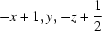
| Symmetry code: (i) −x+1, y, −z+1/2. |
Experimental details
| Crystal data | |
| Chemical formula | [Cu2(C3H6NS2)4] |
| Mr | 607.91 |
| Crystal system, space group | Monoclinic, C2/c |
| Temperature (K) | 293 |
| a, b, c (Å) | 8.068 (3), 19.446 (7), 15.108 (6) |
| β (°) | 99.354 (6) |
| V (Å3) | 2338.7 (15) |
| Z | 4 |
| Radiation type | Mo Kα |
| µ (mm−1) | 2.54 |
| Crystal size (mm) | 0.25 × 0.20 × 0.15 |
| Data collection | |
| Diffractometer | Rigaku Mercury CCD diffractometer |
| Absorption correction | Multi-scan (CrystalClear; Rigaku, 2007) |
| Tmin, Tmax | 0.807, 1.000 |
| No. of measured, independent and observed [I > 2σ(I)] reflections | 9796, 2685, 2423 |
| Rint | 0.048 |
| (sin θ/λ)max (Å−1) | 0.649 |
| Refinement | |
| R[F2 > 2σ(F2)], wR(F2), S | 0.050, 0.141, 1.07 |
| No. of reflections | 2685 |
| No. of parameters | 118 |
| H-atom treatment | H-atom parameters constrained |
| Δρmax, Δρmin (e Å−3) | 0.44, −0.58 |
Computer programs: CrystalClear (Rigaku, 2007), SHELXS97 (Sheldrick, 2008), SHELXL97 (Sheldrick, 2008), SHELXTL (Sheldrick, 2008).
| Cu1—S3 | 2.3072 (13) | Cu1—S2 | 2.3278 (13) |
| Cu1—S4 | 2.3208 (13) | Cu1—S1i | 2.8258 (14) |
| Cu1—S1 | 2.3240 (13) |
| Symmetry code: (i) −x+1, y, −z+1/2. |
Acknowledgements
This work was supported financially by the Research Fund of Huaqiao University (No. 06BS216) and the Young Talent Fund of Fujian Province (No. 2007 F3060).
References
 Engelhardt, L. M., Healy, P. C., Shephard, R. M., Skelton, B. W. & White, A. H. (1988). Inorg. Chem. 27, 2371–2373. CSD CrossRef CAS Web of Science Google Scholar
Fernández, E. J., López-de-Luzuriaga, J. M., Monge, M., Olmos, E., Laguna, A., Villacampa, M. D. & Jones, P. G. (2000). J. Cluster Sci. 11, 153–166. Web of Science CSD CrossRef CAS Google Scholar
Koh, Y. W., Lai, C. S., Du, A. Y., Tiekink, E. R. T. & Loh, K. P. (2003). Chem. Mater. 15, 4544–4554. Web of Science CSD CrossRef CAS Google Scholar
Noro, S., Kitagawa, S., Kondo, M. & Seki, K. (2000). Angew. Chem. Int. Ed. 39, 2081–2084. CrossRef Google Scholar
Rigaku (2007). CrystalClear. Rigaku Corporation, Tokyo, Japan. Google Scholar
Sheldrick, G. M. (2008). Acta Cryst. A64, 112–122. Web of Science CrossRef CAS IUCr Journals Google Scholar
Yaghi, O. M., Li, H., Davis, C., Richardson, D. & Groy, T. L. (1998). Acc. Chem. Res. 31, 474–484. Web of Science CrossRef CAS Google Scholar
This is an open-access article distributed under the terms of the Creative Commons Attribution (CC-BY) Licence, which permits unrestricted use, distribution, and reproduction in any medium, provided the original authors and source are cited.
| CRYSTALLOGRAPHIC COMMUNICATIONS |


Research into transition metal complexes has been rapidly expanding because of their fascinating structural diversity, as well as their potential applications as functional materials and enzymes (Noro et al., 2000; Yaghi et al., 1998). Dialkyldithiocarbamates anions, which are typical sulfur ligands, acting as monodentate, bidentate or bridging ligands, are often chosen for the preparation of a considerable structural variety of complexes (Engelhardt et al., 1988; Fernández et al., 2000; Koh, et al., 2003). We report here the crystal structure of the title copper(II) complex, (I), contanining a dimethyldithiocarbamate ligand.
The crystal structure of (I) is built up by dimeric entities of CuII complex (Fig. 1). The coordination geometry of CuII ion is described as a distorted square-pyramid. The basal coordination positions are occupied by four S atoms from two dimethyldithiocarbamate ligands. Each briding S atom simultaneously occupies an equatorial coordination site on one CuII ion and apical site on the other CuII. The axial Cu—S bond distance is longer than the equatorial Cu—S ones (Table 1).