 | Acta Crystallographica Section E Acta Crystallographica Section E CRYSTALLOGRAPHIC COMMUNICATIONS |


 journal menu


metal-organic compounds
| CRYSTALLOGRAPHIC COMMUNICATIONS |
 access
Poly[dichloridobis(μ2-di-4-pyridyl sulfide-κ2N,N′)cobalt(II)]

aCollege of Chemistry and Chemical Engineering, Luoyang Normal University, Luoyang 471022, People's Republic of China
*Correspondence e-mail: [email protected]
In the title compound, [CoCl2(C10H8N2S)2]n, the CoII atom is located on an inversion centre and is six-coordinated by four N atoms of four symmetry-related di-4-pyridyl sulfide ligands, and two Cl atoms in trans positions, in a distorted octahedral geometry. The bridging bidentate di-4-pyridyl sulfide ligands link the CoII centres into a three-dimensional network. The four coordinating pyridine groups are donors and acceptors (N atoms) for intramolecular C—H⋯N and C—H⋯Cl hydrogen bonds.
Related literature
For di-4-pyridyl sulfide metal complexes, see: Jung et al. (1998![[Jung, O. S., Park, S. H., Kim, D. C. & Kim, K. M. (1998). Inorg. Chem. 37, 610-611.]](../../../../../../logos/arrows/e_arr.gif "Jung, O. S., Park, S. H., Kim, D. C. & Kim, K. M. (1998). Inorg. Chem. 37, 610-611.") , 1999); Kondo et al. (2004); Muthu et al. (2005).
, 1999); Kondo et al. (2004); Muthu et al. (2005).
![[Scheme 1]](si2149scheme1.gif)
Experimental
Crystal data
|
Refinement
|
| |||||||||||||||||
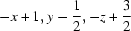 .
.
| |||||||||||||||||||||||||||
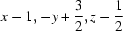 ; (iii)
 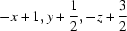 ; (iv)
 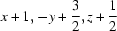 .
. Data collection: SMART (Bruker, 1997); cell refinement: SAINT (Bruker, 1997); data reduction: SAINT; program(s) used to solve structure: SHELXS97 (Sheldrick, 2008); program(s) used to refine structure: SHELXL97 (Sheldrick, 2008); molecular graphics: SHELXTL (Sheldrick, 2008); software used to prepare material for publication: SHELXTL.
Supporting information
contains datablocks I, global. DOI: 10.1107/S1600536809001676/si2149sup1.cif
Structure factors: contains datablock I. DOI: 10.1107/S1600536809001676/si2149Isup2.hkl
To a stirred solution of di-4-pyridyl sulfide (0.5 mmol) in ethanol-H2O 20 ml (v/v, 1:1) was added solid CoCl2(0.5 mmol). Then the obtained mixture was basified with NaOH (0.5 mol/l) to a pH of 6.0 and stirred at 343K for 4h, filtrated. One week later, red crystals appeared.
The H atoms were positioned geometrically and treated as riding, with C—H = 0.93 Å (CH) and Uĩso~(H) = 1.2Ueq(C).
Data collection: SMART (Bruker, 1997); cell SAINT (Bruker, 1997); data reduction: SAINT (Bruker, 1997); program(s) used to solve structure: SHELXS97 (Sheldrick, 2008); program(s) used to refine structure: SHELXL97 (Sheldrick, 2008); molecular graphics: SHELXTL (Sheldrick, 2008); software used to prepare material for publication: SHELXTL (Sheldrick, 2008).
![[Figure 1]](./si2149fig1thm.gif) | Fig. 1. A view of the local coordination of the Co(II) cation in the title compound. Displacement ellipsoids are drawn at the 30% probability level. Symmetry codes: (A) (-x, 1 - y, 1 - z); (B) (-1 + x, 3/2 - y, -1/2 + z); (C) (1 - x, -1/2 + y, 3/2 - z). |
![[Figure 2]](./si2149fig2thm.gif) | Fig. 2. A view of the two-dimensional network. |
![[Figure 3]](./si2149fig3thm.gif) | Fig. 3. A view of the compound packing down the a axis. |
| [CoCl2(C10H8N2S)2] | F(000) = 514 |
| Mr = 506.32 | Dx = 1.571 Mg m−3 |
| Monoclinic, P21/c | Mo Kα radiation, λ = 0.71073 Å |
| Hall symbol: -P 2ybc | Cell parameters from 2498 reflections |
| a = 7.4940 (11) Å | θ = 2.6–29.0° |
| b = 15.355 (2) Å | µ = 1.26 mm−1 |
| c = 9.4009 (14) Å | T = 296 K |
| β = 98.413 (2)° | Block, red |
| V = 1070.1 (3) Å3 | 0.44 × 0.34 × 0.24 mm |
| Z = 2 |
| Bruker SMART CCD area-detector diffractometer | 1969 independent reflections |
| Radiation source: fine-focus sealed tube | 1720 reflections with I > 2σ(I) |
| Graphite monochromator | Rint = 0.017 |
| ϕ and ω scans | θmax = 25.5°, θmin = 2.6° |
| Absorption correction: multi-scan (SADABS; Bruker, 1997) | h = −9→8 |
| Tmin = 0.608, Tmax = 0.747 | k = −14→18 |
| 5174 measured reflections | l = −11→11 |
| Refinement on F2 | Primary atom site location: structure-invariant direct methods |
| Least-squares matrix: full | Secondary atom site location: difference Fourier map |
| R[F2 > 2σ(F2)] = 0.027 | Hydrogen site location: inferred from neighbouring sites |
| wR(F2) = 0.070 | H-atom parameters constrained |
| S = 1.05 | w = 1/[σ2(Fo2) + (0.0329P)2 + 0.5314P] where P = (Fo2 + 2Fc2)/3 |
| 1969 reflections | (Δ/σ)max < 0.001 |
| 133 parameters | Δρmax = 0.38 e Å−3 |
| 0 restraints | Δρmin = −0.26 e Å−3 |
| [CoCl2(C10H8N2S)2] | V = 1070.1 (3) Å3 |
| Mr = 506.32 | Z = 2 |
| Monoclinic, P21/c | Mo Kα radiation |
| a = 7.4940 (11) Å | µ = 1.26 mm−1 |
| b = 15.355 (2) Å | T = 296 K |
| c = 9.4009 (14) Å | 0.44 × 0.34 × 0.24 mm |
| β = 98.413 (2)° |
| Bruker SMART CCD area-detector diffractometer | 1969 independent reflections |
| Absorption correction: multi-scan (SADABS; Bruker, 1997) | 1720 reflections with I > 2σ(I) |
| Tmin = 0.608, Tmax = 0.747 | Rint = 0.017 |
| 5174 measured reflections |
| R[F2 > 2σ(F2)] = 0.027 | 0 restraints |
| wR(F2) = 0.070 | H-atom parameters constrained |
| S = 1.05 | Δρmax = 0.38 e Å−3 |
| 1969 reflections | Δρmin = −0.26 e Å−3 |
| 133 parameters |
| x | y | z | Uiso*/Ueq | ||
| Co1 | 0.0000 | 0.5000 | 0.5000 | 0.02605 (13) | |
| Cl1 | 0.20061 (7) | 0.43179 (4) | 0.35327 (6) | 0.04042 (16) | |
| S1 | 0.46119 (10) | 0.86590 (4) | 0.38777 (6) | 0.0496 (2) | |
| N1 | 0.1375 (2) | 0.62685 (11) | 0.48432 (19) | 0.0336 (4) | |
| N2 | 0.8140 (2) | 0.95816 (11) | 0.79735 (18) | 0.0295 (4) | |
| C1 | 0.3135 (3) | 0.63405 (14) | 0.5315 (2) | 0.0319 (5) | |
| H1 | 0.3717 | 0.5866 | 0.5793 | 0.038* | |
| C2 | 0.4148 (3) | 0.70682 (14) | 0.5143 (2) | 0.0335 (5) | |
| H2 | 0.5363 | 0.7088 | 0.5527 | 0.040* | |
| C3 | 0.3335 (3) | 0.77696 (14) | 0.4393 (2) | 0.0336 (5) | |
| C4 | 0.1498 (3) | 0.77243 (16) | 0.3907 (3) | 0.0485 (6) | |
| H4 | 0.0894 | 0.8187 | 0.3410 | 0.058* | |
| C5 | 0.0589 (3) | 0.69710 (16) | 0.4181 (3) | 0.0492 (6) | |
| H5 | −0.0651 | 0.6952 | 0.3886 | 0.059* | |
| C6 | 0.6455 (3) | 0.92970 (14) | 0.8003 (2) | 0.0316 (5) | |
| H6 | 0.6015 | 0.9310 | 0.8877 | 0.038* | |
| C7 | 0.5337 (3) | 0.89872 (14) | 0.6820 (2) | 0.0349 (5) | |
| H7 | 0.4174 | 0.8803 | 0.6902 | 0.042* | |
| C8 | 0.5962 (3) | 0.89534 (14) | 0.5507 (2) | 0.0335 (5) | |
| C9 | 0.7705 (3) | 0.92370 (16) | 0.5454 (2) | 0.0433 (6) | |
| H9 | 0.8182 | 0.9221 | 0.4595 | 0.052* | |
| C10 | 0.8725 (3) | 0.95443 (16) | 0.6695 (2) | 0.0411 (6) | |
| H10 | 0.9889 | 0.9737 | 0.6640 | 0.049* |
| U11 | U22 | U33 | U12 | U13 | U23 | |
| Co1 | 0.0256 (2) | 0.0273 (2) | 0.0247 (2) | 0.00031 (16) | 0.00196 (15) | 0.00041 (15) |
| Cl1 | 0.0376 (3) | 0.0546 (4) | 0.0284 (3) | 0.0153 (3) | 0.0027 (2) | −0.0004 (2) |
| S1 | 0.0709 (4) | 0.0438 (4) | 0.0278 (3) | −0.0271 (3) | −0.0134 (3) | 0.0079 (3) |
| N1 | 0.0322 (10) | 0.0303 (10) | 0.0371 (10) | −0.0001 (8) | 0.0009 (8) | 0.0009 (8) |
| N2 | 0.0310 (9) | 0.0302 (10) | 0.0261 (9) | −0.0020 (8) | 0.0000 (7) | −0.0012 (7) |
| C1 | 0.0358 (12) | 0.0290 (11) | 0.0287 (11) | 0.0006 (9) | −0.0023 (9) | 0.0031 (9) |
| C2 | 0.0326 (11) | 0.0336 (12) | 0.0310 (11) | −0.0032 (9) | −0.0064 (9) | −0.0002 (9) |
| C3 | 0.0436 (13) | 0.0287 (11) | 0.0259 (10) | −0.0068 (9) | −0.0037 (9) | −0.0022 (9) |
| C4 | 0.0454 (14) | 0.0302 (13) | 0.0637 (17) | 0.0008 (11) | −0.0125 (12) | 0.0064 (12) |
| C5 | 0.0309 (12) | 0.0374 (13) | 0.0743 (18) | −0.0003 (10) | −0.0086 (12) | 0.0023 (13) |
| C6 | 0.0339 (11) | 0.0340 (11) | 0.0265 (10) | −0.0025 (9) | 0.0031 (9) | 0.0002 (9) |
| C7 | 0.0345 (11) | 0.0352 (12) | 0.0333 (12) | −0.0093 (10) | −0.0004 (9) | 0.0005 (10) |
| C8 | 0.0437 (13) | 0.0265 (11) | 0.0269 (11) | −0.0063 (9) | −0.0058 (9) | 0.0022 (9) |
| C9 | 0.0495 (14) | 0.0531 (15) | 0.0280 (12) | −0.0121 (12) | 0.0079 (10) | −0.0043 (11) |
| C10 | 0.0346 (12) | 0.0550 (15) | 0.0340 (12) | −0.0127 (11) | 0.0061 (10) | −0.0060 (11) |
| Co1—N1i | 2.2184 (18) | C2—C3 | 1.379 (3) |
| Co1—N1 | 2.2185 (18) | C2—H2 | 0.9300 |
| Co1—N2ii | 2.2822 (17) | C3—C4 | 1.388 (3) |
| Co1—N2iii | 2.2822 (17) | C4—C5 | 1.386 (3) |
| Co1—Cl1 | 2.4221 (5) | C4—H4 | 0.9300 |
| Co1—Cl1i | 2.4222 (5) | C5—H5 | 0.9300 |
| S1—C8 | 1.766 (2) | C6—C7 | 1.376 (3) |
| S1—C3 | 1.775 (2) | C6—H6 | 0.9300 |
| N1—C1 | 1.334 (3) | C7—C8 | 1.384 (3) |
| N1—C5 | 1.338 (3) | C7—H7 | 0.9300 |
| N2—C10 | 1.340 (3) | C8—C9 | 1.385 (3) |
| N2—C6 | 1.340 (3) | C9—C10 | 1.381 (3) |
| N2—Co1iv | 2.2822 (17) | C9—H9 | 0.9300 |
| C1—C2 | 1.373 (3) | C10—H10 | 0.9300 |
| C1—H1 | 0.9300 | ||
| N1i—Co1—N1 | 180.0 | C1—C2—H2 | 120.5 |
| N1i—Co1—N2ii | 94.00 (6) | C3—C2—H2 | 120.5 |
| N1—Co1—N2ii | 86.00 (6) | C2—C3—C4 | 118.2 (2) |
| N1i—Co1—N2iii | 86.00 (6) | C2—C3—S1 | 121.68 (17) |
| N1—Co1—N2iii | 94.00 (6) | C4—C3—S1 | 119.80 (17) |
| N2ii—Co1—N2iii | 180.00 (8) | C5—C4—C3 | 118.1 (2) |
| N1i—Co1—Cl1 | 89.50 (5) | C5—C4—H4 | 120.9 |
| N1—Co1—Cl1 | 90.50 (5) | C3—C4—H4 | 120.9 |
| N2ii—Co1—Cl1 | 90.03 (4) | N1—C5—C4 | 124.4 (2) |
| N2iii—Co1—Cl1 | 89.97 (4) | N1—C5—H5 | 117.8 |
| N1i—Co1—Cl1i | 90.50 (5) | C4—C5—H5 | 117.8 |
| N1—Co1—Cl1i | 89.50 (5) | N2—C6—C7 | 124.10 (19) |
| N2ii—Co1—Cl1i | 89.97 (4) | N2—C6—H6 | 118.0 |
| N2iii—Co1—Cl1i | 90.03 (4) | C7—C6—H6 | 118.0 |
| Cl1—Co1—Cl1i | 179.999 (1) | C6—C7—C8 | 119.2 (2) |
| C8—S1—C3 | 102.90 (10) | C6—C7—H7 | 120.4 |
| C1—N1—C5 | 115.77 (19) | C8—C7—H7 | 120.4 |
| C1—N1—Co1 | 119.81 (14) | C7—C8—C9 | 117.7 (2) |
| C5—N1—Co1 | 124.16 (15) | C7—C8—S1 | 123.87 (17) |
| C10—N2—C6 | 115.96 (18) | C9—C8—S1 | 118.24 (16) |
| C10—N2—Co1iv | 121.39 (14) | C10—C9—C8 | 119.1 (2) |
| C6—N2—Co1iv | 122.47 (13) | C10—C9—H9 | 120.5 |
| N1—C1—C2 | 124.4 (2) | C8—C9—H9 | 120.5 |
| N1—C1—H1 | 117.8 | N2—C10—C9 | 124.0 (2) |
| C2—C1—H1 | 117.8 | N2—C10—H10 | 118.0 |
| C1—C2—C3 | 119.0 (2) | C9—C10—H10 | 118.0 |
| N2ii—Co1—N1—C1 | −149.12 (16) | S1—C3—C4—C5 | 172.1 (2) |
| N2iii—Co1—N1—C1 | 30.88 (16) | C1—N1—C5—C4 | 3.4 (4) |
| Cl1—Co1—N1—C1 | −59.12 (16) | Co1—N1—C5—C4 | −170.7 (2) |
| Cl1i—Co1—N1—C1 | 120.88 (16) | C3—C4—C5—N1 | −2.4 (4) |
| N2ii—Co1—N1—C5 | 24.8 (2) | C10—N2—C6—C7 | −0.6 (3) |
| N2iii—Co1—N1—C5 | −155.2 (2) | Co1iv—N2—C6—C7 | −175.65 (16) |
| Cl1—Co1—N1—C5 | 114.8 (2) | N2—C6—C7—C8 | 0.6 (3) |
| Cl1i—Co1—N1—C5 | −65.2 (2) | C6—C7—C8—C9 | 0.0 (3) |
| C5—N1—C1—C2 | −1.0 (3) | C6—C7—C8—S1 | −174.41 (17) |
| Co1—N1—C1—C2 | 173.43 (16) | C3—S1—C8—C7 | −41.6 (2) |
| N1—C1—C2—C3 | −2.4 (3) | C3—S1—C8—C9 | 144.02 (19) |
| C1—C2—C3—C4 | 3.3 (3) | C7—C8—C9—C10 | −0.6 (4) |
| C1—C2—C3—S1 | −169.79 (17) | S1—C8—C9—C10 | 174.20 (19) |
| C8—S1—C3—C2 | −51.6 (2) | C6—N2—C10—C9 | 0.0 (4) |
| C8—S1—C3—C4 | 135.4 (2) | Co1iv—N2—C10—C9 | 175.13 (19) |
| C2—C3—C4—C5 | −1.0 (4) | C8—C9—C10—N2 | 0.6 (4) |
| Symmetry codes: (i) −x, −y+1, −z+1; (ii) x−1, −y+3/2, z−1/2; (iii) −x+1, y−1/2, −z+3/2; (iv) −x+1, y+1/2, −z+3/2. |
| D—H···A | D—H | H···A | D···A | D—H···A |
| C5—H5···N2ii | 0.93 | 2.62 | 3.119 (3) | 114 |
| C6—H6···Cl1iv | 0.93 | 2.66 | 3.292 (2) | 126 |
| C10—H10···Cl1v | 0.93 | 2.64 | 3.292 (2) | 128 |
| Symmetry codes: (ii) x−1, −y+3/2, z−1/2; (iv) −x+1, y+1/2, −z+3/2; (v) x+1, −y+3/2, z+1/2. |
Experimental details
| Crystal data | |
| Chemical formula | [CoCl2(C10H8N2S)2] |
| Mr | 506.32 |
| Crystal system, space group | Monoclinic, P21/c |
| Temperature (K) | 296 |
| a, b, c (Å) | 7.4940 (11), 15.355 (2), 9.4009 (14) |
| β (°) | 98.413 (2) |
| V (Å3) | 1070.1 (3) |
| Z | 2 |
| Radiation type | Mo Kα |
| µ (mm−1) | 1.26 |
| Crystal size (mm) | 0.44 × 0.34 × 0.24 |
| Data collection | |
| Diffractometer | Bruker SMART CCD area-detector diffractometer |
| Absorption correction | Multi-scan (SADABS; Bruker, 1997) |
| Tmin, Tmax | 0.608, 0.747 |
| No. of measured, independent and observed [I > 2σ(I)] reflections | 5174, 1969, 1720 |
| Rint | 0.017 |
| (sin θ/λ)max (Å−1) | 0.606 |
| Refinement | |
| R[F2 > 2σ(F2)], wR(F2), S | 0.027, 0.070, 1.05 |
| No. of reflections | 1969 |
| No. of parameters | 133 |
| H-atom treatment | H-atom parameters constrained |
| Δρmax, Δρmin (e Å−3) | 0.38, −0.26 |
Computer programs: SMART (Bruker, 1997), SAINT (Bruker, 1997), SHELXS97 (Sheldrick, 2008), SHELXL97 (Sheldrick, 2008), SHELXTL (Sheldrick, 2008).
| Co1—N1 | 2.2185 (18) | Co1—Cl1 | 2.4221 (5) |
| Co1—N2i | 2.2822 (17) | ||
| N1—Co1—N2i | 94.00 (6) | N1—Co1—Cl1 | 90.50 (5) |
| Symmetry code: (i) −x+1, y−1/2, −z+3/2. |
| D—H···A | D—H | H···A | D···A | D—H···A |
| C5—H5···N2ii | 0.93 | 2.62 | 3.119 (3) | 114.0 |
| C6—H6···Cl1iii | 0.93 | 2.66 | 3.292 (2) | 125.9 |
| C10—H10···Cl1iv | 0.93 | 2.64 | 3.292 (2) | 127.9 |
| Symmetry codes: (ii) x−1, −y+3/2, z−1/2; (iii) −x+1, y+1/2, −z+3/2; (iv) x+1, −y+3/2, z+1/2. |
Acknowledgements
The authors thank Luo Yang Normal University for supporting this work.
References
 Bruker (1997). SMART, SAINT and SADABS. Bruker AXS Inc., Madison, Wisconsin, USA. Google Scholar
Jung, O. S., Park, S. H., Kim, D. C. & Kim, K. M. (1998). Inorg. Chem. 37, 610–611. Web of Science CSD CrossRef CAS Google Scholar
Jung, O. S., Park, S. H., Park, C. H. & Park, J. K. (1999). Chem. Lett. 28, 923–927. CSD CrossRef Google Scholar
Kondo, M., Shimizu, Y., Miyazawa, M., Irie, Y., Nakamura, A., Naito, T., Maeda, K., Uchida, F., Nakamoto, T. & Inaba, A. (2004). Chem. Lett. 33, 514–518. Web of Science CSD CrossRef CAS Google Scholar
Muthu, S., Ni, Z. & Vittal, J. J. (2005). Inorg. Chim. Acta, 358, 595–605. Web of Science CSD CrossRef CAS Google Scholar
Sheldrick, G. M. (2008). Acta Cryst. A64, 112–122. Web of Science CrossRef CAS IUCr Journals Google Scholar
This is an open-access article distributed under the terms of the Creative Commons Attribution (CC-BY) Licence, which permits unrestricted use, distribution, and reproduction in any medium, provided the original authors and source are cited.
| CRYSTALLOGRAPHIC COMMUNICATIONS |


As well known, di-4-pyridyl sulfide possesses a magic angle (C-S-C, ~100°) and conformational nonrigidity so it has some flexibility compared with other linear rigid ligands such as simple 4, 4'-bipyridine analogues. A number of metal complexes derived from di-4-pyridyl sulfide have been reported previously, such as the silver(I) complexes (Jung et al., 1999), copper(II) complexes (Muthu et al., 2005), nickel(II) complex (Kondo et al., 2004), as well as the cobalt(II) complex that showing 2-fold interpenetrating structures (Jung et al., 1998).
As shown in Fig. 1, the local geometry of the cobalt atoms is a distorted octahedral arrangement with two chlorine atoms in trans positions and four pyridine units in a propeller arrangement (Tab. 1). Each di-4-pyridyl sulfide ligand connects two cobalt(II) ions defining the edges of a 40-membered [Co(II)]4 sheet (Fig. 2). The bent angle of the sulfur atom [C-S-C = 102.90 (10) °]. The Co-Co separation through a di-4-pyridyl sulfide ligand is 11.2646 (10) Å, and through the diagonal of the rhombus is 15.355 (2) Å. There are six intramolecular C—H···N and C—H···Cl hydrogen bonding contacts around the coordination sphere of the cobalt atom (Tab. 2). The packing of the layered structure is shown in Fig.3.