 | Acta Crystallographica Section E Acta Crystallographica Section E CRYSTALLOGRAPHIC COMMUNICATIONS |


 journal menu


inorganic compounds
| CRYSTALLOGRAPHIC COMMUNICATIONS |
 access
Neptunium(III) copper(I) diselenide

aChemistry Department, Northwestern University, 2145 Sheridan Rd, Evanston, IL 60208, USA, and bChemistry Division, Argonne National Laboratory, Argonne, IL 60439, USA
*Correspondence e-mail: [email protected]
The title compound, NpCuSe2, is the first ternary neptunium transition-metal chalcogenide. It was synthesized from the elements at 873 K in an evacuated fused-silica tube. Single crystals were grown by vapor transport with I2. NpCuSe2 crystallizes in the LaCuS2 structure type and can be viewed as a stacking of layers of CuSe4 tetrahedra and of double layers of NpSe7 monocapped trigonal prisms along [100]. Because there are no Se—Se bonds in the structure, the formal oxidation states of Np/Cu/Se may be assigned as +III/+I/−II, respectively.
Related literature
For discussion of the LaCuS2 structure type, see: Julien-Pouzol et al. (1981![[Julien-Pouzol, M., Jaulmes, S., Mazurier, A. & Guittard, M. (1981). Acta Cryst. B37, 1901-1903.]](../../../../../../logos/arrows/e_arr.gif "Julien-Pouzol, M., Jaulmes, S., Mazurier, A. & Guittard, M. (1981). Acta Cryst. B37, 1901-1903.") ); Ijjaali et al. (2004). For other compounds with Cu—Se bonds, see: Daoudi et al. (1996); Strobel & Schleid (2004); Ijjaali et al. (2004). For other neptunium selenides, see: Wastin et al. (1995); Wojakowski (1985). For computational details, see Gelato & Parthé (1987).
); Ijjaali et al. (2004). For other compounds with Cu—Se bonds, see: Daoudi et al. (1996); Strobel & Schleid (2004); Ijjaali et al. (2004). For other neptunium selenides, see: Wastin et al. (1995); Wojakowski (1985). For computational details, see Gelato & Parthé (1987).
Experimental
Crystal data
|
Refinement
|
| |||||||||||||||||||||||||||
 ; (iii)
  ; (vi)
  ; (vii)
  ; (viii)
  .
. Data collection: APEX2 (Bruker, 2006); cell refinement: SAINT (Bruker, 2006); data reduction: SAINT; program(s) used to solve structure: SHELXS97 (Sheldrick, 2008); program(s) used to refine structure: SHELXL97 (Sheldrick, 2008); molecular graphics: CrystalMaker (Palmer, 2008); software used to prepare material for publication: SHELXTL (Sheldrick, 2008).
Supporting information
contains datablocks I, global. DOI: 10.1107/S160053680900395X/wm2219sup1.cif
Structure factors: contains datablock I. DOI: 10.1107/S160053680900395X/wm2219Isup2.hkl
NpCuSe2was formed in an attempted synthesis of the Np analogue of U3Cu2Se7 (Daoudi et al., 1996). Caution! 237Np is an α-emitting radioisotope and as such is considered a health risk. Its use requires appropriate infrastructure and personnel trained in the handling of radioactive materials. The following reagents were used as obtained from the manufacturer: Cu (Aldrich, 99.5%) and Se (Aldrich, 99%). Resublimed I2 was utilized as a transport reagent. 237Np chunks were crushed and used as provided from Oak Ridge National Laboratory. A reaction mixture of 20.2 mg Np (0.085 mmol), 3.58 mg Cu (0.056 mmol), and 15.55 mg Se (0.197 mmol) was loaded into a fused-silica ampoule in an Ar-filled dry box that was then evacuated to 10 -4 Torr and sealed. The sample was placed in a computer controlled furnace, heated to 873 K in 8 h, kept at 873 K for 72 h, cooled at 5 K/h to 373 K, and finally air cooled in the oven to 298 K. The resultant black powder was reloaded into a fused-silica ampoule with 4 mg I2. The ampoule was evacuated to 10 -4 Torr and sealed. The sample was placed in a computer controlled furnace, heated to 873 K in 8 h, kept at 873 K for 336 h, cooled at 6.94 K/h to 373 K, before finally being air cooled to 298 K. Black rectangular plates and blocks of NpCuSe2 were obtained in low yield. The crystals used in characterization were manually extracted from the product mixture.
The program STRUCTURE TIDY (Gelato & Parthé, 1987) was employed to standardize the atomic coordinates of the structure. The highest peak is 1.71 Å and the deepest hole is 0.08 Å from atom Np1.
Data collection: APEX2 (Bruker, 2006); cell SAINT (Bruker, 2006); data reduction: SAINT (Bruker, 2006); program(s) used to solve structure: SHELXS97 (Sheldrick, 2008); program(s) used to refine structure: SHELXL97 (Sheldrick, 2008); molecular graphics: CrystalMaker (Palmer, 2008); software used to prepare material for publication: SHELXTL (Sheldrick, 2008).
![[Figure 1]](./wm2219fig1thm.gif) | Fig. 1. A view nearly down [010] of the unit cell of NpCuSe2, with displacement ellipsoids at the 99% probability level. |
| NpCuSe2 | F(000) = 760 |
| Mr = 458.46 | Dx = 8.692 Mg m−3 |
| Monoclinic, P21/c | Mo Kα radiation, λ = 0.71073 Å |
| Hall symbol: -P 2ybc | Cell parameters from 4110 reflections |
| a = 6.6796 (5) Å | θ = 4.0–33.7° |
| b = 7.4384 (6) Å | µ = 56.06 mm−1 |
| c = 7.1066 (5) Å | T = 100 K |
| β = 97.156 (1)° | Block, black |
| V = 350.34 (5) Å3 | 0.08 × 0.05 × 0.04 mm |
| Z = 4 |
| Bruker APEXII CCD diffractometer | 1376 independent reflections |
| Radiation source: fine-focus sealed tube | 1309 reflections with I > 2σ(I) |
| Graphite monochromator | Rint = 0.036 |
| ϕ and ω scans | θmax = 33.9°, θmin = 3.1° |
| Absorption correction: numerical (face indexed; SADABS; Sheldrick, 2006) | h = −10→10 |
| Tmin = 0.045, Tmax = 0.212 | k = −11→11 |
| 6189 measured reflections | l = −11→11 |
| Refinement on F2 | 0 restraints |
| Least-squares matrix: full | Primary atom site location: structure-invariant direct methods |
| R[F2 > 2σ(F2)] = 0.028 | Secondary atom site location: difference Fourier map |
| wR(F2) = 0.068 | w = [1/[σ2(Fo2) + (0.0312)Fo2]2 |
| S = 1.35 | (Δ/σ)max < 0.001 |
| 1376 reflections | Δρmax = 2.43 e Å−3 |
| 37 parameters | Δρmin = −4.48 e Å−3 |
| NpCuSe2 | V = 350.34 (5) Å3 |
| Mr = 458.46 | Z = 4 |
| Monoclinic, P21/c | Mo Kα radiation |
| a = 6.6796 (5) Å | µ = 56.06 mm−1 |
| b = 7.4384 (6) Å | T = 100 K |
| c = 7.1066 (5) Å | 0.08 × 0.05 × 0.04 mm |
| β = 97.156 (1)° |
| Bruker APEXII CCD diffractometer | 1376 independent reflections |
| Absorption correction: numerical (face indexed; SADABS; Sheldrick, 2006) | 1309 reflections with I > 2σ(I) |
| Tmin = 0.045, Tmax = 0.212 | Rint = 0.036 |
| 6189 measured reflections |
| R[F2 > 2σ(F2)] = 0.028 | 37 parameters |
| wR(F2) = 0.068 | 0 restraints |
| S = 1.35 | Δρmax = 2.43 e Å−3 |
| 1376 reflections | Δρmin = −4.48 e Å−3 |
| x | y | z | Uiso*/Ueq | ||
| Cu1 | 0.07000 (11) | 0.66155 (10) | 0.04945 (11) | 0.00850 (14) | |
| Np1 | 0.30684 (3) | 0.04823 (3) | 0.19759 (3) | 0.00478 (8) | |
| Se1 | 0.09977 (8) | 0.39107 (7) | 0.28075 (8) | 0.00539 (11) | |
| Se2 | 0.58173 (9) | 0.27585 (7) | 0.00026 (8) | 0.00520 (11) |
| U11 | U22 | U33 | U12 | U13 | U23 | |
| Cu1 | 0.0082 (3) | 0.0081 (3) | 0.0091 (3) | −0.0008 (2) | 0.0009 (2) | −0.0017 (2) |
| Np1 | 0.00560 (11) | 0.00354 (11) | 0.00509 (11) | −0.00032 (6) | 0.00021 (8) | −0.00020 (6) |
| Se1 | 0.0063 (2) | 0.0041 (2) | 0.0056 (2) | 0.00028 (16) | −0.00019 (18) | −0.00004 (17) |
| Se2 | 0.0058 (2) | 0.0044 (2) | 0.0051 (2) | 0.00028 (17) | −0.00027 (18) | 0.00013 (17) |
| Cu1—Se2i | 2.4409 (9) | Np1—Se1 | 2.9950 (6) |
| Cu1—Se1ii | 2.4490 (9) | Np1—Se1v | 3.1419 (6) |
| Cu1—Se1iii | 2.5066 (9) | Np1—Cu1viii | 3.3772 (8) |
| Cu1—Se1 | 2.5899 (9) | Np1—Cu1x | 3.3866 (8) |
| Cu1—Cu1iii | 2.6421 (15) | Np1—Cu1vii | 3.4894 (8) |
| Cu1—Np1ii | 3.3772 (8) | Se1—Cu1viii | 2.4490 (9) |
| Cu1—Np1iv | 3.3866 (8) | Se1—Cu1iii | 2.5066 (9) |
| Cu1—Np1v | 3.4894 (8) | Se1—Np1ii | 2.9784 (6) |
| Np1—Se2vi | 2.9330 (6) | Se1—Np1vii | 3.1419 (6) |
| Np1—Se2vii | 2.9540 (6) | Se2—Cu1i | 2.4409 (9) |
| Np1—Se2 | 2.9743 (6) | Se2—Np1vi | 2.9330 (6) |
| Np1—Se1viii | 2.9784 (6) | Se2—Np1v | 2.9540 (6) |
| Np1—Se2ix | 2.9785 (6) | Se2—Np1xi | 2.9785 (6) |
| Se2i—Cu1—Se1ii | 116.52 (4) | Se2vi—Np1—Cu1viii | 135.297 (18) |
| Se2i—Cu1—Se1iii | 102.85 (3) | Se2vii—Np1—Cu1viii | 86.489 (18) |
| Se1ii—Cu1—Se1iii | 112.76 (4) | Se2—Np1—Cu1viii | 130.824 (18) |
| Se2i—Cu1—Se1 | 103.94 (3) | Se1viii—Np1—Cu1viii | 47.587 (17) |
| Se1ii—Cu1—Se1 | 103.44 (3) | Se2ix—Np1—Cu1viii | 85.522 (17) |
| Se1iii—Cu1—Se1 | 117.57 (3) | Se1—Np1—Cu1viii | 44.705 (16) |
| Se2i—Cu1—Cu1iii | 116.56 (4) | Se1v—Np1—Cu1viii | 101.316 (18) |
| Se1ii—Cu1—Cu1iii | 126.51 (5) | Se2vi—Np1—Cu1x | 44.728 (17) |
| Se1iii—Cu1—Cu1iii | 60.33 (3) | Se2vii—Np1—Cu1x | 145.739 (18) |
| Se1—Cu1—Cu1iii | 57.24 (3) | Se2—Np1—Cu1x | 128.963 (18) |
| Se2i—Cu1—Np1ii | 155.73 (3) | Se1viii—Np1—Cu1x | 44.687 (17) |
| Se1ii—Cu1—Np1ii | 59.35 (2) | Se2ix—Np1—Cu1x | 73.231 (18) |
| Se1iii—Cu1—Np1ii | 100.32 (3) | Se1—Np1—Cu1x | 125.113 (18) |
| Se1—Cu1—Np1ii | 58.107 (19) | Se1v—Np1—Cu1x | 72.255 (17) |
| Cu1iii—Cu1—Np1ii | 69.64 (3) | Cu1viii—Np1—Cu1x | 91.556 (15) |
| Se2i—Cu1—Np1iv | 57.74 (2) | Se2vi—Np1—Cu1vii | 98.092 (18) |
| Se1ii—Cu1—Np1iv | 58.79 (2) | Se2vii—Np1—Cu1vii | 88.423 (18) |
| Se1iii—Cu1—Np1iv | 124.26 (3) | Se2—Np1—Cu1vii | 162.568 (18) |
| Se1—Cu1—Np1iv | 117.81 (3) | Se1viii—Np1—Cu1vii | 44.741 (17) |
| Cu1iii—Cu1—Np1iv | 172.48 (5) | Se2ix—Np1—Cu1vii | 43.454 (17) |
| Np1ii—Cu1—Np1iv | 113.38 (2) | Se1—Np1—Cu1vii | 88.717 (17) |
| Se2i—Cu1—Np1v | 57.06 (2) | Se1v—Np1—Cu1vii | 123.660 (17) |
| Se1ii—Cu1—Np1v | 160.72 (3) | Cu1viii—Np1—Cu1vii | 45.22 (2) |
| Se1iii—Cu1—Np1v | 56.76 (2) | Cu1x—Np1—Cu1vii | 66.861 (13) |
| Se1—Cu1—Np1v | 95.83 (3) | Cu1viii—Se1—Cu1iii | 99.74 (3) |
| Cu1iii—Cu1—Np1v | 65.14 (3) | Cu1viii—Se1—Cu1 | 148.28 (3) |
| Np1ii—Cu1—Np1v | 134.78 (2) | Cu1iii—Se1—Cu1 | 62.43 (3) |
| Np1iv—Cu1—Np1v | 111.51 (2) | Cu1viii—Se1—Np1ii | 76.53 (2) |
| Se2vi—Np1—Se2vii | 122.772 (13) | Cu1iii—Se1—Np1ii | 78.50 (2) |
| Se2vi—Np1—Se2 | 91.915 (16) | Cu1—Se1—Np1ii | 74.31 (2) |
| Se2vii—Np1—Se2 | 74.152 (12) | Cu1viii—Se1—Np1 | 75.95 (2) |
| Se2vi—Np1—Se1viii | 89.408 (17) | Cu1iii—Se1—Np1 | 81.29 (2) |
| Se2vii—Np1—Se1viii | 128.634 (17) | Cu1—Se1—Np1 | 122.48 (3) |
| Se2—Np1—Se1viii | 150.258 (17) | Np1ii—Se1—Np1 | 142.27 (2) |
| Se2vi—Np1—Se2ix | 74.394 (9) | Cu1viii—Se1—Np1vii | 79.17 (2) |
| Se2vii—Np1—Se2ix | 72.516 (18) | Cu1iii—Se1—Np1vii | 178.90 (3) |
| Se2—Np1—Se2ix | 127.853 (11) | Cu1—Se1—Np1vii | 118.47 (3) |
| Se1viii—Np1—Se2ix | 80.988 (16) | Np1ii—Se1—Np1vii | 101.074 (17) |
| Se2vi—Np1—Se1 | 160.988 (17) | Np1—Se1—Np1vii | 98.541 (17) |
| Se2vii—Np1—Se1 | 74.905 (16) | Cu1i—Se2—Np1vi | 77.53 (2) |
| Se2—Np1—Se1 | 86.315 (17) | Cu1i—Se2—Np1v | 109.10 (3) |
| Se1viii—Np1—Se1 | 82.962 (10) | Np1vi—Se2—Np1v | 100.770 (17) |
| Se2ix—Np1—Se1 | 121.133 (17) | Cu1i—Se2—Np1 | 146.34 (3) |
| Se2vi—Np1—Se1v | 76.958 (16) | Np1vi—Se2—Np1 | 88.085 (16) |
| Se2vii—Np1—Se1v | 141.588 (16) | Np1v—Se2—Np1 | 103.371 (19) |
| Se2—Np1—Se1v | 72.469 (16) | Cu1i—Se2—Np1xi | 79.48 (2) |
| Se1viii—Np1—Se1v | 78.926 (17) | Np1vi—Se2—Np1xi | 148.12 (2) |
| Se2ix—Np1—Se1v | 144.944 (16) | Np1v—Se2—Np1xi | 107.484 (18) |
| Se1—Np1—Se1v | 84.479 (14) | Np1—Se2—Np1xi | 99.254 (17) |
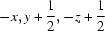
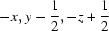
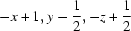
| Symmetry codes: (i) −x+1, −y+1, −z; (ii) −x, y+1/2, −z+1/2; (iii) −x, −y+1, −z; (iv) x, y+1, z; (v) x, −y+1/2, z−1/2; (vi) −x+1, −y, −z; (vii) x, −y+1/2, z+1/2; (viii) −x, y−1/2, −z+1/2; (ix) −x+1, y−1/2, −z+1/2; (x) x, y−1, z; (xi) −x+1, y+1/2, −z+1/2. |
Experimental details
| Crystal data | |
| Chemical formula | NpCuSe2 |
| Mr | 458.46 |
| Crystal system, space group | Monoclinic, P21/c |
| Temperature (K) | 100 |
| a, b, c (Å) | 6.6796 (5), 7.4384 (6), 7.1066 (5) |
| β (°) | 97.156 (1) |
| V (Å3) | 350.34 (5) |
| Z | 4 |
| Radiation type | Mo Kα |
| µ (mm−1) | 56.06 |
| Crystal size (mm) | 0.08 × 0.05 × 0.04 |
| Data collection | |
| Diffractometer | Bruker APEXII CCD diffractometer |
| Absorption correction | Numerical (face indexed; SADABS; Sheldrick, 2006) |
| Tmin, Tmax | 0.045, 0.212 |
| No. of measured, independent and observed [I > 2σ(I)] reflections | 6189, 1376, 1309 |
| Rint | 0.036 |
| (sin θ/λ)max (Å−1) | 0.785 |
| Refinement | |
| R[F2 > 2σ(F2)], wR(F2), S | 0.028, 0.068, 1.35 |
| No. of reflections | 1376 |
| No. of parameters | 37 |
| Δρmax, Δρmin (e Å−3) | 2.43, −4.48 |
Computer programs: APEX2 (Bruker, 2006), SAINT (Bruker, 2006), SHELXS97 (Sheldrick, 2008), SHELXL97 (Sheldrick, 2008), CrystalMaker (Palmer, 2008), SHELXTL (Sheldrick, 2008).
| Cu1—Se2i | 2.4409 (9) | Np1—Se2 | 2.9743 (6) |
| Cu1—Se1ii | 2.4490 (9) | Np1—Se1vi | 2.9784 (6) |
| Cu1—Se1iii | 2.5066 (9) | Np1—Se2vii | 2.9785 (6) |
| Cu1—Se1 | 2.5899 (9) | Np1—Se1 | 2.9950 (6) |
| Np1—Se2iv | 2.9330 (6) | Np1—Se1viii | 3.1419 (6) |
| Np1—Se2v | 2.9540 (6) | ||
| Se2i—Cu1—Se1ii | 116.52 (4) | Se2i—Cu1—Se1 | 103.94 (3) |
| Se2i—Cu1—Se1iii | 102.85 (3) | Se1ii—Cu1—Se1 | 103.44 (3) |
| Se1ii—Cu1—Se1iii | 112.76 (4) |
| Symmetry codes: (i) −x+1, −y+1, −z; (ii) −x, y+1/2, −z+1/2; (iii) −x, −y+1, −z; (iv) −x+1, −y, −z; (v) x, −y+1/2, z+1/2; (vi) −x, y−1/2, −z+1/2; (vii) −x+1, y−1/2, −z+1/2; (viii) x, −y+1/2, z−1/2. |
Acknowledgements
The research was supported at Northwestern University by the US Department of Energy, Basic Energy Sciences grant ER-15522, and at Argonne National Laboratory by the US Department of Energy, OBES, Chemical Sciences Division, under contract DEAC02–06CH11357. We are indebted to Dr Richard G. Haire of Oak Ridge National Laboratory for the gift of Np metal.
References
 Bruker (2006). APEX2 and SAINT. Bruker AXS Inc., Madison, Wisconsin, USA. Google Scholar
Daoudi, A., Lamire, M., Levet, J. C. & Noël, H. (1996). J. Solid State Chem. 123, 331–336. CrossRef CAS Web of Science Google Scholar
Gelato, L. M. & Parthé, E. (1987). J. Appl. Cryst. 20, 139–143. CrossRef Web of Science IUCr Journals Google Scholar
Ijjaali, I., Mitchell, K. & Ibers, J. A. (2004). J. Solid State Chem. 177, 760–764. Web of Science CrossRef CAS Google Scholar
Julien-Pouzol, M., Jaulmes, S., Mazurier, A. & Guittard, M. (1981). Acta Cryst. B37, 1901–1903. CrossRef CAS Web of Science IUCr Journals Google Scholar
Palmer, D. (2008). CrystalMaker. CrystalMaker Software Ltd, Yarnton, Oxfordshire, England. Google Scholar
Sheldrick, G. M. (2006). SADABS University of Göttingen, Germany. Google Scholar
Sheldrick, G. M. (2008). Acta Cryst. A64, 112–122. Web of Science CrossRef CAS IUCr Journals Google Scholar
Strobel, S. & Schleid, T. (2004). Z Naturforsch. Teil B., 59, 985–991. CAS Google Scholar
Wastin, F., Spirlet, J. C. & Rebizant, J. (1995). J. Alloys Compd, 219, 232–237. CrossRef CAS Web of Science Google Scholar
Wojakowski, A. (1985). J. Less Common Met. 107, 155–158. CrossRef CAS Web of Science Google Scholar
This is an open-access article distributed under the terms of the Creative Commons Attribution (CC-BY) Licence, which permits unrestricted use, distribution, and reproduction in any medium, provided the original authors and source are cited.
| CRYSTALLOGRAPHIC COMMUNICATIONS |


In keeping with earlier descriptions of the LaCuS2 structure type (Julien-Pouzol et al., 1981; Ijjaali et al., 2004) the structure of NpCuSe2 can be viewed as a stacking of layers of CuSe4 tetrahedra and double layers of NpSe7 monocapped trigonal prisms along [100]. Figure 1 provides a view nearly down [010] of the unit cell. It displays the stacking of layers along [100] where atom Se1 is contained within the Cu layer and atom Se2 is contained within the Np double layer. The Cu—Se bond distances are reasonable for a Cu(I) compound; they range from 2.4409 (9) to 2.5899 (9) Å compared to 2.458 (2) to 2.490 (4) Å in SrCuCeSe3 (Strobel & Schleid, 2004) and 2.450 (1) to 2.607 (1) Å in the Ce analogue CeCuSe2 (Ijjaali et al., 2004). The Np—Se bond distances range from 2.9330 (6) to 3.1419 (6) Å. Comparisons are limited but can be made with the Np—Se distance of 2.903 (1) Å in NpSe (Wastin et al., 1995) and those of 2.932 and 3.086 Å in NpAsSe (Wojakowski, 1985). There are no Se—Se bonds in NpCuSe2, so formal oxidation states may be assigned for Np/Cu/Se of +III/+I/-II.
The chemistry of Np is transitional between that of U and Pu. All three elements exhibit multiple oxidation states in their compounds. NpCuSe2 is the first example of a neptunium chalcogenide compound analogous to a lanthanide(III) structure rather than to a transition-metal or uranium(IV) structure. The Pu analogue is unknown, although arguments based on the stability of various Pu oxidation states suggest it should be stable.