 | Acta Crystallographica Section E Acta Crystallographica Section E CRYSTALLOGRAPHIC COMMUNICATIONS |


 journal menu


organic compounds
| CRYSTALLOGRAPHIC COMMUNICATIONS |
 access
6,6′-Dimethoxy-2,2′-[p-phenylenebis(nitrilomethylidyne)]diphenol chloroform disolvate

aSchool of Chemical Sciences, Universiti Sains Malaysia, 11800 USM, Penang, Malaysia, bKulliyyah of Science, International Islamic University Malaysia (IIUM), 25200 Kuantan, Pahang, Malaysia, and cX-ray Crystallography Unit, School of Physics, Universiti Sains Malaysia, 11800 USM, Penang, Malaysia
*Correspondence e-mail: [email protected], [email protected]
The title compound, C22H20N2O4·2CHCl3, a new Schiff base compound, lies across a crystallographic inversion centre. An intramolecular O—H⋯N hydrogen bond generates a six-membered ring, producing an S(6) ring motif. Intermolecular bifurcated C—H⋯O hydrogen bonds involving the two O atoms of the Schiff base ligand and the H atom of the chloroform solvent of crystallization, generate an R21(5) ring motif. The crystal structure is stabilized by intermolecular C—H⋯π and π–π interactions [centroid to centroid distance = 3.6158 (10) Å]. In the molecules are stacked down the c axis.
Related literature
For hydrogen-bond motifs, see: Bernstein et al. (1995![[Bernstein, J., Davis, R. E., Shimoni, L. & Chamg, N.-L. (1995). Angew. Chem. Int. Ed. Engl. 34, 1555-1573.]](../../../../../../logos/arrows/e_arr.gif "Bernstein, J., Davis, R. E., Shimoni, L. & Chamg, N.-L. (1995). Angew. Chem. Int. Ed. Engl. 34, 1555-1573.") ). For the synthesis and applications of Schiff bases see, for example: Salem & Amer (1995); Teoh et al. (1997); Viswanathamurthi et al. (1998); Cohen et al. (1964); Kabak et al. (2000); Parra et al. (2007); Al-Douh et al. (2006, 2007, 2008); Liu et al. (2006); Shah et al. (2008). For the stability of the temperature controller used for the data collection, see: Cosier & Glazer (1986). For bond-length data, see: Allen et al. (1987).
). For the synthesis and applications of Schiff bases see, for example: Salem & Amer (1995); Teoh et al. (1997); Viswanathamurthi et al. (1998); Cohen et al. (1964); Kabak et al. (2000); Parra et al. (2007); Al-Douh et al. (2006, 2007, 2008); Liu et al. (2006); Shah et al. (2008). For the stability of the temperature controller used for the data collection, see: Cosier & Glazer (1986). For bond-length data, see: Allen et al. (1987).
![[Scheme 1]](at2731scheme1.gif)
Experimental
Crystal data
|
Refinement
|
|
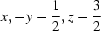 .
. Data collection: APEX2 (Bruker, 2005); cell refinement: SAINT (Bruker, 2005); data reduction: SAINT; program(s) used to solve structure: SHELXTL (Sheldrick, 2008); program(s) used to refine structure: SHELXTL; molecular graphics: SHELXTL; software used to prepare material for publication: SHELXTL and PLATON (Spek, 2009).
Supporting information
contains datablocks global, I. DOI: 10.1107/S1600536809007302/at2731sup1.cif
Structure factors: contains datablock I. DOI: 10.1107/S1600536809007302/at2731Isup2.hkl
The synthetic method has been described earlier (Al-Douh et al., 2006, 2007). Single crystals suitable for X-ray diffraction were obtained by slow evaporation of chloroform at room temperature.
H atoms of the hydroxy group was positioned by a freely rotating O—H bond and constrained with a fixed distance of 0.84 Å. The rest of the hydrogen atoms were positioned geometrically with a riding model approximation with C—H = 0.93–1.00 Å and Uiso(H) = 1.2 or 1.5 (C & O).
Data collection: APEX2 (Bruker, 2005); cell SAINT (Bruker, 2005); data reduction: SAINT (Bruker, 2005); program(s) used to solve structure: SHELXTL (Sheldrick, 2008); program(s) used to refine structure: SHELXTL (Sheldrick, 2008); molecular graphics: SHELXTL (Sheldrick, 2008); software used to prepare material for publication: SHELXTL (Sheldrick, 2008) and PLATON (Spek, 2009).
![[Figure 1]](./at2731fig1thm.gif) | Fig. 1. The molecular structure of the title compound, showing 50% probability displacement ellipsoids and the atomic numbering [symmetry code of unlabelled atoms -x + 1, -y, -z + 2]. Intramolecular H bonds are drawn as dashed lines. |
![[Figure 2]](./at2731fig2thm.gif) | Fig. 2. The crystal packing of the title compound, viewed down the c-axis showing stacking of molecules along the c-axis. Intermolecular hydrogen bonds are shown as dashed lines. |
| C22H20N2O4·2CHCl3 | F(000) = 628 |
| Mr = 615.14 | Dx = 1.521 Mg m−3 |
| Monoclinic, P21/c | Mo Kα radiation, λ = 0.71073 Å |
| Hall symbol: -P 2ybc | Cell parameters from 3653 reflections |
| a = 10.4773 (2) Å | θ = 2.8–29.6° |
| b = 21.3287 (5) Å | µ = 0.67 mm−1 |
| c = 6.2424 (2) Å | T = 100 K |
| β = 105.669 (2)° | Plate, yellow |
| V = 1343.13 (6) Å3 | 0.54 × 0.18 × 0.07 mm |
| Z = 2 |
| Bruker SMART APEXII CCD area-detector diffractometer | 3069 independent reflections |
| Radiation source: fine-focus sealed tube | 2361 reflections with I > 2σ(I) |
| Graphite monochromator | Rint = 0.033 |
| ϕ and ω scans | θmax = 27.5°, θmin = 2.0° |
| Absorption correction: multi-scan (SADABS; Bruker, 2005) | h = −13→13 |
| Tmin = 0.712, Tmax = 0.958 | k = −27→27 |
| 10624 measured reflections | l = −8→8 |
| Refinement on F2 | Primary atom site location: structure-invariant direct methods |
| Least-squares matrix: full | Secondary atom site location: difference Fourier map |
| R[F2 > 2σ(F2)] = 0.036 | Hydrogen site location: inferred from neighbouring sites |
| wR(F2) = 0.090 | H-atom parameters constrained |
| S = 1.03 | w = 1/[σ2(Fo2) + (0.0405P)2 + 0.6965P] where P = (Fo2 + 2Fc2)/3 |
| 3069 reflections | (Δ/σ)max < 0.001 |
| 165 parameters | Δρmax = 0.35 e Å−3 |
| 0 restraints | Δρmin = −0.25 e Å−3 |
| C22H20N2O4·2CHCl3 | V = 1343.13 (6) Å3 |
| Mr = 615.14 | Z = 2 |
| Monoclinic, P21/c | Mo Kα radiation |
| a = 10.4773 (2) Å | µ = 0.67 mm−1 |
| b = 21.3287 (5) Å | T = 100 K |
| c = 6.2424 (2) Å | 0.54 × 0.18 × 0.07 mm |
| β = 105.669 (2)° |
| Bruker SMART APEXII CCD area-detector diffractometer | 3069 independent reflections |
| Absorption correction: multi-scan (SADABS; Bruker, 2005) | 2361 reflections with I > 2σ(I) |
| Tmin = 0.712, Tmax = 0.958 | Rint = 0.033 |
| 10624 measured reflections |
| R[F2 > 2σ(F2)] = 0.036 | 0 restraints |
| wR(F2) = 0.090 | H-atom parameters constrained |
| S = 1.03 | Δρmax = 0.35 e Å−3 |
| 3069 reflections | Δρmin = −0.25 e Å−3 |
| 165 parameters |
Experimental. The crystal was placed in the cold stream of an Oxford Cyrosystems Cobra open-flow nitrogen cryostat (Cosier & Glazer, 1986) operating at 100.0 (1) K. |
Geometry. All e.s.d.'s (except the e.s.d. in the dihedral angle between two l.s. planes) are estimated using the full covariance matrix. The cell e.s.d.'s are taken into account individually in the estimation of e.s.d.'s in distances, angles and torsion angles; correlations between e.s.d.'s in cell parameters are only used when they are defined by crystal symmetry. An approximate (isotropic) treatment of cell e.s.d.'s is used for estimating e.s.d.'s involving l.s. planes. |
Refinement. Refinement of F2 against ALL reflections. The weighted R-factor wR and goodness of fit S are based on F2, conventional R-factors R are based on F, with F set to zero for negative F2. The threshold expression of F2 > σ(F2) is used only for calculating R-factors(gt) etc. and is not relevant to the choice of reflections for refinement. R-factors based on F2 are statistically about twice as large as those based on F, and R- factors based on ALL data will be even larger. |
| x | y | z | Uiso*/Ueq | ||
| Cl1 | 0.05508 (5) | 0.10427 (3) | 0.75969 (9) | 0.03053 (15) | |
| Cl2 | 0.09644 (5) | 0.19372 (3) | 0.43542 (10) | 0.03061 (15) | |
| Cl3 | 0.06333 (6) | 0.06178 (3) | 0.32245 (10) | 0.03145 (15) | |
| O1 | 0.71504 (12) | 0.11003 (6) | 0.4437 (2) | 0.0159 (3) | |
| H1 | 0.6880 | 0.0909 | 0.5406 | 0.024* | |
| O2 | 0.76612 (13) | 0.16921 (6) | 0.1108 (2) | 0.0167 (3) | |
| N1 | 0.54474 (15) | 0.06871 (7) | 0.6416 (3) | 0.0131 (3) | |
| C1 | 0.61066 (18) | 0.13631 (8) | 0.2936 (3) | 0.0126 (4) | |
| C2 | 0.63590 (18) | 0.16924 (8) | 0.1137 (3) | 0.0125 (4) | |
| C3 | 0.53268 (19) | 0.19797 (8) | −0.0409 (3) | 0.0146 (4) | |
| H3A | 0.5499 | 0.2209 | −0.1606 | 0.017* | |
| C4 | 0.40308 (19) | 0.19342 (8) | −0.0216 (3) | 0.0159 (4) | |
| H4A | 0.3325 | 0.2128 | −0.1295 | 0.019* | |
| C5 | 0.37710 (18) | 0.16110 (9) | 0.1525 (3) | 0.0153 (4) | |
| H5A | 0.2888 | 0.1583 | 0.1643 | 0.018* | |
| C6 | 0.48096 (18) | 0.13218 (8) | 0.3132 (3) | 0.0130 (4) | |
| C7 | 0.45272 (19) | 0.09798 (8) | 0.4963 (3) | 0.0147 (4) | |
| H7A | 0.3645 | 0.0971 | 0.5096 | 0.018* | |
| C8 | 0.51663 (18) | 0.03447 (8) | 0.8182 (3) | 0.0126 (4) | |
| C9 | 0.62640 (18) | 0.01408 (9) | 0.9863 (3) | 0.0153 (4) | |
| H9A | 0.7133 | 0.0235 | 0.9766 | 0.018* | |
| C10 | 0.39007 (19) | 0.01950 (9) | 0.8339 (3) | 0.0166 (4) | |
| H10A | 0.3146 | 0.0325 | 0.7202 | 0.020* | |
| C11 | 0.7985 (2) | 0.20505 (10) | −0.0612 (3) | 0.0197 (4) | |
| H11A | 0.8939 | 0.2020 | −0.0459 | 0.029* | |
| H11B | 0.7744 | 0.2490 | −0.0487 | 0.029* | |
| H11C | 0.7493 | 0.1887 | −0.2067 | 0.029* | |
| C12 | 0.0159 (2) | 0.12323 (10) | 0.4736 (4) | 0.0231 (5) | |
| H12A | −0.0821 | 0.1294 | 0.4173 | 0.028* |
| U11 | U22 | U33 | U12 | U13 | U23 | |
| Cl1 | 0.0318 (3) | 0.0392 (3) | 0.0202 (3) | 0.0063 (2) | 0.0064 (2) | 0.0025 (2) |
| Cl2 | 0.0281 (3) | 0.0258 (3) | 0.0401 (4) | −0.0015 (2) | 0.0128 (2) | 0.0010 (2) |
| Cl3 | 0.0394 (3) | 0.0294 (3) | 0.0264 (3) | −0.0015 (2) | 0.0102 (2) | −0.0048 (2) |
| O1 | 0.0158 (6) | 0.0169 (7) | 0.0145 (7) | 0.0007 (5) | 0.0034 (5) | 0.0060 (6) |
| O2 | 0.0184 (7) | 0.0165 (7) | 0.0168 (7) | 0.0003 (5) | 0.0079 (6) | 0.0046 (6) |
| N1 | 0.0192 (8) | 0.0095 (7) | 0.0115 (8) | −0.0006 (6) | 0.0053 (6) | 0.0004 (6) |
| C1 | 0.0184 (9) | 0.0062 (8) | 0.0120 (9) | 0.0000 (7) | 0.0023 (7) | −0.0009 (7) |
| C2 | 0.0165 (9) | 0.0087 (8) | 0.0127 (9) | −0.0017 (7) | 0.0047 (7) | −0.0021 (7) |
| C3 | 0.0230 (10) | 0.0084 (9) | 0.0124 (10) | −0.0012 (7) | 0.0050 (8) | 0.0004 (7) |
| C4 | 0.0195 (9) | 0.0115 (9) | 0.0143 (10) | 0.0017 (7) | 0.0005 (8) | 0.0010 (8) |
| C5 | 0.0144 (9) | 0.0128 (9) | 0.0189 (10) | 0.0006 (7) | 0.0047 (8) | 0.0000 (8) |
| C6 | 0.0188 (9) | 0.0084 (8) | 0.0121 (9) | −0.0021 (7) | 0.0050 (7) | −0.0023 (7) |
| C7 | 0.0170 (9) | 0.0116 (9) | 0.0167 (10) | −0.0024 (7) | 0.0066 (8) | −0.0008 (7) |
| C8 | 0.0188 (9) | 0.0080 (8) | 0.0126 (9) | 0.0003 (7) | 0.0070 (7) | −0.0024 (7) |
| C9 | 0.0151 (9) | 0.0138 (9) | 0.0186 (10) | −0.0007 (7) | 0.0072 (8) | 0.0011 (8) |
| C10 | 0.0171 (9) | 0.0148 (9) | 0.0164 (10) | 0.0021 (7) | 0.0021 (8) | 0.0024 (8) |
| C11 | 0.0220 (10) | 0.0222 (11) | 0.0179 (11) | −0.0021 (8) | 0.0105 (8) | 0.0048 (8) |
| C12 | 0.0190 (10) | 0.0284 (12) | 0.0214 (11) | 0.0022 (8) | 0.0049 (8) | 0.0025 (9) |
| Cl1—C12 | 1.768 (2) | C4—H4A | 0.9500 |
| Cl2—C12 | 1.771 (2) | C5—C6 | 1.408 (3) |
| Cl3—C12 | 1.763 (2) | C5—H5A | 0.9500 |
| O1—C1 | 1.354 (2) | C6—C7 | 1.452 (3) |
| O1—H1 | 0.8400 | C7—H7A | 0.9500 |
| O2—C2 | 1.369 (2) | C8—C10 | 1.393 (3) |
| O2—C11 | 1.431 (2) | C8—C9 | 1.400 (3) |
| N1—C7 | 1.292 (2) | C9—C10i | 1.381 (3) |
| N1—C8 | 1.418 (2) | C9—H9A | 0.9500 |
| C1—C6 | 1.400 (3) | C10—C9i | 1.381 (3) |
| C1—C2 | 1.409 (3) | C10—H10A | 0.9500 |
| C2—C3 | 1.383 (3) | C11—H11A | 0.9800 |
| C3—C4 | 1.399 (3) | C11—H11B | 0.9800 |
| C3—H3A | 0.9500 | C11—H11C | 0.9800 |
| C4—C5 | 1.375 (3) | C12—H12A | 1.0000 |
| C1—O1—H1 | 109.5 | C6—C7—H7A | 119.2 |
| C2—O2—C11 | 116.63 (14) | C10—C8—C9 | 118.75 (17) |
| C7—N1—C8 | 121.48 (16) | C10—C8—N1 | 125.04 (17) |
| O1—C1—C6 | 122.35 (17) | C9—C8—N1 | 116.21 (16) |
| O1—C1—C2 | 117.87 (16) | C10i—C9—C8 | 120.83 (18) |
| C6—C1—C2 | 119.78 (16) | C10i—C9—H9A | 119.6 |
| O2—C2—C3 | 125.84 (17) | C8—C9—H9A | 119.6 |
| O2—C2—C1 | 114.35 (15) | C9i—C10—C8 | 120.41 (17) |
| C3—C2—C1 | 119.81 (17) | C9i—C10—H10A | 119.8 |
| C2—C3—C4 | 120.26 (18) | C8—C10—H10A | 119.8 |
| C2—C3—H3A | 119.9 | O2—C11—H11A | 109.5 |
| C4—C3—H3A | 119.9 | O2—C11—H11B | 109.5 |
| C5—C4—C3 | 120.46 (17) | H11A—C11—H11B | 109.5 |
| C5—C4—H4A | 119.8 | O2—C11—H11C | 109.5 |
| C3—C4—H4A | 119.8 | H11A—C11—H11C | 109.5 |
| C4—C5—C6 | 120.21 (18) | H11B—C11—H11C | 109.5 |
| C4—C5—H5A | 119.9 | Cl3—C12—Cl1 | 110.39 (12) |
| C6—C5—H5A | 119.9 | Cl3—C12—Cl2 | 110.22 (12) |
| C1—C6—C5 | 119.47 (17) | Cl1—C12—Cl2 | 109.93 (12) |
| C1—C6—C7 | 120.62 (17) | Cl3—C12—H12A | 108.7 |
| C5—C6—C7 | 119.90 (17) | Cl1—C12—H12A | 108.7 |
| N1—C7—C6 | 121.54 (17) | Cl2—C12—H12A | 108.7 |
| N1—C7—H7A | 119.2 | ||
| C11—O2—C2—C3 | 3.6 (3) | C2—C1—C6—C7 | 179.44 (17) |
| C11—O2—C2—C1 | −176.48 (16) | C4—C5—C6—C1 | −0.3 (3) |
| O1—C1—C2—O2 | 1.5 (2) | C4—C5—C6—C7 | −179.84 (17) |
| C6—C1—C2—O2 | −179.08 (16) | C8—N1—C7—C6 | −178.93 (16) |
| O1—C1—C2—C3 | −178.60 (16) | C1—C6—C7—N1 | −2.4 (3) |
| C6—C1—C2—C3 | 0.9 (3) | C5—C6—C7—N1 | 177.12 (17) |
| O2—C2—C3—C4 | 178.67 (17) | C7—N1—C8—C10 | 11.6 (3) |
| C1—C2—C3—C4 | −1.3 (3) | C7—N1—C8—C9 | −169.16 (17) |
| C2—C3—C4—C5 | 0.9 (3) | C10—C8—C9—C10i | −0.9 (3) |
| C3—C4—C5—C6 | −0.1 (3) | N1—C8—C9—C10i | 179.83 (17) |
| O1—C1—C6—C5 | 179.37 (17) | C9—C8—C10—C9i | 0.9 (3) |
| C2—C1—C6—C5 | −0.1 (3) | N1—C8—C10—C9i | −179.90 (17) |
| O1—C1—C6—C7 | −1.1 (3) |
| Symmetry code: (i) −x+1, −y, −z+2. |
| D—H···A | D—H | H···A | D···A | D—H···A |
| O1—H1···N1 | 0.84 | 1.84 | 2.584 (2) | 147 |
| C12—H12A···O1ii | 1.00 | 2.21 | 3.120 (3) | 150 |
| C12—H12A···O2ii | 1.00 | 2.30 | 3.121 (3) | 139 |
| C3—H3A···Cg1iii | 0.95 | 2.73 | 3.5221 (19) | 142 |
| Symmetry codes: (ii) x−1, y, z; (iii) x, −y−1/2, z−3/2. |
Experimental details
| Crystal data | |
| Chemical formula | C22H20N2O4·2CHCl3 |
| Mr | 615.14 |
| Crystal system, space group | Monoclinic, P21/c |
| Temperature (K) | 100 |
| a, b, c (Å) | 10.4773 (2), 21.3287 (5), 6.2424 (2) |
| β (°) | 105.669 (2) |
| V (Å3) | 1343.13 (6) |
| Z | 2 |
| Radiation type | Mo Kα |
| µ (mm−1) | 0.67 |
| Crystal size (mm) | 0.54 × 0.18 × 0.07 |
| Data collection | |
| Diffractometer | Bruker SMART APEXII CCD area-detector diffractometer |
| Absorption correction | Multi-scan (SADABS; Bruker, 2005) |
| Tmin, Tmax | 0.712, 0.958 |
| No. of measured, independent and observed [I > 2σ(I)] reflections | 10624, 3069, 2361 |
| Rint | 0.033 |
| (sin θ/λ)max (Å−1) | 0.650 |
| Refinement | |
| R[F2 > 2σ(F2)], wR(F2), S | 0.036, 0.090, 1.03 |
| No. of reflections | 3069 |
| No. of parameters | 165 |
| H-atom treatment | H-atom parameters constrained |
| Δρmax, Δρmin (e Å−3) | 0.35, −0.25 |
Computer programs: APEX2 (Bruker, 2005), SAINT (Bruker, 2005), SHELXTL (Sheldrick, 2008), SHELXTL (Sheldrick, 2008) and PLATON (Spek, 2009).
| D—H···A | D—H | H···A | D···A | D—H···A |
| O1—H1···N1 | 0.8400 | 1.8400 | 2.584 (2) | 147.00 |
| C12—H12A···O1i | 1.0000 | 2.2100 | 3.120 (3) | 150.00 |
| C12—H12A···O2i | 1.0000 | 2.3000 | 3.121 (3) | 139.00 |
| C3—H3A···Cg1ii | 0.9500 | 2.7300 | 3.5221 (19) | 142.00 |
| Symmetry codes: (i) x−1, y, z; (ii) x, −y−1/2, z−3/2. |
Footnotes
‡Additional correspondence author, e-mail: [email protected].
Acknowledgements
We thank the Malaysian Government and Universiti Sains Malaysia for an FRGS grant [304/PKIMIA/638122] to conduct this work. MHAl-D thanks the Yemen Government and Hadhramout University of Science and Technology for financial scholarship support. HKF and RK thank the Malaysian Government and Universiti Sains Malaysia for the Science Fund grant No. 305/PFIZIK/613312. RK thanks Universiti Sains Malaysia for a post-doctoral research fellowship. HKF also thanks Universiti Sains Malaysia for the Research University Golden Goose grant No. 1001/PFIZIK/811012.
References
 Al-Douh, M. H., Hamid, S. A. & Osman, H. (2008). In Proceedings of Asian Scientific Conference on Pharmaceutical Technology, June 1–3, Batu Ferringhi, Penang, Malaysia, Poster ASC088. Google Scholar
Al-Douh, M. H., Hamid, S. A., Osman, H., Ng, S.-L. & Fun, H.-K. (2006). Acta Cryst. E62, o3954–o3956. Web of Science CSD CrossRef IUCr Journals Google Scholar
Al-Douh, M. H., Hamid, S. A., Osman, H., Ng, S.-L. & Fun, H.-K. (2007). Acta Cryst. E63, o3570–o3571. Web of Science CSD CrossRef IUCr Journals Google Scholar
Allen, F. H., Kennard, O., Watson, D. G., Brammer, L., Orpen, A. G. & Taylor, R. (1987). J. Chem. Soc. Perkin Trans. 2, pp. S1–S19. CrossRef Web of Science Google Scholar
Bernstein, J., Davis, R. E., Shimoni, L. & Chamg, N.-L. (1995). Angew. Chem. Int. Ed. Engl. 34, 1555–1573. CrossRef CAS Web of Science Google Scholar
Bruker (2005). APEX2, SAINT and SADABS. Bruker AXS Inc., Madison, Wisconsin, USA. Google Scholar
Cohen, M. D., Schmidt, G. M. J. & Flavian, S. (1964). J. Chem. Soc. pp. 2041–2051. CrossRef Web of Science Google Scholar
Cosier, J. & Glazer, A. M. (1986). J. Appl. Cryst. 19, 105–107. CrossRef CAS Web of Science IUCr Journals Google Scholar
Kabak, A., Elmalıi, A., Elerman, Y. & Durlu, T. N. (2000). J. Mol. Struct. 553, 187–192. Web of Science CSD CrossRef CAS Google Scholar
Liu, Y.-F., Xia, H.-T., Yang, S.-P. & Wang, D.-Q. (2006). Acta Cryst. E62, o5908–o5909. Web of Science CSD CrossRef CAS IUCr Journals Google Scholar
Parra, M. R., Garcia, T., Lorenzo, E. & Pariente, F. (2007). Biosens. Bioelectron. 22, 2675–2681. Web of Science PubMed Google Scholar
Salem, I. A. & Amer, S. A. (1995). Transition Met. Chem. 20, 494–497. CrossRef CAS Web of Science Google Scholar
Shah, A. M., Helal, M. H. S., Al-Douh, M. H., Hamid, S. A. & Osman, H. (2008). In Proceedings of 22nd Scientific Meeting of Malaysian Society of Pharmacology and Physiology, April 5-6, Kuala Lumpur, Malaysia, Poster 58. Google Scholar
Sheldrick, G. M. (2008). Acta Cryst. A64, 112–122. Web of Science CrossRef CAS IUCr Journals Google Scholar
Spek, A. L. (2009). Acta Cryst. D65, 148–155. Web of Science CrossRef CAS IUCr Journals Google Scholar
Teoh, S. G., Yeap, G. Y., Loh, C. C., Foong, L. W., Teo, S. B. & Fun, H.-K. (1997). Polyhedron, 16, 2213–2221. CSD CrossRef CAS Web of Science Google Scholar
Viswanathamurthi, P., Dharmaraj, N., Anuradha, S. & Natarajan, K. (1998). Transition Met. Chem. 23, 337–341. Web of Science CrossRef CAS Google Scholar
This is an open-access article distributed under the terms of the Creative Commons Attribution (CC-BY) Licence, which permits unrestricted use, distribution, and reproduction in any medium, provided the original authors and source are cited.
| CRYSTALLOGRAPHIC COMMUNICATIONS |


Bis-Schiff bases are a class of important compounds used as pharmaceutical, medicinal and industrial materials. Schiff bases have also been used extensively in coordination and inorganic chemistry. Salem and Amer used H2O2 to study the kinetics of the oxidation of a manganese complex with bis-Schiff base of salicyldehyde (Salem & Amer, 1995). Many of these Schiff bases were found to form suitable inner coordination spheres between tin atom with O and N atoms as quadridentate chelates (Teoh et al., 1997). Meanwhile, ruthenium complexes of bis-Schiff bases derived from o-vanillin and salicyldehyde were shown to exhibit dibasic tetradentate chelation (Viswanathamurthi et al., 1998). The intramolecular hydrogen bonds formed between O and N atoms in Schiff bases are responsible for the formation of these metal complexes (Cohen et al., 1964). Kabak et al. (2000) prepared the derivative of another isomer of the title compound and studied the photochromic conformational properties of this derivative, while Parra et al. (2007) examined the intercalation of another derivative of bis-Schiff bases with DNA by UV spectroscopy. Recently, we reported the crystal structure of the meta-isomer of the title compound (Al-Douh et al., 2007), while the single-crystal of the second isomer in the ortho-position was obtained and the data are consistent with the reported structure (Liu et al., 2006). The proton and carbon NMR spectroscopies of the title compound and its isomers were also studied (Al-Douh et al., 2008). Our group has been actively involved in synthesizing bis-Schiff bases and investigating their DNA binding ability using spectroscopic techniques employing calf thymus DNA (Shah et al., 2008). We have synthesized the third symmetric Schiff base by the condensation of o-vanillin with p-phenylenediamine and its X-ray crystal structure is presented here.
The title compound, (Fig. 1), lies across a crystallographic inversion centre [symmetry code of unlabelled atoms -x + 1, -y, -z + 2]. The bond lengths (Allen et al., 1987) and angles are within normal ranges. An intramolecular O—H···N hydrogen bond generates a six-membered ring, producing S(6) ring motif (Bernstein et al., 1995). Intermolecular bifurcated C—H···O hydrogen bonds involving the two oxygen atoms of the Schiff base ligand and the hydrogen atom of the chloroform solvent of crystallization generate a R21(5) ring motif. There are short contacts [C1–C9 = 3.267 (3) and C2–C9 = 3.399 (3) Å] which are shorter than the sum of the van der Waals radius of carbon atom. The crystal structure is stabilized by intermolecular C—H···π interaction (Cg1 is the centroid of the C1–C6 benzene ring) (Table 1) and intermolecular π-π interaction [Cg1···Cg2i, ii, iii, iv = 3.6158 (10) Å; symmetry codes: (i) x, 1/2 - y, 1/2 + z (ii) x, y, -1 + z (iii) 1 - x, -y, 1 - z (iv) x, y, 1 + z, (Cg2 is the centroid of the benzene ring in the middle of the main molecule)]. In the crystal structure molecule are stacked down the c axis (Fig. 2).