 | Acta Crystallographica Section E Acta Crystallographica Section E CRYSTALLOGRAPHIC COMMUNICATIONS |


 journal menu


organic compounds
| CRYSTALLOGRAPHIC COMMUNICATIONS |
 access
6,8-Dihydroxy-3-methylisocoumarin

aSchool of Medicine and Pharmacy, Ocean University of China, Qingdao, Shandong 266003, People's Republic of China, bCollege of Science, South China Agricultural University, Guangzhou, Guangdong 510642, People's Republic of China, and cCollege of Chemistry and Chemical Engineering, Luoyang Normal University, Luoyang, Henan 471022, People's Republic of China
*Correspondence e-mail: [email protected]
The title compound, C10H8O4, was isolated from the fermentation culture of the endophytic fungus Cephalosporium sp. In the molecules are connected into a one-dimensional chain along [101] by intermolecular O—H⋯O hydrogen bonds involving the hydroxyl and carbonyl functionalities. The chains are linked by non-classical C—H⋯O interactions, forming extended two-dimensional layers approximately parallel to (11 ).
).
Related literature
For new bioactive from marine fungi, see: Shao et al. (2007![[Shao, C. L., She, Z. G., Guo, Z. Y., Peng, H., Cai, X. L., Zhou, S. N., Gu, Y. C. & Lin, Y. C. (2007). Magn. Reson. Chem. 45, 434-438.]](../../../../../../logos/arrows/e_arr.gif "Shao, C. L., She, Z. G., Guo, Z. Y., Peng, H., Cai, X. L., Zhou, S. N., Gu, Y. C. & Lin, Y. C. (2007). Magn. Reson. Chem. 45, 434-438.") ). For the investigation of an endophytic strain Cephalosporium sp., see: Wei et al. (2008); Hemingway et al. (1977); Kendall et al. (1989). For crystal structures with non-classical C—H⋯O interactions, see: Nangia (2002).
). For the investigation of an endophytic strain Cephalosporium sp., see: Wei et al. (2008); Hemingway et al. (1977); Kendall et al. (1989). For crystal structures with non-classical C—H⋯O interactions, see: Nangia (2002).
![[Scheme 1]](bh2219scheme1.gif)
Experimental
Crystal data
|
Refinement
|
| ||||||||||||||||||||||
 ; (ii)
 Data collection: APEX2 (Bruker, 2004); cell refinement: SAINT (Bruker, 2004); data reduction: SAINT; program(s) used to solve structure: SHELXS97 (Sheldrick, 2008); program(s) used to refine structure: SHELXL97 (Sheldrick 2008); molecular graphics: SHELXTL (Sheldrick 2008); software used to prepare material for publication: SHELXTL and PLATON (Spek, 2009).
Supporting information
contains datablocks global, I. DOI: 10.1107/S1600536809008083/bh2219sup1.cif
Structure factors: contains datablock I. DOI: 10.1107/S1600536809008083/bh2219Isup2.hkl
A strain of fungus Cephalosporium sp. (No. 2090) was deposited in the School of Chemistry and Chemical Engineering, Sun Yat-sen University, Guangzhou, People's Republic of China. Culture conditions: GYT medium (glucose 10 g/L, peptone 2 g/L, yeast extract 1 g/L, NaCl 2.5 g/L) and incubation at 298 K for 4 weeks. The cultures (70 L) were filtered through cheesecloth. The filtrate was concentrated to 3 L below 323 K, extracted five times by shaking with an equal volume of ethyl acetate. The extract was evaporated under reduced pressure below 323 K. The combined organic extracts were chromatographed on silica-gel, eluting with petroleum ether/ethyl acetate, to yield the title compound. Crystals were obtained by evaporation of an ethyl acetate solution.
All H atoms were positioned geometrically and treated as riding, with C—H bond lengths constrained to 0.93 (aromatic CH), 0.96 (methyl CH3), and 0.82 Å (hydroxyl OH), and with Uiso(H) = 1.5Ueq(carrier atom) or for CH3 and OH groups and Uiso(H) = 1.2Ueq(carrier C) otherwise.
Data collection: APEX2 (Bruker, 2004); cell SAINT (Bruker, 2004); data reduction: SAINT (Bruker, 2004); program(s) used to solve structure: SHELXS97 (Sheldrick, 2008); program(s) used to refine structure: SHELXL97 (Sheldrick 2008); molecular graphics: SHELXTL (Sheldrick 2008); software used to prepare material for publication: SHELXTL (Sheldrick 2008) and PLATON (Spek, 2009).
![[Figure 1]](./bh2219fig1thm.gif) | Fig. 1. View of the title molecule with atom numbering scheme and 30% probability displacement ellipsoids for non-hydrogen atoms. |
![[Figure 2]](./bh2219fig2thm.gif) | Fig. 2. View of the 2D layers formed by intermolecular O—H···O hydrogen bonds and weak non-conventional intermolecular C—H···O interactions. |
| C10H8O4 | F(000) = 400 |
| Mr = 192.16 | Dx = 1.500 Mg m−3 |
| Monoclinic, P21/c | Mo Kα radiation, λ = 0.71073 Å |
| Hall symbol: -P 2ybc | Cell parameters from 1738 reflections |
| a = 3.8201 (7) Å | θ = 2.6–25.5° |
| b = 15.710 (3) Å | µ = 0.12 mm−1 |
| c = 14.196 (2) Å | T = 291 K |
| β = 92.668 (2)° | Block, yellow |
| V = 851.1 (3) Å3 | 0.27 × 0.20 × 0.19 mm |
| Z = 4 |
| Bruker APEXII CCD diffractometer | 1586 independent reflections |
| Radiation source: fine-focus sealed tube | 1272 reflections with I > 2σ(I) |
| Graphite monochromator | Rint = 0.021 |
| ϕ and ω scans | θmax = 25.5°, θmin = 2.6° |
| Absorption correction: multi-scan (SADABS; Sheldrick, 1996) | h = −4→4 |
| Tmin = 0.969, Tmax = 0.978 | k = −19→13 |
| 4781 measured reflections | l = −17→17 |
| Refinement on F2 | Secondary atom site location: difference Fourier map |
| Least-squares matrix: full | Hydrogen site location: inferred from neighbouring sites |
| R[F2 > 2σ(F2)] = 0.034 | H-atom parameters constrained |
| wR(F2) = 0.094 | w = 1/[σ2(Fo2) + (0.0441P)2 + 0.1957P] where P = (Fo2 + 2Fc2)/3 |
| S = 1.04 | (Δ/σ)max < 0.001 |
| 1586 reflections | Δρmax = 0.18 e Å−3 |
| 131 parameters | Δρmin = −0.14 e Å−3 |
| 0 restraints | Extinction correction: SHELXL97 (Sheldrick 2008), Fc*=kFc[1+0.001xFc2λ3/sin(2θ)]-1/4 |
| 0 constraints | Extinction coefficient: 0.015 (3) |
| Primary atom site location: structure-invariant direct methods |
| C10H8O4 | V = 851.1 (3) Å3 |
| Mr = 192.16 | Z = 4 |
| Monoclinic, P21/c | Mo Kα radiation |
| a = 3.8201 (7) Å | µ = 0.12 mm−1 |
| b = 15.710 (3) Å | T = 291 K |
| c = 14.196 (2) Å | 0.27 × 0.20 × 0.19 mm |
| β = 92.668 (2)° |
| Bruker APEXII CCD diffractometer | 1586 independent reflections |
| Absorption correction: multi-scan (SADABS; Sheldrick, 1996) | 1272 reflections with I > 2σ(I) |
| Tmin = 0.969, Tmax = 0.978 | Rint = 0.021 |
| 4781 measured reflections |
| R[F2 > 2σ(F2)] = 0.034 | 0 restraints |
| wR(F2) = 0.094 | H-atom parameters constrained |
| S = 1.04 | Δρmax = 0.18 e Å−3 |
| 1586 reflections | Δρmin = −0.14 e Å−3 |
| 131 parameters |
| x | y | z | Uiso*/Ueq | ||
| O1 | 0.3482 (3) | 0.32453 (7) | 0.81217 (7) | 0.0451 (3) | |
| O2 | 0.3544 (3) | 0.19366 (7) | 0.75748 (8) | 0.0572 (4) | |
| O3 | 0.0718 (3) | 0.15766 (7) | 0.58873 (8) | 0.0552 (4) | |
| H3 | 0.1709 | 0.1476 | 0.6400 | 0.083* | |
| O4 | −0.4021 (3) | 0.39231 (7) | 0.41364 (7) | 0.0487 (3) | |
| H4 | −0.4514 | 0.3541 | 0.3759 | 0.073* | |
| C1 | 0.3853 (4) | 0.45742 (12) | 0.89102 (11) | 0.0516 (4) | |
| H1A | 0.3148 | 0.5160 | 0.8859 | 0.077* | |
| H1B | 0.6359 | 0.4542 | 0.8987 | 0.077* | |
| H1C | 0.2819 | 0.4321 | 0.9446 | 0.077* | |
| C2 | 0.2659 (4) | 0.41080 (10) | 0.80372 (10) | 0.0395 (4) | |
| C3 | 0.1028 (4) | 0.44079 (10) | 0.72629 (10) | 0.0379 (4) | |
| H3A | 0.0505 | 0.4985 | 0.7224 | 0.046* | |
| C4 | 0.0042 (3) | 0.38590 (9) | 0.64774 (9) | 0.0318 (3) | |
| C5 | −0.1641 (4) | 0.41528 (9) | 0.56587 (10) | 0.0355 (3) | |
| H5 | −0.2230 | 0.4725 | 0.5598 | 0.043* | |
| C6 | −0.2453 (4) | 0.35866 (10) | 0.49244 (10) | 0.0354 (3) | |
| C7 | −0.1659 (4) | 0.27235 (9) | 0.50066 (10) | 0.0378 (4) | |
| H7 | −0.2235 | 0.2354 | 0.4512 | 0.045* | |
| C8 | −0.0016 (4) | 0.24192 (9) | 0.58233 (10) | 0.0368 (3) | |
| C9 | 0.0880 (4) | 0.29837 (9) | 0.65755 (9) | 0.0337 (3) | |
| C10 | 0.2651 (4) | 0.26818 (10) | 0.74166 (10) | 0.0401 (4) |
| U11 | U22 | U33 | U12 | U13 | U23 | |
| O1 | 0.0531 (7) | 0.0503 (7) | 0.0308 (5) | 0.0018 (5) | −0.0102 (5) | −0.0008 (5) |
| O2 | 0.0802 (9) | 0.0448 (7) | 0.0447 (7) | 0.0086 (6) | −0.0182 (6) | 0.0060 (5) |
| O3 | 0.0804 (9) | 0.0330 (6) | 0.0503 (7) | 0.0065 (5) | −0.0162 (6) | −0.0011 (5) |
| O4 | 0.0677 (8) | 0.0425 (6) | 0.0342 (6) | 0.0033 (5) | −0.0174 (5) | −0.0004 (5) |
| C1 | 0.0488 (10) | 0.0661 (11) | 0.0390 (9) | −0.0024 (8) | −0.0060 (7) | −0.0131 (8) |
| C2 | 0.0382 (8) | 0.0459 (9) | 0.0344 (8) | −0.0026 (7) | 0.0008 (6) | −0.0058 (6) |
| C3 | 0.0414 (8) | 0.0372 (8) | 0.0350 (8) | −0.0021 (6) | 0.0002 (6) | −0.0034 (6) |
| C4 | 0.0311 (7) | 0.0354 (8) | 0.0291 (7) | −0.0033 (6) | 0.0016 (6) | −0.0006 (6) |
| C5 | 0.0405 (8) | 0.0314 (8) | 0.0344 (7) | 0.0001 (6) | −0.0011 (6) | 0.0009 (6) |
| C6 | 0.0354 (8) | 0.0407 (8) | 0.0297 (7) | −0.0013 (6) | −0.0037 (6) | 0.0029 (6) |
| C7 | 0.0437 (8) | 0.0379 (9) | 0.0312 (7) | −0.0045 (6) | −0.0047 (6) | −0.0053 (6) |
| C8 | 0.0412 (8) | 0.0318 (8) | 0.0370 (8) | −0.0010 (6) | −0.0011 (6) | −0.0003 (6) |
| C9 | 0.0344 (8) | 0.0364 (8) | 0.0301 (7) | −0.0011 (6) | −0.0005 (6) | 0.0019 (6) |
| C10 | 0.0436 (9) | 0.0422 (9) | 0.0339 (8) | 0.0007 (7) | −0.0030 (6) | 0.0033 (6) |
| O1—C10 | 1.3626 (18) | C3—C4 | 1.4457 (19) |
| O1—C2 | 1.3951 (19) | C3—H3A | 0.9300 |
| O2—C10 | 1.2370 (18) | C4—C5 | 1.3813 (19) |
| O3—C8 | 1.3553 (18) | C4—C9 | 1.417 (2) |
| O3—H3 | 0.8200 | C5—C6 | 1.394 (2) |
| O4—C6 | 1.3518 (17) | C5—H5 | 0.9300 |
| O4—H4 | 0.8200 | C6—C7 | 1.393 (2) |
| C1—C2 | 1.493 (2) | C7—C8 | 1.378 (2) |
| C1—H1A | 0.9600 | C7—H7 | 0.9300 |
| C1—H1B | 0.9600 | C8—C9 | 1.418 (2) |
| C1—H1C | 0.9600 | C9—C10 | 1.426 (2) |
| C2—C3 | 1.325 (2) | ||
| C10—O1—C2 | 121.61 (11) | C4—C5—C6 | 119.64 (13) |
| C8—O3—H3 | 109.5 | C4—C5—H5 | 120.2 |
| C6—O4—H4 | 109.5 | C6—C5—H5 | 120.2 |
| C2—C1—H1A | 109.5 | O4—C6—C7 | 122.43 (13) |
| C2—C1—H1B | 109.5 | O4—C6—C5 | 116.35 (13) |
| H1A—C1—H1B | 109.5 | C7—C6—C5 | 121.22 (13) |
| C2—C1—H1C | 109.5 | C8—C7—C6 | 119.81 (13) |
| H1A—C1—H1C | 109.5 | C8—C7—H7 | 120.1 |
| H1B—C1—H1C | 109.5 | C6—C7—H7 | 120.1 |
| C3—C2—O1 | 120.81 (13) | O3—C8—C7 | 118.69 (13) |
| C3—C2—C1 | 128.92 (15) | O3—C8—C9 | 121.23 (13) |
| O1—C2—C1 | 110.27 (13) | C7—C8—C9 | 120.08 (13) |
| C2—C3—C4 | 121.57 (14) | C4—C9—C8 | 119.18 (12) |
| C2—C3—H3A | 119.2 | C4—C9—C10 | 120.08 (13) |
| C4—C3—H3A | 119.2 | C8—C9—C10 | 120.74 (13) |
| C5—C4—C9 | 120.07 (12) | O2—C10—O1 | 115.39 (13) |
| C5—C4—C3 | 122.96 (13) | O2—C10—C9 | 125.66 (14) |
| C9—C4—C3 | 116.96 (12) | O1—C10—C9 | 118.96 (13) |
| C10—O1—C2—C3 | 0.1 (2) | C5—C4—C9—C8 | 0.3 (2) |
| C10—O1—C2—C1 | 179.78 (13) | C3—C4—C9—C8 | −179.69 (13) |
| O1—C2—C3—C4 | −0.1 (2) | C5—C4—C9—C10 | 179.32 (13) |
| C1—C2—C3—C4 | −179.74 (14) | C3—C4—C9—C10 | −0.66 (19) |
| C2—C3—C4—C5 | −179.60 (14) | O3—C8—C9—C4 | −179.69 (13) |
| C2—C3—C4—C9 | 0.4 (2) | C7—C8—C9—C4 | 0.5 (2) |
| C9—C4—C5—C6 | −1.1 (2) | O3—C8—C9—C10 | 1.3 (2) |
| C3—C4—C5—C6 | 178.85 (13) | C7—C8—C9—C10 | −178.57 (13) |
| C4—C5—C6—O4 | −178.42 (12) | C2—O1—C10—O2 | 179.49 (13) |
| C4—C5—C6—C7 | 1.3 (2) | C2—O1—C10—C9 | −0.4 (2) |
| O4—C6—C7—C8 | 179.14 (14) | C4—C9—C10—O2 | −179.17 (15) |
| C5—C6—C7—C8 | −0.5 (2) | C8—C9—C10—O2 | −0.2 (2) |
| C6—C7—C8—O3 | 179.79 (14) | C4—C9—C10—O1 | 0.7 (2) |
| C6—C7—C8—C9 | −0.3 (2) | C8—C9—C10—O1 | 179.67 (13) |
| D—H···A | D—H | H···A | D···A | D—H···A |
| O3—H3···O2 | 0.82 | 1.92 | 2.6426 (16) | 146 |
| O4—H4···O2i | 0.82 | 1.96 | 2.7225 (15) | 155 |
| C5—H5···O4ii | 0.93 | 2.60 | 3.4659 (19) | 155 |
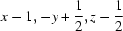
| Symmetry codes: (i) x−1, −y+1/2, z−1/2; (ii) −x−1, −y+1, −z+1. |
Experimental details
| Crystal data | |
| Chemical formula | C10H8O4 |
| Mr | 192.16 |
| Crystal system, space group | Monoclinic, P21/c |
| Temperature (K) | 291 |
| a, b, c (Å) | 3.8201 (7), 15.710 (3), 14.196 (2) |
| β (°) | 92.668 (2) |
| V (Å3) | 851.1 (3) |
| Z | 4 |
| Radiation type | Mo Kα |
| µ (mm−1) | 0.12 |
| Crystal size (mm) | 0.27 × 0.20 × 0.19 |
| Data collection | |
| Diffractometer | Bruker APEXII CCD diffractometer |
| Absorption correction | Multi-scan (SADABS; Sheldrick, 1996) |
| Tmin, Tmax | 0.969, 0.978 |
| No. of measured, independent and observed [I > 2σ(I)] reflections | 4781, 1586, 1272 |
| Rint | 0.021 |
| (sin θ/λ)max (Å−1) | 0.606 |
| Refinement | |
| R[F2 > 2σ(F2)], wR(F2), S | 0.034, 0.094, 1.04 |
| No. of reflections | 1586 |
| No. of parameters | 131 |
| H-atom treatment | H-atom parameters constrained |
| Δρmax, Δρmin (e Å−3) | 0.18, −0.14 |
Computer programs: APEX2 (Bruker, 2004), SAINT (Bruker, 2004), SHELXS97 (Sheldrick, 2008), SHELXL97 (Sheldrick 2008), SHELXTL (Sheldrick 2008) and PLATON (Spek, 2009).
| D—H···A | D—H | H···A | D···A | D—H···A |
| O4—H4···O2i | 0.82 | 1.96 | 2.7225 (15) | 155.3 |
| C5—H5···O4ii | 0.93 | 2.60 | 3.4659 (19) | 155 |
| Symmetry codes: (i) x−1, −y+1/2, z−1/2; (ii) −x−1, −y+1, −z+1. |
Acknowledgements
The authors acknowledge financial support from the National Natural Science Foundation of China (No. 40776073), the Basic Research Program of Science and Technology, Ministry of Science and Technology of China (No. 2007FY210500) and the Youthful Fund of Guangdong Medical College (No. XQ0511).
References
 Bruker (2004). APEX2 and SAINT. Bruker AXS Inc., Madison, Wisconsin, USA. Google Scholar
Hemingway, R. W., McGraw, G. W. & Barras, S. J. (1977). J. Agric. Food Chem. 25, 717–722. CrossRef CAS Web of Science Google Scholar
Kendall, J. K., Fisher, T. H., Schultz, H. P. & Schultz, T. P. (1989). J. Org. Chem. 54, 4218–4220. CrossRef CAS Web of Science Google Scholar
Nangia, A. (2002). CrystEngComm, 4, 93–101. Web of Science CrossRef CAS Google Scholar
Shao, C. L., She, Z. G., Guo, Z. Y., Peng, H., Cai, X. L., Zhou, S. N., Gu, Y. C. & Lin, Y. C. (2007). Magn. Reson. Chem. 45, 434–438. Web of Science CrossRef PubMed CAS Google Scholar
Sheldrick, G. M. (1996). SADABS. University of Göttingen, Germany. Google Scholar
Sheldrick, G. M. (2008). Acta Cryst. A64, 112–122. Web of Science CrossRef CAS IUCr Journals Google Scholar
Spek, A. L. (2009). Acta Cryst. D65, 148–155. Web of Science CrossRef CAS IUCr Journals Google Scholar
Wei, M. Y., Li, S. D., Chen, X. T., Shao, C. L., She, Z. G. & Lin, Y. C. (2008). Chem. Res. Appl. 20, 790–792. CAS Google Scholar
This is an open-access article distributed under the terms of the Creative Commons Attribution (CC-BY) Licence, which permits unrestricted use, distribution, and reproduction in any medium, provided the original authors and source are cited.
| CRYSTALLOGRAPHIC COMMUNICATIONS |


Endophytic fungi have proven to be a rich source of novel structural compounds with interesting biological activities and a high level of biodiversity. In the course of our search for new or bioactive secondary metabolites from the marine fungi (Shao et al., 2007). we have investigated an endophytic strain Cephalosporium sp. (Wei et al., 2008). The title compound was previously isolated from the organic extracts of the fungus Ceratocystis minor (Hemingway et al., 1977), and elucidated on the basic of spectroscopic analysis (Kendall et al., 1989). Herein, the title compound was isolated from the fermentation culture of the endophytic fungus Cephalosporium sp., and its crystal structure is reported.
The asymmetric unit of the title compound contains one independent molecule (Fig. 1), in which the bond lengths and angles are within the expected ranges. The structural analysis reveals that the most relevant feature is the arrangement of the molecules, which are connected to form a one-dimensional chain along the [101] direction, by the formation of intermolecular O—H···O hydrogen bonds. Furthermore, weak non-conventional intermolecular C—H···O interactions are observed (Nangia, 2002), in which C5—H5 is a donor and O4 is an acceptor. These interactions consolidate the crystal packing. Details of hydrogen bonds are given in Table 1.