Experimental
Crystal data
C5H6N3O2+·C2HO4− Mr = 229.16 Orthorhombic, P n a 21 a = 15.268 (4) Å b = 6.921 (3) Å c = 8.807 (2) Å V = 930.6 (5) Å3 Z = 4 Mo Kα radiation μ = 0.15 mm−1 T = 293 K 0.33 × 0.25 × 0.21 mm
|
Data collection
Enraf–Nonius Turbo CAD-4 diffractometer Absorption correction: none 2228 measured reflections 1190 independent reflections 1003 reflections with I > 2σ(I) Rint = 0.020 2 standard reflections frequency: 120 min intensity decay: 1%
|
| D—H⋯A | D—H | H⋯A | D⋯A | D—H⋯A | | O3—H3⋯O2i | 0.82 | 1.82 | 2.632 (2) | 171 | | N1—H1⋯O2 | 0.86 | 1.85 | 2.706 (3) | 175 | | N2—H2A⋯O1 | 0.86 | 1.99 | 2.837 (3) | 170 | | N2—H2B⋯O5 | 0.86 | 2.09 | 2.673 (3) | 124 | | N2—H2B⋯O4ii | 0.86 | 2.51 | 3.188 (3) | 136 | | C3—H3A⋯O5iii | 0.93 | 2.44 | 3.178 (3) | 136 | | C4—H4⋯O1iv | 0.93 | 2.33 | 3.258 (3) | 174 | | C5—H5⋯O6v | 0.93 | 2.57 | 3.262 (3) | 132 | Symmetry codes: (i) 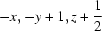 ; (ii) ; (ii)  ; (iii) ; (iii) 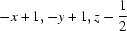 ; (iv) x, y, z-1; (v) ; (iv) x, y, z-1; (v) 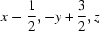 . .
| |
Data collection: CAD-4 EXPRESS (Enraf–Nonius, 1994![[Enraf-Nonius (1994). CAD-4 EXPRESS. Enraf-Nonius, Delft, The Netherlands.]](../../../../../../logos/arrows/e_arr.gif "Enraf-Nonius (1994). CAD-4 EXPRESS. Enraf-Nonius, Delft, The Netherlands.") ); cell refinement: CAD-4 EXPRESS; data reduction: XCAD4 (Harms & Wocadlo, 1996); program(s) used to solve structure: SHELXS97 (Sheldrick, 2008); program(s) used to refine structure: SHELXL97 (Sheldrick, 2008); molecular graphics: ORTEP-3 (Farrugia, 1997) and DIAMOND (Brandenburg & Putz, 2005); software used to prepare material for publication: WinGX (Farrugia, 1999).
); cell refinement: CAD-4 EXPRESS; data reduction: XCAD4 (Harms & Wocadlo, 1996); program(s) used to solve structure: SHELXS97 (Sheldrick, 2008); program(s) used to refine structure: SHELXL97 (Sheldrick, 2008); molecular graphics: ORTEP-3 (Farrugia, 1997) and DIAMOND (Brandenburg & Putz, 2005); software used to prepare material for publication: WinGX (Farrugia, 1999).
Supporting information
An aqueous solution containing 0.004 mol of H2C2O4 in 10 ml of water, was added to 0.004 mol of 2-amino-3-nitropyridine in 20 ml of pure acetic acid. The obtained yellow solution was stirred at 333 K for 10 min and then left to stand at room temperature. Yellow single crystals of the title compound were obtained after some days.
Data collection: CAD-4 EXPRESS (Enraf–Nonius, 1994); cell refinement: CAD-4 EXPRESS (Enraf–Nonius, 1994); data reduction: XCAD4 (Harms & Wocadlo, 1996); program(s) used to solve structure: SHELXS97 (Sheldrick, 2008); program(s) used to refine structure: SHELXL97 (Sheldrick, 2008); molecular graphics: ORTEP-3 (Farrugia, 1997) and DIAMOND (Brandenburg & Putz, 2005); software used to prepare material for publication: WinGX (Farrugia, 1999).
2-Amino-3-nitropyridinium hydrogen oxalate
top Crystal data top | C5H6N3O2+·C2HO4− | Dx = 1.636 Mg m−3 |
| Mr = 229.16 | Mo Kα radiation, λ = 0.71073 Å |
| Orthorhombic, Pna21 | Cell parameters from 25 reflections |
| a = 15.268 (4) Å | θ = 9–11° |
| b = 6.921 (3) Å | µ = 0.15 mm−1 |
| c = 8.807 (2) Å | T = 293 K |
| V = 930.6 (5) Å3 | Rectangular prism, yellow |
| Z = 4 | 0.33 × 0.25 × 0.21 mm |
| F(000) = 472 | |
Data collection top Enraf–Nonius Turbo CAD-4
diffractometer | Rint = 0.020 |
| Radiation source: Enraf–Nonius FR590 | θmax = 28.0°, θmin = 2.7° |
| Graphite monochromator | h = −20→0 |
| Nonprofiled ω scans | k = −7→9 |
| 2228 measured reflections | l = −11→0 |
| 1190 independent reflections | 2 standard reflections every 120 min |
| 1003 reflections with I > 2σ(I) | intensity decay: 1% |
Refinement top | Refinement on F2 | Secondary atom site location: difference Fourier map |
| Least-squares matrix: full | Hydrogen site location: inferred from neighbouring sites |
| R[F2 > 2σ(F2)] = 0.034 | H-atom parameters constrained |
| wR(F2) = 0.088 | w = 1/[σ2(Fo2) + (0.0559P)2 + 0.0295P]
where P = (Fo2 + 2Fc2)/3 |
| S = 1.06 | (Δ/σ)max = 0.001 |
| 1190 reflections | Δρmax = 0.33 e Å−3 |
| 147 parameters | Δρmin = −0.20 e Å−3 |
| 1 restraint | Extinction correction: SHELXL97 (Sheldrick, 2008), Fc*=kFc[1+0.001xFc2λ3/sin(2θ)]-1/4 |
| Primary atom site location: structure-invariant direct methods | Extinction coefficient: 0.053 (6) |
Crystal data top | C5H6N3O2+·C2HO4− | V = 930.6 (5) Å3 |
| Mr = 229.16 | Z = 4 |
| Orthorhombic, Pna21 | Mo Kα radiation |
| a = 15.268 (4) Å | µ = 0.15 mm−1 |
| b = 6.921 (3) Å | T = 293 K |
| c = 8.807 (2) Å | 0.33 × 0.25 × 0.21 mm |
Data collection top Enraf–Nonius Turbo CAD-4
diffractometer | Rint = 0.020 |
| 2228 measured reflections | 2 standard reflections every 120 min |
| 1190 independent reflections | intensity decay: 1% |
| 1003 reflections with I > 2σ(I) | |
Refinement top | R[F2 > 2σ(F2)] = 0.034 | 1 restraint |
| wR(F2) = 0.088 | H-atom parameters constrained |
| S = 1.06 | Δρmax = 0.33 e Å−3 |
| 1190 reflections | Δρmin = −0.20 e Å−3 |
| 147 parameters | |
Special details top Geometry. H atoms were treated as riding, with C—H = 0.93 A °, N—H = 0.86 A ° and O—H = 0.82 A °, and with Uiso(H) = 1.2Ueq(C,N) and 1.5Ueq(O). All e.s.d.'s (except the e.s.d. in the dihedral angle between two l.s. planes) are estimated using the full covariance matrix. The cell e.s.d.'s are taken into account individually in the estimation of e.s.d.'s in distances, angles and torsion angles; correlations between e.s.d.'s in cell parameters are only used when they are defined by crystal symmetry. An approximate (isotropic) treatment of cell e.s.d.'s is used for estimating e.s.d.'s involving l.s. planes. |
Refinement. Refinement of F2 against ALL reflections. The weighted R-factor wR and goodness of fit S are based on F2, conventional R-factors R are based on F, with F set to zero for negative F2. The threshold expression of F2 > σ(F2) is used only for calculating R-factors(gt) etc. and is not relevant to the choice of reflections for refinement. R-factors based on F2 are statistically about twice as large as those based on F, and R- factors based on ALL data will be even larger. |
Fractional atomic coordinates and isotropic or equivalent isotropic displacement parameters (Å2) top| | x | y | z | Uiso*/Ueq | |
| O1 | 0.18864 (12) | 0.6389 (3) | 0.4311 (2) | 0.0512 (5) | |
| O2 | 0.10055 (11) | 0.5552 (3) | 0.2423 (2) | 0.0408 (4) | |
| O3 | 0.05130 (11) | 0.5172 (3) | 0.6129 (2) | 0.0391 (4) | |
| H3 | 0.0051 | 0.5043 | 0.6593 | 0.059* | |
| O4 | −0.03139 (11) | 0.6833 (3) | 0.4481 (2) | 0.0494 (5) | |
| O5 | 0.49613 (12) | 0.5813 (3) | 0.1226 (3) | 0.0532 (5) | |
| O6 | 0.52023 (11) | 0.6750 (3) | −0.1071 (3) | 0.0545 (5) | |
| N1 | 0.23161 (12) | 0.5903 (3) | 0.0374 (3) | 0.0375 (5) | |
| H1 | 0.1920 | 0.5818 | 0.1065 | 0.045* | |
| N2 | 0.33259 (15) | 0.6060 (3) | 0.2291 (3) | 0.0462 (6) | |
| H2A | 0.2900 | 0.6012 | 0.2930 | 0.055* | |
| H2B | 0.3857 | 0.6133 | 0.2612 | 0.055* | |
| N3 | 0.47122 (12) | 0.6244 (3) | −0.0050 (3) | 0.0367 (5) | |
| C1 | 0.31649 (14) | 0.6020 (3) | 0.0827 (3) | 0.0321 (5) | |
| C2 | 0.37793 (14) | 0.6148 (3) | −0.0380 (3) | 0.0318 (5) | |
| C3 | 0.35201 (16) | 0.6188 (4) | −0.1871 (3) | 0.0363 (5) | |
| H3A | 0.3936 | 0.6300 | −0.2638 | 0.044* | |
| C4 | 0.26384 (17) | 0.6061 (4) | −0.2236 (3) | 0.0437 (6) | |
| H4 | 0.2452 | 0.6078 | −0.3241 | 0.052* | |
| C5 | 0.20572 (16) | 0.5911 (4) | −0.1078 (3) | 0.0421 (6) | |
| H5 | 0.1463 | 0.5811 | −0.1298 | 0.050* | |
| C6 | 0.11677 (14) | 0.5994 (3) | 0.3773 (3) | 0.0303 (5) | |
| C7 | 0.03636 (14) | 0.6065 (3) | 0.4838 (3) | 0.0302 (5) | |
Atomic displacement parameters (Å2) top| | U11 | U22 | U33 | U12 | U13 | U23 |
| O1 | 0.0315 (8) | 0.0930 (14) | 0.0292 (9) | −0.0146 (10) | −0.0004 (7) | −0.0040 (10) |
| O2 | 0.0286 (7) | 0.0684 (11) | 0.0254 (8) | −0.0040 (8) | 0.0007 (7) | −0.0037 (9) |
| O3 | 0.0300 (8) | 0.0618 (12) | 0.0256 (7) | 0.0005 (8) | 0.0063 (7) | 0.0065 (8) |
| O4 | 0.0346 (9) | 0.0660 (12) | 0.0475 (11) | 0.0110 (8) | 0.0040 (8) | 0.0115 (10) |
| O5 | 0.0342 (9) | 0.0727 (13) | 0.0528 (12) | 0.0094 (9) | −0.0082 (9) | 0.0076 (11) |
| O6 | 0.0330 (9) | 0.0779 (13) | 0.0526 (12) | −0.0118 (9) | 0.0125 (8) | −0.0050 (11) |
| N1 | 0.0243 (9) | 0.0522 (14) | 0.0361 (12) | −0.0015 (8) | 0.0039 (8) | −0.0004 (9) |
| N2 | 0.0317 (10) | 0.0773 (18) | 0.0296 (11) | −0.0022 (10) | 0.0002 (8) | 0.0046 (11) |
| N3 | 0.0259 (9) | 0.0401 (10) | 0.0440 (12) | 0.0007 (8) | 0.0035 (9) | −0.0039 (9) |
| C1 | 0.0271 (10) | 0.0372 (12) | 0.0319 (12) | −0.0008 (9) | 0.0024 (9) | 0.0020 (9) |
| C2 | 0.0252 (10) | 0.0356 (11) | 0.0347 (12) | 0.0013 (8) | 0.0024 (9) | −0.0014 (10) |
| C3 | 0.0352 (12) | 0.0427 (14) | 0.0311 (12) | 0.0002 (10) | 0.0057 (10) | −0.0004 (10) |
| C4 | 0.0407 (13) | 0.0592 (17) | 0.0311 (13) | 0.0026 (11) | −0.0038 (10) | −0.0018 (11) |
| C5 | 0.0271 (10) | 0.0585 (16) | 0.0406 (15) | 0.0020 (10) | −0.0049 (10) | −0.0044 (12) |
| C6 | 0.0279 (10) | 0.0391 (11) | 0.0240 (10) | −0.0029 (9) | 0.0015 (9) | 0.0033 (9) |
| C7 | 0.0263 (10) | 0.0382 (11) | 0.0261 (11) | −0.0040 (8) | −0.0003 (8) | −0.0026 (9) |
Geometric parameters (Å, º) top | O1—C6 | 1.226 (3) | N2—H2A | 0.8600 |
| O2—C6 | 1.252 (3) | N2—H2B | 0.8600 |
| O3—C7 | 1.314 (3) | N3—C2 | 1.455 (3) |
| O3—H3 | 0.8200 | C1—C2 | 1.420 (3) |
| O4—C7 | 1.205 (3) | C2—C3 | 1.372 (3) |
| O5—N3 | 1.223 (3) | C3—C4 | 1.387 (3) |
| O6—N3 | 1.221 (3) | C3—H3A | 0.9300 |
| N1—C5 | 1.338 (4) | C4—C5 | 1.356 (4) |
| N1—C1 | 1.358 (3) | C4—H4 | 0.9300 |
| N1—H1 | 0.8600 | C5—H5 | 0.9300 |
| N2—C1 | 1.313 (3) | C6—C7 | 1.545 (3) |
| | | |
| C7—O3—H3 | 109.5 | C2—C3—C4 | 120.0 (2) |
| C5—N1—C1 | 124.2 (2) | C2—C3—H3A | 120.0 |
| C5—N1—H1 | 117.9 | C4—C3—H3A | 120.0 |
| C1—N1—H1 | 117.9 | C5—C4—C3 | 117.8 (2) |
| C1—N2—H2A | 120.0 | C5—C4—H4 | 121.1 |
| C1—N2—H2B | 120.0 | C3—C4—H4 | 121.1 |
| H2A—N2—H2B | 120.0 | N1—C5—C4 | 121.7 (2) |
| O6—N3—O5 | 123.8 (2) | N1—C5—H5 | 119.1 |
| O6—N3—C2 | 117.8 (2) | C4—C5—H5 | 119.1 |
| O5—N3—C2 | 118.5 (2) | O1—C6—O2 | 126.8 (2) |
| N2—C1—N1 | 117.9 (2) | O1—C6—C7 | 118.0 (2) |
| N2—C1—C2 | 127.6 (2) | O2—C6—C7 | 115.25 (19) |
| N1—C1—C2 | 114.5 (2) | O4—C7—O3 | 125.6 (2) |
| C3—C2—C1 | 121.8 (2) | O4—C7—C6 | 122.5 (2) |
| C3—C2—N3 | 118.2 (2) | O3—C7—C6 | 111.85 (19) |
| C1—C2—N3 | 120.0 (2) | | |
| | | |
| C5—N1—C1—N2 | 177.8 (3) | C1—C2—C3—C4 | −1.3 (4) |
| C5—N1—C1—C2 | −0.2 (4) | N3—C2—C3—C4 | 178.7 (2) |
| N2—C1—C2—C3 | −176.6 (3) | C2—C3—C4—C5 | 0.4 (4) |
| N1—C1—C2—C3 | 1.2 (3) | C1—N1—C5—C4 | −0.7 (5) |
| N2—C1—C2—N3 | 3.3 (4) | C3—C4—C5—N1 | 0.6 (4) |
| N1—C1—C2—N3 | −178.8 (2) | O1—C6—C7—O4 | 134.2 (3) |
| O6—N3—C2—C3 | 14.8 (3) | O2—C6—C7—O4 | −45.0 (3) |
| O5—N3—C2—C3 | −165.1 (2) | O1—C6—C7—O3 | −46.9 (3) |
| O6—N3—C2—C1 | −165.2 (2) | O2—C6—C7—O3 | 133.9 (2) |
| O5—N3—C2—C1 | 15.0 (3) | | |
Hydrogen-bond geometry (Å, º) top | D—H···A | D—H | H···A | D···A | D—H···A |
| O3—H3···O2i | 0.82 | 1.82 | 2.632 (2) | 171 |
| N1—H1···O2 | 0.86 | 1.85 | 2.706 (3) | 175 |
| N2—H2A···O1 | 0.86 | 1.99 | 2.837 (3) | 170 |
| N2—H2B···O5 | 0.86 | 2.09 | 2.673 (3) | 124 |
| N2—H2B···O4ii | 0.86 | 2.51 | 3.188 (3) | 136 |
| C3—H3A···O5iii | 0.93 | 2.44 | 3.178 (3) | 136 |
| C4—H4···O1iv | 0.93 | 2.33 | 3.258 (3) | 174 |
| C5—H5···O6v | 0.93 | 2.57 | 3.262 (3) | 132 |
| Symmetry codes: (i) −x, −y+1, z+1/2; (ii) x+1/2, −y+3/2, z; (iii) −x+1, −y+1, z−1/2; (iv) x, y, z−1; (v) x−1/2, −y+3/2, z. |
Experimental details
| Crystal data |
| Chemical formula | C5H6N3O2+·C2HO4− |
| Mr | 229.16 |
| Crystal system, space group | Orthorhombic, Pna21 |
| Temperature (K) | 293 |
| a, b, c (Å) | 15.268 (4), 6.921 (3), 8.807 (2) |
| V (Å3) | 930.6 (5) |
| Z | 4 |
| Radiation type | Mo Kα |
| µ (mm−1) | 0.15 |
| Crystal size (mm) | 0.33 × 0.25 × 0.21 |
| |
| Data collection |
| Diffractometer | Enraf–Nonius Turbo CAD-4
diffractometer |
| Absorption correction | – |
No. of measured, independent and
observed [I > 2σ(I)] reflections | 2228, 1190, 1003 |
| Rint | 0.020 |
| (sin θ/λ)max (Å−1) | 0.659 |
| |
| Refinement |
| R[F2 > 2σ(F2)], wR(F2), S | 0.034, 0.088, 1.06 |
| No. of reflections | 1190 |
| No. of parameters | 147 |
| No. of restraints | 1 |
| H-atom treatment | H-atom parameters constrained |
| Δρmax, Δρmin (e Å−3) | 0.33, −0.20 |
Hydrogen-bond geometry (Å, º) top | D—H···A | D—H | H···A | D···A | D—H···A |
| O3—H3···O2i | 0.82 | 1.82 | 2.632 (2) | 171.2 |
| N1—H1···O2 | 0.86 | 1.85 | 2.706 (3) | 175.1 |
| N2—H2A···O1 | 0.86 | 1.99 | 2.837 (3) | 169.9 |
| N2—H2B···O5 | 0.86 | 2.09 | 2.673 (3) | 124.2 |
| N2—H2B···O4ii | 0.86 | 2.51 | 3.188 (3) | 136.4 |
| C3—H3A···O5iii | 0.93 | 2.44 | 3.178 (3) | 135.9 |
| C4—H4···O1iv | 0.93 | 2.33 | 3.258 (3) | 173.9 |
| C5—H5···O6v | 0.93 | 2.57 | 3.262 (3) | 131.8 |
| Symmetry codes: (i) −x, −y+1, z+1/2; (ii) x+1/2, −y+3/2, z; (iii) −x+1, −y+1, z−1/2; (iv) x, y, z−1; (v) x−1/2, −y+3/2, z. |
References
 Akriche, S. & Rzaigui, M. (2000). Z. Kristallogr. New Cryst. Struct. 215, 617–618. CAS Google Scholar
Akriche, S. & Rzaigui, M. (2009). Acta Cryst. E65, m123. Web of Science CSD CrossRef IUCr Journals Google Scholar
Brandenburg, K. & Putz, H. (2005). DIAMOND. Crystal Impact GbR, Bonn, Germany. Google Scholar
Desiraju, G. R. (1989). Crystal Engineering: The Design of Organic Solids, Vol. 54. New York: Elsevier. Google Scholar
Desiraju, G. R. (1995). Angew. Chem. Int. Ed. Engl. 34, 2311–2321. CrossRef CAS Web of Science Google Scholar
Enraf–Nonius (1994). CAD-4 EXPRESS. Enraf–Nonius, Delft, The Netherlands. Google Scholar
Farrugia, L. J. (1997). J. Appl. Cryst. 30, 565. CrossRef IUCr Journals Google Scholar
Farrugia, L. J. (1999). J. Appl. Cryst. 32, 837–838. CrossRef CAS IUCr Journals Google Scholar
Harms, K. & Wocadlo, S. (1996). XCAD4. University of Marburg, Germany. Google Scholar
Le Fur, Y., Masse, R. & Nicoud, J. F. (1998). New J. Chem. pp. 159–163. Web of Science CSD CrossRef CAS Google Scholar
Nicoud, J. F., Masse, R., Bourgogne, C. & Evans, C. (1997). J. Mater. Chem. 7, 35–39. CSD CrossRef CAS Web of Science Google Scholar
Sheldrick, G. M. (2008). Acta Cryst. A64, 112–122. Web of Science CrossRef CAS IUCr Journals Google Scholar
This is an open-access article distributed under the terms of the Creative Commons Attribution (CC-BY) Licence, which permits unrestricted use, distribution, and reproduction in any medium, provided the original authors and source are cited.
 | CRYSTALLOGRAPHIC
COMMUNICATIONS |
ISSN: 2056-9890
Open

access


 journal menu



![[Scheme 1]](kj2116scheme1.gif)
![[Figure 1]](./kj2116fig1thm.gif)
![[Figure 2]](./kj2116fig2thm.gif)


The search for new molecular materials for the non-linear optics lies at the basis of our ongoing study of 2-amino-3-nitropyridinium salts. Our strategy is aimed at the production of very cohesive non-centrosymmetric packing of chromophores. We have previously reported two centrosymetric structures of 2-amino-3-nitropyridinium (Akriche & Rzaigui, 2000; Akriche & Rzaigui, 2009). We report here a new non-centrosymmetric structure, 2-amino-3-nitropyridinium hydrogenoxalate.
The asymmetric unit of the title compound consists of one (HC2O4)- anion and one (2-NH2-3-NO2C5H3NH)+ cation (Fig. 1). In the hydrogenoxalate (HC2O4)-, the H atom is located at O3 as is also indicated by elongation of the corresponding C—O distance [O3—C7 is 1.314 (3) Å]. The bond length of C6—C7 is relatively long [1.545 (3) Å] as expected for an oxalate anion. In the 2-amino-3-nitropyridinium cation, nitro and amino groups are ortho to one another, which explains the presence of the intra-cation contact N2—H2B···O5 (Le Fur et al., 1998; Nicoud et al.,1997).
The structure projection in Fig. 2 shows that the oxalate ions are organized in corrugated chains extending along the c axis. The cations are located between these chains and manifest multiple H-bonds. In fact, in this structure there are three categories of H-bond (Table 1), O—H···O, N—H···O and C—H···O. Within each oxalate chain, the (HC2O4)- groups are interconnected by strong O—H···O hydrogen bonds. These chains are themselves interconnected by N—H···O interactions originating from the NH+ and NH2 groups of the cations. It is worth noticing the presence of long C—H···O contacts (Desiraju, 1989; Desiraju, 1995) occurring between cations and between cations and anions. The density of this H-bond scheme constitutes probably the main factor responsible for the formation of a non-centrosymetric material.