 | Acta Crystallographica Section E Acta Crystallographica Section E CRYSTALLOGRAPHIC COMMUNICATIONS |


 journal menu


organic compounds
| CRYSTALLOGRAPHIC COMMUNICATIONS |
 access
Hydroxonium 1-ammonioethane-1,1-diyldiphosphonate

aDepartment of Chemical Engineering, Wuhan University of Science and Engineering, Wuhan 430073, People's Republic of China
*Correspondence e-mail: [email protected]
The title complex, H3O+·NH3C(CH3)(PO3H)2−, contains a hydroxonium ion and an NH3C(CH3)(PO3H)2− anion. The three H atoms of H3O+ form a pseudo-tetrahedron by being distributed over four positions with occupation factors of 0.75. Multiple N—H⋯O and O—H⋯O hydrogen bonds in the form an intricate three-dimensional supramolecular network.
Related literature
For the structures of organophosphonates, see: Clearfield (2002![[Clearfield, A. (2002). Recent Opin. Solid Mater. Sci. 6, 495-506.]](../../../../../../logos/arrows/e_arr.gif "Clearfield, A. (2002). Recent Opin. Solid Mater. Sci. 6, 495-506.") ); Finn et al. (2003). For similar bisphosphonates, see: Fernández et al. (2003); For complexes with 1-aminoethylidene-1,1-diphosphonic acid, see: Yin et al. (2005); Ding et al. (2006); Li et al. (2008). For the synthesis, see: Chai et al. (1980).
); Finn et al. (2003). For similar bisphosphonates, see: Fernández et al. (2003); For complexes with 1-aminoethylidene-1,1-diphosphonic acid, see: Yin et al. (2005); Ding et al. (2006); Li et al. (2008). For the synthesis, see: Chai et al. (1980).
![[Scheme 1]](rn2053scheme1.gif)
Experimental
Crystal data
|
Refinement
|
|
 ; (ii)
  ; (vi)
  ; (vii)
 Data collection: SMART (Bruker, 2001); cell refinement: SAINT (Bruker, 2001); data reduction: SAINT; program(s) used to solve structure: SHELXS97 (Sheldrick, 2008b); program(s) used to refine structure: SHELXL97 (Sheldrick, 2008b); molecular graphics: ORTEP-3 for Windows (Farrugia, 1997) and PLATON (Spek, 2009); software used to prepare material for publication: SHELXL97.
Supporting information
contains datablocks I, global. DOI: 10.1107/S1600536809008770/rn2053sup1.cif
Structure factors: contains datablock I. DOI: 10.1107/S1600536809008770/rn2053Isup2.hkl
The AEDPH4 was synthesized according to the US Patent 4239695 (Chai et al., 1980). It was crystallized directly from the AEDPH4 aqueous solution. When the mixture was heated for 24h, colorless crystals were obtained.
All H atoms attached to C and N atoms were fixed geometrically and treated as riding with C—H = 0.96 Å (C), N—H = 0.89Å with Uiso(H) = 1.5Ueq(C,N). The H atoms of hydroxyl were located in difference Fourier maps and included in the subsequent refinement.
The three hydrogen atoms of the H3O+ cation are statistically distributed over four positions with occupation factor of 0.75, building a pseudo tetrahedron.
Data collection: SMART (Bruker, 2001); cell SAINT (Bruker, 2001); data reduction: SAINT (Bruker, 2001); program(s) used to solve structure: SHELXS97 (Sheldrick, 2008b); program(s) used to refine structure: SHELXL97 (Sheldrick, 2008b); molecular graphics: ORTEP-3 for Windows (Farrugia, 1997) and PLATON (Spek, 2009); software used to prepare material for publication: SHELXL97 (Sheldrick, 2008b).
![[Figure 1]](./rn2053fig1thm.gif) | Fig. 1. The asymmetric unit of (I) with the atom-labelling scheme. Displacement ellipsoids are drawn at the 30% probability level. |
![[Figure 2]](./rn2053fig2thm.gif) | Fig. 2. Partial packing view of compound ( I ), showing the formation of the three dimensional network built from hydrogen bonds. For the sake of clarity, H atoms not involved in hydrogen bonding have been omitted. |
| H3O+·C2H8N2O6P2− | F(000) = 464 |
| Mr = 223.06 | Dx = 1.802 Mg m−3 |
| Monoclinic, P21/c | Mo Kα radiation, λ = 0.71073 Å |
| Hall symbol: -P 2ybc | Cell parameters from 3640 reflections |
| a = 7.3372 (6) Å | θ = 2.7–29.8° |
| b = 10.6553 (8) Å | µ = 0.53 mm−1 |
| c = 10.6128 (8) Å | T = 293 K |
| β = 97.705 (1)° | Plate, colorless |
| V = 822.22 (11) Å3 | 0.36 × 0.27 × 0.18 mm |
| Z = 4 |
| Bruker SMART 4K CCD area-detector diffractometer | 1837 reflections with I > 2σ(I) |
| Graphite monochromator | Rint = 0.015 |
| ϕ and ω scans | θmax = 28.0°, θmin = 2.7° |
| Absorption correction: multi-scan (SADABS; Sheldrick, 2008a) | h = −9→9 |
| Tmin = 0.831, Tmax = 0.910 | k = −9→14 |
| 5340 measured reflections | l = −13→11 |
| 1972 independent reflections |
| Refinement on F2 | Secondary atom site location: difference Fourier map |
| Least-squares matrix: full | Hydrogen site location: inferred from neighbouring sites |
| R[F2 > 2σ(F2)] = 0.032 | H atoms treated by a mixture of independent and constrained refinement |
| wR(F2) = 0.097 | w = 1/[σ2(Fo2) + (0.0481P)2 + 0.8715P] where P = (Fo2 + 2Fc2)/3 |
| S = 1.10 | (Δ/σ)max = 0.001 |
| 1972 reflections | Δρmax = 0.40 e Å−3 |
| 136 parameters | Δρmin = −0.61 e Å−3 |
| 4 restraints | Extinction correction: SHELXL97 (Sheldrick, 2008), Fc*=kFc[1+0.001xFc2λ3/sin(2θ)]-1/4 |
| Primary atom site location: structure-invariant direct methods | Extinction coefficient: 0.023 (2) |
| H3O+·C2H8N2O6P2− | V = 822.22 (11) Å3 |
| Mr = 223.06 | Z = 4 |
| Monoclinic, P21/c | Mo Kα radiation |
| a = 7.3372 (6) Å | µ = 0.53 mm−1 |
| b = 10.6553 (8) Å | T = 293 K |
| c = 10.6128 (8) Å | 0.36 × 0.27 × 0.18 mm |
| β = 97.705 (1)° |
| Bruker SMART 4K CCD area-detector diffractometer | 1972 independent reflections |
| Absorption correction: multi-scan (SADABS; Sheldrick, 2008a) | 1837 reflections with I > 2σ(I) |
| Tmin = 0.831, Tmax = 0.910 | Rint = 0.015 |
| 5340 measured reflections |
| R[F2 > 2σ(F2)] = 0.032 | 4 restraints |
| wR(F2) = 0.097 | H atoms treated by a mixture of independent and constrained refinement |
| S = 1.10 | Δρmax = 0.40 e Å−3 |
| 1972 reflections | Δρmin = −0.61 e Å−3 |
| 136 parameters |
Geometry. All esds (except the esd in the dihedral angle between two l.s. planes) are estimated using the full covariance matrix. The cell esds are taken into account individually in the estimation of esds in distances, angles and torsion angles; correlations between esds in cell parameters are only used when they are defined by crystal symmetry. An approximate (isotropic) treatment of cell esds is used for estimating esds involving l.s. planes. |
| x | y | z | Uiso*/Ueq | Occ. (<1) | |
| C1 | 0.9948 (2) | 0.56114 (16) | 0.24265 (16) | 0.0131 (3) | |
| C2 | 0.9672 (3) | 0.62357 (19) | 0.36861 (18) | 0.0209 (4) | |
| H2A | 1.0741 | 0.6722 | 0.3993 | 0.031* | |
| H2B | 0.9488 | 0.5602 | 0.4299 | 0.031* | |
| H2C | 0.8615 | 0.6774 | 0.3556 | 0.031* | |
| N1 | 1.0165 (2) | 0.66564 (14) | 0.14939 (14) | 0.0152 (3) | |
| H1A | 0.9151 | 0.7124 | 0.1391 | 0.023* | |
| H1B | 1.0347 | 0.6329 | 0.0750 | 0.023* | |
| H1C | 1.1124 | 0.7131 | 0.1792 | 0.023* | |
| O1W | 0.4462 (2) | 0.70203 (18) | 0.52441 (17) | 0.0363 (4) | |
| O1 | 0.63612 (19) | 0.57626 (13) | 0.17124 (14) | 0.0209 (3) | |
| O2 | 0.75556 (18) | 0.37252 (13) | 0.27913 (13) | 0.0208 (3) | |
| O3 | 0.80235 (18) | 0.42568 (13) | 0.05066 (12) | 0.0208 (3) | |
| O4 | 1.23166 (19) | 0.41015 (14) | 0.13108 (14) | 0.0209 (3) | |
| O5 | 1.20389 (18) | 0.37077 (13) | 0.35944 (13) | 0.0204 (3) | |
| O6 | 1.36080 (17) | 0.56986 (13) | 0.29441 (13) | 0.0199 (3) | |
| P1 | 0.78594 (6) | 0.47061 (4) | 0.18354 (4) | 0.01339 (15) | |
| P2 | 1.21301 (6) | 0.47175 (4) | 0.26319 (4) | 0.01358 (15) | |
| H3 | 1.227 (5) | 0.456 (3) | 0.079 (3) | 0.051 (10)* | |
| H4 | 0.562 (5) | 0.568 (3) | 0.208 (3) | 0.049 (10)* | |
| H5 | 0.5658 (17) | 0.698 (3) | 0.554 (3) | 0.018 (7)* | 0.75 |
| H6 | 0.386 (4) | 0.673 (3) | 0.587 (2) | 0.018 (7)* | 0.75 |
| H7 | 0.426 (4) | 0.663 (2) | 0.4485 (15) | 0.013 (7)* | 0.75 |
| H8 | 0.422 (5) | 0.7827 (13) | 0.509 (4) | 0.038 (10)* | 0.75 |
| U11 | U22 | U33 | U12 | U13 | U23 | |
| C1 | 0.0145 (7) | 0.0114 (7) | 0.0138 (7) | −0.0006 (6) | 0.0032 (6) | 0.0007 (6) |
| C2 | 0.0254 (9) | 0.0214 (9) | 0.0164 (8) | 0.0030 (7) | 0.0042 (7) | −0.0040 (7) |
| N1 | 0.0165 (7) | 0.0123 (7) | 0.0173 (7) | −0.0002 (5) | 0.0040 (5) | 0.0017 (5) |
| O1W | 0.0356 (9) | 0.0393 (10) | 0.0331 (9) | 0.0008 (8) | 0.0010 (7) | −0.0001 (7) |
| O1 | 0.0155 (6) | 0.0200 (7) | 0.0283 (7) | 0.0043 (5) | 0.0073 (5) | 0.0065 (5) |
| O2 | 0.0210 (6) | 0.0164 (6) | 0.0261 (7) | 0.0001 (5) | 0.0068 (5) | 0.0073 (5) |
| O3 | 0.0217 (6) | 0.0236 (7) | 0.0169 (6) | −0.0005 (5) | 0.0022 (5) | −0.0037 (5) |
| O4 | 0.0248 (7) | 0.0184 (7) | 0.0201 (7) | 0.0019 (5) | 0.0051 (5) | −0.0036 (5) |
| O5 | 0.0191 (6) | 0.0189 (6) | 0.0227 (7) | 0.0010 (5) | 0.0005 (5) | 0.0066 (5) |
| O6 | 0.0148 (6) | 0.0193 (6) | 0.0259 (7) | −0.0038 (5) | 0.0037 (5) | −0.0049 (5) |
| P1 | 0.0127 (2) | 0.0124 (2) | 0.0152 (2) | −0.00029 (15) | 0.00251 (16) | 0.00126 (15) |
| P2 | 0.0123 (2) | 0.0125 (2) | 0.0158 (2) | 0.00017 (15) | 0.00167 (16) | 0.00006 (15) |
| C1—N1 | 1.512 (2) | O1W—H6 | 0.896 (10) |
| C1—C2 | 1.531 (2) | O1W—H7 | 0.900 (10) |
| C1—P1 | 1.8479 (17) | O1W—H8 | 0.888 (10) |
| C1—P2 | 1.8505 (17) | O1—P1 | 1.5666 (14) |
| C2—H2A | 0.9600 | O1—H4 | 0.71 (3) |
| C2—H2B | 0.9600 | O2—P1 | 1.4940 (13) |
| C2—H2C | 0.9600 | O3—P1 | 1.5093 (13) |
| N1—H1A | 0.8900 | O4—P2 | 1.5706 (14) |
| N1—H1B | 0.8900 | O4—H3 | 0.73 (4) |
| N1—H1C | 0.8900 | O5—P2 | 1.4914 (13) |
| O1W—H5 | 0.893 (10) | O6—P2 | 1.5106 (13) |
| N1—C1—C2 | 106.82 (14) | H5—O1W—H7 | 109 (3) |
| N1—C1—P1 | 108.51 (11) | H6—O1W—H7 | 118 (3) |
| C2—C1—P1 | 108.82 (12) | H5—O1W—H8 | 106 (3) |
| N1—C1—P2 | 106.91 (11) | H6—O1W—H8 | 111 (3) |
| C2—C1—P2 | 109.54 (12) | H7—O1W—H8 | 106 (3) |
| P1—C1—P2 | 115.87 (9) | P1—O1—H4 | 116 (3) |
| C1—C2—H2A | 109.5 | P2—O4—H3 | 113 (3) |
| C1—C2—H2B | 109.5 | O2—P1—O3 | 116.77 (8) |
| H2A—C2—H2B | 109.5 | O2—P1—O1 | 113.10 (8) |
| C1—C2—H2C | 109.5 | O3—P1—O1 | 107.04 (8) |
| H2A—C2—H2C | 109.5 | O2—P1—C1 | 109.10 (8) |
| H2B—C2—H2C | 109.5 | O3—P1—C1 | 108.44 (8) |
| C1—N1—H1A | 109.5 | O1—P1—C1 | 101.18 (8) |
| C1—N1—H1B | 109.5 | O5—P2—O6 | 116.47 (8) |
| H1A—N1—H1B | 109.5 | O5—P2—O4 | 109.10 (8) |
| C1—N1—H1C | 109.5 | O6—P2—O4 | 109.82 (8) |
| H1A—N1—H1C | 109.5 | O5—P2—C1 | 109.54 (8) |
| H1B—N1—H1C | 109.5 | O6—P2—C1 | 104.71 (8) |
| H5—O1W—H6 | 107 (3) | O4—P2—C1 | 106.71 (8) |
| N1—C1—P1—O2 | −176.13 (11) | N1—C1—P2—O5 | 177.18 (11) |
| C2—C1—P1—O2 | −60.25 (14) | C2—C1—P2—O5 | 61.79 (14) |
| P2—C1—P1—O2 | 63.66 (11) | P1—C1—P2—O5 | −61.75 (11) |
| N1—C1—P1—O3 | 55.70 (13) | N1—C1—P2—O6 | 51.57 (12) |
| C2—C1—P1—O3 | 171.58 (12) | C2—C1—P2—O6 | −63.82 (13) |
| P2—C1—P1—O3 | −64.51 (11) | P1—C1—P2—O6 | 172.64 (9) |
| N1—C1—P1—O1 | −56.68 (12) | N1—C1—P2—O4 | −64.85 (12) |
| C2—C1—P1—O1 | 59.20 (13) | C2—C1—P2—O4 | 179.76 (12) |
| P2—C1—P1—O1 | −176.89 (9) | P1—C1—P2—O4 | 56.22 (11) |
| D—H···A | D—H | H···A | D···A | D—H···A |
| N1—H1C···O2i | 0.89 | 1.98 | 2.809 (2) | 155 |
| N1—H1A···O5i | 0.89 | 1.90 | 2.713 (2) | 151 |
| N1—H1B···O3ii | 0.89 | 2.01 | 2.824 (2) | 152 |
| O4—H3···O3ii | 0.73 (4) | 1.86 (4) | 2.591 (2) | 176 (4) |
| O1—H4···O6iii | 0.71 (3) | 1.84 (3) | 2.550 (2) | 172 (4) |
| O1W—H5···O5iv | 0.89 (1) | 1.95 (2) | 2.804 (2) | 159 (3) |
| O1W—H8···O1v | 0.89 (1) | 2.64 (4) | 3.061 (2) | 110 (3) |
| O1W—H8···O3vi | 0.89 (1) | 2.27 (2) | 3.041 (2) | 145 (3) |
| O1W—H6···O2vii | 0.90 (1) | 1.94 (1) | 2.828 (2) | 175 (3) |
| O1W—H7···O6iii | 0.90 (1) | 1.92 (1) | 2.815 (2) | 173 (3) |
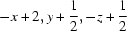
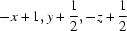
| Symmetry codes: (i) −x+2, y+1/2, −z+1/2; (ii) −x+2, −y+1, −z; (iii) x−1, y, z; (iv) −x+2, −y+1, −z+1; (v) x, −y+3/2, z+1/2; (vi) −x+1, y+1/2, −z+1/2; (vii) −x+1, −y+1, −z+1. |
Experimental details
| Crystal data | |
| Chemical formula | H3O+·C2H8N2O6P2− |
| Mr | 223.06 |
| Crystal system, space group | Monoclinic, P21/c |
| Temperature (K) | 293 |
| a, b, c (Å) | 7.3372 (6), 10.6553 (8), 10.6128 (8) |
| β (°) | 97.705 (1) |
| V (Å3) | 822.22 (11) |
| Z | 4 |
| Radiation type | Mo Kα |
| µ (mm−1) | 0.53 |
| Crystal size (mm) | 0.36 × 0.27 × 0.18 |
| Data collection | |
| Diffractometer | Bruker SMART 4K CCD area-detector diffractometer |
| Absorption correction | Multi-scan (SADABS; Sheldrick, 2008a) |
| Tmin, Tmax | 0.831, 0.910 |
| No. of measured, independent and observed [I > 2σ(I)] reflections | 5340, 1972, 1837 |
| Rint | 0.015 |
| (sin θ/λ)max (Å−1) | 0.661 |
| Refinement | |
| R[F2 > 2σ(F2)], wR(F2), S | 0.032, 0.097, 1.10 |
| No. of reflections | 1972 |
| No. of parameters | 136 |
| No. of restraints | 4 |
| H-atom treatment | H atoms treated by a mixture of independent and constrained refinement |
| Δρmax, Δρmin (e Å−3) | 0.40, −0.61 |
Computer programs: SMART (Bruker, 2001), SAINT (Bruker, 2001), SHELXS97 (Sheldrick, 2008b), SHELXL97 (Sheldrick, 2008b), ORTEP-3 for Windows (Farrugia, 1997) and PLATON (Spek, 2009).
| D—H···A | D—H | H···A | D···A | D—H···A |
| N1—H1C···O2i | 0.89 | 1.98 | 2.809 (2) | 155.4 |
| N1—H1A···O5i | 0.89 | 1.90 | 2.713 (2) | 150.9 |
| N1—H1B···O3ii | 0.89 | 2.01 | 2.824 (2) | 152.4 |
| O4—H3···O3ii | 0.73 (4) | 1.86 (4) | 2.591 (2) | 176 (4) |
| O1—H4···O6iii | 0.71 (3) | 1.84 (3) | 2.550 (2) | 172 (4) |
| O1W—H5···O5iv | 0.893 (10) | 1.954 (15) | 2.804 (2) | 159 (3) |
| O1W—H8···O1v | 0.888 (10) | 2.64 (4) | 3.061 (2) | 110 (3) |
| O1W—H8···O3vi | 0.888 (10) | 2.27 (2) | 3.041 (2) | 145 (3) |
| O1W—H6···O2vii | 0.896 (10) | 1.935 (11) | 2.828 (2) | 175 (3) |
| O1W—H7···O6iii | 0.900 (10) | 1.920 (11) | 2.815 (2) | 173 (3) |
| Symmetry codes: (i) −x+2, y+1/2, −z+1/2; (ii) −x+2, −y+1, −z; (iii) x−1, y, z; (iv) −x+2, −y+1, −z+1; (v) x, −y+3/2, z+1/2; (vi) −x+1, y+1/2, −z+1/2; (vii) −x+1, −y+1, −z+1. |
Acknowledgements
This work was supported financially by the Foundation of Education Department of Hubei Province (No. Q20081705).
References
 Bruker (2001). SMART and SAINT. Bruker AXS Inc., Madison, Wisconsin, USA. Google Scholar
Chai, B. J., Covina, W. & Muggee, F. D. (1980). US Patent No. 4 239 695. Google Scholar
Clearfield, A. (2002). Recent Opin. Solid Mater. Sci. 6, 495–506. Web of Science CrossRef CAS Google Scholar
Ding, D., Yin, M., Lu, H., Fan, Y., Hou, H. & Wang, Y. (2006). J. Solid State Chem. 179, 747–752. Web of Science CSD CrossRef CAS Google Scholar
Farrugia, L. J. (1997). J. Appl. Cryst. 30, 565. CrossRef IUCr Journals Google Scholar
Fernández, D., Vega, D. & Ellena, J. A. (2003). Acta Cryst. C59, o289–o292. Web of Science CSD CrossRef IUCr Journals Google Scholar
Finn, R. C., Zubieta, J. & Haushalter, R. C. (2003). Prog. Inorg. Chem. 51, 421–601. CAS Google Scholar
Li, M., Xiang, J. F., Chen, S. P., Wu, S. M., Yuan, L. J., Li, H., He, H. J. & Sun, J. T. (2008). J. Coord. Chem. 61(3), 372–383. Web of Science CSD CrossRef Google Scholar
Sheldrick, G. M. (2008a). SADABS. University of Göttingen, Germany. Google Scholar
Sheldrick, G. M. (2008b). Acta Cryst. A64, 112–122. Web of Science CrossRef CAS IUCr Journals Google Scholar
Spek, A. L. (2009). Acta Cryst. D65, 148–155. Web of Science CrossRef CAS IUCr Journals Google Scholar
Yin, P., Wang, X. C., Gao, S. & Zheng, L. M. (2005). J. Solid State Chem. 178, 1049–1053. Web of Science CSD CrossRef CAS Google Scholar
This is an open-access article distributed under the terms of the Creative Commons Attribution (CC-BY) Licence, which permits unrestricted use, distribution, and reproduction in any medium, provided the original authors and source are cited.
| CRYSTALLOGRAPHIC COMMUNICATIONS |


Organophosphonic acids and their compounds have attracted tremendous interest. A series of phosphonate hybrid materials have been prepared and show potential applications in catalysts, sensors, sorbents, magnetic and luminescent materials. Such materials also illustrate a variety of structures from one-dimensional chains, two-dimensional layers to three-dimensional porous frameworks. (Finn et al., 2003). Introduction of some functional groups to phosphonic acids, such as crown ether, –COOH, –OH, –NR2 or mixed groups will modify their complexing ability and construct a great number of novel phosphonates (Clearfield, 2002). Compared with other phosphonic acids, 1-aminoethylidene-1,1-diphosphonic acid (AEDPH4) is easier to synthesize. However, little attention has been paid to the structural study of metal-AEDP compounds (Yin et al., 2005; Ding et al., 2006). In our recent paper, it is found that AEDPH4 is inclined to transfer one proton to the amino group, which is in agreement with Fernández's results on similar bisphosphonates. (Li et al., 2008; Fernández et al., 2003). Deprotonation of it will result in predictable hydrogen aggregates from stronger P—O—H···O—P to weaker C—H···O hydrogen bonds. Herein, we report its structure, (I).
The asymmetric unit of (I)is built up from one deprotonated AEDPH3 anion and a disordered H3O+ cation, which are linked through four types of Ow-H···O hydrogen bonds (Fig. 1, Table 1). Two of the four protons of phosphonates are used in protonation, one for the amino group, the other for the H3O+ cation. The combination of different hydrogen bond interactions, N-H···O and O-H···O results in the formation of an intricate three dimensional supramolecular network (Fig.2, Table 1).