 | Acta Crystallographica Section E Acta Crystallographica Section E CRYSTALLOGRAPHIC COMMUNICATIONS |


 journal menu


metal-organic compounds
| CRYSTALLOGRAPHIC COMMUNICATIONS |
 access
Poly[bis(methanol-κO)tris(μ-pyrimidine-κ2N:N′)tetrakis(thiocyanato-κN)dinickel(II)]

aInstitut für Anorganische Chemie, Christian-Albrechts-Universität Kiel, Max-Eyth-Strasse 2, D-24118 Kiel, Germany
*Correspondence e-mail: [email protected]
In the of the title compound, [Ni2(NCS)4(C4H4N2)3(CH3OH)2]n, each nickel(II) cation is coordinated by three N-bonded pyrimidine ligands, two N-bonded thiocyanate anions and one O-bonded methanol molecule in a distorted octahedral environment. The asymmetric unit consists of one nickel cation, two thiocyanate anions and one methanol molecule in general positions, as well as one pyrimidine ligand located around a twofold rotation axis. The crystal structure consists of μ-N:N′ pyrimidine-bridged zigzag-like nickel thiocyanate chains; these are further linked by μ-N:N-bridging pyrimidine ligands into layers which are stacked perpendicular to the b axis. The layers are connected via weak O—H⋯S hydrogen bonding.
Related literature
For related pyrimidine structures, see: Lloret et al. (1998![[Lloret, F., Munno, G. D., Julve, M., Cano, J., Ruiz, R. & Caneschi, A. (1998). Angew. Chem. Int. Ed. Engl. 37, 135-138.]](../../../../../../logos/arrows/e_arr.gif "Lloret, F., Munno, G. D., Julve, M., Cano, J., Ruiz, R. & Caneschi, A. (1998). Angew. Chem. Int. Ed. Engl. 37, 135-138.") ); Näther et al. (2007); Näther & Greve (2003). For general background, see: Wriedt et al. (2008) and literature cited therein.
); Näther et al. (2007); Näther & Greve (2003). For general background, see: Wriedt et al. (2008) and literature cited therein.
![[Scheme 1]](si2156scheme1.gif)
Experimental
Crystal data
|
| ||||||||||||||||
 .
.
| |||||||||||||||||
 .
. Data collection: X-AREA (Stoe & Cie, 2008); cell refinement: X-AREA; data reduction: X-RED32 (Stoe & Cie, 2008; program(s) used to solve structure: SHELXS97 (Sheldrick, 2008); program(s) used to refine structure: SHELXL97 (Sheldrick, 2008); molecular graphics: XP in SHELXTL (Sheldrick, 2008); software used to prepare material for publication: XCIF in SHELXTL.
Supporting information
contains datablocks I, global. DOI: 10.1107/S1600536809005674/si2156sup1.cif
Structure factors: contains datablock I. DOI: 10.1107/S1600536809005674/si2156Isup2.hkl
Ni(SCN)2, pyrimidine and methanol were obtained from Alfa Aesar. 0.125 mmol (21.5 mg) Ni(SCN)2, 0.25 mmol (20.0 mg) pyrimidine and 0.5 ml methanol were transfered in a closed test-tube. The mixture was heated at 120 °C for three days. After cooling green needle-shaped single crystals of the title compound were obtained in a heterogenous mixture.
All H atoms were located in difference map but were positioned with idealized geometry and were refined isotropic with Ueq(H) = 1.2 Ueq(C) of the parent atom using a riding model with C—H = 0.95 Å.
The was determined on the bases of 1746 Friedel pairs. The crystal was racemically twinned and therefore a twin was performed (BASF: 0.09169 with e.s.d.: 0.00739).
Data collection: X-AREA (Stoe & Cie, 2008); cell X-AREA (Stoe & Cie, 2008); data reduction: X-RED32 (Stoe & Cie, 2008; program(s) used to solve structure: SHELXS97 (Sheldrick, 2008); program(s) used to refine structure: SHELXL97 (Sheldrick, 2008); molecular graphics: XP in SHELXTL (Sheldrick, 2008); software used to prepare material for publication: XCIF in SHELXTL (Sheldrick, 2008).
![[Figure 1]](./si2156fig1thm.gif) | Fig. 1. Crystal structure of the title compound with labelling and displacement ellipsoids drawn at the 50% probability level. [Symmetry codes: (i) -x+1, -y+1/2, z+1/2; (ii) -x+3/2, -y+1/2, z.] |
![[Figure 2]](./si2156fig2thm.gif) | Fig. 2. The crystal structure of the title compound with view along the b axis. |
![[Figure 3]](./si2156fig3thm.gif) | Fig. 3. The crystal structure of the title compound with view along the c axis. |
| [Ni2(NCS)4(C4H4N2)3(CH4O)2] | F(000) = 2672 |
| Mr = 654.10 | Dx = 1.660 Mg m−3 |
| Orthorhombic, Fdd2 | Mo Kα radiation, λ = 0.71073 Å |
| Hall symbol: F 2 -2d | Cell parameters from 26829 reflections |
| a = 20.0624 (4) Å | θ = 2.4–30.2° |
| b = 32.5018 (6) Å | µ = 1.80 mm−1 |
| c = 8.0268 (2) Å | T = 80 K |
| V = 5233.99 (19) Å3 | Needle, green |
| Z = 8 | 0.19 × 0.09 × 0.03 mm |
| Stoe IPDS-2 diffractometer | 3743 independent reflections |
| Radiation source: fine-focus sealed tube | 3659 reflections with I > 2σ(I) |
| Graphite monochromator | Rint = 0.043 |
| ω scans | θmax = 29.8°, θmin = 2.4° |
| Absorption correction: numerical (X-SHAPE and X-RED32; Stoe & Cie, 2008) | h = −28→28 |
| Tmin = 0.813, Tmax = 0.936 | k = −45→45 |
| 26228 measured reflections | l = −11→11 |
| Refinement on F2 | Secondary atom site location: difference Fourier map |
| Least-squares matrix: full | Hydrogen site location: inferred from neighbouring sites |
| R[F2 > 2σ(F2)] = 0.020 | H atoms treated by a mixture of independent and constrained refinement |
| wR(F2) = 0.048 | w = 1/[σ2(Fo2) + (0.0258P)2 + 3.6623P] where P = (Fo2 + 2Fc2)/3 |
| S = 1.09 | (Δ/σ)max = 0.001 |
| 3743 reflections | Δρmax = 0.34 e Å−3 |
| 170 parameters | Δρmin = −0.21 e Å−3 |
| 1 restraint | Absolute structure: Flack (1983), 1746 Friedel pairs |
| Primary atom site location: structure-invariant direct methods | Absolute structure parameter: 0.0917 (74) |
| [Ni2(NCS)4(C4H4N2)3(CH4O)2] | V = 5233.99 (19) Å3 |
| Mr = 654.10 | Z = 8 |
| Orthorhombic, Fdd2 | Mo Kα radiation |
| a = 20.0624 (4) Å | µ = 1.80 mm−1 |
| b = 32.5018 (6) Å | T = 80 K |
| c = 8.0268 (2) Å | 0.19 × 0.09 × 0.03 mm |
| Stoe IPDS-2 diffractometer | 3743 independent reflections |
| Absorption correction: numerical (X-SHAPE and X-RED32; Stoe & Cie, 2008) | 3659 reflections with I > 2σ(I) |
| Tmin = 0.813, Tmax = 0.936 | Rint = 0.043 |
| 26228 measured reflections |
| R[F2 > 2σ(F2)] = 0.020 | H atoms treated by a mixture of independent and constrained refinement |
| wR(F2) = 0.048 | Δρmax = 0.34 e Å−3 |
| S = 1.09 | Δρmin = −0.21 e Å−3 |
| 3743 reflections | Absolute structure: Flack (1983), 1746 Friedel pairs |
| 170 parameters | Absolute structure parameter: 0.0917 (74) |
| 1 restraint |
Geometry. All e.s.d.'s (except the e.s.d. in the dihedral angle between two l.s. planes) are estimated using the full covariance matrix. The cell e.s.d.'s are taken into account individually in the estimation of e.s.d.'s in distances, angles and torsion angles; correlations between e.s.d.'s in cell parameters are only used when they are defined by crystal symmetry. An approximate (isotropic) treatment of cell e.s.d.'s is used for estimating e.s.d.'s involving l.s. planes. |
Refinement. Refinement of F2 against ALL reflections. The weighted R-factor wR and goodness of fit S are based on F2, conventional R-factors R are based on F, with F set to zero for negative F2. The threshold expression of F2 > σ(F2) is used only for calculating R-factors(gt) etc. and is not relevant to the choice of reflections for refinement. R-factors based on F2 are statistically about twice as large as those based on F, and R- factors based on ALL data will be even larger. |
| x | y | z | Uiso*/Ueq | ||
| Ni1 | 0.606548 (9) | 0.227000 (5) | 0.78384 (2) | 0.01902 (4) | |
| N1 | 0.55175 (7) | 0.27249 (4) | 0.65206 (17) | 0.0215 (2) | |
| N2 | 0.47332 (7) | 0.29025 (4) | 0.44204 (17) | 0.0223 (2) | |
| C1 | 0.50701 (7) | 0.26330 (4) | 0.5344 (2) | 0.0221 (2) | |
| H1 | 0.4985 | 0.2350 | 0.5149 | 0.026* | |
| C2 | 0.48569 (8) | 0.33035 (5) | 0.4691 (2) | 0.0254 (3) | |
| H2 | 0.4634 | 0.3505 | 0.4036 | 0.030* | |
| C3 | 0.52997 (9) | 0.34281 (5) | 0.5898 (2) | 0.0270 (3) | |
| H3 | 0.5379 | 0.3712 | 0.6103 | 0.032* | |
| C4 | 0.56250 (9) | 0.31286 (5) | 0.6799 (2) | 0.0256 (3) | |
| H4 | 0.5933 | 0.3208 | 0.7638 | 0.031* | |
| N11 | 0.69268 (6) | 0.24119 (4) | 0.64396 (16) | 0.0216 (2) | |
| C11 | 0.7500 | 0.2500 | 0.7204 (3) | 0.0221 (4) | |
| H11 | 0.7500 | 0.2500 | 0.8388 | 0.027* | |
| C13 | 0.7500 | 0.2500 | 0.3882 (3) | 0.0322 (5) | |
| H13 | 0.7500 | 0.2500 | 0.2698 | 0.039* | |
| C14 | 0.69298 (8) | 0.24151 (6) | 0.4778 (2) | 0.0275 (3) | |
| H14 | 0.6528 | 0.2357 | 0.4196 | 0.033* | |
| N21 | 0.58003 (7) | 0.18291 (4) | 0.61601 (18) | 0.0257 (3) | |
| C21 | 0.55990 (7) | 0.15388 (4) | 0.5486 (2) | 0.0223 (3) | |
| S21 | 0.53215 (3) | 0.113396 (13) | 0.45037 (6) | 0.03346 (9) | |
| N31 | 0.63443 (7) | 0.26781 (4) | 0.96274 (18) | 0.0249 (3) | |
| C31 | 0.63460 (8) | 0.29113 (5) | 1.07238 (19) | 0.0228 (3) | |
| S31 | 0.63423 (3) | 0.323347 (15) | 1.22718 (6) | 0.03821 (11) | |
| O41 | 0.66278 (7) | 0.18126 (4) | 0.90523 (16) | 0.0300 (3) | |
| C41 | 0.67557 (12) | 0.17680 (6) | 1.0780 (3) | 0.0418 (5) | |
| H41A | 0.6591 | 0.2011 | 1.1375 | 0.063* | |
| H41B | 0.7237 | 0.1740 | 1.0962 | 0.063* | |
| H41C | 0.6528 | 0.1522 | 1.1198 | 0.063* | |
| H1O4 | 0.6830 (14) | 0.1640 (8) | 0.854 (3) | 0.047 (7)* |
| U11 | U22 | U33 | U12 | U13 | U23 | |
| Ni1 | 0.01457 (7) | 0.02028 (8) | 0.02220 (8) | −0.00051 (7) | −0.00029 (7) | −0.00255 (7) |
| N1 | 0.0171 (6) | 0.0219 (6) | 0.0254 (6) | −0.0014 (4) | −0.0012 (4) | 0.0006 (5) |
| N2 | 0.0169 (6) | 0.0217 (5) | 0.0282 (6) | −0.0005 (5) | −0.0006 (5) | 0.0003 (5) |
| C1 | 0.0175 (6) | 0.0196 (5) | 0.0291 (6) | −0.0006 (4) | −0.0011 (6) | −0.0018 (6) |
| C2 | 0.0253 (8) | 0.0222 (6) | 0.0287 (7) | 0.0000 (5) | 0.0014 (6) | 0.0019 (6) |
| C3 | 0.0329 (9) | 0.0193 (6) | 0.0287 (7) | −0.0039 (6) | 0.0002 (6) | −0.0016 (5) |
| C4 | 0.0276 (8) | 0.0239 (6) | 0.0254 (7) | −0.0048 (6) | −0.0021 (6) | −0.0014 (5) |
| N11 | 0.0165 (6) | 0.0253 (6) | 0.0231 (6) | −0.0003 (5) | 0.0005 (5) | −0.0011 (4) |
| C11 | 0.0173 (9) | 0.0262 (9) | 0.0230 (9) | 0.0002 (7) | 0.000 | 0.000 |
| C13 | 0.0257 (12) | 0.0499 (15) | 0.0208 (10) | −0.0044 (10) | 0.000 | 0.000 |
| C14 | 0.0202 (7) | 0.0376 (8) | 0.0247 (7) | −0.0016 (6) | −0.0022 (6) | −0.0019 (6) |
| N21 | 0.0230 (6) | 0.0245 (6) | 0.0296 (7) | −0.0003 (5) | −0.0028 (5) | −0.0053 (5) |
| C21 | 0.0183 (6) | 0.0246 (6) | 0.0239 (6) | 0.0029 (5) | 0.0015 (5) | 0.0018 (5) |
| S21 | 0.0355 (2) | 0.02680 (18) | 0.0381 (2) | −0.00436 (16) | −0.00331 (18) | −0.00964 (16) |
| N31 | 0.0222 (6) | 0.0263 (6) | 0.0262 (6) | −0.0024 (5) | 0.0006 (5) | −0.0035 (5) |
| C31 | 0.0177 (6) | 0.0241 (6) | 0.0265 (8) | −0.0009 (5) | 0.0005 (5) | 0.0012 (5) |
| S31 | 0.0431 (3) | 0.0360 (2) | 0.0355 (2) | −0.00220 (19) | 0.00501 (19) | −0.01510 (18) |
| O41 | 0.0285 (6) | 0.0306 (6) | 0.0308 (6) | 0.0096 (5) | −0.0014 (5) | 0.0020 (5) |
| C41 | 0.0516 (12) | 0.0336 (9) | 0.0403 (10) | 0.0021 (8) | −0.0217 (9) | 0.0030 (7) |
| Ni1—N31 | 2.0334 (14) | N11—C14 | 1.334 (2) |
| Ni1—N21 | 2.0376 (13) | N11—C11 | 1.3346 (16) |
| Ni1—O41 | 2.1053 (12) | C11—N11iii | 1.3346 (16) |
| Ni1—N11 | 2.1118 (13) | C11—H11 | 0.9500 |
| Ni1—N2i | 2.1200 (13) | C13—C14 | 1.379 (2) |
| Ni1—N1 | 2.1244 (13) | C13—C14iii | 1.379 (2) |
| N1—C1 | 1.337 (2) | C13—H13 | 0.9500 |
| N1—C4 | 1.348 (2) | C14—H14 | 0.9500 |
| N2—C1 | 1.332 (2) | N21—C21 | 1.160 (2) |
| N2—C2 | 1.3444 (19) | C21—S21 | 1.6320 (16) |
| N2—Ni1ii | 2.1200 (13) | N31—C31 | 1.161 (2) |
| C1—H1 | 0.9500 | C31—S31 | 1.6250 (16) |
| C2—C3 | 1.376 (2) | O41—C41 | 1.418 (2) |
| C2—H2 | 0.9500 | O41—H1O4 | 0.80 (3) |
| C3—C4 | 1.377 (2) | C41—H41A | 0.9800 |
| C3—H3 | 0.9500 | C41—H41B | 0.9800 |
| C4—H4 | 0.9500 | C41—H41C | 0.9800 |
| N31—Ni1—N21 | 176.02 (6) | C4—C3—H3 | 121.0 |
| N31—Ni1—O41 | 89.22 (6) | N1—C4—C3 | 121.66 (15) |
| N21—Ni1—O41 | 87.09 (5) | N1—C4—H4 | 119.2 |
| N31—Ni1—N11 | 90.45 (5) | C3—C4—H4 | 119.2 |
| N21—Ni1—N11 | 90.90 (6) | C14—N11—C11 | 117.02 (16) |
| O41—Ni1—N11 | 87.81 (5) | C14—N11—Ni1 | 122.48 (11) |
| N31—Ni1—N2i | 87.56 (5) | C11—N11—Ni1 | 120.49 (12) |
| N21—Ni1—N2i | 90.73 (5) | N11—C11—N11iii | 125.2 (2) |
| O41—Ni1—N2i | 86.62 (5) | N11—C11—H11 | 117.4 |
| N11—Ni1—N2i | 174.11 (5) | N11iii—C11—H11 | 117.4 |
| N31—Ni1—N1 | 92.29 (5) | C14—C13—C14iii | 117.1 (2) |
| N21—Ni1—N1 | 91.44 (5) | C14—C13—H13 | 121.4 |
| O41—Ni1—N1 | 177.66 (5) | C14iii—C13—H13 | 121.4 |
| N11—Ni1—N1 | 90.39 (5) | N11—C14—C13 | 121.79 (16) |
| N2i—Ni1—N1 | 95.23 (5) | N11—C14—H14 | 119.1 |
| C1—N1—C4 | 116.23 (14) | C13—C14—H14 | 119.1 |
| C1—N1—Ni1 | 122.94 (10) | C21—N21—Ni1 | 166.20 (14) |
| C4—N1—Ni1 | 120.79 (11) | N21—C21—S21 | 178.86 (16) |
| C1—N2—C2 | 117.01 (14) | C31—N31—Ni1 | 164.08 (13) |
| C1—N2—Ni1ii | 122.90 (10) | N31—C31—S31 | 179.26 (16) |
| C2—N2—Ni1ii | 119.50 (11) | C41—O41—Ni1 | 128.45 (12) |
| N2—C1—N1 | 125.96 (13) | C41—O41—H1O4 | 110 (2) |
| N2—C1—H1 | 117.0 | Ni1—O41—H1O4 | 121.7 (19) |
| N1—C1—H1 | 117.0 | O41—C41—H41A | 109.5 |
| N2—C2—C3 | 121.22 (15) | O41—C41—H41B | 109.5 |
| N2—C2—H2 | 119.4 | H41A—C41—H41B | 109.5 |
| C3—C2—H2 | 119.4 | O41—C41—H41C | 109.5 |
| C2—C3—C4 | 117.90 (14) | H41A—C41—H41C | 109.5 |
| C2—C3—H3 | 121.0 | H41B—C41—H41C | 109.5 |
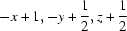
| Symmetry codes: (i) −x+1, −y+1/2, z+1/2; (ii) −x+1, −y+1/2, z−1/2; (iii) −x+3/2, −y+1/2, z. |
| D—H···A | D—H | H···A | D···A | D—H···A |
| O41—H1O4···S21iv | 0.80 (3) | 2.50 (3) | 3.2474 (14) | 154 (2) |
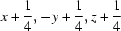
| Symmetry code: (iv) x+1/4, −y+1/4, z+1/4. |
Experimental details
| Crystal data | |
| Chemical formula | [Ni2(NCS)4(C4H4N2)3(CH4O)2] |
| Mr | 654.10 |
| Crystal system, space group | Orthorhombic, Fdd2 |
| Temperature (K) | 80 |
| a, b, c (Å) | 20.0624 (4), 32.5018 (6), 8.0268 (2) |
| V (Å3) | 5233.99 (19) |
| Z | 8 |
| Radiation type | Mo Kα |
| µ (mm−1) | 1.80 |
| Crystal size (mm) | 0.19 × 0.09 × 0.03 |
| Data collection | |
| Diffractometer | Stoe IPDS2 diffractometer |
| Absorption correction | Numerical (X-SHAPE and X-RED32; Stoe & Cie, 2008) |
| Tmin, Tmax | 0.813, 0.936 |
| No. of measured, independent and observed [I > 2σ(I)] reflections | 26228, 3743, 3659 |
| Rint | 0.043 |
| (sin θ/λ)max (Å−1) | 0.699 |
| Refinement | |
| R[F2 > 2σ(F2)], wR(F2), S | 0.020, 0.048, 1.09 |
| No. of reflections | 3743 |
| No. of parameters | 170 |
| No. of restraints | 1 |
| H-atom treatment | H atoms treated by a mixture of independent and constrained refinement |
| Δρmax, Δρmin (e Å−3) | 0.34, −0.21 |
| Absolute structure | Flack (1983), 1746 Friedel pairs |
| Absolute structure parameter | 0.0917 (74) |
Computer programs: X-AREA (Stoe & Cie, 2008), X-RED32 (Stoe & Cie, 2008, SHELXS97 (Sheldrick, 2008), SHELXL97 (Sheldrick, 2008), XP in SHELXTL (Sheldrick, 2008), XCIF in SHELXTL (Sheldrick, 2008).
| Ni1—N31 | 2.0334 (14) | Ni1—N11 | 2.1118 (13) |
| Ni1—N21 | 2.0376 (13) | Ni1—N2i | 2.1200 (13) |
| Ni1—O41 | 2.1053 (12) | Ni1—N1 | 2.1244 (13) |
| N31—Ni1—N21 | 176.02 (6) | O41—Ni1—N1 | 177.66 (5) |
| O41—Ni1—N2i | 86.62 (5) | N2i—Ni1—N1 | 95.23 (5) |
| N11—Ni1—N2i | 174.11 (5) |
| Symmetry code: (i) −x+1, −y+1/2, z+1/2. |
| D—H···A | D—H | H···A | D···A | D—H···A |
| O41—H1O4···S21ii | 0.80 (3) | 2.50 (3) | 3.2474 (14) | 154 (2) |
| Symmetry code: (ii) x+1/4, −y+1/4, z+1/4. |
Acknowledgements
MW thanks the Stiftung Stipendien-Fonds des Verbandes der Chemischen Industrie and the Studienstiftung des deutschen Volkes for a PhD scholarship. We gratefully acknowledge financial support by the State of Schleswig-Holstein and we thank Professor Dr Wolfgang Bensch for the opportunity to use of his experimental facility.
References
 Flack, H. D. (1983). Acta Cryst. A39, 876–881. CrossRef CAS Web of Science IUCr Journals Google Scholar
Lloret, F., Munno, G. D., Julve, M., Cano, J., Ruiz, R. & Caneschi, A. (1998). Angew. Chem. Int. Ed. Engl. 37, 135–138. CrossRef CAS Google Scholar
Näther, C., Bhosekar, G. & Jess, I. (2007). Eur. J. Inorg. Chem. pp. 5353–5359. Google Scholar
Näther, C. & Greve, J. (2003). J. Solid State Chem. 176, 259–265. Google Scholar
Sheldrick, G. M. (2008). Acta Cryst. A64, 112–122. Web of Science CrossRef CAS IUCr Journals Google Scholar
Stoe & Cie (2008). X-AREA, X-RED32 and X-SHAPE. Stoe & Cie, Darmstadt, Germany. Google Scholar
Wriedt, M., Jess, I. & Näther, C. (2008). Eur. J. Inorg. Chem. pp. 363–372. Google Scholar
This is an open-access article distributed under the terms of the Creative Commons Attribution (CC-BY) Licence, which permits unrestricted use, distribution, and reproduction in any medium, provided the original authors and source are cited.
| CRYSTALLOGRAPHIC COMMUNICATIONS |


Recently, we have shown that new ligand deficient coordination polymers with interesting magnetic properties can be prepared by thermal decomposition of suitable ligand rich precursor compounds (Näther & Greve, 2003; Wriedt et al., 2008; and Näther et al., 2007). In our ongoing investigation on the synthesis, structures and properties of new coordination polymers based on paramagnetic metal pseudohalides and N-donor ligands (Lloret et al. 1998), we have reacted nickel(II) thiocyanate with pyrimidine in methanol. In this reaction single crystals of the title compound has been formed.
The 2:3 title compound [Ni(SCN)2(pyrimidine)3*2MeOH]n (Fig. 1) represents a two-dimensional coordination polymer, which consists of µ-1,3-(N,N) pyrimidine bridged zigzag like nickel thiocyanates chains, which are further linked by µ-1,3-(N,N) bridged pyrimidine ligands into layers (Fig. 2 and 3). Within each layer the nickel cations are bridged by three µ-1,3-(N,N') pyrimidine ligands and are further terminal coordinated by two N-bonded thiocyanate anions and one O-bonded methanol molecule. Thus, each nickel cation is octahedrally coordinated. The asymmetric unit consists of one nickel cation, two thiocyanate anions and one methanol molecule in general position as well as one pyrimidine ligand located around a twofold rotation axis. The Ni—NCS distances amount to 2.0334 (14) and 2.0376 (13) Å and the Ni—Npyrimidine distances range from 2.1118 (13) to 2.1244 (13) Å as well as the angles around the iron cations range between 86.62 (5) and 177.66 (5)° (Tab. 1). The shortest intra- and interchain Ni···Ni distances amount to 5.9470 (1) and 8.4023 (1) Å, respectively.