 | Acta Crystallographica Section E Acta Crystallographica Section E CRYSTALLOGRAPHIC COMMUNICATIONS |


 journal menu


metal-organic compounds
| CRYSTALLOGRAPHIC COMMUNICATIONS |
 access
Poly[diaqua(μ3-succinato)cadmium(II)]

aDepartment of Materials Science and Engineering, Northeastern University at Qinhuangdao, Qinhuangdao, Hebei 066000, People's Republic of China
*Correspondence e-mail: [email protected]
The title compound, [Cd(C4H4O4)(H2O)2]n, has been synthesized under hydrothermal conditions. The asymmetric unit consists of one Cd2+ cation, one succinate anion and two aqua ligands. The Cd atoms present a distorted pentagonal bipyramidal coordination and are bridged into layers parallel to (201) by succinate ligands.
Related literature
For different bridging modes in succinato complexes, see: Ng (1998![[Ng, S. W. (1998). Acta Cryst. C54, 745-750.]](../../../../../../logos/arrows/e_arr.gif "Ng, S. W. (1998). Acta Cryst. C54, 745-750.") ); Rastsvetaeva et al. (1996); Brusau et al. (2000); He et al. (2006); He et al. (2007). For geometrical comparisons with related compounds, see Huo et al. (2005); Zhuo et al. (2006).
); Rastsvetaeva et al. (1996); Brusau et al. (2000); He et al. (2006); He et al. (2007). For geometrical comparisons with related compounds, see Huo et al. (2005); Zhuo et al. (2006).
![[Scheme 1]](bg2243scheme1.gif)
Experimental
Crystal data
|
Refinement
|
| ||||||||||||||||||
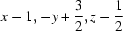 ; (ii)
 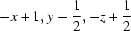 .
. Data collection: SMART (Bruker, 1998); cell refinement: SAINT (Bruker, 1998); data reduction: SAINT; program(s) used to solve structure: SHELXS97 (Sheldrick, 2008); program(s) used to refine structure: SHELXL97 (Sheldrick, 2008); molecular graphics: SHELXTL (Sheldrick, 2008); software used to prepare material for publication: SHELXTL.
Supporting information
contains datablocks global, I. DOI: 10.1107/S1600536809011593/bg2243sup1.cif
Structure factors: contains datablock I. DOI: 10.1107/S1600536809011593/bg2243Isup2.hkl
Cd(NO3)2.4H2O (0.5 mmol, 0.154 g), succinic acid (0.5 mmol, 0.059 g), sodium hydroxide (1 mmol, 0.04 g) and water (12 ml) were placed in a 23-ml Teflon-lined Parr bomb. The bomb was heated at 453 K for 3 d. The colourless block-shapped crystals were filtered off and washed with water and acetone (yield 45%, based on Cd).
Water H atoms were located in a difference Fourier map and refined with restrained O-H (0.85 (1)Å) and free Uiso(H). H atoms on C atom were positoned geometrically and refined using a riding model, with C—H = 0.97 Å.
Data collection: SMART (Bruker, 1998); cell SAINT (Bruker, 1998); data reduction: SAINT (Bruker, 1998); program(s) used to solve structure: SHELXS97 (Sheldrick, 2008); program(s) used to refine structure: SHELXL97 (Sheldrick, 2008); molecular graphics: SHELXTL (Sheldrick, 2008); software used to prepare material for publication: SHELXTL (Sheldrick, 2008).
![[Figure 1]](./bg2243fig1thm.gif) | Fig. 1. A view of the molecular structure of (I) with the atom-numbering scheme and 30% displacement ellipsoids. Atoms with the suffix A and B are generated by the symmetry operations x + 1, -y + 3/2, z + 1/2 and -x + 2, -y + 1, -z + 2, respectively. |
![[Figure 2]](./bg2243fig2thm.gif) | Fig. 2. The 2-D layer structure of compound (I) (H atoms of methylenes are omitted for clarity). |
| [Cd(C4H4O4)(H2O)2] | F(000) = 512.0 |
| Mr = 264.51 | Dx = 2.32 Mg m−3 |
| Monoclinic, P21/c | Mo Kα radiation, λ = 0.71073 Å |
| Hall symbol: -P 2ybc | Cell parameters from 2567 reflections |
| a = 7.7130 (15) Å | θ = 2.6–25.5° |
| b = 12.231 (2) Å | µ = 2.87 mm−1 |
| c = 8.0560 (16) Å | T = 293 K |
| β = 94.71 (3)° | Block, colorless |
| V = 757.4 (2) Å3 | 0.40 × 0.30 × 0.21 mm |
| Z = 4 |
| Bruker SMART CD area-detector diffractometer | 1409 independent reflections |
| Radiation source: fine-focus sealed tube | 1335 reflections with I > 2σ(I) |
| Graphite monochromator | Rint = 0.028 |
| ϕ and ω scans | θmax = 25.5°, θmin = 3.0° |
| Absorption correction: multi-scan (SADABS; Bruker, 1998) | h = −9→9 |
| Tmin = 0.35, Tmax = 0.55 | k = −14→14 |
| 6371 measured reflections | l = −9→9 |
| Refinement on F2 | Primary atom site location: structure-invariant direct methods |
| Least-squares matrix: full | Secondary atom site location: difference Fourier map |
| R[F2 > 2σ(F2)] = 0.023 | Hydrogen site location: constr |
| wR(F2) = 0.053 | H atoms treated by a mixture of independent and constrained refinement |
| S = 1.05 | w = 1/[σ2(Fo2) + (0.0207P)2 + 1.5P] where P = (Fo2 + 2Fc2)/3 |
| 1409 reflections | (Δ/σ)max < 0.001 |
| 116 parameters | Δρmax = 0.40 e Å−3 |
| 6 restraints | Δρmin = −0.68 e Å−3 |
| [Cd(C4H4O4)(H2O)2] | V = 757.4 (2) Å3 |
| Mr = 264.51 | Z = 4 |
| Monoclinic, P21/c | Mo Kα radiation |
| a = 7.7130 (15) Å | µ = 2.87 mm−1 |
| b = 12.231 (2) Å | T = 293 K |
| c = 8.0560 (16) Å | 0.40 × 0.30 × 0.21 mm |
| β = 94.71 (3)° |
| Bruker SMART CD area-detector diffractometer | 1409 independent reflections |
| Absorption correction: multi-scan (SADABS; Bruker, 1998) | 1335 reflections with I > 2σ(I) |
| Tmin = 0.35, Tmax = 0.55 | Rint = 0.028 |
| 6371 measured reflections |
| R[F2 > 2σ(F2)] = 0.023 | 6 restraints |
| wR(F2) = 0.053 | H atoms treated by a mixture of independent and constrained refinement |
| S = 1.05 | Δρmax = 0.40 e Å−3 |
| 1409 reflections | Δρmin = −0.68 e Å−3 |
| 116 parameters |
Geometry. All esds (except the esd in the dihedral angle between two l.s. planes) are estimated using the full covariance matrix. The cell esds are taken into account individually in the estimation of esds in distances, angles and torsion angles; correlations between esds in cell parameters are only used when they are defined by crystal symmetry. An approximate (isotropic) treatment of cell esds is used for estimating esds involving l.s. planes. |
Refinement. Refinement of F2 against ALL reflections. The weighted R-factor wR and goodness of fit S are based on F2, conventional R-factors R are based on F, with F set to zero for negative F2. The threshold expression of F2 > σ(F2) is used only for calculating R-factors(gt) etc. and is not relevant to the choice of reflections for refinement. R-factors based on F2 are statistically about twice as large as those based on F, and R- factors based on ALL data will be even larger. |
| x | y | z | Uiso*/Ueq | ||
| Cd1 | 0.17614 (3) | 0.587427 (19) | 0.08353 (3) | 0.02570 (10) | |
| C1 | 0.4820 (4) | 0.6353 (3) | 0.2526 (4) | 0.0274 (7) | |
| C2 | 0.6501 (5) | 0.6626 (3) | 0.3501 (6) | 0.0454 (10) | |
| H2A | 0.6471 | 0.6327 | 0.4613 | 0.055* | |
| H2B | 0.7436 | 0.6262 | 0.2983 | 0.055* | |
| C3 | 0.6922 (4) | 0.7799 (3) | 0.3648 (5) | 0.0349 (9) | |
| H3A | 0.6046 | 0.8150 | 0.4262 | 0.042* | |
| H3B | 0.6840 | 0.8113 | 0.2538 | 0.042* | |
| C4 | 0.8675 (4) | 0.8072 (3) | 0.4482 (4) | 0.0252 (7) | |
| O1 | 0.4603 (3) | 0.5387 (2) | 0.2005 (3) | 0.0367 (6) | |
| O2 | 0.3664 (3) | 0.70570 (19) | 0.2216 (3) | 0.0352 (6) | |
| O3 | 0.9815 (3) | 0.7385 (2) | 0.4838 (3) | 0.0399 (6) | |
| O4 | 0.8946 (3) | 0.90780 (18) | 0.4832 (3) | 0.0307 (6) | |
| O5 | 0.0710 (4) | 0.5424 (2) | 0.3376 (3) | 0.0402 (6) | |
| H5A | −0.012 (5) | 0.499 (3) | 0.325 (6) | 0.072 (18)* | |
| H5B | 0.047 (5) | 0.598 (2) | 0.392 (5) | 0.056 (15)* | |
| O6 | 0.2576 (3) | 0.5909 (2) | −0.1850 (3) | 0.0332 (6) | |
| H6A | 0.348 (4) | 0.553 (3) | −0.197 (5) | 0.044 (12)* | |
| H6B | 0.278 (5) | 0.6562 (17) | −0.213 (5) | 0.051 (13)* |
| U11 | U22 | U33 | U12 | U13 | U23 | |
| Cd1 | 0.01635 (14) | 0.02632 (15) | 0.03318 (16) | −0.00248 (9) | −0.00550 (10) | −0.00305 (10) |
| C1 | 0.0181 (16) | 0.0294 (18) | 0.0342 (18) | −0.0041 (14) | −0.0016 (14) | −0.0046 (15) |
| C2 | 0.032 (2) | 0.034 (2) | 0.065 (3) | −0.0035 (17) | −0.0250 (19) | 0.0000 (19) |
| C3 | 0.0231 (18) | 0.0299 (19) | 0.049 (2) | −0.0034 (15) | −0.0132 (16) | −0.0034 (16) |
| C4 | 0.0213 (16) | 0.0263 (18) | 0.0278 (18) | −0.0025 (14) | −0.0003 (13) | −0.0029 (14) |
| O1 | 0.0220 (12) | 0.0292 (14) | 0.0572 (17) | 0.0006 (10) | −0.0056 (11) | −0.0134 (12) |
| O2 | 0.0245 (13) | 0.0274 (13) | 0.0512 (16) | 0.0008 (10) | −0.0117 (11) | −0.0102 (11) |
| O3 | 0.0264 (13) | 0.0286 (13) | 0.0619 (18) | 0.0039 (11) | −0.0132 (12) | −0.0085 (12) |
| O4 | 0.0229 (12) | 0.0228 (12) | 0.0448 (15) | −0.0029 (9) | −0.0078 (11) | −0.0017 (10) |
| O5 | 0.0414 (16) | 0.0419 (17) | 0.0377 (16) | 0.0015 (14) | 0.0054 (12) | −0.0026 (13) |
| O6 | 0.0306 (14) | 0.0266 (14) | 0.0432 (15) | 0.0036 (11) | 0.0070 (11) | 0.0052 (11) |
| Cd1—O4i | 2.255 (2) | C2—H2A | 0.9700 |
| Cd1—O2 | 2.284 (2) | C2—H2B | 0.9700 |
| Cd1—O6 | 2.302 (3) | C3—C4 | 1.498 (4) |
| Cd1—O4ii | 2.316 (2) | C3—H3A | 0.9700 |
| Cd1—O5 | 2.329 (3) | C3—H3B | 0.9700 |
| Cd1—O1 | 2.389 (2) | C4—O3 | 1.233 (4) |
| Cd1—O3i | 2.690 (2) | C4—O4 | 1.275 (4) |
| C1—O2 | 1.250 (4) | O5—H5B | 0.84 (3) |
| C1—O1 | 1.260 (4) | O5—H5A | 0.84 (3) |
| C1—C2 | 1.498 (5) | O6—H6A | 0.85 (3) |
| C2—C3 | 1.474 (5) | O6—H6B | 0.85 (3) |
| O4i—Cd1—O2 | 136.02 (8) | C1—C2—H2B | 108.3 |
| O4i—Cd1—O6 | 89.54 (10) | H2A—C2—H2B | 107.4 |
| O2—Cd1—O6 | 103.41 (10) | C2—C3—C4 | 116.0 (3) |
| O4i—Cd1—O4ii | 74.92 (9) | C2—C3—H3A | 108.3 |
| O2—Cd1—O4ii | 147.52 (8) | C4—C3—H3A | 108.3 |
| O6—Cd1—O4ii | 82.91 (9) | C2—C3—H3B | 108.3 |
| O4i—Cd1—O5 | 85.77 (10) | C4—C3—H3B | 108.3 |
| O2—Cd1—O5 | 88.74 (10) | H3A—C3—H3B | 107.4 |
| O6—Cd1—O5 | 166.39 (10) | O3—C4—O4 | 120.4 (3) |
| O4ii—Cd1—O5 | 83.54 (10) | O3—C4—C3 | 123.5 (3) |
| O4i—Cd1—O1 | 166.71 (8) | O4—C4—C3 | 116.1 (3) |
| O2—Cd1—O1 | 55.52 (8) | C1—O1—Cd1 | 89.42 (19) |
| O6—Cd1—O1 | 93.60 (10) | C1—O2—Cd1 | 94.6 (2) |
| O4ii—Cd1—O1 | 92.64 (8) | C4—O4—Cd1iii | 103.8 (2) |
| O5—Cd1—O1 | 88.23 (10) | C4—O4—Cd1iv | 146.3 (2) |
| O2—C1—O1 | 120.4 (3) | Cd1iii—O4—Cd1iv | 105.08 (9) |
| O2—C1—C2 | 121.6 (3) | Cd1—O5—H5B | 112 (3) |
| O1—C1—C2 | 118.0 (3) | Cd1—O5—H5A | 111 (3) |
| C3—C2—C1 | 115.8 (3) | H5B—O5—H5A | 112 (3) |
| C3—C2—H2A | 108.3 | Cd1—O6—H6A | 113 (3) |
| C1—C2—H2A | 108.3 | Cd1—O6—H6B | 110 (3) |
| C3—C2—H2B | 108.3 | H6A—O6—H6B | 108 (3) |
| O2—C1—C2—C3 | −16.9 (6) | O1—C1—O2—Cd1 | 2.1 (4) |
| O1—C1—C2—C3 | 162.3 (4) | C2—C1—O2—Cd1 | −178.7 (3) |
| C1—C2—C3—C4 | −174.5 (3) | O4i—Cd1—O2—C1 | 170.1 (2) |
| C2—C3—C4—O3 | 9.5 (6) | O6—Cd1—O2—C1 | −86.3 (2) |
| C2—C3—C4—O4 | −170.0 (4) | O4ii—Cd1—O2—C1 | 11.7 (3) |
| O2—C1—O1—Cd1 | −2.0 (3) | O5—Cd1—O2—C1 | 87.5 (2) |
| C2—C1—O1—Cd1 | 178.7 (3) | O1—Cd1—O2—C1 | −1.2 (2) |
| O4i—Cd1—O1—C1 | −151.7 (4) | O3—C4—O4—Cd1iii | 5.3 (4) |
| O2—Cd1—O1—C1 | 1.2 (2) | C3—C4—O4—Cd1iii | −175.2 (3) |
| O6—Cd1—O1—C1 | 105.0 (2) | O3—C4—O4—Cd1iv | 153.9 (3) |
| O4ii—Cd1—O1—C1 | −172.0 (2) | C3—C4—O4—Cd1iv | −26.5 (6) |
| O5—Cd1—O1—C1 | −88.5 (2) |
| Symmetry codes: (i) x−1, −y+3/2, z−1/2; (ii) −x+1, y−1/2, −z+1/2; (iii) x+1, −y+3/2, z+1/2; (iv) −x+1, y+1/2, −z+1/2. |
Experimental details
| Crystal data | |
| Chemical formula | [Cd(C4H4O4)(H2O)2] |
| Mr | 264.51 |
| Crystal system, space group | Monoclinic, P21/c |
| Temperature (K) | 293 |
| a, b, c (Å) | 7.7130 (15), 12.231 (2), 8.0560 (16) |
| β (°) | 94.71 (3) |
| V (Å3) | 757.4 (2) |
| Z | 4 |
| Radiation type | Mo Kα |
| µ (mm−1) | 2.87 |
| Crystal size (mm) | 0.40 × 0.30 × 0.21 |
| Data collection | |
| Diffractometer | Bruker SMART CD area-detector diffractometer |
| Absorption correction | Multi-scan (SADABS; Bruker, 1998) |
| Tmin, Tmax | 0.35, 0.55 |
| No. of measured, independent and observed [I > 2σ(I)] reflections | 6371, 1409, 1335 |
| Rint | 0.028 |
| (sin θ/λ)max (Å−1) | 0.606 |
| Refinement | |
| R[F2 > 2σ(F2)], wR(F2), S | 0.023, 0.053, 1.05 |
| No. of reflections | 1409 |
| No. of parameters | 116 |
| No. of restraints | 6 |
| H-atom treatment | H atoms treated by a mixture of independent and constrained refinement |
| Δρmax, Δρmin (e Å−3) | 0.40, −0.68 |
Computer programs: SMART (Bruker, 1998), SAINT (Bruker, 1998), SHELXS97 (Sheldrick, 2008), SHELXL97 (Sheldrick, 2008), SHELXTL (Sheldrick, 2008).
| Cd1—O4i | 2.255 (2) | Cd1—O5 | 2.329 (3) |
| Cd1—O2 | 2.284 (2) | Cd1—O1 | 2.389 (2) |
| Cd1—O6 | 2.302 (3) | Cd1—O3i | 2.690 (2) |
| Cd1—O4ii | 2.316 (2) |
| Symmetry codes: (i) x−1, −y+3/2, z−1/2; (ii) −x+1, y−1/2, −z+1/2. |
References
 Bruker (1998). SMART, SAINT and SADABS. Bruker AXS Inc., Madison, Wisconsin, USA. Google Scholar
Brusau, E. V., Pedregosa, J. C. G., Narda, E., Echeverria, G. & Punte, G. (2000). J. Solid State Chem. 153, 1–8. Web of Science CSD CrossRef CAS Google Scholar
He, Y.-K., Wang, X.-F., Zhang, L.-T., Han, Z.-B. & Ng, S. W. (2007). Acta Cryst. E63, m3019. Web of Science CSD CrossRef IUCr Journals Google Scholar
He, Q., Zi, J.-F. & Zhang, F.-J. (2006). Acta Cryst. E62, m1266–m1267. Web of Science CSD CrossRef IUCr Journals Google Scholar
Huo, L.-H., Gao, S. & Ng, S. W. (2005). Acta Cryst. E61, m2357–m2358. Web of Science CSD CrossRef IUCr Journals Google Scholar
Ng, S. W. (1998). Acta Cryst. C54, 745–750. Web of Science CSD CrossRef CAS IUCr Journals Google Scholar
Rastsvetaeva, R. K., Pushcharovsky, D. Yu., Furmanova, N. G. & Sharp, H. (1996). Z. Kristallogr. 211, 808–810. CSD CrossRef CAS Web of Science Google Scholar
Sheldrick, G. M. (2008). Acta Cryst. A64, 112–122. Web of Science CrossRef CAS IUCr Journals Google Scholar
Zhuo, X., Pan, Z.-R., Wang, Z.-W., Li, Y.-Z. & Zheng, H.-G. (2006). Chin. J. Inorg. Chem. 22, 1847–1851. CAS Google Scholar
This is an open-access article distributed under the terms of the Creative Commons Attribution (CC-BY) Licence, which permits unrestricted use, distribution, and reproduction in any medium, provided the original authors and source are cited.
| CRYSTALLOGRAPHIC COMMUNICATIONS |


The succinate dianion has been used as a bridging ligand in the preparation of multinuclear metal complexes. A variety of bridging modes have been found (Ng,1998; Rastsvetaeva et al., 1996; Brusau et al., 2000; He et al., 2006; He et al., 2007). We report herein the synthesis and crystal stucture of a new succinate complex [Cd(C4H4O4)(H2O)2] (I).
The asymmetric unit consists of one Cd2+ cation, one succinate anion and two aqua ligands (Fig. 1). The Cd atom is coordinated by seven O atoms of three succinate anions and two aqua ligand, forming a distorted pentagonal bipyramidal coordination geometry (Table 1), with Cd—O bond lengths which agree well with those observed in analogous complexes (Huo et al., 2005; Zhuo et al., 2006). Cd atoms are bridged by succinate ligands into a two-dimensional layer (Fig. 2).