Related literature
For bond-length data, see: Dinger et al. (1998![[Dinger, M. B., Henderson, W., Nicholson, B. K. & Robinson, W. T. (1998). J. Organomet. Chem. 560, 169-181.]](../../../../../../logos/arrows/e_arr.gif "Dinger, M. B., Henderson, W., Nicholson, B. K. & Robinson, W. T. (1998). J. Organomet. Chem. 560, 169-181.") ); Wei et al. (2008).
); Wei et al. (2008).
Experimental
Crystal data
[AgCl(C2H2N2S2)] Mr = 261.50 Orthorhombic, P 21 21 21 a = 4.0316 (9) Å b = 8.473 (2) Å c = 18.368 (4) Å V = 627.4 (2) Å3 Z = 4 Mo Kα radiation μ = 4.19 mm−1 T = 294 K 0.23 × 0.13 × 0.06 mm
|
Data collection
Bruker SMART CCD area-detector diffractometer Absorption correction: multi-scan (SADABS; Bruker, 1997) Tmin = 0.446, Tmax = 0.786 4169 measured reflections 1161 independent reflections 1085 reflections with I > 2σ(I) Rint = 0.035
|
Refinement
R[F2 > 2σ(F2)] = 0.031 wR(F2) = 0.083 S = 1.09 1161 reflections 73 parameters H-atom parameters constrained Δρmax = 1.22 e Å−3 Δρmin = −0.65 e Å−3 Absolute structure: Flack (1983), 438 Friedel pairs Flack parameter: 0.05 (6)
|
| Ag1—S2i | 2.5454 (14) | | Ag1—S2 | 2.5695 (15) | | Ag1—Cl1ii | 2.5897 (15) | | Ag1—Cl1 | 2.6514 (15) | Symmetry codes: (i) 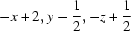 ; (ii) x-1, y, z. ; (ii) x-1, y, z.
| |
| D—H⋯A | D—H | H⋯A | D⋯A | D—H⋯A | | N1—H1⋯Cl1ii | 0.86 | 2.38 | 3.197 (4) | 158 | Symmetry code: (ii) x-1, y, z.
| |
Data collection: SMART (Bruker, 1997); cell refinement: SAINT (Bruker, 1997); data reduction: SAINT; program(s) used to solve structure: SHELXS97 (Sheldrick, 2008); program(s) used to refine structure: SHELXL97 (Sheldrick, 2008); molecular graphics: SHELXTL (Sheldrick, 2008); software used to prepare material for publication: SHELXTL.
Supporting information
1,3,4-Thiadiazolium-2-thiolate (0.5 mmol) was added at room temperature to a ammonia solution (10 ml) of AgCl (0.5 mmol). After the addition, a colourless precipitate immediately formed and the suspension was stirred for 2 h. The precipitate was filtered off and washed with MeCN. Single crystals suitable for X-ray analysis were obtained by slow diffusion of Et2O into a water solution of the solid.
H atoms were positioned geometrically and treated as riding, with N-H = 0.86 Å and Uiso(H) = 1.2Ueq(N), and C-H = 0.93 Å and Uiso(H) = 1.2Ueq(C).
Data collection: SMART (Bruker, 1997); cell refinement: SAINT (Bruker, 1997); data reduction: SAINT (Bruker, 1997); program(s) used to solve structure: SHELXS97 (Sheldrick, 2008); program(s) used to refine structure: SHELXL97 (Sheldrick, 2008); molecular graphics: SHELXTL (Sheldrick, 2008); software used to prepare material for publication: SHELXTL (Sheldrick, 2008).
Poly[µ
2-chlorido-(µ
2-3
H+-1,3,4-thiadiazolium-2-thiolato-
κ2S:
S)silver(I)]
top Crystal data top | [AgCl(C2H2N2S2)] | F(000) = 496 |
| Mr = 261.50 | Dx = 2.768 Mg m−3 |
| Orthorhombic, P212121 | Mo Kα radiation, λ = 0.71073 Å |
| Hall symbol: P 2ac 2ab | Cell parameters from 1870 reflections |
| a = 4.0316 (9) Å | θ = 3.3–27.2° |
| b = 8.473 (2) Å | µ = 4.19 mm−1 |
| c = 18.368 (4) Å | T = 294 K |
| V = 627.4 (2) Å3 | Block, colourless |
| Z = 4 | 0.23 × 0.13 × 0.06 mm |
Data collection top Bruker SMART CCD area-detector
diffractometer | 1161 independent reflections |
| Radiation source: fine-focus sealed tube | 1085 reflections with I > 2σ(I) |
| Graphite monochromator | Rint = 0.035 |
| ϕ and ω scans | θmax = 25.5°, θmin = 2.7° |
Absorption correction: multi-scan
(SADABS; Bruker, 1997) | h = −4→4 |
| Tmin = 0.446, Tmax = 0.786 | k = −10→10 |
| 4169 measured reflections | l = −22→22 |
Refinement top | Refinement on F2 | Secondary atom site location: difference Fourier map |
| Least-squares matrix: full | Hydrogen site location: inferred from neighbouring sites |
| R[F2 > 2σ(F2)] = 0.031 | H-atom parameters constrained |
| wR(F2) = 0.083 | w = 1/[σ2(Fo2) + (0.0526P)2]
where P = (Fo2 + 2Fc2)/3 |
| S = 1.09 | (Δ/σ)max < 0.001 |
| 1161 reflections | Δρmax = 1.22 e Å−3 |
| 73 parameters | Δρmin = −0.65 e Å−3 |
| 0 restraints | Absolute structure: Flack (1983), 438 Friedel pairs |
| Primary atom site location: structure-invariant direct methods | Absolute structure parameter: 0.05 (6) |
Crystal data top | [AgCl(C2H2N2S2)] | V = 627.4 (2) Å3 |
| Mr = 261.50 | Z = 4 |
| Orthorhombic, P212121 | Mo Kα radiation |
| a = 4.0316 (9) Å | µ = 4.19 mm−1 |
| b = 8.473 (2) Å | T = 294 K |
| c = 18.368 (4) Å | 0.23 × 0.13 × 0.06 mm |
Data collection top Bruker SMART CCD area-detector
diffractometer | 1161 independent reflections |
Absorption correction: multi-scan
(SADABS; Bruker, 1997) | 1085 reflections with I > 2σ(I) |
| Tmin = 0.446, Tmax = 0.786 | Rint = 0.035 |
| 4169 measured reflections | |
Refinement top | R[F2 > 2σ(F2)] = 0.031 | H-atom parameters constrained |
| wR(F2) = 0.083 | Δρmax = 1.22 e Å−3 |
| S = 1.09 | Δρmin = −0.65 e Å−3 |
| 1161 reflections | Absolute structure: Flack (1983), 438 Friedel pairs |
| 73 parameters | Absolute structure parameter: 0.05 (6) |
| 0 restraints | |
Fractional atomic coordinates and isotropic or equivalent isotropic displacement parameters (Å2) top| | x | y | z | Uiso*/Ueq | |
| Ag1 | 0.97702 (12) | −0.03604 (5) | 0.18414 (2) | 0.04254 (19) | |
| Cl1 | 1.4870 (4) | −0.08711 (14) | 0.09609 (6) | 0.0323 (3) | |
| S1 | 0.6628 (4) | 0.55205 (15) | 0.14333 (7) | 0.0346 (3) | |
| S2 | 0.9323 (4) | 0.25800 (16) | 0.21696 (7) | 0.0356 (4) | |
| N1 | 0.6067 (12) | 0.2855 (5) | 0.0889 (2) | 0.0350 (12) | |
| H1 | 0.6188 | 0.1852 | 0.0823 | 0.042* | |
| N2 | 0.4580 (15) | 0.3800 (5) | 0.0387 (2) | 0.0420 (13) | |
| C1 | 0.7324 (12) | 0.3512 (6) | 0.1482 (2) | 0.0266 (11) | |
| C2 | 0.4723 (15) | 0.5228 (6) | 0.0601 (3) | 0.0329 (12) | |
| H2 | 0.3863 | 0.6056 | 0.0327 | 0.039* | |
Atomic displacement parameters (Å2) top| | U11 | U22 | U33 | U12 | U13 | U23 |
| Ag1 | 0.0574 (3) | 0.0311 (3) | 0.0391 (3) | 0.0042 (2) | −0.0090 (2) | 0.00192 (16) |
| Cl1 | 0.0369 (7) | 0.0237 (6) | 0.0365 (6) | −0.0013 (6) | −0.0016 (6) | −0.0009 (5) |
| S1 | 0.0485 (8) | 0.0187 (6) | 0.0364 (7) | 0.0010 (6) | −0.0108 (6) | −0.0037 (6) |
| S2 | 0.0546 (9) | 0.0215 (6) | 0.0307 (7) | 0.0065 (6) | −0.0107 (6) | −0.0034 (5) |
| N1 | 0.059 (3) | 0.019 (2) | 0.026 (2) | 0.003 (2) | −0.007 (2) | −0.0031 (18) |
| N2 | 0.065 (4) | 0.027 (3) | 0.034 (2) | 0.003 (3) | −0.015 (3) | 0.0008 (19) |
| C1 | 0.032 (3) | 0.023 (3) | 0.025 (2) | 0.000 (2) | 0.004 (2) | −0.001 (2) |
| C2 | 0.044 (3) | 0.026 (3) | 0.028 (2) | 0.002 (3) | −0.008 (2) | 0.001 (2) |
Geometric parameters (Å, º) top | Ag1—S2i | 2.5454 (14) | S2—C1 | 1.694 (5) |
| Ag1—S2 | 2.5695 (15) | S2—Ag1iv | 2.5453 (14) |
| Ag1—Cl1ii | 2.5897 (15) | N1—C1 | 1.323 (6) |
| Ag1—Cl1 | 2.6514 (15) | N1—N2 | 1.361 (6) |
| Cl1—Ag1iii | 2.5897 (15) | N1—H1 | 0.86 |
| S1—C1 | 1.727 (5) | N2—C2 | 1.273 (7) |
| S1—C2 | 1.729 (5) | C2—H2 | 0.93 |
| | | |
| S2i—Ag1—S2 | 120.49 (3) | C1—N1—N2 | 118.6 (4) |
| S2i—Ag1—Cl1ii | 116.15 (5) | C1—N1—H1 | 120.7 |
| S2—Ag1—Cl1ii | 104.77 (4) | N2—N1—H1 | 120.7 |
| S2i—Ag1—Cl1 | 102.24 (5) | C2—N2—N1 | 109.3 (4) |
| S2—Ag1—Cl1 | 110.84 (5) | N1—C1—S2 | 126.8 (4) |
| Cl1ii—Ag1—Cl1 | 100.56 (5) | N1—C1—S1 | 108.1 (4) |
| Ag1iii—Cl1—Ag1 | 100.56 (5) | S2—C1—S1 | 125.1 (3) |
| C1—S1—C2 | 88.6 (2) | N2—C2—S1 | 115.4 (4) |
| C1—S2—Ag1iv | 106.32 (18) | N2—C2—H2 | 122.3 |
| C1—S2—Ag1 | 108.09 (18) | S1—C2—H2 | 122.3 |
| Ag1iv—S2—Ag1 | 145.29 (5) | | |
| | | |
| S2i—Ag1—Cl1—Ag1iii | −60.05 (5) | N2—N1—C1—S2 | −179.1 (4) |
| S2—Ag1—Cl1—Ag1iii | 69.61 (5) | N2—N1—C1—S1 | 0.2 (6) |
| Cl1ii—Ag1—Cl1—Ag1iii | 180.0 | Ag1iv—S2—C1—N1 | −172.7 (5) |
| S2i—Ag1—S2—C1 | −158.63 (19) | Ag1—S2—C1—N1 | 2.7 (5) |
| Cl1ii—Ag1—S2—C1 | −25.46 (19) | Ag1iv—S2—C1—S1 | 8.2 (4) |
| Cl1—Ag1—S2—C1 | 82.19 (19) | Ag1—S2—C1—S1 | −176.5 (3) |
| S2i—Ag1—S2—Ag1iv | 13.55 (10) | C2—S1—C1—N1 | −0.5 (4) |
| Cl1ii—Ag1—S2—Ag1iv | 146.72 (12) | C2—S1—C1—S2 | 178.8 (4) |
| Cl1—Ag1—S2—Ag1iv | −105.63 (12) | N1—N2—C2—S1 | −0.9 (7) |
| C1—N1—N2—C2 | 0.4 (8) | C1—S1—C2—N2 | 0.8 (5) |
| Symmetry codes: (i) −x+2, y−1/2, −z+1/2; (ii) x−1, y, z; (iii) x+1, y, z; (iv) −x+2, y+1/2, −z+1/2. |
Hydrogen-bond geometry (Å, º) top | D—H···A | D—H | H···A | D···A | D—H···A |
| N1—H1···Cl1ii | 0.86 | 2.38 | 3.197 (4) | 158 |
| Symmetry code: (ii) x−1, y, z. |
Experimental details
| Crystal data |
| Chemical formula | [AgCl(C2H2N2S2)] |
| Mr | 261.50 |
| Crystal system, space group | Orthorhombic, P212121 |
| Temperature (K) | 294 |
| a, b, c (Å) | 4.0316 (9), 8.473 (2), 18.368 (4) |
| V (Å3) | 627.4 (2) |
| Z | 4 |
| Radiation type | Mo Kα |
| µ (mm−1) | 4.19 |
| Crystal size (mm) | 0.23 × 0.13 × 0.06 |
| |
| Data collection |
| Diffractometer | Bruker SMART CCD area-detector
diffractometer |
| Absorption correction | Multi-scan
(SADABS; Bruker, 1997) |
| Tmin, Tmax | 0.446, 0.786 |
No. of measured, independent and
observed [I > 2σ(I)] reflections | 4169, 1161, 1085 |
| Rint | 0.035 |
| (sin θ/λ)max (Å−1) | 0.606 |
| |
| Refinement |
| R[F2 > 2σ(F2)], wR(F2), S | 0.031, 0.083, 1.09 |
| No. of reflections | 1161 |
| No. of parameters | 73 |
| H-atom treatment | H-atom parameters constrained |
| Δρmax, Δρmin (e Å−3) | 1.22, −0.65 |
| Absolute structure | Flack (1983), 438 Friedel pairs |
| Absolute structure parameter | 0.05 (6) |
Selected bond lengths (Å) top| Ag1—S2i | 2.5454 (14) | Ag1—Cl1ii | 2.5897 (15) |
| Ag1—S2 | 2.5695 (15) | Ag1—Cl1 | 2.6514 (15) |
| Symmetry codes: (i) −x+2, y−1/2, −z+1/2; (ii) x−1, y, z. |
Hydrogen-bond geometry (Å, º) top | D—H···A | D—H | H···A | D···A | D—H···A |
| N1—H1···Cl1ii | 0.86 | 2.38 | 3.197 (4) | 158 |
| Symmetry code: (ii) x−1, y, z. |
Acknowledgements
The authors thank Luoyang Normal University for supporting this work.
References
 Bruker (1997). SMART, SAINT and SADABS. Bruker AXS Inc., Madison, Wisconsin, USA. Google Scholar
Dinger, M. B., Henderson, W., Nicholson, B. K. & Robinson, W. T. (1998). J. Organomet. Chem. 560, 169–181. Web of Science CSD CrossRef CAS Google Scholar
Flack, H. D. (1983). Acta Cryst. A39, 876–881. CrossRef CAS Web of Science IUCr Journals Google Scholar
Sheldrick, G. M. (2008). Acta Cryst. A64, 112–122. Web of Science CrossRef CAS IUCr Journals Google Scholar
Wei, X. Y., Di, D., Chu, W., Zhu, Q. L. & Huang, R. D. (2008). Inorg. Chim. Acta, 361, 1819–1826. Web of Science CSD CrossRef CAS Google Scholar
This is an open-access article distributed under the terms of the Creative Commons Attribution (CC-BY) Licence, which permits unrestricted use, distribution, and reproduction in any medium, provided the original authors and source are cited.
 | CRYSTALLOGRAPHIC
COMMUNICATIONS |
ISSN: 2056-9890
Open

access


 journal menu



![[Scheme 1]](ci2771scheme1.gif)
![[Figure 1]](./ci2771fig1thm.gif)
![[Figure 2]](./ci2771fig2thm.gif)


The asymmetric unit of the title compound consists of one AgI ion, one 1,3,4-thiadiazolium-2-thiolate ligand, and one Cl atom. As depicted in Fig. 1, the AgI ion is coordinated by two S atoms from two thiadiazole ligands and two Cl atoms in a distorted tetrahedral geometry. The Ag—S and Ag—Cl bond distances (Table 1) are within the range expected for such coordination bonds (Dinger et al., 1998; Wei et al., 2008). The thiadiazole ligand shows a monodentate bridging mode. The adjacent AgI atoms are bridged by Cl atoms to form chains, which are cross-linked by thiadiazole ligands to form a two-dimensional network parallel to the ab plane (Fig. 2). In the network, the Ag atoms are separated by 4.0316 (12) Å along the a axis and 4.8822 (13) Å along the b axis. Intramolecular N—H···Cl hydrogen bonds are observed in the network (Table 2).