 | Acta Crystallographica Section E Acta Crystallographica Section E CRYSTALLOGRAPHIC COMMUNICATIONS |


 journal menu


inorganic compounds
| CRYSTALLOGRAPHIC COMMUNICATIONS |
 access
Potassium nickel(II) gallium phosphate hydrate, K[NiGa2(PO4)3(H2O)2]

aDepartment of Chemistry, University of Reading, Whiteknights, Reading, Berks RG6 6AD, England
*Correspondence e-mail: [email protected]
The title compound, potassium nickel(II) digallium tris(phosphate) dihydrate, K[NiGa2(PO4)3(H2O)2], was synthesized hydrothermally. The structure is constructed from distorted trans-NiO4(H2O)2 octahedra linked through vertices and edges to GaO5 trigonal bipyramids and PO4 tetrahedra, forming a three-dimensional framework of formula [NiGa2(PO4)3(H2O)2]−. The K, Ni and one P atom lie on special positions (Wyckoff position 4e, site symmetry 2). There are two sets of channels within the framework, one running parallel to the [10 ] direction and the other parallel to [001]. These intersect, forming a three-dimensional pore network in which the water molecules coordinated to the Ni atoms and the K+ ions required to charge balance the framework reside. The K+ ions lie in a highly distorted environment surrounded by ten O atoms, six of which are closer than 3.1Å. The coordinated water molecules are within hydrogen-bonding distance to O atoms of bridging Ga—O—P groups.
Related literature
For reviews of open-framework phosphate materials, see: Cheetham et al. (1999![[Cheetham, A. K., Ferey, G. & Loiseau, T. (1999). Angew. Chem. Int. Ed. 38, 3268-3292.]](../../../../../../logos/arrows/e_arr.gif "Cheetham, A. K., Ferey, G. & Loiseau, T. (1999). Angew. Chem. Int. Ed. 38, 3268-3292.") ); Harrison (2002); Maspoch et al. (2007). For background to heterometal-substituted gallophosphates, MGaPOs, see: Baerlocher et al. (2001); Lin & Wang (2005). For related octahedral-trigonal bipyramidal silicate structures, see: Rocha & Lin (2005). For ammonium gallophosphates isostructural to the title compound, see: Chippindale et al. (1996, 1998); Bieniok et al. (2008). For the aluminium analogue, K[NiAl2(PO4)3(H2O)2], see: Meyer & Haushalter (1994). The same structure type occurs in Cs[Fe3(PO4)3(H2O)2] (Lii & Huang, 1995) and NH4[CoAl2(PO4)3(H2O)2] (Panz et al., 1998) and is related to that of (NH4)3Ga2(PO4)3 (Lesage et al., 2004). For bond-valence sums, see: Brese & O'Keeffe (1991); For the weighting scheme, see: Prince (1982); Watkin (1994).
); Harrison (2002); Maspoch et al. (2007). For background to heterometal-substituted gallophosphates, MGaPOs, see: Baerlocher et al. (2001); Lin & Wang (2005). For related octahedral-trigonal bipyramidal silicate structures, see: Rocha & Lin (2005). For ammonium gallophosphates isostructural to the title compound, see: Chippindale et al. (1996, 1998); Bieniok et al. (2008). For the aluminium analogue, K[NiAl2(PO4)3(H2O)2], see: Meyer & Haushalter (1994). The same structure type occurs in Cs[Fe3(PO4)3(H2O)2] (Lii & Huang, 1995) and NH4[CoAl2(PO4)3(H2O)2] (Panz et al., 1998) and is related to that of (NH4)3Ga2(PO4)3 (Lesage et al., 2004). For bond-valence sums, see: Brese & O'Keeffe (1991); For the weighting scheme, see: Prince (1982); Watkin (1994).
Experimental
Crystal data
|
Refinement
|
|
 ; (ii)
  ; (iii)
 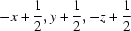 ; (v)
; (v) 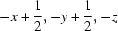 .
.
| ||||||||||||||||||||||
Data collection: CrysAlis Pro (Oxford Diffraction, 2006); cell refinement: CrysAlis RED (Oxford Diffraction, 2006); data reduction: CrysAlis RED (Oxford Diffraction, 2006); program(s) used to solve structure: SIR92 (Altomare et al., 1994); program(s) used to refine structure: CRYSTALS (Betteridge et al., 2003); molecular graphics: CAMERON (Watkin et al., 1996); software used to prepare material for publication: CRYSTALS.
Supporting information
contains datablocks global, I. DOI: 10.1107/S1600536809015438/fi2077sup1.cif
Structure factors: contains datablock I. DOI: 10.1107/S1600536809015438/fi2077Isup2.hkl
The title compound was prepared hydrothermally from a gel of composition Ga2O3: NiCl2.6H2O:10H3PO4:156H2O:0.1Si(OEt)4:5KH2PO4 which was heated at 433 K for 7 d in a Teflon-lined stainless steel autoclave. The solid product was collected by filtration, washed with deionized water and dried in air. The product consisted of large yellow faceted blocks of the title compound, which could be easily separated from unidentified white powder.
Prior to reflections with I<3σ(I) were omitted. The H atoms of the water molecule, H2O4, were located in a difference Fourier map. Their fractional coordinates were refined subject to bond length and angle restraints [O4–H = 0.85 (1) Å, H–O4–H = 109 (5) °] with isotropic displacement parameters fixed at 0.05 Å2.
Data collection: CrysAlis PRO (Oxford Diffraction, 2006); cell CrysAlis RED (Oxford Diffraction, 2006); data reduction: CrysAlis RED (Oxford Diffraction, 2006); program(s) used to solve structure: SIR92 (Altomare et al., 1994); program(s) used to refine structure: CRYSTALS (Betteridge et al., 2003); molecular graphics: CAMERON (Watkin et al., 1996); software used to prepare material for publication: CRYSTALS (Betteridge et al., 2003).
![[Figure 1]](./fi2077fig1thm.gif) | Fig. 1. Local coordination of the title compound with displacement ellipsoids drawn at the 50% probability level. H atoms are shown as spheres of arbitary radius. [Symmetry codes: (i) -x, y, -z + 1/2; (ii) x, -y, z + 1/2; (iii) -x, -y, -z; (iv) -x + 1/2, y + 1/2, -z + 1/2; (v) -x + 1/2, -y + 1/2, -z; (viii) x - 1/2, 1/2 - y, 1/2 + z; (ix) -x + 1/2, y + 1/2, z]. |
![[Figure 2]](./fi2077fig2thm.gif) | Fig. 2. View of the main channels running parallel to the [1 0 1] direction shown as (a) ball and stick and (b) polyhedral representation. The cross pore distance O1···O5x is 7.251 (1) Å. The colour of each polyhedron corresponds to the colour of the central atom as defined in Fig. 1. [Symmetry codes: (x) 1/2 - x, 1/2 - y, -z] |
![[Figure 3]](./fi2077fig3thm.gif) | Fig. 3. View along the c axis as (a) ball and stick and (b) polyhedral representation showing the elliptical channels bounded by eight membered rings. The shortest cross channel distances are 4.092 (2) and 4.360 (1) Å for O2···O2xi and O2···O6ix respectively. These channels intersect with the main channels shown in Fig.2 to form a 3-D pore network. [Symmetry codes: (ix) -x + 1/2, y + 1/2, z; (xi) -x, 1 - y, z]. |
| K[NiGa2(PO4)3(H2O)2] | F(000) = 1080 |
| Mr = 558.17 | Dx = 3.286 Mg m−3 |
| Monoclinic, C2/c | Mo Kα radiation, λ = 0.71073 Å |
| Hall symbol: -C 2yc | Cell parameters from 3597 reflections |
| a = 13.2095 (13) Å | θ = 3–32.4° |
| b = 10.1733 (9) Å | µ = 7.27 mm−1 |
| c = 8.8130 (9) Å | T = 150 K |
| β = 107.68 (1)° | Block, yellow |
| V = 1128.4 (2) Å3 | 0.09 × 0.08 × 0.06 mm |
| Z = 4 |
| Oxford Diffraction Xcalibur diffractometer | 1734 reflections with I > 2σ(I) |
| Graphite monochromator | Rint = 0.018 |
| ω/2θ scans | θmax = 32.6°, θmin = 2.6° |
| Absorption correction: multi-scan (CrysAlis RED; Oxford Diffraction, 2006) | h = −15→19 |
| Tmin = 0.54, Tmax = 0.65 | k = −15→15 |
| 3597 measured reflections | l = −13→11 |
| 1913 independent reflections |
| Refinement on F | Primary atom site location: structure-invariant direct methods |
| Least-squares matrix: full | Hydrogen site location: inferred from neighbouring sites |
| R[F2 > 2σ(F2)] = 0.022 | Only H-atom coordinates refined |
| wR(F2) = 0.025 | Method, part 1, Chebychev polynomial, (Watkin, 1994, Prince, 1982) [weight] = 1.0/[A0*T0(x) + A1*T1(x) ··· + An-1]*Tn-1(x)] where Ai are the Chebychev coefficients listed below and x = F /Fmax Method = Robust Weighting (Prince, 1982) W = [weight] * [1-(deltaF/6*sigmaF)2]2 Ai are: 18.9 -12.3 16.6 |
| S = 1.04 | (Δ/σ)max = 0.001 |
| 1667 reflections | Δρmax = 0.84 e Å−3 |
| 103 parameters | Δρmin = −0.91 e Å−3 |
| 3 restraints |
| K[NiGa2(PO4)3(H2O)2] | V = 1128.4 (2) Å3 |
| Mr = 558.17 | Z = 4 |
| Monoclinic, C2/c | Mo Kα radiation |
| a = 13.2095 (13) Å | µ = 7.27 mm−1 |
| b = 10.1733 (9) Å | T = 150 K |
| c = 8.8130 (9) Å | 0.09 × 0.08 × 0.06 mm |
| β = 107.68 (1)° |
| Oxford Diffraction Xcalibur diffractometer | 1913 independent reflections |
| Absorption correction: multi-scan (CrysAlis RED; Oxford Diffraction, 2006) | 1734 reflections with I > 2σ(I) |
| Tmin = 0.54, Tmax = 0.65 | Rint = 0.018 |
| 3597 measured reflections |
| R[F2 > 2σ(F2)] = 0.022 | 3 restraints |
| wR(F2) = 0.025 | Only H-atom coordinates refined |
| S = 1.04 | Δρmax = 0.84 e Å−3 |
| 1667 reflections | Δρmin = −0.91 e Å−3 |
| 103 parameters |
| x | y | z | Uiso*/Ueq | ||
| Ga1 | 0.172478 (11) | 0.075592 (15) | 0.069169 (16) | 0.0036 | |
| Ni1 | 0.0000 | 0.27385 (3) | 0.2500 | 0.0053 | |
| K1 | 0.0000 | 0.63513 (6) | 0.2500 | 0.0264 | |
| P1 | 0.0000 | 0.00118 (5) | 0.2500 | 0.0036 | |
| P2 | 0.20870 (3) | 0.37358 (4) | 0.17941 (4) | 0.0043 | |
| O1 | 0.05847 (8) | 0.09109 (11) | −0.11504 (12) | 0.0063 | |
| O2 | 0.09754 (9) | 0.39793 (11) | 0.18796 (14) | 0.0082 | |
| O3 | 0.07314 (9) | 0.09888 (11) | 0.19895 (13) | 0.0064 | |
| O4 | 0.09834 (9) | 0.29514 (12) | 0.48612 (14) | 0.0111 | |
| O5 | 0.20652 (8) | −0.08860 (10) | 0.16197 (12) | 0.0061 | |
| O6 | 0.27707 (8) | 0.04382 (11) | −0.04158 (13) | 0.0070 | |
| O7 | 0.23679 (8) | 0.22862 (11) | 0.15963 (13) | 0.0070 | |
| H1 | 0.135 (3) | 0.236 (3) | 0.547 (4) | 0.0500* | |
| H2 | 0.136 (3) | 0.361 (3) | 0.481 (5) | 0.0500* |
| U11 | U22 | U33 | U12 | U13 | U23 | |
| Ga1 | 0.00279 (8) | 0.00233 (9) | 0.00525 (8) | −0.00019 (4) | 0.00068 (5) | 0.00009 (4) |
| Ni1 | 0.00413 (11) | 0.00400 (12) | 0.00818 (12) | 0.0000 | 0.00228 (8) | 0.0000 |
| K1 | 0.0287 (3) | 0.0109 (2) | 0.0465 (4) | 0.0000 | 0.0215 (3) | 0.0000 |
| P1 | 0.00246 (18) | 0.0030 (2) | 0.00514 (19) | 0.0000 | 0.00089 (14) | 0.0000 |
| P2 | 0.00345 (15) | 0.00312 (15) | 0.00631 (14) | −0.00077 (10) | 0.00159 (11) | −0.00031 (10) |
| O1 | 0.0048 (4) | 0.0058 (4) | 0.0066 (4) | 0.0003 (3) | −0.0007 (3) | −0.0014 (3) |
| O2 | 0.0042 (4) | 0.0074 (4) | 0.0140 (4) | 0.0001 (3) | 0.0042 (3) | 0.0016 (4) |
| O3 | 0.0058 (4) | 0.0043 (4) | 0.0108 (4) | −0.0002 (3) | 0.0051 (3) | 0.0010 (3) |
| O4 | 0.0106 (5) | 0.0083 (4) | 0.0115 (5) | −0.0003 (4) | −0.0009 (4) | 0.0023 (4) |
| O5 | 0.0063 (4) | 0.0039 (4) | 0.0072 (4) | 0.0008 (3) | 0.0006 (3) | 0.0018 (3) |
| O6 | 0.0071 (4) | 0.0062 (4) | 0.0090 (4) | 0.0011 (3) | 0.0042 (3) | 0.0013 (3) |
| O7 | 0.0068 (4) | 0.0038 (4) | 0.0104 (4) | −0.0017 (3) | 0.0029 (3) | −0.0030 (3) |
| Ga1—O1 | 1.8556 (11) | P1—O1ii | 1.5279 (11) |
| Ga1—O3 | 1.9994 (11) | P1—O1iii | 1.5279 (11) |
| Ga1—O5 | 1.8541 (10) | P1—O3 | 1.5452 (11) |
| Ga1—O6 | 1.9455 (11) | P1—O3i | 1.5452 (11) |
| Ga1—O7 | 1.8357 (11) | P2—O2 | 1.5135 (11) |
| Ni1—O2 | 1.9951 (11) | P2—O5iv | 1.5510 (11) |
| Ni1—O2i | 1.9951 (11) | P2—O6v | 1.5348 (12) |
| Ni1—O3 | 2.1374 (11) | P2—O7 | 1.5434 (12) |
| Ni1—O3i | 2.1374 (11) | O4—H1 | 0.850 (10) |
| Ni1—O4 | 2.1030 (12) | O4—H2 | 0.848 (10) |
| Ni1—O4i | 2.1030 (12) | ||
| O1—Ga1—O3 | 89.49 (5) | O4i—Ni1—O4 | 168.18 (7) |
| O1—Ga1—O5 | 119.09 (5) | O1ii—P1—O1iii | 104.18 (9) |
| O1—Ga1—O6 | 94.97 (5) | O1ii—P1—O3 | 114.14 (6) |
| O1—Ga1—O7 | 116.97 (5) | O1iii—P1—O3 | 112.42 (6) |
| O3—Ga1—O5 | 88.16 (5) | O3i—P1—O1ii | 112.42 (6) |
| O3—Ga1—O6 | 174.93 (4) | O3i—P1—O1iii | 114.14 (6) |
| O3—Ga1—O7 | 87.06 (5) | O3i—P1—O3 | 99.94 (8) |
| O5—Ga1—O6 | 87.57 (5) | O2—P2—O7 | 115.61 (6) |
| O5—Ga1—O7 | 123.66 (5) | O5iv—P2—O2 | 111.12 (6) |
| O6—Ga1—O7 | 93.05 (5) | O5iv—P2—O6v | 110.43 (6) |
| O2i—Ni1—O2 | 101.49 (7) | O5iv—P2—O7 | 101.91 (6) |
| O2—Ni1—O3 | 95.65 (4) | O6v—P2—O2 | 107.68 (6) |
| O2i—Ni1—O3 | 162.84 (5) | O6v—P2—O7 | 110.02 (6) |
| O2—Ni1—O4 | 87.12 (5) | Ga1—O1—P1iii | 135.47 (7) |
| O2i—Ni1—O4 | 85.41 (5) | Ga1—O3—Ni1 | 129.51 (5) |
| O3i—Ni1—O2 | 162.84 (5) | Ga1—O3—P1 | 131.86 (7) |
| O3i—Ni1—O2i | 95.65 (4) | Ni1—O2—P2 | 128.84 (7) |
| O3i—Ni1—O3 | 67.23 (6) | Ni1—O3—P1 | 96.42 (5) |
| O3i—Ni1—O4 | 93.46 (4) | Ni1—O4—H1 | 128 (3) |
| O3i—Ni1—O4i | 96.38 (5) | Ni1—O4—H2 | 103 (3) |
| O4i—Ni1—O2 | 85.41 (5) | H1—O4—H2 | 111 (3) |
| O4i—Ni1—O2i | 87.12 (5) | Ga1—O5—P2vi | 129.28 (7) |
| O3—Ni1—O4 | 96.38 (5) | Ga1—O6—P2v | 125.62 (7) |
| O4i—Ni1—O3 | 93.46 (4) | Ga1—O7—P2 | 139.82 (7) |
| Symmetry codes: (i) −x, y, −z+1/2; (ii) x, −y, z+1/2; (iii) −x, −y, −z; (iv) −x+1/2, y+1/2, −z+1/2; (v) −x+1/2, −y+1/2, −z; (vi) −x+1/2, y−1/2, −z+1/2. |
| D—H···A | D—H | H···A | D···A | D—H···A |
| O4—H1···O5ii | 0.85 (1) | 1.90 (1) | 2.741 (2) | 172 |
| O4—H2···O6iv | 0.85 (1) | 2.16 (2) | 2.976 (2) | 161 |
| Symmetry codes: (ii) x, −y, z+1/2; (iv) −x+1/2, y+1/2, −z+1/2. |
Experimental details
| Crystal data | |
| Chemical formula | K[NiGa2(PO4)3(H2O)2] |
| Mr | 558.17 |
| Crystal system, space group | Monoclinic, C2/c |
| Temperature (K) | 150 |
| a, b, c (Å) | 13.2095 (13), 10.1733 (9), 8.8130 (9) |
| β (°) | 107.68 (1) |
| V (Å3) | 1128.4 (2) |
| Z | 4 |
| Radiation type | Mo Kα |
| µ (mm−1) | 7.27 |
| Crystal size (mm) | 0.09 × 0.08 × 0.06 |
| Data collection | |
| Diffractometer | Oxford Diffraction Xcalibur diffractometer |
| Absorption correction | Multi-scan (CrysAlis RED; Oxford Diffraction, 2006) |
| Tmin, Tmax | 0.54, 0.65 |
| No. of measured, independent and observed [I > 2σ(I)] reflections | 3597, 1913, 1734 |
| Rint | 0.018 |
| (sin θ/λ)max (Å−1) | 0.758 |
| Refinement | |
| R[F2 > 2σ(F2)], wR(F2), S | 0.022, 0.025, 1.04 |
| No. of reflections | 1667 |
| No. of parameters | 103 |
| No. of restraints | 3 |
| H-atom treatment | Only H-atom coordinates refined |
| Δρmax, Δρmin (e Å−3) | 0.84, −0.91 |
Computer programs: CrysAlis PRO (Oxford Diffraction, 2006), CrysAlis RED (Oxford Diffraction, 2006), SIR92 (Altomare et al., 1994), CRYSTALS (Betteridge et al., 2003), CAMERON (Watkin et al., 1996).
| Ga1—O1 | 1.8556 (11) | Ni1—O4i | 2.1030 (12) |
| Ga1—O3 | 1.9994 (11) | P1—O1ii | 1.5279 (11) |
| Ga1—O5 | 1.8541 (10) | P1—O1iii | 1.5279 (11) |
| Ga1—O6 | 1.9455 (11) | P1—O3 | 1.5452 (11) |
| Ga1—O7 | 1.8357 (11) | P1—O3i | 1.5452 (11) |
| Ni1—O2 | 1.9951 (11) | P2—O2 | 1.5135 (11) |
| Ni1—O2i | 1.9951 (11) | P2—O5iv | 1.5510 (11) |
| Ni1—O3 | 2.1374 (11) | P2—O6v | 1.5348 (12) |
| Ni1—O3i | 2.1374 (11) | P2—O7 | 1.5434 (12) |
| Ni1—O4 | 2.1030 (12) | ||
| O1—Ga1—O3 | 89.49 (5) | O4i—Ni1—O3 | 93.46 (4) |
| O1—Ga1—O5 | 119.09 (5) | O4i—Ni1—O4 | 168.18 (7) |
| O1—Ga1—O6 | 94.97 (5) | O1ii—P1—O1iii | 104.18 (9) |
| O1—Ga1—O7 | 116.97 (5) | O1ii—P1—O3 | 114.14 (6) |
| O3—Ga1—O5 | 88.16 (5) | O1iii—P1—O3 | 112.42 (6) |
| O3—Ga1—O6 | 174.93 (4) | O3i—P1—O1ii | 112.42 (6) |
| O3—Ga1—O7 | 87.06 (5) | O3i—P1—O1iii | 114.14 (6) |
| O5—Ga1—O6 | 87.57 (5) | O3i—P1—O3 | 99.94 (8) |
| O5—Ga1—O7 | 123.66 (5) | O2—P2—O7 | 115.61 (6) |
| O6—Ga1—O7 | 93.05 (5) | O5iv—P2—O2 | 111.12 (6) |
| O2i—Ni1—O2 | 101.49 (7) | O5iv—P2—O6v | 110.43 (6) |
| O2—Ni1—O3 | 95.65 (4) | O5iv—P2—O7 | 101.91 (6) |
| O2i—Ni1—O3 | 162.84 (5) | O6v—P2—O2 | 107.68 (6) |
| O2—Ni1—O4 | 87.12 (5) | O6v—P2—O7 | 110.02 (6) |
| O2i—Ni1—O4 | 85.41 (5) | Ga1—O1—P1iii | 135.47 (7) |
| O3i—Ni1—O2 | 162.84 (5) | Ga1—O3—Ni1 | 129.51 (5) |
| O3i—Ni1—O2i | 95.65 (4) | Ga1—O3—P1 | 131.86 (7) |
| O3i—Ni1—O3 | 67.23 (6) | Ni1—O2—P2 | 128.84 (7) |
| O3i—Ni1—O4 | 93.46 (4) | Ni1—O3—P1 | 96.42 (5) |
| O3i—Ni1—O4i | 96.38 (5) | Ga1—O5—P2vi | 129.28 (7) |
| O4i—Ni1—O2 | 85.41 (5) | Ga1—O6—P2v | 125.62 (7) |
| O4i—Ni1—O2i | 87.12 (5) | Ga1—O7—P2 | 139.82 (7) |
| O3—Ni1—O4 | 96.38 (5) |
| Symmetry codes: (i) −x, y, −z+1/2; (ii) x, −y, z+1/2; (iii) −x, −y, −z; (iv) −x+1/2, y+1/2, −z+1/2; (v) −x+1/2, −y+1/2, −z; (vi) −x+1/2, y−1/2, −z+1/2. |
| D—H···A | D—H | H···A | D···A | D—H···A |
| O4—H1···O5ii | 0.85 (1) | 1.896 (11) | 2.741 (2) | 172 |
| O4—H2···O6iv | 0.85 (1) | 2.163 (17) | 2.976 (2) | 161 |
| Symmetry codes: (ii) x, −y, z+1/2; (iv) −x+1/2, y+1/2, −z+1/2. |
Acknowledgements
The authors thank the EPSRC for a grant in support of a single-crystal diffractometer.
References
 Altomare, A., Cascarano, G., Giacovazzo, C., Guagliardi, A., Burla, M. C., Polidori, G. & Camalli, M. (1994). J. Appl. Cryst. 27, 435. CrossRef Web of Science IUCr Journals Google Scholar
Baerlocher, C., Meier, W. M. & Olson, D. H. (2001). Atlas of Zeolite Structure Types (updates at http://www.iza-structure.org/ ), 5th ed. London: Elsevier. Google Scholar
Betteridge, P. W., Carruthers, J. R., Cooper, R. I., Prout, K. & Watkin, D. J. (2003). J. Appl. Cryst. 36, 1487. Web of Science CrossRef IUCr Journals Google Scholar
Bieniok, A., Brendel, U., Lottermoser, W. & Amthauer, G. (2008). Z. Kristallogr. 223, 186–194. Web of Science CrossRef CAS Google Scholar
Brese, N. E. & O'Keeffe, M. (1991). Acta Cryst. B47, 192–197. CrossRef CAS Web of Science IUCr Journals Google Scholar
Cheetham, A. K., Ferey, G. & Loiseau, T. (1999). Angew. Chem. Int. Ed. 38, 3268–3292. Web of Science CrossRef CAS Google Scholar
Chippindale, A. M., Cowley, A. R. & Bond, A. D. (1998). Acta Cryst. C54, IUC9800061. CrossRef IUCr Journals Google Scholar
Chippindale, A. M., Cowley, A. R. & Walton, R. I. (1996). J. Mater. Chem. 6, 611–614. CrossRef CAS Web of Science Google Scholar
Harrison, W. T. A. (2002). Curr. Opin. Solid State Mater. Sci. 6, 407–413. Web of Science CrossRef CAS Google Scholar
Lesage, J., Guesdon, A., Raveau, B. & Petříček, V. (2004). J. Solid State Chem. 177, 3581–3589. Web of Science CrossRef CAS Google Scholar
Lii, K.-H. & Huang, C.-Y. (1995). J. Chem. Soc. Dalton Trans. pp. 571–574. CrossRef Web of Science Google Scholar
Lin, C.-H. & Wang, S. L. (2005). Inorg. Chem. 44, 251–257. Web of Science CSD CrossRef PubMed CAS Google Scholar
Maspoch, D., Ruiz-Molina, D. & Veciana, J. (2007). Chem. Soc. Rev. 6 770–818. Web of Science CrossRef Google Scholar
Meyer, L. M. & Haushalter, R. C. (1994). Chem. Mater. 6, 349–350. CrossRef CAS Web of Science Google Scholar
Oxford Diffraction, (2006). CrysAlis RED and CrysAlis Pro. Oxford Diffraction Ltd, Abingdon, England. Google Scholar
Panz, C., Polborn, K. & Behrens, P. (1998). Inorg. Chim. Acta, 269, 73–82. Web of Science CrossRef CAS Google Scholar
Prince, E. (1982). Mathematical Techniques in Crystallography and Materials Science. New York: Springer-Verlag. Google Scholar
Rocha, J. & Lin, Z. (2005). Reviews in Mineralogy and Geochemistry 57: Micro- and Mesoporous Mineral Phases, edited by G. Ferraris & S. Merlino, pp. 173–201. Mineralogical Society of America. Google Scholar
Watkin, D. (1994). Acta Cryst. A50, 411–437. CrossRef CAS Web of Science IUCr Journals Google Scholar
Watkin, D. J., Prout, C. K. & Pearce, L. J. (1996). CAMERON. Chemical Crystallography Laboratory, Oxford, England. Google Scholar
This is an open-access article distributed under the terms of the Creative Commons Attribution (CC-BY) Licence, which permits unrestricted use, distribution, and reproduction in any medium, provided the original authors and source are cited.
| CRYSTALLOGRAPHIC COMMUNICATIONS |


Although the majority of heterometal substituted gallophosphates, MeGaPOs, contain MO4 (M = Me or Ga) and PO4 units (Baerlocher et al., 2001), some are known in which the metal atoms have non-tetrahedral geometries. For example, NGP-1 (Lin & Wang, 2005), the only organically templated NiGaPO reported to date, contains Ni and Ga disordered over the same octahedral metal sites, together with GaO5 and PO4 units. K[NiGa2(PO4)3(H2O)2] is assembled from the same polyhedra as NGP-1 and is isostructural with a number of ammonium transition-metal gallophosphates, NH4[MeGa2(PO4)3(H2O)2] (Me = Mn (Chippindale et al., 1998), Fe, Ni (Bieniok et al., 2008), Co (Chippindale et al., 1996)) and has an aluminium analogue, K[NiAl2(PO4)3(H2O)2] (Meyer & Haushalter, 1994). The same structure type occurs in Cs[Fe3(PO4)3(H2O)2] (Lii & Huang, 1995) and NH4[CoAl2(PO4)3(H2O)2] (Panz et al., 1998) and is related to that of (NH4)3Ga2(PO4)3 (Lesage et al., 2004).
The two phosphorus atoms have tetrahedral geometry (P1, point symmetry C2v; P2,1). Unlike in NGP-1, the metal atoms are located in two distinct sites; Ga1 in a GaO5 trigonal bipyramid (1) and Ni1 in an NiO4(H2O)2 distorted octahedron (C2v), in which the terminal water molecules, H2O4, lie trans to each other (Fig. 1). Two of the other oxygen atoms in the NiO6 unit, O2 and O2i, are two coordinate whilst O3 and O3i are three coordinate. As expected, the M—O3 (M = Ni, Ga) and P1—O3 bond lengths are the longest M—O and P–O bond lengths observed in the structure. Bond-valence sums (Brese & OKeeffe, 1991) for P1, P2, Ga1 and Ni1 are 4.80, 4.81, 3.22 and 1.93. respectively, which together with the yellow colour of the crystals, confirm the presence of Ni2+ in the structure.
The GaO5, NiO6 and PO4 units link together through edge- and vertex-sharing arrangements to give a three-dimensional framework of composition [NiGa2(PO4)3(H2O)2]-. A set of approximately circular channels, running parallel to the [101] direction, contain the water molecules and potassium ions (Fig. 2). A second set of channels, elliptical in shape, run parallel to the c axis (Fig. 3) and intersect with the first set to generate a three-dimensional pore network.
The potassium atom lies in a very distorted coordination environment with six near oxygen atoms (K1···O in range 2.865 (1) to 3.072 (1) Å) with two additional O atoms at 3.397 (1) and two at 3.456 (1) Å). H2O4 is also involved in hydrogen bonding to Ga—O—P bridging oxygen atoms.