 | Acta Crystallographica Section E Acta Crystallographica Section E CRYSTALLOGRAPHIC COMMUNICATIONS |


 journal menu


organic compounds
| CRYSTALLOGRAPHIC COMMUNICATIONS |
 access
1H-Pyrazolo[4,3-g]benzothiazol-7-amine

aLaboratorio 233, Departamento de Química, Universidad Simon Bolivar (USB), Apartado 47206, Caracas 1080-A, Venezuela, and bCentro de Química, Instituto Venezolano de Investigaciones Científicas (IVIC), Apartado 21827, Caracas 1020-A, Venezuela
*Correspondence e-mail: [email protected], [email protected]
The molecule of the title compound, C8H6N4S, is almost planar [maximum deviation from the mean plane = 0.020 (1) Å for the S atom]. In the crystal, a supramolecular three-dimensional arrangement arises from N—H⋯N hydrogen bonds and weak aromatic stacking interactions along the a axis [centroid–centroid separation = 3.582 (2) Å].
Related literature
For background on DNA intercalation agents, see: Cagnoli et al. (1968![[Cagnoli, N., Martani, A. & Fravolini, A. (1968). Ann. Chim. pp. 823-837.]](../../../../../../logos/arrows/e_arr.gif "Cagnoli, N., Martani, A. & Fravolini, A. (1968). Ann. Chim. pp. 823-837.") ); Martínez & Chacón-García (2005); Chakrabarty et al. (2008). For further synthetic details, see: Salazar & Dorta (2004).
); Martínez & Chacón-García (2005); Chakrabarty et al. (2008). For further synthetic details, see: Salazar & Dorta (2004).
![[Scheme 1]](hb2931scheme1.gif)
Experimental
Crystal data
|
Refinement
|
| |||||||||||||||||||||||||||
 ; (ii)
  ; (iii)
  .
. Data collection: CrystalClear (Rigaku, 2002); cell refinement: CrystalClear; data reduction: CrystalStructure (Rigaku/MSC, 2004); program(s) used to solve structure: SHELXTL-NT (Sheldrick, 2008); program(s) used to refine structure: SHELXTL-NT; molecular graphics: SHELXTL-NT and DIAMOND (Brandenburg, 1999); software used to prepare material for publication: SHELXTL-NT and PLATON (Spek, 2009).
Supporting information
contains datablock I. DOI: 10.1107/S1600536809012550/hb2931sup1.cif
Structure factors: contains datablock I. DOI: 10.1107/S1600536809012550/hb2931Isup2.hkl
To a solution of 6-aminoindazole (2.00 g, 15 mmol) and NH4SCN (2.29 g, 30 mmol) in acetic acid (25 ml) was added dropwise pentylpyridinium tribromide (5.86 g, 15 mmol) (Salazar & Dorta, 2004). The resulting solution was stirred for 3 h at room temperature and then, 3 h at 80°C. The reaction mixture was then poured into ice (50 g), the precipitate was filtered and discarded. The resulting solution was neutralized with K2CO3, and the formed precipitate was filtered, washed with AcOEt and dried; to give a yellow powder corresponding to the title compound. Yield: 1.80 g (63%). The melting point (uncorrected) was measured with a Fischer-Johns micro hot-stage apparatus: d 563 K.
The yellow powder was dissolved in a minimum amount of 1,4-dioxane and the solution was left for several days at room temperature, during which the solution gradually reduced its volume to give light brown blocks of (I).
IR data [KBr pellets, (cm-1)]: 3367, 3314, 3181, 1629. 1H NMR [500 MHz, DMSO-d6, d (p.p.m.)]: 13.04 (brs, 1H, NH), 8.05 (s, 1H,), 7.57 (d, 1H, J = 6.84 Hz), 7.45 (brs, 2H, NH2), 7.21 (d, 1H, J = 6.88 Hz).13 C NMR [126 MHz, DMSO-d6, d (p.p.m.)]: 166.97 (C6), 152.21 (C5), 135.41 (C1), 134.99 (C2), 119.13 (C8), 118.01 (C3), 113.95 (C4), 109.39 (C7).
The N-bound H atoms were located in difference maps and refined as riding in their as found relative positions with Uiso(H) = 1.2Ueq(N). The C-bound H atoms were placed in idealized positions (C—H = 0.93–0.98 Å) and refined as riding with Uiso(H) = 1.2Ueq(C).
Data collection: CrystalClear (Rigaku, 2002); cell CrystalClear (Rigaku, 2002); data reduction: CrystalStructure (Rigaku/MSC, 2004); program(s) used to solve structure: SHELXTL-NT (Sheldrick, 2008); program(s) used to refine structure: SHELXTL-NT (Sheldrick, 2008); molecular graphics: SHELXTL-NT (Sheldrick, 2008) and DIAMOND (Brandenburg, 1999); software used to prepare material for publication: SHELXTL-NT (Sheldrick, 2008) and PLATON (Spek, 2009).
![[Figure 1]](./hb2931fig1thm.gif) | Fig. 1. The molecular structure of (I), showing displacement elipsoids drawn at the 35% probability level and H atoms shown as spheres of arbitrary radius. |
![[Figure 2]](./hb2931fig2thm.gif) | Fig. 2. View of the hydrogen bonded layer in the bc plane in (I). The H atoms have been omitted for clarity and dashed lines indicate the donor···acceptor interactions for hydrogen bonds. |
| C8H6N4S | F(000) = 392 |
| Mr = 190.23 | Dx = 1.549 Mg m−3 |
| Monoclinic, P21/c | Mo Kα radiation, λ = 0.71070 Å |
| Hall symbol: -P 2ybc | Cell parameters from 5546 reflections |
| a = 4.499 (2) Å | θ = 1.4–27.8° |
| b = 14.979 (8) Å | µ = 0.35 mm−1 |
| c = 12.112 (7) Å | T = 293 K |
| β = 92.442 (19)° | Block, light brown |
| V = 815.6 (7) Å3 | 0.50 × 0.48 × 0.28 mm |
| Z = 4 |
| Rigaku AFC7S Mercury diffractometer | 1564 independent reflections |
| Radiation source: Normal-focus sealed tube | 1356 reflections with I > 2σ(I) |
| Graphite monochromator | Rint = 0.027 |
| ω scans | θmax = 27.8°, θmin = 2.2° |
| Absorption correction: multi-scan (Jacobson, 1998) | h = −5→5 |
| Tmin = 0.837, Tmax = 0.904 | k = −17→17 |
| 8415 measured reflections | l = −10→13 |
| Refinement on F2 | Primary atom site location: structure-invariant direct methods |
| Least-squares matrix: full | Secondary atom site location: difference Fourier map |
| R[F2 > 2σ(F2)] = 0.043 | Hydrogen site location: inferred from neighbouring sites |
| wR(F2) = 0.117 | H-atom parameters constrained |
| S = 1.12 | w = 1/[σ2(Fo2) + (0.0537P)2 + 0.4259P] where P = (Fo2 + 2Fc2)/3 |
| 1564 reflections | (Δ/σ)max = 0.001 |
| 118 parameters | Δρmax = 0.21 e Å−3 |
| 0 restraints | Δρmin = −0.39 e Å−3 |
| C8H6N4S | V = 815.6 (7) Å3 |
| Mr = 190.23 | Z = 4 |
| Monoclinic, P21/c | Mo Kα radiation |
| a = 4.499 (2) Å | µ = 0.35 mm−1 |
| b = 14.979 (8) Å | T = 293 K |
| c = 12.112 (7) Å | 0.50 × 0.48 × 0.28 mm |
| β = 92.442 (19)° |
| Rigaku AFC7S Mercury diffractometer | 1564 independent reflections |
| Absorption correction: multi-scan (Jacobson, 1998) | 1356 reflections with I > 2σ(I) |
| Tmin = 0.837, Tmax = 0.904 | Rint = 0.027 |
| 8415 measured reflections |
| R[F2 > 2σ(F2)] = 0.043 | 0 restraints |
| wR(F2) = 0.117 | H-atom parameters constrained |
| S = 1.12 | Δρmax = 0.21 e Å−3 |
| 1564 reflections | Δρmin = −0.39 e Å−3 |
| 118 parameters |
Geometry. All e.s.d.'s (except the e.s.d. in the dihedral angle between two l.s. planes) are estimated using the full covariance matrix. The cell e.s.d.'s are taken into account individually in the estimation of e.s.d.'s in distances, angles and torsion angles; correlations between e.s.d.'s in cell parameters are only used when they are defined by crystal symmetry. An approximate (isotropic) treatment of cell e.s.d.'s is used for estimating e.s.d.'s involving l.s. planes. |
Refinement. Refinement of F2 against ALL reflections. The weighted R-factor wR and goodness of fit S are based on F2, conventional R-factors R are based on F, with F set to zero for negative F2. The threshold expression of F2 > σ(F2) is used only for calculating R-factors(gt) etc. and is not relevant to the choice of reflections for refinement. R-factors based on F2 are statistically about twice as large as those based on F, and R- factors based on ALL data will be even larger. |
| x | y | z | Uiso*/Ueq | ||
| S1 | 1.01959 (12) | 0.29819 (4) | 0.80928 (4) | 0.0375 (2) | |
| N1 | 0.4558 (5) | 0.03847 (13) | 0.69844 (15) | 0.0469 (5) | |
| N2 | 0.6362 (4) | 0.11194 (12) | 0.70868 (14) | 0.0399 (5) | |
| H2 | 0.7275 | 0.1305 | 0.6432 | 0.048* | |
| N3 | 0.8801 (4) | 0.31237 (12) | 1.01512 (15) | 0.0374 (4) | |
| N4 | 1.2153 (5) | 0.42105 (13) | 0.95801 (16) | 0.0467 (5) | |
| H6 | 1.3202 | 0.4479 | 0.8999 | 0.056* | |
| H5 | 1.2408 | 0.4424 | 1.0345 | 0.056* | |
| C1 | 0.3414 (6) | 0.02732 (16) | 0.79596 (19) | 0.0447 (6) | |
| H1 | 0.2103 | −0.0183 | 0.8125 | 0.054* | |
| C2 | 0.4424 (5) | 0.09335 (14) | 0.87253 (17) | 0.0364 (5) | |
| C3 | 0.3893 (5) | 0.11384 (15) | 0.98363 (18) | 0.0425 (5) | |
| H3 | 0.2600 | 0.0790 | 1.0233 | 0.051* | |
| C4 | 0.5305 (5) | 0.18567 (15) | 1.03243 (18) | 0.0408 (5) | |
| H4 | 0.4976 | 0.1996 | 1.1057 | 0.049* | |
| C5 | 0.7267 (5) | 0.23892 (14) | 0.97160 (16) | 0.0352 (5) | |
| C6 | 1.0420 (5) | 0.34903 (14) | 0.94037 (17) | 0.0354 (5) | |
| C7 | 0.7767 (5) | 0.22046 (13) | 0.86132 (16) | 0.0319 (5) | |
| C8 | 0.6336 (5) | 0.14676 (14) | 0.81177 (16) | 0.0333 (5) |
| U11 | U22 | U33 | U12 | U13 | U23 | |
| S1 | 0.0429 (4) | 0.0374 (4) | 0.0325 (4) | −0.0007 (2) | 0.0051 (2) | 0.00195 (19) |
| N1 | 0.0621 (14) | 0.0372 (11) | 0.0414 (11) | −0.0055 (9) | 0.0022 (9) | −0.0022 (8) |
| N2 | 0.0526 (12) | 0.0365 (10) | 0.0308 (10) | −0.0003 (9) | 0.0058 (8) | −0.0021 (7) |
| N3 | 0.0424 (11) | 0.0372 (10) | 0.0326 (10) | 0.0027 (8) | 0.0028 (8) | −0.0032 (7) |
| N4 | 0.0574 (13) | 0.0421 (11) | 0.0405 (11) | −0.0088 (9) | 0.0014 (9) | 0.0000 (8) |
| C1 | 0.0550 (15) | 0.0365 (12) | 0.0426 (13) | −0.0047 (10) | 0.0028 (10) | 0.0023 (9) |
| C2 | 0.0414 (13) | 0.0312 (11) | 0.0367 (11) | 0.0028 (9) | 0.0031 (9) | 0.0043 (8) |
| C3 | 0.0489 (14) | 0.0417 (13) | 0.0375 (12) | −0.0020 (10) | 0.0084 (10) | 0.0051 (9) |
| C4 | 0.0503 (14) | 0.0439 (13) | 0.0290 (11) | 0.0011 (10) | 0.0091 (10) | 0.0018 (8) |
| C5 | 0.0385 (12) | 0.0340 (11) | 0.0331 (11) | 0.0060 (9) | 0.0029 (8) | 0.0005 (8) |
| C6 | 0.0363 (12) | 0.0334 (11) | 0.0364 (11) | 0.0055 (9) | −0.0002 (8) | 0.0019 (8) |
| C7 | 0.0346 (12) | 0.0323 (11) | 0.0289 (10) | 0.0054 (9) | 0.0038 (8) | 0.0016 (8) |
| C8 | 0.0384 (12) | 0.0312 (11) | 0.0303 (10) | 0.0083 (9) | 0.0011 (8) | 0.0007 (8) |
| S1—C7 | 1.734 (2) | C1—C2 | 1.418 (3) |
| S1—C6 | 1.760 (2) | C1—H1 | 0.9300 |
| N1—C1 | 1.319 (3) | C2—C8 | 1.405 (3) |
| N1—N2 | 1.370 (3) | C2—C3 | 1.411 (3) |
| N2—C8 | 1.354 (3) | C3—C4 | 1.371 (3) |
| N2—H2 | 0.9500 | C3—H3 | 0.9300 |
| N3—C6 | 1.307 (3) | C4—C5 | 1.419 (3) |
| N3—C5 | 1.391 (3) | C4—H4 | 0.9300 |
| N4—C6 | 1.343 (3) | C5—C7 | 1.392 (3) |
| N4—H6 | 0.9529 | C7—C8 | 1.400 (3) |
| N4—H5 | 0.9822 | ||
| C7—S1—C6 | 88.59 (10) | C2—C3—H3 | 120.4 |
| C1—N1—N2 | 105.85 (18) | C3—C4—C5 | 120.3 (2) |
| C8—N2—N1 | 111.39 (18) | C3—C4—H4 | 119.9 |
| C8—N2—H2 | 132.7 | C5—C4—H4 | 119.9 |
| N1—N2—H2 | 115.8 | N3—C5—C7 | 115.03 (19) |
| C6—N3—C5 | 110.62 (18) | N3—C5—C4 | 123.89 (19) |
| C6—N4—H6 | 121.6 | C7—C5—C4 | 121.1 (2) |
| C6—N4—H5 | 117.1 | N3—C6—N4 | 124.3 (2) |
| H6—N4—H5 | 121.2 | N3—C6—S1 | 115.53 (17) |
| N1—C1—C2 | 111.8 (2) | N4—C6—S1 | 120.12 (16) |
| N1—C1—H1 | 124.1 | C5—C7—C8 | 118.54 (19) |
| C2—C1—H1 | 124.1 | C5—C7—S1 | 110.22 (16) |
| C8—C2—C3 | 120.5 (2) | C8—C7—S1 | 131.23 (16) |
| C8—C2—C1 | 103.94 (19) | N2—C8—C7 | 132.6 (2) |
| C3—C2—C1 | 135.5 (2) | N2—C8—C2 | 107.05 (19) |
| C4—C3—C2 | 119.2 (2) | C7—C8—C2 | 120.32 (19) |
| C4—C3—H3 | 120.4 |
| D—H···A | D—H | H···A | D···A | D—H···A |
| N2—H2···N3i | 0.95 | 1.92 | 2.864 (3) | 170 |
| N4—H5···N1ii | 0.98 | 2.19 | 3.123 (3) | 158 |
| N4—H6···N1iii | 0.95 | 2.09 | 3.019 (3) | 164 |
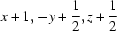
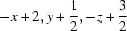
| Symmetry codes: (i) x, −y+1/2, z−1/2; (ii) x+1, −y+1/2, z+1/2; (iii) −x+2, y+1/2, −z+3/2. |
Experimental details
| Crystal data | |
| Chemical formula | C8H6N4S |
| Mr | 190.23 |
| Crystal system, space group | Monoclinic, P21/c |
| Temperature (K) | 293 |
| a, b, c (Å) | 4.499 (2), 14.979 (8), 12.112 (7) |
| β (°) | 92.442 (19) |
| V (Å3) | 815.6 (7) |
| Z | 4 |
| Radiation type | Mo Kα |
| µ (mm−1) | 0.35 |
| Crystal size (mm) | 0.50 × 0.48 × 0.28 |
| Data collection | |
| Diffractometer | Rigaku AFC7S Mercury diffractometer |
| Absorption correction | Multi-scan (Jacobson, 1998) |
| Tmin, Tmax | 0.837, 0.904 |
| No. of measured, independent and observed [I > 2σ(I)] reflections | 8415, 1564, 1356 |
| Rint | 0.027 |
| (sin θ/λ)max (Å−1) | 0.656 |
| Refinement | |
| R[F2 > 2σ(F2)], wR(F2), S | 0.043, 0.117, 1.12 |
| No. of reflections | 1564 |
| No. of parameters | 118 |
| H-atom treatment | H-atom parameters constrained |
| Δρmax, Δρmin (e Å−3) | 0.21, −0.39 |
Computer programs: CrystalClear (Rigaku, 2002), CrystalStructure (Rigaku/MSC, 2004), SHELXTL-NT (Sheldrick, 2008) and DIAMOND (Brandenburg, 1999), SHELXTL-NT (Sheldrick, 2008) and PLATON (Spek, 2009).
| D—H···A | D—H | H···A | D···A | D—H···A |
| N2—H2···N3i | 0.95 | 1.92 | 2.864 (3) | 170 |
| N4—H5···N1ii | 0.98 | 2.19 | 3.123 (3) | 158 |
| N4—H6···N1iii | 0.95 | 2.09 | 3.019 (3) | 164 |
| Symmetry codes: (i) x, −y+1/2, z−1/2; (ii) x+1, −y+1/2, z+1/2; (iii) −x+2, y+1/2, −z+3/2. |
Acknowledgements
The authors thank DID Universidad Simón Bolívar for financial support (project: S1–IN–CB–001–08) and FONACIT–MCT Venezuela (project: LAB-199700821).
References
 Brandenburg, K. (1999). DIAMOND. Crystal Impact GbR, Bonn,Germany. Google Scholar
Cagnoli, N., Martani, A. & Fravolini, A. (1968). Ann. Chim. pp. 823–837. Google Scholar
Chakrabarty, M., Kundu, T., Arima, S. & Harigaya, Y. (2008). Tetrahedron, 64, 6711–6723. Web of Science CrossRef CAS Google Scholar
Jacobson, R. (1998). Private communication to the Rigaku Corporation, Tokyo, Japan. Google Scholar
Martínez, R. & Chacón-García, L. (2005). Curr. Med. Chem. 12, 127–151. Web of Science PubMed Google Scholar
Rigaku (2002). CrystalClear. Rigaku Corporation, Tokyo, Japan. Google Scholar
Rigaku/MSC (2004). CrystalStructure. Rigaku/MSC, The Woodlands, Texas, USA. Google Scholar
Salazar, J. & Dorta, R. (2004). Synlett. 7, 1318–1320. Web of Science CrossRef Google Scholar
Sheldrick, G. M. (2008). Acta Cryst. A64, 112–122. Web of Science CrossRef CAS IUCr Journals Google Scholar
Spek, A. L. (2009). Acta Cryst. D65, 148–155. Web of Science CrossRef CAS IUCr Journals Google Scholar
This is an open-access article distributed under the terms of the Creative Commons Attribution (CC-BY) Licence, which permits unrestricted use, distribution, and reproduction in any medium, provided the original authors and source are cited.
| CRYSTALLOGRAPHIC COMMUNICATIONS |


Most of the significant advances against diseases have been made by designing and testing new structures, which are often heteroaromatic derivatives. Actually, the discovery of new compounds with antitumoral activity has become one of the most important goals in medicinal chemistry. One interesting group of potential chemotherapeutic agents includes molecules which interact with DNA like intercalator agents (Martínez & Chacón-García, 2005). Intercalation occurs when ligands of an appropriate size and chemical nature, fit themselves in between base pairs of DNA. Such ligands are mostly polycyclic, aromatic and planar. These kinds of agents are used in chemotherapeutic treatment to inhibit DNA replication in rapidly growing cancer cells. The title compound (I) is a polycyclic, aromatic and heterocyclic molecule and could be used to develop a new type of DNA intercalators agents (Chakrabarty et al. 2008).
The molecular structure is shown in figure 1, with its respective labels. The molecule adopts a conformation essenciality planar, with maximum deviation of the mean plane of 0.020 (1)Å for atom S1. The crystal structure of (I), consists of the self-assembly of the molecules through hydrogen bonding interactions of the kind N—H···N. The crystal packing (Fig. 2), consists of infinite chains in zigzag along the b axis generated by intermolecular interactions of hydrogen bond between the amino group and N atom of the imidazole ring [N1···N4 = 3.019 (3)Å]. These chains are connected through the interaction between the atoms N2 and N3 forming a two-dimensional wavy-like arrangement in the bc plane These layers are stacking through weak π–π interactions along the a axis (Cg3···Cg1, where Cg3 = C2/C3/C4/C5/C7/C8 and Cg1 = S1/C6/N3/C5/C7) together with an additional hydrogen bond lead to the formation of a three-dimensional hydrogen bonded network.