 | Acta Crystallographica Section E Acta Crystallographica Section E CRYSTALLOGRAPHIC COMMUNICATIONS |


 journal menu


metal-organic compounds
| CRYSTALLOGRAPHIC COMMUNICATIONS |
 access
Bis(2,6-diamino-3,5-dibromopyridinium) hexabromidostannate(IV)

aFaculty of Information Technology and Science, Al-Balqa'a Applied University, Salt, Jordan, bDepartment of Chemistry, University of Jordan, Amman, Jordan, and cDepartment of Chemistry, Al al-Bayt University, Mafraq 25113, Jordan
*Correspondence e-mail: [email protected]
The of the title compound, (C5H6Br2N3)2[SnBr6], contains one cation and one half-anion in which the Sn atom is located on a crystallographic centre of inversion and is in a quasi-octahedral geometry. The crystal structure is assembled via hydrogen-bonding interactions of two kinds, N(pyridine/amine)—H⋯Br—Sn, along with C—Br⋯Br—Sn interactions [3.4925 (19) Å]. The cations are involved in π–π stacking, which adds an extra supramolecularity as it presents a strong case of offset-face-to-face motifs [centroid–centroid distance = 3.577 (3) Å]. The intermolecular hydrogen bonds, short Br⋯Br interactions and π–π stacking result in the formation of a three-dimensional supramolecular architecture.
Related literature
For general background to hybrid organic–inorganic compounds, see: Aruta et al. (2005![[Aruta, C., Licci, F., Zappettini, A., Bolzoni, F., Rastelli, F., Ferro, P. & Besagni, T. (2005). Appl. Phys. A, 81, 963-968.]](../../../../../../logos/arrows/e_arr.gif "Aruta, C., Licci, F., Zappettini, A., Bolzoni, F., Rastelli, F., Ferro, P. & Besagni, T. (2005). Appl. Phys. A, 81, 963-968.") ); Hill (1998); Kagan et al. (1999); Knutson et al. (2005); Raptopoulou et al. (2002). For related structures, see: Al-Far & Ali (2007); Al-Far, Ali & Al-Sou'od (2007); Ali & Al-Far (2007); Ali et al. (2008); Ali, Al-Far & Ng (2007); Awwadi et al. (2007); Tudela & Khan (1991); Willey et al. (1998). For bond-length data, see: Allen et al. (1987).
); Hill (1998); Kagan et al. (1999); Knutson et al. (2005); Raptopoulou et al. (2002). For related structures, see: Al-Far & Ali (2007); Al-Far, Ali & Al-Sou'od (2007); Ali & Al-Far (2007); Ali et al. (2008); Ali, Al-Far & Ng (2007); Awwadi et al. (2007); Tudela & Khan (1991); Willey et al. (1998). For bond-length data, see: Allen et al. (1987).
![[Scheme 1]](hk2669scheme1.gif)
Experimental
Crystal data
|
Refinement
|
| ||||||||||
|
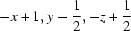 ; (iii)
 Data collection: XSCANS (Bruker, 1996); cell refinement: XSCANS; data reduction: SHELXTL (Sheldrick, 2008); program(s) used to solve structure: SHELXS97 (Sheldrick, 2008); program(s) used to refine structure: SHELXL97 (Sheldrick, 2008); molecular graphics: SHELXTL; software used to prepare material for publication: SHELXTL.
Supporting information
contains datablocks I, global. DOI: 10.1107/S1600536809015189/hk2669sup1.cif
Structure factors: contains datablock I. DOI: 10.1107/S1600536809015189/hk2669Isup2.hkl
For the preparation of the title compound, the warm solution of SnCl2 metal (1.0 mmol) dissolved in absolute ethanol (15 ml) was mixed with a stirred hot solution of 2,6-diaminopyridine (98%; 2 mmol) dissolved in ethanol (20 ml). The mixture was acidified with HBr (48%, 2-3 ml), and then treated with liquid Br2 (2-3 ml). The resulting mixture was stirred for 3 h, and then allowed to evaporate at room temperature. The salt crystallized over 2 d, as nice parallelepiped yellow crystals (yield; 82%).
H atoms were positioned geometrically, with N-H = 0.86 Å (for NH and NH2) and C-H = 0.93 Å for aromatic H, respectively, and constrained to ride on their parent atoms, with Uiso(H) = 1.2Ueq(C,N).
Data collection: XSCANS (Bruker, 1996); cell XSCANS (Bruker, 1996); data reduction: SHELXTL (Sheldrick, 2008); program(s) used to solve structure: SHELXS97 (Sheldrick, 2008); program(s) used to refine structure: SHELXL97 (Sheldrick, 2008); molecular graphics: SHELXTL (Sheldrick, 2008); software used to prepare material for publication: SHELXTL (Sheldrick, 2008).
![[Figure 1]](./hk2669fig1thm.gif) | Fig. 1. The molecular structure of the title molecule, with the atom-numbering scheme. Displacement ellipsoids are drawn at the 50% probability level [symmetry code (A): 2 - x, 1 - y, 1 - z]. |
![[Figure 2]](./hk2669fig2thm.gif) | Fig. 2. A partial packing diagram of the title compound. Hydrogen bonds and Br···Br interactions are shown as dashed lines. |
| (C5H6Br2N3)2[SnBr6] | F(000) = 1028 |
| Mr = 1133.97 | Dx = 3.042 Mg m−3 |
| Monoclinic, P21/c | Mo Kα radiation, λ = 0.71073 Å |
| Hall symbol: -P 2ybc | Cell parameters from 29 reflections |
| a = 8.3696 (14) Å | θ = 5.7–12.5° |
| b = 16.720 (2) Å | µ = 17.18 mm−1 |
| c = 9.5814 (15) Å | T = 295 K |
| β = 112.556 (12)° | Parallelepiped, yellow |
| V = 1238.3 (3) Å3 | 0.30 × 0.30 × 0.20 mm |
| Z = 2 |
| Bruker P4 diffractometer | 1437 reflections with I > 2σ(I) |
| Radiation source: fine-focus sealed tube | Rint = 0.078 |
| Graphite monochromator | θmax = 25.0°, θmin = 2.4° |
| ω scans | h = −9→1 |
| Absorption correction: ψ scan (XSCANS; Bruker, 1996) | k = −19→1 |
| Tmin = 0.008, Tmax = 0.035 | l = −10→11 |
| 2825 measured reflections | 3 standard reflections every 97 reflections |
| 2162 independent reflections | intensity decay: 0.01% |
| Refinement on F2 | Primary atom site location: structure-invariant direct methods |
| Least-squares matrix: full | Secondary atom site location: difference Fourier map |
| R[F2 > 2σ(F2)] = 0.059 | Hydrogen site location: inferred from neighbouring sites |
| wR(F2) = 0.146 | H-atom parameters constrained |
| S = 1.00 | w = 1/[σ2(Fo2) + (0.0766P)2] where P = (Fo2 + 2Fc2)/3 |
| 2162 reflections | (Δ/σ)max < 0.001 |
| 124 parameters | Δρmax = 0.97 e Å−3 |
| 0 restraints | Δρmin = −1.63 e Å−3 |
| (C5H6Br2N3)2[SnBr6] | V = 1238.3 (3) Å3 |
| Mr = 1133.97 | Z = 2 |
| Monoclinic, P21/c | Mo Kα radiation |
| a = 8.3696 (14) Å | µ = 17.18 mm−1 |
| b = 16.720 (2) Å | T = 295 K |
| c = 9.5814 (15) Å | 0.30 × 0.30 × 0.20 mm |
| β = 112.556 (12)° |
| Bruker P4 diffractometer | 1437 reflections with I > 2σ(I) |
| Absorption correction: ψ scan (XSCANS; Bruker, 1996) | Rint = 0.078 |
| Tmin = 0.008, Tmax = 0.035 | 3 standard reflections every 97 reflections |
| 2825 measured reflections | intensity decay: 0.01% |
| 2162 independent reflections |
| R[F2 > 2σ(F2)] = 0.059 | 0 restraints |
| wR(F2) = 0.146 | H-atom parameters constrained |
| S = 1.00 | Δρmax = 0.97 e Å−3 |
| 2162 reflections | Δρmin = −1.63 e Å−3 |
| 124 parameters |
Geometry. All e.s.d.'s (except the e.s.d. in the dihedral angle between two l.s. planes) are estimated using the full covariance matrix. The cell e.s.d.'s are taken into account individually in the estimation of e.s.d.'s in distances, angles and torsion angles; correlations between e.s.d.'s in cell parameters are only used when they are defined by crystal symmetry. An approximate (isotropic) treatment of cell e.s.d.'s is used for estimating e.s.d.'s involving l.s. planes. |
Refinement. Refinement of F2 against ALL reflections. The weighted R-factor wR and goodness of fit S are based on F2, conventional R-factors R are based on F, with F set to zero for negative F2. The threshold expression of F2 > σ(F2) is used only for calculating R-factors(gt) etc. and is not relevant to the choice of reflections for refinement. R-factors based on F2 are statistically about twice as large as those based on F, and R- factors based on ALL data will be even larger. |
| x | y | z | Uiso*/Ueq | ||
| Sn1 | 1.0000 | 0.5000 | 0.5000 | 0.0284 (3) | |
| Br1 | 1.06913 (19) | 0.61962 (8) | 0.68737 (17) | 0.0445 (4) | |
| Br2 | 1.03622 (19) | 0.59582 (8) | 0.30353 (17) | 0.0447 (4) | |
| Br3 | 0.66959 (17) | 0.53289 (8) | 0.39554 (18) | 0.0423 (4) | |
| Br4 | 0.7063 (2) | 0.32003 (9) | −0.12875 (19) | 0.0510 (5) | |
| Br5 | 0.2397 (2) | 0.45315 (8) | 0.10813 (18) | 0.0483 (4) | |
| N1 | 0.3496 (13) | 0.2261 (5) | 0.0181 (12) | 0.032 (3) | |
| H1 | 0.3148 | 0.1789 | 0.0281 | 0.039* | |
| N2 | 0.5374 (16) | 0.1644 (6) | −0.0743 (13) | 0.047 (3) | |
| H2A | 0.6200 | 0.1663 | −0.1066 | 0.056* | |
| H2B | 0.4940 | 0.1190 | −0.0650 | 0.056* | |
| N3 | 0.1518 (14) | 0.2743 (6) | 0.1119 (13) | 0.044 (3) | |
| H3A | 0.1211 | 0.2259 | 0.1191 | 0.053* | |
| H3B | 0.1029 | 0.3134 | 0.1386 | 0.053* | |
| C1 | 0.4759 (17) | 0.2325 (7) | −0.0381 (15) | 0.034 (3) | |
| C2 | 0.5364 (17) | 0.3061 (7) | −0.0492 (17) | 0.036 (3) | |
| C3 | 0.4653 (17) | 0.3720 (8) | −0.0099 (15) | 0.040 (4) | |
| H3 | 0.5047 | 0.4227 | −0.0212 | 0.048* | |
| C4 | 0.3354 (18) | 0.3649 (7) | 0.0466 (15) | 0.034 (3) | |
| C5 | 0.2745 (17) | 0.2888 (8) | 0.0595 (15) | 0.039 (3) |
| U11 | U22 | U33 | U12 | U13 | U23 | |
| Sn1 | 0.0293 (7) | 0.0234 (6) | 0.0365 (8) | 0.0000 (5) | 0.0169 (6) | −0.0002 (5) |
| Br1 | 0.0485 (9) | 0.0374 (7) | 0.0537 (10) | −0.0074 (7) | 0.0264 (8) | −0.0159 (7) |
| Br2 | 0.0494 (9) | 0.0430 (8) | 0.0499 (10) | −0.0016 (7) | 0.0279 (8) | 0.0093 (7) |
| Br3 | 0.0271 (7) | 0.0319 (7) | 0.0677 (10) | 0.0009 (6) | 0.0180 (7) | −0.0014 (7) |
| Br4 | 0.0472 (9) | 0.0493 (9) | 0.0706 (11) | −0.0030 (8) | 0.0381 (9) | −0.0045 (8) |
| Br5 | 0.0480 (9) | 0.0333 (7) | 0.0680 (11) | 0.0059 (7) | 0.0272 (9) | −0.0091 (7) |
| N1 | 0.037 (6) | 0.018 (5) | 0.055 (8) | −0.003 (5) | 0.032 (6) | −0.002 (5) |
| N2 | 0.061 (9) | 0.029 (6) | 0.059 (8) | 0.003 (6) | 0.032 (7) | −0.011 (6) |
| N3 | 0.042 (7) | 0.035 (6) | 0.069 (9) | −0.014 (6) | 0.037 (7) | −0.017 (6) |
| C1 | 0.035 (8) | 0.024 (6) | 0.042 (9) | 0.007 (6) | 0.012 (7) | −0.002 (6) |
| C2 | 0.037 (8) | 0.016 (6) | 0.063 (9) | 0.004 (6) | 0.028 (7) | 0.001 (6) |
| C3 | 0.038 (9) | 0.032 (7) | 0.048 (9) | −0.018 (7) | 0.015 (8) | 0.007 (6) |
| C4 | 0.049 (9) | 0.017 (6) | 0.034 (8) | −0.002 (6) | 0.013 (7) | −0.004 (5) |
| C5 | 0.032 (8) | 0.046 (8) | 0.030 (8) | −0.003 (7) | 0.004 (6) | −0.012 (6) |
| Sn1—Br1 | 2.6002 (13) | N3—H3A | 0.8600 |
| Sn1—Br1i | 2.6002 (13) | N3—H3B | 0.8600 |
| Sn1—Br2 | 2.5768 (14) | C1—N1 | 1.362 (16) |
| Sn1—Br2i | 2.5768 (14) | C1—N2 | 1.349 (15) |
| Sn1—Br3 | 2.6131 (14) | C1—C2 | 1.350 (17) |
| Sn1—Br3i | 2.6131 (14) | C2—Br4 | 1.868 (12) |
| N1—C5 | 1.357 (15) | C2—C3 | 1.372 (18) |
| N1—H1 | 0.8600 | C3—C4 | 1.392 (18) |
| N2—H2A | 0.8600 | C3—H3 | 0.9300 |
| N2—H2B | 0.8600 | C4—Br5 | 1.878 (12) |
| N3—C5 | 1.328 (16) | C4—C5 | 1.394 (18) |
| Br1—Sn1—Br1i | 180.0 | H2A—N2—H2B | 120.0 |
| Br1i—Sn1—Br3 | 88.56 (5) | C5—N3—H3A | 120.0 |
| Br1—Sn1—Br3i | 88.56 (5) | C5—N3—H3B | 120.0 |
| Br1—Sn1—Br3 | 91.44 (5) | H3A—N3—H3B | 120.0 |
| Br1i—Sn1—Br3i | 91.44 (5) | N2—C1—C2 | 123.9 (12) |
| Br2—Sn1—Br1 | 88.21 (5) | N2—C1—N1 | 117.8 (11) |
| Br2i—Sn1—Br1i | 88.21 (5) | C2—C1—N1 | 118.3 (10) |
| Br2i—Sn1—Br1 | 91.79 (5) | C1—C2—Br4 | 120.9 (9) |
| Br2—Sn1—Br1i | 91.79 (5) | C1—C2—C3 | 119.7 (11) |
| Br2i—Sn1—Br2 | 180.0 | C3—C2—Br4 | 119.3 (9) |
| Br2—Sn1—Br3 | 89.60 (5) | C2—C3—C4 | 121.6 (11) |
| Br2i—Sn1—Br3i | 89.61 (5) | C2—C3—H3 | 119.2 |
| Br2i—Sn1—Br3 | 90.39 (5) | C4—C3—H3 | 119.2 |
| Br2—Sn1—Br3i | 90.39 (5) | C3—C4—Br5 | 123.1 (9) |
| Br3i—Sn1—Br3 | 180.0 | C3—C4—C5 | 118.6 (11) |
| C1—N1—H1 | 117.6 | C5—C4—Br5 | 118.3 (10) |
| C5—N1—C1 | 124.9 (10) | N1—C5—C4 | 116.9 (12) |
| C5—N1—H1 | 117.6 | N3—C5—N1 | 118.8 (12) |
| C1—N2—H2A | 120.0 | N3—C5—C4 | 124.2 (12) |
| C1—N2—H2B | 120.0 | ||
| N2—C1—N1—C5 | −179.9 (12) | C2—C3—C4—C5 | −2 (2) |
| C2—C1—N1—C5 | 2 (2) | C2—C3—C4—Br5 | 177.8 (11) |
| N2—C1—C2—C3 | 179.9 (14) | C1—N1—C5—N3 | 179.6 (13) |
| N1—C1—C2—C3 | −3 (2) | C1—N1—C5—C4 | −2 (2) |
| N2—C1—C2—Br4 | 4 (2) | C3—C4—C5—N3 | 179.8 (13) |
| N1—C1—C2—Br4 | −178.7 (10) | Br5—C4—C5—N3 | 0.4 (19) |
| C1—C2—C3—C4 | 2 (2) | C3—C4—C5—N1 | 1.2 (19) |
| Br4—C2—C3—C4 | 178.5 (11) | Br5—C4—C5—N1 | −178.2 (9) |
| Symmetry code: (i) −x+2, −y+1, −z+1. |
| D—H···A | D—H | H···A | D···A | D—H···A |
| N1—H1···Br3ii | 0.86 | 2.54 | 3.354 (9) | 159 |
| N2—H2B···Br3ii | 0.86 | 2.88 | 3.612 (12) | 144 |
| N3—H3A···Br2ii | 0.86 | 2.79 | 3.608 (10) | 160 |
| N3—H3B···Br1iii | 0.86 | 2.82 | 3.604 (10) | 153 |
| Symmetry codes: (ii) −x+1, y−1/2, −z+1/2; (iii) −x+1, −y+1, −z+1. |
Experimental details
| Crystal data | |
| Chemical formula | (C5H6Br2N3)2[SnBr6] |
| Mr | 1133.97 |
| Crystal system, space group | Monoclinic, P21/c |
| Temperature (K) | 295 |
| a, b, c (Å) | 8.3696 (14), 16.720 (2), 9.5814 (15) |
| β (°) | 112.556 (12) |
| V (Å3) | 1238.3 (3) |
| Z | 2 |
| Radiation type | Mo Kα |
| µ (mm−1) | 17.18 |
| Crystal size (mm) | 0.30 × 0.30 × 0.20 |
| Data collection | |
| Diffractometer | Bruker P4 diffractometer |
| Absorption correction | ψ scan (XSCANS; Bruker, 1996) |
| Tmin, Tmax | 0.008, 0.035 |
| No. of measured, independent and observed [I > 2σ(I)] reflections | 2825, 2162, 1437 |
| Rint | 0.078 |
| (sin θ/λ)max (Å−1) | 0.595 |
| Refinement | |
| R[F2 > 2σ(F2)], wR(F2), S | 0.059, 0.146, 1.00 |
| No. of reflections | 2162 |
| No. of parameters | 124 |
| H-atom treatment | H-atom parameters constrained |
| Δρmax, Δρmin (e Å−3) | 0.97, −1.63 |
Computer programs: XSCANS (Bruker, 1996), SHELXTL (Sheldrick, 2008), SHELXS97 (Sheldrick, 2008), SHELXL97 (Sheldrick, 2008).
| Sn1—Br1 | 2.6002 (13) | Sn1—Br3 | 2.6131 (14) |
| Sn1—Br2 | 2.5768 (14) | ||
| Br1i—Sn1—Br3 | 88.56 (5) | Br2i—Sn1—Br1 | 91.79 (5) |
| Br1—Sn1—Br3 | 91.44 (5) | Br2—Sn1—Br3 | 89.60 (5) |
| Br2—Sn1—Br1 | 88.21 (5) | Br2i—Sn1—Br3 | 90.39 (5) |
| Symmetry code: (i) −x+2, −y+1, −z+1. |
| D—H···A | D—H | H···A | D···A | D—H···A |
| N1—H1···Br3ii | 0.86 | 2.54 | 3.354 (9) | 159.1 |
| N2—H2B···Br3ii | 0.86 | 2.88 | 3.612 (12) | 144.1 |
| N3—H3A···Br2ii | 0.86 | 2.79 | 3.608 (10) | 160.4 |
| N3—H3B···Br1iii | 0.86 | 2.82 | 3.604 (10) | 152.5 |
| Symmetry codes: (ii) −x+1, y−1/2, −z+1/2; (iii) −x+1, −y+1, −z+1. |
Acknowledgements
The University of Jordan, Al-Balqa'a Applied University and Al al-Bayt University are thanked for financial support.
References
 Al-Far, R. & Ali, B. F. (2007). Acta Cryst. C63, m137–m139. Web of Science CSD CrossRef IUCr Journals Google Scholar
Ali, B. F. & Al-Far, R. (2007). Acta Cryst. E63, m892–m894. Web of Science CSD CrossRef IUCr Journals Google Scholar
Ali, B. F., Al-Far, R. & Al-Sou'od, K. (2007). J. Chem. Crystallogr. 37, 265–273. Web of Science CrossRef CAS Google Scholar
Ali, B. F., Al-Far, R. H. & Haddad, S. F. (2008). Acta Cryst. E64, m749–m750. Web of Science CSD CrossRef CAS IUCr Journals Google Scholar
Ali, B. F., Al-Far, R. & Ng, S. W. (2007). Acta Cryst. E63, m2102–m2103. Web of Science CSD CrossRef IUCr Journals Google Scholar
Allen, F. H., Kennard, O., Watson, D. G., Brammer, L., Orpen, A. G. & Taylor, R. (1987). J. Chem. Soc. Perkin Trans. 2, pp. S1–19. CrossRef Web of Science Google Scholar
Aruta, C., Licci, F., Zappettini, A., Bolzoni, F., Rastelli, F., Ferro, P. & Besagni, T. (2005). Appl. Phys. A, 81, 963–968. Web of Science CrossRef CAS Google Scholar
Awwadi, F. F., Willett, R. D., Peterson, K. A. & Twamley, B. (2007). J. Phys. Chem. A, 111, 2319–2328. Web of Science CSD CrossRef PubMed CAS Google Scholar
Bruker (1996). XSCANS. Bruker AXS Inc., Madison, Wisconsin, USA. Google Scholar
Hill, C. L. (1998). Chem. Rev. 98, 1–2. CSD CrossRef PubMed CAS Web of Science Google Scholar
Kagan, C. R., Mitzi, D. B. & Dimitrakopoulos, C. D. (1999). Science, 286, 945–947. Web of Science CrossRef PubMed CAS Google Scholar
Knutson, J. L., Martin, J. D. & Mitzi, D. B. (2005). Inorg. Chem. 44, 4699–4705. Web of Science CrossRef PubMed CAS Google Scholar
Raptopoulou, C. P., Terzis, A., Mousdis, G. A. & Papavassiliou, G. C. (2002). Z. Naturforsch. Teil B, 57, 645–650. CAS Google Scholar
Sheldrick, G. M. (2008). Acta Cryst. A64, 112–122. Web of Science CrossRef CAS IUCr Journals Google Scholar
Tudela, D. & Khan, M. A. (1991). J. Chem. Soc. Dalton Trans. pp. 1003–1006. CSD CrossRef Web of Science Google Scholar
Willey, G. R., Woodman, T. J., Somasundaram, U., Aris, D. R. & Errington, W. (1998). J. Chem. Soc. Dalton Trans. pp. 2573–2576. Web of Science CSD CrossRef Google Scholar
This is an open-access article distributed under the terms of the Creative Commons Attribution (CC-BY) Licence, which permits unrestricted use, distribution, and reproduction in any medium, provided the original authors and source are cited.
| CRYSTALLOGRAPHIC COMMUNICATIONS |


Non-covalent interactions play an important role in organizing structural units in both natural and artificial systems. Hybrid organic-inorganic compounds are of great interest owing to their ionic, electrical, magnetic and optical properties (Hill, 1998; Kagan et al., 1999; Raptopoulou et al., 2002). Tin metal-halo based hybrids are of particular interest as being materials with interesting optical and magnetic properties (Aruta et al., 2005; Knutson et al., 2005; Kagan et al., 1999). We are currently carrying out studies about lattice including different types of intermolecular interactions (aryl···aryl, X···X, X···aryl and X···H). Within our research of hybrid compounds containing tin metal (Al-Far & Ali 2007; Al-Far, Ali & Al-Sou'od, 2007; Ali & Al-Far, 2007; Ali, Al-Far & Ng, 2007), we report herein the crystal structure of the title compound.
The asymmetric unit of the title compound contains one cation and one-half anion, in which the Sn atom is located on a crystallographic centre of inversion and is in a quasi-octahedral geometry (Fig. 1 and Table 1). The Sn-Br bonds are in accordance with the corresponding values in similar compounds (Willey et al., 1998; Tudela & Khan 1991; Ali et al., 2008; Al-Far & Ali 2007). The pyridine ring of the starting cation have undergone bromination during the synthesis process (Al-Far & Ali, 2007). In the cation, the bond lengths (Allen et al., 1987) and angles are within normal ranges.
In the crystal structure, weak intermolecular N-H···Br interactions (Table 2) link the molecules into alternating layers of cations and stacks of anions (Fig. 2), in which they may be effective in the stabilization of the structure. The anion stacks are interacting with the cation layers in an extensive hydrogen bonding and Br···Br halogen bonding interactions. Each anion is surrounded by six cations via three H—N—H···Br, one N—H···Br interactions and the symmetry related ones along with one Br···Br interaction [Br2···Br4i = 3.4925 (19) Å, symmetry code (i): 2 - x, 1 - y, -z)] and the symmetry related one. On the other hand, each cation is associated with three anions, through six (Npyridinic, Naminic)—H···Br—Sn hydrogen bonding interactions, and by one C—Br···Br—Sn interaction. It is noteworthy that structural and theoretical results (Awwadi et al. 2007; and references therein), show the significance of linear C—Br···Br synthons in influencing structures of crystalline materials and in use as potential building blocks in crystal engineering via supramolecular synthesis.
Moreover, interactions between cations perpendicular to [101] represent a case of strong offset face-to-face π–π motif. This is evident by the centroids separation distance of 5.059 (3) Å, with the perpendicular distance between planes being 3.577 (3) Å (the sliding angle between planes is 45.0 (3)°).