 | Acta Crystallographica Section E Acta Crystallographica Section E CRYSTALLOGRAPHIC COMMUNICATIONS |


 journal menu


metal-organic compounds
| CRYSTALLOGRAPHIC COMMUNICATIONS |
 access
Bis[2-(aminomethyl)pyridine-κ2N,N′]bis(thiocyanato-κN)copper(II)

aNational Changhua University of Education, Department of Chemistry, Changhua, Taiwan 50058
*Correspondence e-mail: [email protected]
In the title complex, [Cu(NCS)2(C6H8N2)2], the CuII atom, lying on an inversion center, adopts a Jahn–Teller distorted octahedral CuN6 coordination geometry. The two bidentate 2-aminomethylpyridine ligands are coordinated in a trans fashion, while the two thiocyanate ligands are at the axial positions and coordinate to the Cu atom in a bent mode with a C—N—Cu angle of 127.49 (10)°. Intermolecular N—H⋯N and N—H⋯S hydrogen bonds link the copper complex molecules into an infinite two-dimensional network.
Related literature
For six-coordinate trans-dithiocyanato Cu(II) complexes similar to the title complex, see: Gary et al. (2004![[Gary, J. B., Kautz, J. A., Klausmeyer, K. K. & Wong, C.-W. (2004). Acta Cryst. E60, m328-m329.]](../../../../../../logos/arrows/e_arr.gif "Gary, J. B., Kautz, J. A., Klausmeyer, K. K. & Wong, C.-W. (2004). Acta Cryst. E60, m328-m329.") ); Ferrer et al. (1992); Gorji et al. (2001); Kozlowski & Hodgson (1975); Li & Zhang (2004).
); Ferrer et al. (1992); Gorji et al. (2001); Kozlowski & Hodgson (1975); Li & Zhang (2004).
![[Scheme 1]](pv2151scheme1.gif)
Experimental
Crystal data
|
Refinement
|
| ||||||||||||||||||||||
 ; (ii)
 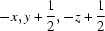 .
. Data collection: APEX2 (Bruker, 2004); cell refinement: SAINT (Bruker, 2004); data reduction: SAINT; program(s) used to solve structure: SHELXS97 (Sheldrick, 2008); program(s) used to refine structure: SHELXL97 (Sheldrick, 2008); molecular graphics: SHELXTL (Sheldrick, 2008); software used to prepare material for publication: SHELXTL.
Supporting information
contains datablocks I, global. DOI: 10.1107/S1600536809013427/pv2151sup1.cif
Structure factors: contains datablock I. DOI: 10.1107/S1600536809013427/pv2151Isup2.hkl
To a methanolic solution (10 ml) of Cu(O2CCH3)2.H2O (1.0 mmol, 0.199 g), a methanolic solution (10.0 ml) of 2-aminomethylpyridine (2.0 mmol, 0.207 ml) was added dropwise with stirring. Then to this mixture of solution, NaSCN (2.0 mmol, 0.162 g) in methanol (5.0 ml) was added and the mixture was stirred for 5 min. The solution was kept undisturbed. Blue crystals suitable for X-ray crystallography were obtained after one week by slow evaporation of the solvent.
All the H atoms were positioned geometrically and refined as riding atoms, with N—H = 0.92, Caryl—H = 0.95, Cmethylene—H = 0.99 Å while Uiso(H) = 1.2Ueq(C or N) for all H atoms.
Data collection: APEX2 (Bruker, 2004); cell SAINT (Bruker, 2004); data reduction: SAINT (Bruker, 2004); program(s) used to solve structure: SHELXS97 (Sheldrick, 2008); program(s) used to refine structure: SHELXL97 (Sheldrick, 2008); molecular graphics: SHELXTL (Sheldrick, 2008); software used to prepare material for publication: SHELXTL (Sheldrick, 2008).
![[Figure 1]](./pv2151fig1thm.gif) | Fig. 1. The structure of the title complex, showing 50% displacement ellipsoids for non-H atoms. The H atoms are dipicted by circles of an arbitrary radius. The unlabelled atoms are related to the labelled ones by -x, 1 - y, 1 - z. |
![[Figure 2]](./pv2151fig2thm.gif) | Fig. 2. A packing diagram of the title compound along the a axis. Hyrogen bonds are shown as dashed lines. |
| [Cu(NCS)2(C6H8N2)2] | F(000) = 406 |
| Mr = 395.99 | Dx = 1.626 Mg m−3 |
| Monoclinic, P21/c | Mo Kα radiation, λ = 0.71073 Å |
| Hall symbol: -P 2ybc | Cell parameters from 3360 reflections |
| a = 9.1023 (4) Å | θ = 3.1–28.0° |
| b = 9.1740 (4) Å | µ = 1.62 mm−1 |
| c = 9.6895 (4) Å | T = 150 K |
| β = 91.872 (3)° | Plate, blue |
| V = 808.69 (6) Å3 | 0.46 × 0.38 × 0.31 mm |
| Z = 2 |
| Bruker SMART APEXII diffractometer | 2086 independent reflections |
| Radiation source: fine-focus sealed tube | 1776 reflections with I > 2σ |
| Graphite monochromator | Rint = 0.031 |
| ω scans | θmax = 28.7°, θmin = 2.2° |
| Absorption correction: multi-scan (SADABS; Sheldrick, 2003) | h = −12→12 |
| Tmin = 0.497, Tmax = 0.603 | k = −12→12 |
| 11419 measured reflections | l = −13→12 |
| Refinement on F2 | Primary atom site location: structure-invariant direct methods |
| Least-squares matrix: full | Secondary atom site location: difference Fourier map |
| R[F2 > 2σ(F2)] = 0.023 | Hydrogen site location: inferred from neighbouring sites |
| wR(F2) = 0.063 | H-atom parameters constrained |
| S = 1.13 | w = 1/[σ2(Fo2) + (0.0308P)2 + 0.2097P] where P = (Fo2 + 2Fc2)/3 |
| 2086 reflections | (Δ/σ)max < 0.001 |
| 106 parameters | Δρmax = 0.35 e Å−3 |
| 0 restraints | Δρmin = −0.40 e Å−3 |
| [Cu(NCS)2(C6H8N2)2] | V = 808.69 (6) Å3 |
| Mr = 395.99 | Z = 2 |
| Monoclinic, P21/c | Mo Kα radiation |
| a = 9.1023 (4) Å | µ = 1.62 mm−1 |
| b = 9.1740 (4) Å | T = 150 K |
| c = 9.6895 (4) Å | 0.46 × 0.38 × 0.31 mm |
| β = 91.872 (3)° |
| Bruker SMART APEXII diffractometer | 2086 independent reflections |
| Absorption correction: multi-scan (SADABS; Sheldrick, 2003) | 1776 reflections with I > 2σ |
| Tmin = 0.497, Tmax = 0.603 | Rint = 0.031 |
| 11419 measured reflections |
| R[F2 > 2σ(F2)] = 0.023 | 0 restraints |
| wR(F2) = 0.063 | H-atom parameters constrained |
| S = 1.13 | Δρmax = 0.35 e Å−3 |
| 2086 reflections | Δρmin = −0.40 e Å−3 |
| 106 parameters |
Geometry. All e.s.d.'s (except the e.s.d. in the dihedral angle between two l.s. planes) are estimated using the full covariance matrix. The cell e.s.d.'s are taken into account individually in the estimation of e.s.d.'s in distances, angles and torsion angles; correlations between e.s.d.'s in cell parameters are only used when they are defined by crystal symmetry. An approximate (isotropic) treatment of cell e.s.d.'s is used for estimating e.s.d.'s involving l.s. planes. |
Refinement. Refinement of F2 against ALL reflections. The weighted R-factor wR and goodness of fit S are based on F2, conventional R-factors R are based on F, with F set to zero for negative F2. The threshold expression of F2 > σ(F2) is used only for calculating R-factors(gt) etc. and is not relevant to the choice of reflections for refinement. R-factors based on F2 are statistically about twice as large as those based on F, and R- factors based on ALL data will be even larger. |
| x | y | z | Uiso*/Ueq | ||
| C1 | 0.27555 (16) | 0.35413 (16) | 0.48964 (15) | 0.0151 (3) | |
| C2 | 0.41671 (16) | 0.30420 (16) | 0.52349 (17) | 0.0187 (3) | |
| H2 | 0.4607 | 0.2302 | 0.4701 | 0.022* | |
| C3 | 0.49184 (16) | 0.36421 (17) | 0.63614 (17) | 0.0199 (3) | |
| H3 | 0.5878 | 0.3311 | 0.6618 | 0.024* | |
| C4 | 0.42557 (17) | 0.47314 (17) | 0.71109 (17) | 0.0190 (3) | |
| H4 | 0.4759 | 0.5170 | 0.7878 | 0.023* | |
| C5 | 0.28491 (17) | 0.51688 (16) | 0.67232 (16) | 0.0170 (3) | |
| H5 | 0.2395 | 0.5917 | 0.7236 | 0.020* | |
| C6 | 0.18680 (17) | 0.29582 (17) | 0.36793 (16) | 0.0188 (3) | |
| H6A | 0.2513 | 0.2813 | 0.2888 | 0.023* | |
| H6B | 0.1435 | 0.2005 | 0.3918 | 0.023* | |
| C7 | −0.15576 (16) | 0.17946 (16) | 0.52438 (16) | 0.0175 (3) | |
| Cu1 | 0.0000 | 0.5000 | 0.5000 | 0.01369 (8) | |
| N1 | 0.20991 (13) | 0.45719 (14) | 0.56437 (13) | 0.0142 (2) | |
| N2 | 0.06857 (13) | 0.39999 (14) | 0.32960 (13) | 0.0161 (3) | |
| H2A | −0.0087 | 0.3513 | 0.2869 | 0.019* | |
| H2B | 0.1030 | 0.4680 | 0.2688 | 0.019* | |
| N3 | −0.08726 (15) | 0.26276 (15) | 0.58955 (15) | 0.0244 (3) | |
| S1 | −0.25589 (5) | 0.06047 (5) | 0.43612 (4) | 0.02601 (11) |
| U11 | U22 | U33 | U12 | U13 | U23 | |
| C1 | 0.0159 (7) | 0.0142 (6) | 0.0154 (7) | 0.0005 (5) | 0.0020 (5) | 0.0008 (5) |
| C2 | 0.0166 (7) | 0.0171 (7) | 0.0225 (8) | 0.0036 (6) | 0.0032 (6) | 0.0011 (6) |
| C3 | 0.0140 (7) | 0.0215 (7) | 0.0243 (8) | 0.0029 (6) | 0.0003 (6) | 0.0069 (6) |
| C4 | 0.0167 (7) | 0.0224 (8) | 0.0177 (8) | −0.0027 (6) | −0.0030 (6) | 0.0016 (6) |
| C5 | 0.0164 (7) | 0.0187 (7) | 0.0159 (7) | −0.0008 (6) | 0.0001 (6) | −0.0009 (5) |
| C6 | 0.0187 (7) | 0.0201 (7) | 0.0176 (8) | 0.0052 (6) | −0.0015 (6) | −0.0049 (6) |
| C7 | 0.0168 (7) | 0.0183 (7) | 0.0175 (8) | 0.0037 (6) | 0.0027 (6) | 0.0057 (6) |
| Cu1 | 0.01194 (13) | 0.01631 (13) | 0.01273 (14) | 0.00240 (9) | −0.00107 (9) | −0.00347 (9) |
| N1 | 0.0130 (6) | 0.0152 (5) | 0.0143 (6) | 0.0009 (5) | 0.0004 (5) | 0.0000 (5) |
| N2 | 0.0154 (6) | 0.0190 (6) | 0.0140 (6) | 0.0017 (5) | −0.0006 (5) | −0.0019 (5) |
| N3 | 0.0261 (7) | 0.0213 (7) | 0.0255 (8) | −0.0016 (6) | −0.0033 (6) | 0.0040 (6) |
| S1 | 0.0235 (2) | 0.0293 (2) | 0.0251 (2) | −0.00253 (17) | −0.00159 (16) | −0.00652 (17) |
| C1—N1 | 1.3430 (19) | C6—N2 | 1.4775 (18) |
| C1—C2 | 1.393 (2) | C6—H6A | 0.9900 |
| C1—C6 | 1.506 (2) | C6—H6B | 0.9900 |
| C2—C3 | 1.383 (2) | C7—N3 | 1.160 (2) |
| C2—H2 | 0.9500 | C7—S1 | 1.6440 (16) |
| C3—C4 | 1.385 (2) | Cu1—N2 | 2.0062 (12) |
| C3—H3 | 0.9500 | Cu1—N2i | 2.0062 (12) |
| C4—C5 | 1.382 (2) | Cu1—N1 | 2.0288 (12) |
| C4—H4 | 0.9500 | Cu1—N1i | 2.0288 (12) |
| C5—N1 | 1.3466 (19) | N2—H2A | 0.9200 |
| C5—H5 | 0.9500 | N2—H2B | 0.9200 |
| N1—C1—C2 | 121.85 (14) | C1—C6—H6B | 109.8 |
| N1—C1—C6 | 115.83 (12) | H6A—C6—H6B | 108.2 |
| C2—C1—C6 | 122.32 (13) | N3—C7—S1 | 178.26 (15) |
| C3—C2—C1 | 118.90 (14) | N2—Cu1—N2i | 180.0 |
| C3—C2—H2 | 120.5 | N2—Cu1—N1 | 81.33 (5) |
| C1—C2—H2 | 120.5 | N2i—Cu1—N1 | 98.67 (5) |
| C2—C3—C4 | 119.23 (14) | N2—Cu1—N1i | 98.67 (5) |
| C2—C3—H3 | 120.4 | N2i—Cu1—N1i | 81.33 (5) |
| C4—C3—H3 | 120.4 | N1—Cu1—N1i | 180.0 |
| C5—C4—C3 | 118.84 (14) | C1—N1—C5 | 118.81 (13) |
| C5—C4—H4 | 120.6 | C1—N1—Cu1 | 113.68 (10) |
| C3—C4—H4 | 120.6 | C5—N1—Cu1 | 127.49 (10) |
| N1—C5—C4 | 122.33 (14) | C6—N2—Cu1 | 109.43 (9) |
| N1—C5—H5 | 118.8 | C6—N2—H2A | 109.8 |
| C4—C5—H5 | 118.8 | Cu1—N2—H2A | 109.8 |
| N2—C6—C1 | 109.56 (12) | C6—N2—H2B | 109.8 |
| N2—C6—H6A | 109.8 | Cu1—N2—H2B | 109.8 |
| C1—C6—H6A | 109.8 | H2A—N2—H2B | 108.2 |
| N2—C6—H6B | 109.8 | ||
| N1—C1—C2—C3 | −0.9 (2) | C6—C1—N1—Cu1 | 3.52 (16) |
| C6—C1—C2—C3 | 179.38 (14) | C4—C5—N1—C1 | −1.7 (2) |
| C1—C2—C3—C4 | −0.7 (2) | C4—C5—N1—Cu1 | 176.34 (11) |
| C2—C3—C4—C5 | 1.1 (2) | N2—Cu1—N1—C1 | −17.99 (10) |
| C3—C4—C5—N1 | 0.1 (2) | N2i—Cu1—N1—C1 | 162.01 (10) |
| N1—C1—C6—N2 | 19.63 (18) | N2—Cu1—N1—C5 | 163.84 (13) |
| C2—C1—C6—N2 | −160.67 (14) | N2i—Cu1—N1—C5 | −16.16 (13) |
| C2—C1—N1—C5 | 2.2 (2) | C1—C6—N2—Cu1 | −33.03 (14) |
| C6—C1—N1—C5 | −178.14 (13) | N1—Cu1—N2—C6 | 27.99 (10) |
| C2—C1—N1—Cu1 | −176.18 (11) | N1i—Cu1—N2—C6 | −152.01 (10) |
| Symmetry code: (i) −x, −y+1, −z+1. |
| D—H···A | D—H | H···A | D···A | D—H···A |
| N2—H2A···N3ii | 0.92 | 2.27 | 3.0717 (19) | 145 |
| N2—H2B···S1iii | 0.92 | 2.60 | 3.4628 (13) | 156 |
| Symmetry codes: (ii) x, −y+1/2, z−1/2; (iii) −x, y+1/2, −z+1/2. |
Experimental details
| Crystal data | |
| Chemical formula | [Cu(NCS)2(C6H8N2)2] |
| Mr | 395.99 |
| Crystal system, space group | Monoclinic, P21/c |
| Temperature (K) | 150 |
| a, b, c (Å) | 9.1023 (4), 9.1740 (4), 9.6895 (4) |
| β (°) | 91.872 (3) |
| V (Å3) | 808.69 (6) |
| Z | 2 |
| Radiation type | Mo Kα |
| µ (mm−1) | 1.62 |
| Crystal size (mm) | 0.46 × 0.38 × 0.31 |
| Data collection | |
| Diffractometer | Bruker SMART APEXII diffractometer |
| Absorption correction | Multi-scan (SADABS; Sheldrick, 2003) |
| Tmin, Tmax | 0.497, 0.603 |
| No. of measured, independent and observed (I > 2σ) reflections | 11419, 2086, 1776 |
| Rint | 0.031 |
| (sin θ/λ)max (Å−1) | 0.675 |
| Refinement | |
| R[F2 > 2σ(F2)], wR(F2), S | 0.023, 0.063, 1.13 |
| No. of reflections | 2086 |
| No. of parameters | 106 |
| H-atom treatment | H-atom parameters constrained |
| Δρmax, Δρmin (e Å−3) | 0.35, −0.40 |
Computer programs: APEX2 (Bruker, 2004), SAINT (Bruker, 2004), SHELXS97 (Sheldrick, 2008), SHELXL97 (Sheldrick, 2008), SHELXTL (Sheldrick, 2008).
| D—H···A | D—H | H···A | D···A | D—H···A |
| N2—H2A···N3i | 0.92 | 2.27 | 3.0717 (19) | 145 |
| N2—H2B···S1ii | 0.92 | 2.60 | 3.4628 (13) | 156 |
| Symmetry codes: (i) x, −y+1/2, z−1/2; (ii) −x, y+1/2, −z+1/2. |
Acknowledgements
We thank the National Science Council of Taiwan for financial support of this work.
References
 Bruker (2004). APEX2 and SAINT. Bruker AXS Inc., Madison, Wisconsin, USA. Google Scholar
Ferrer, S., Haasnoot, J. G., Reedijk, J., Muller, E., Biagini-Cingi, M., Manotti-Lanfredi, A. M., Ugozzoli, F. & Foglia, C. (1992). J. Chem. Soc. Dalton Trans. pp. 3029–3034. CSD CrossRef Web of Science Google Scholar
Gary, J. B., Kautz, J. A., Klausmeyer, K. K. & Wong, C.-W. (2004). Acta Cryst. E60, m328–m329. Web of Science CSD CrossRef IUCr Journals Google Scholar
Gorji, A., Mahmoudkhani, A. H. M. & Amirnasr, M. (2001). Inorg. Chim. Acta, 315, 133–138. Web of Science CSD CrossRef CAS Google Scholar
Kozlowski, D. L. & Hodgson, D. L. (1975). J. Chem. Soc. Dalton Trans. pp. 55–58. CSD CrossRef Web of Science Google Scholar
Li, Z.-X. & Zhang, X.-L. (2004). Acta Cryst. E60, m1597–m1598. Web of Science CSD CrossRef CAS IUCr Journals Google Scholar
Sheldrick, G. M. (2003). SADABS. University of Göttingen, Germany. Google Scholar
Sheldrick, G. M. (2008). Acta Cryst. A64, 112–122. Web of Science CrossRef CAS IUCr Journals Google Scholar
This is an open-access article distributed under the terms of the Creative Commons Attribution (CC-BY) Licence, which permits unrestricted use, distribution, and reproduction in any medium, provided the original authors and source are cited.
| CRYSTALLOGRAPHIC COMMUNICATIONS |


The tilte complex was readily obtained from the reaction between copper(II) acetate, 2-aminomethylpyridine, and sodium thiocyanate. The complex consists of two trans bidentate ligands and two trans thiocyanate ligands (Fig. 1). It exhibits an octahedron coordination geometry at the Cu atom which is located on the inversion center. The bent coordination of thiocyanate results in the C5—N1—Cu1 bond angle of 127.49 (10)°. The pyridine ring is twisted from the equatorial plane defined by the Cu and the four N atoms; the interplanar angle is 17.86 (8)°. Intermolecular H-bonds of the type N—H···N and N—H···S exist, linking the complex into a into a two-dimensional hydrogen bonded network (Table 1).
Six-coordinate trans-dithiocyanato Cu(II) complexes similar to the title complex have been reported in the literature (Gary et al., 2004; Ferrer et al., 1992; Gorji et al., 2001; Kozlowski & Hodgson, 1975; Li & Zhang, 2004).