Experimental
Crystal data
Mn4(C2O4)(PO4)2(H2O)2 Mr = 266.88 Monoclinic, P 21 /c a = 10.2759 (2) Å b = 6.5220 (1) Å c = 10.0701 (1) Å β = 116.926 (1)° V = 601.73 (2) Å3 Z = 4 Mo Kα radiation μ = 4.45 mm−1 T = 296 K 0.21 × 0.19 × 0.17 mm
|
Data collection
Bruker APEXII CCD area-detector diffractometer Absorption correction: multi-scan (SADABS; Bruker, 2007![[Bruker (2007). APEX2, SAINT and SADABS. Bruker AXS Inc., Madison, Wisconsin, USA.]](../../../../../../logos/arrows/e_arr.gif "Bruker (2007). APEX2, SAINT and SADABS. Bruker AXS Inc., Madison, Wisconsin, USA.") ) Tmin = 0.455, Tmax = 0.519 (expected range = 0.412–0.470) ) Tmin = 0.455, Tmax = 0.519 (expected range = 0.412–0.470) 5971 measured reflections 1653 independent reflections 1467 reflections with I > 2σ(I) Rint = 0.031
|
| Mn1—O2i | 2.1199 (15) | | Mn1—O3ii | 2.1407 (15) | | Mn1—O1 | 2.1584 (15) | | Mn1—O3iii | 2.2219 (15) | | Mn1—O5 | 2.2525 (15) | | Mn1—O7W | 2.2637 (17) | | Mn2—O2iv | 2.1145 (15) | | Mn2—O4ii | 2.1218 (15) | | Mn2—O1 | 2.1220 (16) | | Mn2—O6v | 2.1809 (17) | | Mn2—O5 | 2.2190 (16) | | Mn2—O7Wvi | 2.5641 (14) | Symmetry codes: (i) 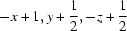 ; (ii) ; (ii) 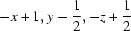 ; (iii) ; (iii)  ; (iv) -x+1, -y, -z+1; (v) -x, -y, -z; (vi) ; (iv) -x+1, -y, -z+1; (v) -x, -y, -z; (vi)  . .
| |
| D—H⋯A | D—H | H⋯A | D⋯A | D—H⋯A | | O7W—H7A⋯O6 | 0.85 (2) | 2.00 (2) | 2.828 (3) | 167 (3) | | O7W—H7B⋯O4vii | 0.86 (2) | 1.95 (2) | 2.787 (2) | 167 (3) | Symmetry code: (vii) -x+1, -y, -z.
| |
Data collection: APEX2 (Bruker, 2007); cell refinement: SAINT (Bruker, 2007); data reduction: SAINT; program(s) used to solve structure: SHELXS97 (Sheldrick, 2008); program(s) used to refine structure: SHELXL97 (Sheldrick, 2008); molecular graphics: SHELXTL (Sheldrick, 2008); software used to prepare material for publication: SHELXTL.
Supporting information
Colorless block crystals were synthesized hydrothermally from a mixture of, H3BO3, H2C2O4, ethylenediamine, H3PO4 and water. In a typical synthesis, 0. 98 g MnCl2˙4H2O was dissolved in a mixture of 5 mL water, with 0.92 g H3BO3, 2 ml (85%) H3PO4 and 0.05 ml ethylenediamine at constant stirring. Finally, the mixture was kept in a 30 ml Teflon – lined steel autoclave at 443 K for 5 days. The autoclave was slowly cooled to room temperature. Colorless block crystals of the title compound were obtained.
The H atoms of the coordinated water molecule were refined with Uiso(H) = 1.2Ueq(O) and distance restraints d(O—H) of 0.85 (1) Å and d(H···H) of 1.33 (1) Å, respectively. The highest peak in the difference map is 0.47 e/Å3, and 0.75 Å from O4, and the minimum peak is -0.55 e/Å3, and 0.60 Å from Mn1.
Data collection: APEX2 (Bruker, 2007); cell refinement: SAINT (Bruker, 2007); data reduction: SAINT (Bruker, 2007); program(s) used to solve structure: SHELXS97 (Sheldrick, 2008); program(s) used to refine structure: SHELXL97 (Sheldrick, 2008); molecular graphics: SHELXTL (Sheldrick, 2008); software used to prepare material for publication: SHELXTL (Sheldrick, 2008).
poly[diaqua-µ-oxalato-di-µ-phosphato-tetramanganese(II)]
top Crystal data top | [Mn4(C2O4)(PO4)2(H2O)2] | F(000) = 516 |
| Mr = 266.88 | Dx = 2.946 Mg m−3 |
| Monoclinic, P21/c | Mo Kα radiation, λ = 0.71073 Å |
| Hall symbol: -P 2ybc | Cell parameters from 2504 reflections |
| a = 10.2759 (2) Å | θ = 2.2–29.9° |
| b = 6.5220 (1) Å | µ = 4.45 mm−1 |
| c = 10.0701 (1) Å | T = 296 K |
| β = 116.926 (1)° | Block, colourless |
| V = 601.73 (2) Å3 | 0.21 × 0.19 × 0.17 mm |
| Z = 4 | |
Data collection top Bruker APEXII CCD area-detector
diffractometer | 1653 independent reflections |
| Radiation source: fine-focus sealed tube | 1467 reflections with I > 2σ(I) |
| Graphite monochromator | Rint = 0.031 |
| ϕ and ω scans | θmax = 29.9°, θmin = 2.2° |
Absorption correction: multi-scan
(SADABS; Bruker, 2007) | h = −14→11 |
| Tmin = 0.455, Tmax = 0.519 | k = −9→8 |
| 5971 measured reflections | l = −13→13 |
Refinement top | Refinement on F2 | Primary atom site location: structure-invariant direct methods |
| Least-squares matrix: full | Secondary atom site location: difference Fourier map |
| R[F2 > 2σ(F2)] = 0.026 | Hydrogen site location: inferred from neighbouring sites |
| wR(F2) = 0.065 | H atoms treated by a mixture of independent and constrained refinement |
| S = 1.05 | w = 1/[σ2(Fo2) + (0.0352P)2 + 0.1904P]
where P = (Fo2 + 2Fc2)/3 |
| 1653 reflections | (Δ/σ)max < 0.001 |
| 106 parameters | Δρmax = 0.47 e Å−3 |
| 3 restraints | Δρmin = −0.55 e Å−3 |
Crystal data top | [Mn4(C2O4)(PO4)2(H2O)2] | V = 601.73 (2) Å3 |
| Mr = 266.88 | Z = 4 |
| Monoclinic, P21/c | Mo Kα radiation |
| a = 10.2759 (2) Å | µ = 4.45 mm−1 |
| b = 6.5220 (1) Å | T = 296 K |
| c = 10.0701 (1) Å | 0.21 × 0.19 × 0.17 mm |
| β = 116.926 (1)° | |
Data collection top Bruker APEXII CCD area-detector
diffractometer | 1653 independent reflections |
Absorption correction: multi-scan
(SADABS; Bruker, 2007) | 1467 reflections with I > 2σ(I) |
| Tmin = 0.455, Tmax = 0.519 | Rint = 0.031 |
| 5971 measured reflections | |
Refinement top | R[F2 > 2σ(F2)] = 0.026 | 3 restraints |
| wR(F2) = 0.065 | H atoms treated by a mixture of independent and constrained refinement |
| S = 1.05 | Δρmax = 0.47 e Å−3 |
| 1653 reflections | Δρmin = −0.55 e Å−3 |
| 106 parameters | |
Special details top Geometry. All e.s.d.'s (except the e.s.d. in the dihedral angle between two l.s. planes) are estimated using the full covariance matrix. The cell e.s.d.'s are taken into account individually in the estimation of e.s.d.'s in distances, angles and torsion angles; correlations between e.s.d.'s in cell parameters are only used when they are defined by crystal symmetry. An approximate (isotropic) treatment of cell e.s.d.'s is used for estimating e.s.d.'s involving l.s. planes. |
Refinement. Refinement of F2 against ALL reflections. The weighted R-factor wR and goodness of fit S are based on F2, conventional R-factors R are based on F, with F set to zero for negative F2. The threshold expression of F2 > σ(F2) is used only for calculating R-factors(gt) etc. and is not relevant to the choice of reflections for refinement. R-factors based on F2 are statistically about twice as large as those based on F, and R- factors based on ALL data will be even larger. |
Fractional atomic coordinates and isotropic or equivalent isotropic displacement parameters (Å2) top| | x | y | z | Uiso*/Ueq | |
| Mn1 | 0.38352 (4) | 0.14623 (5) | 0.02672 (4) | 0.01004 (10) | |
| Mn2 | 0.26622 (4) | −0.02679 (6) | 0.26753 (4) | 0.01198 (10) | |
| P1 | 0.60110 (6) | 0.15130 (8) | 0.39476 (6) | 0.00740 (13) | |
| O1 | 0.45405 (17) | 0.0984 (2) | 0.26145 (16) | 0.0123 (3) | |
| O2 | 0.65691 (17) | −0.0342 (2) | 0.50294 (16) | 0.0110 (3) | |
| O3 | 0.57805 (17) | 0.3259 (2) | 0.48610 (17) | 0.0112 (3) | |
| O4 | 0.71121 (17) | 0.2029 (2) | 0.33744 (17) | 0.0124 (3) | |
| O5 | 0.17132 (17) | 0.0906 (3) | 0.03574 (17) | 0.0148 (3) | |
| O6 | −0.03134 (18) | 0.0699 (3) | −0.18037 (17) | 0.0174 (4) | |
| O7W | 0.22135 (19) | 0.1426 (2) | −0.21781 (18) | 0.0157 (4) | |
| H7A | 0.1384 (17) | 0.118 (4) | −0.222 (3) | 0.019* | |
| H7B | 0.231 (3) | 0.043 (3) | −0.268 (3) | 0.019* | |
| C1 | 0.0400 (2) | 0.0465 (3) | −0.0428 (2) | 0.0122 (4) | |
Atomic displacement parameters (Å2) top| | U11 | U22 | U33 | U12 | U13 | U23 |
| Mn1 | 0.01109 (18) | 0.00852 (19) | 0.01143 (17) | 0.00060 (12) | 0.00591 (14) | 0.00116 (11) |
| Mn2 | 0.00891 (18) | 0.0177 (2) | 0.00885 (17) | −0.00151 (13) | 0.00360 (14) | −0.00260 (12) |
| P1 | 0.0080 (3) | 0.0070 (3) | 0.0073 (2) | −0.00008 (19) | 0.0035 (2) | −0.00015 (18) |
| O1 | 0.0098 (8) | 0.0162 (8) | 0.0092 (7) | −0.0004 (6) | 0.0027 (6) | 0.0008 (6) |
| O2 | 0.0140 (8) | 0.0081 (8) | 0.0102 (7) | 0.0009 (6) | 0.0050 (6) | 0.0013 (5) |
| O3 | 0.0140 (8) | 0.0099 (8) | 0.0126 (7) | −0.0005 (6) | 0.0084 (7) | −0.0016 (6) |
| O4 | 0.0129 (8) | 0.0130 (8) | 0.0133 (7) | −0.0006 (6) | 0.0078 (6) | 0.0011 (6) |
| O5 | 0.0088 (8) | 0.0214 (9) | 0.0121 (7) | −0.0022 (7) | 0.0031 (6) | 0.0005 (6) |
| O6 | 0.0105 (8) | 0.0299 (10) | 0.0111 (7) | −0.0017 (7) | 0.0041 (7) | 0.0022 (7) |
| O7W | 0.0160 (9) | 0.0179 (9) | 0.0156 (8) | −0.0021 (7) | 0.0091 (7) | −0.0014 (6) |
| C1 | 0.0106 (10) | 0.0137 (11) | 0.0134 (10) | 0.0008 (8) | 0.0064 (9) | −0.0014 (8) |
Geometric parameters (Å, º) top | Mn1—O2i | 2.1199 (15) | P1—O1 | 1.5386 (16) |
| Mn1—O3ii | 2.1407 (15) | P1—O3 | 1.5481 (15) |
| Mn1—O1 | 2.1584 (15) | P1—O2 | 1.5534 (15) |
| Mn1—O3iii | 2.2219 (15) | O2—Mn2iv | 2.1145 (15) |
| Mn1—O5 | 2.2525 (15) | O2—Mn1ii | 2.1199 (15) |
| Mn1—O7W | 2.2637 (17) | O3—Mn1i | 2.1407 (15) |
| Mn2—O2iv | 2.1145 (15) | O3—Mn1vi | 2.2219 (15) |
| Mn2—O4ii | 2.1218 (15) | O4—Mn2i | 2.1218 (15) |
| Mn2—O1 | 2.1220 (16) | O5—C1 | 1.250 (3) |
| Mn2—O6v | 2.1809 (17) | O6—C1 | 1.249 (3) |
| Mn2—O5 | 2.2190 (16) | O7W—H7A | 0.85 (2) |
| Mn2—O7Wvi | 2.5641 (14) | O7W—H7B | 0.86 (2) |
| P1—O4 | 1.5225 (15) | C1—C1v | 1.558 (4) |
| | | |
| O2i—Mn1—O3ii | 168.73 (6) | O4—P1—O1 | 108.88 (8) |
| O2i—Mn1—O1 | 104.10 (6) | O4—P1—O3 | 113.75 (9) |
| O3ii—Mn1—O1 | 86.86 (6) | O1—P1—O3 | 109.23 (9) |
| O2i—Mn1—O3iii | 91.66 (6) | O4—P1—O2 | 109.64 (9) |
| O3ii—Mn1—O3iii | 82.11 (6) | O1—P1—O2 | 110.00 (9) |
| O1—Mn1—O3iii | 109.24 (6) | O3—P1—O2 | 105.28 (8) |
| O2i—Mn1—O5 | 91.86 (6) | P1—O1—Mn2 | 127.44 (9) |
| O3ii—Mn1—O5 | 93.07 (6) | P1—O1—Mn1 | 129.28 (9) |
| O1—Mn1—O5 | 77.51 (6) | Mn2—O1—Mn1 | 103.21 (7) |
| O3iii—Mn1—O5 | 171.35 (6) | P1—O2—Mn2iv | 117.17 (8) |
| O2i—Mn1—O7W | 81.74 (6) | P1—O2—Mn1ii | 132.87 (9) |
| O3ii—Mn1—O7W | 89.39 (6) | Mn2iv—O2—Mn1ii | 106.93 (6) |
| O1—Mn1—O7W | 155.02 (6) | P1—O3—Mn1i | 126.88 (9) |
| O3iii—Mn1—O7W | 94.65 (6) | P1—O3—Mn1vi | 124.19 (9) |
| O5—Mn1—O7W | 78.05 (6) | Mn1i—O3—Mn1vi | 97.89 (6) |
| O4ii—Mn2—O7Wvi | 154.66 (7) | P1—O4—Mn2i | 129.80 (9) |
| O2iv—Mn2—O4ii | 129.04 (6) | C1—O5—Mn2 | 114.85 (14) |
| O2iv—Mn2—O1 | 93.71 (6) | C1—O5—Mn1 | 143.03 (14) |
| O4ii—Mn2—O1 | 89.96 (6) | Mn2—O5—Mn1 | 97.22 (6) |
| O2iv—Mn2—O6v | 105.17 (6) | C1—O6—Mn2v | 114.67 (14) |
| O4ii—Mn2—O6v | 92.47 (6) | Mn1—O7W—H7A | 106.7 (18) |
| O1—Mn2—O6v | 153.30 (6) | Mn1—O7W—H7B | 115.2 (18) |
| O2iv—Mn2—O5 | 148.61 (6) | H7A—O7W—H7B | 101.8 (13) |
| O4ii—Mn2—O5 | 81.83 (6) | O6—C1—O5 | 126.6 (2) |
| O1—Mn2—O5 | 78.99 (6) | O6—C1—C1v | 118.0 (2) |
| O6v—Mn2—O5 | 75.05 (6) | O5—C1—C1v | 115.4 (2) |
| Symmetry codes: (i) −x+1, y+1/2, −z+1/2; (ii) −x+1, y−1/2, −z+1/2; (iii) x, −y+1/2, z−1/2; (iv) −x+1, −y, −z+1; (v) −x, −y, −z; (vi) x, −y+1/2, z+1/2. |
Hydrogen-bond geometry (Å, º) top | D—H···A | D—H | H···A | D···A | D—H···A |
| O7W—H7A···O6 | 0.85 (2) | 2.00 (2) | 2.828 (3) | 167 (3) |
| O7W—H7B···O4vii | 0.86 (2) | 1.95 (2) | 2.787 (2) | 167 (3) |
| Symmetry code: (vii) −x+1, −y, −z. |
Experimental details
| Crystal data |
| Chemical formula | [Mn4(C2O4)(PO4)2(H2O)2] |
| Mr | 266.88 |
| Crystal system, space group | Monoclinic, P21/c |
| Temperature (K) | 296 |
| a, b, c (Å) | 10.2759 (2), 6.5220 (1), 10.0701 (1) |
| β (°) | 116.926 (1) |
| V (Å3) | 601.73 (2) |
| Z | 4 |
| Radiation type | Mo Kα |
| µ (mm−1) | 4.45 |
| Crystal size (mm) | 0.21 × 0.19 × 0.17 |
| |
| Data collection |
| Diffractometer | Bruker APEXII CCD area-detector
diffractometer |
| Absorption correction | Multi-scan
(SADABS; Bruker, 2007) |
| Tmin, Tmax | 0.455, 0.519 |
No. of measured, independent and
observed [I > 2σ(I)] reflections | 5971, 1653, 1467 |
| Rint | 0.031 |
| (sin θ/λ)max (Å−1) | 0.702 |
| |
| Refinement |
| R[F2 > 2σ(F2)], wR(F2), S | 0.026, 0.065, 1.05 |
| No. of reflections | 1653 |
| No. of parameters | 106 |
| No. of restraints | 3 |
| H-atom treatment | H atoms treated by a mixture of independent and constrained refinement |
| Δρmax, Δρmin (e Å−3) | 0.47, −0.55 |
Selected bond lengths (Å) top| Mn1—O2i | 2.1199 (15) | Mn2—O2iv | 2.1145 (15) |
| Mn1—O3ii | 2.1407 (15) | Mn2—O4ii | 2.1218 (15) |
| Mn1—O1 | 2.1584 (15) | Mn2—O1 | 2.1220 (16) |
| Mn1—O3iii | 2.2219 (15) | Mn2—O6v | 2.1809 (17) |
| Mn1—O5 | 2.2525 (15) | Mn2—O5 | 2.2190 (16) |
| Mn1—O7W | 2.2637 (17) | Mn2—O7Wvi | 2.5641 (14) |
| Symmetry codes: (i) −x+1, y+1/2, −z+1/2; (ii) −x+1, y−1/2, −z+1/2; (iii) x, −y+1/2, z−1/2; (iv) −x+1, −y, −z+1; (v) −x, −y, −z; (vi) x, −y+1/2, z+1/2. |
Hydrogen-bond geometry (Å, º) top | D—H···A | D—H | H···A | D···A | D—H···A |
| O7W—H7A···O6 | 0.85 (2) | 2.00 (2) | 2.828 (3) | 167 (3) |
| O7W—H7B···O4vii | 0.86 (2) | 1.95 (2) | 2.787 (2) | 167 (3) |
| Symmetry code: (vii) −x+1, −y, −z. |
Acknowledgements
This work was supported by the Main Teacher Project of Hena Province (Reference 649082)
References
 Bruker (2007). APEX2, SAINT and SADABS. Bruker AXS Inc., Madison, Wisconsin, USA. Google Scholar
Cao, J.-J., Li, G.-D. & Chen, J.-S. (2009). J. Solid State Chem. 182, 102–106. Web of Science CSD CrossRef CAS Google Scholar
Christensen, A. N., Norby, P. & Hanson, J. C. (1994). Z. Kristallogr. 209, 874–877. CrossRef CAS Google Scholar
Decurtins, S., Schmalle, H. W., Schneuwly, P., Ensling, J. & Gütlich, P. (1994). J. Am. Chem. Soc. 116, 9521–9528. CSD CrossRef CAS Web of Science Google Scholar
Sheldrick, G. M. (2008). Acta Cryst. A64, 112–122. Web of Science CrossRef CAS IUCr Journals Google Scholar
Zhang, X. J., Xing, Y. H., Wang, C. G., Han, J., Li, J., Ge, M. F., Zeng, X. Q. & Niu, S. Y. (2009). Inorg. Chim. Acta, 362, 1058–1064. Web of Science CSD CrossRef CAS Google Scholar
This is an open-access article distributed under the terms of the Creative Commons Attribution (CC-BY) Licence, which permits unrestricted use, distribution, and reproduction in any medium, provided the original authors and source are cited.
 | CRYSTALLOGRAPHIC
COMMUNICATIONS |
ISSN: 2056-9890
Open

access


 journal menu



![[Figure 1]](./si2161fig1thm.gif)
![[Figure 2]](./si2161fig2thm.gif)
![[Figure 3]](./si2161fig3thm.gif)


Over the past decades, the synthesis of new two and three dimensional inorganic materials has received great attention, due to their functional applications. Among the hybrid compounds are metal oxalates which exhibit vast diversity and unusual structural features. The oxalate anion displays various coordination modes when it is bound to metal cations. For example, the structures of HgC2O4(Christensen et al., 1994), [In2(SeO3)2(C2O4)(H2O)2]˙2(H2O) (Cao et al., 2009) and Nd(C2O4)(CH3COO)(H2O) (Zhang et al., 2009) have been investigated in the past years. In this work, we designed and synthesized the title compound, MnC2O4Mn3(PO4)2˙2(H2O), which features a three-dimensional framework.
In the structure of the title compound, there are two MnII atoms, one phosphate, a half oxalate and one water per asymmetric unit (Fig. 1). Mn1 has a MnO6 octahedral coordination environment, but Mn2 is coordinated with five oxygen atoms (Fig. 2 and Fig. 3). The Mn—O oxalate distances (Table 1) are slightly longer than the Mn—O distances of 2.154 (2) Å and 2.166 (2) Å, observed in the polymeric anionic network structure [NiII(bpy)3]2+n [MnII(C2O4)3]n2- (Decurtins et al., 1994). The distorted octahedral MnO6 and tetragonal pyramidal MnO5 centers are linked through bridging oxalate and phosphate groups (Fig. 3). The water molecule has also a weaker bonding contact to the five coordinate atom Mn2, which consequently exhibits a distorted octahedral geometry and bridges the independent atoms Mn1 and Mn2 as well. The water molecule is a donor for intra- and intermolecular O—H···O hydrogen bonds (Table 2).