Experimental
Crystal data
C6H9N2S+·Cl−·CH4N2S Mr = 252.78 Orthorhombic, C m c m a = 6.6459 (4) Å b = 21.6144 (14) Å c = 8.3878 (5) Å V = 1204.88 (12) Å3 Z = 4 Mo Kα radiation μ = 0.63 mm−1 T = 293 K 0.10 × 0.10 × 0.10 mm
|
Data collection
Nonius KappaCCD diffractometer Absorption correction: none 1080 measured reflections 636 independent reflections 447 reflections with I > 2σ(I) Rint = 0.024
|
| D—H⋯A | D—H | H⋯A | D⋯A | D—H⋯A | | N1—H1⋯Cl1i | 0.86 | 2.46 | 3.310 (4) | 171 | | N2—H2A⋯Cl1 | 0.86 | 2.50 | 3.297 (5) | 154 | | N2—H2B⋯S2ii | 0.86 | 2.49 | 3.347 (5) | 173 | Symmetry codes: (i) 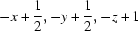 ; (ii) -x, -y, -z+1. ; (ii) -x, -y, -z+1.
| |
Data collection: COLLECT (Nonius, 1998![[Nonius (1998). COLLECT. Nonius BV, Delft, The Nederlands.]](../../../../../../logos/arrows/e_arr.gif "Nonius (1998). COLLECT. Nonius BV, Delft, The Nederlands.") ); cell refinement: DENZO/SCALEPACK (Otwinowski & Minor, 1997); data reduction: DENZO/SCALEPACK; program(s) used to solve structure: SHELXS97 (Sheldrick, 2008); program(s) used to refine structure: SHELXL97 (Sheldrick, 2008); molecular graphics: PLATON/PLUTON (Spek, 2009); software used to prepare material for publication: SHELXL97.
); cell refinement: DENZO/SCALEPACK (Otwinowski & Minor, 1997); data reduction: DENZO/SCALEPACK; program(s) used to solve structure: SHELXS97 (Sheldrick, 2008); program(s) used to refine structure: SHELXL97 (Sheldrick, 2008); molecular graphics: PLATON/PLUTON (Spek, 2009); software used to prepare material for publication: SHELXL97.
Supporting information
Thiourea (2 g, 26 mmol) was reacted with 2,4-pentadione (2.6 g, 26 mmol) in C3H6O (20 ml) solution, to give the corresponding 1:1 adduct after two hour under refluxing. After cooling to room temperature, 3.4 ml HCl 10M was added dropwise to the solution and the resulting mixture was refluxed for one hour before left standing overnight. The filtrate gave yellowish crystal suitable for X-ray analyses after four days of slow evaporation. Yield: 87.69%. m.p. 190±2 °C. Anal. Calc. for C7H13N4S2Cl (%): C, 33.26; H, 5.18; N, 22.16. Found: C, 33.37; H, 5.15; N, 22.25. Selected IR data (cm-1, KBr pellet): 1599 (ν C═N), 1187 (ν C═S). 1H NMR (200 MHz, D2O, δ, p.p.m.): 2.40 (s, 6H, –CH3); 6.83 (s, 1H, –CH). 13C NMR (200 MHz, D2O, δ, p.p.m.): 19.26 (–CH3); 118.32 (–CH); 168.02 (N═C); 172.90 (N═C—S—H).
The H atoms of the NH2 groups were located in the Fourier difference maps and refined by riding motion. Others H atoms were placed geometrically and refined with a riding model. Uiso(H) for H was assigned as 1.2Ueq of the attached C atoms (1.5 for methyl C atoms).
Data collection: COLLECT (Nonius, 1998); cell refinement: DENZO/SCALEPACK (Otwinowski & Minor, 1997); data reduction: DENZO/SCALEPACK (Otwinowski & Minor, 1997); program(s) used to solve structure: SHELXS97 (Sheldrick, 2008); program(s) used to refine structure: SHELXL97 (Sheldrick, 2008); molecular graphics: PLATON/PLUTON (Spek, 2009); software used to prepare material for publication: SHELXL97 (Sheldrick, 2008).
4,6-Dimethyl-2-thioxo-1,2-dihydropyrimidin-3-ium chloride–thiourea (1/1)
top Crystal data top | C6H9N2S+·Cl−·CH4N2S | F(000) = 528 |
| Mr = 252.78 | Dx = 1.393 Mg m−3 |
| Orthorhombic, Cmcm | Mo Kα radiation, λ = 0.71073 Å |
| Hall symbol: -C 2c 2 | Cell parameters from 653 reflections |
| a = 6.6459 (4) Å | θ = 1.0–25.4° |
| b = 21.6144 (14) Å | µ = 0.63 mm−1 |
| c = 8.3878 (5) Å | T = 293 K |
| V = 1204.88 (12) Å3 | Prism, yellow |
| Z = 4 | 0.10 × 0.10 × 0.10 mm |
Data collection top Nonius KappaCCD
diffractometer | 447 reflections with I > 2σ(I) |
| Radiation source: fine-focus sealed tube | Rint = 0.024 |
| Graphite monochromator | θmax = 25.3°, θmin = 3.1° |
| ϕ scans | h = −7→7 |
| 1080 measured reflections | k = −25→25 |
| 636 independent reflections | l = −10→10 |
Refinement top | Refinement on F2 | Primary atom site location: structure-invariant direct methods |
| Least-squares matrix: full | Secondary atom site location: difference Fourier map |
| R[F2 > 2σ(F2)] = 0.055 | Hydrogen site location: inferred from neighbouring sites |
| wR(F2) = 0.175 | H-atom parameters constrained |
| S = 1.05 | w = 1/[σ2(Fo2) + (0.1002P)2 + 1.9948P]
where P = (Fo2 + 2Fc2)/3 |
| 636 reflections | (Δ/σ)max = 0.004 |
| 49 parameters | Δρmax = 0.44 e Å−3 |
| 0 restraints | Δρmin = −0.51 e Å−3 |
Crystal data top | C6H9N2S+·Cl−·CH4N2S | V = 1204.88 (12) Å3 |
| Mr = 252.78 | Z = 4 |
| Orthorhombic, Cmcm | Mo Kα radiation |
| a = 6.6459 (4) Å | µ = 0.63 mm−1 |
| b = 21.6144 (14) Å | T = 293 K |
| c = 8.3878 (5) Å | 0.10 × 0.10 × 0.10 mm |
Data collection top Nonius KappaCCD
diffractometer | 447 reflections with I > 2σ(I) |
| 1080 measured reflections | Rint = 0.024 |
| 636 independent reflections | |
Refinement top | R[F2 > 2σ(F2)] = 0.055 | 0 restraints |
| wR(F2) = 0.175 | H-atom parameters constrained |
| S = 1.05 | Δρmax = 0.44 e Å−3 |
| 636 reflections | Δρmin = −0.51 e Å−3 |
| 49 parameters | |
Special details top Geometry. All e.s.d.'s (except the e.s.d. in the dihedral angle between two l.s. planes) are estimated using the full covariance matrix. The cell e.s.d.'s are taken into account individually in the estimation of e.s.d.'s in distances, angles and torsion angles; correlations between e.s.d.'s in cell parameters are only used when they are defined by crystal symmetry. An approximate (isotropic) treatment of cell e.s.d.'s is used for estimating e.s.d.'s involving l.s. planes. |
Refinement. Refinement of F^2^ against ALL reflections. The weighted R-factor wR and goodness of fit S are based on F^2^, conventional R-factors R are based on F, with F set to zero for negative F^2^. The threshold expression of F^2^ > σ(F^2^) is used only for calculating R-factors(gt) etc. and is not relevant to the choice of reflections for refinement. R-factors based on F^2^ are statistically about twice as large as those based on F, and R- factors based on ALL data will be even larger. |
Fractional atomic coordinates and isotropic or equivalent isotropic displacement parameters (Å2) top| | x | y | z | Uiso*/Ueq | Occ. (<1) |
| Cl1 | 0.0000 | 0.22960 (8) | 0.7500 | 0.0492 (6) | |
| S1 | 0.5000 | 0.32187 (9) | 0.7500 | 0.0582 (7) | |
| S2 | 0.0000 | −0.02324 (10) | 0.7500 | 0.1135 (15) | |
| N1 | 0.5000 | 0.21069 (18) | 0.6134 (5) | 0.0424 (10) | |
| H1 | 0.5000 | 0.2302 | 0.5240 | 0.051* | |
| N2 | 0.0000 | 0.0864 (2) | 0.6144 (5) | 0.0558 (12) | |
| H2A | 0.0000 | 0.1262 | 0.6154 | 0.067* | |
| H2B | 0.0000 | 0.0669 | 0.5251 | 0.067* | |
| C1 | 0.5000 | 0.1485 (2) | 0.6079 (6) | 0.0423 (11) | |
| C2 | 0.0000 | 0.0553 (4) | 0.7500 | 0.0526 (19) | |
| C3 | 0.5000 | 0.1172 (3) | 0.7500 | 0.0448 (17) | |
| H3 | 0.5000 | 0.0741 | 0.7500 | 0.054* | |
| C4 | 0.5000 | 0.2456 (3) | 0.7500 | 0.0431 (16) | |
| C5 | 0.5000 | 0.1187 (3) | 0.4493 (6) | 0.0589 (15) | |
| H5A | 0.5000 | 0.1499 | 0.3679 | 0.088* | |
| H5B | 0.3821 | 0.0934 | 0.4385 | 0.088* | 0.50 |
| H5C | 0.6179 | 0.0934 | 0.4385 | 0.088* | 0.50 |
Atomic displacement parameters (Å2) top| | U11 | U22 | U33 | U12 | U13 | U23 |
| Cl1 | 0.0583 (11) | 0.0481 (11) | 0.0412 (10) | 0.000 | 0.000 | 0.000 |
| S1 | 0.0680 (13) | 0.0463 (11) | 0.0602 (14) | 0.000 | 0.000 | 0.000 |
| S2 | 0.267 (5) | 0.0420 (14) | 0.0316 (11) | 0.000 | 0.000 | 0.000 |
| N1 | 0.048 (2) | 0.052 (3) | 0.0276 (19) | 0.000 | 0.000 | 0.0029 (18) |
| N2 | 0.084 (3) | 0.053 (3) | 0.030 (2) | 0.000 | 0.000 | 0.0004 (19) |
| C1 | 0.048 (3) | 0.046 (3) | 0.033 (3) | 0.000 | 0.000 | 0.000 (2) |
| C2 | 0.078 (5) | 0.053 (4) | 0.027 (4) | 0.000 | 0.000 | 0.000 |
| C3 | 0.059 (4) | 0.041 (4) | 0.035 (4) | 0.000 | 0.000 | 0.000 |
| C4 | 0.036 (3) | 0.053 (4) | 0.040 (4) | 0.000 | 0.000 | 0.000 |
| C5 | 0.086 (4) | 0.063 (3) | 0.028 (3) | 0.000 | 0.000 | −0.007 (2) |
Geometric parameters (Å, º) top | S1—C4 | 1.649 (7) | C1—C5 | 1.479 (7) |
| S2—C2 | 1.698 (8) | C2—N2i | 1.322 (6) |
| N1—C1 | 1.345 (6) | C3—C1i | 1.371 (6) |
| N1—C4 | 1.371 (5) | C3—H3 | 0.9300 |
| N1—H1 | 0.8600 | C4—N1i | 1.371 (5) |
| N2—C2 | 1.322 (6) | C5—H5A | 0.9600 |
| N2—H2A | 0.8600 | C5—H5B | 0.9600 |
| N2—H2B | 0.8600 | C5—H5C | 0.9600 |
| C1—C3 | 1.371 (6) | | |
| | | |
| C1—N1—C4 | 125.3 (4) | C1i—C3—C1 | 120.8 (6) |
| C1—N1—H1 | 117.4 | C1i—C3—H3 | 119.6 |
| C4—N1—H1 | 117.4 | C1—C3—H3 | 119.6 |
| C2—N2—H2A | 120.0 | N1i—C4—N1 | 113.3 (6) |
| C2—N2—H2B | 120.0 | N1i—C4—S1 | 123.3 (3) |
| H2A—N2—H2B | 120.0 | N1—C4—S1 | 123.3 (3) |
| N1—C1—C3 | 117.7 (5) | C1—C5—H5A | 109.5 |
| N1—C1—C5 | 117.8 (4) | C1—C5—H5B | 109.5 |
| C3—C1—C5 | 124.5 (5) | H5A—C5—H5B | 109.5 |
| N2i—C2—N2 | 118.8 (7) | C1—C5—H5C | 109.5 |
| N2i—C2—S2 | 120.6 (3) | H5A—C5—H5C | 109.5 |
| N2—C2—S2 | 120.6 (3) | H5B—C5—H5C | 109.5 |
| | | |
| C4—N1—C1—C3 | 0.000 (1) | C5—C1—C3—C1i | 180.0 |
| C4—N1—C1—C5 | 180.000 (1) | C1—N1—C4—N1i | 0.000 (2) |
| N1—C1—C3—C1i | 0.000 (2) | C1—N1—C4—S1 | 180.0 |
| Symmetry code: (i) x, y, −z+3/2. |
Hydrogen-bond geometry (Å, º) top | D—H···A | D—H | H···A | D···A | D—H···A |
| N1—H1···Cl1ii | 0.86 | 2.46 | 3.310 (4) | 171 |
| N2—H2A···Cl1 | 0.86 | 2.50 | 3.297 (5) | 154 |
| N2—H2B···S2iii | 0.86 | 2.49 | 3.347 (5) | 173 |
| Symmetry codes: (ii) −x+1/2, −y+1/2, −z+1; (iii) −x, −y, −z+1. |
Experimental details
| Crystal data |
| Chemical formula | C6H9N2S+·Cl−·CH4N2S |
| Mr | 252.78 |
| Crystal system, space group | Orthorhombic, Cmcm |
| Temperature (K) | 293 |
| a, b, c (Å) | 6.6459 (4), 21.6144 (14), 8.3878 (5) |
| V (Å3) | 1204.88 (12) |
| Z | 4 |
| Radiation type | Mo Kα |
| µ (mm−1) | 0.63 |
| Crystal size (mm) | 0.10 × 0.10 × 0.10 |
| |
| Data collection |
| Diffractometer | Nonius KappaCCD
diffractometer |
| Absorption correction | – |
No. of measured, independent and
observed [I > 2σ(I)] reflections | 1080, 636, 447 |
| Rint | 0.024 |
| (sin θ/λ)max (Å−1) | 0.601 |
| |
| Refinement |
| R[F2 > 2σ(F2)], wR(F2), S | 0.055, 0.175, 1.05 |
| No. of reflections | 636 |
| No. of parameters | 49 |
| H-atom treatment | H-atom parameters constrained |
| Δρmax, Δρmin (e Å−3) | 0.44, −0.51 |
Hydrogen-bond geometry (Å, º) top | D—H···A | D—H | H···A | D···A | D—H···A |
| N1—H1···Cl1i | 0.86 | 2.46 | 3.310 (4) | 171.4 |
| N2—H2A···Cl1 | 0.86 | 2.50 | 3.297 (5) | 153.8 |
| N2—H2B···S2ii | 0.86 | 2.49 | 3.347 (5) | 172.8 |
| Symmetry codes: (i) −x+1/2, −y+1/2, −z+1; (ii) −x, −y, −z+1. |
Acknowledgements
The authors thank the Agence Universitaire de la Francophonie for financial support (AUF-PSCI No. 6314PS804).
References
 Arslan, H., Flörke, U. & Külcü, N. (2004). Acta Chim. Slov. 51, 787–792. CAS Google Scholar
Hemamalini, M., Muthiah, P. T. & Lynch, D. E. (2005). Acta Cryst. E61, o4107–o4109. Web of Science CSD CrossRef IUCr Journals Google Scholar
Jianqiang, Q., Liufang, W., Yingqi, L., Yumin, S., Yinyue, W. & Xiaofei, J. (2006). J. Rare Earths, 24, 15–19. Google Scholar
Nonius (1998). COLLECT. Nonius BV, Delft, The Nederlands. Google Scholar
Otwinowski, Z. & Minor, W. (1997). Methods in Enzymology, Vol. 276, Macromolecular Crystallography, Part A, edited by C. W. Carter Jr & R. M. Sweet, pp. 307–326. New York: Academic Press. Google Scholar
Sheldrick, G. M. (2008). Acta Cryst. A64, 112–122. Web of Science CrossRef CAS IUCr Journals Google Scholar
Seth, S. & Sur, H. (1995). Acta Cryst. C51, 487–489. CSD CrossRef CAS Web of Science IUCr Journals Google Scholar
Spek, A. L. (2009). Acta Cryst. D65, 148–155. Web of Science CrossRef CAS IUCr Journals Google Scholar
This is an open-access article distributed under the terms of the Creative Commons Attribution (CC-BY) Licence, which permits unrestricted use, distribution, and reproduction in any medium, provided the original authors and source are cited.
 | CRYSTALLOGRAPHIC
COMMUNICATIONS |
ISSN: 2056-9890
Open

access


 journal menu



![[Scheme 1]](er2066scheme1.gif)
![[Figure 1]](./er2066fig1thm.gif)
![[Figure 2]](./er2066fig2thm.gif)


The title compound, C6H9N2S.CH4N2SCl, was characterized by 1H and 13C NMR, solid-state IR and X-ray crystallographic techniques. The X-ray structure determination reveals that the compound crystallizes in the orthorhombic space group Cmcm with a protonated molecular moiety, a chloride anion and one thiourea adduct in the asymmetric unit. The molecular geometry is illustrated in Fig. 1. The C—S bond length of 1.649 (7) Å in the molecular adduct and 1.698 (8) Å in the thiourea are double bonds character and are comparable to those observed for 1-(biphenyl-4-carbonyl)-3-p-tolyl-thiourea [1.647 (3) Å for C—S (Arslan et al., 2004)]. The C—N bond lengths are in the range [1.322 (6)-1.371 (6) Å] and are shorter than the double C—N bond length (Hemamalini et al. <i/>, 2005). All atoms, except H5B and H5C, lie on a mirror plane, similar to the observed structure of 4,6-dimethylpyrimidine-2(1H</>)-thione (Seth & Sur, 1995). The molecular adduct forms hydrogen bonds with two chloride anions by N1—H1···Cl1(-x + 1/2, -y + 1/2, -z + 1) (Fig. 2). Each thiourea molecule is linked to two other thioura molecule by hydrogen bonds and one chloride anion respectively by N2—H2B···S2(-x, -y, -z + 1) and N2—H2A···Cl1 (Table. 2).