 | Acta Crystallographica Section E Acta Crystallographica Section E CRYSTALLOGRAPHIC COMMUNICATIONS |


 journal menu


organic compounds
| CRYSTALLOGRAPHIC COMMUNICATIONS |
 access
4-Amino-2,3,5-trimethylpyridine monohydrate

aDepartment of Chemical Engineering, Zhejiang University, Hangzhou, People's Republic of China, and bCollege of Materials Chemistry and Chemical Engineering, Hangzhou Normal University, Hangzhou, People's Republic of China
*Correspondence e-mail: [email protected]
In the title compound, C8H12N2·H2O, four substituted pyridine molecules alternate with four water molecules, forming a large ring via Owater—H⋯Npyridine and Namine—H⋯Owater hydrogen bonding. Adjacent rings are connected via Owater—H⋯Owater hydrogen-bonds, forming a three-dimensional network.
Related literature
For pyridine-amine derivatives, see: Smith et al. (2005![[Smith, D. T., Shi, R. & Borgens, R. B. (2005). Eur. J. Med. Chem. 40, 908-917.]](../../../../../../logos/arrows/e_arr.gif "Smith, D. T., Shi, R. & Borgens, R. B. (2005). Eur. J. Med. Chem. 40, 908-917.") ); Tsuzuki et al. (2005). For their role as chemical intermediates in the formation of diverse molecules possessing biological activity, see: Birault et al. (2005); Gordon et al. (1996); Player et al. (2007). For related structures, see: Li et al. (2008); Lin et al. (2005); Xie et al. (2008); Yu et al. (2005); Zhou et al. (2005). For the extinction correction, see: Larson (1970).
); Tsuzuki et al. (2005). For their role as chemical intermediates in the formation of diverse molecules possessing biological activity, see: Birault et al. (2005); Gordon et al. (1996); Player et al. (2007). For related structures, see: Li et al. (2008); Lin et al. (2005); Xie et al. (2008); Yu et al. (2005); Zhou et al. (2005). For the extinction correction, see: Larson (1970).
![[Scheme 1]](fl2246scheme1.gif)
Experimental
Crystal data
|

Refinement
|
| |||||||||||||||||||||||||||
 ; (ii)
 Data collection: PROCESS-AUTO (Rigaku, 2007); cell refinement: PROCESS-AUTO; data reduction: CrystalStructure (Rigaku, 2007); program(s) used to solve structure: SHELXS97 (Sheldrick, 2008); program(s) used to refine structure: SHELXL97 (Sheldrick, 2008); molecular graphics: ORTEP-3 for Windows (Farrugia, 1997); software used to prepare material for publication: WinGX (Farrugia, 1999).
Supporting information
contains datablocks General, I. DOI: 10.1107/S1600536809016833/fl2246sup1.cif
Structure factors: contains datablock I. DOI: 10.1107/S1600536809016833/fl2246Isup2.hkl
4-nitro-2,3,5-trimethylpyridine-N-oxide(18.2 g, 100 mmol), Raney nickel (25 g, 426 mmol) and 200 ml of ethanol were placed combined a three-necked flask. 80% Hydrazine hydrate(25 ml, 400 mmol) was added dropwise, maintaining the temperature under 35 degrees centigrade. The mixture was heated to reflux and 80% hydrazine hydrate was added dropwise continually. The catalyst was suction-filtered. Half of the ethanol was concentrated under vacuum. The residue was left at room temperature for 7 days giving some colorless needle shaped crystals suitable for data collection.
Friedel equivalents were merged. All H atoms were placed in calculated positions, with C—H = 0.93 or 0.96Å and N—H = 0.869 or 0.877 Å and included in the final cycles of with a riding model, with Uiso(H) = 1.2Ueq(C,N,O).
Data collection: PROCESS-AUTO (Rigaku, 2007); cell PROCESS-AUTO (Rigaku, 2007); data reduction: CrystalStructure (Rigaku, 2007); program(s) used to solve structure: SHELXS97 (Sheldrick, 2008); program(s) used to refine structure: SHELXL97 (Sheldrick, 2008); molecular graphics: ORTEP-3 for Windows (Farrugia, 1997); software used to prepare material for publication: WinGX (Farrugia, 1999).
![[Figure 1]](./fl2246fig1thm.gif) | Fig. 1. Molecular structure showing 40% probability displacement ellipsoids. |
![[Figure 2]](./fl2246fig2thm.gif) | Fig. 2. Hydrogen-bonding interactions. |
| C8H12N2·H2O | Dx = 1.095 Mg m−3 |
| Mr = 154.21 | Mo Kα radiation, λ = 0.71075 Å |
| Tetragonal, P421c | Cell parameters from 10766 reflections |
| Hall symbol: P -4 2n | θ = 3.3–27.4° |
| a = 19.5710 (9) Å | µ = 0.07 mm−1 |
| c = 4.8819 (2) Å | T = 296 K |
| V = 1869.89 (14) Å3 | Chunk, colorless |
| Z = 8 | 0.33 × 0.27 × 0.22 mm |
| F(000) = 672.00 |
| Rigaku R-AXIS RAPID diffractometer | 951 reflections with F2 > 2.0σ(F2) |
| Detector resolution: 10.00 pixels mm-1 | Rint = 0.045 |
| ω scans | θmax = 27.4° |
| Absorption correction: multi-scan (ABSCOR; Higashi, 1995) | h = −25→25 |
| Tmin = 0.967, Tmax = 0.984 | k = −25→25 |
| 17243 measured reflections | l = −6→5 |
| 1250 independent reflections |
| Refinement on F2 | w = 1/[0.0001Fo2 + 1.1100σ(Fo2)]/(4Fo2) |
| R[F2 > 2σ(F2)] = 0.035 | (Δ/σ)max < 0.001 |
| wR(F2) = 0.088 | Δρmax = 0.23 e Å−3 |
| S = 1.00 | Δρmin = −0.20 e Å−3 |
| 1250 reflections | Extinction correction: Larson (1970) |
| 101 parameters | Extinction coefficient: 460 (64) |
| H-atom parameters constrained |
| C8H12N2·H2O | Z = 8 |
| Mr = 154.21 | Mo Kα radiation |
| Tetragonal, P421c | µ = 0.07 mm−1 |
| a = 19.5710 (9) Å | T = 296 K |
| c = 4.8819 (2) Å | 0.33 × 0.27 × 0.22 mm |
| V = 1869.89 (14) Å3 |
| Rigaku R-AXIS RAPID diffractometer | 1250 independent reflections |
| Absorption correction: multi-scan (ABSCOR; Higashi, 1995) | 951 reflections with F2 > 2.0σ(F2) |
| Tmin = 0.967, Tmax = 0.984 | Rint = 0.045 |
| 17243 measured reflections |
| R[F2 > 2σ(F2)] = 0.035 | 101 parameters |
| wR(F2) = 0.088 | H-atom parameters constrained |
| S = 1.00 | Δρmax = 0.23 e Å−3 |
| 1250 reflections | Δρmin = −0.20 e Å−3 |
Geometry. ENTER SPECIAL DETAILS OF THE MOLECULAR GEOMETRY |
Refinement. Refinement using all reflections. The weighted R-factor (wR) and goodness of fit (S) are based on F2. R-factor (gt) are based on F. The threshold expression of F2 > 2.0 σ(F2) is used only for calculating R-factor (gt). |
| x | y | z | Uiso*/Ueq | ||
| O1 | 0.25888 (6) | 0.28901 (6) | 0.2514 (3) | 0.0571 (4) | |
| N1 | 0.23938 (11) | 0.42486 (10) | 0.3906 (4) | 0.0581 (6) | |
| N2 | 0.19626 (9) | 0.61921 (9) | 0.6961 (4) | 0.0534 (6) | |
| C1 | 0.27642 (12) | 0.47949 (12) | 0.3109 (5) | 0.0528 (7) | |
| C2 | 0.26474 (11) | 0.54519 (11) | 0.4090 (5) | 0.0472 (6) | |
| C3 | 0.21206 (11) | 0.55487 (11) | 0.6011 (4) | 0.0427 (6) | |
| C4 | 0.17323 (12) | 0.49824 (12) | 0.6859 (4) | 0.0465 (6) | |
| C5 | 0.18992 (12) | 0.43602 (12) | 0.5762 (5) | 0.0556 (8) | |
| C6 | 0.33136 (13) | 0.46412 (12) | 0.1049 (7) | 0.0756 (9) | |
| C7 | 0.30672 (12) | 0.60551 (12) | 0.3136 (6) | 0.0690 (9) | |
| C8 | 0.11654 (12) | 0.50507 (12) | 0.8924 (5) | 0.0603 (7) | |
| H5 | 0.1649 | 0.3984 | 0.6350 | 0.067* | |
| H61 | 0.3753 | 0.4674 | 0.1913 | 0.091* | |
| H62 | 0.3251 | 0.4187 | 0.0345 | 0.091* | |
| H63 | 0.3288 | 0.4964 | −0.0428 | 0.091* | |
| H71 | 0.3290 | 0.5943 | 0.1442 | 0.083* | |
| H72 | 0.2774 | 0.6442 | 0.2865 | 0.083* | |
| H73 | 0.3405 | 0.6163 | 0.4495 | 0.083* | |
| H81 | 0.1353 | 0.5184 | 1.0660 | 0.072* | |
| H82 | 0.0847 | 0.5391 | 0.8315 | 0.072* | |
| H83 | 0.0935 | 0.4620 | 0.9113 | 0.072* | |
| H101 | 0.2530 | 0.3317 | 0.2901 | 0.069* | |
| H102 | 0.2457 | 0.2771 | 0.0921 | 0.069* | |
| H201 | 0.1755 | 0.6229 | 0.8489 | 0.064* | |
| H202 | 0.2266 | 0.6511 | 0.6743 | 0.064* |
| U11 | U22 | U33 | U12 | U13 | U23 | |
| O1 | 0.0663 (10) | 0.0465 (9) | 0.0584 (10) | 0.0063 (8) | −0.0044 (9) | −0.0047 (9) |
| N1 | 0.0701 (14) | 0.0454 (11) | 0.0587 (14) | 0.0003 (10) | 0.0039 (14) | −0.0022 (11) |
| N2 | 0.0624 (13) | 0.0433 (11) | 0.0545 (12) | −0.0029 (9) | 0.0092 (11) | −0.0006 (10) |
| C1 | 0.0563 (16) | 0.0549 (16) | 0.0471 (14) | 0.0083 (12) | 0.0024 (13) | −0.0024 (13) |
| C2 | 0.0504 (14) | 0.0454 (14) | 0.0459 (13) | 0.0003 (11) | 0.0032 (14) | 0.0021 (13) |
| C3 | 0.0472 (13) | 0.0398 (12) | 0.0411 (12) | 0.0003 (10) | −0.0022 (12) | 0.0001 (12) |
| C4 | 0.0507 (14) | 0.0452 (13) | 0.0435 (12) | −0.0002 (12) | −0.0022 (12) | 0.0036 (13) |
| C5 | 0.0658 (17) | 0.0454 (15) | 0.0557 (15) | −0.0047 (12) | 0.0015 (15) | 0.0042 (14) |
| C6 | 0.086 (2) | 0.0690 (19) | 0.0717 (19) | 0.0162 (16) | 0.021 (2) | −0.0020 (18) |
| C7 | 0.0674 (17) | 0.0627 (17) | 0.077 (2) | −0.0054 (14) | 0.0164 (17) | 0.0013 (16) |
| C8 | 0.0640 (16) | 0.0609 (15) | 0.0562 (14) | −0.0072 (13) | 0.0067 (15) | 0.0060 (16) |
| N1—C1 | 1.349 (3) | N2—H201 | 0.852 |
| N1—C5 | 1.344 (3) | N2—H202 | 0.868 |
| N2—C3 | 1.377 (2) | C5—H5 | 0.930 |
| C1—C2 | 1.391 (3) | C6—H61 | 0.960 |
| C1—C6 | 1.503 (3) | C6—H62 | 0.960 |
| C2—C3 | 1.407 (3) | C6—H63 | 0.960 |
| C2—C7 | 1.512 (3) | C7—H71 | 0.960 |
| C3—C4 | 1.406 (3) | C7—H72 | 0.960 |
| C4—C5 | 1.370 (3) | C7—H73 | 0.960 |
| C4—C8 | 1.505 (3) | C8—H81 | 0.960 |
| O1—H101 | 0.864 | C8—H82 | 0.960 |
| O1—H102 | 0.852 | C8—H83 | 0.960 |
| C1—N1—C5 | 116.9 (2) | C4—C5—H5 | 117.3 |
| N1—C1—C2 | 123.0 (2) | C1—C6—H61 | 109.5 |
| N1—C1—C6 | 114.8 (2) | C1—C6—H62 | 109.5 |
| C2—C1—C6 | 122.2 (2) | C1—C6—H63 | 109.5 |
| C1—C2—C3 | 118.3 (2) | H61—C6—H62 | 109.5 |
| C1—C2—C7 | 121.8 (2) | H61—C6—H63 | 109.5 |
| C3—C2—C7 | 119.9 (2) | H62—C6—H63 | 109.5 |
| N2—C3—C2 | 120.82 (19) | C2—C7—H71 | 109.5 |
| N2—C3—C4 | 120.0 (2) | C2—C7—H72 | 109.5 |
| C2—C3—C4 | 119.1 (2) | C2—C7—H73 | 109.5 |
| C3—C4—C5 | 117.2 (2) | H71—C7—H72 | 109.5 |
| C3—C4—C8 | 121.7 (2) | H71—C7—H73 | 109.5 |
| C5—C4—C8 | 121.1 (2) | H72—C7—H73 | 109.5 |
| N1—C5—C4 | 125.4 (2) | C4—C8—H81 | 109.5 |
| H101—O1—H102 | 115.0 | C4—C8—H82 | 109.5 |
| C3—N2—H201 | 118.6 | C4—C8—H83 | 109.5 |
| C3—N2—H202 | 117.5 | H81—C8—H82 | 109.5 |
| H201—N2—H202 | 111.9 | H81—C8—H83 | 109.5 |
| N1—C5—H5 | 117.3 | H82—C8—H83 | 109.5 |
| C1—N1—C5—C4 | 1.5 (3) | C7—C2—C3—N2 | 2.6 (3) |
| C5—N1—C1—C2 | −0.9 (3) | C7—C2—C3—C4 | 179.6 (2) |
| C5—N1—C1—C6 | 179.6 (2) | N2—C3—C4—C5 | 177.6 (2) |
| N1—C1—C2—C3 | 0.3 (3) | N2—C3—C4—C8 | −3.5 (3) |
| N1—C1—C2—C7 | −179.4 (2) | C2—C3—C4—C5 | 0.6 (3) |
| C6—C1—C2—C3 | 179.8 (2) | C2—C3—C4—C8 | 179.5 (2) |
| C6—C1—C2—C7 | 0.1 (2) | C3—C4—C5—N1 | −1.3 (3) |
| C1—C2—C3—N2 | −177.1 (2) | C8—C4—C5—N1 | 179.8 (2) |
| C1—C2—C3—C4 | −0.2 (3) |
| D—H···A | D—H | H···A | D···A | D—H···A |
| O1—H101···N1 | 0.86 | 1.91 | 2.771 (2) | 178 |
| O1—H102···O1i | 0.85 | 1.93 | 2.778 (2) | 173 |
| N2—H202···O1ii | 0.87 | 2.17 | 3.009 (2) | 161 |
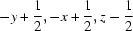
| Symmetry codes: (i) −y+1/2, −x+1/2, z−1/2; (ii) y, −x+1, −z+1. |
Experimental details
| Crystal data | |
| Chemical formula | C8H12N2·H2O |
| Mr | 154.21 |
| Crystal system, space group | Tetragonal, P421c |
| Temperature (K) | 296 |
| a, c (Å) | 19.5710 (9), 4.8819 (2) |
| V (Å3) | 1869.89 (14) |
| Z | 8 |
| Radiation type | Mo Kα |
| µ (mm−1) | 0.07 |
| Crystal size (mm) | 0.33 × 0.27 × 0.22 |
| Data collection | |
| Diffractometer | Rigaku R-AXIS RAPID diffractometer |
| Absorption correction | Multi-scan (ABSCOR; Higashi, 1995) |
| Tmin, Tmax | 0.967, 0.984 |
| No. of measured, independent and observed [F2 > 2.0σ(F2)] reflections | 17243, 1250, 951 |
| Rint | 0.045 |
| (sin θ/λ)max (Å−1) | 0.648 |
| Refinement | |
| R[F2 > 2σ(F2)], wR(F2), S | 0.035, 0.088, 1.00 |
| No. of reflections | 1250 |
| No. of parameters | 101 |
| No. of restraints | ? |
| H-atom treatment | H-atom parameters constrained |
| Δρmax, Δρmin (e Å−3) | 0.23, −0.20 |
Computer programs: PROCESS-AUTO (Rigaku, 2007), CrystalStructure (Rigaku, 2007), SHELXS97 (Sheldrick, 2008), SHELXL97 (Sheldrick, 2008), ORTEP-3 for Windows (Farrugia, 1997), WinGX (Farrugia, 1999).
| D—H···A | D—H | H···A | D···A | D—H···A |
| O1—H101···N1 | 0.864 | 1.907 | 2.771 (2) | 177.7 |
| O1—H102···O1i | 0.852 | 1.930 | 2.778 (2) | 173.4 |
| N2—H202···O1ii | 0.868 | 2.174 | 3.009 (2) | 161.1 |
| Symmetry codes: (i) −y+1/2, −x+1/2, z−1/2; (ii) y, −x+1, −z+1. |
Acknowledgements
We express our gratitude to Zhejiang University and Hangzhou Normal University for financial Support.
References
 Birault, V., Harris, C. J. & Harris, J. C. (2005). UK Patent GB2403721 A. Google Scholar
Farrugia, L. J. (1997). J. Appl. Cryst. 30, 565. CrossRef IUCr Journals Google Scholar
Farrugia, L. J. (1999). J. Appl. Cryst. 32, 837–838. CrossRef CAS IUCr Journals Google Scholar
Gordon, W. R., Brian, D. P. & Andrew, M. T. (1996). J. Med. Chem. 39, 1823–1835. PubMed Web of Science Google Scholar
Higashi, T. (1995). ABSCOR. Rigaku Corporation, Tokyo, Japan. Google Scholar
Larson, A. C. (1970). Crystallographic Computing, edited by F. R. Ahmed, S. R. Hall & C. P. Huber, pp. 291–294. Copenhagen: Munksgaard. Google Scholar
Li, Y., Li, P., Zhou, Q.-P., Zhang, G.-F. & Ng, S. W. (2008). Acta Cryst. E64, o1701. Web of Science CSD CrossRef IUCr Journals Google Scholar
Lin, H., Feng, Y. L. & Gao, S. (2005). Chin. J. Struct. Chem. 24, 375–378. CAS Google Scholar
Player, M. R., Lu, T., Hu, H. & Zhu, X. (2007). World Patent WO2007109459 A2. Google Scholar
Rigaku (2007). CrystalStructure and PROCESS-AUTO. Rigaku/MSC, The Woodlands, Texas, USA. Google Scholar
Sheldrick, G. M. (2008). Acta Cryst. A64, 112–122. Web of Science CrossRef CAS IUCr Journals Google Scholar
Smith, D. T., Shi, R. & Borgens, R. B. (2005). Eur. J. Med. Chem. 40, 908–917. Web of Science CrossRef PubMed CAS Google Scholar
Tsuzuki, S., Kawanishi, Y. & Abe, S. (2005). Biosens. Bioelectron. 20, 1452–1457. Web of Science CrossRef PubMed CAS Google Scholar
Xie, A.-L., Ding, T.-J. & Cao, X.-P. (2008). Acta Cryst. E64, o1746. Web of Science CSD CrossRef IUCr Journals Google Scholar
Yu, Q., Zhu, L. G. & Bian, H. D. (2005). Chin. J. Struct. Chem. 24, 1271–1275. CAS Google Scholar
Zhou, Y. Z., Li, J. F. & Tu, S. J. (2005). Chin. J. Struct. Chem. 24, 1193–1197. CAS Google Scholar
This is an open-access article distributed under the terms of the Creative Commons Attribution (CC-BY) Licence, which permits unrestricted use, distribution, and reproduction in any medium, provided the original authors and source are cited.
| CRYSTALLOGRAPHIC COMMUNICATIONS |


There is continuing interest in pyridin-amine derivatives due to their significant bioactivities (Smith et al., 2005; Tsuzuki et al., 2005) and their role as important chemical intermediates in the formation of diverse molecules possessing biological activities (Birault et al., 2005; Gordon et al., 1996; Player et al., 2007). In general, compounds with amino groups can be used to prepare Schiff base ligands, which have played an important role in the development of coordination chemistry as they can readily form stable complexes with most metal ions (Lin et al., 2005; Yu et al., 2005; Zhou et al., 2005). As part of our continuing investigation of such compounds, we report here the synthesis and crystal structure of a new pyridinamine derivative (Fig.1). Hydrogen-bonding interactions play an important role in the solid-state structure of this compound as they have in similar structures reported earlier (Li et al., 2008; Xie et al., 2008). As shown in Fig.2, four pyridine molecules and four water molecules are linked together alternatively to form a big ring via Owater—H···Npyridine and Namine—H···Owater hydrogen bonding (Table 1). Adjacent rings are connected to form a three-dimensional network via Owater—H···Owater hydrogen-bonding. Channel can be seen within stacks of the hydrogen bonded rings. The inner walls of the channels are occupied by the methyl groups and no solvent was found.