 | Acta Crystallographica Section E Acta Crystallographica Section E CRYSTALLOGRAPHIC COMMUNICATIONS |


 journal menu


metal-organic compounds
| CRYSTALLOGRAPHIC COMMUNICATIONS |
 access
Poly[[tetraaquabis(μ-hydroxyacetato-κ4O1,O2:O1,O1′)-μ2-sulfato-κ2O:O′-dicadmium(II)] monohydrate]

aDepartment of Chemistry, Adam Mickiewicz University, Grunwaldzka 6, 60-780 Poznań, Poland, and bDepartment of Chemistry, Faculty of Science, University of Kragujevac, R. Domanovića 12, PO Box 60, 34000 Kragujevac, Serbia
*Correspondence e-mail: [email protected]
The title compound, {[Cd2(C2H3O3)2(SO4)(H2O)4]·H2O}n, was obtained unintentionally in a transmetallation reaction. The crystal structure contains a two-dimensional metal–organic framework based on CdII–(μ-hydroxyacetato-κ4O1,O2:O1,O1′)–CdII zigzag chains joined together by bridging SO4 anions. The resulting layers are shifted with respect to each other and are stacked along the c axis. Their construction is supported by hydrogen bonds between water molecules and between water molecules and carboxylate or sulfate groups. Neighbouring layers are bridged by hydrogen bonds between the hydroxyl substituent and a sulfate anion. The sulfate anion and solvent water molecule are located on twofold axes. The results demonstrate that care must be taken when preparing ethylenediaminetetraacetic acid-type complexes by transmetallation, in order to avoid precipitation of metal complexes with the α-hydroxyacetate ligand.
Related literature
For examples of the successful application of transmetallation reactions in the synthesis of metal(II) complexes with hexadentate 1,3-propanediaminetetraacetate and 1,4-butanediaminetetraacetate ligands, see: Radanović et al. (2003![[Radanović, D. D., Rychlewska, U., Djuran, M. I., Drašković, N. S., Vasojević, M. M., Hodžić, I. M. & Radanović, D. J. (2003). Polyhedron, 22, 2745-2753.]](../../../../../../logos/arrows/e_arr.gif "Radanović, D. D., Rychlewska, U., Djuran, M. I., Drašković, N. S., Vasojević, M. M., Hodžić, I. M. & Radanović, D. J. (2003). Polyhedron, 22, 2745-2753.") , 2004, 2007); Rychlewska et al. (2000, 2005, 2007).
, 2004, 2007); Rychlewska et al. (2000, 2005, 2007).
![[Scheme 1]](gk2209scheme1.gif)
Experimental
Crystal data
|
Refinement
|
| ||||||||||||||||||
 .
.
|
 ; (iii)
  ; (v)
; (v)  .
. Data collection: CrysAlis CCD (Oxford Diffraction, 2007); cell refinement: CrysAlis RED (Oxford Diffraction, 2007); data reduction: CrysAlis RED; program(s) used to solve structure: SHELXS86 (Sheldrick, 2008); program(s) used to refine structure: SHELXL97 (Sheldrick, 2008); molecular graphics: XP (Siemens, 1989) and Mercury (Bruno et al., 2002); software used to prepare material for publication: SHELXL97.
Supporting information
contains datablocks I, global. DOI: 10.1107/S1600536809017255/gk2209sup1.cif
Structure factors: contains datablock I. DOI: 10.1107/S1600536809017255/gk2209Isup2.hkl
2.56 g (0.003 mol) of CdSO4.8H2O were dissolved in 50 cm3 of distilled water at 70°C. To this solution, 6.27 g of solid Ba[Ba(1,4-bdta)].2H2O containing Ba(HOCH2COO)2 in ratio 3:1, respectively, was added and the reaction mixture was heated at 90°C with stirring for 6 h. The precipitated BaSO4 was removed by filtration and the filtrate was evaporated to ca 10 cm3 and then left in a refrigerator for several days. Colorless crystals of the title compound were collected, washed with ethanol, and air-dried. Yield 0.98 g (59.5%). The complex was recrystallized from hot water while cooling in a refrigerator. Analysis calculated for C4H14Cd2O14S.H2O (FW = 561.03; m. p. 416 K): C 8.84, H 2.87, S 5.90%; found: C 8.93, H 2.83, S 6.28%.
All H atoms attached to C atoms were placed in their idealized positions, the hydroxyl and water H atoms were located on difference Fourier maps. All H atoms were refined as riding on their carrier atoms with constraints imposed on the bond lengths and displacement parameters, i.e. C—H = 0.96 Å O—H = 0.85 Å with Uiso(H) 20% higher than Ueq of the carrier atom.
Data collection: CrysAlis CCD (Oxford Diffraction, 2007); cell CrysAlis RED (Oxford Diffraction, 2007); data reduction: CrysAlis RED (Oxford Diffraction, 2007); program(s) used to solve structure: SHELXS86 (Sheldrick, 2008); program(s) used to refine structure: SHELXL97 (Sheldrick, 2008); molecular graphics: XP (Siemens, 1989) and Mercury (Bruno et al., 2002); software used to prepare material for publication: SHELXL97 (Sheldrick, 2008).
![[Figure 1]](./gk2209fig1thm.gif) | Fig. 1. Basic supramolecular motif showing pentagonal bipyramidal coordination around CdII. Displacement ellipsoids are drawn at the 40% probability level. Symmetry codes: i = -x + 1/2, y - 1/2, -z + 1/2; ii= -x + 1/2, y + 1/2, -z + 1/2; iii= -x, y, -z + 1/2. |
![[Figure 2]](./gk2209fig2thm.gif) | Fig. 2. View down the monoclinic c-direction showing hydrogen bonding (dashed lines), water channels and two-dimensional structure of the complex. |
| [Cd2(C2H3O3)2(SO4)(H2O)4]·H2O | F(000) = 1088 |
| Mr = 561.03 | Dx = 2.437 Mg m−3 |
| Monoclinic, C2/c | Melting point: 416 K |
| Hall symbol: -C 2yc | Mo Kα radiation, λ = 0.71073 Å |
| a = 13.5750 (3) Å | Cell parameters from 5972 reflections |
| b = 8.5777 (1) Å | θ = 2.9–28.0° |
| c = 13.7734 (3) Å | µ = 2.99 mm−1 |
| β = 107.528 (2)° | T = 295 K |
| V = 1529.34 (5) Å3 | Prismatic, colourless |
| Z = 4 | 0.30 × 0.30 × 0.20 mm |
| Kuma KM4 CCD κ-geometry diffractometer | 1710 independent reflections |
| Radiation source: fine-focus sealed tube | 1602 reflections with I > 2σ(I) |
| Graphite monochromator | Rint = 0.018 |
| ω and ϕ scans | θmax = 28.0°, θmin = 2.9° |
| Absorption correction: multi-scan (CrysAlis RED; Oxford Diffraction, 2007) | h = −17→17 |
| Tmin = 0.388, Tmax = 0.550 | k = −10→10 |
| 8842 measured reflections | l = −17→17 |
| Refinement on F2 | Secondary atom site location: difference Fourier map |
| Least-squares matrix: full | Hydrogen site location: inferred from neighbouring sites |
| R[F2 > 2σ(F2)] = 0.015 | H-atom parameters constrained |
| wR(F2) = 0.038 | w = 1/[σ2(Fo2) + (0.0212P)2 + 0.9781P] where P = (Fo2 + 2Fc2)/3 |
| S = 1.13 | (Δ/σ)max = 0.001 |
| 1710 reflections | Δρmax = 0.46 e Å−3 |
| 102 parameters | Δρmin = −0.31 e Å−3 |
| 0 restraints | Extinction correction: SHELXL97 (Sheldrick, 2008), Fc*=kFc[1+0.001xFc2λ3/sin(2θ)]-1/4 |
| Primary atom site location: structure-invariant direct methods | Extinction coefficient: 0.00703 (18) |
| [Cd2(C2H3O3)2(SO4)(H2O)4]·H2O | V = 1529.34 (5) Å3 |
| Mr = 561.03 | Z = 4 |
| Monoclinic, C2/c | Mo Kα radiation |
| a = 13.5750 (3) Å | µ = 2.99 mm−1 |
| b = 8.5777 (1) Å | T = 295 K |
| c = 13.7734 (3) Å | 0.30 × 0.30 × 0.20 mm |
| β = 107.528 (2)° |
| Kuma KM4 CCD κ-geometry diffractometer | 1710 independent reflections |
| Absorption correction: multi-scan (CrysAlis RED; Oxford Diffraction, 2007) | 1602 reflections with I > 2σ(I) |
| Tmin = 0.388, Tmax = 0.550 | Rint = 0.018 |
| 8842 measured reflections |
| R[F2 > 2σ(F2)] = 0.015 | 0 restraints |
| wR(F2) = 0.038 | H-atom parameters constrained |
| S = 1.13 | Δρmax = 0.46 e Å−3 |
| 1710 reflections | Δρmin = −0.31 e Å−3 |
| 102 parameters |
Geometry. All e.s.d.'s (except the e.s.d. in the dihedral angle between two l.s. planes) are estimated using the full covariance matrix. The cell e.s.d.'s are taken into account individually in the estimation of e.s.d.'s in distances, angles and torsion angles; correlations between e.s.d.'s in cell parameters are only used when they are defined by crystal symmetry. An approximate (isotropic) treatment of cell e.s.d.'s is used for estimating e.s.d.'s involving l.s. planes. |
| x | y | z | Uiso*/Ueq | ||
| Cd1 | 0.215433 (10) | 0.885016 (14) | 0.174423 (9) | 0.02516 (7) | |
| O1W | 0.15455 (14) | 0.67573 (17) | 0.07284 (12) | 0.0463 (4) | |
| H1W | 0.1546 | 0.6610 | 0.0118 | 0.056* | |
| H2W | 0.1641 | 0.5894 | 0.1046 | 0.056* | |
| O2W | 0.36889 (11) | 0.85773 (16) | 0.13399 (12) | 0.0344 (3) | |
| H3W | 0.4134 | 0.9233 | 0.1669 | 0.041* | |
| H4W | 0.3970 | 0.7714 | 0.1573 | 0.041* | |
| O1 | 0.14443 (14) | 1.02774 (17) | 0.02309 (11) | 0.0499 (4) | |
| H1O | 0.1128 | 1.0004 | −0.0376 | 0.060* | |
| C1 | 0.12548 (16) | 1.1879 (2) | 0.03179 (14) | 0.0323 (4) | |
| H1A | 0.0528 | 1.2052 | 0.0191 | 0.039* | |
| H1B | 0.1474 | 1.2454 | −0.0178 | 0.039* | |
| C2 | 0.18369 (14) | 1.2435 (2) | 0.13702 (13) | 0.0254 (4) | |
| O2 | 0.23446 (11) | 1.14930 (16) | 0.20257 (11) | 0.0310 (3) | |
| O4 | 0.07190 (15) | 0.87150 (18) | 0.22208 (19) | 0.0617 (6) | |
| S1 | 0.0000 | 0.97501 (7) | 0.2500 | 0.02325 (13) | |
| O5 | 0.05131 (16) | 1.0737 (2) | 0.33543 (12) | 0.0570 (5) | |
| O3W | 0.5000 | 1.0723 (3) | 0.2500 | 0.0749 (10) | |
| H5W | 0.5380 | 1.1144 | 0.2183 | 0.090* | |
| O3 | 0.17860 (15) | 1.38542 (15) | 0.15667 (12) | 0.0396 (3) |
| U11 | U22 | U33 | U12 | U13 | U23 | |
| Cd1 | 0.03149 (10) | 0.02054 (9) | 0.02099 (9) | 0.00182 (4) | 0.00418 (6) | −0.00095 (5) |
| O1W | 0.0858 (12) | 0.0209 (7) | 0.0251 (7) | −0.0006 (7) | 0.0062 (7) | −0.0006 (6) |
| O2W | 0.0402 (8) | 0.0289 (7) | 0.0334 (8) | 0.0051 (6) | 0.0098 (6) | 0.0019 (6) |
| O1 | 0.0872 (12) | 0.0260 (8) | 0.0193 (7) | 0.0107 (7) | −0.0098 (7) | −0.0061 (6) |
| C1 | 0.0445 (11) | 0.0231 (9) | 0.0224 (9) | 0.0022 (8) | −0.0001 (8) | 0.0011 (7) |
| C2 | 0.0323 (9) | 0.0211 (9) | 0.0218 (8) | −0.0040 (7) | 0.0067 (7) | 0.0000 (7) |
| O2 | 0.0416 (7) | 0.0226 (6) | 0.0214 (6) | −0.0032 (5) | −0.0018 (6) | 0.0001 (5) |
| O3 | 0.0629 (10) | 0.0208 (7) | 0.0274 (8) | −0.0011 (6) | 0.0021 (7) | −0.0030 (5) |
| O4 | 0.0565 (11) | 0.0353 (9) | 0.1112 (18) | 0.0121 (7) | 0.0524 (13) | 0.0067 (9) |
| S1 | 0.0263 (3) | 0.0186 (3) | 0.0233 (3) | 0.000 | 0.0051 (2) | 0.000 |
| O5 | 0.0940 (15) | 0.0310 (8) | 0.0250 (8) | −0.0193 (8) | −0.0139 (8) | 0.0032 (7) |
| O3W | 0.0500 (15) | 0.0271 (12) | 0.140 (3) | 0.000 | 0.0168 (17) | 0.000 |
| Cd1—O1 | 2.3584 (14) | O1—H1O | 0.8500 |
| Cd1—O2 | 2.3013 (14) | C1—C2 | 1.504 (3) |
| Cd1—O4 | 2.2386 (16) | C1—H1A | 0.9601 |
| Cd1—O1W | 2.2731 (15) | C1—H1B | 0.9599 |
| Cd1—O2W | 2.3245 (14) | C2—O2 | 1.252 (2) |
| Cd1—O2i | 2.5937 (14) | C2—O3 | 1.253 (2) |
| Cd1—O3i | 2.3379 (17) | O2—Cd1ii | 2.5937 (14) |
| O1W—H1W | 0.8500 | O4—S1 | 1.4543 (16) |
| O1W—H2W | 0.8500 | S1—O5 | 1.4468 (16) |
| O2W—H3W | 0.8500 | O3W—H5W | 0.8500 |
| O2W—H4W | 0.8500 | O3—Cd1ii | 2.3379 (17) |
| O1—C1 | 1.410 (2) | ||
| O4—Cd1—O1W | 87.27 (7) | Cd1—O2W—H3W | 110.5 |
| O4—Cd1—O2 | 93.73 (5) | H4W—O2W—H3W | 102.0 |
| O1W—Cd1—O2 | 152.03 (5) | C1—O1—Cd1 | 117.86 (11) |
| O4—Cd1—O2W | 170.76 (6) | C1—O1—H1O | 107.6 |
| O1W—Cd1—O2W | 87.65 (6) | Cd1—O1—H1O | 132.6 |
| O2—Cd1—O2W | 94.38 (5) | O1—C1—C2 | 109.54 (15) |
| O4—Cd1—O3i | 92.14 (8) | O1—C1—H1A | 109.8 |
| O1W—Cd1—O3i | 127.91 (5) | C2—C1—H1A | 109.8 |
| O2—Cd1—O3i | 80.02 (5) | O1—C1—H1B | 109.7 |
| O2W—Cd1—O3i | 84.91 (6) | C2—C1—H1B | 109.8 |
| O4—Cd1—O1 | 97.23 (7) | H1A—C1—H1B | 108.2 |
| O1W—Cd1—O1 | 83.68 (5) | O2—C2—O3 | 121.68 (18) |
| O2—Cd1—O1 | 68.45 (5) | O2—C2—C1 | 120.37 (17) |
| O2W—Cd1—O1 | 89.87 (6) | O3—C2—C1 | 117.95 (17) |
| O3i—Cd1—O1 | 147.55 (5) | C2—O2—Cd1 | 120.32 (12) |
| O4—Cd1—O2i | 81.27 (6) | C2—O2—Cd1ii | 86.96 (11) |
| O1W—Cd1—O2i | 76.21 (5) | Cd1—O2—Cd1ii | 150.69 (6) |
| O2—Cd1—O2i | 131.594 (18) | S1—O4—Cd1 | 139.34 (10) |
| O2W—Cd1—O2i | 90.02 (5) | O5—S1—O5iii | 108.34 (13) |
| O3i—Cd1—O2i | 52.37 (4) | O5—S1—O4iii | 109.84 (12) |
| O1—Cd1—O2i | 159.88 (5) | O5iii—S1—O4iii | 112.05 (13) |
| Cd1—O1W—H2W | 113.6 | O5—S1—O4 | 112.05 (13) |
| Cd1—O1W—H1W | 128.1 | O5iii—S1—O4 | 109.84 (12) |
| H2W—O1W—H1W | 109.5 | O4iii—S1—O4 | 104.74 (14) |
| Cd1—O2W—H4W | 109.2 | C2—O3—Cd1ii | 98.98 (12) |
| O4—Cd1—O1—C1 | 74.77 (15) | O2i—Cd1—O2—C2 | −163.19 (14) |
| O1W—Cd1—O1—C1 | 161.19 (16) | O4—Cd1—O2—Cd1ii | 74.85 (14) |
| O2—Cd1—O1—C1 | −16.41 (14) | O1W—Cd1—O2—Cd1ii | 166.05 (11) |
| O2W—Cd1—O1—C1 | −111.16 (15) | O2W—Cd1—O2—Cd1ii | −100.72 (13) |
| O3i—Cd1—O1—C1 | −30.9 (2) | O3i—Cd1—O2—Cd1ii | −16.67 (13) |
| O2i—Cd1—O1—C1 | 159.13 (13) | O1—Cd1—O2—Cd1ii | 171.15 (15) |
| Cd1—O1—C1—C2 | 16.3 (2) | O2i—Cd1—O2—Cd1ii | −6.79 (12) |
| O1—C1—C2—O2 | −3.4 (2) | O1W—Cd1—O4—S1 | −144.9 (2) |
| O1—C1—C2—O3 | 177.33 (17) | O2—Cd1—O4—S1 | 7.1 (2) |
| O3—C2—O2—Cd1 | 167.52 (14) | O3i—Cd1—O4—S1 | 87.2 (2) |
| C1—C2—O2—Cd1 | −11.7 (2) | O1—Cd1—O4—S1 | −61.6 (2) |
| O3—C2—O2—Cd1ii | −1.16 (18) | O2i—Cd1—O4—S1 | 138.6 (2) |
| C1—C2—O2—Cd1ii | 179.64 (15) | Cd1—O4—S1—O5 | −57.4 (2) |
| O4—Cd1—O2—C2 | −81.55 (15) | Cd1—O4—S1—O5iii | 63.0 (2) |
| O1W—Cd1—O2—C2 | 9.6 (2) | Cd1—O4—S1—O4iii | −176.5 (3) |
| O2W—Cd1—O2—C2 | 102.89 (14) | O2—C2—O3—Cd1ii | 1.3 (2) |
| O3i—Cd1—O2—C2 | −173.07 (15) | C1—C2—O3—Cd1ii | −179.48 (13) |
| O1—Cd1—O2—C2 | 14.76 (13) |
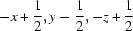
| Symmetry codes: (i) −x+1/2, y−1/2, −z+1/2; (ii) −x+1/2, y+1/2, −z+1/2; (iii) −x, y, −z+1/2. |
| D—H···A | D—H | H···A | D···A | D—H···A |
| O1W—H1W···O2Wiv | 0.85 | 1.94 | 2.784 (2) | 170 |
| O1W—H2w···O3v | 0.85 | 1.88 | 2.723 (2) | 172 |
| O2W—H3W···O3W | 0.85 | 1.88 | 2.720 (2) | 172 |
| O2W—H4W···O5i | 0.85 | 1.82 | 2.648 (2) | 162 |
| O1—H1O···O5vi | 0.85 | 1.81 | 2.659 (2) | 175 |
| O3W—H5W···O4vii | 0.85 | 2.25 | 2.813 (3) | 124 |
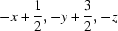
| Symmetry codes: (i) −x+1/2, y−1/2, −z+1/2; (iv) −x+1/2, −y+3/2, −z; (v) x, y−1, z; (vi) x, −y+2, z−1/2; (vii) x+1/2, y+1/2, z. |
Experimental details
| Crystal data | |
| Chemical formula | [Cd2(C2H3O3)2(SO4)(H2O)4]·H2O |
| Mr | 561.03 |
| Crystal system, space group | Monoclinic, C2/c |
| Temperature (K) | 295 |
| a, b, c (Å) | 13.5750 (3), 8.5777 (1), 13.7734 (3) |
| β (°) | 107.528 (2) |
| V (Å3) | 1529.34 (5) |
| Z | 4 |
| Radiation type | Mo Kα |
| µ (mm−1) | 2.99 |
| Crystal size (mm) | 0.30 × 0.30 × 0.20 |
| Data collection | |
| Diffractometer | Kuma KM4 CCD κ-geometry diffractometer |
| Absorption correction | Multi-scan (CrysAlis RED; Oxford Diffraction, 2007) |
| Tmin, Tmax | 0.388, 0.550 |
| No. of measured, independent and observed [I > 2σ(I)] reflections | 8842, 1710, 1602 |
| Rint | 0.018 |
| (sin θ/λ)max (Å−1) | 0.661 |
| Refinement | |
| R[F2 > 2σ(F2)], wR(F2), S | 0.015, 0.038, 1.13 |
| No. of reflections | 1710 |
| No. of parameters | 102 |
| H-atom treatment | H-atom parameters constrained |
| Δρmax, Δρmin (e Å−3) | 0.46, −0.31 |
Computer programs: CrysAlis CCD (Oxford Diffraction, 2007), CrysAlis RED (Oxford Diffraction, 2007), SHELXS86 (Sheldrick, 2008), SHELXL97 (Sheldrick, 2008), XP (Siemens, 1989) and Mercury (Bruno et al., 2002).
| Cd1—O1 | 2.3584 (14) | Cd1—O2W | 2.3245 (14) |
| Cd1—O2 | 2.3013 (14) | Cd1—O2i | 2.5937 (14) |
| Cd1—O4 | 2.2386 (16) | Cd1—O3i | 2.3379 (17) |
| Cd1—O1W | 2.2731 (15) |
| Symmetry code: (i) −x+1/2, y−1/2, −z+1/2. |
| D—H···A | D—H | H···A | D···A | D—H···A |
| O1W—H1W···O2Wii | 0.85 | 1.94 | 2.784 (2) | 170 |
| O1W—H2w···O3iii | 0.85 | 1.88 | 2.723 (2) | 172 |
| O2W—H3W···O3W | 0.85 | 1.88 | 2.720 (2) | 172 |
| O2W—H4W···O5i | 0.85 | 1.82 | 2.648 (2) | 162 |
| O1—H1O···O5iv | 0.85 | 1.81 | 2.659 (2) | 175 |
| O3W—H5W···O4v | 0.85 | 2.25 | 2.813 (3) | 124 |
| Symmetry codes: (i) −x+1/2, y−1/2, −z+1/2; (ii) −x+1/2, −y+3/2, −z; (iii) x, y−1, z; (iv) x, −y+2, z−1/2; (v) x+1/2, y+1/2, z. |
Acknowledgements
This work was funded in part by the Ministry of Science and Technological Development of the Republic of Serbia (Project No. 142008). The authors are grateful to Dr Dušanka D. Radanović (Institute of Chemistry, Technology and Metallurgy, University of Belgrade) for her valuable suggestions.
References
 Bruno, I. J., Cole, J. C., Edgington, P. R., Kessler, M., Macrae, C. F., McCabe, P., Pearson, J. & Taylor, R. (2002). Acta Cryst. B58, 389–397. Web of Science CrossRef CAS IUCr Journals Google Scholar
Oxford Diffraction (2007). CrysAlis CCD and CrysAlis RED. Oxford Diffraction Ltd, Abingdon, England. Google Scholar
Radanović, D. D., Rychlewska, U., Djuran, M. I., Drašković, N. S., Vasojević, M. M., Hodžić, I. M. & Radanović, D. J. (2003). Polyhedron, 22, 2745–2753. Google Scholar
Radanović, D. D., Rychlewska, U., Djuran, M. I., Warżajtis, B., Drašković, N. S. & Gurešić, D. M. (2004). Polyhedron, 23, 2183–2192. Google Scholar
Radanović, D. D., Rychlewska, U., Warżajtis, B., Cvijović, M. S., Dimitrijević, M. Dj. & Djuran, M. I. (2007). Polyhedron, 26, 4799–4808. Google Scholar
Rychlewska, U., Gurešić, D. M., Warżajtis, B., Radanović, D. D. & Djuran, M. I. (2005). Polyhedron, 24, 2009–2016. Web of Science CSD CrossRef CAS Google Scholar
Rychlewska, U., Radanović, D. D., Jevtović, V. S. & Radanović, D. J. (2000). Polyhedron, 19, 1–5. Web of Science CSD CrossRef CAS Google Scholar
Rychlewska, U., Warżajtis, B., Cvetić, D., Radanović, D. D., Gurešić, D. M. & Djuran, M. I. (2007). Polyhedron, 26, 1717–1724. Web of Science CSD CrossRef CAS Google Scholar
Sheldrick, G. M. (2008). Acta Cryst. A64, 112–122. Web of Science CrossRef CAS IUCr Journals Google Scholar
Siemens (1989). XP. Siemens Analytical X-ray Instruments Inc., Madison, Wisconsin, USA. Google Scholar
This is an open-access article distributed under the terms of the Creative Commons Attribution (CC-BY) Licence, which permits unrestricted use, distribution, and reproduction in any medium, provided the original authors and source are cited.
| CRYSTALLOGRAPHIC COMMUNICATIONS |


Research concerning metal–organic frameworks (MOF) has recently become important due to their potential application in a number of areas, including gas storage and catalysis. Prominent in this class of materials are frameworks that involve α-hydroxycarboxylate ligands spanning network nodes. We have recently obtained one such MOF by serendipity, when trying to synthesize cadmium(II) homometallic complex with 1,4-bdta ligand (1,4-bdta stands for 1,4-butanediaminetetraactetate) by the process of transmetallation. So far we have successfully used this strategy for obtaining M(II) complexes with both 1,3-pdta (1,3-propanediaminetetraacetate) (Rychlewska et al., 2000; Radanović et al., 2003; Radanović et al., 2004; Rychlewska et al., 2005, 2007) and 1,4-bdta ligands (Radanović et al., 2007). In this procedure, barium(II) cations, forming the homometallic barium 1,3-pdta or 1,4-bdta complex, are being exchanged by much smaller in size metal(II) cations. At the very first step of this reaction we synthesize the ligands by reacting 1,3-propanediamine (or 1,4-butanediamine) with sodium chloracetate. It turned out that, when trying to synthesize 1,4-bdta ligand, we have obtained, in the reaction mixture, besides the expected H4-1,4-bdta, some amount of α-hydroxycarboxylic acid. Most probably, this α-hydroxycarboxylic acid has originated from the chloracetic acid when heated at pH > 10. Consequent addition of BaCl2 to the solution resulted in formation of two types of barium(II) salts, one formed by H4-1,4-bdta and the other by HOCH2COOH. An attempt to exchange barium(II) by cadmium(II) cations by addition of CdSO4 resulted in percipitation of two-dimensional homometallic MOF formed by CdII cations, hydroxyacetate and sulfate anions, instead of the expected CdII 1,4-bdta complex. This has been unequivocally established by the X-ray crystal structure analysis, the results of which are reported in this paper. We next attempted to verify this hypothetical synthetic route by synthesizing the very same CdII complex starting from (HOCH2COO)2Ba salt. For both samples we have performed elemental microanalyses and NMR measurements which confirmed their identity.
In the crystal the CdII nodes bind together by a singly deprotonated hydroxyacetate and doubly deprotonated sulfate linkers. The hydroxyacetate acts as a tetradentate ligand with α-hydroxyacetate group O1–C1–C2–O2 acting as a bidentate chelate to Cd1, and carboxylate group O2–C2–O3 acting as a bidentate chelate to Cd1 at 1/2 - x, 1/2 + y, 1/2 - z. The two CdII centers sharing the same (O2) carboxylate oxygen and bridged by the O2–C2–O3 carboxylate group are 4.736 (1) Å apart, and extend in a zigzag manner along the b-direction. Each CdII cation is chelated by a hydroxyacetate residue and a carboxylate group, and is coordinated by two water molecules, and one sulfate anion, resulting in a sevenfold coordination mode (Fig. 1). The hydroxyacetate anions and one coordinated water molecule (O1W) lie in the equatorial plane while the other water molecule (O2W) and the sulfate anion take the axial positions. Hence, the coordination polyhedron formed around Cd1 is a distorted pentagonal bipyramid with the in-plane cis bond angles in the range 52.37 (4)–83.68 (5)°, the smallest angle reflecting chelation by the carboxylate ligand, and with the out-of-plane trans angle of 170.76 (6)°. Sulfate anions lie on the twofold axis and connect the neighbouring CdII centers, related by this symmetry axis via O4 oxygen atoms. Separation of the two CdII metal centers bridged by the sulfate group measures 6.773 (1) Å. The sulfate bridges help to extend the basic structural motif in the a-direction, thus forming a (001) layer (Fig. 2). This polymeric two-dimensional construction is additionally supported by hydrogen bonds (Table 2) that involve crystalline water molecule, which also occupies the twofold axis (O3w). This water molecule acts as a double hydrogen bond donor to two coordinated sulfate O atoms (O4 and its symmetry equivalent) and a double hydrogen bond acceptor from the axially coordinated water molecule (O2W and its twofold equivalent). The equatorially coordinated water molecule (O1W) acts as a hydrogen bond donor to carboxylate O3 and the axially coordinated water O2W. The neighbouring two-dimensional layers are bridged by a hydrogen bond formed between a hydroxyl group (O1) acting as a hydrogen-bond donor and the uncoordinated oxygen atom (O5) from the sulfate anion. The hydrogen bond parameters are provided in Table 2.
The reported X-ray analysis allowed us to identify and structurally characterize the unintentionally synthesized two-dimensional MOF and to demonstrate that care must be taken when preparing the edta-type complexes by transmetallation to avoid precipitation of metal complexes with α-hydroxyacetate bridges. To remove the excess of Ba(II) α-hydroxyacetate, a water washing procedure should be repeated several times.