 | Acta Crystallographica Section E Acta Crystallographica Section E CRYSTALLOGRAPHIC COMMUNICATIONS |


 journal menu


organic compounds
| CRYSTALLOGRAPHIC COMMUNICATIONS |
 access
Cyclohexanaminium trichloroacetate

aDepartment of Chemistry, Government College University, Lahore, Pakistan, and bDepartment of Physics, University of Sargodha, Sargodha, Pakistan
*Correspondence e-mail: [email protected]
In the crystal of the title compound, C6H14N+·C2Cl3O2−, centrosymmetric assemblies of two cyclohexanaminium cations and two trichloroacetate ions are linked by N—H⋯O hydrogen bonds, thereby forming R44(12) ring motifs. Further N—H⋯O interactions link the tetramers into chains propagating along the a axis.
Related literature
For related structures, see: Shahwar et al. (2009![[Shahwar, D., Tahir, M. N., Ahmad, N., Khan, M. A. & Yasmeen, A. (2009). Acta Cryst. E65, o1312.]](../../../../../../logos/arrows/e_arr.gif "Shahwar, D., Tahir, M. N., Ahmad, N., Khan, M. A. & Yasmeen, A. (2009). Acta Cryst. E65, o1312.") ); Wang et al. (2005); Jones & Ahrens (1998). For reference structural data, see: Allen et al. (1987). For graph-set notation, see: Bernstein et al. (1995).
); Wang et al. (2005); Jones & Ahrens (1998). For reference structural data, see: Allen et al. (1987). For graph-set notation, see: Bernstein et al. (1995).
![[Scheme 1]](hb2970scheme1.gif)
Experimental
Crystal data
|
Refinement
|
|
 ; (ii)
  ; (iii)
  .
. Data collection: APEX2 (Bruker, 2007); cell refinement: SAINT (Bruker, 2007); data reduction: SAINT; program(s) used to solve structure: SHELXS97 (Sheldrick, 2008); program(s) used to refine structure: SHELXL97 (Sheldrick, 2008); molecular graphics: ORTEP-3 for Windows (Farrugia, 1997) and PLATON (Spek, 2009); software used to prepare material for publication: WinGX (Farrugia, 1999) and PLATON.
Supporting information
contains datablocks global, I. DOI: 10.1107/S1600536809017504/hb2970sup1.cif
Structure factors: contains datablock I. DOI: 10.1107/S1600536809017504/hb2970Isup2.hkl
A solution of trichloroacetic acid (1.635 g, 0.01 mol) in 20 ml of dichloromethane was prepared. To this solution cyclohexyl amine (1.14 ml, 0.01 mol) was added dropwise and stirred for 30 min. The precipitate were filtered out and recrystallized in hot chloroform to yield colourless rods of (I).
The coordinates of H-atoms attached to N1 and C1 were refined. The other H atoms were positioned geometrically (C—H = 0.97 Å) and refined as riding. The constraint Uiso(H) = 1.2Ueq(carrier) was applied for all H atoms.
Data collection: APEX2 (Bruker, 2007); cell SAINT (Bruker, 2007); data reduction: SAINT (Bruker, 2007); program(s) used to solve structure: SHELXS97 (Sheldrick, 2008); program(s) used to refine structure: SHELXL97 (Sheldrick, 2008); molecular graphics: ORTEP-3 for Windows (Farrugia, 1997) and PLATON (Spek, 2009); software used to prepare material for publication: WinGX (Farrugia, 1999) and PLATON (Spek, 2009).
![[Figure 1]](./hb2970fig1thm.gif) | Fig. 1. View of (I) with displacement ellipsoids drawn at the 30% probability level. H-atoms are shown by small spheres of arbitrary radius. |
![[Figure 2]](./hb2970fig2thm.gif) | Fig. 2. The partial packing in (I) showing intermolecular H-bonding between NH3 and trichloroacetate ions and the resulting ring motif. |
| C6H14N+·C2Cl3O2− | F(000) = 544 |
| Mr = 262.55 | Dx = 1.422 Mg m−3 |
| Monoclinic, P21/c | Mo Kα radiation, λ = 0.71073 Å |
| Hall symbol: -P 2ybc | Cell parameters from 2910 reflections |
| a = 6.7217 (4) Å | θ = 2.6–27.9° |
| b = 21.2482 (15) Å | µ = 0.72 mm−1 |
| c = 10.6908 (6) Å | T = 296 K |
| β = 126.590 (3)° | Rod, colorless |
| V = 1225.98 (14) Å3 | 0.25 × 0.18 × 0.12 mm |
| Z = 4 |
| Bruker Kappa APEXII CCD diffractometer | 2910 independent reflections |
| Radiation source: fine-focus sealed tube | 1710 reflections with I > 2σ(I) |
| Graphite monochromator | Rint = 0.038 |
| Detector resolution: 7.50 pixels mm-1 | θmax = 27.9°, θmin = 2.6° |
| ω scans | h = −8→8 |
| Absorption correction: multi-scan (SADABS; Bruker, 2005) | k = −27→26 |
| Tmin = 0.853, Tmax = 0.919 | l = −12→14 |
| 13379 measured reflections |
| Refinement on F2 | Primary atom site location: structure-invariant direct methods |
| Least-squares matrix: full | Secondary atom site location: difference Fourier map |
| R[F2 > 2σ(F2)] = 0.066 | Hydrogen site location: inferred from neighbouring sites |
| wR(F2) = 0.215 | H atoms treated by a mixture of independent and constrained refinement |
| S = 1.05 | w = 1/[σ2(Fo2) + (0.1089P)2 + 0.5776P] where P = (Fo2 + 2Fc2)/3 |
| 2910 reflections | (Δ/σ)max < 0.001 |
| 139 parameters | Δρmax = 0.73 e Å−3 |
| 0 restraints | Δρmin = −0.37 e Å−3 |
| C6H14N+·C2Cl3O2− | V = 1225.98 (14) Å3 |
| Mr = 262.55 | Z = 4 |
| Monoclinic, P21/c | Mo Kα radiation |
| a = 6.7217 (4) Å | µ = 0.72 mm−1 |
| b = 21.2482 (15) Å | T = 296 K |
| c = 10.6908 (6) Å | 0.25 × 0.18 × 0.12 mm |
| β = 126.590 (3)° |
| Bruker Kappa APEXII CCD diffractometer | 2910 independent reflections |
| Absorption correction: multi-scan (SADABS; Bruker, 2005) | 1710 reflections with I > 2σ(I) |
| Tmin = 0.853, Tmax = 0.919 | Rint = 0.038 |
| 13379 measured reflections |
| R[F2 > 2σ(F2)] = 0.066 | 0 restraints |
| wR(F2) = 0.215 | H atoms treated by a mixture of independent and constrained refinement |
| S = 1.05 | Δρmax = 0.73 e Å−3 |
| 2910 reflections | Δρmin = −0.37 e Å−3 |
| 139 parameters |
Geometry. Bond distances, angles etc. have been calculated using the rounded fractional coordinates. All su's are estimated from the variances of the (full) variance-covariance matrix. The cell e.s.d.'s are taken into account in the estimation of distances, angles and torsion angles |
Refinement. Refinement of F2 against ALL reflections. The weighted R-factor wR and goodness of fit S are based on F2, conventional R-factors R are based on F, with F set to zero for negative F2. The threshold expression of F2 > σ(F2) is used only for calculating R-factors(gt) etc. and is not relevant to the choice of reflections for refinement. R-factors based on F2 are statistically about twice as large as those based on F, and R- factors based on ALL data will be even larger. |
| x | y | z | Uiso*/Ueq | ||
| N1 | 0.2904 (5) | 0.05714 (15) | 0.0547 (4) | 0.0480 (10) | |
| C1 | 0.4574 (6) | 0.08854 (16) | 0.2093 (4) | 0.0463 (10) | |
| C2 | 0.7215 (6) | 0.06696 (19) | 0.2878 (5) | 0.0568 (11) | |
| C3 | 0.8922 (7) | 0.0967 (2) | 0.4465 (5) | 0.0731 (15) | |
| C4 | 0.8100 (8) | 0.0827 (3) | 0.5472 (6) | 0.0816 (18) | |
| C5 | 0.5457 (8) | 0.1032 (2) | 0.4704 (5) | 0.0764 (17) | |
| C6 | 0.3726 (7) | 0.0733 (2) | 0.3100 (5) | 0.0626 (15) | |
| Cl1 | 0.9294 (2) | 0.30601 (6) | 0.38465 (15) | 0.0791 (4) | |
| Cl2 | 0.7598 (3) | 0.28803 (6) | 0.57059 (16) | 0.1029 (6) | |
| Cl3 | 0.4167 (2) | 0.28226 (6) | 0.23280 (17) | 0.0950 (5) | |
| O1 | 0.7893 (5) | 0.42783 (12) | 0.4227 (4) | 0.0711 (9) | |
| O2 | 0.4297 (5) | 0.40429 (14) | 0.3696 (3) | 0.0680 (10) | |
| C7 | 0.6272 (5) | 0.39152 (15) | 0.3948 (3) | 0.0406 (9) | |
| C8 | 0.6778 (7) | 0.32022 (15) | 0.3937 (4) | 0.0488 (10) | |
| H1 | 0.432 (7) | 0.1331 (19) | 0.186 (4) | 0.0553* | |
| H1A | 0.141 (8) | 0.0678 (19) | 0.011 (5) | 0.0575* | |
| H1B | 0.333 (7) | 0.0632 (19) | −0.002 (5) | 0.0575* | |
| H1C | 0.285 (7) | 0.010 (2) | 0.071 (4) | 0.0575* | |
| H2A | 0.72989 | 0.02151 | 0.29833 | 0.0680* | |
| H2B | 0.77440 | 0.07841 | 0.22401 | 0.0680* | |
| H3A | 1.05899 | 0.08085 | 0.49682 | 0.0877* | |
| H3B | 0.89524 | 0.14188 | 0.43499 | 0.0877* | |
| H4A | 0.91813 | 0.10433 | 0.64607 | 0.0973* | |
| H4B | 0.82413 | 0.03787 | 0.56795 | 0.0973* | |
| H5A | 0.53487 | 0.14865 | 0.46040 | 0.0919* | |
| H5B | 0.49516 | 0.09095 | 0.53505 | 0.0919* | |
| H6A | 0.20568 | 0.08903 | 0.25991 | 0.0753* | |
| H6B | 0.37023 | 0.02808 | 0.32080 | 0.0753* |
| U11 | U22 | U33 | U12 | U13 | U23 | |
| N1 | 0.0401 (14) | 0.0439 (17) | 0.0601 (19) | 0.0011 (12) | 0.0300 (14) | 0.0040 (13) |
| C1 | 0.0436 (16) | 0.0341 (17) | 0.057 (2) | 0.0007 (13) | 0.0278 (16) | 0.0035 (14) |
| C2 | 0.0426 (17) | 0.063 (2) | 0.066 (2) | 0.0015 (16) | 0.0331 (17) | 0.0043 (18) |
| C3 | 0.0463 (19) | 0.084 (3) | 0.072 (3) | −0.0074 (19) | 0.026 (2) | −0.002 (2) |
| C4 | 0.066 (2) | 0.093 (4) | 0.064 (3) | −0.002 (2) | 0.027 (2) | −0.007 (2) |
| C5 | 0.079 (3) | 0.088 (3) | 0.068 (3) | 0.003 (2) | 0.047 (2) | −0.010 (2) |
| C6 | 0.0508 (19) | 0.072 (3) | 0.074 (3) | −0.0019 (18) | 0.042 (2) | −0.001 (2) |
| Cl1 | 0.0779 (7) | 0.0700 (7) | 0.0894 (8) | 0.0142 (5) | 0.0499 (7) | −0.0143 (6) |
| Cl2 | 0.1635 (14) | 0.0733 (8) | 0.0817 (9) | 0.0174 (8) | 0.0784 (10) | 0.0311 (6) |
| Cl3 | 0.0748 (7) | 0.0673 (8) | 0.0937 (9) | −0.0196 (5) | 0.0236 (7) | −0.0294 (6) |
| O1 | 0.0498 (14) | 0.0401 (14) | 0.111 (2) | −0.0005 (11) | 0.0413 (15) | 0.0006 (14) |
| O2 | 0.0564 (15) | 0.0762 (19) | 0.0787 (19) | 0.0110 (13) | 0.0442 (15) | 0.0000 (14) |
| C7 | 0.0409 (16) | 0.0400 (17) | 0.0342 (15) | 0.0016 (13) | 0.0187 (13) | 0.0004 (12) |
| C8 | 0.0579 (19) | 0.0354 (17) | 0.0418 (17) | −0.0009 (14) | 0.0236 (16) | 0.0005 (13) |
| Cl1—C8 | 1.776 (6) | C5—C6 | 1.523 (6) |
| Cl2—C8 | 1.762 (4) | C1—H1 | 0.97 (4) |
| Cl3—C8 | 1.758 (4) | C2—H2B | 0.9700 |
| O1—C7 | 1.218 (5) | C2—H2A | 0.9700 |
| O2—C7 | 1.217 (5) | C3—H3A | 0.9700 |
| N1—C1 | 1.492 (5) | C3—H3B | 0.9700 |
| N1—H1A | 0.85 (6) | C4—H4A | 0.9700 |
| N1—H1C | 1.02 (4) | C4—H4B | 0.9700 |
| N1—H1B | 0.82 (5) | C5—H5B | 0.9700 |
| C1—C6 | 1.523 (7) | C5—H5A | 0.9700 |
| C1—C2 | 1.513 (7) | C6—H6B | 0.9700 |
| C2—C3 | 1.508 (6) | C6—H6A | 0.9700 |
| C3—C4 | 1.504 (8) | C7—C8 | 1.554 (5) |
| C4—C5 | 1.510 (9) | ||
| C1—N1—H1C | 109 (2) | H3A—C3—H3B | 108.00 |
| C1—N1—H1A | 111 (3) | C3—C4—H4A | 109.00 |
| C1—N1—H1B | 113 (3) | C3—C4—H4B | 109.00 |
| H1B—N1—H1C | 110 (4) | C5—C4—H4A | 109.00 |
| H1A—N1—H1B | 112 (5) | C5—C4—H4B | 109.00 |
| H1A—N1—H1C | 102 (4) | H4A—C4—H4B | 108.00 |
| N1—C1—C2 | 109.8 (3) | C4—C5—H5A | 110.00 |
| N1—C1—C6 | 109.7 (4) | C4—C5—H5B | 109.00 |
| C2—C1—C6 | 110.7 (3) | C6—C5—H5A | 110.00 |
| C1—C2—C3 | 110.6 (4) | C6—C5—H5B | 109.00 |
| C2—C3—C4 | 111.4 (4) | H5A—C5—H5B | 108.00 |
| C3—C4—C5 | 111.6 (4) | C1—C6—H6A | 109.00 |
| C4—C5—C6 | 110.7 (4) | C1—C6—H6B | 110.00 |
| C1—C6—C5 | 110.5 (4) | C5—C6—H6A | 109.00 |
| N1—C1—H1 | 105 (2) | C5—C6—H6B | 110.00 |
| C2—C1—H1 | 114 (3) | H6A—C6—H6B | 108.00 |
| C6—C1—H1 | 108 (3) | O1—C7—O2 | 127.7 (3) |
| C1—C2—H2A | 110.00 | O1—C7—C8 | 116.8 (4) |
| C1—C2—H2B | 110.00 | O2—C7—C8 | 115.5 (3) |
| C3—C2—H2A | 110.00 | Cl1—C8—Cl2 | 107.1 (2) |
| C3—C2—H2B | 110.00 | Cl1—C8—Cl3 | 107.2 (2) |
| H2A—C2—H2B | 108.00 | Cl1—C8—C7 | 112.7 (3) |
| C2—C3—H3A | 109.00 | Cl2—C8—Cl3 | 111.3 (2) |
| C2—C3—H3B | 109.00 | Cl2—C8—C7 | 107.5 (2) |
| C4—C3—H3A | 109.00 | Cl3—C8—C7 | 111.1 (3) |
| C4—C3—H3B | 109.00 | ||
| N1—C1—C2—C3 | −178.3 (3) | C4—C5—C6—C1 | −55.8 (5) |
| C6—C1—C2—C3 | −57.1 (4) | O1—C7—C8—Cl1 | −15.1 (4) |
| N1—C1—C6—C5 | 178.2 (3) | O1—C7—C8—Cl2 | 102.6 (4) |
| C2—C1—C6—C5 | 56.9 (4) | O1—C7—C8—Cl3 | −135.5 (3) |
| C1—C2—C3—C4 | 56.5 (5) | O2—C7—C8—Cl1 | 165.9 (2) |
| C2—C3—C4—C5 | −55.9 (6) | O2—C7—C8—Cl2 | −76.4 (3) |
| C3—C4—C5—C6 | 55.4 (6) | O2—C7—C8—Cl3 | 45.6 (4) |
| D—H···A | D—H | H···A | D···A | D—H···A |
| N1—H1A···O1i | 0.85 (6) | 1.96 (6) | 2.788 (6) | 167 (4) |
| N1—H1B···O2ii | 0.82 (5) | 1.96 (5) | 2.770 (5) | 168 (4) |
| N1—H1C···O1iii | 1.02 (4) | 1.83 (4) | 2.837 (4) | 169 (4) |
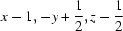
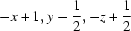
| Symmetry codes: (i) x−1, −y+1/2, z−1/2; (ii) x, −y+1/2, z−1/2; (iii) −x+1, y−1/2, −z+1/2. |
Experimental details
| Crystal data | |
| Chemical formula | C6H14N+·C2Cl3O2− |
| Mr | 262.55 |
| Crystal system, space group | Monoclinic, P21/c |
| Temperature (K) | 296 |
| a, b, c (Å) | 6.7217 (4), 21.2482 (15), 10.6908 (6) |
| β (°) | 126.590 (3) |
| V (Å3) | 1225.98 (14) |
| Z | 4 |
| Radiation type | Mo Kα |
| µ (mm−1) | 0.72 |
| Crystal size (mm) | 0.25 × 0.18 × 0.12 |
| Data collection | |
| Diffractometer | Bruker Kappa APEXII CCD diffractometer |
| Absorption correction | Multi-scan (SADABS; Bruker, 2005) |
| Tmin, Tmax | 0.853, 0.919 |
| No. of measured, independent and observed [I > 2σ(I)] reflections | 13379, 2910, 1710 |
| Rint | 0.038 |
| (sin θ/λ)max (Å−1) | 0.658 |
| Refinement | |
| R[F2 > 2σ(F2)], wR(F2), S | 0.066, 0.215, 1.05 |
| No. of reflections | 2910 |
| No. of parameters | 139 |
| H-atom treatment | H atoms treated by a mixture of independent and constrained refinement |
| Δρmax, Δρmin (e Å−3) | 0.73, −0.37 |
Computer programs: APEX2 (Bruker, 2007), SAINT (Bruker, 2007), SHELXS97 (Sheldrick, 2008), SHELXL97 (Sheldrick, 2008), ORTEP-3 for Windows (Farrugia, 1997) and PLATON (Spek, 2009), WinGX (Farrugia, 1999) and PLATON (Spek, 2009).
| D—H···A | D—H | H···A | D···A | D—H···A |
| N1—H1A···O1i | 0.85 (6) | 1.96 (6) | 2.788 (6) | 167 (4) |
| N1—H1B···O2ii | 0.82 (5) | 1.96 (5) | 2.770 (5) | 168 (4) |
| N1—H1C···O1iii | 1.02 (4) | 1.83 (4) | 2.837 (4) | 169 (4) |
| Symmetry codes: (i) x−1, −y+1/2, z−1/2; (ii) x, −y+1/2, z−1/2; (iii) −x+1, y−1/2, −z+1/2. |
Acknowledgements
NA greatfully acknowledges the Higher Education Commission, Islamabad, Pakistan, for providing a Scholarship under the Indigenous PhD Program (PIN 042–120599-PS2–156).
References
 Allen, F. H., Kennard, O., Watson, D. G., Brammer, L., Orpen, A. G. & Taylor, R. (1987). J. Chem. Soc. Perkin Trans. 2, pp. S1–19. CrossRef Web of Science Google Scholar
Bernstein, J., Davis, R. E., Shimoni, L. & Chang, N.-L. (1995). Angew. Chem. Int. Ed. Engl. 34, 1555–1573. CrossRef CAS Web of Science Google Scholar
Bruker (2005). SADABS. Bruker AXS Inc., Madison, Wisconsin, USA. Google Scholar
Bruker (2007). APEX2 and SAINT. Bruker AXS Inc., Madison, Wisconsin, USA. Google Scholar
Farrugia, L. J. (1997). J. Appl. Cryst. 30, 565. CrossRef IUCr Journals Google Scholar
Farrugia, L. J. (1999). J. Appl. Cryst. 32, 837–838. CrossRef CAS IUCr Journals Google Scholar
Jones, P. G. & Ahrens, B. (1998). Eur. J. Org. Chem. 8, 1687-1688. CrossRef Google Scholar
Shahwar, D., Tahir, M. N., Ahmad, N., Khan, M. A. & Yasmeen, A. (2009). Acta Cryst. E65, o1312. Web of Science CSD CrossRef IUCr Journals Google Scholar
Sheldrick, G. M. (2008). Acta Cryst. A64, 112–122. Web of Science CrossRef CAS IUCr Journals Google Scholar
Spek, A. L. (2009). Acta Cryst. D65, 148–155. Web of Science CrossRef CAS IUCr Journals Google Scholar
Wang, J.-P., Cheng, X.-X., Wang, J.-G. & Chen, Q.-H. (2005). Acta Cryst. E61, o4006–o4007. Web of Science CSD CrossRef CAS IUCr Journals Google Scholar
This is an open-access article distributed under the terms of the Creative Commons Attribution (CC-BY) Licence, which permits unrestricted use, distribution, and reproduction in any medium, provided the original authors and source are cited.
| CRYSTALLOGRAPHIC COMMUNICATIONS |


In continuation of synthesizing various organic ammonium salts (Shahwar et al., 2009), the title compound (I), (Fig. 1) is being reported. The crystal structures of (II) Cyclohexylammonium dichloroacetate (Wang et al., 2005) and (III) Cyclohexylamine cyclohexylammonium chloride (Jones & Ahrens, 1998) have been reported.
In (I), the bond distance and bond angles are within normal ranges (Allen et al., 1987). In the title compound, two cyclohexanaminium ions and two trichloroacetate ions are interlinked through intermolecular H-bonding of N—H···O type (Table 1) forming ring motifs R44(12) (Bernstein et al., 1995) (Fig. 2). The ring motifs are further connected through the same along the a axis resulting in one-dimensional polymeric chains. The cyclohexanaminium ions are in chair confirmations with N-atoms at a distance of 0.628 (9)Å from the central plane.