 | Acta Crystallographica Section E Acta Crystallographica Section E CRYSTALLOGRAPHIC COMMUNICATIONS |


 journal menu


organic compounds
| CRYSTALLOGRAPHIC COMMUNICATIONS |
 access
2-[(E)-(2-Aminophenyl)iminomethyl]-5-(dimethylamino)phenol

aJiangxi Key Laboratory of Organic Chemistry, Jiangxi Science and Technology Normal University, Nanchang 330013, People's Republic of China, and bAcademic Administration of JiangXi University of Traditional Chinese Medicine, Nanchang 330047, People's Republic of China
*Correspondence e-mail: [email protected]
The molecule of the title compound, C17H21N3O, displays a trans configuration with respect to the C=N double bond. The dihedral angle between the planes of the two benzene rings is 50.96 (11)° and a strong intramolecular O—H⋯N hydrogen bond is present. An intermolecular N—H⋯O hydrogen-bonding interaction stabilizes the crystal structure.
Related literature
For general background to the properties of Schiff base compounds, see: Weber et al. (2007![[Weber, B., Tandon, R. & Himsl, D. (2007). Z. Anorg. Allg. Chem. 633, 1159-1162.]](../../../../../../logos/arrows/e_arr.gif "Weber, B., Tandon, R. & Himsl, D. (2007). Z. Anorg. Allg. Chem. 633, 1159-1162.") ); Chen et al. (2008); May et al. (2004). For the structure of a related compound, see: Elmah et al. (1999).
); Chen et al. (2008); May et al. (2004). For the structure of a related compound, see: Elmah et al. (1999).
![[Scheme 1]](rz2315scheme1.gif)
Experimental
Crystal data
|
Refinement
|
| ||||||||||||||||||||||
 .
. Data collection: CrystalClear (Rigaku, 2005); cell refinement: CrystalClear; data reduction: CrystalClear; program(s) used to solve structure: SHELXS97 (Sheldrick, 2008); program(s) used to refine structure: SHELXL97 (Sheldrick, 2008); molecular graphics: SHELXTL (Sheldrick,2008); software used to prepare material for publication: SHELXL97.
Supporting information
contains datablocks I, global. DOI: 10.1107/S1600536809015773/rz2315sup1.cif
Structure factors: contains datablock I. DOI: 10.1107/S1600536809015773/rz2315Isup2.hkl
Benzene-1,2-diamine (0.59 g, 5 mmol) and 4-(diethylamino)-2-hydroxybenzaldehyde (0.965 g, 5 mmol) were dissolved in methanol (15 ml). The mixture was heated to reflux for 6 h, then cooled to room temperature, then the solution was filtered and dried (yield 84%). Crystals of the title compound suitable for X-ray were grown by slow evaporation of an ethanol solution. Esi-MS: calcd for C17H21N3O + H m/z 283.37, found 284.72.
The H atom of the hydroxy group was found in a difference Fourier map and refined freely. The other H atoms were placed geometrically and treated as riding atoms, with N—H =0.86 Å, C—H = 0.93–0.97 Å, and with Uiso(H) = 1.2 Ueq(C, N) or 1.5 Ueq(C) for methyl H atoms. In the absence of significant effects, 1505 Friedel pairs were merged in the final refinement.
Data collection: CrystalClear (Rigaku, 2005); cell CrystalClear (Rigaku, 2005); data reduction: CrystalClear (Rigaku, 2005); program(s) used to solve structure: SHELXS97 (Sheldrick, 2008); program(s) used to refine structure: SHELXL97 (Sheldrick, 2008); molecular graphics: SHELXTL (Sheldrick,2008); software used to prepare material for publication: SHELXL97 (Sheldrick, 2008).
![[Figure 1]](./rz2315fig1thm.gif) | Fig. 1. The molecular structure of the title compound with the atomic numbering scheme. Displacement ellipsoids are drawn at the 30% probability level. |
![[Figure 2]](./rz2315fig2thm.gif) | Fig. 2. Packing diagram of the title compound, showing the structure along the a axis. Intermolecular N—H···O hydrogen bonds are shown as dashed lines. |
| C17H21N3O | F(000) = 608 |
| Mr = 283.37 | Dx = 1.213 Mg m−3 |
| Orthorhombic, P212121 | Mo Kα radiation, λ = 0.71073 Å |
| Hall symbol: P 2ac 2ab | Cell parameters from 1474 reflections |
| a = 6.5904 (13) Å | θ = 3.1–27.8° |
| b = 12.703 (3) Å | µ = 0.08 mm−1 |
| c = 18.538 (4) Å | T = 293 K |
| V = 1552.0 (6) Å3 | Prism, yellow |
| Z = 4 | 0.20 × 0.20 × 0.20 mm |
| Rigaku SCXmini diffractometer | 3566 independent reflections |
| Radiation source: fine-focus sealed tube | 1996 reflections with I > 2σ(I) |
| Graphite monochromator | Rint = 0.063 |
| Detector resolution: 13.6612 pixels mm-1 | θmax = 27.5°, θmin = 3.2° |
| ω scans | h = −8→8 |
| Absorption correction: multi-scan (CrystalClear; Rigaku, 2005) | k = −16→16 |
| Tmin = 0.973, Tmax = 0.979 | l = −24→24 |
| 16156 measured reflections |
| Refinement on F2 | Primary atom site location: structure-invariant direct methods |
| Least-squares matrix: full | Secondary atom site location: difference Fourier map |
| R[F2 > 2σ(F2)] = 0.058 | Hydrogen site location: inferred from neighbouring sites |
| wR(F2) = 0.176 | H atoms treated by a mixture of independent and constrained refinement |
| S = 1.04 | w = 1/[σ2(Fo2) + (0.1P)2] where P = (Fo2 + 2Fc2)/3 |
| 2061 reflections | (Δ/σ)max = 0.001 |
| 194 parameters | Δρmax = 0.13 e Å−3 |
| 0 restraints | Δρmin = −0.14 e Å−3 |
| C17H21N3O | V = 1552.0 (6) Å3 |
| Mr = 283.37 | Z = 4 |
| Orthorhombic, P212121 | Mo Kα radiation |
| a = 6.5904 (13) Å | µ = 0.08 mm−1 |
| b = 12.703 (3) Å | T = 293 K |
| c = 18.538 (4) Å | 0.20 × 0.20 × 0.20 mm |
| Rigaku SCXmini diffractometer | 3566 independent reflections |
| Absorption correction: multi-scan (CrystalClear; Rigaku, 2005) | 1996 reflections with I > 2σ(I) |
| Tmin = 0.973, Tmax = 0.979 | Rint = 0.063 |
| 16156 measured reflections |
| R[F2 > 2σ(F2)] = 0.058 | 0 restraints |
| wR(F2) = 0.176 | H atoms treated by a mixture of independent and constrained refinement |
| S = 1.04 | Δρmax = 0.13 e Å−3 |
| 2061 reflections | Δρmin = −0.14 e Å−3 |
| 194 parameters |
Geometry. All e.s.d.'s (except the e.s.d. in the dihedral angle between two l.s. planes) are estimated using the full covariance matrix. The cell e.s.d.'s are taken into account individually in the estimation of e.s.d.'s in distances, angles and torsion angles; correlations between e.s.d.'s in cell parameters are only used when they are defined by crystal symmetry. An approximate (isotropic) treatment of cell e.s.d.'s is used for estimating e.s.d.'s involving l.s. planes. |
Refinement. Refinement of F2 against ALL reflections. The weighted R-factor wR and goodness of fit S are based on F2, conventional R-factors R are based on F, with F set to zero for negative F2. The threshold expression of F2 > σ(F2) is used only for calculating R-factors(gt) etc. and is not relevant to the choice of reflections for refinement. R-factors based on F2 are statistically about twice as large as those based on F, and R- factors based on ALL data will be even larger. |
| x | y | z | Uiso*/Ueq | ||
| C1 | 0.2951 (5) | 0.8186 (2) | 0.07623 (17) | 0.0481 (8) | |
| O1 | −0.0143 (4) | 0.8354 (2) | 0.14362 (14) | 0.0690 (8) | |
| N2 | 0.3009 (5) | 0.7252 (2) | 0.18825 (15) | 0.0600 (8) | |
| C3 | 0.0114 (5) | 0.9219 (3) | 0.03213 (18) | 0.0532 (8) | |
| H3A | −0.1196 | 0.9471 | 0.0389 | 0.064* | |
| C4 | 0.1183 (5) | 0.9498 (2) | −0.03042 (18) | 0.0528 (8) | |
| C2 | 0.0966 (5) | 0.8582 (3) | 0.08329 (17) | 0.0508 (8) | |
| C11 | 0.3911 (6) | 0.7562 (2) | 0.13124 (19) | 0.0569 (9) | |
| H11A | 0.5264 | 0.7374 | 0.1249 | 0.068* | |
| C6 | 0.3994 (5) | 0.8473 (2) | 0.01367 (17) | 0.0543 (8) | |
| H6A | 0.5309 | 0.8225 | 0.0072 | 0.065* | |
| N1 | 0.0326 (4) | 1.0119 (3) | −0.08228 (15) | 0.0627 (8) | |
| C5 | 0.3174 (5) | 0.9101 (3) | −0.03833 (17) | 0.0535 (8) | |
| H5A | 0.3928 | 0.9270 | −0.0792 | 0.064* | |
| C12 | 0.4162 (5) | 0.6759 (3) | 0.24289 (18) | 0.0555 (9) | |
| C9 | 0.1458 (6) | 1.0453 (3) | −0.1467 (2) | 0.0724 (11) | |
| H9A | 0.0496 | 1.0655 | −0.1839 | 0.087* | |
| H9B | 0.2228 | 0.9858 | −0.1648 | 0.087* | |
| N3 | 0.1521 (5) | 0.5451 (3) | 0.25389 (18) | 0.0844 (11) | |
| H3B | 0.1048 | 0.4891 | 0.2739 | 0.101* | |
| H3C | 0.0871 | 0.5743 | 0.2190 | 0.101* | |
| C13 | 0.3329 (6) | 0.5880 (3) | 0.27784 (19) | 0.0619 (10) | |
| C14 | 0.4406 (7) | 0.5432 (3) | 0.3335 (2) | 0.0773 (12) | |
| H14A | 0.3869 | 0.4849 | 0.3571 | 0.093* | |
| C16 | 0.7079 (7) | 0.6677 (3) | 0.3207 (2) | 0.0798 (12) | |
| H16A | 0.8329 | 0.6943 | 0.3352 | 0.096* | |
| C17 | 0.6027 (6) | 0.7135 (3) | 0.2645 (2) | 0.0660 (10) | |
| H17A | 0.6589 | 0.7710 | 0.2406 | 0.079* | |
| C7 | −0.1687 (6) | 1.0581 (3) | −0.0710 (2) | 0.0727 (11) | |
| H7A | −0.2585 | 1.0041 | −0.0522 | 0.087* | |
| H7B | −0.2223 | 1.0804 | −0.1173 | 0.087* | |
| C10 | 0.2883 (6) | 1.1352 (3) | −0.1340 (3) | 0.0871 (13) | |
| H10A | 0.3566 | 1.1524 | −0.1782 | 0.131* | |
| H10B | 0.3866 | 1.1155 | −0.0982 | 0.131* | |
| H10C | 0.2133 | 1.1952 | −0.1175 | 0.131* | |
| C15 | 0.6240 (8) | 0.5819 (4) | 0.3550 (2) | 0.0818 (13) | |
| H15A | 0.6929 | 0.5502 | 0.3930 | 0.098* | |
| C8 | −0.1708 (7) | 1.1508 (4) | −0.0202 (3) | 0.0933 (14) | |
| H8A | −0.3070 | 1.1767 | −0.0154 | 0.140* | |
| H8B | −0.0854 | 1.2055 | −0.0390 | 0.140* | |
| H8C | −0.1213 | 1.1291 | 0.0262 | 0.140* | |
| H1A | 0.067 (7) | 0.796 (4) | 0.168 (2) | 0.098 (16)* |
| U11 | U22 | U33 | U12 | U13 | U23 | |
| C1 | 0.0444 (16) | 0.0430 (16) | 0.0570 (19) | 0.0037 (14) | 0.0031 (16) | −0.0112 (15) |
| O1 | 0.0518 (14) | 0.0809 (18) | 0.0742 (17) | 0.0140 (14) | 0.0173 (13) | 0.0094 (15) |
| N2 | 0.0612 (17) | 0.0546 (16) | 0.0643 (18) | 0.0097 (15) | 0.0110 (15) | 0.0026 (15) |
| C3 | 0.0384 (16) | 0.0548 (19) | 0.067 (2) | 0.0022 (15) | 0.0021 (16) | −0.0071 (17) |
| C4 | 0.0463 (17) | 0.0486 (17) | 0.064 (2) | −0.0065 (15) | −0.0084 (16) | −0.0116 (16) |
| C2 | 0.0469 (17) | 0.0475 (17) | 0.0581 (19) | −0.0039 (16) | 0.0080 (17) | −0.0092 (16) |
| C11 | 0.056 (2) | 0.0458 (18) | 0.069 (2) | 0.0095 (16) | 0.0007 (19) | −0.0099 (17) |
| C6 | 0.0449 (16) | 0.0517 (19) | 0.066 (2) | 0.0060 (16) | 0.0064 (17) | −0.0112 (16) |
| N1 | 0.0488 (16) | 0.0772 (19) | 0.0622 (17) | 0.0011 (15) | −0.0072 (15) | 0.0005 (16) |
| C5 | 0.0438 (17) | 0.0570 (18) | 0.060 (2) | −0.0009 (16) | 0.0015 (17) | −0.0088 (17) |
| C12 | 0.0560 (19) | 0.0485 (18) | 0.062 (2) | 0.0119 (17) | 0.0056 (18) | −0.0012 (17) |
| C9 | 0.068 (2) | 0.080 (3) | 0.069 (2) | 0.004 (2) | −0.014 (2) | 0.004 (2) |
| N3 | 0.077 (2) | 0.084 (2) | 0.093 (2) | −0.0138 (19) | 0.008 (2) | 0.012 (2) |
| C13 | 0.062 (2) | 0.056 (2) | 0.067 (2) | 0.0106 (19) | 0.010 (2) | −0.0010 (18) |
| C14 | 0.084 (3) | 0.067 (2) | 0.080 (3) | 0.019 (2) | 0.020 (2) | 0.012 (2) |
| C16 | 0.066 (2) | 0.083 (3) | 0.090 (3) | 0.019 (2) | −0.004 (2) | 0.000 (3) |
| C17 | 0.063 (2) | 0.059 (2) | 0.076 (2) | 0.010 (2) | 0.005 (2) | 0.0051 (19) |
| C7 | 0.051 (2) | 0.088 (3) | 0.079 (2) | 0.002 (2) | −0.017 (2) | 0.008 (2) |
| C10 | 0.075 (3) | 0.083 (3) | 0.102 (3) | −0.011 (3) | −0.016 (3) | 0.014 (2) |
| C15 | 0.091 (3) | 0.078 (3) | 0.076 (3) | 0.029 (3) | 0.000 (3) | 0.017 (2) |
| C8 | 0.076 (3) | 0.098 (3) | 0.106 (3) | 0.024 (3) | −0.001 (3) | −0.005 (3) |
| C1—C6 | 1.397 (4) | C9—H9B | 0.9700 |
| C1—C2 | 1.407 (4) | N3—C13 | 1.383 (5) |
| C1—C11 | 1.438 (4) | N3—H3B | 0.8600 |
| O1—C2 | 1.367 (4) | N3—H3C | 0.8600 |
| O1—H1A | 0.86 (5) | C13—C14 | 1.376 (5) |
| N2—C11 | 1.275 (4) | C14—C15 | 1.365 (6) |
| N2—C12 | 1.413 (4) | C14—H14A | 0.9300 |
| C3—C2 | 1.367 (4) | C16—C15 | 1.377 (6) |
| C3—C4 | 1.402 (5) | C16—C17 | 1.380 (5) |
| C3—H3A | 0.9300 | C16—H16A | 0.9300 |
| C4—N1 | 1.366 (4) | C17—H17A | 0.9300 |
| C4—C5 | 1.413 (5) | C7—C8 | 1.509 (5) |
| C11—H11A | 0.9300 | C7—H7A | 0.9700 |
| C6—C5 | 1.363 (4) | C7—H7B | 0.9700 |
| C6—H6A | 0.9300 | C10—H10A | 0.9600 |
| N1—C7 | 1.465 (5) | C10—H10B | 0.9600 |
| N1—C9 | 1.471 (4) | C10—H10C | 0.9600 |
| C5—H5A | 0.9300 | C15—H15A | 0.9300 |
| C12—C17 | 1.378 (5) | C8—H8A | 0.9600 |
| C12—C13 | 1.403 (5) | C8—H8B | 0.9600 |
| C9—C10 | 1.497 (5) | C8—H8C | 0.9600 |
| C9—H9A | 0.9700 | ||
| C6—C1—C2 | 116.2 (3) | C13—N3—H3C | 120.0 |
| C6—C1—C11 | 121.1 (3) | H3B—N3—H3C | 120.0 |
| C2—C1—C11 | 122.7 (3) | C14—C13—N3 | 121.4 (4) |
| C2—O1—H1A | 103 (3) | C14—C13—C12 | 118.3 (4) |
| C11—N2—C12 | 118.7 (3) | N3—C13—C12 | 120.2 (3) |
| C2—C3—C4 | 121.1 (3) | C15—C14—C13 | 121.8 (4) |
| C2—C3—H3A | 119.4 | C15—C14—H14A | 119.1 |
| C4—C3—H3A | 119.4 | C13—C14—H14A | 119.1 |
| N1—C4—C3 | 121.4 (3) | C15—C16—C17 | 118.7 (4) |
| N1—C4—C5 | 121.1 (3) | C15—C16—H16A | 120.6 |
| C3—C4—C5 | 117.5 (3) | C17—C16—H16A | 120.6 |
| O1—C2—C3 | 118.2 (3) | C12—C17—C16 | 121.4 (4) |
| O1—C2—C1 | 119.8 (3) | C12—C17—H17A | 119.3 |
| C3—C2—C1 | 121.9 (3) | C16—C17—H17A | 119.3 |
| N2—C11—C1 | 123.5 (3) | N1—C7—C8 | 114.2 (3) |
| N2—C11—H11A | 118.2 | N1—C7—H7A | 108.7 |
| C1—C11—H11A | 118.2 | C8—C7—H7A | 108.7 |
| C5—C6—C1 | 123.0 (3) | N1—C7—H7B | 108.7 |
| C5—C6—H6A | 118.5 | C8—C7—H7B | 108.7 |
| C1—C6—H6A | 118.5 | H7A—C7—H7B | 107.6 |
| C4—N1—C7 | 120.3 (3) | C9—C10—H10A | 109.5 |
| C4—N1—C9 | 121.9 (3) | C9—C10—H10B | 109.5 |
| C7—N1—C9 | 117.4 (3) | H10A—C10—H10B | 109.5 |
| C6—C5—C4 | 120.2 (3) | C9—C10—H10C | 109.5 |
| C6—C5—H5A | 119.9 | H10A—C10—H10C | 109.5 |
| C4—C5—H5A | 119.9 | H10B—C10—H10C | 109.5 |
| C17—C12—C13 | 119.4 (3) | C14—C15—C16 | 120.4 (4) |
| C17—C12—N2 | 122.3 (3) | C14—C15—H15A | 119.8 |
| C13—C12—N2 | 118.3 (3) | C16—C15—H15A | 119.8 |
| N1—C9—C10 | 114.2 (3) | C7—C8—H8A | 109.5 |
| N1—C9—H9A | 108.7 | C7—C8—H8B | 109.5 |
| C10—C9—H9A | 108.7 | H8A—C8—H8B | 109.5 |
| N1—C9—H9B | 108.7 | C7—C8—H8C | 109.5 |
| C10—C9—H9B | 108.7 | H8A—C8—H8C | 109.5 |
| H9A—C9—H9B | 107.6 | H8B—C8—H8C | 109.5 |
| C13—N3—H3B | 120.0 |
| D—H···A | D—H | H···A | D···A | D—H···A |
| N3—H3B···O1i | 0.86 | 2.55 | 3.395 (4) | 167 |
| O1—H1A···N2 | 0.86 (5) | 1.82 (5) | 2.638 (4) | 157 (4) |
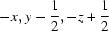
| Symmetry code: (i) −x, y−1/2, −z+1/2. |
Experimental details
| Crystal data | |
| Chemical formula | C17H21N3O |
| Mr | 283.37 |
| Crystal system, space group | Orthorhombic, P212121 |
| Temperature (K) | 293 |
| a, b, c (Å) | 6.5904 (13), 12.703 (3), 18.538 (4) |
| V (Å3) | 1552.0 (6) |
| Z | 4 |
| Radiation type | Mo Kα |
| µ (mm−1) | 0.08 |
| Crystal size (mm) | 0.20 × 0.20 × 0.20 |
| Data collection | |
| Diffractometer | Rigaku SCXmini diffractometer |
| Absorption correction | Multi-scan (CrystalClear; Rigaku, 2005) |
| Tmin, Tmax | 0.973, 0.979 |
| No. of measured, independent and observed [I > 2σ(I)] reflections | 16156, 3566, 1996 |
| Rint | 0.063 |
| (sin θ/λ)max (Å−1) | 0.649 |
| Refinement | |
| R[F2 > 2σ(F2)], wR(F2), S | 0.058, 0.176, 1.04 |
| No. of reflections | 2061 |
| No. of parameters | 194 |
| H-atom treatment | H atoms treated by a mixture of independent and constrained refinement |
| Δρmax, Δρmin (e Å−3) | 0.13, −0.14 |
Computer programs: CrystalClear (Rigaku, 2005), SHELXS97 (Sheldrick, 2008), SHELXL97 (Sheldrick, 2008), SHELXTL (Sheldrick,2008).
| D—H···A | D—H | H···A | D···A | D—H···A |
| N3—H3B···O1i | 0.86 | 2.55 | 3.395 (4) | 167.3 |
| O1—H1A···N2 | 0.86 (5) | 1.82 (5) | 2.638 (4) | 157 (4) |
| Symmetry code: (i) −x, y−1/2, −z+1/2. |
References
 Chen, Z. H., Morimoto, H., Matsunaga, S. & Shibasaki, M. (2008). J. Am. Chem. Soc. 130, 2170–2171. Web of Science CSD CrossRef PubMed CAS Google Scholar
Elmah, A., Kabak, M. & Elerman, Y. (1999). J. Mol. Struct. 484, 229–234. Google Scholar
May, J. P., Ting, R., Lermer, L., Thomas, J. M., Roupioz, Y. & Perrin, D. M. (2004). J. Am. Chem. Soc. 126, 4145–4156. Web of Science CrossRef PubMed CAS Google Scholar
Rigaku (2005). CrystalClear. Rigaku Corporation, Tokyo, Japan. Google Scholar
Sheldrick, G. M. (2008). Acta Cryst. A64, 112–122. Web of Science CrossRef CAS IUCr Journals Google Scholar
Weber, B., Tandon, R. & Himsl, D. (2007). Z. Anorg. Allg. Chem. 633, 1159–1162. Web of Science CSD CrossRef CAS Google Scholar
This is an open-access article distributed under the terms of the Creative Commons Attribution (CC-BY) Licence, which permits unrestricted use, distribution, and reproduction in any medium, provided the original authors and source are cited.
| CRYSTALLOGRAPHIC COMMUNICATIONS |


Schiff base compounds have received considerable attention for many years, primarily due to their importance in the development of coordination chemistry related to magnetism (Weber et al., 2007), catalysis (Chen et al., 2008) and biological processes (May et al.,2004). Our group is interested in the synthesis and preparation of Schiff bases. Here, we report the synthesis and crystal structure of the title compound.
The molecular structure of the title compound is shown in Fig. 1. The dihedral angle between the mean planes of the two aromatic rings is 50.96 (11)°, indicating that the Schiff-base ligand adopts a non-planar conformation. As expected, the molecule displays a trans configuration about the central C11═N2 bond. Bond lengths and angles observed in the structure are in normal ranges and comparable with those of a related Schiff base compound (Elmah et al., 1999). The hydroxy group is involved as donor in a strong intramolecular O—H···N hydrogen bond (Table 1) and as acceptor in an weak intermolecular N—H···O hydrogen interaction (Fig. 2, Table 1).