 | Acta Crystallographica Section E Acta Crystallographica Section E CRYSTALLOGRAPHIC COMMUNICATIONS |


 journal menu


inorganic compounds
| CRYSTALLOGRAPHIC COMMUNICATIONS |
 access
Nd2(WO4)3

aInstitute for Chemical Technologies and Analytics, Division of Structural Chemistry, Vienna University of Technology, Getreidemarkt 9/164-SC, A-1060 Vienna, Austria, and bInstitute of General and Inorganic Chemistry, Bulgarian Academy of Sciences, Acad. Georgi Bonchev Str. Bld.11, 1113 Sofia, Bulgaria
*Correspondence e-mail: [email protected]
The title compound, dineodymium(III) tris[tungstate(VI)], is a member of the Eu2(WO4)3 structure family and crystallizes isotypically with other rare earth tungstates and molybdates of this formula type. The structure is a derivative of the scheelite (CaWO4) structure and can be considered as an ordered defect variant with a threefold scheelite supercell and one rare earth (RE) site unoccupied. The Nd3+ cations are coordinated by eight O atoms in form of a distorted bicapped trigonal prism. The two unique W cations are tetrahedrally surrounded by O atoms. One WO4 tetrahedron has 2 symmetry and is relatively undistorted whereas the other tetrahedron differs considerably from an ideal geometry. This is caused by an additional remote O atom at a distance of 2.149 (4) Å. The resulting WO4 + 1 polyhedra form W2O8 dimers through edge-sharing. Together with the WO4 and NdO8 units, the three-dimensional set-up is accomplished.
Related literature
The determination of scheelite was reported by Dickinson (1920![[Dickinson, R. G. (1920). J. Am. Chem. Soc. 42, 85-93.]](../../../../../../logos/arrows/e_arr.gif "Dickinson, R. G. (1920). J. Am. Chem. Soc. 42, 85-93.") ). For a previous investigation of the structure of Nd2(WO4)3, see: Nassau et al. (1969). Isotypic (RE)2(WO4)3 structures have been reported by Templeton & Zalkin (1963) for RE = Eu; Gärtner et al. (1994) for La; Rong et al. (2003) for Dy, Gressling & Müller-Buschbaum (1995) for Ce. For the role of the crystal structure on the thermal expansion of (RE)2(WO4)3 compounds, see: Sumithra & Umarji (2004). For data standardization, see: Gelato & Parthé (1987).
). For a previous investigation of the structure of Nd2(WO4)3, see: Nassau et al. (1969). Isotypic (RE)2(WO4)3 structures have been reported by Templeton & Zalkin (1963) for RE = Eu; Gärtner et al. (1994) for La; Rong et al. (2003) for Dy, Gressling & Müller-Buschbaum (1995) for Ce. For the role of the crystal structure on the thermal expansion of (RE)2(WO4)3 compounds, see: Sumithra & Umarji (2004). For data standardization, see: Gelato & Parthé (1987).
Experimental
Crystal data
|
Refinement
|
|
 ; (ii)
  ; (iii)
  ; (v)
; (v) 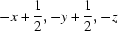 ; (vi)
  .
. Data collection: CAD-4 Software (Enraf–Nonius, 1989); cell refinement: CAD-4 Software; data reduction: HELENA implemented in PLATON (Spek, 2009); program(s) used to solve structure: SHELXS97 (Sheldrick, 2008); program(s) used to refine structure: SHELXL97 (Sheldrick, 2008); molecular graphics: ATOMS (Dowty, 2006); software used to prepare material for publication: SHELXL97.
Supporting information
contains datablocks I, global. DOI: 10.1107/S1600536809018108/si2175sup1.cif
Structure factors: contains datablock I. DOI: 10.1107/S1600536809018108/si2175Isup2.hkl
Single crystals of the title compound were obtained from the melt. Analytical grade starting materials Nd2O3 (Fluka, 99.9%) and WO3 (Aldrich, 99.5%) were mixed and heated under atmospheric conditions in a platinum crucible to 1473 K. Then the furnace was slowly cooled to 1273 K during 24 h, held at that temperature for 5 h and then cooled to 1173 K during 30 h. Then the crucible was taken from the furnace and was quenched in water. Light-purple crystals of the title compound suitable for X-ray diffraction studies were broken from a large chunk by gentle crushing between two glass slides.
The highest peak is 0.76 Å from W2 and the deepest hole 0.69 Å from the same atom. Finally, structure data were standardized with the program STRUCTURETIDY (Gelato & Parthé, 1987).
Data collection: CAD-4 Software (Enraf–Nonius, 1989); cell CAD-4 Software (Enraf–Nonius, 1989); data reduction: HELENA implemented in PLATON (Spek, 2009); program(s) used to solve structure: SHELXS97 (Sheldrick, 2008); program(s) used to refine structure: SHELXL97 (Sheldrick, 2008); molecular graphics: ATOMS (Dowty, 2006); software used to prepare material for publication: SHELXL97 (Sheldrick, 2008).
![[Figure 1]](./si2175fig1thm.gif) | Fig. 1. The crystal structure of Nd2(WO4)3 in a projection along the b- axis, drawn with displacement ellipsoids at the 74% probability level. Nd atoms are given in blue, W atoms in red and O atoms in white. WO4 units are given as red tetrahedra. Nd—O bonds have been omitted for clarity. The of the (distorted) scheelite is indicated. with blue lines. |
| Nd2(WO4)3 | F(000) = 1752 |
| Mr = 1032.03 | Dx = 7.021 Mg m−3 |
| Monoclinic, C2/c | Mo Kα radiation, λ = 0.71073 Å |
| Hall symbol: -C 2yc | Cell parameters from 25 reflections |
| a = 7.7589 (12) Å | θ = 10.5–16.9° |
| b = 11.597 (2) Å | µ = 45.72 mm−1 |
| c = 11.516 (2) Å | T = 293 K |
| β = 109.561 (14)° | Block, light-purple |
| V = 976.4 (3) Å3 | 0.12 × 0.10 × 0.08 mm |
| Z = 4 |
| Enraf–Nonius CAD-4 diffractometer | 1830 reflections with I > 2σ(I) |
| Radiation source: fine-focus sealed tube | Rint = 0.082 |
| Graphite monochromator | θmax = 35.0°, θmin = 3.3° |
| ω/2θ scans | h = −12→12 |
| Absorption correction: numerical (HABITUS; Herrendorf, 1997) | k = −18→18 |
| Tmin = 0.033, Tmax = 0.119 | l = −18→18 |
| 8392 measured reflections | 3 standard reflections every 120 min |
| 2149 independent reflections | intensity decay: none |
| Refinement on F2 | Primary atom site location: structure-invariant direct methods |
| Least-squares matrix: full | Secondary atom site location: difference Fourier map |
| R[F2 > 2σ(F2)] = 0.025 | w = 1/[σ2(Fo2) + (0.0271P)2] where P = (Fo2 + 2Fc2)/3 |
| wR(F2) = 0.063 | (Δ/σ)max = 0.001 |
| S = 1.09 | Δρmax = 2.79 e Å−3 |
| 2149 reflections | Δρmin = −5.24 e Å−3 |
| 79 parameters | Extinction correction: SHELXL97 (Sheldrick, 2008), Fc*=kFc[1+0.001xFc2λ3/sin(2θ)]-1/4 |
| 0 restraints | Extinction coefficient: 0.00516 (13) |
| Nd2(WO4)3 | V = 976.4 (3) Å3 |
| Mr = 1032.03 | Z = 4 |
| Monoclinic, C2/c | Mo Kα radiation |
| a = 7.7589 (12) Å | µ = 45.72 mm−1 |
| b = 11.597 (2) Å | T = 293 K |
| c = 11.516 (2) Å | 0.12 × 0.10 × 0.08 mm |
| β = 109.561 (14)° |
| Enraf–Nonius CAD-4 diffractometer | 1830 reflections with I > 2σ(I) |
| Absorption correction: numerical (HABITUS; Herrendorf, 1997) | Rint = 0.082 |
| Tmin = 0.033, Tmax = 0.119 | 3 standard reflections every 120 min |
| 8392 measured reflections | intensity decay: none |
| 2149 independent reflections |
| R[F2 > 2σ(F2)] = 0.025 | 79 parameters |
| wR(F2) = 0.063 | 0 restraints |
| S = 1.09 | Δρmax = 2.79 e Å−3 |
| 2149 reflections | Δρmin = −5.24 e Å−3 |
Geometry. All e.s.d.'s (except the e.s.d. in the dihedral angle between two l.s. planes) are estimated using the full covariance matrix. The cell e.s.d.'s are taken into account individually in the estimation of e.s.d.'s in distances, angles and torsion angles; correlations between e.s.d.'s in cell parameters are only used when they are defined by crystal symmetry. An approximate (isotropic) treatment of cell e.s.d.'s is used for estimating e.s.d.'s involving l.s. planes. |
Refinement. Refinement of F2 against ALL reflections. The weighted R-factor wR and goodness of fit S are based on F2, conventional R-factors R are based on F, with F set to zero for negative F2. The threshold expression of F2 > σ(F2) is used only for calculating R-factors(gt) etc. and is not relevant to the choice of reflections for refinement. R-factors based on F2 are statistically about twice as large as those based on F, and R- factors based on ALL data will be even larger. |
| x | y | z | Uiso*/Ueq | ||
| Nd | 0.17830 (3) | 0.12676 (2) | 0.59450 (2) | 0.00552 (7) | |
| W1 | 0.15461 (2) | 0.355585 (18) | 0.048983 (19) | 0.00616 (7) | |
| W2 | 0.0000 | 0.11826 (3) | 0.2500 | 0.00700 (7) | |
| O1 | 0.0124 (5) | 0.0407 (4) | 0.3888 (4) | 0.0087 (6) | |
| O2 | 0.0717 (5) | 0.3000 (4) | 0.4608 (4) | 0.0103 (7) | |
| O3 | 0.1944 (5) | 0.2058 (4) | 0.2795 (4) | 0.0138 (8) | |
| O4 | 0.2205 (6) | 0.4270 (4) | 0.1932 (4) | 0.0127 (7) | |
| O5 | 0.3630 (5) | 0.0366 (4) | 0.0596 (4) | 0.0104 (7) | |
| O6 | 0.3846 (5) | 0.2870 (4) | 0.0765 (4) | 0.0115 (7) |
| U11 | U22 | U33 | U12 | U13 | U23 | |
| Nd | 0.00501 (10) | 0.00694 (12) | 0.00528 (12) | −0.00035 (7) | 0.00262 (8) | 0.00007 (8) |
| W1 | 0.00522 (9) | 0.00682 (10) | 0.00802 (10) | −0.00014 (6) | 0.00430 (6) | 0.00015 (6) |
| W2 | 0.00763 (11) | 0.01014 (13) | 0.00401 (12) | 0.000 | 0.00297 (8) | 0.000 |
| O1 | 0.0106 (15) | 0.0089 (16) | 0.0069 (15) | −0.0007 (12) | 0.0032 (12) | 0.0005 (12) |
| O2 | 0.0089 (14) | 0.0138 (18) | 0.0111 (17) | 0.0023 (13) | 0.0074 (12) | 0.0020 (14) |
| O3 | 0.0163 (17) | 0.0133 (19) | 0.0120 (18) | −0.0018 (14) | 0.0050 (14) | −0.0037 (15) |
| O4 | 0.0142 (15) | 0.0180 (19) | 0.0057 (15) | 0.0012 (15) | 0.0031 (12) | −0.0004 (14) |
| O5 | 0.0110 (15) | 0.0111 (17) | 0.0102 (17) | −0.0023 (13) | 0.0048 (13) | 0.0025 (14) |
| O6 | 0.0035 (13) | 0.0133 (18) | 0.0178 (19) | −0.0002 (12) | 0.0036 (13) | −0.0059 (15) |
| Nd—O4i | 2.387 (4) | W1—O5v | 1.741 (4) |
| Nd—O2i | 2.391 (4) | W1—O4 | 1.771 (4) |
| Nd—O3i | 2.427 (5) | W1—O2vi | 1.838 (4) |
| Nd—O6ii | 2.433 (4) | W1—O6 | 1.881 (4) |
| Nd—O1iii | 2.487 (4) | W1—O6v | 2.149 (4) |
| Nd—O5iv | 2.488 (4) | W2—O3 | 1.754 (4) |
| Nd—O1 | 2.495 (4) | W2—O3vi | 1.754 (4) |
| Nd—O2 | 2.497 (4) | W2—O1vi | 1.808 (4) |
| Nd—Ndi | 3.9708 (7) | W2—O1 | 1.808 (4) |
| O4i—Nd—O2i | 110.36 (14) | O5v—W1—O4 | 105.4 (2) |
| O4i—Nd—O3i | 70.63 (16) | O5v—W1—O2vi | 111.35 (18) |
| O2i—Nd—O3i | 70.79 (14) | O4—W1—O2vi | 101.06 (18) |
| O4i—Nd—O6ii | 99.92 (14) | O5v—W1—O6 | 105.45 (19) |
| O2i—Nd—O6ii | 130.65 (14) | O4—W1—O6 | 94.60 (19) |
| O3i—Nd—O6ii | 84.51 (15) | O2vi—W1—O6 | 134.0 (2) |
| O4i—Nd—O1iii | 73.56 (14) | O5v—W1—O6v | 96.3 (2) |
| O2i—Nd—O1iii | 148.71 (14) | O4—W1—O6v | 157.2 (2) |
| O3i—Nd—O1iii | 135.38 (14) | O2vi—W1—O6v | 76.80 (16) |
| O6ii—Nd—O1iii | 76.29 (14) | O6—W1—O6v | 72.57 (17) |
| O4i—Nd—O5iv | 87.53 (15) | O3—W2—O3vi | 109.3 (3) |
| O2i—Nd—O5iv | 70.42 (14) | O3—W2—O1vi | 104.30 (18) |
| O3i—Nd—O5iv | 124.37 (14) | O3vi—W2—O1vi | 109.20 (19) |
| O6ii—Nd—O5iv | 150.80 (14) | O3—W2—O1 | 109.20 (19) |
| O1iii—Nd—O5iv | 78.93 (13) | O3vi—W2—O1 | 104.30 (18) |
| O4i—Nd—O1 | 139.13 (15) | O1vi—W2—O1 | 120.3 (3) |
| O2i—Nd—O1 | 95.50 (13) | W2—O1—Ndiii | 126.85 (18) |
| O3i—Nd—O1 | 149.90 (14) | W2—O1—Nd | 119.87 (19) |
| O6ii—Nd—O1 | 84.99 (14) | Ndiii—O1—Nd | 111.72 (15) |
| O1iii—Nd—O1 | 68.28 (15) | W1vi—O2—Ndi | 134.6 (2) |
| O5iv—Nd—O1 | 71.57 (13) | W1vi—O2—Nd | 115.63 (18) |
| O4i—Nd—O2 | 140.26 (15) | Ndi—O2—Nd | 108.61 (14) |
| O2i—Nd—O2 | 71.39 (14) | W2—O3—Ndi | 136.9 (2) |
| O3i—Nd—O2 | 73.11 (15) | W1—O4—Ndi | 137.0 (3) |
| O6ii—Nd—O2 | 60.61 (13) | W1v—O5—Ndvii | 138.8 (2) |
| O1iii—Nd—O2 | 126.35 (12) | W1—O6—W1v | 107.43 (17) |
| O5iv—Nd—O2 | 127.07 (13) | W1—O6—Ndviii | 130.5 (2) |
| O1—Nd—O2 | 77.15 (13) | W1v—O6—Ndviii | 106.94 (16) |
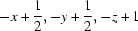
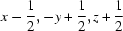
| Symmetry codes: (i) −x+1/2, −y+1/2, −z+1; (ii) x−1/2, −y+1/2, z+1/2; (iii) −x, −y, −z+1; (iv) x, −y, z+1/2; (v) −x+1/2, −y+1/2, −z; (vi) −x, y, −z+1/2; (vii) x, −y, z−1/2; (viii) x+1/2, −y+1/2, z−1/2. |
Experimental details
| Crystal data | |
| Chemical formula | Nd2(WO4)3 |
| Mr | 1032.03 |
| Crystal system, space group | Monoclinic, C2/c |
| Temperature (K) | 293 |
| a, b, c (Å) | 7.7589 (12), 11.597 (2), 11.516 (2) |
| β (°) | 109.561 (14) |
| V (Å3) | 976.4 (3) |
| Z | 4 |
| Radiation type | Mo Kα |
| µ (mm−1) | 45.72 |
| Crystal size (mm) | 0.12 × 0.10 × 0.08 |
| Data collection | |
| Diffractometer | Enraf–Nonius CAD-4 diffractometer |
| Absorption correction | Numerical (HABITUS; Herrendorf, 1997) |
| Tmin, Tmax | 0.033, 0.119 |
| No. of measured, independent and observed [I > 2σ(I)] reflections | 8392, 2149, 1830 |
| Rint | 0.082 |
| (sin θ/λ)max (Å−1) | 0.806 |
| Refinement | |
| R[F2 > 2σ(F2)], wR(F2), S | 0.025, 0.063, 1.09 |
| No. of reflections | 2149 |
| No. of parameters | 79 |
| Δρmax, Δρmin (e Å−3) | 2.79, −5.24 |
Computer programs: CAD-4 Software (Enraf–Nonius, 1989), HELENA implemented in PLATON (Spek, 2009), SHELXS97 (Sheldrick, 2008), SHELXL97 (Sheldrick, 2008), ATOMS (Dowty, 2006).
| Nd—O4i | 2.387 (4) | Nd—O2 | 2.497 (4) |
| Nd—O2i | 2.391 (4) | W1—O5v | 1.741 (4) |
| Nd—O3i | 2.427 (5) | W1—O4 | 1.771 (4) |
| Nd—O6ii | 2.433 (4) | W1—O2vi | 1.838 (4) |
| Nd—O1iii | 2.487 (4) | W1—O6 | 1.881 (4) |
| Nd—O5iv | 2.488 (4) | W2—O3 | 1.754 (4) |
| Nd—O1 | 2.495 (4) | W2—O1 | 1.808 (4) |
| Symmetry codes: (i) −x+1/2, −y+1/2, −z+1; (ii) x−1/2, −y+1/2, z+1/2; (iii) −x, −y, −z+1; (iv) x, −y, z+1/2; (v) −x+1/2, −y+1/2, −z; (vi) −x, y, −z+1/2. |
Acknowledgements
LA gratefully acknowledges the ÖAD (Österreichischer Austauschdienst) for a `Ernst Mach' stipend at TU Vienna.
References
 Dickinson, R. G. (1920). J. Am. Chem. Soc. 42, 85–93. CrossRef CAS Google Scholar
Dowty, E. (2006). ATOMS for Windows. Shape Software, Kingsport, Tennessee, USA. Google Scholar
Enraf–Nonius (1989). CAD-4 Software. Enraf–Nonius, Delft, The Netherlands. Google Scholar
Gärtner, M., Abeln, D., Pring, A., Wilde, M. & Reller, A. (1994). J. Solid State Chem. 111, 128–133. Google Scholar
Gelato, L. M. & Parthé, E. (1987). J. Appl. Cryst. 20, 139–143. CrossRef Web of Science IUCr Journals Google Scholar
Gressling, T. & Müller-Buschbaum, H.-K. (1995). Z. Naturforsch. Teil B, 50, 1513–1516. CAS Google Scholar
Herrendorf, W. (1997). HABITUS. Universities of Karlsruhe and Giessen, Germany. Google Scholar
Nassau, K., Jamieson, P. B. & Shiever, J. W. (1969). J. Phys. Chem. Solids, 30, 1225–1235. CrossRef CAS Web of Science Google Scholar
Rong, S., Cong, W., Tianmin, W., Cheng, D., Xiaolong, D. & Jingkui, L. (2003). Rare Metals, 22, 49-54. Google Scholar
Sheldrick, G. M. (2008). Acta Cryst. A64, 112–122. Web of Science CrossRef CAS IUCr Journals Google Scholar
Spek, A. L. (2009). Acta Cryst. D65, 148–155. Web of Science CrossRef CAS IUCr Journals Google Scholar
Sumithra, S. & Umarji, A. M. (2004). Solid State Sci. 6, 1313–1319. Web of Science CrossRef CAS Google Scholar
Templeton, D. H. & Zalkin, A. (1963). Acta Cryst. 16, 762–766. CrossRef CAS IUCr Journals Web of Science Google Scholar
This is an open-access article distributed under the terms of the Creative Commons Attribution (CC-BY) Licence, which permits unrestricted use, distribution, and reproduction in any medium, provided the original authors and source are cited.
| CRYSTALLOGRAPHIC COMMUNICATIONS |


Rare earth tungstates with formula (RE)2(WO4)3 are interesting materials due to their negative thermal expansion behaviour (Sumithra & Umarji, 2004). Therefore detailed structural data are required for a better understanding and a quantification of these effects. For a number of (RE)2(WO4)3 structures single-crystal data were already published: RE = Eu (Templeton & Zalkin, 1963); La (Gärtner et al., 1994); Dy (Rong et al., 2003); Ce (Gressling & Müller-Buschbaum, 1995). Preparation and an investigation of the crystal structure and the thermal behaviour of the Nd member were also reported some time ago by Nassau et al. (1969), including indication of a phase transition at 1318 K. However, the structural characterization of both low- and high-temperature phases remained preliminary. Although we tried to isolate the proposed high-temperature phase of Nd2(WO4)3 by rapid quenching of the sample from above the transition temperature, we could obtain only the low-temperature polymorph. Here we report the details of the corresponding α-Nd2(WO4)3 structure.
The above mentioned (RE)2(WO4)3 compounds are isotypic with Nd2(WO4)3 and can be considered as a derivative of the scheelite (CaWO4) structure (Dickinson, 1920). The (RE)2(WO4)3 structure is an ordered defect variant with a threefold scheelite supercell. The matrix that relates the scheelite structure with the (RE)2(WO4)3 structure is (110; 001; 210) (Fig. 1). In the "Ca3(WO4)3" supercell structure one rare earth site is unoccupied, thus leading to the formula (RE)2(WO4)3 and distortions of the coordination polyhedra as a consequence.
The Nd3+ cations are coordinated by eight oxygen atoms in form of a distorted bi-capped trigonal prism. The Nd—O distances range from 2.387 (4) to 2.497 (4), conform with the RE—O distances in the isotypic compounds. The W atoms are tetrahedrally surrounded by oxygen atoms. The W2 atom lies at Wyckoff site 4e with site symmetry 2 and W—O distances between 1.754 (4) and 1.808 (4) Å. The W1 atom is on a general position with similar distances between 1.741 (4) and 1.881 (4) Å. An additional O atom lies 2.149 (4) Å from W1, resulting in an overall '4 + 1' coordination for the W1 atom. These W(1)O4 + 1 polyhedra share edges, thus forming W(1)2O8 dimers. Together with the W(2)O4 and NdO8 units, the three-dimensional structure is assembled (Fig. 1).