 | Acta Crystallographica Section E Acta Crystallographica Section E CRYSTALLOGRAPHIC COMMUNICATIONS |


 journal menu


metal-organic compounds
| CRYSTALLOGRAPHIC COMMUNICATIONS |
 access
Aquabis(2-amino-1,3-thiazole-4-acetato-κ2O,N3)nickel(II)

aCollege of Mechanical & Materials Engineering, Functional Materials Research Institute, China Three Gorges University, Yichang 443002, People's Republic of China
*Correspondence e-mail: [email protected]
In the of the title compound, [Ni(C5H5N2O2S)2(H2O)], the NiII cation is located on a twofold rotation axis and chelated by two 2-amino-1,3-thiazole-4-acetate (ata) anions in the basal coordination plane; a water molecule located on the same twofold rotation axis completes the distorted square-pyramidal coordination geometry. Intermolecular O—H⋯O and N—H⋯O hydrogen bonding, as well as π–π stacking between parallel thiazole rings [centroid–centroid distance 3.531 (8) Å], helps to stabilize the crystal structure.
Related literature
For general background to the potential use of discrete and polymeric metal-organic complexes as functional materials in catalysis, molecular recognition, separation and non-linear optics, see: Batten & Robson (1998![[Batten, S. R. & Robson, R. (1998). Angew. Chem. Int. Ed. 37, 1460-1494.]](../../../../../../logos/arrows/e_arr.gif "Batten, S. R. & Robson, R. (1998). Angew. Chem. Int. Ed. 37, 1460-1494.") ); Fujita et al. (1994); Han et al. (2008); Wu et al. (2001).
); Fujita et al. (1994); Han et al. (2008); Wu et al. (2001).
![[Scheme 1]](xu2518scheme1.gif)
Experimental
Crystal data
|
Refinement
|
| ||||||||||
| |||||||||||||||||||||||||||
 ; (ii)
  ; (iii)
  .
. Data collection: SMART (Bruker, 1997); cell refinement: SAINT (Bruker, 1997); data reduction: SAINT; program(s) used to solve structure: SHELXTL (Sheldrick, 2008); program(s) used to refine structure: SHELXTL; molecular graphics: SHELXTL; software used to prepare material for publication: SHELXTL.
Supporting information
contains datablocks I, global. DOI: 10.1107/S1600536809017978/xu2518sup1.cif
Structure factors: contains datablock I. DOI: 10.1107/S1600536809017978/xu2518Isup2.hkl
A mixture of Ni(CH3COOH)2.4H2O (0.025 g, 0.1 mmol), 2-amino-4-thiazoleacetic acid (0.0316 g, 0.2 mmol) and distilled water (10 ml) was sealed in a 25 ml Teflon-lined stainless autoclave. The pH value of the mixture was adjusted to 6 by a aqueous solution of NaOH (0.1 mol/L), and then heated at 393 K for 3 d. Green crystals were obtained on cooling to room temperature.
H atoms were placed in calculated positions and treated using a riding-model approximation with C—H = 0.93, with Uiso(H) = 1.2Ueq(C); O—H = 0.82 and N—H = 0.86 Å, Uiso(H)=1.5Ueq(O,N).
Data collection: SMART (Bruker, 1997); cell SAINT (Bruker, 1997); data reduction: SAINT (Bruker, 1997); program(s) used to solve structure: SHELXTL (Sheldrick, 2008); program(s) used to refine structure: SHELXTL (Sheldrick, 2008); molecular graphics: SHELXTL (Sheldrick, 2008); software used to prepare material for publication: SHELXTL (Sheldrick, 2008).
![[Figure 1]](./xu2518fig1thm.gif) | Fig. 1. The molecular structure of the title compound with thermal ellipsoids plotted at 50% probability [symmetry code: (i) -x, y, -z + 1/2]. |
| [Ni(C5H5N2O2S)2(H2O)] | F(000) = 800 |
| Mr = 391.07 | Dx = 1.851 Mg m−3 |
| Monoclinic, C2/c | Mo Kα radiation, λ = 0.71073 Å |
| Hall symbol: -C 2yc | Cell parameters from 2106 reflections |
| a = 12.0875 (12) Å | θ = 2.8–25.0° |
| b = 9.1278 (9) Å | µ = 1.71 mm−1 |
| c = 12.7715 (12) Å | T = 293 K |
| β = 95.119 (1)° | Prism, green |
| V = 1403.5 (2) Å3 | 0.12 × 0.10 × 0.06 mm |
| Z = 4 |
| Bruker SMART CCD diffractometer | 1231 independent reflections |
| Radiation source: fine-focus sealed tube | 1119 reflections with I > 2σ(I) |
| Graphite monochromator | Rint = 0.014 |
| CCD Profile fitting scans | θmax = 25.0°, θmin = 2.8° |
| Absorption correction: multi-scan (SADABS; Sheldrick, 1996) | h = −14→14 |
| Tmin = 0.821, Tmax = 0.904 | k = −5→10 |
| 3487 measured reflections | l = −15→14 |
| Refinement on F2 | Primary atom site location: structure-invariant direct methods |
| Least-squares matrix: full | Secondary atom site location: difference Fourier map |
| R[F2 > 2σ(F2)] = 0.024 | Hydrogen site location: inferred from neighbouring sites |
| wR(F2) = 0.065 | H-atom parameters constrained |
| S = 1.01 | w = 1/[σ2(Fo2) + (0.034P)2 + 2.301P] where P = (Fo2 + 2Fc2)/3 |
| 1231 reflections | (Δ/σ)max < 0.001 |
| 102 parameters | Δρmax = 0.31 e Å−3 |
| 0 restraints | Δρmin = −0.29 e Å−3 |
| [Ni(C5H5N2O2S)2(H2O)] | V = 1403.5 (2) Å3 |
| Mr = 391.07 | Z = 4 |
| Monoclinic, C2/c | Mo Kα radiation |
| a = 12.0875 (12) Å | µ = 1.71 mm−1 |
| b = 9.1278 (9) Å | T = 293 K |
| c = 12.7715 (12) Å | 0.12 × 0.10 × 0.06 mm |
| β = 95.119 (1)° |
| Bruker SMART CCD diffractometer | 1231 independent reflections |
| Absorption correction: multi-scan (SADABS; Sheldrick, 1996) | 1119 reflections with I > 2σ(I) |
| Tmin = 0.821, Tmax = 0.904 | Rint = 0.014 |
| 3487 measured reflections |
| R[F2 > 2σ(F2)] = 0.024 | 0 restraints |
| wR(F2) = 0.065 | H-atom parameters constrained |
| S = 1.01 | Δρmax = 0.31 e Å−3 |
| 1231 reflections | Δρmin = −0.29 e Å−3 |
| 102 parameters |
Geometry. All e.s.d.'s (except the e.s.d. in the dihedral angle between two l.s. planes) are estimated using the full covariance matrix. The cell e.s.d.'s are taken into account individually in the estimation of e.s.d.'s in distances, angles and torsion angles; correlations between e.s.d.'s in cell parameters are only used when they are defined by crystal symmetry. An approximate (isotropic) treatment of cell e.s.d.'s is used for estimating e.s.d.'s involving l.s. planes. |
Refinement. Refinement of F2 against ALL reflections. The weighted R-factor wR and goodness of fit S are based on F2, conventional R-factors R are based on F, with F set to zero for negative F2. The threshold expression of F2 > σ(F2) is used only for calculating R-factors(gt) etc. and is not relevant to the choice of reflections for refinement. R-factors based on F2 are statistically about twice as large as those based on F, and R- factors based on ALL data will be even larger. |
| x | y | z | Uiso*/Ueq | ||
| Ni1 | 0.0000 | 0.69428 (4) | 0.2500 | 0.02321 (14) | |
| N1 | 0.10680 (18) | 0.7919 (2) | 0.49121 (17) | 0.0423 (6) | |
| H1A | 0.1428 | 0.7976 | 0.4363 | 0.051* | |
| H1B | 0.1341 | 0.8297 | 0.5496 | 0.051* | |
| N2 | −0.04038 (14) | 0.6630 (2) | 0.40062 (14) | 0.0264 (4) | |
| O1 | −0.16405 (12) | 0.68137 (17) | 0.20264 (12) | 0.0314 (4) | |
| O2 | −0.33123 (12) | 0.5835 (2) | 0.19153 (12) | 0.0369 (4) | |
| O3 | 0.0000 | 0.9133 (2) | 0.2500 | 0.0401 (6) | |
| H3 | 0.0570 | 0.9433 | 0.2270 | 0.060* | |
| C1 | −0.23701 (16) | 0.5998 (2) | 0.23761 (16) | 0.0254 (5) | |
| C2 | −0.20703 (19) | 0.5149 (3) | 0.33761 (18) | 0.0336 (5) | |
| H2A | −0.2751 | 0.4820 | 0.3650 | 0.040* | |
| H2B | −0.1657 | 0.4283 | 0.3204 | 0.040* | |
| C3 | 0.00918 (19) | 0.7248 (3) | 0.48595 (17) | 0.0295 (5) | |
| C4 | −0.14006 (17) | 0.5971 (2) | 0.42235 (17) | 0.0280 (5) | |
| C5 | −0.16604 (19) | 0.6117 (3) | 0.52138 (18) | 0.0364 (6) | |
| H5 | −0.2299 | 0.5739 | 0.5468 | 0.044* | |
| S1 | −0.06560 (5) | 0.71004 (8) | 0.59589 (5) | 0.03934 (19) |
| U11 | U22 | U33 | U12 | U13 | U23 | |
| Ni1 | 0.0186 (2) | 0.0286 (2) | 0.0224 (2) | 0.000 | 0.00139 (15) | 0.000 |
| N1 | 0.0395 (12) | 0.0586 (15) | 0.0285 (11) | −0.0167 (11) | 0.0017 (9) | −0.0117 (10) |
| N2 | 0.0241 (9) | 0.0319 (10) | 0.0229 (9) | −0.0007 (8) | 0.0009 (7) | −0.0001 (8) |
| O1 | 0.0225 (8) | 0.0422 (9) | 0.0291 (9) | −0.0047 (7) | 0.0005 (6) | 0.0090 (7) |
| O2 | 0.0217 (8) | 0.0551 (11) | 0.0327 (9) | −0.0077 (7) | −0.0033 (6) | 0.0127 (8) |
| O3 | 0.0262 (12) | 0.0300 (12) | 0.0666 (17) | 0.000 | 0.0190 (12) | 0.000 |
| C1 | 0.0217 (11) | 0.0292 (11) | 0.0252 (11) | 0.0004 (9) | 0.0016 (9) | −0.0006 (9) |
| C2 | 0.0290 (11) | 0.0352 (13) | 0.0354 (13) | −0.0065 (10) | −0.0038 (10) | 0.0099 (11) |
| C3 | 0.0294 (12) | 0.0343 (13) | 0.0246 (12) | 0.0031 (10) | 0.0014 (9) | −0.0006 (10) |
| C4 | 0.0239 (10) | 0.0314 (12) | 0.0281 (12) | 0.0023 (9) | −0.0004 (9) | 0.0071 (10) |
| C5 | 0.0278 (12) | 0.0504 (15) | 0.0311 (13) | 0.0004 (11) | 0.0039 (10) | 0.0096 (12) |
| S1 | 0.0384 (4) | 0.0570 (4) | 0.0230 (3) | 0.0039 (3) | 0.0044 (3) | −0.0030 (3) |
| Ni1—O1 | 2.0243 (15) | O2—C1 | 1.243 (3) |
| Ni1—O1i | 2.0243 (15) | O3—H3 | 0.8200 |
| Ni1—O3 | 1.999 (2) | C1—C2 | 1.510 (3) |
| Ni1—N2 | 2.0465 (18) | C2—C4 | 1.494 (3) |
| Ni1—N2i | 2.0465 (18) | C2—H2A | 0.9700 |
| N1—C3 | 1.326 (3) | C2—H2B | 0.9700 |
| N1—H1A | 0.8600 | C3—S1 | 1.742 (2) |
| N1—H1B | 0.8600 | C4—C5 | 1.337 (3) |
| N2—C3 | 1.322 (3) | C5—S1 | 1.726 (3) |
| N2—C4 | 1.397 (3) | C5—H5 | 0.9300 |
| O1—C1 | 1.266 (3) | ||
| O3—Ni1—O1 | 93.34 (5) | O2—C1—C2 | 118.64 (19) |
| O3—Ni1—O1i | 93.34 (5) | O1—C1—C2 | 118.57 (18) |
| O1—Ni1—O1i | 173.33 (9) | C4—C2—C1 | 115.36 (19) |
| O3—Ni1—N2 | 98.02 (5) | C4—C2—H2A | 108.4 |
| O1—Ni1—N2 | 87.90 (7) | C1—C2—H2A | 108.4 |
| O1i—Ni1—N2 | 91.17 (7) | C4—C2—H2B | 108.4 |
| O3—Ni1—N2i | 98.02 (5) | C1—C2—H2B | 108.4 |
| O1—Ni1—N2i | 91.17 (7) | H2A—C2—H2B | 107.5 |
| O1i—Ni1—N2i | 87.90 (7) | N2—C3—N1 | 125.1 (2) |
| N2—Ni1—N2i | 163.96 (11) | N2—C3—S1 | 113.70 (17) |
| C3—N1—H1A | 120.0 | N1—C3—S1 | 121.23 (17) |
| C3—N1—H1B | 120.0 | C5—C4—N2 | 115.1 (2) |
| H1A—N1—H1B | 120.0 | C5—C4—C2 | 125.3 (2) |
| C3—N2—C4 | 110.83 (19) | N2—C4—C2 | 119.58 (19) |
| C3—N2—Ni1 | 125.93 (16) | C4—C5—S1 | 111.14 (18) |
| C4—N2—Ni1 | 121.96 (14) | C4—C5—H5 | 124.4 |
| C1—O1—Ni1 | 128.58 (14) | S1—C5—H5 | 124.4 |
| Ni1—O3—H3 | 109.5 | C5—S1—C3 | 89.19 (11) |
| O2—C1—O1 | 122.8 (2) | ||
| O3—Ni1—N2—C3 | −50.65 (19) | C4—N2—C3—N1 | 177.7 (2) |
| O1—Ni1—N2—C3 | −143.73 (19) | Ni1—N2—C3—N1 | −15.1 (3) |
| O1i—Ni1—N2—C3 | 42.88 (19) | C4—N2—C3—S1 | −1.8 (2) |
| N2i—Ni1—N2—C3 | 129.35 (19) | Ni1—N2—C3—S1 | 165.31 (11) |
| O3—Ni1—N2—C4 | 115.15 (16) | C3—N2—C4—C5 | 1.4 (3) |
| O1—Ni1—N2—C4 | 22.08 (17) | Ni1—N2—C4—C5 | −166.37 (17) |
| O1i—Ni1—N2—C4 | −151.32 (17) | C3—N2—C4—C2 | −177.3 (2) |
| N2i—Ni1—N2—C4 | −64.85 (16) | Ni1—N2—C4—C2 | 15.0 (3) |
| O3—Ni1—O1—C1 | −135.01 (18) | C1—C2—C4—C5 | 126.8 (3) |
| N2—Ni1—O1—C1 | −37.09 (19) | C1—C2—C4—N2 | −54.7 (3) |
| N2i—Ni1—O1—C1 | 126.88 (19) | N2—C4—C5—S1 | −0.3 (3) |
| Ni1—O1—C1—O2 | −167.76 (16) | C2—C4—C5—S1 | 178.27 (18) |
| Ni1—O1—C1—C2 | 10.2 (3) | C4—C5—S1—C3 | −0.6 (2) |
| O2—C1—C2—C4 | −140.5 (2) | N2—C3—S1—C5 | 1.44 (19) |
| O1—C1—C2—C4 | 41.5 (3) | N1—C3—S1—C5 | −178.2 (2) |
| Symmetry code: (i) −x, y, −z+1/2. |
| D—H···A | D—H | H···A | D···A | D—H···A |
| N1—H1A···O1i | 0.86 | 2.10 | 2.816 (3) | 140 |
| N1—H1B···O2ii | 0.86 | 1.99 | 2.839 (3) | 170 |
| O3—H3···O2iii | 0.82 | 1.94 | 2.7211 (19) | 158 |
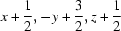
| Symmetry codes: (i) −x, y, −z+1/2; (ii) x+1/2, −y+3/2, z+1/2; (iii) x+1/2, y+1/2, z. |
Experimental details
| Crystal data | |
| Chemical formula | [Ni(C5H5N2O2S)2(H2O)] |
| Mr | 391.07 |
| Crystal system, space group | Monoclinic, C2/c |
| Temperature (K) | 293 |
| a, b, c (Å) | 12.0875 (12), 9.1278 (9), 12.7715 (12) |
| β (°) | 95.119 (1) |
| V (Å3) | 1403.5 (2) |
| Z | 4 |
| Radiation type | Mo Kα |
| µ (mm−1) | 1.71 |
| Crystal size (mm) | 0.12 × 0.10 × 0.06 |
| Data collection | |
| Diffractometer | Bruker SMART CCD diffractometer |
| Absorption correction | Multi-scan (SADABS; Sheldrick, 1996) |
| Tmin, Tmax | 0.821, 0.904 |
| No. of measured, independent and observed [I > 2σ(I)] reflections | 3487, 1231, 1119 |
| Rint | 0.014 |
| (sin θ/λ)max (Å−1) | 0.595 |
| Refinement | |
| R[F2 > 2σ(F2)], wR(F2), S | 0.024, 0.065, 1.01 |
| No. of reflections | 1231 |
| No. of parameters | 102 |
| H-atom treatment | H-atom parameters constrained |
| Δρmax, Δρmin (e Å−3) | 0.31, −0.29 |
Computer programs: SMART (Bruker, 1997), SAINT (Bruker, 1997), SHELXTL (Sheldrick, 2008).
| D—H···A | D—H | H···A | D···A | D—H···A |
| N1—H1A···O1i | 0.86 | 2.10 | 2.816 (3) | 140.1 |
| N1—H1B···O2ii | 0.86 | 1.99 | 2.839 (3) | 169.6 |
| O3—H3···O2iii | 0.82 | 1.94 | 2.7211 (19) | 158 |
| Symmetry codes: (i) −x, y, −z+1/2; (ii) x+1/2, −y+3/2, z+1/2; (iii) x+1/2, y+1/2, z. |
Acknowledgements
This work was supported financially by the National Natural Science Foundation of China (grant No. 20773104), the Program for New Century Excellent Talents in Universities (NCET-06–0891), the Natural Science Foundation of Hubei Province of China (2008CDB030) and the Important Project of Hubei Provincial Education Office (Z20091301).
References
 Batten, S. R. & Robson, R. (1998). Angew. Chem. Int. Ed. 37, 1460–1494. Web of Science CrossRef Google Scholar
Bruker (1997). SMART and SAINT. Bruker AXS Inc., Madison, Wisconsin, USA. Google Scholar
Fujita, M., Kwon, Y. J., Washizu, S. & Ogura, K. (1994). J. Am. Chem. Soc. 116, 1151–1152. CSD CrossRef CAS Web of Science Google Scholar
Han, S. S., Furukawa, H., Yaghi, O. M. & Goddard, W. A. III (2008). J. Am. Chem. Soc. 130, 11580–11581. Web of Science CrossRef PubMed CAS Google Scholar
Sheldrick, G. M. (1996). SADABS. University of Göttingen, Germany. Google Scholar
Sheldrick, G. M. (2008). Acta Cryst. A64, 112–122. Web of Science CrossRef CAS IUCr Journals Google Scholar
Wu, Z.-Y., Xu, D.-J. & Feng, Z.-X. (2001). Polyhedron, 20, 281–284. Web of Science CrossRef CAS Google Scholar
This is an open-access article distributed under the terms of the Creative Commons Attribution (CC-BY) Licence, which permits unrestricted use, distribution, and reproduction in any medium, provided the original authors and source are cited.
| CRYSTALLOGRAPHIC COMMUNICATIONS |


The rational design and synthesis of novel discrete and polymeric metal-organic complexes have attracted intense interest owing to the realisation of their potential for use as functional materials in catalysis, molecular recognition, separation, and nonlinear optics (Batten & Robson, 1998; Fujita et al., 1994). As for the construction of these inorganic/organic hybrid materials, carboxylate ligands have proven to be an efficacious choice (Wu et al., 2001). The employment of multifunctional ligands bearing both anionic and neutral donor atoms, such as nicotinate, isonicotinate, and various pyridinedicarboxylates, has resulted in the preparation of many functional coordination polymers, some with intriguing optical or gas sorption properties (Han et al., 2008). Herein we report the hydrothermal synthesis, structural characterization of the title complex.
The molecular structure of the title complex is shown in Fig. 1. The NiII ion is located on a twofold rotation axis and has a slightly distorted square-pyramidal geometry formed by two oxygen atoms, two nitrogen atoms from ata ligands and one coordinated water molecules (Table 1). The amido N atoms forms N—H···O hydrogen bonds with carboxylate O atoms, linking the molecules into one dimentional chains, which are then linked into a two-dimensional sheet by aromatic π-π stacking between S1-thiazole and S1i-thiazole [symmetry code: (i) -x, 1 - y, 1 - z] rings [centroid–centroid distance 3.531 (8) Å]. Furthermore, the two-dimensional layers are extended to a three-dimensional supramolecular structure by O—H···O hydrogen bonds (Table 2).