 | Acta Crystallographica Section E Acta Crystallographica Section E CRYSTALLOGRAPHIC COMMUNICATIONS |


 journal menu


metal-organic compounds
| CRYSTALLOGRAPHIC COMMUNICATIONS |
 access
Diaquabis(1,3-propanediamine)nickel(II) squarate tetrahydrate

aDepartment of Physics, Faculty of Arts and Sciences, Ondokuz Mayıs University, Kurupelit, TR-55139, Samsun, Turkey, and bDepartment of Chemistry, Faculty of Arts and Sciences, Eskişehir Osmangazi University, TR-26480, Eskişehir, Turkey
*Correspondence e-mail: [email protected]
The of the title compound, [Ni(C3H10N2)2(H2O)2](C4O4)·4H2O, contains one-half of the diaquabis(1,3-propanediamine)nickel(II) cation, one-half of the centrosymmetric squarate anion and two uncoordinated water molecules. In the cation, the NiII atom is located on a crystallographic inversion centre and has a slightly distorted octahedral coordination geometry. The six-membered chelate ring adopts a chair conformation. O—H⋯O hydrogen bonds link the cation and anion through the water molecule, while N—H⋯O hydrogen bonds link the cation and anion and cation and water molecules. In the intermolecular O—H⋯O and N—H⋯O hydrogen bonds link the molecules into a three-dimensional network structure.
Related literature
For general background, see: Bertolasi et al. (2001![[Bertolasi, V., Gilli, P., Ferretti, V. & Gilli, G. (2001). Acta Cryst. B57, 591-598.]](../../../../../../logos/arrows/e_arr.gif "Bertolasi, V., Gilli, P., Ferretti, V. & Gilli, G. (2001). Acta Cryst. B57, 591-598.") ); Gollogly & Hawkins (1972); Lam & Mak (2000); Liebeskind et al. (1993); Mathew et al. (2002); Reetz et al. (1994); Seitz & Imming (1992); Zaman et al. (2001). For related structures, see: Ghosh et al. (1997); Mukherjee et al. (1990); Pariya et al. (1995). For ring-puckering parameters, see: Cremer & Pople (1975). For bond-length data, see: Allen et al. (1987).
); Gollogly & Hawkins (1972); Lam & Mak (2000); Liebeskind et al. (1993); Mathew et al. (2002); Reetz et al. (1994); Seitz & Imming (1992); Zaman et al. (2001). For related structures, see: Ghosh et al. (1997); Mukherjee et al. (1990); Pariya et al. (1995). For ring-puckering parameters, see: Cremer & Pople (1975). For bond-length data, see: Allen et al. (1987).
![[Scheme 1]](hk2703scheme1.gif)
Experimental
Crystal data
|
Refinement
|
| |||||||||||||||||||
|
 .
. Data collection: X-AREA (Stoe & Cie, 2002); cell refinement: X-AREA; data reduction: X-RED32 (Stoe & Cie, 2002); program(s) used to solve structure: SHELXS97 (Sheldrick, 2008); program(s) used to refine structure: SHELXL97 (Sheldrick, 2008); molecular graphics: ORTEP-3 for Windows (Farrugia, 1997); software used to prepare material for publication: WinGX (Farrugia, 1999).
Supporting information
contains datablock I. DOI: 10.1107/S160053680902087X/hk2703sup1.cif
Structure factors: contains datablock I. DOI: 10.1107/S160053680902087X/hk2703Isup2.hkl
For the preparation of the title compound, a solution of squaric acid (0.57 g, 5 mmol) in water (25 ml) was neutralized with sodium hydroxide (0.40 g, 10 mmol) and added dropwise with stirring to a solution of Ni(CH3COO)2.4(H2O) (1.24 g, 5 mmol) in water (25 ml) at 323 K. The solution immediately became suspension and was stirred for 2 h. Then, 1,3-propandiamine (0.74 g, 10 mmol) in methanol (10 ml) was added dropwise to the obtained suspension. The clear solution was stirred for 2 h, and then cooled to room temperature. The crystals formed were filtered and washed with water (10 ml) and methanol (1:1), then dried in air. Anal. Calcd. : C 28.12, H 7.55, N 13.12%; Found C 28.06, H 7.61, N 13.18%.
Atoms H1E, H1F, H4A, H4B, H5A and H5B (for H2O) were located in difference syntheses and refined isotropically. The remaining H atoms were positioned geometrically with N-H = 0.90 Å (for NH2) and C-H = 0.97 Å (for CH2) and constrained to ride on their parent atoms, with Uiso(H) = 1.2Ueq(C,N).
Data collection: X-AREA (Stoe & Cie, 2002); cell X-AREA (Stoe & Cie, 2002); data reduction: X-RED32 (Stoe & Cie, 2002); program(s) used to solve structure: SHELXS97 (Sheldrick, 2008); program(s) used to refine structure: SHELXL97 (Sheldrick, 2008); molecular graphics: ORTEP-3 for Windows (Farrugia, 1997); software used to prepare material for publication: WinGX (Farrugia, 1999).
![[Figure 1]](./hk2703fig1thm.gif) | Fig. 1. The molecular structure of the title molecule, with the atom-numbering scheme. Displacement ellipsoids are drawn at the 40% probability [symmetry code: (i) 1 - x, 1 - y, 1 - z. |
![[Figure 2]](./hk2703fig2thm.gif) | Fig. 2. A partial packing diagram of the title compound. Hydrogen bonds are shown as dashed lines. H atoms not involved in hydrogen bonding have been omitted for clarity [symmetry code: (i) 1 - x, 1 - y, 1 - z]. |
| [Ni(C3H10N2)2(H2O)2](C4O4)·4H2O | F(000) = 456.0 |
| Mr = 427.09 | Dx = 1.480 Mg m−3 |
| Monoclinic, P21/c | Mo Kα radiation, λ = 0.71073 Å |
| Hall symbol: -P 2ybc | Cell parameters from 2204 reflections |
| a = 8.0429 (4) Å | θ = 2.2–28.0° |
| b = 9.1752 (5) Å | µ = 1.06 mm−1 |
| c = 14.6510 (8) Å | T = 296 K |
| β = 117.570 (4)° | Plate, violet |
| V = 958.40 (9) Å3 | 0.75 × 0.45 × 0.05 mm |
| Z = 2 |
| Stoe IPDS II diffractometer | 2204 independent reflections |
| Radiation source: sealed X-ray tube, 12 x 0.4 mm long-fine focus | 2003 reflections with I > 2σ(I) |
| Plane graphite monochromator | Rint = 0.020 |
| Detector resolution: 6.67 pixels mm-1 | θmax = 27.5°, θmin = 2.7° |
| w–scan rotation method | h = −10→10 |
| Absorption correction: integration (X-RED32; Stoe & Cie, 2002) | k = −11→11 |
| Tmin = 0.638, Tmax = 0.949 | l = −19→17 |
| 7288 measured reflections |
| Refinement on F2 | Primary atom site location: structure-invariant direct methods |
| Least-squares matrix: full | Secondary atom site location: difference Fourier map |
| R[F2 > 2σ(F2)] = 0.021 | Hydrogen site location: inferred from neighbouring sites |
| wR(F2) = 0.054 | H atoms treated by a mixture of independent and constrained refinement |
| S = 1.06 | w = 1/[σ2(Fo2) + (0.0282P)2 + 0.2118P] where P = (Fo2 + 2Fc2)/3 |
| 2204 reflections | (Δ/σ)max < 0.001 |
| 139 parameters | Δρmax = 0.29 e Å−3 |
| 0 restraints | Δρmin = −0.17 e Å−3 |
| [Ni(C3H10N2)2(H2O)2](C4O4)·4H2O | V = 958.40 (9) Å3 |
| Mr = 427.09 | Z = 2 |
| Monoclinic, P21/c | Mo Kα radiation |
| a = 8.0429 (4) Å | µ = 1.06 mm−1 |
| b = 9.1752 (5) Å | T = 296 K |
| c = 14.6510 (8) Å | 0.75 × 0.45 × 0.05 mm |
| β = 117.570 (4)° |
| Stoe IPDS II diffractometer | 2204 independent reflections |
| Absorption correction: integration (X-RED32; Stoe & Cie, 2002) | 2003 reflections with I > 2σ(I) |
| Tmin = 0.638, Tmax = 0.949 | Rint = 0.020 |
| 7288 measured reflections |
| R[F2 > 2σ(F2)] = 0.021 | 0 restraints |
| wR(F2) = 0.054 | H atoms treated by a mixture of independent and constrained refinement |
| S = 1.06 | Δρmax = 0.29 e Å−3 |
| 2204 reflections | Δρmin = −0.17 e Å−3 |
| 139 parameters |
Geometry. All e.s.d.'s (except the e.s.d. in the dihedral angle between two l.s. planes) are estimated using the full covariance matrix. The cell e.s.d.'s are taken into account individually in the estimation of e.s.d.'s in distances, angles and torsion angles; correlations between e.s.d.'s in cell parameters are only used when they are defined by crystal symmetry. An approximate (isotropic) treatment of cell e.s.d.'s is used for estimating e.s.d.'s involving l.s. planes. |
Refinement. Refinement of F2 against ALL reflections. The weighted R-factor wR and goodness of fit S are based on F2, conventional R-factors R are based on F, with F set to zero for negative F2. The threshold expression of F2 > σ(F2) is used only for calculating R-factors(gt) etc. and is not relevant to the choice of reflections for refinement. R-factors based on F2 are statistically about twice as large as those based on F, and R- factors based on ALL data will be even larger. |
| x | y | z | Uiso*/Ueq | ||
| Ni1 | 0.5000 | 0.5000 | 0.5000 | 0.02232 (7) | |
| O1 | 0.64732 (15) | 0.39000 (12) | 0.43015 (8) | 0.0383 (2) | |
| H1E | 0.713 (3) | 0.432 (2) | 0.4113 (14) | 0.051 (5)* | |
| H1F | 0.692 (3) | 0.315 (3) | 0.4515 (15) | 0.063 (6)* | |
| O2 | 0.73874 (13) | 1.09844 (11) | 0.49933 (8) | 0.0414 (2) | |
| O3 | 0.86500 (14) | 0.77497 (10) | 0.46843 (9) | 0.0434 (2) | |
| O4 | 0.34274 (18) | 0.07964 (14) | 0.36302 (9) | 0.0489 (3) | |
| H4A | 0.455 (3) | 0.082 (2) | 0.3910 (16) | 0.067 (6)* | |
| H4B | 0.317 (3) | 0.029 (3) | 0.401 (2) | 0.075 (7)* | |
| O5 | 0.85562 (18) | 0.53525 (13) | 0.35580 (11) | 0.0462 (3) | |
| H5A | 0.871 (3) | 0.611 (3) | 0.3859 (17) | 0.066 (6)* | |
| H5B | 0.803 (3) | 0.550 (3) | 0.2975 (19) | 0.072 (8)* | |
| N1 | 0.24635 (14) | 0.41813 (12) | 0.38210 (8) | 0.0317 (2) | |
| H1A | 0.2548 | 0.3203 | 0.3845 | 0.038* | |
| H1B | 0.1547 | 0.4421 | 0.3983 | 0.038* | |
| N2 | 0.47942 (14) | 0.69084 (11) | 0.41632 (8) | 0.0294 (2) | |
| H2A | 0.4236 | 0.7588 | 0.4372 | 0.035* | |
| H2B | 0.5970 | 0.7221 | 0.4355 | 0.035* | |
| C1 | 0.1833 (2) | 0.46195 (17) | 0.27461 (10) | 0.0423 (3) | |
| H1C | 0.0568 | 0.4263 | 0.2326 | 0.051* | |
| H1D | 0.2640 | 0.4173 | 0.2497 | 0.051* | |
| C2 | 0.1860 (2) | 0.62587 (16) | 0.26262 (11) | 0.0438 (3) | |
| H2C | 0.1144 | 0.6502 | 0.1902 | 0.053* | |
| H2D | 0.1242 | 0.6710 | 0.2987 | 0.053* | |
| C3 | 0.3806 (2) | 0.68931 (16) | 0.30294 (10) | 0.0406 (3) | |
| H3A | 0.4520 | 0.6320 | 0.2776 | 0.049* | |
| H3B | 0.3718 | 0.7880 | 0.2774 | 0.049* | |
| C4 | 0.88219 (16) | 1.04411 (13) | 0.49952 (9) | 0.0269 (2) | |
| C5 | 0.93844 (16) | 0.89777 (13) | 0.48539 (9) | 0.0271 (2) |
| U11 | U22 | U33 | U12 | U13 | U23 | |
| Ni1 | 0.02176 (11) | 0.02133 (11) | 0.02386 (11) | 0.00055 (7) | 0.01055 (8) | 0.00121 (7) |
| O1 | 0.0460 (6) | 0.0308 (5) | 0.0522 (6) | 0.0070 (4) | 0.0346 (5) | 0.0041 (4) |
| O2 | 0.0319 (5) | 0.0362 (5) | 0.0643 (7) | 0.0049 (4) | 0.0291 (5) | 0.0006 (5) |
| O3 | 0.0453 (5) | 0.0286 (5) | 0.0636 (7) | −0.0116 (4) | 0.0314 (5) | −0.0089 (4) |
| O4 | 0.0416 (6) | 0.0539 (7) | 0.0491 (6) | −0.0045 (5) | 0.0191 (5) | 0.0039 (5) |
| O5 | 0.0530 (7) | 0.0407 (6) | 0.0538 (7) | −0.0009 (5) | 0.0321 (6) | −0.0024 (5) |
| N1 | 0.0279 (5) | 0.0315 (5) | 0.0311 (5) | −0.0026 (4) | 0.0097 (4) | −0.0008 (4) |
| N2 | 0.0309 (5) | 0.0258 (5) | 0.0317 (5) | 0.0005 (4) | 0.0147 (4) | 0.0031 (4) |
| C1 | 0.0455 (8) | 0.0434 (7) | 0.0282 (6) | −0.0033 (6) | 0.0089 (6) | −0.0053 (5) |
| C2 | 0.0453 (8) | 0.0452 (8) | 0.0278 (6) | 0.0055 (6) | 0.0058 (6) | 0.0062 (6) |
| C3 | 0.0517 (8) | 0.0407 (7) | 0.0322 (6) | 0.0026 (6) | 0.0219 (6) | 0.0086 (5) |
| C4 | 0.0251 (5) | 0.0269 (5) | 0.0296 (6) | 0.0008 (4) | 0.0134 (4) | 0.0015 (4) |
| C5 | 0.0269 (5) | 0.0263 (5) | 0.0290 (6) | −0.0021 (4) | 0.0138 (4) | −0.0006 (4) |
| Ni1—O1i | 2.1429 (9) | C1—N1 | 1.4695 (17) |
| Ni1—N1i | 2.1090 (10) | C1—C2 | 1.516 (2) |
| Ni1—N2i | 2.0997 (10) | C1—H1C | 0.9700 |
| O1—Ni1 | 2.1429 (9) | C1—H1D | 0.9700 |
| O1—H1E | 0.80 (2) | C2—C3 | 1.511 (2) |
| O1—H1F | 0.77 (2) | C2—H2C | 0.9700 |
| O4—H4A | 0.80 (2) | C2—H2D | 0.9700 |
| O4—H4B | 0.82 (3) | C3—N2 | 1.4728 (16) |
| O5—H5A | 0.80 (2) | C3—H3A | 0.9700 |
| O5—H5B | 0.77 (2) | C3—H3B | 0.9700 |
| N1—Ni1 | 2.1090 (10) | C4—O2 | 1.2557 (15) |
| N1—H1A | 0.9000 | C4—C5ii | 1.4557 (16) |
| N1—H1B | 0.9000 | C4—C5 | 1.4619 (17) |
| N2—Ni1 | 2.0997 (10) | C5—O3 | 1.2427 (15) |
| N2—H2A | 0.9000 | C5—C4ii | 1.4557 (16) |
| N2—H2B | 0.9000 | ||
| O1—Ni1—O1i | 180.00 (5) | C3—N2—Ni1 | 120.41 (8) |
| N1i—Ni1—N1 | 180.0 | C3—N2—H2A | 107.2 |
| N1i—Ni1—O1 | 91.14 (4) | C3—N2—H2B | 107.2 |
| N1—Ni1—O1 | 88.86 (4) | H2A—N2—H2B | 106.9 |
| N1i—Ni1—O1i | 88.86 (4) | N1—C1—C2 | 112.30 (11) |
| N1—Ni1—O1i | 91.14 (4) | N1—C1—H1C | 109.1 |
| N2i—Ni1—O1 | 88.54 (4) | C2—C1—H1C | 109.1 |
| N2—Ni1—O1 | 91.46 (4) | N1—C1—H1D | 109.1 |
| N2i—Ni1—O1i | 91.46 (4) | C2—C1—H1D | 109.1 |
| N2—Ni1—O1i | 88.54 (4) | H1C—C1—H1D | 107.9 |
| N2i—Ni1—N2 | 180.0 | C3—C2—C1 | 113.88 (12) |
| N2i—Ni1—N1i | 91.94 (4) | C3—C2—H2C | 108.8 |
| N2—Ni1—N1i | 88.06 (4) | C1—C2—H2C | 108.8 |
| N2i—Ni1—N1 | 88.06 (4) | C3—C2—H2D | 108.8 |
| N2—Ni1—N1 | 91.94 (4) | C1—C2—H2D | 108.8 |
| Ni1—O1—H1E | 122.4 (14) | H2C—C2—H2D | 107.7 |
| Ni1—O1—H1F | 118.8 (15) | N2—C3—C2 | 111.42 (11) |
| H1E—O1—H1F | 108.4 (19) | N2—C3—H3A | 109.3 |
| H4A—O4—H4B | 104 (2) | C2—C3—H3A | 109.3 |
| H5A—O5—H5B | 109 (2) | N2—C3—H3B | 109.3 |
| Ni1—N1—H1A | 107.3 | C2—C3—H3B | 109.3 |
| Ni1—N1—H1B | 107.3 | H3A—C3—H3B | 108.0 |
| C1—N1—Ni1 | 120.23 (9) | O2—C4—C5ii | 134.42 (12) |
| C1—N1—H1A | 107.3 | O2—C4—C5 | 135.11 (12) |
| C1—N1—H1B | 107.3 | C5ii—C4—C5 | 90.46 (9) |
| H1A—N1—H1B | 106.9 | O3—C5—C4ii | 135.11 (12) |
| Ni1—N2—H2A | 107.2 | O3—C5—C4 | 135.35 (12) |
| Ni1—N2—H2B | 107.2 | C4ii—C5—C4 | 89.54 (9) |
| C1—N1—Ni1—O1 | −63.90 (10) | N1—C1—C2—C3 | 72.93 (17) |
| C1—N1—Ni1—O1i | 116.10 (10) | C1—C2—C3—N2 | −73.63 (16) |
| C1—N1—Ni1—N2i | −152.47 (10) | C2—C3—N2—Ni1 | 52.35 (14) |
| C1—N1—Ni1—N2 | 27.53 (10) | O2—C4—C5—O3 | −0.2 (3) |
| C3—N2—Ni1—O1 | 60.31 (10) | C5ii—C4—C5—O3 | 179.50 (19) |
| C3—N2—Ni1—O1i | −119.69 (10) | O2—C4—C5—C4ii | −179.72 (18) |
| C2—C1—N1—Ni1 | −50.38 (16) | C5ii—C4—C5—C4ii | 0.0 |
| Symmetry codes: (i) −x+1, −y+1, −z+1; (ii) −x+2, −y+2, −z+1. |
| D—H···A | D—H | H···A | D···A | D—H···A |
| N1—H1B···O5iii | 0.90 | 2.35 | 3.1715 (16) | 152 |
| N2—H2A···O2iv | 0.90 | 2.33 | 3.2174 (14) | 170 |
| O1—H1F···O2v | 0.77 (2) | 2.08 (2) | 2.8345 (15) | 165 (2) |
| O4—H4A···O2v | 0.80 (2) | 2.10 (2) | 2.8765 (16) | 165 (2) |
| O4—H4B···O2i | 0.82 (3) | 2.07 (3) | 2.8965 (16) | 178 (2) |
| O5—H5B···O4vi | 0.77 (2) | 2.10 (3) | 2.8730 (19) | 177 (2) |
| N1—H1A···O4 | 0.90 | 2.38 | 3.2442 (17) | 160 |
| N2—H2B···O3 | 0.90 | 2.04 | 2.9333 (14) | 174 |
| O1—H1E···O5 | 0.80 (2) | 1.93 (2) | 2.7311 (16) | 175.8 (19) |
| O5—H5A···O3 | 0.80 (2) | 1.94 (2) | 2.7296 (16) | 166 (2) |
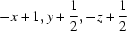
| Symmetry codes: (i) −x+1, −y+1, −z+1; (iii) x−1, y, z; (iv) −x+1, −y+2, −z+1; (v) x, y−1, z; (vi) −x+1, y+1/2, −z+1/2. |
Experimental details
| Crystal data | |
| Chemical formula | [Ni(C3H10N2)2(H2O)2](C4O4)·4H2O |
| Mr | 427.09 |
| Crystal system, space group | Monoclinic, P21/c |
| Temperature (K) | 296 |
| a, b, c (Å) | 8.0429 (4), 9.1752 (5), 14.6510 (8) |
| β (°) | 117.570 (4) |
| V (Å3) | 958.40 (9) |
| Z | 2 |
| Radiation type | Mo Kα |
| µ (mm−1) | 1.06 |
| Crystal size (mm) | 0.75 × 0.45 × 0.05 |
| Data collection | |
| Diffractometer | Stoe IPDS II diffractometer |
| Absorption correction | Integration (X-RED32; Stoe & Cie, 2002) |
| Tmin, Tmax | 0.638, 0.949 |
| No. of measured, independent and observed [I > 2σ(I)] reflections | 7288, 2204, 2003 |
| Rint | 0.020 |
| (sin θ/λ)max (Å−1) | 0.650 |
| Refinement | |
| R[F2 > 2σ(F2)], wR(F2), S | 0.021, 0.054, 1.06 |
| No. of reflections | 2204 |
| No. of parameters | 139 |
| H-atom treatment | H atoms treated by a mixture of independent and constrained refinement |
| Δρmax, Δρmin (e Å−3) | 0.29, −0.17 |
Computer programs: X-AREA (Stoe & Cie, 2002), X-RED32 (Stoe & Cie, 2002), SHELXS97 (Sheldrick, 2008), SHELXL97 (Sheldrick, 2008), ORTEP-3 for Windows (Farrugia, 1997), WinGX (Farrugia, 1999).
| O1—Ni1 | 2.1429 (9) | N2—Ni1 | 2.0997 (10) |
| N1—Ni1 | 2.1090 (10) | ||
| N1—Ni1—O1 | 88.86 (4) | N2—Ni1—N1 | 91.94 (4) |
| N2—Ni1—O1 | 91.46 (4) |
| D—H···A | D—H | H···A | D···A | D—H···A |
| N1—H1B···O5i | 0.90 | 2.35 | 3.1715 (16) | 151.9 |
| N2—H2A···O2ii | 0.90 | 2.33 | 3.2174 (14) | 170.4 |
| O1—H1F···O2iii | 0.77 (2) | 2.08 (2) | 2.8345 (15) | 165 (2) |
| O4—H4A···O2iii | 0.80 (2) | 2.10 (2) | 2.8765 (16) | 165 (2) |
| O4—H4B···O2iv | 0.82 (3) | 2.07 (3) | 2.8965 (16) | 178 (2) |
| O5—H5B···O4v | 0.77 (2) | 2.10 (3) | 2.8730 (19) | 177 (2) |
| N1—H1A···O4 | 0.90 | 2.38 | 3.2442 (17) | 160.2 |
| N2—H2B···O3 | 0.90 | 2.04 | 2.9333 (14) | 173.5 |
| O1—H1E···O5 | 0.80 (2) | 1.93 (2) | 2.7311 (16) | 175.8 (19) |
| O5—H5A···O3 | 0.80 (2) | 1.94 (2) | 2.7296 (16) | 166 (2) |
| Symmetry codes: (i) x−1, y, z; (ii) −x+1, −y+2, −z+1; (iii) x, y−1, z; (iv) −x+1, −y+1, −z+1; (v) −x+1, y+1/2, −z+1/2. |
Acknowledgements
The authors acknowledge the Faculty of Arts and Sciences of Ondokuz Mayıs University, Turkey, for the use of the Stoe IPDS II diffractometer (purchased under grant No. F279 of the University Research Grant of Ondokuz Mayıs University).
References
 Allen, F. H., Kennard, O., Watson, D. G., Brammer, L., Orpen, A. G. & Taylor, R. (1987). J. Chem. Soc. Perkin Trans. 2, pp. S1–S19. CrossRef Web of Science Google Scholar
Bertolasi, V., Gilli, P., Ferretti, V. & Gilli, G. (2001). Acta Cryst. B57, 591–598. Web of Science CSD CrossRef CAS IUCr Journals Google Scholar
Cremer, D. & Pople, J. A. (1975). J. Am. Chem. Soc. 97, 1354–1358. CrossRef CAS Web of Science Google Scholar
Farrugia, L. J. (1997). J. Appl. Cryst. 30, 565. CrossRef IUCr Journals Google Scholar
Farrugia, L. J. (1999). J. Appl. Cryst. 32, 837–838. CrossRef CAS IUCr Journals Google Scholar
Ghosh, S., Mukherjee, M., Mukherjee, A. K. & Ray Chaudhuri, N. (1997). Acta Cryst. C53, 1561–1564. CSD CrossRef CAS Web of Science IUCr Journals Google Scholar
Gollogly, J. R. & Hawkins, C. J. (1972). Inorg. Chem. 11, 156–161. CrossRef CAS Web of Science Google Scholar
Lam, C. K. & Mak, T. C. W. (2000). Tetrahedron, 56, 6657–6665. Web of Science CSD CrossRef CAS Google Scholar
Liebeskind, L. S., Yu, M. S., Yu, R. H., Wang, J. & Hagen, K. S. (1993). J. Am. Chem. Soc. 115, 9048–9050. CSD CrossRef CAS Web of Science Google Scholar
Mathew, S., Paul, G., Shivasankar, K., Choudhury, A. & Rao, C. N. R. (2002). J. Mol. Struct. 641, 263–279. Web of Science CSD CrossRef CAS Google Scholar
Mukherjee, A. K., Mukherjee, M., Ray, S., Ghosh, A. & Chaudhuri, N. R. (1990). J. Chem. Soc. Dalton Trans. pp. 2347–2350. CSD CrossRef Web of Science Google Scholar
Pariya, C., Ghosh, S., Ghosh, A., Mukherjee, M., Mukherjee, A. K. & Chaudhuri, N. R. (1995). J. Chem. Soc. Dalton Trans. pp. 337–342. CSD CrossRef Web of Science Google Scholar
Reetz, M. T., Hoger, S. & Harms, K. (1994). Angew. Chem. Int. Ed. Engl. 33, 181–183. CSD CrossRef Web of Science Google Scholar
Seitz, G. & Imming, P. (1992). Chem. Rev. 92, 1227–1260. CrossRef CAS Web of Science Google Scholar
Sheldrick, G. M. (2008). Acta Cryst. A64, 112–122. Web of Science CrossRef CAS IUCr Journals Google Scholar
Stoe & Cie (2002). X-AREA and X-RED32. Stoe & Cie, Darmstadt, Germany. Google Scholar
Zaman, M. B., Tomura, M. & Yamashita, Y. (2001). Acta Cryst. C57, 621–624. Web of Science CSD CrossRef CAS IUCr Journals Google Scholar
This is an open-access article distributed under the terms of the Creative Commons Attribution (CC-BY) Licence, which permits unrestricted use, distribution, and reproduction in any medium, provided the original authors and source are cited.
| CRYSTALLOGRAPHIC COMMUNICATIONS |


The conformation of six-membered rings arranged by the bidentate coordination of pen (1,3-propanediamine) to transition metals has long been of theoretical interest (Gollogly & Hawkins, 1972). Despite this interest, only a limited number of such complexes have been structurally described. Because of their ability to undergo solid-state phase transitions, some nickel(II) complexes of bis(N-substituted-pen) have been studied in recent times (Mukherjee et al., 1990; Pariya et al., 1995; Ghosh et al., 1997).
Squaric acid (H2C4O4) has been of much interest because of its cyclic structure and possible aromaticity. Recently, considerable progress has been made in the crystal engineering of multidimensional arrays and networks containing metal ions as nodes. Squaric acid is a useful tool for constructing crystalline architectures, due to its rigid, planar four membered ring skeleton, and its proton donating and accepting capabilities for hydrogen bonding (Bertolasi et al., 2001; Reetz et al., 1994; Lam & Mak, 2000; Zaman et al., 2001; Mathew et al., 2002). In addition, squaric acid has been studied for potetial application in xerographic photoreceptors, organic solar cells and optical recording (Liebeskind et al., 1993; Seitz & Imming, 1992).
The asymmetric unit of the title compound contains one centrosymmetric cation, where NiII is located on a crystallographic inversion centre, one centrosymmetric anion and two uncoordinated water molecules (Fig.1 ), in which the bond lengths (Allen et al., 1987) and angles are within normal ranges. In cation, the NiII is hexacoordinated by two O atoms of two water molecules in a trans order and by four N atoms of two pen ligands at the equatorial positions (Table 1). It is suggested that the trans geometry is preferred, when the amine ligand is more bulky. Thus, the coordination environment of NiII is a slightly distorted octahedral. Intramolecular O-H···O hydrogen bonds (Table 2) link the cation and anion through the water molecule, while intramolecular N-H···O hydrogen bonds (Table 2) link the cation and anion and cation and water molecule. The six-membered chelate ring (Ni1/N1/N2/C1-C3) is not planar, having total puckering amplitude, QT, of 0.765 (3) Å and chair conformation [ϕ = 166.25 (3) and θ = 40.42 (3) °] (Cremer & Pople, 1975).
In the crystal structure, intermolecular O-H···O and N-H···O hydrogen bonds (Table 2) link the molecules into chains (Fig. 2), in which they may be effective in the stabilization of the structure.