 | Acta Crystallographica Section E Acta Crystallographica Section E CRYSTALLOGRAPHIC COMMUNICATIONS |


 journal menu


inorganic compounds
| CRYSTALLOGRAPHIC COMMUNICATIONS |
 access
Ni2Si(P2O7)2

aLaboratory of Mineral Solid and Analytical Chemistry, "LCSMA", Department of Chemistry, Faculty of Sciences, University Mohamed I, PO Box 717, 60000 Oujda, Morocco, and bInstitute of Physics of the ASCR, Na Slovance 2, 182 21 Praha 8, Czech Republic
*Correspondence e-mail: [email protected]
Dinickel(II) silicon bis[diphosphate(4−)], Ni2Si(P2O7)2, is isotypic with other phosphates of the formula M2Si(P2O7)2 (M = Co, Cd). All atoms except Si (site symmetry 2) are found in general positions. Ni2O10 dimers formed from edge-sharing NiO6 octahedra are linked by corners and O—P—O bridges, forming slabs parallel to (100), which are in turn interconnected by O—Si—O contacts.
Related literature
For the structures of isotypic compounds, see: Glaum & Schmidt (1996![[Glaum, R. & Schmidt, A. (1996). Acta Cryst. C52, 762-764.]](../../../../../../logos/arrows/e_arr.gif "Glaum, R. & Schmidt, A. (1996). Acta Cryst. C52, 762-764.") ) for Co2Si(P2O7)2 and Trojan et al. (1987) for Cd2Si(P2O7)2. For bond-length and angle data, see: Bostroem (1987); Durif (1995). For the extinction correction, see: Becker & Coppens (1974).
) for Co2Si(P2O7)2 and Trojan et al. (1987) for Cd2Si(P2O7)2. For bond-length and angle data, see: Bostroem (1987); Durif (1995). For the extinction correction, see: Becker & Coppens (1974).
Experimental
Crystal data
|
Refinement
|
|
 ; (iii)
  ; (v)
; (v)  ; (vi)
  ; (vii)
  ; (viii)
  .
. Data collection: CrysAlis CCD (Oxford Diffraction, 2006); cell refinement: CrysAlis RED (Oxford Diffraction, 2006); data reduction: CrysAlis RED; program(s) used to solve structure: Superflip (Palatinus & Chapuis, 2007); program(s) used to refine structure: JANA2006 (Petříček et al., 2006); molecular graphics: DIAMOND (Brandenburg & Putz, 2005); software used to prepare material for publication: JANA2006.
Supporting information
contains datablocks global, I. DOI: 10.1107/S1600536809021734/mg2073sup1.cif
Structure factors: contains datablock I. DOI: 10.1107/S1600536809021734/mg2073Isup2.hkl
Ni2Si(P2O7)2 in the form of powder was prepared by stoichiometric reaction of SiO2 (99.9%, Aldrich) and Ni2P4O12 (the latter being obtained from a reaction of NiO and NH4H2PO4 in a 2:4 ratio at 750 °C for 24 h under O2 atmosphere). The mixture was heated at 500 °C under Ar atmosphere for 2 days and 700 °C for 36 h with intermediate grindings to ensure complete reaction. Subsequent melting at 1300 °C followed by slow cooling to room temperature at a rate of 5 ° h-1 resulted in green crystals of the title compound.
Data collection: CrysAlis CCD (Oxford Diffraction, 2006); cell CrysAlis RED (Oxford Diffraction, 2006); data reduction: CrysAlis RED (Oxford Diffraction, 2006); program(s) used to solve structure: Superflip (Palatinus & Chapuis, 2007); program(s) used to refine structure: JANA2006 (Petříček et al., 2006); molecular graphics: DIAMOND (Brandenburg & Putz, 2005); software used to prepare material for publication: JANA2006 (Petříček et al., 2006).
![[Figure 1]](./mg2073fig1thm.gif) | Fig. 1. Ni2O10 dimers and their connection in Ni2Si(P2O7)2. |
![[Figure 2]](./mg2073fig2thm.gif) | Fig. 2. Projection of Ni2Si(P2O7)2 along [010]. |
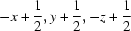
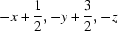
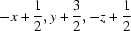
![[Figure 3]](./mg2073fig3thm.gif) | Fig. 3. Local coordination geometry around the Ni atom in Ni2Si(P2O7)2. Symmetry codes: (i) x, 1 + y, z, (iii) x, 1 - y, z (ii) -x + 1/2,y + 1/2,-z + 1/2, (iv) -x + 1/2,-y + 3/2,-z, (v) -x + 1/2,-y + 1/2,-z. Displacement ellipsoids are drawn at the 50% probability level. |
| Ni2Si(P2O7)2 | F(000) = 968 |
| Mr = 493.3 | Dx = 3.351 Mg m−3 |
| Monoclinic, C2/c | Mo Kα radiation, λ = 0.71073 Å |
| Hall symbol: -C 2yc | Cell parameters from 3598 reflections |
| a = 16.8615 (9) Å | θ = 2.7–26.5° |
| b = 4.8948 (2) Å | µ = 4.72 mm−1 |
| c = 12.1925 (5) Å | T = 295 K |
| β = 103.693 (4)° | Plate, yellow |
| V = 977.69 (8) Å3 | 0.27 × 0.16 × 0.07 mm |
| Z = 4 |
| Oxford Diffraction Xcalibur diffractometer with Atlas (Gemini ultra Cu) detector | 1013 independent reflections |
| Radiation source: fine-focus sealed tube | 877 reflections with I > 3σ(I) |
| Graphite monochromator | Rint = 0.023 |
| Detector resolution: 20.7567 pixels mm-1 | θmax = 26.5°, θmin = 3.4° |
| Rotation method data acquisition using ω scans | h = −20→20 |
| Absorption correction: analytical (CrysAlis RED; Oxford Diffraction, 2006) | k = −6→6 |
| Tmin = 0.438, Tmax = 0.829 | l = −15→15 |
| 4978 measured reflections |
| Refinement on F2 | 0 constraints |
| R[F2 > 2σ(F2)] = 0.016 | Weighting scheme based on measured s.u.'s w = 1/[σ2(I) + 0.0004I2] |
| wR(F2) = 0.045 | (Δ/σ)max = 0.010 |
| S = 1.34 | Δρmax = 0.22 e Å−3 |
| 1013 reflections | Δρmin = −0.23 e Å−3 |
| 97 parameters | Extinction correction: B–C type 1 Lorentzian isotropic (Becker & Coppens, 1974) |
| 0 restraints | Extinction coefficient: 370 (80) |
| Ni2Si(P2O7)2 | V = 977.69 (8) Å3 |
| Mr = 493.3 | Z = 4 |
| Monoclinic, C2/c | Mo Kα radiation |
| a = 16.8615 (9) Å | µ = 4.72 mm−1 |
| b = 4.8948 (2) Å | T = 295 K |
| c = 12.1925 (5) Å | 0.27 × 0.16 × 0.07 mm |
| β = 103.693 (4)° |
| Oxford Diffraction Xcalibur diffractometer with Atlas (Gemini ultra Cu) detector | 1013 independent reflections |
| Absorption correction: analytical (CrysAlis RED; Oxford Diffraction, 2006) | 877 reflections with I > 3σ(I) |
| Tmin = 0.438, Tmax = 0.829 | Rint = 0.023 |
| 4978 measured reflections |
| R[F2 > 2σ(F2)] = 0.016 | 97 parameters |
| wR(F2) = 0.045 | 0 restraints |
| S = 1.34 | Δρmax = 0.22 e Å−3 |
| 1013 reflections | Δρmin = −0.23 e Å−3 |
Experimental. Absorption correction CrysAlisPro; Oxford Diffraction, 2009; Version 1.171.33.34d (release 27-02-2009 CrysAlis171.NET) Absorption correction: analytical, implemented in CrysAlis RED (Oxford Diffraction, 2006). |
Refinement. The refinement was carried out against all reflections. The conventional R-factor is always based on F. The goodness of fit as well as the weighted R-factor are based on F and F2 for carried out on F and F2, respectively. The threshold expression is used only for calculating R-factors etc. and it is not relevant to the choice of reflections for refinement. The program used for Jana2006, uses the weighting scheme based on the experimental expectations, see _refine_ls_weighting_details, that does not force S to be one. Therefore the values of S are usually larger than the ones from the SHELX program. |
| x | y | z | Uiso*/Ueq | ||
| Ni1 | 0.247526 (19) | 0.35079 (6) | 0.12916 (2) | 0.00715 (11) | |
| Si1 | 0.5 | 1.16111 (18) | 0.25 | 0.0054 (3) | |
| P1 | 0.12621 (4) | −0.13090 (12) | 0.13612 (5) | 0.00608 (18) | |
| P2 | 0.36378 (4) | 0.83352 (12) | 0.08433 (5) | 0.00583 (18) | |
| O1 | 0.14379 (10) | 0.1598 (3) | 0.12002 (13) | 0.0100 (5) | |
| O2 | 0.04526 (11) | −0.1475 (3) | 0.17733 (12) | 0.0088 (5) | |
| O3 | 0.40484 (11) | 0.7811 (3) | −0.01825 (12) | 0.0091 (5) | |
| O4 | 0.19424 (10) | −0.3018 (3) | 0.20675 (12) | 0.0088 (5) | |
| O5 | 0.29494 (10) | 1.0316 (3) | 0.04486 (12) | 0.0091 (5) | |
| O6 | 0.34569 (10) | 0.5703 (3) | 0.13237 (12) | 0.0101 (5) | |
| O7 | 0.43615 (10) | 0.9697 (3) | 0.16829 (13) | 0.0116 (5) |
| U11 | U22 | U33 | U12 | U13 | U23 | |
| Ni1 | 0.00662 (18) | 0.00720 (17) | 0.00757 (17) | −0.00117 (13) | 0.00154 (12) | 0.00048 (11) |
| Si1 | 0.0046 (5) | 0.0065 (4) | 0.0053 (4) | 0 | 0.0012 (3) | 0 |
| P1 | 0.0054 (3) | 0.0070 (3) | 0.0061 (3) | −0.0008 (2) | 0.0019 (2) | −0.0002 (2) |
| P2 | 0.0055 (3) | 0.0064 (3) | 0.0054 (3) | −0.0008 (2) | 0.0010 (2) | −0.0003 (2) |
| O1 | 0.0076 (9) | 0.0082 (8) | 0.0146 (8) | −0.0006 (7) | 0.0035 (7) | 0.0012 (7) |
| O2 | 0.0085 (9) | 0.0103 (8) | 0.0088 (7) | −0.0003 (7) | 0.0045 (6) | 0.0001 (6) |
| O3 | 0.0086 (9) | 0.0128 (9) | 0.0066 (7) | −0.0004 (7) | 0.0030 (6) | −0.0013 (6) |
| O4 | 0.0079 (9) | 0.0094 (8) | 0.0085 (8) | 0.0019 (7) | 0.0009 (7) | −0.0009 (6) |
| O5 | 0.0091 (9) | 0.0098 (8) | 0.0081 (7) | 0.0015 (7) | 0.0015 (6) | −0.0008 (7) |
| O6 | 0.0090 (9) | 0.0099 (8) | 0.0112 (8) | −0.0022 (7) | 0.0019 (7) | 0.0025 (6) |
| O7 | 0.0092 (10) | 0.0145 (9) | 0.0099 (8) | −0.0035 (7) | −0.0002 (7) | −0.0037 (7) |
| Ni1—O1 | 1.9631 (18) | Si1—O7vii | 1.5881 (16) |
| Ni1—O4i | 2.2351 (17) | P1—O1 | 1.4759 (17) |
| Ni1—O4ii | 2.1436 (14) | P1—O2 | 1.564 (2) |
| Ni1—O5iii | 2.1271 (17) | P1—O3viii | 1.5888 (15) |
| Ni1—O5iv | 2.1509 (14) | P1—O4 | 1.5132 (16) |
| Ni1—O6 | 1.9660 (18) | P2—O3 | 1.5873 (19) |
| Si1—O2v | 1.6018 (18) | P2—O5 | 1.5017 (17) |
| Si1—O2vi | 1.6018 (18) | P2—O6 | 1.4768 (18) |
| Si1—O7 | 1.5881 (16) | P2—O7 | 1.5458 (16) |
| O1—Ni1—O4i | 86.81 (7) | O2vi—Si1—O7 | 110.56 (9) |
| O1—Ni1—O4ii | 95.28 (6) | O2vi—Si1—O7vii | 109.83 (8) |
| O1—Ni1—O5iii | 93.12 (7) | O7—Si1—O7vii | 107.67 (10) |
| O1—Ni1—O5iv | 89.28 (6) | O1—P1—O2 | 108.10 (10) |
| O1—Ni1—O6 | 174.93 (7) | O1—P1—O3viii | 111.07 (9) |
| O4i—Ni1—O4ii | 90.65 (6) | O1—P1—O4 | 117.37 (9) |
| O4i—Ni1—O5iii | 176.27 (5) | O2—P1—O3viii | 98.09 (9) |
| O4i—Ni1—O5iv | 98.09 (6) | O2—P1—O4 | 112.97 (9) |
| O4i—Ni1—O6 | 89.81 (7) | O3viii—P1—O4 | 107.57 (9) |
| O4ii—Ni1—O5iii | 93.07 (6) | O3—P2—O5 | 107.46 (9) |
| O4ii—Ni1—O5iv | 170.37 (7) | O3—P2—O6 | 109.95 (10) |
| O4ii—Ni1—O6 | 88.53 (6) | O3—P2—O7 | 99.69 (9) |
| O5iii—Ni1—O5iv | 78.19 (6) | O5—P2—O6 | 118.30 (10) |
| O5iii—Ni1—O6 | 90 | O5—P2—O7 | 111.28 (9) |
| O5iv—Ni1—O6 | 87.45 (6) | O6—P2—O7 | 108.55 (9) |
| O2v—Si1—O2vi | 108.39 (10) | Si1ix—O2—P1 | 140.73 (11) |
| O2v—Si1—O7 | 109.83 (8) | P1viii—O3—P2 | 132.51 (12) |
| O2v—Si1—O7vii | 110.56 (9) | Si1—O7—P2 | 168.95 (12) |
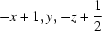
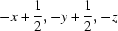
| Symmetry codes: (i) x, y+1, z; (ii) −x+1/2, y+1/2, −z+1/2; (iii) x, y−1, z; (iv) −x+1/2, −y+3/2, −z; (v) x+1/2, y+3/2, z; (vi) −x+1/2, y+3/2, −z+1/2; (vii) −x+1, y, −z+1/2; (viii) −x+1/2, −y+1/2, −z; (ix) x−1/2, y−3/2, z. |
Experimental details
| Crystal data | |
| Chemical formula | Ni2Si(P2O7)2 |
| Mr | 493.3 |
| Crystal system, space group | Monoclinic, C2/c |
| Temperature (K) | 295 |
| a, b, c (Å) | 16.8615 (9), 4.8948 (2), 12.1925 (5) |
| β (°) | 103.693 (4) |
| V (Å3) | 977.69 (8) |
| Z | 4 |
| Radiation type | Mo Kα |
| µ (mm−1) | 4.72 |
| Crystal size (mm) | 0.27 × 0.16 × 0.07 |
| Data collection | |
| Diffractometer | Oxford Diffraction Xcalibur diffractometer with Atlas (Gemini ultra Cu) detector |
| Absorption correction | Analytical (CrysAlis RED; Oxford Diffraction, 2006) |
| Tmin, Tmax | 0.438, 0.829 |
| No. of measured, independent and observed [I > 3σ(I)] reflections | 4978, 1013, 877 |
| Rint | 0.023 |
| (sin θ/λ)max (Å−1) | 0.627 |
| Refinement | |
| R[F2 > 2σ(F2)], wR(F2), S | 0.016, 0.045, 1.34 |
| No. of reflections | 1013 |
| No. of parameters | 97 |
| Δρmax, Δρmin (e Å−3) | 0.22, −0.23 |
Computer programs: CrysAlis CCD (Oxford Diffraction, 2006), CrysAlis RED (Oxford Diffraction, 2006), Superflip (Palatinus & Chapuis, 2007), JANA2006 (Petříček et al., 2006), DIAMOND (Brandenburg & Putz, 2005).
| Ni1—O1 | 1.9631 (18) | Si1—O7vii | 1.5881 (16) |
| Ni1—O4i | 2.2351 (17) | P1—O1 | 1.4759 (17) |
| Ni1—O4ii | 2.1436 (14) | P1—O2 | 1.564 (2) |
| Ni1—O5iii | 2.1271 (17) | P1—O3viii | 1.5888 (15) |
| Ni1—O5iv | 2.1509 (14) | P1—O4 | 1.5132 (16) |
| Ni1—O6 | 1.9660 (18) | P2—O3 | 1.5873 (19) |
| Si1—O2v | 1.6018 (18) | P2—O5 | 1.5017 (17) |
| Si1—O2vi | 1.6018 (18) | P2—O6 | 1.4768 (18) |
| Si1—O7 | 1.5881 (16) | P2—O7 | 1.5458 (16) |
| Symmetry codes: (i) x, y+1, z; (ii) −x+1/2, y+1/2, −z+1/2; (iii) x, y−1, z; (iv) −x+1/2, −y+3/2, −z; (v) x+1/2, y+3/2, z; (vi) −x+1/2, y+3/2, −z+1/2; (vii) −x+1, y, −z+1/2; (viii) −x+1/2, −y+1/2, −z. |
Acknowledgements
We thank the Grant Agency of the Czech Republic (grant No. 202/06/0757) for support.
References
 Becker, P. J. & Coppens, P. (1974). Acta Cryst. A30, 129–147. CrossRef IUCr Journals Web of Science Google Scholar
Bostroem, D. (1987). Am. Mineral. 72, 965–972. CAS Google Scholar
Brandenburg, K. & Putz, H. (2005). DIAMOND. Crystal Impact GbR, Bonn, Germany. Google Scholar
Durif, A. (1995). Crystal Chemistry of Condensed Phosphates. New York: Plenum. Google Scholar
Glaum, R. & Schmidt, A. (1996). Acta Cryst. C52, 762–764. CrossRef CAS Web of Science IUCr Journals Google Scholar
Oxford Diffraction (2006). CrysAlis CCD and CrysAlis RED. Oxford Diffraction Ltd, Abingdon, England. Google Scholar
Palatinus, L. & Chapuis, G. (2007). Superflip. http://superspace.epfl.ch/superflip . Google Scholar
Petříček, V., Dušek, M. & Palatinus, L. (2006). JANA2006. Institute of Physics, Praha, Czech Republic. http://www-xray.fzu.cz/jana/jana.html. Google Scholar
Trojan, M., Brandová, D., Fábry, J., Hybler, J., Jurek, K. & Petříček, V. (1987). Acta Cryst. C43, 2038–2040. CrossRef CAS Web of Science IUCr Journals Google Scholar
This is an open-access article distributed under the terms of the Creative Commons Attribution (CC-BY) Licence, which permits unrestricted use, distribution, and reproduction in any medium, provided the original authors and source are cited.
| CRYSTALLOGRAPHIC COMMUNICATIONS |


Although the isostructural silicodiphosphates M2Si(P2O7)2 have been reported for M = Fe, Ni, Co, Cu, and Cd, full single-crystal structure determinations have been carried out only for the Co and Cd members (Glaum & Schmidt, 1996; Trojan et al., 1987). The structure of Ni2Si(P2O7)2 is reported herein. Its cell parameters are consistent with those obtained earlier from Guinier photographs (Glaum & Schmidt, 1996). The three-dimensional framework is built up of NiO6 octahedra, SiO4 tetrahedra, and P2O7 diphosphate groups. Ni2O10 dimers, formed from pairs of edge-sharing NiO6 octahedra, are interconnected through corners (O4) and O–P–O bridges of the diphosphate groups to generate slabs that lie parallel to (100) (Fig. 1). Neighboring slabs are connected through O–Si–O linkages from the SiO4 groups (Fig. 2). The NiO6 octahedron, whose apices are formed from one bidentate and four monodentate P2O7 groups (Fig. 3), is strongly distorted, with an average Ni–O distance [2.098 (2) Å] that is between those in Ni2P2O7 (2.114 Å) and Ni2SiO4 (2.080 Å) (Bostroem, 1987). The P2O7 group adopts a nearly eclipsed conformation, with an average P–O distance [1.532 (2) Å] that is similar to other diphosphates (Durif, 1995) and a rather small P–O–P angle [132.51 (12) °] owing to its bidentate coordination to the Ni center.