 | Acta Crystallographica Section E Acta Crystallographica Section E CRYSTALLOGRAPHIC COMMUNICATIONS |


 journal menu


metal-organic compounds
| CRYSTALLOGRAPHIC COMMUNICATIONS |
 access
Chlorido(2-formyl-6-hydroxyphenyl-κC1)mercury(II)

aCollege of Chemistry and Chemical Engineering, Luoyang Normal University, Luoyang 471022, People's Republic of China, and bChemical Engineering and Pharmaceutics School, Henan University of Science and Technology, Luoyang 471003, People's Republic of China
*Correspondence e-mail: [email protected]
In the planar [r.m.s. deviation 0.0265 Å] title compound, [Hg(C7H5O2)Cl], the HgII atom shows a typical linear coordination by a C atom of a benzene ring and a Cl atom. The benzene C atom and the aldehyde O atom chelate the HgII atom by assuming the Hg⋯O separation of 2.817 (9) Å as a weak intramolecular coordination bonding distance. The resulting five-membered metallacycle is nearly coplanar with the benzene ring dihedral angle 2.9 (1)°]. Intermolecular O—H⋯O hydrogen bonds are present in the resulting in a one-dimensional supramolecular architecture parallel to [201].
Related literature
For historical background and for properties of cyclometallated compounds, see: Dupont et al. (2005![[Dupont, J., Consorti, C. S. & Spencer, J. (2005). Chem. Rev. 105, 2527-2571.]](../../../../../../logos/arrows/e_arr.gif "Dupont, J., Consorti, C. S. & Spencer, J. (2005). Chem. Rev. 105, 2527-2571.") ); Xu et al. (2009). For the properties of cyclomercurated compounds, see: Wu et al. (2001); Ryabov et al. (2003). For related structure, see: King et al. (2002); Zhou et al. (2005); Hao et al. (2007).
); Xu et al. (2009). For the properties of cyclomercurated compounds, see: Wu et al. (2001); Ryabov et al. (2003). For related structure, see: King et al. (2002); Zhou et al. (2005); Hao et al. (2007).
![[Scheme 1]](si2180scheme1.gif)
Experimental
Crystal data
|
Refinement
|
| |||||||||||||||||
 .
. Data collection: SMART (Bruker, 2004); cell refinement: SAINT (Bruker, 2004); data reduction: SAINT; program(s) used to solve structure: SHELXS97 (Sheldrick, 2008); program(s) used to refine structure: SHELXL97 (Sheldrick, 2008); molecular graphics: SHELXTL (Sheldrick, 2008); software used to prepare material for publication: SHELXTL.
Supporting information
contains datablocks global, I. DOI: 10.1107/S160053680902145X/si2180sup1.cif
Structure factors: contains datablock I. DOI: 10.1107/S160053680902145X/si2180Isup2.hkl
The title compound was prepared from the m-hydroxybenzaldehyde with Hg(OAc)2 and subsequent treatment with LiCl and recrystallized from dichloromethane-petroleum ether solution at room temperature to give the desired product as colorless crystals suitable for single-crystal X-ray diffraction (yield 82%; m.p 442–444 K). IR data (v_max/ cm-1): 3408, 2926, 1651, 1567, 1445, 1291, 1199, 789. NMR δ(H) 7.18(1H,d), 7.45 (1H,t), 7.52(1H,d), 10.12(1H,s), 12.11(1H,m).
H atoms attached to C atoms of the title compound were placed in geometrically idealized positions and treated as riding with C—H distances constrained to 0.93–0.96 Å, and with Uiso(H)=1.2Ueq(C).
Data collection: SMART (Bruker, 2004); cell SAINT (Bruker, 2004); data reduction: SAINT (Bruker, 2004); program(s) used to solve structure: SHELXS97 (Sheldrick, 2008); program(s) used to refine structure: SHELXL97 (Sheldrick, 2008); molecular graphics: SHELXTL (Sheldrick, 2008); software used to prepare material for publication: SHELXTL (Sheldrick, 2008).
![[Figure 1]](./si2180fig1thm.gif) | Fig. 1. The molecular structure of the title compound with displacement ellipsoids at the 30% probability level. |
![[Figure 2]](./si2180fig2thm.gif) | Fig. 2. Partial view of the crystal packing showing the formation of the one-dimensional chain structure formed by the intermolecular O—H···O hydrogen bonds. |
| [Hg(C7H5O2)Cl] | F(000) = 640 |
| Mr = 357.15 | Dx = 2.735 Mg m−3 |
| Monoclinic, P21/c | Mo Kα radiation, λ = 0.71073 Å |
| a = 4.7200 (19) Å | Cell parameters from 1175 reflections |
| b = 17.702 (7) Å | θ = 2.3–22.3° |
| c = 10.506 (4) Å | µ = 18.00 mm−1 |
| β = 98.839 (5)° | T = 296 K |
| V = 867.4 (6) Å3 | Block, colourless |
| Z = 4 | 0.08 × 0.01 × 0.01 mm |
| Bruker SMART APEX CCD area-detector diffractometer | 1595 independent reflections |
| Radiation source: fine-focus sealed tube | 1130 reflections with I > 2σ(I) |
| Graphite monochromator | Rint = 0.050 |
| ϕ and ω scans | θmax = 25.5°, θmin = 2.3° |
| Absorption correction: multi-scan (SADABS; Sheldrick, 1996) | h = −5→5 |
| Tmin = 0.327, Tmax = 0.841 | k = −21→21 |
| 5002 measured reflections | l = −12→12 |
| Refinement on F2 | Primary atom site location: structure-invariant direct methods |
| Least-squares matrix: full | Secondary atom site location: difference Fourier map |
| R[F2 > 2σ(F2)] = 0.045 | Hydrogen site location: inferred from neighbouring sites |
| wR(F2) = 0.114 | H-atom parameters constrained |
| S = 1.01 | w = 1/[σ2(Fo2) + (0.0564P)2 + 3.2348P] where P = (Fo2 + 2Fc2)/3 |
| 1595 reflections | (Δ/σ)max = 0.001 |
| 101 parameters | Δρmax = 0.94 e Å−3 |
| 0 restraints | Δρmin = −2.32 e Å−3 |
| [Hg(C7H5O2)Cl] | V = 867.4 (6) Å3 |
| Mr = 357.15 | Z = 4 |
| Monoclinic, P21/c | Mo Kα radiation |
| a = 4.7200 (19) Å | µ = 18.00 mm−1 |
| b = 17.702 (7) Å | T = 296 K |
| c = 10.506 (4) Å | 0.08 × 0.01 × 0.01 mm |
| β = 98.839 (5)° |
| Bruker SMART APEX CCD area-detector diffractometer | 1595 independent reflections |
| Absorption correction: multi-scan (SADABS; Sheldrick, 1996) | 1130 reflections with I > 2σ(I) |
| Tmin = 0.327, Tmax = 0.841 | Rint = 0.050 |
| 5002 measured reflections |
| R[F2 > 2σ(F2)] = 0.045 | 0 restraints |
| wR(F2) = 0.114 | H-atom parameters constrained |
| S = 1.01 | Δρmax = 0.94 e Å−3 |
| 1595 reflections | Δρmin = −2.32 e Å−3 |
| 101 parameters |
Geometry. All e.s.d.'s (except the e.s.d. in the dihedral angle between two l.s. planes) are estimated using the full covariance matrix. The cell e.s.d.'s are taken into account individually in the estimation of e.s.d.'s in distances, angles and torsion angles; correlations between e.s.d.'s in cell parameters are only used when they are defined by crystal symmetry. An approximate (isotropic) treatment of cell e.s.d.'s is used for estimating e.s.d.'s involving l.s. planes. |
Refinement. Refinement of F2 against ALL reflections. The weighted R-factor wR and goodness of fit S are based on F2, conventional R-factors R are based on F, with F set to zero for negative F2. The threshold expression of F2 > σ(F2) is used only for calculating R-factors(gt) etc. and is not relevant to the choice of reflections for refinement. R-factors based on F2 are statistically about twice as large as those based on F, and R- factors based on ALL data will be even larger. |
| x | y | z | Uiso*/Ueq | ||
| Hg1 | 0.26063 (12) | 0.66539 (3) | 0.30597 (6) | 0.0470 (2) | |
| O1 | −0.160 (2) | 0.6917 (5) | 0.5036 (10) | 0.050 (2) | |
| H1 | −0.2948 | 0.6960 | 0.5439 | 0.074* | |
| O2 | 0.468 (2) | 0.7878 (5) | 0.1758 (9) | 0.052 (2) | |
| Cl1 | 0.4684 (11) | 0.5580 (2) | 0.2416 (5) | 0.0833 (14) | |
| C1 | 0.345 (3) | 0.8403 (7) | 0.2208 (14) | 0.043 (3) | |
| H1A | 0.3802 | 0.8888 | 0.1928 | 0.052* | |
| C2 | 0.151 (3) | 0.8330 (7) | 0.3132 (13) | 0.042 (3) | |
| C3 | 0.039 (3) | 0.8998 (7) | 0.3574 (14) | 0.051 (4) | |
| H3 | 0.0837 | 0.9460 | 0.3235 | 0.061* | |
| C4 | −0.137 (3) | 0.8974 (7) | 0.4509 (13) | 0.048 (4) | |
| H4 | −0.2123 | 0.9420 | 0.4788 | 0.058* | |
| C5 | −0.204 (3) | 0.8276 (7) | 0.5043 (13) | 0.044 (3) | |
| H5 | −0.3193 | 0.8257 | 0.5683 | 0.053* | |
| C6 | −0.092 (3) | 0.7611 (7) | 0.4591 (12) | 0.042 (3) | |
| C7 | 0.087 (2) | 0.7635 (7) | 0.3644 (11) | 0.032 (3) |
| U11 | U22 | U33 | U12 | U13 | U23 | |
| Hg1 | 0.0477 (4) | 0.0392 (3) | 0.0583 (4) | 0.0027 (3) | 0.0213 (3) | −0.0048 (3) |
| O1 | 0.047 (6) | 0.048 (5) | 0.060 (6) | −0.006 (4) | 0.027 (5) | 0.003 (5) |
| O2 | 0.047 (6) | 0.058 (6) | 0.056 (6) | −0.003 (5) | 0.028 (5) | −0.011 (5) |
| Cl1 | 0.098 (4) | 0.044 (2) | 0.117 (4) | 0.016 (2) | 0.045 (3) | −0.010 (2) |
| C1 | 0.033 (7) | 0.043 (7) | 0.054 (8) | −0.002 (6) | 0.007 (6) | 0.005 (7) |
| C2 | 0.029 (6) | 0.053 (8) | 0.043 (7) | −0.008 (6) | 0.007 (6) | 0.000 (6) |
| C3 | 0.058 (9) | 0.034 (7) | 0.070 (10) | 0.012 (6) | 0.038 (8) | 0.012 (7) |
| C4 | 0.056 (9) | 0.035 (7) | 0.056 (9) | 0.006 (6) | 0.012 (7) | −0.010 (6) |
| C5 | 0.040 (8) | 0.053 (8) | 0.044 (8) | 0.005 (7) | 0.020 (6) | −0.007 (7) |
| C6 | 0.027 (7) | 0.054 (8) | 0.045 (8) | −0.012 (6) | 0.007 (6) | 0.000 (6) |
| C7 | 0.023 (6) | 0.043 (7) | 0.026 (6) | −0.004 (5) | −0.008 (5) | 0.001 (5) |
| Hg1—C7 | 2.052 (12) | C2—C3 | 1.403 (17) |
| Hg1—Cl1 | 2.288 (4) | C3—C4 | 1.382 (17) |
| O1—C6 | 1.370 (14) | C3—H3 | 0.9300 |
| O1—H1 | 0.8200 | C4—C5 | 1.412 (18) |
| O2—C1 | 1.229 (14) | C4—H4 | 0.9300 |
| C1—C2 | 1.440 (18) | C5—C6 | 1.402 (17) |
| C1—H1A | 0.9300 | C5—H5 | 0.9300 |
| C2—C7 | 1.394 (16) | C6—C7 | 1.403 (16) |
| C7—Hg1—Cl1 | 178.1 (3) | C3—C4—H4 | 119.9 |
| C6—O1—H1 | 109.5 | C5—C4—H4 | 119.9 |
| O2—C1—C2 | 125.4 (12) | C6—C5—C4 | 118.9 (11) |
| O2—C1—H1A | 117.3 | C6—C5—H5 | 120.6 |
| C2—C1—H1A | 117.3 | C4—C5—H5 | 120.6 |
| C7—C2—C1 | 122.4 (12) | O1—C6—C7 | 117.8 (11) |
| C7—C2—C3 | 120.1 (12) | O1—C6—C5 | 121.2 (11) |
| C1—C2—C3 | 117.3 (11) | C7—C6—C5 | 121.0 (12) |
| C4—C3—C2 | 120.6 (12) | C2—C7—C6 | 119.2 (11) |
| C4—C3—H3 | 119.7 | C2—C7—Hg1 | 120.8 (9) |
| C2—C3—H3 | 119.7 | C6—C7—Hg1 | 119.9 (9) |
| C3—C4—C5 | 120.2 (11) | ||
| O2—C1—C2—C7 | 2 (2) | C3—C2—C7—C6 | 0.8 (19) |
| O2—C1—C2—C3 | 177.6 (14) | C1—C2—C7—Hg1 | −1.9 (18) |
| C7—C2—C3—C4 | −1 (2) | C3—C2—C7—Hg1 | −177.8 (10) |
| C1—C2—C3—C4 | −176.7 (14) | O1—C6—C7—C2 | 177.3 (12) |
| C2—C3—C4—C5 | 1 (2) | C5—C6—C7—C2 | −1.1 (19) |
| C3—C4—C5—C6 | −1 (2) | O1—C6—C7—Hg1 | −4.2 (16) |
| C4—C5—C6—O1 | −177.0 (12) | C5—C6—C7—Hg1 | 177.4 (10) |
| C4—C5—C6—C7 | 1 (2) | Cl1—Hg1—C7—C2 | 46 (10) |
| C1—C2—C7—C6 | 176.6 (12) | Cl1—Hg1—C7—C6 | −132 (10) |
| D—H···A | D—H | H···A | D···A | D—H···A |
| O1—H1···O2i | 0.82 | 1.93 | 2.730 (12) | 165 |
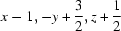
| Symmetry code: (i) x−1, −y+3/2, z+1/2. |
Experimental details
| Crystal data | |
| Chemical formula | [Hg(C7H5O2)Cl] |
| Mr | 357.15 |
| Crystal system, space group | Monoclinic, P21/c |
| Temperature (K) | 296 |
| a, b, c (Å) | 4.7200 (19), 17.702 (7), 10.506 (4) |
| β (°) | 98.839 (5) |
| V (Å3) | 867.4 (6) |
| Z | 4 |
| Radiation type | Mo Kα |
| µ (mm−1) | 18.00 |
| Crystal size (mm) | 0.08 × 0.01 × 0.01 |
| Data collection | |
| Diffractometer | Bruker SMART APEX CCD area-detector diffractometer |
| Absorption correction | Multi-scan (SADABS; Sheldrick, 1996) |
| Tmin, Tmax | 0.327, 0.841 |
| No. of measured, independent and observed [I > 2σ(I)] reflections | 5002, 1595, 1130 |
| Rint | 0.050 |
| (sin θ/λ)max (Å−1) | 0.606 |
| Refinement | |
| R[F2 > 2σ(F2)], wR(F2), S | 0.045, 0.114, 1.01 |
| No. of reflections | 1595 |
| No. of parameters | 101 |
| H-atom treatment | H-atom parameters constrained |
| Δρmax, Δρmin (e Å−3) | 0.94, −2.32 |
Computer programs: SMART (Bruker, 2004), SAINT (Bruker, 2004), SHELXS97 (Sheldrick, 2008), SHELXL97 (Sheldrick, 2008), SHELXTL (Sheldrick, 2008).
| D—H···A | D—H | H···A | D···A | D—H···A |
| O1—H1···O2i | 0.82 | 1.93 | 2.730 (12) | 164.8 |
| Symmetry code: (i) x−1, −y+3/2, z+1/2. |
Acknowledgements
This work was supported by the Natural Science Foundation of Henan Education Department (No. 2009B150019).
References
 Bruker (2004). SMART and SAINT. Bruker AXS Inc., Madison, Wisconsin, USA. Google Scholar
Dupont, J., Consorti, C. S. & Spencer, J. (2005). Chem. Rev. 105, 2527–2571. Web of Science CrossRef PubMed CAS Google Scholar
Hao, X. Q., Gong, J. F., Song, W. T., Wu, Y. J. & Song, M. P. (2007). Inorg. Chem. Commun. 10, 371–375. Web of Science CSD CrossRef CAS Google Scholar
King, J. B., Haneline, M. R., Tsunoda, M. & Gabbai, F. P. (2002). J. Am. Chem. Soc. 124, 9350–9351. Web of Science CSD CrossRef PubMed CAS Google Scholar
Ryabov, A. D., Soukharev, V. S., Alexandrova, L., Lagadec, R. L. & Pfeffer, M. (2003). Inorg. Chem. 42, 6598–6600. Web of Science CSD CrossRef PubMed CAS Google Scholar
Sheldrick, G. M. (1996). SADABS. University of Göttingen, Germany. Google Scholar
Sheldrick, G. M. (2008). Acta Cryst. A64, 112–122. Web of Science CrossRef CAS IUCr Journals Google Scholar
Wu, Y. J., Huo, S. Q., Gong, J. F., Cui, X. L., Ding, K. L., Du, C. X., Liu, Y. H. & Song, M. P. (2001). J. Organomet. Chem. 637–639, 27–46. Web of Science CrossRef CAS Google Scholar
Xu, C., Wang, Z. Q., Fu, W. J., Lou, X. H., Li, Y. F., Cen, F. F., Ma, H. J. & Ji, B. M. (2009). Organometallics, 28, 1909–1916. Web of Science CSD CrossRef CAS Google Scholar
Zhou, W. Q., Yang, W., Qiu, L. H., Yong, Y. & Yu, Z. F. (2005). J. Mol. Struct. 749, 89–95. CAS Google Scholar
This is an open-access article distributed under the terms of the Creative Commons Attribution (CC-BY) Licence, which permits unrestricted use, distribution, and reproduction in any medium, provided the original authors and source are cited.
| CRYSTALLOGRAPHIC COMMUNICATIONS |


Cyclometallated compounds containing a metal-carbon bond stabilized by the intramolecular coordination of one or two neutral atoms have a very rich chemistry and are widely used in synthesis, catalysis and materials (Dupont et al., 2005; Xu et al., 2009). Among them, cyclomercurated compounds are easy to prepare through a C—H activation process and their ease in undergoing transmetallation for the synthesis of other organometallic compounds (Wu et al., 2001; Ryabov et al., 2003).
In the planar title compound (Fig. 1), the mercury(II) atom shows a typical linear coordination geometry with a carbon atom of the benzene ring and the chloride atom in trans position. O2—Hg1 distance (2.817 (9) Å) is shorter than the sum of van der Waals radii (3.29 Å)of Hg and O (King et al., 2002), indicating the presence of the weak intramolecular coordination, while it is longer than those of the related Hg(II) complex (Zhou et al., 2005). The C—Hg and Hg—Cl bond distances are within normal ranges. The C7—Hg1—Cl1 angle is 178.1 (3)°, slightly smaller than the ideal value of 180° in organic derivatives of mercury(Hao et al., 2007). Intermolecular O—H···O hydrogen bonds are present in the crystal structure (Table 1), resulting in a one-dimensional supramolecular architecture (Fig.2).