 | Acta Crystallographica Section E Acta Crystallographica Section E CRYSTALLOGRAPHIC COMMUNICATIONS |


 journal menu


organic compounds
| CRYSTALLOGRAPHIC COMMUNICATIONS |
 access
3,4-Diaminopyridinium hydrogen succinate

aX-ray Crystallography Unit, School of Physics, Universiti Sains Malaysia, 11800 Universiti Sains Malaysia, Penang, Malaysia
*Correspondence e-mail: [email protected]
In the title compound, C5H8N3+·C4H5O4−, the pyridine N atom of the 3,4-diaminopyridine molecule is protonated. The protonated N atom participates in an N—H⋯O hydrogen bond to a succinate O atom of the singly deprotonated succinate anion. Each of the two amino groups are hydrogen-bonded to the O atoms of two different sets of succinate groups.. The crystal structure is further stabilized by O—H⋯O and C—H⋯O hydrogen bonds.
Related literature
For background to the chemistry of substituted pyridines, see: Pozharski et al. (1997![[Pozharski, A. F., Soldatenkov, A. T. & Katritzky, A. R. (1997). In Heterocycles in Life and Society. New York: Wiley.]](../../../../../../logos/arrows/e_arr.gif "Pozharski, A. F., Soldatenkov, A. T. & Katritzky, A. R. (1997). In Heterocycles in Life and Society. New York: Wiley.") ); Katritzky et al. (1996). For the use of 3,4-diaminopyridine in Schiff base reactions, see: Opozda et al. (2006). For related structures, see: Opozda et al. (2006); Rubin-Preminger & Englert (2007); Koleva et al. (2007, 2008). For bond-length data, see: Allen et al. (1987) and for hydrogen-bond motifs, see: Bernstein et al. (1995). For the stability of the temperature controller used in the data collection, see: Cosier & Glazer (1986).
); Katritzky et al. (1996). For the use of 3,4-diaminopyridine in Schiff base reactions, see: Opozda et al. (2006). For related structures, see: Opozda et al. (2006); Rubin-Preminger & Englert (2007); Koleva et al. (2007, 2008). For bond-length data, see: Allen et al. (1987) and for hydrogen-bond motifs, see: Bernstein et al. (1995). For the stability of the temperature controller used in the data collection, see: Cosier & Glazer (1986).
![[Scheme 1]](sj2630scheme1.gif)
Experimental
Crystal data
|
Refinement
|
|
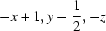 ; (ii)
 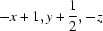 ; (iv)
 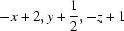 .
. Data collection: APEX2 (Bruker, 2005); cell refinement: SAINT (Bruker, 2005); data reduction: SAINT; program(s) used to solve structure: SHELXTL (Sheldrick, 2008); program(s) used to refine structure: SHELXTL; molecular graphics: SHELXTL; software used to prepare material for publication: SHELXTL and PLATON (Spek, 2009).
Supporting information
contains datablocks global, I. DOI: 10.1107/S1600536809021205/sj2630sup1.cif
Structure factors: contains datablock I. DOI: 10.1107/S1600536809021205/sj2630Isup2.hkl
Hot methanol solutions (20 ml) of 3,4-diaminopyridine (27 mg, Aldrich) and succinic acid (29 mg, Merck) were mixed and warmed for 5 minutes. The resulting solution was allowed to cool slowly at room temperature. Crystals of (I) appeared from the mother liquor after a few days.
All the H aroms were located from the difference Fourier map [N–H = 0.93 (3)–0.97 (3) Å, C–H = 0.84 (2)–1.13 (3)Å & O–H = 0.99 (4) Å] and allowed to refine freely. In the absence of significant effects, 1862 Friedel pairs were merged.
Data collection: APEX2 (Bruker, 2005); cell SAINT (Bruker, 2005); data reduction: SAINT (Bruker, 2005); program(s) used to solve structure: SHELXTL (Sheldrick, 2008); program(s) used to refine structure: SHELXTL (Sheldrick, 2008); molecular graphics: SHELXTL (Sheldrick, 2008); software used to prepare material for publication: SHELXTL (Sheldrick, 2008) and PLATON (Spek, 2009).
![[Figure 1]](./sj2630fig1thm.gif) | Fig. 1. The molecular structure of (I), showing 50% probability displacement ellipsoids and the atom numbering scheme. |
![[Figure 2]](./sj2630fig2thm.gif) | Fig. 2. The overall three-dimensional network of (I). Dashed lines indicate hydrogen bonds. |
| C5H8N3+·C4H5O4− | F(000) = 240 |
| Mr = 227.22 | Dx = 1.523 Mg m−3 |
| Monoclinic, P21 | Mo Kα radiation, λ = 0.71073 Å |
| Hall symbol: P 2yb | Cell parameters from 4153 reflections |
| a = 4.9862 (2) Å | θ = 2.9–38.4° |
| b = 9.5028 (3) Å | µ = 0.12 mm−1 |
| c = 10.4775 (3) Å | T = 100 K |
| β = 93.653 (2)° | Block, colourless |
| V = 495.45 (3) Å3 | 0.41 × 0.13 × 0.08 mm |
| Z = 2 |
| Bruker APEXII CCD area-detector diffractometer | 2280 independent reflections |
| Radiation source: fine-focus sealed tube | 2119 reflections with I > 2σ(I) |
| Graphite monochromator | Rint = 0.028 |
| ϕ and ω scans | θmax = 35.0°, θmin = 2.0° |
| Absorption correction: multi-scan (SADABS; Bruker, 2005) | h = −8→8 |
| Tmin = 0.929, Tmax = 0.991 | k = −15→15 |
| 9518 measured reflections | l = −16→16 |
| Refinement on F2 | Primary atom site location: structure-invariant direct methods |
| Least-squares matrix: full | Secondary atom site location: difference Fourier map |
| R[F2 > 2σ(F2)] = 0.036 | Hydrogen site location: inferred from neighbouring sites |
| wR(F2) = 0.104 | All H-atom parameters refined |
| S = 1.18 | w = 1/[σ2(Fo2) + (0.0624P)2 + 0.022P] where P = (Fo2 + 2Fc2)/3 |
| 2280 reflections | (Δ/σ)max < 0.001 |
| 197 parameters | Δρmax = 0.41 e Å−3 |
| 1 restraint | Δρmin = −0.24 e Å−3 |
| C5H8N3+·C4H5O4− | V = 495.45 (3) Å3 |
| Mr = 227.22 | Z = 2 |
| Monoclinic, P21 | Mo Kα radiation |
| a = 4.9862 (2) Å | µ = 0.12 mm−1 |
| b = 9.5028 (3) Å | T = 100 K |
| c = 10.4775 (3) Å | 0.41 × 0.13 × 0.08 mm |
| β = 93.653 (2)° |
| Bruker APEXII CCD area-detector diffractometer | 2280 independent reflections |
| Absorption correction: multi-scan (SADABS; Bruker, 2005) | 2119 reflections with I > 2σ(I) |
| Tmin = 0.929, Tmax = 0.991 | Rint = 0.028 |
| 9518 measured reflections |
| R[F2 > 2σ(F2)] = 0.036 | 1 restraint |
| wR(F2) = 0.104 | All H-atom parameters refined |
| S = 1.18 | Δρmax = 0.41 e Å−3 |
| 2280 reflections | Δρmin = −0.24 e Å−3 |
| 197 parameters |
Experimental. The crystal was placed in the cold stream of an Oxford Cryosystems Cobra open-flow nitrogen cryostat (Cosier & Glazer, 1986) operating at 100.0 (1) K. |
Geometry. All s.u.'s (except the s.u. in the dihedral angle between two l.s. planes) are estimated using the full covariance matrix. The cell s.u.'s are taken into account individually in the estimation of s.u.'s in distances, angles and torsion angles; correlations between s.u.'s in cell parameters are only used when they are defined by crystal symmetry. An approximate (isotropic) treatment of cell s.u.'s is used for estimating s.u.'s involving l.s. planes. |
Refinement. Refinement of F2 against ALL reflections. The weighted R-factor wR and goodness of fit S are based on F2, conventional R-factors R are based on F, with F set to zero for negative F2. The threshold expression of F2 > σ(F2) is used only for calculating R-factors(gt) etc. and is not relevant to the choice of reflections for refinement. R-factors based on F2 are statistically about twice as large as those based on F, and R- factors based on ALL data will be even larger. |
| x | y | z | Uiso*/Ueq | ||
| O1 | 0.2865 (2) | −0.15266 (13) | 0.23443 (10) | 0.0166 (2) | |
| O2 | 0.2994 (2) | −0.04711 (12) | 0.04363 (10) | 0.0145 (2) | |
| O3 | 1.0339 (2) | 0.20905 (12) | 0.27633 (10) | 0.0148 (2) | |
| O4 | 1.0369 (2) | 0.31053 (11) | 0.08455 (10) | 0.01284 (19) | |
| C6 | 0.3844 (3) | −0.06666 (14) | 0.16351 (13) | 0.0109 (2) | |
| C7 | 0.6179 (3) | 0.02567 (15) | 0.20940 (13) | 0.0127 (2) | |
| C8 | 0.7020 (3) | 0.13495 (15) | 0.11407 (13) | 0.0120 (2) | |
| C9 | 0.9402 (3) | 0.22422 (14) | 0.16284 (12) | 0.0100 (2) | |
| N1 | 0.4164 (2) | 0.40451 (13) | 0.33423 (12) | 0.0123 (2) | |
| N2 | 0.8257 (3) | 0.65927 (15) | 0.17427 (12) | 0.0172 (2) | |
| N3 | 1.0198 (3) | 0.68665 (15) | 0.43411 (12) | 0.0148 (2) | |
| C1 | 0.5088 (3) | 0.41464 (15) | 0.45697 (13) | 0.0128 (2) | |
| C2 | 0.7131 (3) | 0.50705 (15) | 0.49097 (13) | 0.0123 (2) | |
| C3 | 0.8247 (3) | 0.59224 (14) | 0.39891 (13) | 0.0108 (2) | |
| C4 | 0.7264 (3) | 0.57828 (14) | 0.26856 (13) | 0.0113 (2) | |
| C5 | 0.5199 (3) | 0.48313 (15) | 0.24195 (13) | 0.0121 (2) | |
| H9 | 0.149 (6) | −0.108 (4) | 0.012 (3) | 0.059 (11)* | |
| H1N1 | 0.270 (6) | 0.343 (4) | 0.329 (3) | 0.039 (8)* | |
| H1N2 | 0.801 (5) | 0.635 (3) | 0.105 (3) | 0.026 (7)* | |
| H2N2 | 0.992 (6) | 0.706 (4) | 0.202 (3) | 0.036 (7)* | |
| H1N3 | 1.097 (5) | 0.734 (3) | 0.382 (2) | 0.019 (6)* | |
| H2N3 | 1.073 (4) | 0.697 (3) | 0.520 (2) | 0.018 (6)* | |
| H1A | 0.426 (4) | 0.362 (3) | 0.516 (2) | 0.020 (6)* | |
| H2A | 0.770 (4) | 0.517 (3) | 0.574 (2) | 0.018 (5)* | |
| H5A | 0.458 (5) | 0.465 (3) | 0.167 (2) | 0.015 (5)* | |
| H7A | 0.570 (5) | 0.073 (3) | 0.304 (3) | 0.029 (7)* | |
| H7B | 0.758 (6) | −0.037 (4) | 0.247 (3) | 0.043 (8)* | |
| H8A | 0.757 (5) | 0.094 (3) | 0.043 (3) | 0.025 (6)* | |
| H8B | 0.570 (4) | 0.203 (3) | 0.097 (2) | 0.017 (5)* |
| U11 | U22 | U33 | U12 | U13 | U23 | |
| O1 | 0.0190 (5) | 0.0174 (5) | 0.0134 (4) | −0.0080 (4) | 0.0009 (4) | 0.0021 (4) |
| O2 | 0.0170 (4) | 0.0147 (4) | 0.0111 (4) | −0.0043 (4) | −0.0033 (3) | 0.0011 (3) |
| O3 | 0.0168 (4) | 0.0152 (5) | 0.0118 (4) | −0.0047 (4) | −0.0039 (3) | 0.0026 (4) |
| O4 | 0.0121 (4) | 0.0130 (4) | 0.0132 (4) | −0.0020 (3) | −0.0006 (3) | 0.0040 (3) |
| C6 | 0.0115 (5) | 0.0107 (5) | 0.0107 (5) | −0.0012 (4) | 0.0015 (4) | −0.0015 (4) |
| C7 | 0.0130 (5) | 0.0131 (5) | 0.0116 (5) | −0.0046 (4) | −0.0015 (4) | 0.0019 (4) |
| C8 | 0.0113 (5) | 0.0129 (5) | 0.0113 (5) | −0.0038 (4) | −0.0020 (4) | 0.0006 (4) |
| C9 | 0.0094 (5) | 0.0095 (5) | 0.0109 (5) | 0.0000 (4) | −0.0006 (4) | 0.0004 (4) |
| N1 | 0.0129 (5) | 0.0114 (5) | 0.0124 (5) | −0.0025 (4) | −0.0001 (4) | 0.0000 (4) |
| N2 | 0.0227 (6) | 0.0187 (6) | 0.0103 (5) | −0.0088 (5) | 0.0012 (4) | 0.0007 (4) |
| N3 | 0.0164 (5) | 0.0160 (5) | 0.0119 (5) | −0.0066 (4) | 0.0002 (4) | −0.0018 (4) |
| C1 | 0.0143 (5) | 0.0130 (5) | 0.0112 (5) | −0.0027 (4) | 0.0016 (4) | 0.0014 (4) |
| C2 | 0.0142 (5) | 0.0128 (5) | 0.0100 (5) | −0.0015 (4) | 0.0005 (4) | 0.0003 (4) |
| C3 | 0.0110 (5) | 0.0105 (5) | 0.0108 (5) | −0.0013 (4) | 0.0000 (4) | −0.0013 (4) |
| C4 | 0.0129 (5) | 0.0105 (5) | 0.0104 (5) | −0.0016 (4) | 0.0003 (4) | −0.0005 (4) |
| C5 | 0.0127 (5) | 0.0130 (5) | 0.0105 (5) | −0.0022 (4) | −0.0004 (4) | −0.0003 (4) |
| O1—C6 | 1.2265 (18) | N1—H1N1 | 0.93 (3) |
| O2—C6 | 1.3130 (17) | N2—C4 | 1.3695 (19) |
| O2—H9 | 0.99 (4) | N2—H1N2 | 0.77 (3) |
| O3—C9 | 1.2578 (16) | N2—H2N2 | 0.97 (3) |
| O4—C9 | 1.2760 (16) | N3—C3 | 1.3569 (18) |
| C6—C7 | 1.5118 (19) | N3—H1N3 | 0.82 (3) |
| C7—C8 | 1.5183 (19) | N3—H2N3 | 0.93 (2) |
| C7—H7A | 1.13 (3) | C1—C2 | 1.3749 (19) |
| C7—H7B | 0.98 (3) | C1—H1A | 0.91 (2) |
| C8—C9 | 1.5213 (18) | C2—C3 | 1.4013 (19) |
| C8—H8A | 0.90 (3) | C2—H2A | 0.91 (2) |
| C8—H8B | 0.93 (2) | C3—C4 | 1.4275 (18) |
| N1—C1 | 1.3414 (18) | C4—C5 | 1.3853 (18) |
| N1—C5 | 1.3501 (18) | C5—H5A | 0.84 (2) |
| C6—O2—H9 | 116 (2) | C4—N2—H1N2 | 118 (2) |
| O1—C6—O2 | 123.87 (13) | C4—N2—H2N2 | 112.4 (17) |
| O1—C6—C7 | 121.47 (12) | H1N2—N2—H2N2 | 121 (2) |
| O2—C6—C7 | 114.66 (12) | C3—N3—H1N3 | 122.4 (17) |
| C6—C7—C8 | 115.28 (11) | C3—N3—H2N3 | 119.1 (16) |
| C6—C7—H7A | 107.9 (14) | H1N3—N3—H2N3 | 119 (2) |
| C8—C7—H7A | 113.1 (15) | N1—C1—C2 | 119.84 (13) |
| C6—C7—H7B | 107 (2) | N1—C1—H1A | 117.7 (15) |
| C8—C7—H7B | 117.4 (18) | C2—C1—H1A | 122.4 (15) |
| H7A—C7—H7B | 94 (2) | C1—C2—C3 | 120.72 (12) |
| C7—C8—C9 | 113.76 (10) | C1—C2—H2A | 119.8 (16) |
| C7—C8—H8A | 111.0 (18) | C3—C2—H2A | 119.4 (16) |
| C9—C8—H8A | 104.5 (17) | N3—C3—C2 | 120.27 (12) |
| C7—C8—H8B | 112.4 (14) | N3—C3—C4 | 121.19 (12) |
| C9—C8—H8B | 101.8 (15) | C2—C3—C4 | 118.54 (11) |
| H8A—C8—H8B | 113 (2) | N2—C4—C5 | 121.32 (12) |
| O3—C9—O4 | 123.29 (12) | N2—C4—C3 | 121.34 (12) |
| O3—C9—C8 | 119.24 (12) | C5—C4—C3 | 117.30 (12) |
| O4—C9—C8 | 117.47 (11) | N1—C5—C4 | 122.02 (12) |
| C1—N1—C5 | 121.56 (12) | N1—C5—H5A | 114.7 (16) |
| C1—N1—H1N1 | 108.8 (17) | C4—C5—H5A | 123.1 (16) |
| C5—N1—H1N1 | 129.4 (17) | ||
| O1—C6—C7—C8 | −175.22 (13) | C1—C2—C3—C4 | −1.6 (2) |
| O2—C6—C7—C8 | 5.09 (18) | N3—C3—C4—N2 | 0.2 (2) |
| C6—C7—C8—C9 | −179.08 (12) | C2—C3—C4—N2 | 179.47 (13) |
| C7—C8—C9—O3 | −4.90 (18) | N3—C3—C4—C5 | −177.55 (14) |
| C7—C8—C9—O4 | 174.38 (12) | C2—C3—C4—C5 | 1.74 (19) |
| C5—N1—C1—C2 | 0.1 (2) | C1—N1—C5—C4 | 0.0 (2) |
| N1—C1—C2—C3 | 0.7 (2) | N2—C4—C5—N1 | −178.70 (13) |
| C1—C2—C3—N3 | 177.65 (14) | C3—C4—C5—N1 | −1.0 (2) |
| D—H···A | D—H | H···A | D···A | D—H···A |
| O2—H9···O4i | 0.99 (4) | 1.53 (4) | 2.4815 (14) | 159 (3) |
| N1—H1N1···O3ii | 0.93 (3) | 1.80 (3) | 2.7036 (16) | 163 (3) |
| N2—H1N2···O2iii | 0.77 (3) | 2.36 (3) | 3.0440 (17) | 150 (3) |
| N2—H2N2···O1iv | 0.97 (3) | 2.00 (3) | 2.9473 (17) | 164 (3) |
| N3—H1N3···O1iv | 0.82 (3) | 2.15 (3) | 2.9720 (18) | 176 (2) |
| N3—H2N3···O3v | 0.93 (2) | 2.23 (2) | 3.0699 (17) | 149.7 (18) |
| C2—H2A···O3v | 0.91 (2) | 2.56 (3) | 3.2907 (17) | 138 (2) |
| C5—H5A···O2iii | 0.84 (2) | 2.59 (2) | 3.1923 (18) | 129.7 (19) |
| Symmetry codes: (i) −x+1, y−1/2, −z; (ii) x−1, y, z; (iii) −x+1, y+1/2, −z; (iv) x+1, y+1, z; (v) −x+2, y+1/2, −z+1. |
Experimental details
| Crystal data | |
| Chemical formula | C5H8N3+·C4H5O4− |
| Mr | 227.22 |
| Crystal system, space group | Monoclinic, P21 |
| Temperature (K) | 100 |
| a, b, c (Å) | 4.9862 (2), 9.5028 (3), 10.4775 (3) |
| β (°) | 93.653 (2) |
| V (Å3) | 495.45 (3) |
| Z | 2 |
| Radiation type | Mo Kα |
| µ (mm−1) | 0.12 |
| Crystal size (mm) | 0.41 × 0.13 × 0.08 |
| Data collection | |
| Diffractometer | Bruker APEXII CCD area-detector diffractometer |
| Absorption correction | Multi-scan (SADABS; Bruker, 2005) |
| Tmin, Tmax | 0.929, 0.991 |
| No. of measured, independent and observed [I > 2σ(I)] reflections | 9518, 2280, 2119 |
| Rint | 0.028 |
| (sin θ/λ)max (Å−1) | 0.807 |
| Refinement | |
| R[F2 > 2σ(F2)], wR(F2), S | 0.036, 0.104, 1.18 |
| No. of reflections | 2280 |
| No. of parameters | 197 |
| No. of restraints | 1 |
| H-atom treatment | All H-atom parameters refined |
| Δρmax, Δρmin (e Å−3) | 0.41, −0.24 |
Computer programs: APEX2 (Bruker, 2005), SAINT (Bruker, 2005), SHELXTL (Sheldrick, 2008) and PLATON (Spek, 2009).
| D—H···A | D—H | H···A | D···A | D—H···A |
| O2—H9···O4i | 0.99 (4) | 1.53 (4) | 2.4815 (14) | 159 (3) |
| N1—H1N1···O3ii | 0.93 (3) | 1.80 (3) | 2.7036 (16) | 163 (3) |
| N2—H1N2···O2iii | 0.77 (3) | 2.36 (3) | 3.0440 (17) | 150 (3) |
| N2—H2N2···O1iv | 0.97 (3) | 2.00 (3) | 2.9473 (17) | 164 (3) |
| N3—H1N3···O1iv | 0.82 (3) | 2.15 (3) | 2.9720 (18) | 176 (2) |
| N3—H2N3···O3v | 0.93 (2) | 2.23 (2) | 3.0699 (17) | 149.7 (18) |
| C2—H2A···O3v | 0.91 (2) | 2.56 (3) | 3.2907 (17) | 138 (2) |
| C5—H5A···O2iii | 0.84 (2) | 2.59 (2) | 3.1923 (18) | 129.7 (19) |
| Symmetry codes: (i) −x+1, y−1/2, −z; (ii) x−1, y, z; (iii) −x+1, y+1/2, −z; (iv) x+1, y+1, z; (v) −x+2, y+1/2, −z+1. |
Footnotes
‡Thomson Reuters ResearcherID: A-3561-2009.
Acknowledgements
HKF and KBS thank the Malaysian Government and Universiti Sains Malaysia for the Science Fund grant No. 305/PFIZIK/613312. KBS thanks Universiti Sains Malaysia for a post–doctoral research fellowship. HKF also thanks Universiti Sains Malaysia for the Research University Golden Goose grant No.1001/PFIZIK/811012.
References
 Allen, F. H., Kennard, O., Watson, D. G., Brammer, L., Orpen, A. G. & Taylor, R. (1987). J. Chem. Soc. Perkin Trans. 2, pp. S1–19. CrossRef Web of Science Google Scholar
Bernstein, J., Davis, R. E., Shimoni, L. & Chang, N.-L. (1995). Angew. Chem. Int. Ed. Engl. 34, 1555–1573. CrossRef CAS Web of Science Google Scholar
Bruker (2005). APEX2, SAINT and SADABS. Bruker AXS Inc., Madison, Wisconsin, USA. Google Scholar
Cosier, J. & Glazer, A. M. (1986). J. Appl. Cryst. 19, 105–107. CrossRef CAS Web of Science IUCr Journals Google Scholar
Katritzky, A. R., Rees, C. W. & Scriven, E. F. V. (1996). Editors. Comprehensive Heterocyclic Chemistry II. Oxford: Pergamon Press. Google Scholar
Koleva, B., Kolev, T., Tsanev, T., Kotov, S., Mayer-Figge, H., Seidel, R. W. & Sheldrich, W. S. (2008). J. Mol. Struct. 881, 146–155. Web of Science CSD CrossRef CAS Google Scholar
Koleva, B., Tsanev, T., Kolev, T., Mayer-Figge, H. & Sheldrick, W. S. (2007). Acta Cryst. E63, o3356. Web of Science CSD CrossRef IUCr Journals Google Scholar
Opozda, E. M., Lasocha, W. & Wlodarczyk–Gajda, B. (2006). J. Mol. Struct. 784, 149–156. Web of Science CSD CrossRef CAS Google Scholar
Pozharski, A. F., Soldatenkov, A. T. & Katritzky, A. R. (1997). In Heterocycles in Life and Society. New York: Wiley. Google Scholar
Rubin-Preminger, J. M. & Englert, U. (2007). Acta Cryst. E63, o757–o758. Web of Science CSD CrossRef IUCr Journals Google Scholar
Sheldrick, G. M. (2008). Acta Cryst. A64, 112–122. Web of Science CrossRef CAS IUCr Journals Google Scholar
Spek, A. L. (2009). Acta Cryst. D65, 148–155. Web of Science CrossRef CAS IUCr Journals Google Scholar
This is an open-access article distributed under the terms of the Creative Commons Attribution (CC-BY) Licence, which permits unrestricted use, distribution, and reproduction in any medium, provided the original authors and source are cited.
| CRYSTALLOGRAPHIC COMMUNICATIONS |


Pyridine and its derivatives play an important role in heterocyclic chemistry (Pozharski et al. 1997; Katritzky et al. 1996). 3,4-diaminopyridine is used as a component in Schiff base reactions (Opozda et al. 2006). The crystal structure of 3,4-diaminopyridine (Rubin-Preminger & Englert, 2007), 3,4-diaminopyridinium hydrogen squarate (Koleva et al., 2007) and 3,4-diaminopyridinium hydrogen tartarate (Koleva et al., 2008) have been reported in the literature. Since our aim is to study some interesting hydrogen-bonding interactions, the synthesis and structure of the title compound (I) is presented here.
The asymmetric unit of (I) (Fig 1), contains a protonated 3,4-diaminopyridinium cation and a hydrogen succinate anion. The bond lengths (Allen et al., 1987) and angles are normal. In the 3,4-diaminopyridinium cation, protonation of the N1 atom leads to a slight increase in the C1—N1—C5 angle to 121.56 (12)°, compared to 115.69 (19)° in 3,4-diaminopyridine (Rubin-Preminger & Englert, 2007). The 3,4-diaminopyridinium cation is planar, with a maximum deviation of 0.0070 (15)Å for atom C4.
In the crystal packing (Fig. 2), the protonated N1 atom is hydrogen bonded to the carboxylate oxygen atom of O3 through N—H···O hydrogen bonds. The two amino groups (N2 and N3) are involved in the hydrogen bonding via N—H···O H-bonds with hydrogen succinate oxygen atom (O1) to form an R12(7) ring motif (Bernstein et al., 1995). The N3 amino group and ring carbon atom (C2) are both hydrogen-bonded to the carboxylate oxygen atom (O3) to form an R12(6) ring motif. The molecules are further connected via O—H···O hydrogen bonds forming a 3-D network (Table 1 and Fig 2).