 | Acta Crystallographica Section E Acta Crystallographica Section E CRYSTALLOGRAPHIC COMMUNICATIONS |


 journal menu


organic compounds
| CRYSTALLOGRAPHIC COMMUNICATIONS |
 access
2,2-Dibromo-1-(4-hydroxy-3-methoxyphenyl)ethanone

aNational Engineering Laboratory for Biomass Chemical Utilization; Key and Open Laboratory of Forest Chemical Engineering SFA, Institute of Chemical Industry of Forest Products CAF, Nanjing 210042, People's Republic of China
*Correspondence e-mail: [email protected]
The molecule of the title compound, C9H8Br2O3, is stabilized by an intramolecular O—H⋯O interaction. Intermolecular C—H⋯O interactions connect molecules into a two-dimensional array in the bc plane; connections between these are afforded by π–π stacking interactions [centroid–centroid distance 3.596 (5) Å].
Related literature
For the beta-O-4 in lignin, see: Cathala et al. (2003![[Cathala, B., Saake, B., Faix, O. & Monties, B. (2003). J. Chromatogr. A, 1020, 229-239.]](../../../../../../logos/arrows/e_arr.gif "Cathala, B., Saake, B., Faix, O. & Monties, B. (2003). J. Chromatogr. A, 1020, 229-239.") ). For attempts to prepare well defined linear polymers with the β-O-4 structure and to develop new methods of utilizing lignins, see: Kishimoto et al. (2005).
). For attempts to prepare well defined linear polymers with the β-O-4 structure and to develop new methods of utilizing lignins, see: Kishimoto et al. (2005).
![[Scheme 1]](tk2463scheme1.gif)
Experimental
Crystal data
|
Refinement
|
| ||||||||||||||||||||||||||||||||
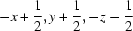 ; (ii)
 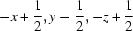 .
. Data collection: CAD-4 EXPRESS (Enraf–Nonius, 1994); cell refinement: CAD-4 EXPRESS; data reduction: XCAD4 (Harms & Wocadlo, 1995); program(s) used to solve structure: SHELXS97 (Sheldrick, 2008); program(s) used to refine structure: SHELXL97 (Sheldrick, 2008); molecular graphics: SHELXTL (Sheldrick, 2008); software used to prepare material for publication: SHELXTL.
Supporting information
contains datablocks qj0709, I. DOI: 10.1107/S1600536809020650/tk2463sup1.cif
Structure factors: contains datablock I. DOI: 10.1107/S1600536809020650/tk2463Isup2.hkl
To a stirred solution of acetovanillone (5 g, 0.03 mol) in anhydrous CHCl3, bromine (3.1 ml, 0.06 mol) was added dropwise under nitrogen over 2 h at 273 K. The reaction mixture was kept at 273k for 1 h. The reaction mixture was diluted with ether and washed with ice-cold water and brine. The solution was dried over anhydrous Na2SO4 and concentrated to dryness in vacuo. The crude crystalline product was purified by to obtain a pure white solid, (I). Colourless single crystals were grown by slow evaporation of an ethyl acetate solution of (I).
H atoms were placed in calculated positions and treated using a riding model, with C—H = 0.93–0.98 Å and O—H = 0.85 Å, and with Uiso(H) = 1.2Ueq(C, O) or 1.5Ueq(C) for methyl-H atoms.
Data collection: CAD-4 EXPRESS (Enraf–Nonius, 1994); cell CAD-4 EXPRESS (Enraf–Nonius, 1994); data reduction: XCAD4 (Harms & Wocadlo, 1995); program(s) used to solve structure: SHELXS97 (Sheldrick, 2008); program(s) used to refine structure: SHELXL97 (Sheldrick, 2008); molecular graphics: SHELXTL (Sheldrick, 2008); software used to prepare material for publication: SHELXTL (Sheldrick, 2008).
![[Figure 1]](./tk2463fig1thm.gif) | Fig. 1. The molecular structure and atom-labeling scheme for (I), with displacement ellipsoids drawn at the 30% probability level. |
| C9H8Br2O3 | F(000) = 624 |
| Mr = 323.97 | Dx = 2.065 Mg m−3 |
| Monoclinic, P21/n | Mo Kα radiation, λ = 0.71073 Å |
| Hall symbol: -P 2yn | Cell parameters from 25 reflections |
| a = 7.0370 (14) Å | θ = 10–13° |
| b = 10.805 (2) Å | µ = 7.76 mm−1 |
| c = 13.871 (3) Å | T = 295 K |
| β = 98.80 (3)° | Needle, colourless |
| V = 1042.3 (4) Å3 | 0.10 × 0.05 × 0.05 mm |
| Z = 4 |
| Enraf–Nonius CAD-4 diffractometer | 894 reflections with I > 2σ(I) |
| Radiation source: fine-focus sealed tube | Rint = 0.041 |
| Graphite monochromator | θmax = 25.3°, θmin = 2.4° |
| ω/2θ scans | h = 0→8 |
| Absorption correction: ψ scan (North et al., 1968) | k = 0→12 |
| Tmin = 0.511, Tmax = 0.698 | l = −16→16 |
| 2060 measured reflections | 3 standard reflections every 200 reflections |
| 1900 independent reflections | intensity decay: 1% |
| Refinement on F2 | Primary atom site location: structure-invariant direct methods |
| Least-squares matrix: full | Secondary atom site location: difference Fourier map |
| R[F2 > 2σ(F2)] = 0.067 | Hydrogen site location: inferred from neighbouring sites |
| wR(F2) = 0.159 | H-atom parameters constrained |
| S = 0.96 | w = 1/[σ2(Fo2) + (0.0723P)2] where P = (Fo2 + 2Fc2)/3 |
| 1900 reflections | (Δ/σ)max < 0.001 |
| 127 parameters | Δρmax = 0.56 e Å−3 |
| 61 restraints | Δρmin = −0.65 e Å−3 |
| C9H8Br2O3 | V = 1042.3 (4) Å3 |
| Mr = 323.97 | Z = 4 |
| Monoclinic, P21/n | Mo Kα radiation |
| a = 7.0370 (14) Å | µ = 7.76 mm−1 |
| b = 10.805 (2) Å | T = 295 K |
| c = 13.871 (3) Å | 0.10 × 0.05 × 0.05 mm |
| β = 98.80 (3)° |
| Enraf–Nonius CAD-4 diffractometer | 894 reflections with I > 2σ(I) |
| Absorption correction: ψ scan (North et al., 1968) | Rint = 0.041 |
| Tmin = 0.511, Tmax = 0.698 | 3 standard reflections every 200 reflections |
| 2060 measured reflections | intensity decay: 1% |
| 1900 independent reflections |
| R[F2 > 2σ(F2)] = 0.067 | 61 restraints |
| wR(F2) = 0.159 | H-atom parameters constrained |
| S = 0.96 | Δρmax = 0.56 e Å−3 |
| 1900 reflections | Δρmin = −0.65 e Å−3 |
| 127 parameters |
Geometry. All e.s.d.'s (except the e.s.d. in the dihedral angle between two l.s. planes) are estimated using the full covariance matrix. The cell e.s.d.'s are taken into account individually in the estimation of e.s.d.'s in distances, angles and torsion angles; correlations between e.s.d.'s in cell parameters are only used when they are defined by crystal symmetry. An approximate (isotropic) treatment of cell e.s.d.'s is used for estimating e.s.d.'s involving l.s. planes. |
Refinement. Refinement of F2 against ALL reflections. The weighted R-factor wR and goodness of fit S are based on F2, conventional R-factors R are based on F, with F set to zero for negative F2. The threshold expression of F2 > σ(F2) is used only for calculating R-factors(gt) etc. and is not relevant to the choice of reflections for refinement. R-factors based on F2 are statistically about twice as large as those based on F, and R- factors based on ALL data will be even larger. |
| x | y | z | Uiso*/Ueq | ||
| Br1 | 0.08467 (19) | 0.97920 (12) | 0.38634 (8) | 0.0775 (5) | |
| Br2 | 0.51183 (19) | 0.91674 (13) | 0.35768 (10) | 0.0890 (5) | |
| O1 | 0.1990 (9) | 1.1174 (7) | −0.1321 (4) | 0.0521 (17) | |
| O2 | 0.2770 (9) | 0.8866 (7) | −0.1677 (4) | 0.062 (2) | |
| H2A | 0.2526 | 0.9407 | −0.2123 | 0.074* | |
| O3 | 0.2364 (10) | 1.1382 (6) | 0.2363 (4) | 0.0578 (19) | |
| C1 | 0.1731 (15) | 1.2472 (10) | −0.1180 (7) | 0.065 (3) | |
| H1A | 0.1408 | 1.2869 | −0.1802 | 0.097* | |
| H1B | 0.2900 | 1.2820 | −0.0840 | 0.097* | |
| H1C | 0.0712 | 1.2596 | −0.0802 | 0.097* | |
| C2 | 0.2291 (13) | 1.0450 (8) | −0.0514 (6) | 0.041 (2) | |
| C3 | 0.2247 (12) | 1.0754 (8) | 0.0407 (5) | 0.036 (2) | |
| H3A | 0.2002 | 1.1572 | 0.0554 | 0.043* | |
| C4 | 0.2555 (12) | 0.9894 (8) | 0.1168 (5) | 0.0303 (19) | |
| C5 | 0.2965 (12) | 0.8669 (8) | 0.0924 (5) | 0.037 (2) | |
| H5A | 0.3198 | 0.8071 | 0.1410 | 0.045* | |
| C6 | 0.3021 (13) | 0.8348 (9) | −0.0047 (6) | 0.043 (2) | |
| H6A | 0.3279 | 0.7536 | −0.0208 | 0.052* | |
| C7 | 0.2714 (13) | 0.9187 (9) | −0.0728 (6) | 0.044 (2) | |
| C8 | 0.2469 (13) | 1.0318 (9) | 0.2175 (6) | 0.039 (2) | |
| C9 | 0.2485 (13) | 0.9338 (9) | 0.2920 (6) | 0.048 (2) | |
| H9A | 0.2046 | 0.8555 | 0.2606 | 0.057* |
| U11 | U22 | U33 | U12 | U13 | U23 | |
| Br1 | 0.0952 (10) | 0.0694 (9) | 0.0809 (7) | 0.0149 (8) | 0.0546 (7) | 0.0129 (7) |
| Br2 | 0.0631 (8) | 0.0828 (11) | 0.1166 (10) | 0.0081 (8) | −0.0004 (7) | 0.0338 (8) |
| O1 | 0.051 (4) | 0.059 (5) | 0.046 (3) | −0.001 (4) | 0.008 (3) | 0.009 (3) |
| O2 | 0.065 (5) | 0.072 (5) | 0.055 (4) | 0.001 (4) | 0.030 (3) | −0.003 (4) |
| O3 | 0.105 (6) | 0.018 (4) | 0.058 (4) | 0.001 (4) | 0.037 (4) | −0.001 (3) |
| C1 | 0.072 (8) | 0.055 (8) | 0.068 (7) | −0.007 (7) | 0.017 (6) | 0.020 (6) |
| C2 | 0.044 (5) | 0.035 (5) | 0.045 (4) | −0.001 (4) | 0.009 (4) | 0.003 (4) |
| C3 | 0.041 (5) | 0.020 (4) | 0.048 (4) | −0.006 (4) | 0.013 (4) | 0.000 (3) |
| C4 | 0.027 (4) | 0.024 (4) | 0.040 (3) | −0.003 (4) | 0.006 (3) | 0.000 (3) |
| C5 | 0.038 (5) | 0.031 (4) | 0.041 (4) | 0.004 (4) | −0.002 (4) | 0.001 (4) |
| C6 | 0.046 (5) | 0.034 (5) | 0.052 (4) | 0.000 (4) | 0.015 (4) | −0.005 (4) |
| C7 | 0.046 (5) | 0.048 (5) | 0.045 (4) | 0.002 (5) | 0.025 (4) | −0.005 (4) |
| C8 | 0.042 (5) | 0.025 (5) | 0.053 (4) | 0.004 (4) | 0.019 (4) | 0.001 (4) |
| C9 | 0.049 (5) | 0.033 (5) | 0.064 (5) | −0.002 (5) | 0.015 (4) | 0.004 (4) |
| Br1—C9 | 1.935 (9) | C2—C7 | 1.437 (12) |
| Br2—C9 | 1.945 (9) | C3—C4 | 1.398 (10) |
| O1—C2 | 1.355 (10) | C3—H3A | 0.9300 |
| O1—C1 | 1.431 (12) | C4—C5 | 1.407 (11) |
| O2—C7 | 1.369 (9) | C4—C8 | 1.481 (11) |
| O2—H2A | 0.8500 | C5—C6 | 1.398 (11) |
| O3—C8 | 1.184 (10) | C5—H5A | 0.9300 |
| C1—H1A | 0.9600 | C6—C7 | 1.302 (11) |
| C1—H1B | 0.9600 | C6—H6A | 0.9300 |
| C1—H1C | 0.9600 | C8—C9 | 1.478 (12) |
| C2—C3 | 1.324 (11) | C9—H9A | 0.9800 |
| C2—O1—C1 | 117.4 (7) | C6—C5—H5A | 119.9 |
| C7—O2—H2A | 119.6 | C4—C5—H5A | 119.9 |
| O1—C1—H1A | 109.5 | C7—C6—C5 | 120.0 (9) |
| O1—C1—H1B | 109.5 | C7—C6—H6A | 120.0 |
| H1A—C1—H1B | 109.5 | C5—C6—H6A | 120.0 |
| O1—C1—H1C | 109.5 | C6—C7—O2 | 119.7 (9) |
| H1A—C1—H1C | 109.5 | C6—C7—C2 | 121.9 (8) |
| H1B—C1—H1C | 109.5 | O2—C7—C2 | 118.4 (8) |
| C3—C2—O1 | 129.0 (9) | O3—C8—C9 | 122.4 (8) |
| C3—C2—C7 | 118.0 (8) | O3—C8—C4 | 121.4 (8) |
| O1—C2—C7 | 112.9 (7) | C9—C8—C4 | 116.2 (8) |
| C2—C3—C4 | 122.7 (8) | C8—C9—Br1 | 110.5 (6) |
| C2—C3—H3A | 118.7 | C8—C9—Br2 | 107.5 (6) |
| C4—C3—H3A | 118.7 | Br1—C9—Br2 | 109.3 (4) |
| C3—C4—C5 | 117.2 (7) | C8—C9—H9A | 109.8 |
| C3—C4—C8 | 118.9 (7) | Br1—C9—H9A | 109.8 |
| C5—C4—C8 | 123.9 (7) | Br2—C9—H9A | 109.8 |
| C6—C5—C4 | 120.1 (8) | ||
| C1—O1—C2—C3 | 5.5 (14) | O1—C2—C7—C6 | −179.1 (8) |
| C1—O1—C2—C7 | −174.4 (8) | C3—C2—C7—O2 | −179.7 (9) |
| O1—C2—C3—C4 | 178.7 (8) | O1—C2—C7—O2 | 0.2 (12) |
| C7—C2—C3—C4 | −1.3 (13) | C3—C4—C8—O3 | −8.6 (13) |
| C2—C3—C4—C5 | 1.4 (13) | C5—C4—C8—O3 | 170.2 (9) |
| C2—C3—C4—C8 | −179.7 (9) | C3—C4—C8—C9 | 170.2 (8) |
| C3—C4—C5—C6 | −1.0 (12) | C5—C4—C8—C9 | −10.9 (12) |
| C8—C4—C5—C6 | −179.8 (8) | O3—C8—C9—Br1 | 35.2 (12) |
| C4—C5—C6—C7 | 0.7 (14) | C4—C8—C9—Br1 | −143.6 (7) |
| C5—C6—C7—O2 | −179.9 (8) | O3—C8—C9—Br2 | −84.0 (10) |
| C5—C6—C7—C2 | −0.7 (14) | C4—C8—C9—Br2 | 97.2 (8) |
| C3—C2—C7—C6 | 1.0 (14) |
| D—H···A | D—H | H···A | D···A | D—H···A |
| O2—H2A···O1 | 0.85 | 2.27 | 2.617 (11) | 105 |
| C1—H1A···O2i | 0.96 | 2.51 | 3.398 (11) | 153 |
| C5—H5A···O3ii | 0.93 | 2.57 | 3.460 (10) | 161 |
| C9—H9A···O3ii | 0.98 | 2.38 | 3.222 (11) | 143 |
| Symmetry codes: (i) −x+1/2, y+1/2, −z−1/2; (ii) −x+1/2, y−1/2, −z+1/2. |
Experimental details
| Crystal data | |
| Chemical formula | C9H8Br2O3 |
| Mr | 323.97 |
| Crystal system, space group | Monoclinic, P21/n |
| Temperature (K) | 295 |
| a, b, c (Å) | 7.0370 (14), 10.805 (2), 13.871 (3) |
| β (°) | 98.80 (3) |
| V (Å3) | 1042.3 (4) |
| Z | 4 |
| Radiation type | Mo Kα |
| µ (mm−1) | 7.76 |
| Crystal size (mm) | 0.10 × 0.05 × 0.05 |
| Data collection | |
| Diffractometer | Enraf–Nonius CAD-4 diffractometer |
| Absorption correction | ψ scan (North et al., 1968) |
| Tmin, Tmax | 0.511, 0.698 |
| No. of measured, independent and observed [I > 2σ(I)] reflections | 2060, 1900, 894 |
| Rint | 0.041 |
| (sin θ/λ)max (Å−1) | 0.601 |
| Refinement | |
| R[F2 > 2σ(F2)], wR(F2), S | 0.067, 0.159, 0.96 |
| No. of reflections | 1900 |
| No. of parameters | 127 |
| No. of restraints | 61 |
| H-atom treatment | H-atom parameters constrained |
| Δρmax, Δρmin (e Å−3) | 0.56, −0.65 |
Computer programs: CAD-4 EXPRESS (Enraf–Nonius, 1994), XCAD4 (Harms & Wocadlo, 1995), SHELXS97 (Sheldrick, 2008), SHELXL97 (Sheldrick, 2008), SHELXTL (Sheldrick, 2008).
| D—H···A | D—H | H···A | D···A | D—H···A |
| O2—H2A···O1 | 0.85 | 2.27 | 2.617 (11) | 105 |
| C1—H1A···O2i | 0.96 | 2.51 | 3.398 (11) | 153 |
| C5—H5A···O3ii | 0.93 | 2.57 | 3.460 (10) | 161 |
| C9—H9A···O3ii | 0.98 | 2.38 | 3.222 (11) | 143 |
| Symmetry codes: (i) −x+1/2, y+1/2, −z−1/2; (ii) −x+1/2, y−1/2, −z+1/2. |
Acknowledgements
The authors thank the Natural Science Foundation of Shandong Province (grant No. Y2005B04) for support.
References
 Cathala, B., Saake, B., Faix, O. & Monties, B. (2003). J. Chromatogr. A, 1020, 229–239. Web of Science CrossRef PubMed CAS Google Scholar
Enraf–Nonius (1994). CAD-4 EXPRESS. Enraf–Nonius, Delft, The Netherlands. Google Scholar
Harms, K. & Wocadlo, S. (1995). XCAD4. University of Marburg, Germany. Google Scholar
Kishimoto, T., Uraki, Y. & Ubukata, M. (2005). Org. Biomol. Chem. 3, 1067–1073. Web of Science CrossRef PubMed CAS Google Scholar
North, A. C. T., Phillips, D. C. & Mathews, F. S. (1968). Acta Cryst. A24, 351–359. CrossRef IUCr Journals Web of Science Google Scholar
Sheldrick, G. M. (2008). Acta Cryst. A64, 112–122. Web of Science CrossRef CAS IUCr Journals Google Scholar
This is an open-access article distributed under the terms of the Creative Commons Attribution (CC-BY) Licence, which permits unrestricted use, distribution, and reproduction in any medium, provided the original authors and source are cited.
| CRYSTALLOGRAPHIC COMMUNICATIONS |


Lignin is natural polymer occurring in plant cell walls and is considered to be the second most abundant biopolymer after cellulose. The beta-O-4 structure is the most abundant substructure in lignin (Cathala et al., 2003). In order to prepare well defined linear polymers composed of the β-O-4 structure and in attempt to develop new utilization methods of lignins (Kishimoto et al., 2005), a new compound, 2,2-dibromo-1-(4-hydroxy-3-methoxyphenyl)ethanone, (I), was synthesized and its structure determined using single-crystal X-ray methods.
The molecular conformation of (I), Fig. 1, is stabilized by an intramolecular O—H···O interaction formed between the hydroxyl-H and methoxy-O atoms (H···O = 2.27 Å). The molecules are connected into a 2-D array via C-H···O interactions in the bc-plane (Table 1). Connections between the layers are afforded by π-π stacking interactions, with the shortest centroid···centroid distance being 3.596 (5)Å.