 | Acta Crystallographica Section E Acta Crystallographica Section E CRYSTALLOGRAPHIC COMMUNICATIONS |


 journal menu


inorganic compounds
| CRYSTALLOGRAPHIC COMMUNICATIONS |
 access
Redetermination of AgNb2PS10 revealing a silver deficiency

aDepartment of Chemistry, Konkuk University, Seoul 143-701, Republic of Korea, and bDivision of Energy Systems Research and Department of Chemistry, Ajou University, Suwon 443-749, Republic of Korea
*Correspondence e-mail: [email protected]
In comparison with a previous crystallographic study [Goh et al. (2002![[Goh, E., Kim, S. & Jung, D. (2002). J. Solid State Chem. 168, 119-125.]](../../../../../../logos/arrows/e_arr.gif "Goh, E., Kim, S. & Jung, D. (2002). J. Solid State Chem. 168, 119-125.") ). J. Solid State Chem. 168, 119–125] of the title compound, silver diniobium tris(disulfide) tetrathiophosphate(V), that reports a full occupation of the silver position and isotropic displacement parameters for the atoms, the current redetermination reveals a silver deficiency with a site-occupation factor of 0.88 (1) and reports all atoms with anisotropic displacement parameters. The structure of Ag0.88Nb2PS10 is composed of ∞1[Nb2PS10] chains, which are built up from pairs of distorted bicapped trigonal-prismatic [NbS8] polyhedra forming [Nb2S12] dimers and of tetrahedral [PS4] groups. These chains are connected via the statistically disordered Ag+ ions, forming double layers. Adjacent layers are stacked solely through into a three-dimensional structure. Short and long Nb—Nb distances [2.880 (1) and 3.770 (2) Å, respectively] alternate along the chain and S22− and S2− anionic species are observed.
). J. Solid State Chem. 168, 119–125] of the title compound, silver diniobium tris(disulfide) tetrathiophosphate(V), that reports a full occupation of the silver position and isotropic displacement parameters for the atoms, the current redetermination reveals a silver deficiency with a site-occupation factor of 0.88 (1) and reports all atoms with anisotropic displacement parameters. The structure of Ag0.88Nb2PS10 is composed of ∞1[Nb2PS10] chains, which are built up from pairs of distorted bicapped trigonal-prismatic [NbS8] polyhedra forming [Nb2S12] dimers and of tetrahedral [PS4] groups. These chains are connected via the statistically disordered Ag+ ions, forming double layers. Adjacent layers are stacked solely through into a three-dimensional structure. Short and long Nb—Nb distances [2.880 (1) and 3.770 (2) Å, respectively] alternate along the chain and S22− and S2− anionic species are observed.
Related literature
The synthesis and structural characterization of stoichiometric AgNb2PS10 and NaNb2PS10 have been published (Goh et al., 2002). For Nb2PS10-related quaternary thiophosphates with general formula MNb2PS10, see: Do & Yun (1996) for KNb2PS10, Kim & Yun (2002) for RbNb2PS10, Kwak et al. (2007) for CsNb2PS10, and Bang et al. (2008) for TlNb2PS10; for related pentanary thiophosphates M,M′Nb2PS10, see: Kwak & Yun (2008) for K0.34Cu0.5Nb2PS10, Dong et al. (2005a) for K0.5Ag0.5Nb2PS10, and Dong et al. (2005b) for Rb0.38Ag0.5Nb2PS10. For data standardization, see: Gelato & Parthé (1987). For ionic radii, see: Shannon (1976). For structure validation, see: Spek (2009). For typical P—S bond distances, see: Brec et al. (1983). For typical Nb4+—Nb4+ bond distances, see: Angenault et al. (2000).
Experimental
Crystal data
|
Refinement
|
| |||||||||||||||||||||||||||||||||||||||||||||||||||||||||||||||||||||||
 ; (ii)
 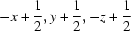 ; (iii)
  ; (iv)
 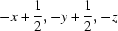 ; (v)
; (v)  ; (vi)
 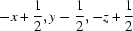 ; (vii)
 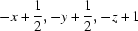 .
. Data collection: MAC Science MXC3 (MAC Science, 1994); cell refinement: MAC Science MXC3; data reduction: MAC Science MXC3; program(s) used to solve structure: SHELXS97 (Sheldrick, 2008); program(s) used to refine structure: SHELXL97 (Sheldrick, 2008); molecular graphics: locally modified version of ORTEP (Johnson, 1965); software used to prepare material for publication: WinGX (Farrugia, 1999).
Supporting information
contains datablocks global, I. DOI: 10.1107/S1600536809025100/wm2240sup1.cif
Structure factors: contains datablock I. DOI: 10.1107/S1600536809025100/wm2240Isup2.hkl
Ag0.88Nb2PS10 was prepared by the reaction of the elements Nb, P, and S with an elemental ratio of 2:1:10 in the eutectic mixture of AgCl/LiCl (Kojima, 99.5%). The starting materials, Nb powder (CERAC 99.8%), P powder (CERAC 99.5%), and S powder (Aldrich 99.999%) were placed in a silica glass tube. The mass ratio of reactants and halide was 1:2. The tube was evacuated to 0.133 Pa, sealed, and heated to 973 K where it was kept for 7d. Afterwards, the tube was cooled at a rate of 4 K/h to room temperature. Black needle-shaped crystals were isolated from the by leaching out with water. The crystals are stable in water and air. Electron microprobe analysis of the crystals established their and the presence of Ag, Nb, P and S. No other element was detected.
Large anisotropic displacement parameters (ADPs) of the silver atom were found when the structure was refined with the stoichiometric model AgNb2PS10, (Goh et al., 2002). The deficient nature of the Ag site was checked by refining the occupancy of Ag while that of the other atoms were fixed. With the non-stoichiometric model (AgxNb2PS10), the occupation factor of the Ag site was reduced significantly from 1 to 0.88 (1) and the reliability factor (wR2 = 0.1089) was improved in comparison with full occupation of the silver position (wR2 = 0.1341). In addition, the anisotropic displacement parameters in the disordered model became plausible. As no evidence was found for ordering of the Ag site, a statistically disordered structure was assumed. With the composition established, the data for the compound were corrected for absorption with the use of the analytical method (de Meulenaer & Tompa, 1965). The highest residual electron density is 0.96 Å from the S1 site and the deepest hole is 0.73 Å from the Ag site. No additional symmetry, as tested by PLATON (Spek, 2009), was detected in this structure. Structure data were finally standardized by means of the program STRUCTURE TIDY (Gelato & Parthé, 1987).
Data collection: MAC Science MXC3 (MAC Science, 1994); cell MAC Science MXC3 (MAC Science, 1994); data reduction: MAC Science MXC3 (MAC Science, 1994); program(s) used to solve structure: SHELXS97 (Sheldrick, 2008); program(s) used to refine structure: SHELXL97 (Sheldrick, 2008); molecular graphics: locally modified version of ORTEP (Johnson, 1965); software used to prepare material for publication: WinGX (Farrugia, 1999).
![[Figure 1]](./wm2240fig1thm.gif) | Fig. 1. A view of the structure of Ag0.88Nb2PS10 down the b axis showing the double layers and the two-dimensional nature of the compound. Large and small filled circles are Nb and P atoms respectively; large open circles are S atoms; grey circles represent Ag atoms. |
![[Figure 2]](./wm2240fig2thm.gif) | Fig. 2. A view of the structure of Ag0.88Nb2PS10 showing the coordination around Nb, Ag, and P atoms. Anisotropic displacement ellipsoids are drawn at the 70% probability level. Symmetry codes are as given in Table 1. |
| Ag0.88Nb2PS10 | F(000) = 2385 |
| Mr = 631.78 | Dx = 3.485 Mg m−3 |
| Monoclinic, C2/c | Mo Kα radiation, λ = 0.71073 Å |
| Hall symbol: -C 2yc | Cell parameters from 24 reflections |
| a = 24.001 (5) Å | θ = 10.0–15.0° |
| b = 7.7711 (17) Å | µ = 5.1 mm−1 |
| c = 12.960 (3) Å | T = 290 K |
| β = 94.833 (19)° | Needle, black |
| V = 2408.6 (9) Å3 | 0.60 × 0.06 × 0.04 mm |
| Z = 8 |
| MAC Science MXC3 diffractometer | 1835 reflections with I > 2σ(I) |
| Radiation source: normal-focus sealed tube | Rint = 0.017 |
| Graphite monochromator | θmax = 25.0°, θmin = 1.7° |
| ω–2θ scans | h = −28→28 |
| Absorption correction: analytical (de Meulenaer & Tompa, 1965) | k = 0→9 |
| Tmin = 0.727, Tmax = 0.821 | l = 0→15 |
| 2221 measured reflections | 2 standard reflections every 100 reflections |
| 2114 independent reflections | intensity decay: none |
| Refinement on F2 | 0 restraints |
| Least-squares matrix: full | Primary atom site location: structure-invariant direct methods |
| R[F2 > 2σ(F2)] = 0.045 | Secondary atom site location: difference Fourier map |
| wR(F2) = 0.109 | w = 1/[σ2(Fo2) + (0.029P)2 + 98.0899P] where P = (Fo2 + 2Fc2)/3 |
| S = 1.16 | (Δ/σ)max < 0.001 |
| 2114 reflections | Δρmax = 1.82 e Å−3 |
| 128 parameters | Δρmin = −1.20 e Å−3 |
| Ag0.88Nb2PS10 | V = 2408.6 (9) Å3 |
| Mr = 631.78 | Z = 8 |
| Monoclinic, C2/c | Mo Kα radiation |
| a = 24.001 (5) Å | µ = 5.1 mm−1 |
| b = 7.7711 (17) Å | T = 290 K |
| c = 12.960 (3) Å | 0.60 × 0.06 × 0.04 mm |
| β = 94.833 (19)° |
| MAC Science MXC3 diffractometer | 1835 reflections with I > 2σ(I) |
| Absorption correction: analytical (de Meulenaer & Tompa, 1965) | Rint = 0.017 |
| Tmin = 0.727, Tmax = 0.821 | 2 standard reflections every 100 reflections |
| 2221 measured reflections | intensity decay: none |
| 2114 independent reflections |
| R[F2 > 2σ(F2)] = 0.045 | 0 restraints |
| wR(F2) = 0.109 | w = 1/[σ2(Fo2) + (0.029P)2 + 98.0899P] where P = (Fo2 + 2Fc2)/3 |
| S = 1.16 | Δρmax = 1.82 e Å−3 |
| 2114 reflections | Δρmin = −1.20 e Å−3 |
| 128 parameters |
Geometry. All s.u.'s (except the s.u. in the dihedral angle between two l.s. planes) are estimated using the full covariance matrix. The cell s.u.'s are taken into account individually in the estimation of s.u.'s in distances, angles and torsion angles; correlations between s.u.'s in cell parameters are only used when they are defined by crystal symmetry. An approximate (isotropic) treatment of cell s.u.'s is used for estimating s.u.'s involving l.s. planes. |
Refinement. Refinement of F2 against ALL reflections. The weighted R-factor wR and goodness of fit S are based on F2, conventional R-factors R are based on F, with F set to zero for negative F2. The threshold expression of F2 > 2σ(F2) is used only for calculating R-factors(gt) etc. and is not relevant to the choice of reflections for refinement. R-factors based on F2 are statistically about twice as large as those based on F, and R- factors based on ALL data will be even larger. |
| x | y | z | Uiso*/Ueq | Occ. (<1) | |
| Ag | 0.05548 (4) | 0.51279 (13) | 0.09923 (9) | 0.0397 (4) | 0.878 (4) |
| Nb1 | 0.13913 (3) | 0.05530 (10) | 0.00408 (6) | 0.0156 (2) | |
| Nb2 | 0.36226 (3) | 0.43048 (10) | 0.28691 (6) | 0.0155 (2) | |
| P | 0.40291 (10) | 0.1092 (3) | 0.1376 (2) | 0.0223 (5) | |
| S1 | 0.04299 (12) | 0.4143 (4) | 0.3739 (3) | 0.0399 (7) | |
| S2 | 0.06326 (9) | 0.1230 (3) | 0.56424 (18) | 0.0208 (5) | |
| S3 | 0.06437 (10) | 0.1186 (3) | 0.12793 (19) | 0.0240 (5) | |
| S4 | 0.15627 (9) | 0.1535 (3) | 0.35711 (17) | 0.0186 (5) | |
| S5 | 0.21371 (10) | 0.1063 (3) | 0.14306 (18) | 0.0243 (5) | |
| S6 | 0.28921 (9) | 0.4481 (3) | 0.13057 (18) | 0.0204 (5) | |
| S7 | 0.28941 (10) | 0.3584 (3) | 0.40463 (19) | 0.0245 (5) | |
| S8 | 0.34993 (11) | 0.1158 (3) | 0.00528 (19) | 0.0276 (6) | |
| S9 | 0.36001 (11) | 0.0935 (3) | 0.2684 (2) | 0.0257 (5) | |
| S10 | 0.43518 (9) | 0.3553 (3) | 0.15040 (17) | 0.0185 (5) |
| U11 | U22 | U33 | U12 | U13 | U23 | |
| Ag | 0.0377 (6) | 0.0321 (6) | 0.0492 (7) | −0.0076 (4) | 0.0037 (5) | −0.0051 (5) |
| Nb1 | 0.0138 (4) | 0.0169 (4) | 0.0160 (4) | −0.0008 (3) | 0.0009 (3) | 0.0006 (3) |
| Nb2 | 0.0131 (4) | 0.0155 (4) | 0.0178 (4) | 0.0003 (3) | 0.0014 (3) | 0.0006 (3) |
| P | 0.0228 (13) | 0.0150 (12) | 0.0295 (13) | −0.0008 (10) | 0.0049 (10) | 0.0013 (10) |
| S1 | 0.0326 (15) | 0.0216 (13) | 0.066 (2) | −0.0078 (12) | 0.0070 (14) | 0.0056 (13) |
| S2 | 0.0156 (11) | 0.0233 (12) | 0.0234 (12) | 0.0028 (9) | 0.0012 (9) | −0.0009 (10) |
| S3 | 0.0205 (12) | 0.0256 (13) | 0.0260 (12) | 0.0066 (10) | 0.0025 (9) | 0.0025 (10) |
| S4 | 0.0193 (11) | 0.0152 (11) | 0.0212 (11) | −0.0010 (9) | 0.0010 (9) | −0.0012 (9) |
| S5 | 0.0189 (11) | 0.0324 (14) | 0.0211 (12) | −0.0080 (10) | −0.0006 (9) | 0.0029 (10) |
| S6 | 0.0148 (11) | 0.0253 (12) | 0.0209 (11) | −0.0024 (9) | 0.0011 (9) | 0.0001 (9) |
| S7 | 0.0200 (12) | 0.0309 (13) | 0.0230 (12) | −0.0063 (10) | 0.0034 (9) | −0.0016 (10) |
| S8 | 0.0395 (15) | 0.0215 (13) | 0.0210 (12) | −0.0060 (11) | −0.0016 (11) | −0.0024 (10) |
| S9 | 0.0313 (13) | 0.0191 (12) | 0.0274 (13) | −0.0017 (10) | 0.0068 (10) | 0.0018 (10) |
| S10 | 0.0156 (10) | 0.0182 (11) | 0.0214 (12) | −0.0005 (9) | 0.0004 (9) | 0.0022 (9) |
| Ag—S1i | 2.536 (3) | Nb2—S3ii | 2.476 (3) |
| Ag—S9ii | 2.620 (3) | Nb2—S7 | 2.479 (3) |
| Ag—S2iii | 2.875 (3) | Nb2—S5ii | 2.508 (2) |
| Ag—S8iv | 2.916 (3) | Nb2—S2viii | 2.551 (3) |
| Ag—S1iii | 2.965 (4) | Nb2—S4ii | 2.558 (2) |
| Ag—S3 | 3.091 (3) | Nb2—S6 | 2.569 (3) |
| Ag—Piv | 3.440 (3) | Nb2—S9 | 2.630 (3) |
| Ag—Agv | 3.549 (2) | Nb2—S10 | 2.656 (2) |
| Ag—Pii | 3.552 (3) | Nb1—Nb2vii | 2.8800 (13) |
| Ag—Nb1 | 4.3137 (15) | Nb1—Piv | 3.298 (3) |
| Nb1—S5 | 2.462 (2) | Nb1—Nb2iv | 3.7702 (15) |
| Nb1—S2vi | 2.466 (2) | Nb2—Nb1ii | 2.8800 (13) |
| Nb1—S7vii | 2.518 (3) | Nb2—Nb1iv | 3.7702 (15) |
| Nb1—S6iv | 2.551 (2) | P—S1vii | 2.009 (4) |
| Nb1—S3 | 2.554 (3) | P—S8 | 2.048 (4) |
| Nb1—S4vi | 2.562 (2) | P—S9 | 2.059 (4) |
| Nb1—S8iv | 2.573 (3) | P—S10 | 2.065 (3) |
| Nb1—S10iv | 2.659 (2) | ||
| S1i—Ag—S9ii | 131.39 (11) | S7—Nb2—S5ii | 47.83 (9) |
| S1i—Ag—S2iii | 113.11 (9) | S3ii—Nb2—S2viii | 48.11 (8) |
| S9ii—Ag—S2iii | 79.08 (8) | S7—Nb2—S2viii | 89.05 (8) |
| S1i—Ag—S8iv | 136.99 (9) | S5ii—Nb2—S2viii | 107.42 (8) |
| S9ii—Ag—S8iv | 78.25 (8) | S3ii—Nb2—S4ii | 89.92 (8) |
| S2iii—Ag—S8iv | 101.58 (7) | S7—Nb2—S4ii | 120.91 (8) |
| S1i—Ag—S1iii | 100.08 (10) | S5ii—Nb2—S4ii | 78.94 (8) |
| S9ii—Ag—S1iii | 127.42 (9) | S2viii—Nb2—S4ii | 136.85 (8) |
| S2iii—Ag—S1iii | 70.06 (8) | S3ii—Nb2—S6 | 137.11 (9) |
| S8iv—Ag—S1iii | 68.05 (8) | S7—Nb2—S6 | 91.58 (8) |
| S1i—Ag—S3 | 74.93 (8) | S5ii—Nb2—S6 | 77.74 (8) |
| S9ii—Ag—S3 | 96.70 (8) | S2viii—Nb2—S6 | 173.34 (8) |
| S2iii—Ag—S3 | 171.84 (8) | S4ii—Nb2—S6 | 47.42 (8) |
| S8iv—Ag—S3 | 70.59 (7) | S3ii—Nb2—S9 | 129.58 (9) |
| S1iii—Ag—S3 | 107.95 (8) | S7—Nb2—S9 | 79.70 (8) |
| S1i—Ag—Piv | 112.54 (9) | S5ii—Nb2—S9 | 124.43 (9) |
| S9ii—Ag—Piv | 112.55 (8) | S2viii—Nb2—S9 | 85.10 (8) |
| S2iii—Ag—Piv | 95.91 (7) | S4ii—Nb2—S9 | 127.37 (8) |
| S8iv—Ag—Piv | 36.42 (7) | S6—Nb2—S9 | 88.49 (8) |
| S1iii—Ag—Piv | 35.58 (7) | S3ii—Nb2—S10 | 86.73 (8) |
| S3—Ag—Piv | 79.17 (7) | S7—Nb2—S10 | 153.96 (9) |
| S1i—Ag—Agv | 55.36 (8) | S5ii—Nb2—S10 | 154.21 (8) |
| S9ii—Ag—Agv | 168.61 (8) | S2viii—Nb2—S10 | 90.51 (8) |
| S2iii—Ag—Agv | 89.75 (6) | S4ii—Nb2—S10 | 75.33 (7) |
| S8iv—Ag—Agv | 102.14 (7) | S6—Nb2—S10 | 86.02 (8) |
| S1iii—Ag—Agv | 44.72 (6) | S9—Nb2—S10 | 74.33 (8) |
| S3—Ag—Agv | 94.11 (6) | S3ii—Nb2—Nb1ii | 56.36 (6) |
| S5—Nb1—S2vi | 111.70 (8) | S7—Nb2—Nb1ii | 55.44 (6) |
| S5—Nb1—S7vii | 47.90 (9) | S5ii—Nb2—Nb1ii | 53.84 (6) |
| S2vi—Nb1—S7vii | 90.11 (8) | S2viii—Nb2—Nb1ii | 53.60 (6) |
| S5—Nb1—S6iv | 90.67 (8) | S4ii—Nb2—Nb1ii | 116.29 (6) |
| S2vi—Nb1—S6iv | 140.23 (9) | S6—Nb2—Nb1ii | 131.50 (6) |
| S7vii—Nb1—S6iv | 80.99 (8) | S9—Nb2—Nb1ii | 114.81 (6) |
| S5—Nb1—S3 | 90.87 (8) | S10—Nb2—Nb1ii | 139.55 (6) |
| S2vi—Nb1—S3 | 48.16 (8) | S3ii—Nb2—Nb1iv | 112.00 (6) |
| S7vii—Nb1—S3 | 107.97 (8) | S7—Nb2—Nb1iv | 132.44 (6) |
| S6iv—Nb1—S3 | 168.99 (8) | S5ii—Nb2—Nb1iv | 113.61 (6) |
| S5—Nb1—S4vi | 119.57 (9) | S2viii—Nb2—Nb1iv | 135.05 (6) |
| S2vi—Nb1—S4vi | 92.77 (8) | S4ii—Nb2—Nb1iv | 42.61 (5) |
| S7vii—Nb1—S4vi | 79.56 (8) | S6—Nb2—Nb1iv | 42.40 (5) |
| S6iv—Nb1—S4vi | 47.56 (8) | S9—Nb2—Nb1iv | 86.53 (6) |
| S3—Nb1—S4vi | 138.99 (8) | S10—Nb2—Nb1iv | 44.85 (5) |
| S5—Nb1—S8iv | 78.70 (9) | Nb1ii—Nb2—Nb1iv | 158.61 (3) |
| S2vi—Nb1—S8iv | 130.83 (9) | S1vii—P—S8 | 108.46 (17) |
| S7vii—Nb1—S8iv | 123.89 (9) | S1vii—P—S9 | 112.81 (17) |
| S6iv—Nb1—S8iv | 84.30 (8) | S8—P—S9 | 111.87 (16) |
| S3—Nb1—S8iv | 85.31 (9) | S1vii—P—S10 | 117.65 (16) |
| S4vi—Nb1—S8iv | 124.80 (8) | S8—P—S10 | 104.24 (14) |
| S5—Nb1—S10iv | 155.38 (9) | S9—P—S10 | 101.46 (14) |
| S2vi—Nb1—S10iv | 85.32 (8) | Nb1ix—S2—Nb2viii | 70.04 (7) |
| S7vii—Nb1—S10iv | 154.11 (8) | S3ix—S2—Agx | 146.81 (13) |
| S6iv—Nb1—S10iv | 86.32 (8) | S2vi—S3—Nb2vii | 67.87 (10) |
| S3—Nb1—S10iv | 87.75 (8) | S2vi—S3—Nb1 | 63.68 (9) |
| S4vi—Nb1—S10iv | 75.23 (7) | Nb2vii—S3—Nb1 | 69.84 (7) |
| S8iv—Nb1—S10iv | 76.69 (8) | S2vi—S3—Ag | 149.39 (13) |
| S5—Nb1—Nb2vii | 55.35 (6) | Nb2vii—S3—Ag | 132.70 (10) |
| S2vi—Nb1—Nb2vii | 56.36 (6) | Nb1—S3—Ag | 99.22 (8) |
| S7vii—Nb1—Nb2vii | 54.18 (6) | S6vii—S4—Nb2vii | 66.56 (9) |
| S6iv—Nb1—Nb2vii | 134.56 (6) | S6vii—S4—Nb1ix | 65.96 (9) |
| S3—Nb1—Nb2vii | 53.80 (6) | Nb2vii—S4—Nb1ix | 94.84 (8) |
| S4vi—Nb1—Nb2vii | 120.09 (6) | S7vii—S5—Nb1 | 67.50 (10) |
| S8iv—Nb1—Nb2vii | 112.84 (6) | S7vii—S5—Nb2vii | 65.33 (10) |
| S10iv—Nb1—Nb2vii | 137.39 (6) | Nb1—S5—Nb2vii | 70.81 (7) |
| S5—Nb1—Nb2iv | 132.20 (6) | S4ii—S6—Nb1iv | 66.48 (9) |
| S2vi—Nb1—Nb2iv | 112.84 (6) | S4ii—S6—Nb2 | 66.02 (9) |
| S7vii—Nb1—Nb2iv | 115.85 (6) | Nb1iv—S6—Nb2 | 94.83 (8) |
| S6iv—Nb1—Nb2iv | 42.76 (6) | S5ii—S7—Nb2 | 66.84 (10) |
| S3—Nb1—Nb2iv | 132.49 (6) | S5ii—S7—Nb1ii | 64.60 (10) |
| S4vi—Nb1—Nb2iv | 42.55 (5) | Nb2—S7—Nb1ii | 70.38 (7) |
| S8iv—Nb1—Nb2iv | 85.19 (6) | P—S8—Nb1iv | 90.34 (11) |
| S10iv—Nb1—Nb2iv | 44.79 (5) | P—S9—Nb2 | 90.49 (11) |
| Nb2vii—Nb1—Nb2iv | 161.96 (3) | P—S10—Nb2 | 89.62 (11) |
| Piv—Nb1—Nb2iv | 56.18 (5) | P—S10—Nb1iv | 87.61 (11) |
| S3ii—Nb2—S7 | 111.78 (8) | Nb2—S10—Nb1iv | 90.36 (7) |
| S3ii—Nb2—S5ii | 91.64 (9) |
| Symmetry codes: (i) −x, y, −z+1/2; (ii) −x+1/2, y+1/2, −z+1/2; (iii) x, −y+1, z−1/2; (iv) −x+1/2, −y+1/2, −z; (v) −x, −y+1, −z; (vi) x, −y, z−1/2; (vii) −x+1/2, y−1/2, −z+1/2; (viii) −x+1/2, −y+1/2, −z+1; (ix) x, −y, z+1/2; (x) x, −y+1, z+1/2. |
Experimental details
| Crystal data | |
| Chemical formula | Ag0.88Nb2PS10 |
| Mr | 631.78 |
| Crystal system, space group | Monoclinic, C2/c |
| Temperature (K) | 290 |
| a, b, c (Å) | 24.001 (5), 7.7711 (17), 12.960 (3) |
| β (°) | 94.833 (19) |
| V (Å3) | 2408.6 (9) |
| Z | 8 |
| Radiation type | Mo Kα |
| µ (mm−1) | 5.1 |
| Crystal size (mm) | 0.60 × 0.06 × 0.04 |
| Data collection | |
| Diffractometer | MAC Science MXC3 diffractometer |
| Absorption correction | Analytical (de Meulenaer & Tompa, 1965) |
| Tmin, Tmax | 0.727, 0.821 |
| No. of measured, independent and observed [I > 2σ(I)] reflections | 2221, 2114, 1835 |
| Rint | 0.017 |
| (sin θ/λ)max (Å−1) | 0.594 |
| Refinement | |
| R[F2 > 2σ(F2)], wR(F2), S | 0.045, 0.109, 1.16 |
| No. of reflections | 2114 |
| No. of parameters | 128 |
| w = 1/[σ2(Fo2) + (0.029P)2 + 98.0899P] where P = (Fo2 + 2Fc2)/3 | |
| Δρmax, Δρmin (e Å−3) | 1.82, −1.20 |
Computer programs: MAC Science MXC3 (MAC Science, 1994), SHELXS97 (Sheldrick, 2008), SHELXL97 (Sheldrick, 2008), locally modified version of ORTEP (Johnson, 1965), WinGX (Farrugia, 1999).
| Ag—S1i | 2.536 (3) | Nb2—S3ii | 2.476 (3) |
| Ag—S9ii | 2.620 (3) | Nb2—S7 | 2.479 (3) |
| Ag—S2iii | 2.875 (3) | Nb2—S5ii | 2.508 (2) |
| Ag—S8iv | 2.916 (3) | Nb2—S2vii | 2.551 (3) |
| Ag—S1iii | 2.965 (4) | Nb2—S4ii | 2.558 (2) |
| Ag—S3 | 3.091 (3) | Nb2—S6 | 2.569 (3) |
| Nb1—S5 | 2.462 (2) | Nb2—S9 | 2.630 (3) |
| Nb1—S2v | 2.466 (2) | Nb2—S10 | 2.656 (2) |
| Nb1—S7vi | 2.518 (3) | Nb1—Nb2vi | 2.8800 (13) |
| Nb1—S6iv | 2.551 (2) | Nb1—Nb2iv | 3.7702 (15) |
| Nb1—S3 | 2.554 (3) | P—S1vi | 2.009 (4) |
| Nb1—S4v | 2.562 (2) | P—S8 | 2.048 (4) |
| Nb1—S8iv | 2.573 (3) | P—S9 | 2.059 (4) |
| Nb1—S10iv | 2.659 (2) | P—S10 | 2.065 (3) |
| S1vi—P—S8 | 108.46 (17) | S1vi—P—S10 | 117.65 (16) |
| S1vi—P—S9 | 112.81 (17) | S8—P—S10 | 104.24 (14) |
| S8—P—S9 | 111.87 (16) | S9—P—S10 | 101.46 (14) |
| Symmetry codes: (i) −x, y, −z+1/2; (ii) −x+1/2, y+1/2, −z+1/2; (iii) x, −y+1, z−1/2; (iv) −x+1/2, −y+1/2, −z; (v) x, −y, z−1/2; (vi) −x+1/2, y−1/2, −z+1/2; (vii) −x+1/2, −y+1/2, −z+1. |
Acknowledgements
This work was supported by a Korea Research Foundation Grant funded by the Korean Government (MOEHRD) (KRF-2007–412-J04001). Use was made of the X-ray facilities supported by Ajou University.
References
 Angenault, J., Cieren, X. & Quarton, M. (2000). J. Solid State Chem. 153, 55–65. Web of Science CrossRef CAS Google Scholar
Bang, H., Kim, Y., Kim, S. & Kim, S. (2008). J. Solid State Chem. 181, 1978–1802. Web of Science CrossRef Google Scholar
Brec, R., Grenouilleau, P., Evain, M. & Rouxel, J. (1983). Rev. Chim. Mineral. 20, 295–304. CAS Google Scholar
Do, J. & Yun, H. (1996). Inorg. Chem. 35, 3729–3730. CrossRef PubMed CAS Web of Science Google Scholar
Dong, Y., Kim, S. & Yun, H. (2005b). Acta Cryst. C61, i25–i26. Web of Science CrossRef CAS IUCr Journals Google Scholar
Dong, Y., Kim, S., Yun, H. & Lim, H. (2005a). Bull. Kor. Chem. Soc. 26, 309-311. CAS Google Scholar
Farrugia, L. J. (1999). J. Appl. Cryst. 32, 837–838. CrossRef CAS IUCr Journals Google Scholar
Gelato, L. M. & Parthé, E. (1987). J. Appl. Cryst. 20, 139–143. CrossRef Web of Science IUCr Journals Google Scholar
Goh, E., Kim, S. & Jung, D. (2002). J. Solid State Chem. 168, 119–125. Web of Science CrossRef CAS Google Scholar
Johnson, C. K. (1965). ORTEP. Report ORNL-3794. Oak Ridge National Laboratory, Tennessee, USA. Google Scholar
Kim, C.-K. & Yun, H.-S. (2002). Acta Cryst. C58, i53–i54. Web of Science CrossRef CAS IUCr Journals Google Scholar
Kwak, J., Kim, C., Yun, H. & Do, J. (2007). Bull. Kor. Chem. Soc. 28, 701–704. CAS Google Scholar
Kwak, J. & Yun, H. (2008). Bull. Kor. Chem. Soc. 29, 273-275. CAS Google Scholar
MAC Science (1994). MXC Diffractometer Control Software. Mac Science Corporation, Tokyo, Japan. Google Scholar
Meulenaer, J. de & Tompa, H. (1965). Acta Cryst. 19, 1014–1018. CrossRef IUCr Journals Web of Science Google Scholar
Shannon, R. D. (1976). Acta Cryst. A32, 751–767. CrossRef CAS IUCr Journals Web of Science Google Scholar
Sheldrick, G. M. (2008). Acta Cryst. A64, 112–122. Web of Science CrossRef CAS IUCr Journals Google Scholar
Spek, A. L. (2009). Acta Cryst. D65, 148–155. Web of Science CrossRef CAS IUCr Journals Google Scholar
This is an open-access article distributed under the terms of the Creative Commons Attribution (CC-BY) Licence, which permits unrestricted use, distribution, and reproduction in any medium, provided the original authors and source are cited.
| CRYSTALLOGRAPHIC COMMUNICATIONS |


In comparison with the previous study of AgNb2PS10 (Goh et al., 2002), both lattice parameters and atomic coordinates of the current redetermination are the same within their standard deviations. However, our investigation indicated that there is a deficiency of Ag atoms in the title compound with a site occupation factor (s.o.f.) of 0.88 (1). This observation is consistent with crystal structure refinements from crystals obtained from other reaction batches. Therefore we assume that the crystal originally investigated by Goh et al. (2002) shows the same behaviour. In general, non-stoichiometry in multinary niobium thiophosphates is not uncommon and has been observed in one of our previous studies (Kwak & Yun, 2008).
The structure of Ag0.88Nb2PS10 consists of one-dimensional ∞1[Nb2PS10] chains along the [001] direction that are connected via the statistically disordered Ag+ ions to form a double layer parallel to the bc plane. These layers then stack on top of each other to form the three-dimensional structure with a van der Waals gap as shown in Fig. 1. There is no bonding interaction, only van der Waals forces, between the double layers.
As shown in other phases in the M,M'Nb2PS10 family, viz KNb2PS10 (Do & Yun, 1996), RbNb2PS10 (Kim & Yun, 2002), CsNb2PS10 (Kwak et al., 2007), TlNb2PS10 (Bang et al., 2008), K0.34Cu0.5Nb2PS10 (Kwak & Yun, 2008), K0.5Ag0.5Nb2PS10 (Dong et al., 2005a), and Rb0.38Ag0.5Nb2PS10 (Dong et al., 2005b), each of the chains is made up of pairs of [NbS8] polyhedra forming characteristic [Nb2S12] units and tetrahedral [PS4] groups. In the title compound, the Nb1 and Nb2 atoms are surrounded by 8 S atoms in a bicapped trigonal-prismatic fashion. Two prisms are sharing a rectangular face to form the [Nb2S12] unit. This unit shows an approximate 2-fold rotational symmetry and the rotation axis bisects the short Nb1—Nb2 distance and the (S—S)2- sides of the rectangular face shared by each trigonal prism. The [Nb2S12] unit is bound to each other to form the infinite [Nb2S9] chains by sharing the S—S prism edge. One of the S atoms at the prism edge and two other capping S atoms are bound to the P atom and an additional S atom (S1) is attached to the P atom to complete the [PS4] tetrahedral coordination. The P—S distances (2.048 (4)–2.065 (3) Å) are in good agreement with P—S distances found in related phases (Brec et al., 1983). The S1 atom is the only sulfur atom that is not coordinated to any of the Nb atoms causing the short P—S1 distance (2.009 (4) Å) as well as the large ADP of the S1 atom (Do & Yun, 1996). Along the chains, the Nb atoms associate in pairs with Nb—Nb interactions alternating in the sequence of one short and one long distances. Although the short distance (2.880 (1) Å) is typical of Nb4+—Nb4+ bonding interactions (Angenault et al., 2000), the long distance (3.770 (2) Å) implies that there is no significant Nb—Nb interaction and such an arrangement is consistent with the highly resistive and diamagnetic nature of the compound.
The silver atom is surrounded by six S atoms. The coordination around the Ag atom can be described as [2 + 4] (Fig. 2). Two S atoms are coordinated to the Ag atom (Ag—S1, 2.536 (3) Å; Ag—S9, 2.620 (3) Å), whereas four S atoms are weakly bound to the Ag atoms (Ag—S, 2.875 (3)–3.091 (3) Å). These distances are comparable to the sum of the ionic radii of each element, 2.51 Å for CN=2 and 2.99 Å for CN=6 (Shannon, 1976).