 | Acta Crystallographica Section E Acta Crystallographica Section E CRYSTALLOGRAPHIC COMMUNICATIONS |


 journal menu


inorganic compounds
| CRYSTALLOGRAPHIC COMMUNICATIONS |
 access
of langbeinite-type K2YHf(PO4)3

aDepartment of Inorganic Chemistry, Taras Shevchenko National University, 64 Volodymyrska Str., 01601 Kyiv, Ukraine
*Correspondence e-mail: [email protected]
Potassium yttrium hafnium tris(orthophosphate) belongs to the langbeinite-family and is built up from [MO6] octahedra [in which the positions of the two independent M sites are mutually occupied by Y and Hf in a 0.605 (10):0.395 (10) ratio] and [PO4] tetrahedra connected via vertices into a three-dimensional framework. This framework is penetrated by large closed cavities in which the two independent K atoms are located; one of the K atoms is nine-coordinated and the other is 12-coordinated by surrounding O atoms. The K, Y and Hf atoms lie on threefold rotation axes, whereas the P and O atoms are located in general positions.
Related literature
For the structure of the mineral langbeinite, see: K2Mg2(SO4)3 (Zemann & Zemann, 1957![[Zemann, A. & Zemann, J. (1957). Acta Cryst. 10, 409-413.]](../../../../../../logos/arrows/e_arr.gif "Zemann, A. & Zemann, J. (1957). Acta Cryst. 10, 409-413.") ). For powder diffraction investigations and Rietveld refinements of phosphate-based langbeinites, see: K2MZr(PO4)3, M = Y, Gd (Wulff et al., 1992); K2FeZr(PO4)3 (Orlova et al., 2003); K2LnZr(PO4)3, Ln = Ce—Lu (Trubach et al., 2004). Hafnium-containing phosphate langbeinites are reported for K2BiHf(PO4)3 (Losilla et al., 1998) and K1.93Mn0.53Hf1.47(PO4)3 (Ogorodnyk et al., 2007a). For the synthesis of zirconium- or hafnium-containing langbeinite-related phosphates from fluoride precursors using flux techniques, see: Ogorodnyk et al. (2007a,b). Parameters needed to calculate bond-valence sums were taken from Brown & Altermatt (1985) and Brese & O'Keeffe (1991), respectively. For ionic radii, see: Shannon (1976). For crystallographic background, see: Boultif & Louër (2004).
). For powder diffraction investigations and Rietveld refinements of phosphate-based langbeinites, see: K2MZr(PO4)3, M = Y, Gd (Wulff et al., 1992); K2FeZr(PO4)3 (Orlova et al., 2003); K2LnZr(PO4)3, Ln = Ce—Lu (Trubach et al., 2004). Hafnium-containing phosphate langbeinites are reported for K2BiHf(PO4)3 (Losilla et al., 1998) and K1.93Mn0.53Hf1.47(PO4)3 (Ogorodnyk et al., 2007a). For the synthesis of zirconium- or hafnium-containing langbeinite-related phosphates from fluoride precursors using flux techniques, see: Ogorodnyk et al. (2007a,b). Parameters needed to calculate bond-valence sums were taken from Brown & Altermatt (1985) and Brese & O'Keeffe (1991), respectively. For ionic radii, see: Shannon (1976). For crystallographic background, see: Boultif & Louër (2004).
Experimental
Crystal data
|
Data collection
|
| |||||||||||||||||||||||||||||||||||||||||||||||||
 ; (ii)
  ; (iii)
  ; (iv)
  .
. Data collection: PCXRD (Shimadzu, 2006); cell refinement: FULLPROF (Rodriguez-Carvajal, 2006); data reduction: FULLPROF; method used to solve structure: coordinates taken from an isotypic structure; program(s) used to refine structure: FULLPROF; molecular graphics: DIAMOND (Brandenburg, 1999); software used to prepare material for publication: PLATON (Spek, 2009) and enCIFer (Allen et al., 2004).
Supporting information
contains datablocks global, I. DOI: 10.1107/S1600536809027573/wm2244sup1.cif
Rietveld powder data: contains datablock I. DOI: 10.1107/S1600536809027573/wm2244Isup2.rtv
Well-shaped tetrahedral crystals of K2YHf(PO4)3 were grown using a technique. A mixture of 4.52 g KPO3 and 3.4 g K4P2O7 (initial K/P molar ratio was set equal to 1.35) was melted in a platinum crucible at 1273 K. The melt was kept at this temperature for 1 h and after that the temperature was decreased to 1173 K. Dispersed in an agate mortar, a mixture of 1.36 g HfF4 and 0,78 g YF3 was added to the phosphate under stirring. The crystallization of the melts was performed from 1173 to 893 K at a rate of 30 K/h. The synthesized crystalline sample was separated from remaining glass by leaching with hot water. The dimensions of the crystals were found to be in a range 0.01–0.05 mm. The sample was ground in an agate mortar before performing powder XRD data collection. The recorded powder pattern indicated a single phase material.
The element ratio was determined using ICP-AES analyses (Shimadzu ICPE-9000 spectrometer). The sample for measurements was prepared by dissolution of calculated amount of K2YHf(PO4)3 in sulfuric acid (98%) with final dilution by bidistilled water. Element ratio was found to be: 2.02:0.97:0.98:3.04 for K:Y:Hf:P which fits well with the theoretical values.
The cubic cell was found by Dicvol 2004 (Boultif & Louër, 2004). The Hf-containing langbeinite-related compound with general composition K1.93Mn0.53Hf1.47(PO4)3 (ICSD-418669, Ogorodnyk et al., 2007a) was selected as a starting model for At first profile matching was performed. Then background and scaling factors were added to the refined parameters. The background was approximated using a 6-coefficient polynomial function. Modified pseudo-Voigt function (Thompson et al., 1987) was used for the profile On the next stage atomic positions were refined. Due to previous investigations of langbeinite-related phosphates and close ionic radii of Y and Hf common positions M1 and M2 occupied by both these elements were suggested. Their coordinates, anisotropic displacement parameters (ADP) and occupancies were constrained. After the of the metal occupancies in M1 and M2 positions and of isotropic displacement parameters, we tried to refine ADPs of the heavy atoms (Y, Hf and K). The isotropic displacement parameters of the four O atoms were constrained to be equal before the final cycles of the The experimental, calculated and difference pattern of the is shown in Fig. 2.
Data collection: PCXRD (Shimadzu, 2006); cell FULLPROF (Rodriguez-Carvajal, 2006); data reduction: FULLPROF (Rodriguez-Carvajal, 2006); program(s) used to solve structure: coordinates taken from an isotypic structure; program(s) used to refine structure: FULLPROF (Rodriguez-Carvajal, 2006); molecular graphics: DIAMOND (Brandenburg, 1999); software used to prepare material for publication: PLATON (Spek, 2009) and enCIFer (Allen et al., 2004).
![[Figure 1]](./wm2244fig1thm.gif) | Fig. 1. A view of the asymmetric unit of K2YHf(PO4)3. Displacement ellipsoids are drawn at the 50% probability level. |
![[Figure 2]](./wm2244fig2thm.gif) | Fig. 2. Rietveld refinement of K2YHf(PO4)3. Experimental (dots), calculated (red curve) and difference (blue curve) data for 2θ range 8-72°. |
| K2HfY(PO4)3 | Cu Kα radiation, λ = 1.540530 Å |
| Mr = 630.51 | T = 293 K |
| Cubic, P213 | Particle morphology: isometric |
| a = 10.30748 (9) Å | colourless |
| V = 1095.11 (2) Å3 | flat_sheet, 15 × 15 mm |
| Z = 4 | Specimen preparation: Prepared at 293 K and 101.3 kPa |
| Dx = 3.824 Mg m−3 |
| Shimadzu XRD-6000 diffractometer | Data collection mode: reflection |
| Radiation source: X-ray tube, X-ray | Scan method: step |
| Graphite monochromator | 2θmin = 5.023°, 2θmax = 105.023°, 2θstep = 0.02° |
| Specimen mounting: glass container |
| Rp = 5.375 | Profile function: Thompson–Cox–Hastings pseudo-Voigt Axial divergence asymmetry (Thompson et al., 1987) |
| Rwp = 7.075 | 48 parameters |
| Rexp = 2.809 | 0 restraints |
| RBragg = 4.248 | 14 constraints |
| R(F) = 3.14 | Standard least squares refinement |
| χ2 = 6.300 | (Δ/σ)max = 0.001 |
| 5001 data points | Background function: FullProf Background 6-coeficient polynomial function |
| Excluded region(s): undef |
| K2HfY(PO4)3 | Z = 4 |
| Mr = 630.51 | Cu Kα radiation, λ = 1.540530 Å |
| Cubic, P213 | T = 293 K |
| a = 10.30748 (9) Å | flat_sheet, 15 × 15 mm |
| V = 1095.11 (2) Å3 |
| Shimadzu XRD-6000 diffractometer | Scan method: step |
| Specimen mounting: glass container | 2θmin = 5.023°, 2θmax = 105.023°, 2θstep = 0.02° |
| Data collection mode: reflection |
| Rp = 5.375 | χ2 = 6.300 |
| Rwp = 7.075 | 5001 data points |
| Rexp = 2.809 | 48 parameters |
| RBragg = 4.248 | 0 restraints |
| R(F) = 3.14 |
Geometry. Bond distances, angles etc. have been calculated using the rounded fractional coordinates. All su's are estimated from the variances of the (full) variance-covariance matrix. The cell e.s.d.'s are taken into account in the estimation of distances, angles and torsion angles |
| x | y | z | Uiso*/Ueq | Occ. (<1) | |
| K1 | 0.6984 (4) | 0.6984 (4) | 0.6984 (4) | 0.12 (9) | |
| K2 | 0.9307 (5) | 0.9307 (5) | 0.9307 (5) | 0.07 (9) | |
| Y1 | 0.14694 (11) | 0.14694 (11) | 0.14694 (11) | 0.06 (9) | 0.395 (10) |
| Y2 | 0.41559 (18) | 0.41559 (18) | 0.41559 (18) | 0.05 (9) | 0.605 (10) |
| Hf1 | 0.14694 (11) | 0.14694 (11) | 0.14694 (11) | 0.06 (9) | 0.605 (10) |
| Hf2 | 0.41559 (18) | 0.41559 (18) | 0.41559 (18) | 0.05 (9) | 0.395 (10) |
| P1 | 0.4609 (5) | 0.2311 (8) | 0.1292 (8) | 0.06 (9) | |
| O1 | 0.3207 (14) | 0.2448 (13) | 0.0864 (15) | 0.07 (9) | |
| O2 | 0.5337 (12) | 0.3118 (13) | 0.0155 (16) | 0.07 (9) | |
| O3 | 0.4970 (13) | 0.0965 (13) | 0.1595 (13) | 0.07 (9) | |
| O4 | 0.4750 (14) | 0.3063 (15) | 0.2526 (17) | 0.07 (9) |
| U11 | U22 | U33 | U12 | U13 | U23 | |
| K1 | 0.12 (9) | 0.12 (9) | 0.12 (9) | −0.031 (4) | −0.031 (4) | −0.031 (4) |
| K2 | 0.07 (9) | 0.07 (9) | 0.07 (9) | −0.019 (3) | −0.019 (3) | −0.019 (3) |
| Y1 | 0.06 (9) | 0.06 (9) | 0.06 (9) | 0.0018 (9) | 0.0018 (9) | 0.0018 (9) |
| Y2 | 0.05 (9) | 0.05 (9) | 0.05 (9) | 0.0034 (9) | 0.0034 (9) | 0.0034 (9) |
| Hf1 | 0.06 (9) | 0.06 (9) | 0.06 (9) | 0.0018 (9) | 0.0018 (9) | 0.0018 (9) |
| Hf2 | 0.05 (9) | 0.05 (9) | 0.05 (9) | 0.0034 (9) | 0.0034 (9) | 0.0034 (9) |
| K1—O1i | 2.981 (16) | Hf1—O1xiii | 2.148 (14) |
| K1—O2ii | 3.345 (14) | Hf1—O2xiv | 2.085 (15) |
| K1—O4ii | 3.413 (16) | Hf2—O3i | 2.211 (14) |
| K1—O1iii | 2.981 (16) | Hf2—O4 | 2.113 (17) |
| K1—O2iv | 3.345 (14) | Hf2—O4xi | 2.113 (17) |
| K1—O4iv | 3.413 (16) | Hf2—O3iii | 2.211 (14) |
| K1—O1v | 2.981 (16) | Hf2—O4xiii | 2.113 (17) |
| K1—O2vi | 3.345 (14) | Hf2—O3v | 2.211 (14) |
| K1—O4vi | 3.413 (16) | Y1—O1 | 2.148 (14) |
| K2—O3ii | 2.907 (14) | Y1—O2x | 2.085 (15) |
| K2—O2vii | 2.912 (14) | Y1—O2xii | 2.085 (15) |
| K2—O4ii | 3.207 (17) | Y1—O1xiii | 2.148 (14) |
| K2—O4vii | 3.336 (17) | Y1—O2xiv | 2.085 (15) |
| K2—O3iv | 2.907 (14) | Y1—O1xi | 2.148 (14) |
| K2—O2viii | 2.912 (14) | Y2—O3i | 2.211 (14) |
| K2—O4iv | 3.207 (17) | Y2—O4 | 2.113 (17) |
| K2—O4viii | 3.336 (17) | Y2—O3v | 2.211 (14) |
| K2—O3vi | 2.907 (14) | Y2—O4xi | 2.113 (17) |
| K2—O2ix | 2.912 (14) | Y2—O3iii | 2.211 (14) |
| K2—O4vi | 3.207 (17) | Y2—O4xiii | 2.113 (17) |
| K2—O4ix | 3.336 (17) | P1—O1 | 1.518 (16) |
| Hf1—O1 | 2.148 (14) | P1—O2 | 1.621 (17) |
| Hf1—O2x | 2.085 (15) | P1—O3 | 1.470 (16) |
| Hf1—O1xi | 2.148 (14) | P1—O4 | 1.497 (19) |
| Hf1—O2xii | 2.085 (15) | ||
| O1—Hf1—O2x | 97.9 (5) | O2x—Y1—O2xii | 80.1 (5) |
| O1—Hf1—O1xi | 89.3 (5) | O1xiii—Y1—O2x | 172.6 (5) |
| O1—Hf1—O2xii | 172.6 (5) | O2x—Y1—O2xiv | 80.1 (5) |
| O1—Hf1—O1xiii | 89.3 (5) | O1xi—Y1—O2xii | 97.9 (5) |
| O1—Hf1—O2xiv | 92.5 (5) | O1xi—Y1—O1xiii | 89.3 (5) |
| O1xi—Hf1—O2x | 92.5 (5) | O1xi—Y1—O2xiv | 172.6 (5) |
| O2x—Hf1—O2xii | 80.1 (5) | O1xiii—Y1—O2xii | 92.5 (5) |
| O1xiii—Hf1—O2x | 172.6 (5) | O2xii—Y1—O2xiv | 80.1 (5) |
| O2x—Hf1—O2xiv | 80.1 (5) | O1xiii—Y1—O2xiv | 97.9 (5) |
| O1xi—Hf1—O2xii | 97.9 (5) | O3i—Y2—O4 | 93.1 (6) |
| O1xi—Hf1—O1xiii | 89.3 (5) | O4—Y2—O4xi | 87.8 (6) |
| O1xi—Hf1—O2xiv | 172.6 (5) | O3iii—Y2—O4 | 171.5 (6) |
| O1xiii—Hf1—O2xii | 92.5 (5) | O4—Y2—O4xiii | 87.8 (6) |
| O2xii—Hf1—O2xiv | 80.1 (5) | O3v—Y2—O4 | 83.9 (5) |
| O1xiii—Hf1—O2xiv | 97.9 (5) | O3i—Y2—O4xi | 83.9 (5) |
| O3i—Hf2—O4 | 93.1 (6) | O3i—Y2—O3iii | 95.4 (5) |
| O4—Hf2—O4xi | 87.8 (6) | O3i—Y2—O4xiii | 171.5 (6) |
| O3iii—Hf2—O4 | 171.5 (6) | O3i—Y2—O3v | 95.4 (5) |
| O4—Hf2—O4xiii | 87.8 (6) | O3iii—Y2—O4xi | 93.1 (6) |
| O3v—Hf2—O4 | 83.9 (5) | O4xi—Y2—O4xiii | 87.8 (6) |
| O3i—Hf2—O4xi | 83.9 (5) | O3v—Y2—O4xi | 171.5 (6) |
| O3i—Hf2—O3iii | 95.4 (5) | O3iii—Y2—O4xiii | 83.9 (5) |
| O3i—Hf2—O4xiii | 171.5 (6) | O3iii—Y2—O3v | 95.4 (5) |
| O3i—Hf2—O3v | 95.4 (5) | O3v—Y2—O4xiii | 93.1 (6) |
| O3iii—Hf2—O4xi | 93.1 (6) | O1—P1—O2 | 100.5 (9) |
| O4xi—Hf2—O4xiii | 87.8 (6) | O1—P1—O3 | 113.0 (9) |
| O3v—Hf2—O4xi | 171.5 (6) | O1—P1—O4 | 106.9 (9) |
| O3iii—Hf2—O4xiii | 83.9 (5) | O2—P1—O3 | 121.4 (8) |
| O3iii—Hf2—O3v | 95.4 (5) | O2—P1—O4 | 107.7 (9) |
| O3v—Hf2—O4xiii | 93.1 (6) | O3—P1—O4 | 106.5 (9) |
| O1—Y1—O2x | 97.9 (5) | Hf1—O1—P1 | 131.7 (9) |
| O1—Y1—O1xi | 89.3 (5) | Y1—O1—P1 | 131.7 (9) |
| O1—Y1—O2xii | 172.6 (5) | Hf1xv—O2—P1 | 160.8 (9) |
| O1—Y1—O1xiii | 89.3 (5) | Hf2xvi—O3—P1 | 145.6 (9) |
| O1—Y1—O2xiv | 92.5 (5) | Hf2—O4—P1 | 157.5 (10) |
| O1xi—Y1—O2x | 92.5 (5) | Y2—O4—P1 | 157.5 (10) |
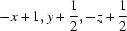
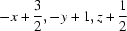
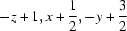
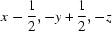
| Symmetry codes: (i) −x+1, y+1/2, −z+1/2; (ii) −x+3/2, −y+1, z+1/2; (iii) −z+1/2, −x+1, y+1/2; (iv) −y+1, z+1/2, −x+3/2; (v) y+1/2, −z+1/2, −x+1; (vi) z+1/2, −x+3/2, −y+1; (vii) −z+1, x+1/2, −y+3/2; (viii) −y+3/2, −z+1, x+1/2; (ix) x+1/2, −y+3/2, −z+1; (x) x−1/2, −y+1/2, −z; (xi) z, x, y; (xii) −z, x−1/2, −y+1/2; (xiii) y, z, x; (xiv) −y+1/2, −z, x−1/2; (xv) x+1/2, −y+1/2, −z; (xvi) −x+1, y−1/2, −z+1/2. |
Experimental details
| Crystal data | |
| Chemical formula | K2HfY(PO4)3 |
| Mr | 630.51 |
| Crystal system, space group | Cubic, P213 |
| Temperature (K) | 293 |
| a (Å) | 10.30748 (9) |
| V (Å3) | 1095.11 (2) |
| Z | 4 |
| Radiation type | Cu Kα, λ = 1.540530 Å |
| Specimen shape, size (mm) | Flat_sheet, 15 × 15 |
| Data collection | |
| Diffractometer | Shimadzu XRD-6000 diffractometer |
| Specimen mounting | Glass container |
| Data collection mode | Reflection |
| Scan method | Step |
| 2θ values (°) | 2θmin = 5.023 2θmax = 105.023 2θstep = 0.02 |
| Refinement | |
| R factors and goodness of fit | Rp = 5.375, Rwp = 7.075, Rexp = 2.809, Bragg = 4.248, R(F) = 3.14, χ2 = 6.300 |
| No. of data points | 5001 |
| No. of parameters | 48 |
Computer programs: PCXRD (Shimadzu, 2006), FULLPROF (Rodriguez-Carvajal, 2006), coordinates taken from an isotypic structure, DIAMOND (Brandenburg, 1999), PLATON (Spek, 2009) and enCIFer (Allen et al., 2004).
| K1—O1i | 2.981 (16) | Hf2—O4 | 2.113 (17) |
| K1—O2ii | 3.345 (14) | Y1—O1 | 2.148 (14) |
| K1—O4ii | 3.413 (16) | Y1—O2iv | 2.085 (15) |
| K2—O3ii | 2.907 (14) | Y2—O3i | 2.211 (14) |
| K2—O2iii | 2.912 (14) | Y2—O4 | 2.113 (17) |
| K2—O4ii | 3.207 (17) | P1—O1 | 1.518 (16) |
| K2—O4iii | 3.336 (17) | P1—O2 | 1.621 (17) |
| Hf1—O1 | 2.148 (14) | P1—O3 | 1.470 (16) |
| Hf1—O2iv | 2.085 (15) | P1—O4 | 1.497 (19) |
| Hf2—O3i | 2.211 (14) | ||
| O1—P1—O2 | 100.5 (9) | O2—P1—O3 | 121.4 (8) |
| O1—P1—O3 | 113.0 (9) | O2—P1—O4 | 107.7 (9) |
| O1—P1—O4 | 106.9 (9) | O3—P1—O4 | 106.5 (9) |
| Symmetry codes: (i) −x+1, y+1/2, −z+1/2; (ii) −x+3/2, −y+1, z+1/2; (iii) −z+1, x+1/2, −y+3/2; (iv) x−1/2, −y+1/2, −z. |
References
 Allen, F. H., Johnson, O., Shields, G. P., Smith, B. R. & Towler, M. (2004). J. Appl. Cryst. 37, 335–338. Web of Science CrossRef CAS IUCr Journals Google Scholar
Boultif, A. & Louër, D. (2004). J. Appl. Cryst. 37, 724–731. Web of Science CrossRef CAS IUCr Journals Google Scholar
Brandenburg, K. (1999). DIAMOND. Crystal Impact GbR, Bonn, Germany. Google Scholar
Brese, N. E. & O'Keeffe, M. (1991). Acta Cryst. B47, 192–197. CrossRef CAS Web of Science IUCr Journals Google Scholar
Brown, I. D. & Altermatt, D. (1985). Acta Cryst. B41, 244–247. CrossRef CAS Web of Science IUCr Journals Google Scholar
Losilla, E. R., Bruque, S., Aranda, M. A. G., Moreno-Real, L., Morin, E. & Quarton, M. (1998). Solid State Ionics, 112, 53–62. Web of Science CrossRef CAS Google Scholar
Ogorodnyk, I. V., Baumer, V. N., Zatovsky, I. V., Slobodyanik, N. S., Shishkin, O. V. & Domasevitch, K. V. (2007b). Acta Cryst. B63, 819–827. Web of Science CrossRef IUCr Journals Google Scholar
Ogorodnyk, I. V., Zatovsky, I. V., Baumer, V. N., Slobodyanik, N. S., Shishkin, O. V. & Vorona, I. P. (2007a). J. Solid State Chem. 180, 2838–2844. Web of Science CrossRef CAS Google Scholar
Orlova, A. I., Trubach, I. G., Kurazhkovskaya, V. S., Pertierra, P., Salvado, M. A., Garcia-Granda, S., Khainakov, S. A. & Garcia, J. R. (2003). J. Solid State Chem. 173, 314–318. Web of Science CrossRef CAS Google Scholar
Rodriguez-Carvajal, J. (2006). FULLPROF. Laboratoire Le'on Brillouin (CEA–CNRS), France. Google Scholar
Shannon, R. D. (1976). Acta Cryst. A32, 751–767. CrossRef CAS IUCr Journals Web of Science Google Scholar
Shimadzu (2006). PCXRD. Shimadzu Corporation, Kyoto, Japan. Google Scholar
Spek, A. L. (2009). Acta Cryst. D65, 148–155. Web of Science CrossRef CAS IUCr Journals Google Scholar
Thompson, P., Cox, D. E. & Hastings, J. B. (1987). J. Appl. Cryst. 20, 79–83. CrossRef CAS Web of Science IUCr Journals Google Scholar
Trubach, I. G., Beskrovnyi, A. I., Orlova, A. I., Orlova, V. A. & Kurazhkovskaya, V. S. (2004). Crystallogr. Rep. 49, 614–618. Web of Science CrossRef CAS Google Scholar
Wulff, H., Guth, U. & Loescher, B. (1992). Powder Diffr. 7, 103–106. CrossRef CAS Google Scholar
Zemann, A. & Zemann, J. (1957). Acta Cryst. 10, 409–413. CrossRef CAS IUCr Journals Web of Science Google Scholar
This is an open-access article distributed under the terms of the Creative Commons Attribution (CC-BY) Licence, which permits unrestricted use, distribution, and reproduction in any medium, provided the original authors and source are cited.
| CRYSTALLOGRAPHIC COMMUNICATIONS |


Among a great variety of langbeinite-type based phosphate (mineral langbeinite K2Mg2(SO4)3, Zemann & Zemann, 1957), only several compounds containing hafnium were reported: K2BiHf(PO4)3 (Losilla et al., 1998) and K1.93Mn0.53Hf1.47(PO4)3 (Ogorodnyk et al., 2007a). At the same time a great number of zirconium-containing phosphates with langbeinite framework were synthesized and structurally characterized: K2MZr(PO4)3, M = Y, Gd (Wulff et al., 1992); K2FeZr(PO4)3 (Orlova et al., 2003); K2LnZr(PO4)3, Ln = Ce—Lu (Trubach et al., 2004b); Cs1+xLnxZr2-x(PO4)3, Ln = Sm—Lu (Ogorodnyk et al., 2007b). This can be connected with the similarity of chemical behavior of zirconium and hafnium on the one hand and the rareness (or, possibly, the high prices) of hafnium raw materials in comparison with zirconium ones on the other hand.
Due to similar chemical properties of Zr and Hf and the close values of their ionic radii (for coordination number 6 they are 0.72 and 0.71 Å for Zr and Hf, respectively; Shannon, 1976) the cell parameters of K2YHf(PO4)3 are slightly smaller than of K2YZr(PO4)3 (a= 10.3346 (1) Å; Wulff et al., 1992).
K, Y and Hf atoms lie on the 3-fold rotation axes in 4a positions (Fig. 1). P and O atoms are located in 12b positions. Both Y and Hf atoms occupy two hexacoordinated positions competitively. M1 position is preferably occupied by Hf while M2 is by Y. The structure contains [MO6] octahedra and [PO4] tetrahedra which are connected via vertices. Two nearest [MO6] octahedra are joined to each other by three bridging orthophosphate tetrahedra forming {M2P3O18} groups. These groups form three-dimensional framework penetrated with large closed cavities. Two independent potassium atoms are located in each cavity. K1 atom is nine-coordinated, while K2 is twelve-coordinated.
Bond valence sums (BVS) were calculated using parameters for Hf, Y, P from Brese & O'Keeffe (1991) and for K from Brown & Altermatt (1985). The calculation were performed for formula sum K2YHf(PO4)3 taking into account occupancies of the octahedrally coordinatedd M positions. The sum of BVS of positively charged atoms is equal to 24.16 while the chemical charge of the remaining O atoms is equal to -24.