 | Acta Crystallographica Section E Acta Crystallographica Section E CRYSTALLOGRAPHIC COMMUNICATIONS |


 journal menu


metal-organic compounds
| CRYSTALLOGRAPHIC COMMUNICATIONS |
 access
Diaqua(5,5,7,12,12,14-hexamethyl-1,4,8,11-tetraazacyclotetradecane)nickel(II) tetracyanidonickelate(II)

aSchool of Chemistry and Chemical Engineering, Jiangsu University, Zhenjiang 212013, People's Republic of China
*Correspondence e-mail: [email protected]
In the title complex, [Ni(C16H36N4)(H2O)2][Ni(CN)4], the [Ni(teta)(H2O)2]2+ cations (teta = 5,5,7,12,12,14-hexamethyl-1,4,8,11-tetraazacyclotetradecane) and [Ni(CN)4]2− anions are arranged in an alternating fashion through electrostatic and N—H⋯N and O—H⋯N hydrogen-bonding interactions, forming a two-dimensional layered structure. Adjacent layers are linked through weak van der Waals interactions, resulting in a three-dimensional supramolecular network.
Related literature
For background to cyanide-bridged complexes, see: Lescouëzec et al. (2005![[Lescouëzec, R., Toma, L. M., Vaissermann, J., Verdaguer, M., Delgado, F. S., Ruiz-Pérez, C., Lloret, F. & Julve, M. (2005). Coord. Chem. Rev. 249, 2691-2729.]](../../../../../../logos/arrows/e_arr.gif "Lescouëzec, R., Toma, L. M., Vaissermann, J., Verdaguer, M., Delgado, F. S., Ruiz-Pérez, C., Lloret, F. & Julve, M. (2005). Coord. Chem. Rev. 249, 2691-2729.") ); Liu et al. (2008); Xu et al. (2009). For related structures, see: Jiang et al. (2005, 2007); Ni et al. (2008); Yamada & Iwasaki (1969).
); Liu et al. (2008); Xu et al. (2009). For related structures, see: Jiang et al. (2005, 2007); Ni et al. (2008); Yamada & Iwasaki (1969).
![[Scheme 1]](at2863scheme1.gif)
Experimental
Crystal data
|
Refinement
|
|
 ; (ii)
 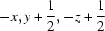 .
. Data collection: SMART (Bruker, 2004); cell refinement: SAINT (Bruker, 2004); data reduction: SAINT; program(s) used to solve structure: SHELXS97 (Sheldrick, 2008); program(s) used to refine structure: SHELXL97 (Sheldrick, 2008); molecular graphics: SHELXTL (Sheldrick, 2008) and DIAMOND (Brandenburg, 2006); software used to prepare material for publication: SHELXL97.
Supporting information
contains datablocks I, global. DOI: 10.1107/S1600536809033820/at2863sup1.cif
Structure factors: contains datablock I. DOI: 10.1107/S1600536809033820/at2863Isup2.hkl
A solution of Ni(teta)(ClO4)2 (0.05 mmol) in DMF (10 ml) was added to a solution of K[Cr(salen)(CN)2].H2O (0.05 mmol) in MeOH/H2O (1/1(V/V),10 ml) mixture. The resulting solution was filtrated and the filtrate was left to allow slow evaporation in dark at room temperature. Pink prism crystals of the title complex were obtained after two weeks, washed with MeOH and H2O, respectively, and dried in air. Anal. Calc. for C20H40Ni2N8O2: C, 44.32; H, 7.44; N, 20.68; Ni, 21.66%. Found: C, 44.28; H, 7.49; N, 20.71; Ni, 21.52%.
All non-H atoms were refined anisotropically. The C(H) atoms of the teta ligands were placed incalculated position [C-H = 0.99 Å or 0.98 Å] and refined using a riding model, with Uiso(H) = 1.2Ueq(C) or Uiso(H) = 1.5Ueq(C). The N(H) atoms were located from the difference Fourier maps, and refined as riding with Uiso(H) = 1.2Ueq(N). The O(H) atoms of the coordinated water molecules were located in a difference Fourier map and refined as riding [O-H = 0.84 Å], with Uiso(H) = 1.5Ueq(O).
Data collection: SMART (Bruker, 2004); cell SAINT (Bruker, 2004); data reduction: SAINT (Bruker, 2004); program(s) used to solve structure: SHELXS97 (Sheldrick, 2008); program(s) used to refine structure: SHELXL97 (Sheldrick, 2008); molecular graphics: SHELXTL (Sheldrick, 2008) and DIAMOND (Brandenburg, 2006); software used to prepare material for publication: SHELXL97 (Sheldrick, 2008).
![[Figure 1]](./at2863fig1thm.gif) | Fig. 1. ORTEP view of the title complex. Displacement ellipsoids are drawn at the 30% probability level. Hydrogen atoms have been omitted for clarity. |
![[Figure 2]](./at2863fig2thm.gif) | Fig. 2. Projection of the title complex viewed from the a-axis, showing the two-dimensional structure. Hydrogen bonds are shown as dashed lines. Symmetry codes: (i) x, -y-0.5, z+0.5; (ii) -x, y+0.5, -z+0.5. |
![[Figure 3]](./at2863fig3thm.gif) | Fig. 3. The three-dimensional supramolecular network of the title complex. |
| [Ni(C16H36N4)(H2O)2][Ni(CN)4] | F(000) = 576 |
| Mr = 542.02 | Dx = 1.389 Mg m−3 |
| Monoclinic, P21/c | Mo Kα radiation, λ = 0.71073 Å |
| Hall symbol: -P 2ybc | Cell parameters from 4392 reflections |
| a = 8.065 (8) Å | θ = 2.3–26.0° |
| b = 13.255 (12) Å | µ = 1.48 mm−1 |
| c = 13.559 (10) Å | T = 173 K |
| β = 116.59 (4)° | Prism, pink |
| V = 1296 (2) Å3 | 0.58 × 0.16 × 0.12 mm |
| Z = 2 |
| Bruker SMART APEX diffractometer | 1576 reflections with I > 2σ(I) |
| Radiation source: fine-focus sealed tube | Rint = 0.047 |
| ϕ and ω scans | θmax = 26.0°, θmin = 2.3° |
| Absorption correction: multi-scan (SADABS; Bruker, 2004) | h = −9→9 |
| Tmin = 0.808, Tmax = 0.888 | k = −16→15 |
| 9778 measured reflections | l = −16→16 |
| 2530 independent reflections |
| Refinement on F2 | Primary atom site location: structure-invariant direct methods |
| Least-squares matrix: full | Secondary atom site location: difference Fourier map |
| R[F2 > 2σ(F2)] = 0.032 | Hydrogen site location: inferred from neighbouring sites |
| wR(F2) = 0.093 | H atoms treated by a mixture of independent and constrained refinement |
| S = 1.01 | w = 1/[σ2(Fo2) + (0.0423P)2 + 0.2883P] where P = (Fo2 + 2Fc2)/3 |
| 2530 reflections | (Δ/σ)max < 0.001 |
| 163 parameters | Δρmax = 0.73 e Å−3 |
| 2 restraints | Δρmin = −0.51 e Å−3 |
| [Ni(C16H36N4)(H2O)2][Ni(CN)4] | V = 1296 (2) Å3 |
| Mr = 542.02 | Z = 2 |
| Monoclinic, P21/c | Mo Kα radiation |
| a = 8.065 (8) Å | µ = 1.48 mm−1 |
| b = 13.255 (12) Å | T = 173 K |
| c = 13.559 (10) Å | 0.58 × 0.16 × 0.12 mm |
| β = 116.59 (4)° |
| Bruker SMART APEX diffractometer | 2530 independent reflections |
| Absorption correction: multi-scan (SADABS; Bruker, 2004) | 1576 reflections with I > 2σ(I) |
| Tmin = 0.808, Tmax = 0.888 | Rint = 0.047 |
| 9778 measured reflections |
| R[F2 > 2σ(F2)] = 0.032 | 2 restraints |
| wR(F2) = 0.093 | H atoms treated by a mixture of independent and constrained refinement |
| S = 1.01 | Δρmax = 0.73 e Å−3 |
| 2530 reflections | Δρmin = −0.51 e Å−3 |
| 163 parameters |
Geometry. All esds (except the esd in the dihedral angle between two l.s. planes) are estimated using the full covariance matrix. The cell esds are taken into account individually in the estimation of esds in distances, angles and torsion angles; correlations between esds in cell parameters are only used when they are defined by crystal symmetry. An approximate (isotropic) treatment of cell esds is used for estimating esds involving l.s. planes. |
Refinement. Refinement of F2 against ALL reflections. The weighted R-factor wR and goodness of fit S are based on F2, conventional R-factors R are based on F, with F set to zero for negative F2. The threshold expression of F2 > 2sigma(F2) is used only for calculating R-factors(gt) etc. and is not relevant to the choice of reflections for R-factors based on F2 are statistically about twice as large as those based on F, and R- factors based on ALL data will be even larger. |
| x | y | z | Uiso*/Ueq | ||
| Ni1 | 0.0000 | 0.0000 | 0.0000 | 0.02563 (16) | |
| Ni2 | 0.0000 | 0.0000 | 0.5000 | 0.02354 (15) | |
| O1 | 0.1715 (3) | 0.08968 (15) | 0.44654 (15) | 0.0298 (5) | |
| H1A | 0.153 (5) | 0.1515 (9) | 0.449 (3) | 0.045* | |
| H1B | 0.146 (4) | 0.086 (2) | 0.3803 (10) | 0.045* | |
| N1 | −0.1059 (5) | −0.2055 (2) | 0.0474 (2) | 0.0537 (8) | |
| N2 | 0.0522 (4) | 0.0799 (2) | 0.2194 (2) | 0.0477 (7) | |
| N3 | −0.1760 (3) | −0.02613 (18) | 0.33256 (18) | 0.0278 (6) | |
| H3 | −0.120 (4) | 0.012 (2) | 0.303 (2) | 0.033* | |
| N4 | 0.1362 (3) | −0.12904 (18) | 0.49057 (19) | 0.0282 (6) | |
| H4 | 0.097 (4) | −0.176 (2) | 0.513 (2) | 0.034* | |
| C1 | −0.0637 (4) | −0.1267 (2) | 0.0321 (2) | 0.0358 (7) | |
| C2 | 0.0293 (4) | 0.0502 (2) | 0.1355 (2) | 0.0321 (7) | |
| C3 | −0.4969 (4) | −0.0695 (3) | 0.3047 (2) | 0.0441 (8) | |
| H3A | −0.5060 | −0.1329 | 0.2655 | 0.066* | |
| H3B | −0.6212 | −0.0410 | 0.2806 | 0.066* | |
| H3C | −0.4408 | −0.0823 | 0.3842 | 0.066* | |
| C4 | −0.3767 (4) | 0.0051 (2) | 0.2793 (2) | 0.0368 (8) | |
| C5 | −0.4462 (5) | 0.0123 (3) | 0.1536 (3) | 0.0538 (10) | |
| H5A | −0.3779 | 0.0654 | 0.1371 | 0.081* | |
| H5B | −0.5788 | 0.0283 | 0.1181 | 0.081* | |
| H5C | −0.4261 | −0.0524 | 0.1256 | 0.081* | |
| C6 | −0.1359 (4) | −0.1309 (2) | 0.3117 (2) | 0.0368 (8) | |
| H6A | −0.1808 | −0.1416 | 0.2316 | 0.044* | |
| H6B | −0.2009 | −0.1791 | 0.3382 | 0.044* | |
| C7 | 0.0699 (4) | −0.1490 (2) | 0.3712 (2) | 0.0348 (7) | |
| H7A | 0.0977 | −0.2197 | 0.3601 | 0.042* | |
| H7B | 0.1344 | −0.1039 | 0.3413 | 0.042* | |
| C8 | 0.4289 (5) | −0.2269 (3) | 0.5442 (3) | 0.0530 (10) | |
| H8A | 0.3772 | −0.2838 | 0.5674 | 0.080* | |
| H8B | 0.5634 | −0.2242 | 0.5901 | 0.080* | |
| H8C | 0.4023 | −0.2355 | 0.4668 | 0.080* | |
| C9 | 0.3411 (4) | −0.1285 (2) | 0.5574 (2) | 0.0348 (7) | |
| H9 | 0.3932 | −0.0713 | 0.5319 | 0.042* | |
| C10 | 0.3891 (4) | −0.1115 (2) | 0.6794 (2) | 0.0412 (8) | |
| H10A | 0.3070 | −0.1558 | 0.6969 | 0.049* | |
| H10B | 0.5175 | −0.1358 | 0.7238 | 0.049* |
| U11 | U22 | U33 | U12 | U13 | U23 | |
| Ni1 | 0.0380 (3) | 0.0219 (3) | 0.0229 (3) | −0.0001 (2) | 0.0188 (2) | 0.0007 (2) |
| Ni2 | 0.0290 (3) | 0.0228 (3) | 0.0216 (3) | 0.0012 (2) | 0.0138 (2) | 0.0004 (2) |
| O1 | 0.0416 (12) | 0.0258 (12) | 0.0265 (10) | 0.0003 (11) | 0.0195 (9) | −0.0004 (10) |
| N1 | 0.093 (2) | 0.0286 (16) | 0.069 (2) | −0.0054 (17) | 0.0625 (19) | −0.0004 (15) |
| N2 | 0.078 (2) | 0.0434 (17) | 0.0344 (14) | −0.0084 (16) | 0.0364 (15) | −0.0043 (13) |
| N3 | 0.0293 (14) | 0.0323 (15) | 0.0234 (12) | −0.0030 (11) | 0.0134 (11) | 0.0006 (10) |
| N4 | 0.0342 (15) | 0.0242 (14) | 0.0339 (13) | 0.0020 (12) | 0.0221 (11) | 0.0032 (11) |
| C1 | 0.052 (2) | 0.0330 (19) | 0.0348 (16) | 0.0011 (16) | 0.0302 (16) | −0.0012 (14) |
| C2 | 0.0469 (19) | 0.0269 (18) | 0.0293 (15) | 0.0004 (15) | 0.0232 (14) | 0.0052 (13) |
| C3 | 0.0329 (18) | 0.058 (2) | 0.0374 (17) | −0.0086 (17) | 0.0117 (14) | 0.0059 (16) |
| C4 | 0.0325 (17) | 0.046 (2) | 0.0281 (15) | −0.0030 (16) | 0.0100 (13) | 0.0061 (14) |
| C5 | 0.048 (2) | 0.076 (3) | 0.0265 (16) | −0.0072 (19) | 0.0068 (15) | 0.0096 (17) |
| C6 | 0.052 (2) | 0.0327 (19) | 0.0296 (15) | −0.0100 (16) | 0.0220 (15) | −0.0087 (14) |
| C7 | 0.049 (2) | 0.0287 (18) | 0.0381 (17) | 0.0009 (15) | 0.0300 (15) | −0.0054 (13) |
| C8 | 0.052 (2) | 0.042 (2) | 0.078 (3) | 0.0205 (17) | 0.040 (2) | 0.0140 (18) |
| C9 | 0.0366 (18) | 0.0316 (18) | 0.0446 (17) | 0.0071 (15) | 0.0258 (15) | 0.0087 (14) |
| C10 | 0.0329 (18) | 0.048 (2) | 0.0398 (17) | 0.0071 (16) | 0.0133 (14) | 0.0166 (15) |
| Ni1—C1 | 1.863 (4) | C3—H3B | 0.9800 |
| Ni1—C1i | 1.863 (4) | C3—H3C | 0.9800 |
| Ni1—C2i | 1.867 (3) | C4—C10ii | 1.537 (5) |
| Ni1—C2 | 1.867 (3) | C4—C5 | 1.541 (4) |
| Ni2—N4 | 2.067 (3) | C5—H5A | 0.9800 |
| Ni2—N4ii | 2.067 (3) | C5—H5B | 0.9800 |
| Ni2—N3ii | 2.099 (3) | C5—H5C | 0.9800 |
| Ni2—N3 | 2.099 (3) | C6—C7 | 1.505 (4) |
| Ni2—O1ii | 2.179 (2) | C6—H6A | 0.9900 |
| Ni2—O1 | 2.179 (2) | C6—H6B | 0.9900 |
| O1—H1A | 0.835 (10) | C7—H7A | 0.9900 |
| O1—H1B | 0.830 (10) | C7—H7B | 0.9900 |
| N1—C1 | 1.146 (4) | C8—C9 | 1.532 (4) |
| N2—C2 | 1.137 (3) | C8—H8A | 0.9800 |
| N3—C6 | 1.482 (4) | C8—H8B | 0.9800 |
| N3—C4 | 1.505 (4) | C8—H8C | 0.9800 |
| N3—H3 | 0.88 (3) | C9—C10 | 1.538 (4) |
| N4—C7 | 1.484 (4) | C9—H9 | 1.0000 |
| N4—C9 | 1.487 (4) | C10—C4ii | 1.537 (5) |
| N4—H4 | 0.81 (3) | C10—H10A | 0.9900 |
| C3—C4 | 1.528 (4) | C10—H10B | 0.9900 |
| C3—H3A | 0.9800 | ||
| C1—Ni1—C1i | 180.0 (2) | H3B—C3—H3C | 109.5 |
| C1—Ni1—C2i | 88.96 (13) | N3—C4—C3 | 111.6 (3) |
| C1i—Ni1—C2i | 91.04 (13) | N3—C4—C10ii | 108.0 (2) |
| C1—Ni1—C2 | 91.04 (13) | C3—C4—C10ii | 111.1 (3) |
| C1i—Ni1—C2 | 88.96 (13) | N3—C4—C5 | 109.2 (3) |
| C2i—Ni1—C2 | 180.0 (3) | C3—C4—C5 | 109.6 (3) |
| N4—Ni2—N4ii | 180.00 (14) | C10ii—C4—C5 | 107.2 (3) |
| N4—Ni2—N3ii | 94.74 (10) | C4—C5—H5A | 109.5 |
| N4ii—Ni2—N3ii | 85.26 (10) | C4—C5—H5B | 109.5 |
| N4—Ni2—N3 | 85.26 (10) | H5A—C5—H5B | 109.5 |
| N4ii—Ni2—N3 | 94.74 (10) | C4—C5—H5C | 109.5 |
| N3ii—Ni2—N3 | 180.0 | H5A—C5—H5C | 109.5 |
| N4—Ni2—O1ii | 90.18 (10) | H5B—C5—H5C | 109.5 |
| N4ii—Ni2—O1ii | 89.82 (10) | N3—C6—C7 | 109.3 (2) |
| N3ii—Ni2—O1ii | 87.30 (10) | N3—C6—H6A | 109.8 |
| N3—Ni2—O1ii | 92.70 (10) | C7—C6—H6A | 109.8 |
| N4—Ni2—O1 | 89.82 (10) | N3—C6—H6B | 109.8 |
| N4ii—Ni2—O1 | 90.18 (10) | C7—C6—H6B | 109.8 |
| N3ii—Ni2—O1 | 92.70 (10) | H6A—C6—H6B | 108.3 |
| N3—Ni2—O1 | 87.30 (10) | N4—C7—C6 | 109.2 (2) |
| O1ii—Ni2—O1 | 180.0 | N4—C7—H7A | 109.8 |
| Ni2—O1—H1A | 112 (2) | C6—C7—H7A | 109.8 |
| Ni2—O1—H1B | 116 (2) | N4—C7—H7B | 109.8 |
| H1A—O1—H1B | 98 (3) | C6—C7—H7B | 109.8 |
| C6—N3—C4 | 116.5 (2) | H7A—C7—H7B | 108.3 |
| C6—N3—Ni2 | 105.14 (17) | C9—C8—H8A | 109.5 |
| C4—N3—Ni2 | 122.34 (18) | C9—C8—H8B | 109.5 |
| C6—N3—H3 | 105.1 (19) | H8A—C8—H8B | 109.5 |
| C4—N3—H3 | 106 (2) | C9—C8—H8C | 109.5 |
| Ni2—N3—H3 | 99 (2) | H8A—C8—H8C | 109.5 |
| C7—N4—C9 | 115.1 (2) | H8B—C8—H8C | 109.5 |
| C7—N4—Ni2 | 105.86 (18) | N4—C9—C8 | 111.8 (3) |
| C9—N4—Ni2 | 115.77 (19) | N4—C9—C10 | 109.4 (2) |
| C7—N4—H4 | 105 (2) | C8—C9—C10 | 110.1 (3) |
| C9—N4—H4 | 107 (2) | N4—C9—H9 | 108.5 |
| Ni2—N4—H4 | 107 (2) | C8—C9—H9 | 108.5 |
| N1—C1—Ni1 | 177.2 (3) | C10—C9—H9 | 108.5 |
| N2—C2—Ni1 | 178.0 (3) | C4ii—C10—C9 | 120.0 (2) |
| C4—C3—H3A | 109.5 | C4ii—C10—H10A | 107.3 |
| C4—C3—H3B | 109.5 | C9—C10—H10A | 107.3 |
| H3A—C3—H3B | 109.5 | C4ii—C10—H10B | 107.3 |
| C4—C3—H3C | 109.5 | C9—C10—H10B | 107.3 |
| H3A—C3—H3C | 109.5 | H10A—C10—H10B | 106.9 |
| Symmetry codes: (i) −x, −y, −z; (ii) −x, −y, −z+1. |
| D—H···A | D—H | H···A | D···A | D—H···A |
| N4—H4···N1iii | 0.81 (3) | 2.46 (3) | 3.250 (4) | 164 (3) |
| N3—H3···N2 | 0.88 (3) | 2.34 (3) | 3.201 (4) | 167 (3) |
| O1—H1B···N2 | 0.83 (1) | 1.96 (1) | 2.789 (4) | 172 (3) |
| O1—H1A···N1iv | 0.84 (1) | 1.94 (1) | 2.775 (4) | 179 (3) |
| Symmetry codes: (iii) x, −y−1/2, z+1/2; (iv) −x, y+1/2, −z+1/2. |
Experimental details
| Crystal data | |
| Chemical formula | [Ni(C16H36N4)(H2O)2][Ni(CN)4] |
| Mr | 542.02 |
| Crystal system, space group | Monoclinic, P21/c |
| Temperature (K) | 173 |
| a, b, c (Å) | 8.065 (8), 13.255 (12), 13.559 (10) |
| β (°) | 116.59 (4) |
| V (Å3) | 1296 (2) |
| Z | 2 |
| Radiation type | Mo Kα |
| µ (mm−1) | 1.48 |
| Crystal size (mm) | 0.58 × 0.16 × 0.12 |
| Data collection | |
| Diffractometer | Bruker SMART APEX diffractometer |
| Absorption correction | Multi-scan (SADABS; Bruker, 2004) |
| Tmin, Tmax | 0.808, 0.888 |
| No. of measured, independent and observed [I > 2σ(I)] reflections | 9778, 2530, 1576 |
| Rint | 0.047 |
| (sin θ/λ)max (Å−1) | 0.617 |
| Refinement | |
| R[F2 > 2σ(F2)], wR(F2), S | 0.032, 0.093, 1.01 |
| No. of reflections | 2530 |
| No. of parameters | 163 |
| No. of restraints | 2 |
| H-atom treatment | H atoms treated by a mixture of independent and constrained refinement |
| Δρmax, Δρmin (e Å−3) | 0.73, −0.51 |
Computer programs: SMART (Bruker, 2004), SAINT (Bruker, 2004), SHELXS97 (Sheldrick, 2008), SHELXL97 (Sheldrick, 2008), SHELXTL (Sheldrick, 2008) and DIAMOND (Brandenburg, 2006).
| D—H···A | D—H | H···A | D···A | D—H···A |
| N4—H4···N1i | 0.81 (3) | 2.46 (3) | 3.250 (4) | 164 (3) |
| N3—H3···N2 | 0.88 (3) | 2.34 (3) | 3.201 (4) | 167 (3) |
| O1—H1B···N2 | 0.830 (10) | 1.964 (11) | 2.789 (4) | 172 (3) |
| O1—H1A···N1ii | 0.835 (10) | 1.939 (11) | 2.775 (4) | 179 (3) |
| Symmetry codes: (i) x, −y−1/2, z+1/2; (ii) −x, y+1/2, −z+1/2. |
Acknowledgements
The authors thank the Natural Science Foundation of Jiangsu Province (BK2009196) and the Foundation of the State Key Laboratory of Coordination Chemistry (China) for financial support.
References
 Brandenburg, K. (2006). DIAMOND. Crystal Impact GbR, Bonn, Germany. Google Scholar
Bruker (2004). SMART, SAINT and SADABS. Bruker AXS Inc., Madison,Wisconsin, USA. Google Scholar
Jiang, L., Feng, X. L., Su, C. Y., Chen, X. M. & Lu, T. B. (2007). Inorg. Chem. 46, 2637–2644. Web of Science CSD CrossRef PubMed CAS Google Scholar
Jiang, L., Lu, T. B. & Feng, X. L. (2005). Inorg. Chem. 44, 7056–7062. Web of Science CSD CrossRef PubMed CAS Google Scholar
Lescouëzec, R., Toma, L. M., Vaissermann, J., Verdaguer, M., Delgado, F. S., Ruiz-Pérez, C., Lloret, F. & Julve, M. (2005). Coord. Chem. Rev. 249, 2691–2729. Google Scholar
Liu, W.-Y., Zhou, H., Guo, J.-X. & Yuan, A.-H. (2008). Acta Cryst. E64, m1152–m1153. Web of Science CrossRef IUCr Journals Google Scholar
Ni, Z. H., Zhang, L. F., Ge, C. H., Cui, A. L., Kou, H. Z. & Jiang, J. Z. (2008). Inorg. Chem. Commun. 11, 94–96. Web of Science CSD CrossRef CAS Google Scholar
Sheldrick, G. M. (2008). Acta Cryst. A64, 112–122. Web of Science CrossRef CAS IUCr Journals Google Scholar
Xu, Y., Shen, X. P., Zhou, H., Shu, H. Q., Li, W. X. & Yuan, A. H. (2009). J. Mol. Struct. 921, 341–345. Web of Science CSD CrossRef CAS Google Scholar
Yamada, S. & Iwasaki, K. (1969). Bull. Chem. Soc. Jpn, 42, 1463. CrossRef Web of Science Google Scholar
This is an open-access article distributed under the terms of the Creative Commons Attribution (CC-BY) Licence, which permits unrestricted use, distribution, and reproduction in any medium, provided the original authors and source are cited.
| CRYSTALLOGRAPHIC COMMUNICATIONS |


In the past decades, there has been a continuous interest in the utilization of cyano-containing building blocks for constructing either ion-paired or cyano-bridged assemblies due to their potential applications and intriguing architectures (Lescouëzec et al., 2005; Liu et al., 2008; Xu et al., 2009). It has been found that cyano-bridged bimetallic assemblies, derived from tailored cyanometalate entities [MLp(CN)q]n- (L = polydentate ligand) and unsaturated coordinated complex [M'(L)]m+, possess extraordinarily excellent magnetic properties such as SMM (single molecular magnets) and SCM (single chain magnets). Recently, we had expected to obtain such low-dimensional system using [Cr(salen)(CN)2]- (Yamada et al., 1969; Ni et al., 2008) and [Ni(teta)]2+ as the building blocks. However, an unexpected tetracyanonickel(II)-based complex of [Ni(teta)(H2O)2][Ni(CN)4] instead of any [Cr(salen)(CN)2]--based complex was obtained. So far, Jiang et al. (Jiang et al., 2005; 2007) have reported several complexes based on the direct assembly of [Ni(CN)4]2- and [Ni(teta)]2+ building blocks, and they found that all these complexes showed cyano-bridged structures. In contrast to these reported complexes, the title complex of [Ni(teta)(H2O)2][Ni(CN)4] is ion-paired and its crystal structure is reported here.
The title complex consists of [Ni(teta)(H2O)2]2+ cation and [Ni(CN)4]2- anion (Fig. 1). In [Ni(teta)(H2O)2]2+ cation, the NiII ion assumes a distorted octahedral coordination geometry, in which the equatorial sites are occupied by four nitrogen atoms of the macrocyclic ligand teta with the Ni(2)—N bond distances of 2.067 (3) and 2.100 (3) Å, while the axial positions are occupied by two oxygen atoms of water molecules with Ni(2)—O distance of 2.183 (2) Å. As usual, [Ni(CN)4]2- anion exhibits a square planar structure, where all four cyano groups are terminal ones, with Ni(1)—C(1) and Ni(1)—C(2) distances of 1.862 (3) and 1.869 (3) Å, respectively. The Ni(1)—C—N bonds deviate slightly from linearity with the bond angles 177.2 (3) and 178.1 (3)°. [Ni(teta)(H2O)2]2+ and [Ni(CN)4]2- are arranged in an alternating fashion, forming a two-dimensional layered structure through electrostatic and hydrogen bonding interactions (Fig. 2). Furthermore, adjacent layers are linked through weak van der Waals interactions, resulting in a three-dimensional supramolecular network (Fig. 3).