 | Acta Crystallographica Section E Acta Crystallographica Section E CRYSTALLOGRAPHIC COMMUNICATIONS |


 journal menu


metal-organic compounds
| CRYSTALLOGRAPHIC COMMUNICATIONS |
 access
Tetra-μ-oxido-tetrakis{dioxido[3-(2-pyridyl)-1H-pyrazole]molybdenum(VI)}

aCollege of Chemistry and Chemical Engineering, Liaocheng University, Liaocheng 252059, People's Republic of China, and bAdvanced Material Institute of Research, Department of Chemistry and Chemical Engineering, ShanDong Institute of Education, Jinan 250013, People's Republic of China
*Correspondence e-mail: [email protected]
In the title compound, [Mo4O12(C8H7N3)4], the MoVI ion has a distorted octahedral coordination completed by two terminal O atoms, two μ-oxide atoms and two N atoms from one 3-(2-pyridyl)-1H-pyrazole ligand. It is noteworthy that in the tetranuclear unit ( symmetry), any three MoVI atoms define a plane, and the fourth lies 1.8 (1) Å out of that plane. The degree of linearity of the oxide bridges between two Mo atoms is 175.38 (13)°. Moreover, the N—H group forms an intramolecular hydrogen bond (four per molecule).
Related literature
For the properties and potential medical applications of polyoxometalate clusters, see: Pope & Müller (1991![[Pope, M. T. & Müller, A. (1991). Angew. Chem. Int. Ed. Engl. 30, 34-38.]](../../../../../../logos/arrows/e_arr.gif "Pope, M. T. & Müller, A. (1991). Angew. Chem. Int. Ed. Engl. 30, 34-38.") ); Khenkin & Neumann (2008); Zhang et al. (2006, 2007, 2009). For Mo—O and Mo—N distances, see: Rana et al. (2003). For general background, see: Mezei et al. (2007).
); Khenkin & Neumann (2008); Zhang et al. (2006, 2007, 2009). For Mo—O and Mo—N distances, see: Rana et al. (2003). For general background, see: Mezei et al. (2007).
![[Scheme 1]](zq2001scheme1.gif)
Experimental
Crystal data
|
Refinement
|
| |||||||||||||||||
 .
. Data collection: APEX2 (Bruker, 2004); cell refinement: SAINT-Plus (Bruker, 2001); data reduction: SAINT-Plus; program(s) used to solve structure: SHELXS97 (Sheldrick, 2008); program(s) used to refine structure: SHELXL97 (Sheldrick, 2008); molecular graphics: SHELXTL (Sheldrick, 2008); software used to prepare material for publication: SHELXTL.
Supporting information
contains datablocks global, I. DOI: 10.1107/S1600536809031717/zq2001sup1.cif
Structure factors: contains datablock I. DOI: 10.1107/S1600536809031717/zq2001Isup2.hkl
A mixture of 3-(2-pyridyl)pyrazole (1 mmoL) and molybdenum trioxide (1 mmoL) in 10 ml distilled water sealed in a 25 ml Teflon-lined stainless steel autoclave was kept at 433 K for three days. Colourless crystals suitable for an X-ray experiment were obtained. Anal. Calc. for C32H28Mo4N12O12: C 33.22, H 1.90, N 14.53%; Found: C 33.13, H 1.79, N 14.32%.
All hydrogen atoms bound to carbon were refined using a riding model with C—H = 0.93 Å and Uiso = 1.2Ueq (C) for aromatic atoms. The H atom on nitrogen was located from difference density maps and was refined with a distance restraint of N–H = 0.97 (1) Å.
Data collection: APEX2 (Bruker, 2004); cell SAINT-Plus (Bruker, 2001); data reduction: SAINT-Plus (Bruker, 2001); program(s) used to solve structure: SHELXS97 (Sheldrick, 2008); program(s) used to refine structure: SHELXL97 (Sheldrick, 2008); molecular graphics: SHELXTL (Sheldrick, 2008); software used to prepare material for publication: SHELXTL (Sheldrick, 2008).
![[Figure 1]](./zq2001fig1thm.gif) | Fig. 1. A view of the title compound with the unique atom-labelling scheme. Displacement ellipsoids are drawn at the 30% probability level. |
![[Figure 2]](./zq2001fig2thm.gif) | Fig. 2. The packing diagram of the title compound with the hydrogen bonds of N2—H1A···O2. |
| [Mo4O12(C8H7N3)4] | Dx = 2.025 Mg m−3 |
| Mr = 1156.42 | Mo Kα radiation, λ = 0.71073 Å |
| Tetragonal, P42/n | Cell parameters from 1675 reflections |
| Hall symbol: -P 4bc | θ = 2.0–25.0° |
| a = 14.4412 (16) Å | µ = 1.37 mm−1 |
| c = 9.094 (2) Å | T = 298 K |
| V = 1896.6 (5) Å3 | Block, colourless |
| Z = 2 | 0.12 × 0.10 × 0.08 mm |
| F(000) = 1136 |
| Bruker APEXII CCD area-detector diffractometer | 1675 independent reflections |
| Radiation source: fine-focus sealed tube | 1316 reflections with I > 2σ(I) |
| Graphite monochromator | Rint = 0.036 |
| ϕ and ω scans | θmax = 25.0°, θmin = 2.0° |
| Absorption correction: multi-scan (SADABS; Bruker, 2001) | h = −17→16 |
| Tmin = 0.853, Tmax = 0.898 | k = −12→17 |
| 7579 measured reflections | l = −9→10 |
| Refinement on F2 | Primary atom site location: structure-invariant direct methods |
| Least-squares matrix: full | Secondary atom site location: difference Fourier map |
| R[F2 > 2σ(F2)] = 0.024 | Hydrogen site location: inferred from neighbouring sites |
| wR(F2) = 0.064 | H atoms treated by a mixture of independent and constrained refinement |
| S = 1.00 | w = 1/[σ2(Fo2) + (0.0295P)2 + 2.0306P] where P = (Fo2 + 2Fc2)/3 |
| 1675 reflections | (Δ/σ)max = 0.001 |
| 139 parameters | Δρmax = 0.35 e Å−3 |
| 1 restraint | Δρmin = −0.35 e Å−3 |
| [Mo4O12(C8H7N3)4] | Z = 2 |
| Mr = 1156.42 | Mo Kα radiation |
| Tetragonal, P42/n | µ = 1.37 mm−1 |
| a = 14.4412 (16) Å | T = 298 K |
| c = 9.094 (2) Å | 0.12 × 0.10 × 0.08 mm |
| V = 1896.6 (5) Å3 |
| Bruker APEXII CCD area-detector diffractometer | 1675 independent reflections |
| Absorption correction: multi-scan (SADABS; Bruker, 2001) | 1316 reflections with I > 2σ(I) |
| Tmin = 0.853, Tmax = 0.898 | Rint = 0.036 |
| 7579 measured reflections |
| R[F2 > 2σ(F2)] = 0.024 | 1 restraint |
| wR(F2) = 0.064 | H atoms treated by a mixture of independent and constrained refinement |
| S = 1.00 | Δρmax = 0.35 e Å−3 |
| 1675 reflections | Δρmin = −0.35 e Å−3 |
| 139 parameters |
Geometry. All e.s.d.'s (except the e.s.d. in the dihedral angle between two l.s. planes) are estimated using the full covariance matrix. The cell e.s.d.'s are taken into account individually in the estimation of e.s.d.'s in distances, angles and torsion angles; correlations between e.s.d.'s in cell parameters are only used when they are defined by crystal symmetry. An approximate (isotropic) treatment of cell e.s.d.'s is used for estimating e.s.d.'s involving l.s. planes. |
Refinement. Refinement of F2 against ALL reflections. The weighted R-factor wR and goodness of fit S are based on F2, conventional R-factors R are based on F, with F set to zero for negative F2. The threshold expression of F2 > σ(F2) is used only for calculating R-factors(gt) etc. and is not relevant to the choice of reflections for refinement. R-factors based on F2 are statistically about twice as large as those based on F, and R- factors based on ALL data will be even larger. |
| x | y | z | Uiso*/Ueq | ||
| Mo1 | 0.642839 (18) | 0.904662 (19) | 0.19761 (3) | 0.02233 (12) | |
| N1 | 0.61994 (19) | 0.90081 (18) | 0.4404 (3) | 0.0257 (6) | |
| N2 | 0.6811 (2) | 0.8938 (2) | 0.5516 (3) | 0.0311 (7) | |
| N3 | 0.4862 (2) | 0.8976 (2) | 0.2532 (3) | 0.0314 (7) | |
| O1 | 0.76035 (15) | 0.88536 (16) | 0.2362 (2) | 0.0302 (5) | |
| O2 | 0.61894 (17) | 0.86807 (17) | 0.0193 (3) | 0.0359 (6) | |
| O3 | 0.63381 (18) | 1.02324 (17) | 0.1907 (3) | 0.0370 (6) | |
| C1 | 0.6375 (3) | 0.8821 (3) | 0.6815 (4) | 0.0345 (9) | |
| H1 | 0.6656 | 0.8765 | 0.7731 | 0.041* | |
| C2 | 0.5439 (3) | 0.8800 (2) | 0.6536 (4) | 0.0354 (9) | |
| H2A | 0.4963 | 0.8726 | 0.7215 | 0.042* | |
| C3 | 0.5355 (2) | 0.8917 (2) | 0.4995 (4) | 0.0283 (8) | |
| C4 | 0.4595 (2) | 0.8907 (2) | 0.3953 (4) | 0.0321 (8) | |
| C5 | 0.3667 (3) | 0.8828 (2) | 0.4346 (5) | 0.0413 (10) | |
| H5 | 0.3492 | 0.8796 | 0.5329 | 0.050* | |
| C6 | 0.3014 (3) | 0.8798 (3) | 0.3248 (5) | 0.0519 (11) | |
| H6 | 0.2391 | 0.8724 | 0.3477 | 0.062* | |
| C7 | 0.3291 (3) | 0.8878 (3) | 0.1802 (5) | 0.0504 (11) | |
| H7 | 0.2853 | 0.8870 | 0.1054 | 0.060* | |
| C8 | 0.4208 (3) | 0.8969 (3) | 0.1471 (5) | 0.0423 (10) | |
| H8 | 0.4386 | 0.9027 | 0.0492 | 0.051* | |
| H1A | 0.746 (3) | 0.894 (3) | 0.540 (5) | 0.080* |
| U11 | U22 | U33 | U12 | U13 | U23 | |
| Mo1 | 0.02453 (18) | 0.02550 (18) | 0.01698 (17) | 0.00112 (12) | 0.00115 (11) | 0.00047 (12) |
| N1 | 0.0347 (15) | 0.0237 (14) | 0.0187 (14) | 0.0010 (12) | −0.0011 (12) | −0.0010 (11) |
| N2 | 0.0367 (17) | 0.0338 (16) | 0.0227 (16) | 0.0002 (14) | 0.0014 (13) | −0.0026 (13) |
| N3 | 0.0298 (16) | 0.0315 (16) | 0.0328 (16) | 0.0037 (13) | −0.0038 (13) | −0.0050 (13) |
| O1 | 0.0245 (12) | 0.0387 (14) | 0.0273 (13) | 0.0000 (11) | 0.0026 (10) | 0.0028 (11) |
| O2 | 0.0466 (15) | 0.0403 (14) | 0.0209 (13) | −0.0016 (12) | −0.0022 (11) | 0.0006 (11) |
| O3 | 0.0448 (15) | 0.0294 (13) | 0.0368 (15) | 0.0040 (11) | 0.0047 (12) | 0.0037 (11) |
| C1 | 0.044 (2) | 0.039 (2) | 0.0201 (19) | 0.0018 (17) | 0.0019 (16) | 0.0017 (16) |
| C2 | 0.041 (2) | 0.034 (2) | 0.031 (2) | 0.0022 (17) | 0.0135 (17) | 0.0045 (16) |
| C3 | 0.0357 (19) | 0.0203 (17) | 0.0289 (19) | 0.0051 (14) | 0.0086 (16) | −0.0006 (14) |
| C4 | 0.036 (2) | 0.0216 (17) | 0.039 (2) | 0.0017 (15) | 0.0111 (17) | 0.0006 (16) |
| C5 | 0.034 (2) | 0.035 (2) | 0.055 (3) | 0.0049 (17) | 0.0090 (19) | 0.0055 (19) |
| C6 | 0.033 (2) | 0.055 (3) | 0.067 (3) | 0.0006 (19) | 0.002 (2) | 0.003 (2) |
| C7 | 0.033 (2) | 0.067 (3) | 0.051 (3) | 0.005 (2) | −0.010 (2) | −0.007 (2) |
| C8 | 0.036 (2) | 0.046 (2) | 0.044 (2) | 0.0043 (18) | −0.0021 (18) | −0.0070 (19) |
| Mo1—O3 | 1.719 (2) | C1—C2 | 1.375 (5) |
| Mo1—O2 | 1.740 (2) | C1—H1 | 0.9300 |
| Mo1—O1 | 1.755 (2) | C2—C3 | 1.416 (5) |
| Mo1—O1i | 2.207 (2) | C2—H2A | 0.9300 |
| Mo1—N1 | 2.233 (3) | C3—C4 | 1.449 (5) |
| Mo1—N3 | 2.320 (3) | C4—C5 | 1.392 (5) |
| N1—C3 | 1.340 (4) | C5—C6 | 1.374 (6) |
| N1—N2 | 1.346 (4) | C5—H5 | 0.9300 |
| N2—C1 | 1.349 (4) | C6—C7 | 1.379 (6) |
| N2—H1A | 0.94 (5) | C6—H6 | 0.9300 |
| N3—C8 | 1.350 (5) | C7—C8 | 1.364 (6) |
| N3—C4 | 1.353 (5) | C7—H7 | 0.9300 |
| O1—Mo1ii | 2.207 (2) | C8—H8 | 0.9300 |
| O3—Mo1—O2 | 104.69 (12) | N2—C1—C2 | 107.4 (3) |
| O3—Mo1—O1 | 103.82 (11) | N2—C1—H1 | 126.3 |
| O2—Mo1—O1 | 109.26 (11) | C2—C1—H1 | 126.3 |
| O3—Mo1—O1i | 159.53 (10) | C1—C2—C3 | 105.4 (3) |
| O2—Mo1—O1i | 86.03 (10) | C1—C2—H2A | 127.3 |
| O1—Mo1—O1i | 88.51 (13) | C3—C2—H2A | 127.3 |
| O3—Mo1—N1 | 92.85 (10) | N1—C3—C2 | 109.3 (3) |
| O2—Mo1—N1 | 152.17 (11) | N1—C3—C4 | 115.3 (3) |
| O1—Mo1—N1 | 86.65 (10) | C2—C3—C4 | 135.3 (3) |
| O1i—Mo1—N1 | 71.30 (9) | N3—C4—C5 | 121.7 (4) |
| O3—Mo1—N3 | 88.74 (11) | N3—C4—C3 | 114.1 (3) |
| O2—Mo1—N3 | 89.78 (11) | C5—C4—C3 | 124.2 (3) |
| O1—Mo1—N3 | 153.15 (10) | C6—C5—C4 | 118.4 (4) |
| O1i—Mo1—N3 | 73.68 (9) | C6—C5—H5 | 120.8 |
| N1—Mo1—N3 | 68.85 (10) | C4—C5—H5 | 120.8 |
| C3—N1—N2 | 106.7 (3) | C5—C6—C7 | 119.5 (4) |
| C3—N1—Mo1 | 122.3 (2) | C5—C6—H6 | 120.3 |
| N2—N1—Mo1 | 130.4 (2) | C7—C6—H6 | 120.3 |
| N1—N2—C1 | 111.2 (3) | C8—C7—C6 | 120.0 (4) |
| N1—N2—H1A | 124 (3) | C8—C7—H7 | 120.0 |
| C1—N2—H1A | 124 (3) | C6—C7—H7 | 120.0 |
| C8—N3—C4 | 118.9 (3) | N3—C8—C7 | 121.4 (4) |
| C8—N3—Mo1 | 121.8 (3) | N3—C8—H8 | 119.3 |
| C4—N3—Mo1 | 119.3 (2) | C7—C8—H8 | 119.3 |
| Mo1—O1—Mo1ii | 175.38 (13) |
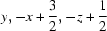
| Symmetry codes: (i) −y+3/2, x, −z+1/2; (ii) y, −x+3/2, −z+1/2. |
| D—H···A | D—H | H···A | D···A | D—H···A |
| N2—H1A···O2ii | 0.94 (5) | 1.86 (5) | 2.783 (4) | 168 (4) |
| Symmetry code: (ii) y, −x+3/2, −z+1/2. |
Experimental details
| Crystal data | |
| Chemical formula | [Mo4O12(C8H7N3)4] |
| Mr | 1156.42 |
| Crystal system, space group | Tetragonal, P42/n |
| Temperature (K) | 298 |
| a, c (Å) | 14.4412 (16), 9.094 (2) |
| V (Å3) | 1896.6 (5) |
| Z | 2 |
| Radiation type | Mo Kα |
| µ (mm−1) | 1.37 |
| Crystal size (mm) | 0.12 × 0.10 × 0.08 |
| Data collection | |
| Diffractometer | Bruker APEXII CCD area-detector diffractometer |
| Absorption correction | Multi-scan (SADABS; Bruker, 2001) |
| Tmin, Tmax | 0.853, 0.898 |
| No. of measured, independent and observed [I > 2σ(I)] reflections | 7579, 1675, 1316 |
| Rint | 0.036 |
| (sin θ/λ)max (Å−1) | 0.595 |
| Refinement | |
| R[F2 > 2σ(F2)], wR(F2), S | 0.024, 0.064, 1.00 |
| No. of reflections | 1675 |
| No. of parameters | 139 |
| No. of restraints | 1 |
| H-atom treatment | H atoms treated by a mixture of independent and constrained refinement |
| Δρmax, Δρmin (e Å−3) | 0.35, −0.35 |
Computer programs: APEX2 (Bruker, 2004), SAINT-Plus (Bruker, 2001), SHELXS97 (Sheldrick, 2008), SHELXL97 (Sheldrick, 2008), SHELXTL (Sheldrick, 2008).
| D—H···A | D—H | H···A | D···A | D—H···A |
| N2—H1A···O2i | 0.94 (5) | 1.86 (5) | 2.783 (4) | 168 (4) |
| Symmetry code: (i) y, −x+3/2, −z+1/2. |
Acknowledgements
Financial support from the Natural Science Foundation of China (grant No. 20171028, 20325105), the National Ministry of Science and Technology of China (grant No. 2001CB6105-07) and the Ministry of Education of China, Shandong University, is gratefully acknowledged.
References
 Bruker (2001). SAINT-Plus and SADABS. Bruker AXS Inc., Madison, Wisconsin, USA. Google Scholar
Bruker (2004). APEX2. Bruker AXS Inc., Madison, Wisconsin, USA. Google Scholar
Khenkin, A. M. & Neumann, R. (2008). J. Am. Chem. Soc. 130, 14474–14476. Web of Science CrossRef PubMed CAS Google Scholar
Mezei, G., Zaleski, C. M. & Pecoraro, V. L. (2007). Chem. Rev. 107, 4933–5003. Web of Science CrossRef PubMed CAS Google Scholar
Pope, M. T. & Müller, A. (1991). Angew. Chem. Int. Ed. Engl. 30, 34–38. CrossRef Web of Science Google Scholar
Rana, A., Dinda, R., Ghosh, S. & Blake, A. J. (2003). Polyhedron, 22, 3075–3082. Web of Science CSD CrossRef CAS Google Scholar
Sheldrick, G. M. (2008). Acta Cryst. A64, 112–122. Web of Science CrossRef CAS IUCr Journals Google Scholar
Zhang, X. T., Dou, J. M., Wang, D. Q., Zhou, Y., Zhang, Y. X., Li, R. J., Yan, S. S., Ni, Z. H. & Jiang, J. Z. (2007). Cryst. Growth Des. 7, 1699–1705. Web of Science CrossRef CAS Google Scholar
Zhang, X. T., Dou, J. M., Wei, P. H., Li, D. C., Li, B., Shi, C. W. & Hu, B. (2009). Inorg. Chim. Acta, 362, 3325–3332. Web of Science CSD CrossRef CAS Google Scholar
Zhang, X. T., Wang, D. Q., Dou, J. M., Yan, S. S., Yao, X. X. & Jang, J. Z. (2006). Inorg. Chem. 45, 10629–10635. Web of Science CrossRef PubMed CAS Google Scholar
This is an open-access article distributed under the terms of the Creative Commons Attribution (CC-BY) Licence, which permits unrestricted use, distribution, and reproduction in any medium, provided the original authors and source are cited.
| CRYSTALLOGRAPHIC COMMUNICATIONS |


The design and synthesis of polyoxometalate clusters has attracted continuous research interest not only because of their appealing structural and topological novelty, but also due to their unusual optical, electronic, magnetic, and catalytic properties, as well as their potential medical application (Pope et al.; Khenkin et al.; Zhang et al. (2007); Zhang et al. (2006); Zhang et al. (2009). In the present paper, we describe the synthesis and structural characterization of tetrakis((µ-oxo)-bis(3-(2-pyridyl)pyrazole)molybdenum(vi)).
In the asymmetric unit of complex I, there exhibit one 3-(2-pyridyl)pyrazole ligand and one molybdenum oxide MoVIO3, Fig. 1. The MoVI ion surrounded by one 3-(2-pyridyl)pyrazole ligand is hexa-coordinated by four oxygen atoms and two nitrogen atoms, with distorted octahedral coordination sphere. The bond distances of Mo—O and Mo—N are in the normal range compared to the reported complexes containing the N—Mo—O atoms (Rana et al.). It is worthy noting that the simple basic Mo3HL units are assembled to form one 8-MC-4 complex, which could be described as `folded' with two adjacent Mo3 planes forming a dihedral angle of about 38.65°. Moreover, the N—H group forms a very nice intramolecular hydrogen bond (4 per molecule), shown in Fig. 2.