 | Acta Crystallographica Section E Acta Crystallographica Section E CRYSTALLOGRAPHIC COMMUNICATIONS |


 journal menu


inorganic compounds
| CRYSTALLOGRAPHIC COMMUNICATIONS |
 access
Trineodymium(III) pentairon(III) dodecaoxide, Nd3Fe5O12

aGraduate School of Materials Science and Engineering, Nagoya Institute of Technology, Gokiso-cho, Showa-ku, Japan, and bHokkaido University of Education HAKODATE, Yahata-cho, Hakodate-shi, Japan
*Correspondence e-mail: [email protected]
The title compound, Nd3Fe5O12 (NdIG), has an iron garnet structure. One of the Fe atoms is coordinated by six O atoms in a slightly distorted octahedral geometry and has  The other Fe atom is coordinated by four O atoms in a slightly distorted tetrahedral geometry and has
  The FeO6 octahedron and FeO4 tetrahedron are linked together by corners. The Nd atom is coordinated by eight O atoms in a distorted dodecahedral geometry and has 222 The O atoms occupy general positions.
Related literature
The title compound is isotypic with the Iad form of Y3Fe5O12 (YIG), see: Bonnet et al. (1975![[Bonnet, M., Delapalme, A., Fuess, H. & Thomas, M. (1975). Acta Cryst. B31, 2233-2240.]](../../../../../../logos/arrows/e_arr.gif "Bonnet, M., Delapalme, A., Fuess, H. & Thomas, M. (1975). Acta Cryst. B31, 2233-2240.") ). For crystal growth from low-temperature liquid-phase epitaxy, see: Fratello et al. (1986). X-ray intensities were measured avoiding multiple diffraction, see: Takenaka et al. (2008). For details of the full-matrix least-squares program QNTAO, see: Tanaka et al. (2008). For the anisotropic extinction refinement, see: Becker & Coppens (1975).
). For crystal growth from low-temperature liquid-phase epitaxy, see: Fratello et al. (1986). X-ray intensities were measured avoiding multiple diffraction, see: Takenaka et al. (2008). For details of the full-matrix least-squares program QNTAO, see: Tanaka et al. (2008). For the anisotropic extinction refinement, see: Becker & Coppens (1975).
Experimental
Crystal data
|

Data collection
Refinement
|
| |||||||||||||||||||||
 ; (iii)
 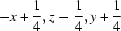 ; (iv)
  .
. Data collection: AFC-5, specially designed for PF-BL14A (Rigaku Corporation, 1984) and IUANGLE (Tanaka et al., 1994).; cell refinement: RSLC-3 (Sakurai & Kobayashi, 1979); data reduction: RDEDIT (Tanaka, 2008); program(s) used to solve structure: QNTAO (Tanaka et al., 2008); program(s) used to refine structure: QNTAO (Tanaka et al., 2008); molecular graphics: ATOMS for Windows (Dowty, 2000); software used to prepare material for publication: RDEDIT.
Supporting information
contains datablocks global, I. DOI: 10.1107/S1600536809036794/br2118sup1.cif
Structure factors: contains datablock I. DOI: 10.1107/S1600536809036794/br2118Isup2.hkl
Single crystals of neodymium iron garnet were prepared by low temperature liquid phase on Sm3(ScGa)5O12 seeds with lattice parameters near the projected values for NdIG.
The Becker–Coppens type 1 Gaussian anisotropic extinction parameters were employed (× 10-4 seconds). z11 = 10.2 (5), z22 = 10 (2), z33 = 12 (2), z12 = 1(1), z13 = -0.5 (7), z23 = -1(1). X-ray intensities were measured avoiding multiple diffraction. (Takenaka et al., 2008).
Data collection: AFC-5, specially designed for PF-BL14A (Rigaku Corporation, 1984) and IUANGLE (Tanaka et al., 1994).; cell RSLC-3 UNICS system (Sakurai & Kobayashi, 1979); data reduction: RDEDIT (Tanaka, 2008); program(s) used to solve structure: QNTAO (Tanaka et al., 2008); program(s) used to refine structure: QNTAO (Tanaka et al., 2008); molecular graphics: ATOMS for Windows (Dowty, 2000); software used to prepare material for publication: RDEDIT (Tanaka, 2008).
![[Figure 1]](./br2118fig1thm.gif) | Fig. 1. The structure of Nd3Fe5O12. Small red and large green spheres represent O and Nd atoms, respectively. Purple octahedron and blue tetrahedron represent FeO6 and FeO4 units, respectively. |
![[Figure 2]](./br2118fig2thm.gif) | Fig. 2. View of NdO8 with displacement ellipsoids at the 90% probability level. Green and red ellipsoids represent Nd and O atoms, in Fig.1. |
| Nd3Fe5O12 | Dx = 5.985 Mg m−3 |
| Mr = 903.97 | Synchrotron radiation, λ = 0.67171 Å |
| Cubic, Ia3d | Cell parameters from 24 reflections |
| Hall symbol: -I 4bd 2c 3 | θ = 35.7–42.4° |
| a = 12.6128 (2) Å | µ = 18.30 mm−1 |
| V = 2006.48 (6) Å3 | T = 298 K |
| Z = 8 | Sphere, black |
| F(000) = 3248 | 0.03 mm (radius) |
| Rigaku AFC four-circle diffractometer | 1159 independent reflections |
| Si 111 monochromator | 1159 reflections with F > 3σ(F) |
| Detector resolution: 1.25×1.25 degrees pixels mm-1 | Rint = 0.017 |
| ω/2θ scans | θmax = 53.9°, θmin = 3.7° |
| Absorption correction: for a sphere Transmission coefficients for spheres tabulated in International Tables C (1992\bbr00), Table 6.3.3.3, were interpolated with Lagrange's method (four point interpolation; Yamauchi et al., 1965). | h = −8→30 |
| Tmin = 0.502, Tmax = 0.527 | k = −8→30 |
| 6653 measured reflections | l = −8→30 |
| Refinement on F | Primary atom site location: isomorphous structure methods |
| Least-squares matrix: full | Weighting scheme based on measured s.u.'s |
| R[F2 > 2σ(F2)] = 0.016 | (Δ/σ)max = 0.003 |
| wR(F2) = 0.018 | Δρmax = 1.61 e Å−3 |
| S = 1.42 | Δρmin = −1.75 e Å−3 |
| 6653 reflections | Extinction correction: (B-C type 1 Gaussian anisotropic; Becker & Coppens (1975) |
| 23 parameters | Extinction coefficient: 0.308 (5) |
| Nd3Fe5O12 | Z = 8 |
| Mr = 903.97 | Synchrotron radiation, λ = 0.67171 Å |
| Cubic, Ia3d | µ = 18.30 mm−1 |
| a = 12.6128 (2) Å | T = 298 K |
| V = 2006.48 (6) Å3 | 0.03 mm (radius) |
| Rigaku AFC four-circle diffractometer | 1159 independent reflections |
| Absorption correction: for a sphere Transmission coefficients for spheres tabulated in International Tables C (1992\bbr00), Table 6.3.3.3, were interpolated with Lagrange's method (four point interpolation; Yamauchi et al., 1965). | 1159 reflections with F > 3σ(F) |
| Tmin = 0.502, Tmax = 0.527 | Rint = 0.017 |
| 6653 measured reflections |
| R[F2 > 2σ(F2)] = 0.016 | 23 parameters |
| wR(F2) = 0.018 | Δρmax = 1.61 e Å−3 |
| S = 1.42 | Δρmin = −1.75 e Å−3 |
| 6653 reflections |
| x | y | z | Uiso*/Ueq | ||
| Nd1 | 0.125000 | 0.000000 | 0.250000 | 0.00557 (1) | |
| Fe1 | 0.000000 | 0.000000 | 0.000000 | 0.00501 (1) | |
| Fe2 | 0.375000 | 0.000000 | 0.250000 | 0.00564 (1) | |
| O1 | −0.029295 (2) | 0.053092 (2) | 0.149342 (2) | 0.00762 (5) |
| U11 | U22 | U33 | U12 | U13 | U23 | |
| Nd1 | 0.00421 (1) | 0.00525 (1) | 0.00525 (1) | 0 | 0 | 0.00121 (1) |
| Fe1 | 0.00501 (2) | 0.00501 (2) | 0.00501 (2) | −0.00024 (2) | −0.00024 (2) | −0.00024 (2) |
| Fe2 | 0.00442 (3) | 0.00625 (2) | 0.00625 (2) | 0 | 0 | 0 |
| O1 | 0.00791 (8) | 0.00880 (9) | 0.00614 (7) | −0.00027 (7) | 0.00102 (6) | 0.00041 (7) |
| Nd1—O1 | 2.4182 (1) | Fe1—O1i | 2.0330 (1) |
| Nd1—O1i | 2.5296 (1) | Fe1—O1viii | 2.0330 (1) |
| Nd1—O1ii | 2.4182 (1) | Fe1—O1ix | 2.0330 (1) |
| Nd1—O1iii | 2.5296 (1) | Fe1—O1x | 2.0330 (1) |
| Nd1—O1iv | 2.4182 (1) | Fe1—O1xi | 2.0330 (1) |
| Nd1—O1v | 2.5296 (1) | Fe2—O1xii | 1.8755 (1) |
| Nd1—O1vi | 2.4182 (1) | Fe2—O1iv | 1.8755 (1) |
| Nd1—O1vii | 2.5296 (1) | Fe2—O1xiii | 1.8755 (1) |
| Fe1—O1 | 2.0330 (1) | Fe2—O1vi | 1.8755 (1) |
| O1—Nd1—O1i | 67.83 (1) | O1—Fe1—O1viii | 85.59 (1) |
| O1—Nd1—O1ii | 72.82 (1) | O1—Fe1—O1ix | 180.00 |
| O1—Nd1—O1iii | 124.94 (1) | O1—Fe1—O1x | 94.41 (1) |
| O1—Nd1—O1iv | 110.91 (1) | O1—Fe1—O1xi | 94.41 (1) |
| O1—Nd1—O1v | 72.97 (1) | O1xii—Fe2—O1vi | 114.47 (1) |
| O1—Nd1—O1vi | 159.79 (1) | O1xii—Fe2—O1iv | 114.47 (1) |
| O1—Nd1—O1vii | 95.60 (1) | O1xii—Fe2—O1xiii | 99.87 (1) |
| O1—Fe1—O1i | 85.59 (1) |
| Symmetry codes: (i) z, x, y; (ii) x, −y, −z+1/2; (iii) z, −x, −y+1/2; (iv) −x+1/4, −z+1/4, −y+1/4; (v) −z+1/4, −y+1/4, −x+1/4; (vi) −x+1/4, z−1/4, y+1/4; (vii) −z+1/4, y−1/4, x+1/4; (viii) y, z, x; (ix) −x, −y, −z; (x) −z, −x, −y; (xi) −y, −z, −x; (xii) x+1/2, y, −z+1/2; (xiii) x+1/2, −y, z. |
Experimental details
| Crystal data | |
| Chemical formula | Nd3Fe5O12 |
| Mr | 903.97 |
| Crystal system, space group | Cubic, Ia3d |
| Temperature (K) | 298 |
| a (Å) | 12.6128 (2) |
| V (Å3) | 2006.48 (6) |
| Z | 8 |
| Radiation type | Synchrotron, λ = 0.67171 Å |
| µ (mm−1) | 18.30 |
| Crystal size (mm) | 0.03 (radius) |
| Data collection | |
| Diffractometer | Rigaku AFC four-circle diffractometer |
| Absorption correction | For a sphere Transmission coefficients for spheres tabulated in International Tables C (1992\bbr00), Table 6.3.3.3, were interpolated with Lagrange's method (four point interpolation; Yamauchi et al., 1965). |
| Tmin, Tmax | 0.502, 0.527 |
| No. of measured, independent and observed [F > 3σ(F)] reflections | 6653, 1159, 1159 |
| Rint | 0.017 |
| (sin θ/λ)max (Å−1) | 1.202 |
| Refinement | |
| R[F2 > 2σ(F2)], wR(F2), S | 0.016, 0.018, 1.42 |
| No. of reflections | 6653 |
| No. of parameters | 23 |
| No. of restraints | ? |
| Δρmax, Δρmin (e Å−3) | 1.61, −1.75 |
Computer programs: AFC-5, specially designed for PF-BL14A (Rigaku Corporation, 1984) and IUANGLE (Tanaka et al., 1994)., RSLC-3 UNICS system (Sakurai & Kobayashi, 1979), RDEDIT (Tanaka, 2008), QNTAO (Tanaka et al., 2008), ATOMS for Windows (Dowty, 2000).
| Nd1—O1 | 2.4182 (1) | Fe1—O1 | 2.0330 (1) |
| Nd1—O1i | 2.5296 (1) | Fe2—O1ii | 1.8755 (1) |
| O1—Fe1—O1i | 85.59 (1) | O1ii—Fe2—O1iv | 99.87 (1) |
| O1ii—Fe2—O1iii | 114.47 (1) |
| Symmetry codes: (i) z, x, y; (ii) x+1/2, y, −z+1/2; (iii) −x+1/4, z−1/4, y+1/4; (iv) x+1/2, −y, z. |
Acknowledgements
The authors thank Dr V. J. Fratello for supplying the crystals.
References
 Becker, P. J. & Coppens, P. (1975). Acta Cryst. A31, 417–425. CrossRef CAS IUCr Journals Web of Science Google Scholar
Bonnet, M., Delapalme, A., Fuess, H. & Thomas, M. (1975). Acta Cryst. B31, 2233–2240. CrossRef CAS IUCr Journals Web of Science Google Scholar
Dowty, E. (2000). ATOMS for Windows. Shape Software, Kingsport, Tennessee, USA. Google Scholar
Fratello, V. J., Brandle, C. D., Slusky, S. E. G., Valentino, A. J., Norelli, M. P. & Wolfe, R. (1986). Cryst. Growth, 75, 281–283. CrossRef CAS Web of Science Google Scholar
International Tables for X-ray Crystallography, Vol. C (1992). Birmingham: Kynoch Press. Google Scholar
Rigaku Corporation (1984). AFC-5. Rigaku Corporation, Tokyo, Japan. Google Scholar
Sakurai, T. & Kobayashi, K. (1979). Rep. Inst. Phys. Chem. Res. 55, 69–77. Google Scholar
Takenaka, Y., Sakakura, T., Tanaka, K. & Kishimoto, S. (2008). Acta Cryst. A64, C566. CrossRef IUCr Journals Google Scholar
Tanaka, K. (2008). RDEDIT. Unpublished. Google Scholar
Tanaka, K., Kumazawa, S., Tsubokawa, M., Maruno, S. & Shirotani, I. (1994). Acta Cryst. A50, 246–252. CrossRef CAS IUCr Journals Google Scholar
Tanaka, K., Makita, R., Funahashi, S., Komori, T. & Zaw Win (2008). Acta Cryst. A64, 437–449. Web of Science CrossRef IUCr Journals Google Scholar
Yamauchi, J., Moriguchi, S. & Ichimatsu, S. (1965). Numerical calculation methods for computers. Tokyo: Baifūkan. Google Scholar
This is an open-access article distributed under the terms of the Creative Commons Attribution (CC-BY) Licence, which permits unrestricted use, distribution, and reproduction in any medium, provided the original authors and source are cited.
| CRYSTALLOGRAPHIC COMMUNICATIONS |


The title compound, Nd3Fe5O12 (NdIG), was difficult to be grown. It was grown by the low-temperature-liquid-phase epitaxy for the first time by Fratello et al. (1986). Though the crystal structure was assumed as iron-garnet-type structure by lattice constant and extinction rule, the complete structure was not determined. In this paper, we determine the O atom position and the complete structure by the full matrix least-squares program QNTAO. Since the R-factor is small and the residual density has no significant peaks where no atoms exists, the structure was finally determined to be iron-garnet structure. It is isotypic with the Ia3d form of Y3Fe5O12 (YIG). (Bonnet et al., 1975). The Nd atom is coordinated by eight oxygen atoms. It forms a distorted dodecahedron. There are two Fe site symmetries. One of the Fe atom is coordinated by six oxygen atoms with site symmetry 3. It forms a slightly distorted octahedron. The other Fe atom is coordinated by four oxygen atoms, site symmetry 4. It forms a slightly distorted tetrahedron. FeO6 octahedron and FeO4 tetrahedron are linked together by corners. The structure of NdIG is drawn in Fig.1. And displacement ellipsoids of NdO8 is drawn in Fig.2.