 | Acta Crystallographica Section E Acta Crystallographica Section E CRYSTALLOGRAPHIC COMMUNICATIONS |


 journal menu


organic compounds
| CRYSTALLOGRAPHIC COMMUNICATIONS |
 access
4-Methyl-2-oxo-2,3,4,5-tetrahydro-1H-1,5-benzodiazepine-5-carbaldehyde

aCentre of Advanced Study in Crystallography and Biophysics, University of Madras, Guindy Campus, Chennai 600 025, India, and bDepartment of Chemistry, Government Arts College (Autonomous), Coimbatore 641 018, India
*Correspondence e-mail: [email protected]
In the title compound, C11H12N2O2, a benzodiazepine derivative, the seven-membered ring adopts a distorted boat conformation. The crystal packing is controlled by intermolecular N—H⋯O and C—H⋯O interactions.
Related literature
For the hypnotic effects of benzodiazepines, see: Gringauz (1999![[Gringauz, A. (1999). Introduction to Medicinal Chemistry, pp. 578-580. New York: Wiley-VCH.]](../../../../../../logos/arrows/e_arr.gif "Gringauz, A. (1999). Introduction to Medicinal Chemistry, pp. 578-580. New York: Wiley-VCH.") ). For their use in the treatment of gastrointestinal and central nervous system disorders, see: Rahbaek et al. (1999). For other therapeutic applications, see: Albright et al. (1998); Lee et al. (1999). For hydrogen-bond motifs, see: Bernstein et al. (1995). For puckering and asymmetry parameters, see: Cremer & Pople (1975);) ; Nardelli (1983). For details of the preparation, see: Venkatraj et al. (2008).
). For their use in the treatment of gastrointestinal and central nervous system disorders, see: Rahbaek et al. (1999). For other therapeutic applications, see: Albright et al. (1998); Lee et al. (1999). For hydrogen-bond motifs, see: Bernstein et al. (1995). For puckering and asymmetry parameters, see: Cremer & Pople (1975);) ; Nardelli (1983). For details of the preparation, see: Venkatraj et al. (2008).
![[Scheme 1]](bt5041scheme1.gif)
Experimental
Crystal data
|
Refinement
|
| ||||||||||||||||||||||
 ; (ii)
  .
. Data collection: APEX2 (Bruker, 2004); cell refinement: SAINT (Bruker, 2004); data reduction: SAINT; program(s) used to solve structure: SHELXS97 (Sheldrick, 2008); program(s) used to refine structure: SHELXL97 (Sheldrick, 2008); molecular graphics: ORTEP-3 (Farrugia, 1997); software used to prepare material for publication: SHELXL97 and PLATON (Spek, 2009).
Supporting information
contains datablocks global, I. DOI: 10.1107/S1600536809034825/bt5041sup1.cif
Structure factors: contains datablock I. DOI: 10.1107/S1600536809034825/bt5041Isup2.hkl
An ice-cold solution of acetic-formic anhydride was prepared from acetic anhydride (10 ml) and 85% formic acid (5 ml) was added slowly to a cold solution of tetrahydrobenzodiazepin-2-one (0.88 g) in anhydrous benzene (30 ml). The reaction mixture was stirred at room temperature for 4 hrs. The organic layer was separated, dried over anhydrous Na2SO4 and concentrated. The resulting mass was purified by crystallization from benzene-petroleum ether (333–353° K) mixture (1:1) (Venkatraj et al., 2008)
The H atom bonded to N was freely refined whereas the other H atoms were positioned geometrically (C—H=0.93–0.98 Å) and allowed to ride on their parent atoms, with 1.5Ueq(C) for methyl H and 1.2 Ueq(C) for other H atoms.
Data collection: APEX2 (Bruker, 2004); cell SAINT (Bruker, 2004); data reduction: SAINT (Bruker, 2004); program(s) used to solve structure: SHELXS97 (Sheldrick, 2008); program(s) used to refine structure: SHELXL97 (Sheldrick, 2008); molecular graphics: ORTEP-3 (Farrugia, 1997); software used to prepare material for publication: SHELXL97 (Sheldrick, 2008) and PLATON (Spek, 2009).
![[Figure 1]](./bt5041fig1thm.gif) | Fig. 1. Perspective view of the molecule showing the thermal ellipsoids are drawn at 50% probability level. |
![[Figure 2]](./bt5041fig2thm.gif) | Fig. 2. The crystal packing of the molecules viewed down a–axis. H atoms not involved in hydrogen bonding have been omitted for clarity. |
| C11H12N2O2 | F(000) = 432 |
| Mr = 204.23 | Dx = 1.359 Mg m−3 |
| Monoclinic, P21/c | Mo Kα radiation, λ = 0.71073 Å |
| Hall symbol: -P 2ybc | Cell parameters from 2563 reflections |
| a = 5.3284 (1) Å | θ = 2.1–32.9° |
| b = 12.9387 (4) Å | µ = 0.10 mm−1 |
| c = 14.6227 (5) Å | T = 293 K |
| β = 97.968 (2)° | Block, colourless |
| V = 998.39 (5) Å3 | 0.30 × 0.20 × 0.15 mm |
| Z = 4 |
| Bruker Kappa APEXII area-detector diffractometer | 3727 independent reflections |
| Radiation source: fine-focus sealed tube | 2453 reflections with I > 2σ(I) |
| Graphite monochromator | Rint = 0.028 |
| ω and ϕ scans | θmax = 32.9°, θmin = 2.1° |
| Absorption correction: multi-scan (SADABS; Sheldrick, 2001) | h = −8→8 |
| Tmin = 0.977, Tmax = 0.986 | k = −19→19 |
| 14697 measured reflections | l = −22→12 |
| Refinement on F2 | Primary atom site location: structure-invariant direct methods |
| Least-squares matrix: full | Secondary atom site location: difference Fourier map |
| R[F2 > 2σ(F2)] = 0.055 | Hydrogen site location: inferred from neighbouring sites |
| wR(F2) = 0.163 | H atoms treated by a mixture of independent and constrained refinement |
| S = 1.05 | w = 1/[σ2(Fo2) + (0.076P)2 + 0.1596P] where P = (Fo2 + 2Fc2)/3 |
| 3727 reflections | (Δ/σ)max = 0.004 |
| 141 parameters | Δρmax = 0.40 e Å−3 |
| 0 restraints | Δρmin = −0.17 e Å−3 |
| C11H12N2O2 | V = 998.39 (5) Å3 |
| Mr = 204.23 | Z = 4 |
| Monoclinic, P21/c | Mo Kα radiation |
| a = 5.3284 (1) Å | µ = 0.10 mm−1 |
| b = 12.9387 (4) Å | T = 293 K |
| c = 14.6227 (5) Å | 0.30 × 0.20 × 0.15 mm |
| β = 97.968 (2)° |
| Bruker Kappa APEXII area-detector diffractometer | 3727 independent reflections |
| Absorption correction: multi-scan (SADABS; Sheldrick, 2001) | 2453 reflections with I > 2σ(I) |
| Tmin = 0.977, Tmax = 0.986 | Rint = 0.028 |
| 14697 measured reflections |
| R[F2 > 2σ(F2)] = 0.055 | 0 restraints |
| wR(F2) = 0.163 | H atoms treated by a mixture of independent and constrained refinement |
| S = 1.05 | Δρmax = 0.40 e Å−3 |
| 3727 reflections | Δρmin = −0.17 e Å−3 |
| 141 parameters |
Geometry. All e.s.d.'s (except the e.s.d. in the dihedral angle between two l.s. planes) are estimated using the full covariance matrix. The cell e.s.d.'s are taken into account individually in the estimation of e.s.d.'s in distances, angles and torsion angles; correlations between e.s.d.'s in cell parameters are only used when they are defined by crystal symmetry. An approximate (isotropic) treatment of cell e.s.d.'s is used for estimating e.s.d.'s involving l.s. planes. |
Refinement. Refinement of F2 against ALL reflections. The weighted R-factor wR and goodness of fit S are based on F2, conventional R-factors R are based on F, with F set to zero for negative F2. The threshold expression of F2 > σ(F2) is used only for calculating R-factors(gt) etc. and is not relevant to the choice of reflections for refinement. R-factors based on F2 are statistically about twice as large as those based on F, and R- factors based on ALL data will be even larger. |
| x | y | z | Uiso*/Ueq | ||
| O1 | 0.5676 (2) | 0.55730 (10) | 0.36634 (8) | 0.0596 (3) | |
| O2 | 0.4734 (2) | 0.15716 (8) | 0.36319 (8) | 0.0498 (3) | |
| N1 | 0.3101 (2) | 0.49320 (9) | 0.24515 (8) | 0.0411 (3) | |
| H1 | 0.395 (4) | 0.5303 (15) | 0.2083 (14) | 0.060 (5)* | |
| C2 | 0.3797 (3) | 0.50642 (10) | 0.33737 (10) | 0.0391 (3) | |
| C3 | 0.2127 (3) | 0.45788 (10) | 0.39982 (9) | 0.0370 (3) | |
| H3A | 0.0372 | 0.4725 | 0.3762 | 0.044* | |
| H3B | 0.2490 | 0.4889 | 0.4606 | 0.044* | |
| C4 | 0.2483 (2) | 0.34179 (10) | 0.40847 (8) | 0.0320 (3) | |
| H4 | 0.4214 | 0.3286 | 0.4385 | 0.038* | |
| N5 | 0.22002 (19) | 0.29427 (8) | 0.31600 (7) | 0.0319 (2) | |
| C6 | 0.0534 (2) | 0.33715 (10) | 0.24086 (8) | 0.0313 (3) | |
| C7 | −0.1530 (3) | 0.27966 (12) | 0.19987 (10) | 0.0421 (3) | |
| H7 | −0.1912 | 0.2168 | 0.2256 | 0.051* | |
| C8 | −0.3011 (3) | 0.31534 (14) | 0.12141 (11) | 0.0522 (4) | |
| H8 | −0.4377 | 0.2764 | 0.0938 | 0.063* | |
| C9 | −0.2459 (3) | 0.40821 (15) | 0.08435 (11) | 0.0552 (4) | |
| H9 | −0.3435 | 0.4315 | 0.0306 | 0.066* | |
| C10 | −0.0470 (3) | 0.46775 (12) | 0.12580 (10) | 0.0479 (4) | |
| H10 | −0.0138 | 0.5315 | 0.1006 | 0.057* | |
| C11 | 0.1037 (2) | 0.43294 (10) | 0.20486 (9) | 0.0343 (3) | |
| C12 | 0.0669 (3) | 0.29350 (14) | 0.46723 (11) | 0.0503 (4) | |
| H12A | −0.1043 | 0.3047 | 0.4387 | 0.075* | |
| H12B | 0.0909 | 0.3245 | 0.5274 | 0.075* | |
| H12C | 0.0990 | 0.2206 | 0.4728 | 0.075* | |
| C13 | 0.3356 (3) | 0.20421 (10) | 0.30322 (10) | 0.0388 (3) | |
| H13 | 0.3090 | 0.1754 | 0.2444 | 0.047* |
| U11 | U22 | U33 | U12 | U13 | U23 | |
| O1 | 0.0699 (7) | 0.0577 (7) | 0.0464 (7) | −0.0305 (6) | −0.0085 (5) | 0.0062 (5) |
| O2 | 0.0557 (6) | 0.0390 (5) | 0.0529 (7) | 0.0129 (4) | 0.0013 (5) | 0.0044 (5) |
| N1 | 0.0551 (7) | 0.0357 (6) | 0.0325 (6) | −0.0110 (5) | 0.0055 (5) | 0.0007 (5) |
| C2 | 0.0496 (7) | 0.0299 (6) | 0.0359 (7) | −0.0042 (5) | −0.0012 (5) | 0.0001 (5) |
| C3 | 0.0445 (7) | 0.0363 (6) | 0.0298 (6) | 0.0006 (5) | 0.0036 (5) | −0.0063 (5) |
| C4 | 0.0333 (5) | 0.0362 (6) | 0.0259 (5) | −0.0012 (4) | 0.0019 (4) | −0.0012 (5) |
| N5 | 0.0358 (5) | 0.0295 (5) | 0.0297 (5) | 0.0016 (4) | 0.0026 (4) | −0.0011 (4) |
| C6 | 0.0319 (5) | 0.0347 (6) | 0.0269 (6) | 0.0025 (4) | 0.0027 (4) | −0.0038 (5) |
| C7 | 0.0389 (7) | 0.0466 (8) | 0.0404 (7) | −0.0060 (5) | 0.0034 (5) | −0.0092 (6) |
| C8 | 0.0389 (7) | 0.0694 (10) | 0.0453 (8) | 0.0016 (7) | −0.0052 (6) | −0.0185 (8) |
| C9 | 0.0544 (9) | 0.0720 (11) | 0.0348 (7) | 0.0229 (8) | −0.0100 (6) | −0.0063 (7) |
| C10 | 0.0634 (9) | 0.0443 (8) | 0.0337 (7) | 0.0138 (7) | −0.0012 (6) | 0.0021 (6) |
| C11 | 0.0407 (6) | 0.0338 (6) | 0.0278 (6) | 0.0033 (5) | 0.0027 (5) | −0.0041 (5) |
| C12 | 0.0563 (9) | 0.0571 (9) | 0.0397 (8) | −0.0147 (7) | 0.0142 (6) | 0.0001 (7) |
| C13 | 0.0428 (7) | 0.0298 (6) | 0.0436 (7) | 0.0026 (5) | 0.0055 (5) | −0.0019 (5) |
| O1—C2 | 1.2240 (16) | C6—C11 | 1.3872 (18) |
| O2—C13 | 1.2248 (17) | C6—C7 | 1.3925 (17) |
| N1—C2 | 1.3589 (18) | C7—C8 | 1.379 (2) |
| N1—C11 | 1.4088 (17) | C7—H7 | 0.9300 |
| N1—H1 | 0.89 (2) | C8—C9 | 1.367 (3) |
| C2—C3 | 1.498 (2) | C8—H8 | 0.9300 |
| C3—C4 | 1.5170 (18) | C9—C10 | 1.381 (2) |
| C3—H3A | 0.9700 | C9—H9 | 0.9300 |
| C3—H3B | 0.9700 | C10—C11 | 1.3881 (18) |
| C4—N5 | 1.4740 (16) | C10—H10 | 0.9300 |
| C4—C12 | 1.5145 (19) | C12—H12A | 0.9600 |
| C4—H4 | 0.9800 | C12—H12B | 0.9600 |
| N5—C13 | 1.3430 (16) | C12—H12C | 0.9600 |
| N5—C6 | 1.4259 (15) | C13—H13 | 0.9300 |
| C2—N1—C11 | 125.06 (12) | C8—C7—C6 | 120.40 (14) |
| C2—N1—H1 | 116.2 (13) | C8—C7—H7 | 119.8 |
| C11—N1—H1 | 118.5 (13) | C6—C7—H7 | 119.8 |
| O1—C2—N1 | 120.58 (14) | C9—C8—C7 | 119.65 (14) |
| O1—C2—C3 | 122.74 (13) | C9—C8—H8 | 120.2 |
| N1—C2—C3 | 116.67 (12) | C7—C8—H8 | 120.2 |
| C2—C3—C4 | 112.83 (11) | C8—C9—C10 | 120.70 (14) |
| C2—C3—H3A | 109.0 | C8—C9—H9 | 119.6 |
| C4—C3—H3A | 109.0 | C10—C9—H9 | 119.6 |
| C2—C3—H3B | 109.0 | C9—C10—C11 | 120.32 (15) |
| C4—C3—H3B | 109.0 | C9—C10—H10 | 119.8 |
| H3A—C3—H3B | 107.8 | C11—C10—H10 | 119.8 |
| N5—C4—C12 | 110.87 (11) | C6—C11—C10 | 119.08 (13) |
| N5—C4—C3 | 109.94 (10) | C6—C11—N1 | 121.10 (11) |
| C12—C4—C3 | 111.93 (12) | C10—C11—N1 | 119.78 (13) |
| N5—C4—H4 | 108.0 | C4—C12—H12A | 109.5 |
| C12—C4—H4 | 108.0 | C4—C12—H12B | 109.5 |
| C3—C4—H4 | 108.0 | H12A—C12—H12B | 109.5 |
| C13—N5—C6 | 118.62 (11) | C4—C12—H12C | 109.5 |
| C13—N5—C4 | 119.93 (11) | H12A—C12—H12C | 109.5 |
| C6—N5—C4 | 121.21 (10) | H12B—C12—H12C | 109.5 |
| C11—C6—C7 | 119.78 (12) | O2—C13—N5 | 124.93 (13) |
| C11—C6—N5 | 120.50 (10) | O2—C13—H13 | 117.5 |
| C7—C6—N5 | 119.61 (12) | N5—C13—H13 | 117.5 |
| C11—N1—C2—O1 | 177.36 (14) | N5—C6—C7—C8 | −173.39 (13) |
| C11—N1—C2—C3 | −3.9 (2) | C6—C7—C8—C9 | −0.7 (2) |
| O1—C2—C3—C4 | −105.49 (15) | C7—C8—C9—C10 | −1.4 (2) |
| N1—C2—C3—C4 | 75.77 (15) | C8—C9—C10—C11 | 1.4 (2) |
| C2—C3—C4—N5 | −52.89 (14) | C7—C6—C11—C10 | −2.81 (19) |
| C2—C3—C4—C12 | −176.57 (11) | N5—C6—C11—C10 | 173.34 (12) |
| C12—C4—N5—C13 | −81.79 (15) | C7—C6—C11—N1 | 179.59 (12) |
| C3—C4—N5—C13 | 153.92 (12) | N5—C6—C11—N1 | −4.25 (18) |
| C12—C4—N5—C6 | 92.50 (14) | C9—C10—C11—C6 | 0.7 (2) |
| C3—C4—N5—C6 | −31.80 (15) | C9—C10—C11—N1 | 178.38 (13) |
| C13—N5—C6—C11 | −118.66 (14) | C2—N1—C11—C6 | −42.1 (2) |
| C4—N5—C6—C11 | 66.98 (16) | C2—N1—C11—C10 | 140.35 (15) |
| C13—N5—C6—C7 | 57.50 (17) | C6—N5—C13—O2 | −176.50 (13) |
| C4—N5—C6—C7 | −116.86 (13) | C4—N5—C13—O2 | −2.1 (2) |
| C11—C6—C7—C8 | 2.8 (2) |
| D—H···A | D—H | H···A | D···A | D—H···A |
| N1—H1···O2i | 0.89 (2) | 2.12 (2) | 2.9745 (16) | 161.3 (18) |
| C13—H13···O1ii | 0.93 | 2.38 | 3.2220 (18) | 150 |
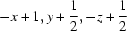
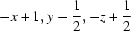
| Symmetry codes: (i) −x+1, y+1/2, −z+1/2; (ii) −x+1, y−1/2, −z+1/2. |
Experimental details
| Crystal data | |
| Chemical formula | C11H12N2O2 |
| Mr | 204.23 |
| Crystal system, space group | Monoclinic, P21/c |
| Temperature (K) | 293 |
| a, b, c (Å) | 5.3284 (1), 12.9387 (4), 14.6227 (5) |
| β (°) | 97.968 (2) |
| V (Å3) | 998.39 (5) |
| Z | 4 |
| Radiation type | Mo Kα |
| µ (mm−1) | 0.10 |
| Crystal size (mm) | 0.30 × 0.20 × 0.15 |
| Data collection | |
| Diffractometer | Bruker Kappa APEXII area-detector diffractometer |
| Absorption correction | Multi-scan (SADABS; Sheldrick, 2001) |
| Tmin, Tmax | 0.977, 0.986 |
| No. of measured, independent and observed [I > 2σ(I)] reflections | 14697, 3727, 2453 |
| Rint | 0.028 |
| (sin θ/λ)max (Å−1) | 0.765 |
| Refinement | |
| R[F2 > 2σ(F2)], wR(F2), S | 0.055, 0.163, 1.05 |
| No. of reflections | 3727 |
| No. of parameters | 141 |
| H-atom treatment | H atoms treated by a mixture of independent and constrained refinement |
| Δρmax, Δρmin (e Å−3) | 0.40, −0.17 |
Computer programs: APEX2 (Bruker, 2004), SAINT (Bruker, 2004), SHELXS97 (Sheldrick, 2008), ORTEP-3 (Farrugia, 1997), SHELXL97 (Sheldrick, 2008) and PLATON (Spek, 2009).
| D—H···A | D—H | H···A | D···A | D—H···A |
| N1—H1···O2i | 0.89 (2) | 2.12 (2) | 2.9745 (16) | 161.3 (18) |
| C13—H13···O1ii | 0.93 | 2.38 | 3.2220 (18) | 149.8 |
| Symmetry codes: (i) −x+1, y+1/2, −z+1/2; (ii) −x+1, y−1/2, −z+1/2. |
Acknowledgements
KR thanks Dr Babu Varghese, SAIF, IIT-Madras, India, for his help with the data collection and the management of Kandaswami Kandar's College, Velur, Namakkal, India, for their encouragement to pursue the programme.
References
 Albright, J. D., Feich, M. F., Santos, E. G. D., Dusza, J. P., Sum, F.-W., Venkatesan, A. M., Coupet, J., Chan, P. S., Ru, X., Mazandarani, H. & Bailey, T. (1998). J. Med. Chem. 41, 2442–2444. Web of Science CrossRef CAS PubMed Google Scholar
Bernstein, J., Davis, R. E., Shimoni, L. & Chang, N.-L. (1995). Angew. Chem. Int. Ed. Engl. 34, 1555–1573. CrossRef CAS Web of Science Google Scholar
Bruker (2004). APEX2 and SAINT. Bruker AXS Inc., Madison, Wisconsin, USA. Google Scholar
Cremer, D. & Pople, J. A. (1975). J. Am. Chem. Soc. 97, 1354–1358. CrossRef CAS Web of Science Google Scholar
Farrugia, L. J. (1997). J. Appl. Cryst. 30, 565. CrossRef IUCr Journals Google Scholar
Gringauz, A. (1999). Introduction to Medicinal Chemistry, pp. 578–580. New York: Wiley-VCH. Google Scholar
Lee, J., Gauthier, D. & Rivero, R. A. (1999). J. Org. Chem. 64, 3060–3064. Web of Science CrossRef PubMed CAS Google Scholar
Nardelli, M. (1983). Acta Cryst. C39, 1141–1142. CrossRef CAS Web of Science IUCr Journals Google Scholar
Rahbaek, L., Breinholt, J., Frisvad, J. C. & Christophersen, C. (1999). J. Org. Chem. 64, 1689–1692. Web of Science CrossRef PubMed Google Scholar
Sheldrick, G. M. (2001). SADABS. University of Göttingen, Germany. Google Scholar
Sheldrick, G. M. (2008). Acta Cryst. A64, 112–122. Web of Science CrossRef CAS IUCr Journals Google Scholar
Spek, A. L. (2009). Acta Cryst. D65, 148–155. Web of Science CrossRef CAS IUCr Journals Google Scholar
Venkatraj, M., Ponnuswamy, S. & Jeyaraman, R. (2008). Indian J. Chem. Sect. B, 47, 129–135. Google Scholar
This is an open-access article distributed under the terms of the Creative Commons Attribution (CC-BY) Licence, which permits unrestricted use, distribution, and reproduction in any medium, provided the original authors and source are cited.
| CRYSTALLOGRAPHIC COMMUNICATIONS |


Benzodiazepines are used for the purpose of hypnotic effects, owing to their less toxic and less severe withdrawal effects when compared with barbiturates (Gringauz, 1999). Benzodiazepines from aspergillus include asperlicin, which is used for treatment of gastrointestinal and central nervous system (CNS) disorders (Rahbaek et al.,1999). The other therapeutic applications (Lee et al., 1999) of benzodiazepines include vasopressin antagonists (Albright et al., 1998). In view of these importance and to ascertain the molecular conformation, crystallographic study of the title compound has been carried out.
The ORTEP diagram of the title compound is shown in Fig.1. The benzodiazepine ring adopts a distorted boat conformation. The puckering parameters (Cremer & Pople, 1975) and the asymmetry parameters (Nardelli, 1983) for this ring are q2 = 0.933 (1) Å, q3 = 0.170 (1) Å, ϕ2 = 144.8 (1)°, ϕ3 = 18.0 (4)° and Δ2(C4)=13.2 (1)°. The sum of the bond angles at N1(359.8°) and N5(359.8°) of the benzodiazepine ring is in accordance with sp2 hybridization.
The crystal packing is controlled by N—H···O and C—H···O types of intermolecular interactions in addition to van der Waals forces. Atom N1 at (x, y, z) donates a proton to O2 (1 - x, 1/2 + y, 1/2 - z), which forms a C7 (Bernstein et al., 1995) one dimensional chain running along b–axis. The intermolecular hydrogen bond C13—H13···O1 also connects the molecule into another C7 chain running along b–axis. Thus the combination of N—H···O and C—H···O intermolecular hydrogen bonds form a graph set motif of R22(7) dimer to stabilize the molecules and extend along b–axis (Fig. 2).