 | Acta Crystallographica Section E Acta Crystallographica Section E CRYSTALLOGRAPHIC COMMUNICATIONS |


 journal menu


metal-organic compounds
| CRYSTALLOGRAPHIC COMMUNICATIONS |
 access
Hexakis(1H-imidazole-κN3)cobalt(III) tris(hexafluoridophosphate) hexahydrate

aFaculty of Chemistry, Nicolaus Copernicus University, Gagarina 7, 87-100 Toruń, Poland, and bDepartment of Chemistry, University of Stellenbosch, Private Bag X1, Matieland 7602, South Africa
*Correspondence e-mail: [email protected]
In the of the title compound, [Co(C3H4N2)6](PF6)3·6H2O, the CoIII atom lies on a special position with site-symmetry  and the P atom is located on a special position with
  . The CoIII atom has an almost ideal octahedral coordination formed by the N atoms of six imidazole ligands. The water molecules form hydrogen-bonded helical chains propagating in [001] by O—H⋯O interactions with a distance of 2.913 (2) Å. They simultaneously interact as hydrogen-bond acceptors and donors with the cations and anions, respectively, resulting in the formation of a three-dimensional assembly. Weak C—H⋯F interactions further stabilize the crystal structure.
Related literature
For CoIII complexes with heterocycles, see: Wojtczak et al. (1990![[Wojtczak, A., Kosturkiewicz, Z. & Surdykowski, A. (1990). Acta Cryst. C46, 578-581.]](../../../../../../logos/arrows/e_arr.gif "Wojtczak, A., Kosturkiewicz, Z. & Surdykowski, A. (1990). Acta Cryst. C46, 578-581.") ); Pazderski et al. (2008). For the hexakis(imidazole)-cobalt(III) ion in solution, see: Navon & Panigel (1989); Wiśniewska & Kita (2006). For Co—N bond distances in hexakis(imidazole)-cobalt(II) complexes, see: Tong et al. (2002). For CoIII—N and CoII—N bond lengths in hexaammine–cobalt complexes, see: Kime & Ibers (1969). The water molecules present in the crystal structure form helical chains similar to those observed in a trichlorophloroglucinol structure, see: Saha & Nangia (2005).
); Pazderski et al. (2008). For the hexakis(imidazole)-cobalt(III) ion in solution, see: Navon & Panigel (1989); Wiśniewska & Kita (2006). For Co—N bond distances in hexakis(imidazole)-cobalt(II) complexes, see: Tong et al. (2002). For CoIII—N and CoII—N bond lengths in hexaammine–cobalt complexes, see: Kime & Ibers (1969). The water molecules present in the crystal structure form helical chains similar to those observed in a trichlorophloroglucinol structure, see: Saha & Nangia (2005).
![[Scheme 1]](hg2572scheme1.gif)
Experimental
Crystal data
|

Refinement
|
|
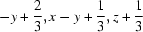 ; (ii)
 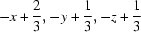 ; (iv)
 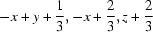 .
. Data collection: SMART (Bruker, 2001); cell refinement: SAINT (Bruker, 2002); data reduction: SAINT; program(s) used to solve structure: SHELXS97 (Sheldrick, 2008); program(s) used to refine structure: SHELXL97 (Sheldrick, 2008); molecular graphics: X-SEED (Barbour 2001); software used to prepare material for publication: SHELXL97.
Supporting information
contains datablocks I, global. DOI: 10.1107/S160053680903863X/hg2572sup1.cif
Structure factors: contains datablock I. DOI: 10.1107/S160053680903863X/hg2572Isup2.hkl
A mixture of 11.84 g (174 mmol) of imidazole and 2.02 g (5 mmol) of Co(pyridine)3Cl3 was grinded for several minutes until the color changed from green to red. The mixture was subsequently dissolved in 100 ml of distilled water and the pH was adjusted to 2–3 by adding 3 M HCl. Then the mixture was diluted with water to a final volume of 2 l and passed through a Sephadex SP C-25 column starting with an aqueous 0.05 M HCl solution as The fraction obtained by using 0.2 M HCl was evaporated in a stream of cold air and the product [Co(imidazole)6]Cl3 was filtrated and washed with ethanol. 10 mg of this compound was placed in a 50 ml beaker and 20 ml of a saturated aqueous solution of NH4PF6 was added. Red crystals suitable for single-crystal X-ray analysis were obtained by slow evaporation.
Water H atoms were located in a difference map and refined with a restrained O—H distance of 0.96 (3) Å, whereas Uiso(H) values were allowed to refine independently. The remaining H atoms were positioned geometrically, with C—H = 0.95 Å and N—H = 0.88 Å, and constrained to ride on their parent atoms with Uiso(H) = 1.2Ueq(C,N).
Data collection: SMART (Bruker, 2001); cell SAINT (Bruker, 2002); data reduction: SAINT (Bruker, 2002); program(s) used to solve structure: SHELXS97 (Sheldrick, 2008); program(s) used to refine structure: SHELXL97 (Sheldrick, 2008); molecular graphics: X-SEED (Barbour 2001); software used to prepare material for publication: SHELXL97 (Sheldrick, 2008).
![[Figure 1]](./hg2572fig1thm.gif) | Fig. 1. The molecular structure of (I), with the atom-numbering scheme [symmetry codes:(i) y,-x + y,-z; (ii) -x + y, -x, z; (iii) -x, -y, -z; (iv) -y, x-y, z; (v) x-y, x, -z; (vi) -x + 2/3,-y + 1/3,-z + 1/3]. Displacement ellipsoids are drawn at the 50% probability level. |
![[Figure 2]](./hg2572fig2thm.gif) | Fig. 2. The crystal packing of (I) viewed down [001] with the extensive net of hydrogen bonds leading to a three-dimensional arrangement (the red dashed lines indicate strong hydrogen bonding and the blue weak ones). |
| [Co(C3H4N2)6](PF6)3·6H2O | Dx = 1.880 Mg m−3 |
| Mr = 1010.43 | Mo Kα radiation, λ = 0.71073 Å |
| Trigonal, R3 | Cell parameters from 3782 reflections |
| Hall symbol: -R 3 | θ = 3.1–28.2° |
| a = 20.9911 (13) Å | µ = 0.77 mm−1 |
| c = 7.0156 (9) Å | T = 100 K |
| V = 2677.1 (4) Å3 | Block, red |
| Z = 3 | 0.25 × 0.25 × 0.21 mm |
| F(000) = 1530 |
| Bruker SMART APEX CCD area-detector diffractometer | 1373 independent reflections |
| Radiation source: fine-focus sealed tube | 1288 reflections with I > 2σ(I) |
| Graphite monochromator | Rint = 0.026 |
| ω scans | θmax = 28.2°, θmin = 3.1° |
| Absorption correction: multi-scan (SADABS; Sheldrick, 1997) | h = −22→27 |
| Tmin = 0.832, Tmax = 0.856 | k = −26→26 |
| 4893 measured reflections | l = −9→8 |
| Refinement on F2 | Primary atom site location: structure-invariant direct methods |
| Least-squares matrix: full | Secondary atom site location: difference Fourier map |
| R[F2 > 2σ(F2)] = 0.031 | Hydrogen site location: inferred from neighbouring sites |
| wR(F2) = 0.083 | H atoms treated by a mixture of independent and constrained refinement |
| S = 1.08 | w = 1/[σ2(Fo2) + (0.0444P)2 + 4.9022P] where P = (Fo2 + 2Fc2)/3 |
| 1373 reflections | (Δ/σ)max < 0.001 |
| 98 parameters | Δρmax = 0.54 e Å−3 |
| 3 restraints | Δρmin = −0.31 e Å−3 |
| [Co(C3H4N2)6](PF6)3·6H2O | Z = 3 |
| Mr = 1010.43 | Mo Kα radiation |
| Trigonal, R3 | µ = 0.77 mm−1 |
| a = 20.9911 (13) Å | T = 100 K |
| c = 7.0156 (9) Å | 0.25 × 0.25 × 0.21 mm |
| V = 2677.1 (4) Å3 |
| Bruker SMART APEX CCD area-detector diffractometer | 1373 independent reflections |
| Absorption correction: multi-scan (SADABS; Sheldrick, 1997) | 1288 reflections with I > 2σ(I) |
| Tmin = 0.832, Tmax = 0.856 | Rint = 0.026 |
| 4893 measured reflections |
| R[F2 > 2σ(F2)] = 0.031 | 3 restraints |
| wR(F2) = 0.083 | H atoms treated by a mixture of independent and constrained refinement |
| S = 1.08 | Δρmax = 0.54 e Å−3 |
| 1373 reflections | Δρmin = −0.31 e Å−3 |
| 98 parameters |
Geometry. All e.s.d.'s (except the e.s.d. in the dihedral angle between two l.s. planes) are estimated using the full covariance matrix. The cell e.s.d.'s are taken into account individually in the estimation of e.s.d.'s in distances, angles and torsion angles; correlations between e.s.d.'s in cell parameters are only used when they are defined by crystal symmetry. An approximate (isotropic) treatment of cell e.s.d.'s is used for estimating e.s.d.'s involving l.s. planes. |
Refinement. Refinement of F2 against ALL reflections. The weighted R-factor wR and goodness of fit S are based on F2, conventional R-factors R are based on F, with F set to zero for negative F2. The threshold expression of F2 > σ(F2) is used only for calculating R-factors(gt) etc. and is not relevant to the choice of reflections for refinement. R-factors based on F2 are statistically about twice as large as those based on F, and R- factors based on ALL data will be even larger. |
| x | y | z | Uiso*/Ueq | ||
| Co1 | 0.0000 | 0.0000 | 0.0000 | 0.01001 (15) | |
| F2 | 0.25776 (5) | 0.09189 (5) | 0.20301 (16) | 0.0242 (3) | |
| N1 | 0.05651 (7) | 0.08788 (7) | 0.15758 (19) | 0.0126 (3) | |
| N3 | 0.14686 (7) | 0.19255 (7) | 0.2646 (2) | 0.0161 (3) | |
| H3 | 0.1914 | 0.2302 | 0.2812 | 0.019* | |
| C5 | 0.02873 (8) | 0.11667 (8) | 0.2899 (2) | 0.0155 (3) | |
| H5 | −0.0213 | 0.0945 | 0.3285 | 0.019* | |
| C2 | 0.12841 (8) | 0.13594 (8) | 0.1462 (2) | 0.0150 (3) | |
| H2 | 0.1618 | 0.1307 | 0.0653 | 0.018* | |
| C4 | 0.08453 (9) | 0.18177 (8) | 0.3556 (2) | 0.0171 (3) | |
| H4 | 0.0810 | 0.2134 | 0.4464 | 0.020* | |
| P1 | 0.3333 | 0.1667 | 0.1667 | 0.01496 (16) | |
| F1 | 0.34563 (7) | 0.13360 (7) | −0.02524 (19) | 0.0421 (4) | |
| F3 | 0.37650 (6) | 0.13458 (7) | 0.2841 (2) | 0.0402 (4) | |
| O1 | 0.27980 (6) | 0.31811 (6) | 0.37976 (18) | 0.0203 (3) | |
| H6 | 0.3046 (15) | 0.3048 (15) | 0.473 (4) | 0.052 (8)* | |
| H7 | 0.2625 (15) | 0.3462 (14) | 0.447 (4) | 0.051 (8)* |
| U11 | U22 | U33 | U12 | U13 | U23 | |
| Co1 | 0.00877 (17) | 0.00877 (17) | 0.0125 (3) | 0.00438 (9) | 0.000 | 0.000 |
| F2 | 0.0135 (4) | 0.0191 (5) | 0.0324 (6) | 0.0026 (4) | 0.0030 (4) | 0.0038 (4) |
| N1 | 0.0126 (6) | 0.0113 (6) | 0.0144 (6) | 0.0063 (5) | −0.0004 (5) | 0.0004 (5) |
| N3 | 0.0148 (6) | 0.0122 (6) | 0.0179 (7) | 0.0041 (5) | −0.0023 (5) | −0.0005 (5) |
| C5 | 0.0158 (7) | 0.0158 (7) | 0.0158 (8) | 0.0085 (6) | −0.0001 (5) | −0.0015 (6) |
| C2 | 0.0137 (7) | 0.0137 (7) | 0.0171 (7) | 0.0063 (6) | −0.0016 (5) | −0.0009 (5) |
| C4 | 0.0205 (8) | 0.0153 (7) | 0.0161 (8) | 0.0095 (6) | −0.0020 (6) | −0.0023 (6) |
| P1 | 0.0104 (3) | 0.0156 (3) | 0.0172 (3) | 0.0052 (2) | 0.00177 (19) | 0.0010 (2) |
| F1 | 0.0372 (7) | 0.0354 (7) | 0.0378 (7) | 0.0062 (5) | 0.0167 (5) | −0.0130 (5) |
| F3 | 0.0160 (5) | 0.0422 (7) | 0.0588 (9) | 0.0118 (5) | 0.0027 (5) | 0.0283 (6) |
| O1 | 0.0192 (6) | 0.0197 (6) | 0.0207 (6) | 0.0086 (5) | −0.0039 (5) | −0.0035 (5) |
| Co1—N1 | 1.9605 (13) | C5—C4 | 1.361 (2) |
| Co1—N1i | 1.9605 (13) | C5—H5 | 0.9500 |
| Co1—N1ii | 1.9605 (13) | C2—H2 | 0.9500 |
| Co1—N1iii | 1.9605 (13) | C4—H4 | 0.9500 |
| Co1—N1iv | 1.9605 (13) | P1—F1vi | 1.5939 (12) |
| Co1—N1v | 1.9605 (13) | P1—F1 | 1.5938 (12) |
| F2—P1 | 1.5985 (9) | P1—F2vi | 1.5985 (9) |
| N1—C2 | 1.3340 (19) | P1—F3vi | 1.6012 (11) |
| N1—C5 | 1.3854 (19) | P1—F3 | 1.6012 (11) |
| N3—C2 | 1.339 (2) | O1—H6 | 0.96 (3) |
| N3—C4 | 1.369 (2) | O1—H7 | 0.96 (3) |
| N3—H3 | 0.8800 | ||
| N1—Co1—N1i | 88.68 (5) | N1—C5—H5 | 125.5 |
| N1—Co1—N1ii | 91.32 (5) | N1—C2—N3 | 110.48 (14) |
| N1—Co1—N1v | 88.68 (5) | N1—C2—H2 | 124.8 |
| N1—Co1—N1iii | 180.00 (9) | N3—C2—H2 | 124.8 |
| N1v—Co1—N1iii | 91.32 (5) | C5—C4—N3 | 106.26 (14) |
| N1v—Co1—N1i | 91.32 (5) | C5—C4—H4 | 126.9 |
| N1iii—Co1—N1i | 91.32 (5) | N3—C4—H4 | 126.9 |
| N1v—Co1—N1ii | 180.00 (9) | F1vi—P1—F1 | 180.0 |
| N1iii—Co1—N1ii | 88.68 (5) | F1vi—P1—F2 | 89.75 (6) |
| N1i—Co1—N1ii | 88.68 (5) | F1—P1—F2 | 90.25 (6) |
| N1—Co1—N1iv | 91.32 (5) | F1vi—P1—F2vi | 90.25 (6) |
| N1v—Co1—N1iv | 88.68 (5) | F1—P1—F2vi | 89.75 (6) |
| N1iii—Co1—N1iv | 88.68 (5) | F2—P1—F2vi | 179.997 (1) |
| N1i—Co1—N1iv | 180.00 (5) | F1vi—P1—F3vi | 90.13 (8) |
| N1ii—Co1—N1iv | 91.32 (5) | F1—P1—F3vi | 89.86 (8) |
| C2—N1—C5 | 105.91 (12) | F2—P1—F3vi | 90.15 (6) |
| C2—N1—Co1 | 126.96 (11) | F2vi—P1—F3vi | 89.85 (6) |
| C5—N1—Co1 | 126.84 (10) | F1vi—P1—F3 | 89.86 (8) |
| C2—N3—C4 | 108.30 (13) | F1—P1—F3 | 90.14 (8) |
| C2—N3—H3 | 125.8 | F2—P1—F3 | 89.85 (6) |
| C4—N3—H3 | 125.8 | F2vi—P1—F3 | 90.15 (6) |
| C4—C5—N1 | 109.04 (14) | F3vi—P1—F3 | 180.0 |
| C4—C5—H5 | 125.5 | H6—O1—H7 | 105.7 (19) |
| N1v—Co1—N1—C2 | −98.46 (15) | C2—N1—C5—C4 | 0.10 (17) |
| N1i—Co1—N1—C2 | −7.11 (13) | Co1—N1—C5—C4 | −174.02 (11) |
| N1ii—Co1—N1—C2 | 81.54 (15) | C5—N1—C2—N3 | 0.45 (17) |
| N1iv—Co1—N1—C2 | 172.89 (13) | Co1—N1—C2—N3 | 174.56 (10) |
| N1v—Co1—N1—C5 | 74.46 (10) | C4—N3—C2—N1 | −0.82 (18) |
| N1i—Co1—N1—C5 | 165.81 (14) | N1—C5—C4—N3 | −0.58 (18) |
| N1ii—Co1—N1—C5 | −105.54 (10) | C2—N3—C4—C5 | 0.85 (18) |
| N1iv—Co1—N1—C5 | −14.19 (14) |
| Symmetry codes: (i) y, −x+y, −z; (ii) −x+y, −x, z; (iii) −x, −y, −z; (iv) −y, x−y, z; (v) x−y, x, −z; (vi) −x+2/3, −y+1/3, −z+1/3. |
| D—H···A | D—H | H···A | D···A | D—H···A |
| O1—H6···O1vii | 0.96 (3) | 1.98 (3) | 2.913 (2) | 163 (3) |
| N3—H3···O1 | 0.88 | 1.98 | 2.834 (2) | 165 |
| O1—H7···F3viii | 0.96 (3) | 2.10 (3) | 2.945 (2) | 146 (2) |
| C2—H2···F3vi | 0.95 | 2.34 | 3.042 (2) | 131 |
| C4—H4···F1ix | 0.95 | 2.40 | 3.303 (2) | 158 |
| Symmetry codes: (vi) −x+2/3, −y+1/3, −z+1/3; (vii) −y+2/3, x−y+1/3, z+1/3; (viii) x−y, x, −z+1; (ix) −x+y+1/3, −x+2/3, z+2/3. |
Experimental details
| Crystal data | |
| Chemical formula | [Co(C3H4N2)6](PF6)3·6H2O |
| Mr | 1010.43 |
| Crystal system, space group | Trigonal, R3 |
| Temperature (K) | 100 |
| a, c (Å) | 20.9911 (13), 7.0156 (9) |
| V (Å3) | 2677.1 (4) |
| Z | 3 |
| Radiation type | Mo Kα |
| µ (mm−1) | 0.77 |
| Crystal size (mm) | 0.25 × 0.25 × 0.21 |
| Data collection | |
| Diffractometer | Bruker SMART APEX CCD area-detector diffractometer |
| Absorption correction | Multi-scan (SADABS; Sheldrick, 1997) |
| Tmin, Tmax | 0.832, 0.856 |
| No. of measured, independent and observed [I > 2σ(I)] reflections | 4893, 1373, 1288 |
| Rint | 0.026 |
| (sin θ/λ)max (Å−1) | 0.666 |
| Refinement | |
| R[F2 > 2σ(F2)], wR(F2), S | 0.031, 0.083, 1.08 |
| No. of reflections | 1373 |
| No. of parameters | 98 |
| No. of restraints | 3 |
| H-atom treatment | H atoms treated by a mixture of independent and constrained refinement |
| Δρmax, Δρmin (e Å−3) | 0.54, −0.31 |
Computer programs: SMART (Bruker, 2001), SAINT (Bruker, 2002), SHELXS97 (Sheldrick, 2008), SHELXL97 (Sheldrick, 2008), X-SEED (Barbour 2001).
| D—H···A | D—H | H···A | D···A | D—H···A |
| O1—H6···O1i | 0.96 (3) | 1.98 (3) | 2.913 (2) | 163 (3) |
| N3—H3···O1 | 0.88 | 1.975 | 2.834 (2) | 165 |
| O1—H7···F3ii | 0.96 (3) | 2.10 (3) | 2.945 (2) | 146 (2) |
| C2—H2···F3iii | 0.95 | 2.34 | 3.042 (2) | 131 |
| C4—H4···F1iv | 0.95 | 2.40 | 3.303 (2) | 158 |
| Symmetry codes: (i) −y+2/3, x−y+1/3, z+1/3; (ii) x−y, x, −z+1; (iii) −x+2/3, −y+1/3, −z+1/3; (iv) −x+y+1/3, −x+2/3, z+2/3. |
Acknowledgements
The authors wish to thank the Nicolaus Copernicus University and the National Research Foundation of South Africa for financial support.
References
 Barbour, L. J. (2001). J. Supramol. Chem. 1, 189–191. CrossRef CAS Google Scholar
Bruker (2001). SMART. Bruker AXS Inc., Madison, Wisconsin, USA. Google Scholar
Bruker (2002). SAINT. Bruker AXS Inc., Madison, Wisconsin, USA. Google Scholar
Kime, N. E. & Ibers, J. A. (1969). Acta Cryst. B25, 168–169. CrossRef CAS IUCr Journals Web of Science Google Scholar
Navon, G. & Panigel, R. (1989). Inorg. Chem. 28, 1405–1407. CrossRef CAS Web of Science Google Scholar
Pazderski, L., Surdykowski, A., Pazderska-Szablowicz, M., Sitkowski, J., Kozerski, L., Kamieński, B. & Szłyk, E. (2008). Cent. Eur. J. Chem. 6, 55–64. Web of Science CrossRef CAS Google Scholar
Saha, B. K. & Nangia, A. (2005). Chem. Commun. 24, 3024–3026. Web of Science CSD CrossRef Google Scholar
Sheldrick, G. M. (1997). SADABS. University of Göttingen, Germany. Google Scholar
Sheldrick, G. M. (2008). Acta Cryst. A64, 112–122. Web of Science CrossRef CAS IUCr Journals Google Scholar
Tong, M.-L., Li, W., Chen, X.-M. & Ng, S. W. (2002). Acta Cryst. E58, m186–m188. Web of Science CSD CrossRef IUCr Journals Google Scholar
Wiśniewska, J. & Kita, P. (2006). Transition Met. Chem. 31, 232–236. Google Scholar
Wojtczak, A., Kosturkiewicz, Z. & Surdykowski, A. (1990). Acta Cryst. C46, 578–581. CSD CrossRef CAS Web of Science IUCr Journals Google Scholar
This is an open-access article distributed under the terms of the Creative Commons Attribution (CC-BY) Licence, which permits unrestricted use, distribution, and reproduction in any medium, provided the original authors and source are cited.
| CRYSTALLOGRAPHIC COMMUNICATIONS |


During the course of ongoing studies on CoIII complexes with heterocycles (Wojtczak et al., 1990; Pazderski et al., 2008) the title compound (I) was isolated. The crystal structure of (I) is built of mononuclear [Co(imidazole)6]3+ trications with the Co1 atom lying on Wyckoff position 3a (site symmetry 3), PF6- anions with P atom lying on Wyckoff position 9 d (site symmetry 1) and lattice water molecules (Fig.1). It is worth mentioning that this is the first structure consisting of a hexakis(imidazole)-cobalt(III) cationic complex, whereas more than 15 structures consisting of a hexakis(imidazole)-cobalt(II) complex ion were reported. Furthermore, there are only two papers on the hexakis(imidazole)-cobalt(III) ion in solution, describing spectroscopic (Navon & Panigel, 1989) and kinetic properties (Wiśniewska & Kita, 2006) respectively. The CoIII ion has an almost ideal octahedral environment formed by six imidazole N atoms, with cis-N—Co—N angles of 88.68 (7)° and 91.32 (7)°. The planes of neighbouring imidazole rings are twisted from their usual perpendicular positions. This is the result of the extensive net of hydrogen bonds in the structure in which imidazole rings are involved (dihedral angle = 72.4 (6)°). The Co—N bond distance is equal to 1.961 (1) Å and as expected is slightly shorter than those reported for hexakis(imidazole)-cobalt(II) complexes with distances of 2.140±2.188 Å (Tong et al., 2002). A similar relation of bond lengths was reported for CoIII—N and Co(II)—N in hexaamminecobalt complexes (Kime & Ibers, 1969) with differences between those distances of 0.18 Å. The water molecules present in the crystal structure form helical chains (helix pitch = 7.016 (2) Å, c axis) similar to those observed in a trichlorophloroglucinol structure (Saha & Nangia, 2005). They are propagated in [001] directions by O1—H6···O1i interactions (symmetry operation: -y + 2/3, x-y + 1/3, z + 1/3) with a distance of 2.913 (2) Å), which are stabilized by hydrogen bonding with the remaining molecular units (Table 1) giving in turn a three-dimensional assembly. The weak C—H···F interactions (Table 1) further stabilize the packing arrangement (Fig. 2).