 | Acta Crystallographica Section E Acta Crystallographica Section E CRYSTALLOGRAPHIC COMMUNICATIONS |


 journal menu


metal-organic compounds
| CRYSTALLOGRAPHIC COMMUNICATIONS |
 access
Synchrotron study of poly[[di-μ-aqua(μ-2,2′-bipyridyl-5,5′-dicarboxylato)dipotassium] dihydrate]

aUniversity of Notre Dame, Department of Chemistry and Biochemistry, 251 Nieuwland Science Hall, Notre Dame, IN 46556-5670, USA
*Correspondence e-mail: [email protected]
The title compound, {[K2(C12H6N2O4)(H2O)2]·2H2O}n, forms a three-dimensional coordination polymer in the solid state. The asymmetric unit consists of one K+ ion, half of a 2,2′-bipyridyl-5,5′-dicarboxylate ligand, one coordinated water molecule and one solvent water molecule. The K+ ion is 7-coordinated by the oxygen atoms of two water molecules and by five oxygen atoms of four carboxylate groups, one of which is chelating. The extended structure can be described as a binodal network in which each K+ is a six-connected node, bonding to four carboxylate groups and two bridging water molecules, and the 2,2′-bipyridyl-5,5′-dicarboxylate linkers are eight-connected nodes, with each carboxylate group bridging four metal centers. Overall, this arrangement generates a complex network with point symbol {34.412.512}{34.44.54.63}2. Both of the bridging water molecules participate as donors in hydrogen-bonding interactions; one to solvent water molecules and a second to an oxygen atom of a carboxylate group.
Related literature
For topological analysis, see: Blatov (2007![[Blatov, V. A. (2007). http://www.topos.ssu.samara.ru/ .]](../../../../../../logos/arrows/e_arr.gif "Blatov, V. A. (2007). http://www.topos.ssu.samara.ru/ .") ). For background to metal-organic frameworks (MOFs), see: MacDougall et al. (2005). The 2,2′-bipyridyl-5,5′-dicarboxylate ligand has been used as a linear linker for a variety of MOFs, see: Finn & Zubieta, (2002); Schoknecht & Kempe (2004); Szeto et al., (2008). It is a particularly interesting linker due to the fact that the pyridyl N atoms have the ability to act as Lewis bases for binding metal centers (Szeto et al., 2008). There has been only one structural example of this ligand bound to an alkali metal reported, viz. Rb (Hafizovic et al., 2007). For synthetic details, see: Anderson et al. (1985).
). For background to metal-organic frameworks (MOFs), see: MacDougall et al. (2005). The 2,2′-bipyridyl-5,5′-dicarboxylate ligand has been used as a linear linker for a variety of MOFs, see: Finn & Zubieta, (2002); Schoknecht & Kempe (2004); Szeto et al., (2008). It is a particularly interesting linker due to the fact that the pyridyl N atoms have the ability to act as Lewis bases for binding metal centers (Szeto et al., 2008). There has been only one structural example of this ligand bound to an alkali metal reported, viz. Rb (Hafizovic et al., 2007). For synthetic details, see: Anderson et al. (1985).
![[Scheme 1]](wm2256scheme1.gif)
Experimental
Crystal data
|
Refinement
|
| ||||||||||||||||||||||
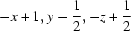 ; (ii)
 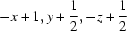 .
. Data collection: APEX2 (Bruker, 2008); cell refinement: SAINT (Bruker, 2008); data reduction: SAINT; program(s) used to solve structure: SHELXS97 (Sheldrick, 2008b); program(s) used to refine structure: SHELXL97 (Sheldrick, 2008b); molecular graphics: SHELXTL (Sheldrick, 2008b); software used to prepare material for publication: SHELXTL.
Supporting information
contains datablocks global, I. DOI: 10.1107/S1600536809038756/wm2256sup1.cif
Structure factors: contains datablock I. DOI: 10.1107/S1600536809038756/wm2256Isup2.hkl
The title complex was prepared using a modification of the method of Seddon and Pilling (Anderson et al., 1985) for the preparation of 2,2'-bipyridyl-4,4'-dicarboxylic acid. 5,5'-dimethyl-2,2'-bipyridine and K[MnO4] were purchased from Aldrich and used without further purification. 1H NMR data were collected on a Varian Unity Plus 300 spectrometer at 298 K. K[MnO4] (10 g, 63 mmol) was added to a solution of 5,5'-dimethyl-2,2'-bipyridine (1.6 g, 8.7 mmol) in 100 mL H2O. The mixture was heated to reflux for 12 h. Upon cooling, the mixture was filtered and the black precipitate was washed with water (2x 30 mL). The filtrate and the washings were combined and extracted with diethyl ether to remove unreacted starting material. The aqueous fraction was collected and the solvent was removed under vacuum, leaving a sticky white solid. The solid was heated under vacuum at 373 K overnight to give a fine white powder. Single crystals were grown from an aqueous solution upon slow evaporation of the solvent.
Hydrogen atoms were placed at calculated positions and allowed to ride on the position of the parent atom, with the exception of those on the coordinated O3 water molecule which were located in the difference fourier map. H atoms of the uncoordinated water molecule O4 could not be located unambiguously and were eventually excluded from the refinement.
Data collection: APEX2 (Bruker, 2008); cell SAINT (Bruker, 2008); data reduction: SAINT (Bruker, 2008); program(s) used to solve structure: SHELXS97 (Sheldrick, 2008b); program(s) used to refine structure: SHELXL97 (Sheldrick, 2008b); molecular graphics: SHELXTL (Sheldrick, 2008b); software used to prepare material for publication: SHELXTL (Sheldrick, 2008b).
![[Figure 1]](./wm2256fig1thm.gif) | Fig. 1. A portion of the polymeric structure of the title compound. All hydrogen atoms except those located on O3 have been omitted. Thermal ellipsoids are shown at the 50% probablility level. |
![[Figure 2]](./wm2256fig2thm.gif) | Fig. 2. Thermal ellipsoid plot of the asymmetric unit of the title compound. Thermal ellipsoids are shown at the 50% probablility level. |
| [K2(C12H6N2O4)(H2O)2]·2H2O | F(000) = 404 |
| Mr = 392.46 | Dx = 1.646 Mg m−3 |
| Monoclinic, P21/c | Synchrotron radiation, λ = 0.77490 Å |
| Hall symbol: -P 2yc | Cell parameters from 1984 reflections |
| a = 3.6769 (6) Å | θ = 2.8–27.6° |
| b = 8.2042 (14) Å | µ = 0.76 mm−1 |
| c = 26.292 (4) Å | T = 150 K |
| β = 92.924 (2)° | Plate, colorless |
| V = 792.1 (2) Å3 | 0.04 × 0.03 × 0.01 mm |
| Z = 2 |
| Bruker APEXII diffractometer | 1622 independent reflections |
| Radiation source: synchrotron | 1301 reflections with I > 2σ(I) |
| Channel-cut Si-<111> crystal monochromator | Rint = 0.045 |
| Detector resolution: 83.33 pixels mm-1 | θmax = 29.0°, θmin = 2.8° |
| ω and ϕ scans | h = −4→4 |
| Absorption correction: multi-scan (SADABS; Sheldrick, 2008a) | k = −10→10 |
| Tmin = 0.654, Tmax = 0.746 | l = −32→32 |
| 8561 measured reflections |
| Refinement on F2 | Primary atom site location: structure-invariant direct methods |
| Least-squares matrix: full | Secondary atom site location: difference Fourier map |
| R[F2 > 2σ(F2)] = 0.045 | Hydrogen site location: inferred from neighbouring sites |
| wR(F2) = 0.128 | H atoms treated by a mixture of independent and constrained refinement |
| S = 1.08 | w = 1/[σ2(Fo2) + (0.0609P)2 + 1.2501P] where P = (Fo2 + 2Fc2)/3 |
| 1622 reflections | (Δ/σ)max < 0.001 |
| 117 parameters | Δρmax = 1.03 e Å−3 |
| 0 restraints | Δρmin = −0.51 e Å−3 |
| [K2(C12H6N2O4)(H2O)2]·2H2O | V = 792.1 (2) Å3 |
| Mr = 392.46 | Z = 2 |
| Monoclinic, P21/c | Synchrotron radiation, λ = 0.77490 Å |
| a = 3.6769 (6) Å | µ = 0.76 mm−1 |
| b = 8.2042 (14) Å | T = 150 K |
| c = 26.292 (4) Å | 0.04 × 0.03 × 0.01 mm |
| β = 92.924 (2)° |
| Bruker APEXII diffractometer | 1622 independent reflections |
| Absorption correction: multi-scan (SADABS; Sheldrick, 2008a) | 1301 reflections with I > 2σ(I) |
| Tmin = 0.654, Tmax = 0.746 | Rint = 0.045 |
| 8561 measured reflections |
| R[F2 > 2σ(F2)] = 0.045 | 0 restraints |
| wR(F2) = 0.128 | H atoms treated by a mixture of independent and constrained refinement |
| S = 1.08 | Δρmax = 1.03 e Å−3 |
| 1622 reflections | Δρmin = −0.51 e Å−3 |
| 117 parameters |
Geometry. All e.s.d.'s (except the e.s.d. in the dihedral angle between two l.s. planes) are estimated using the full covariance matrix. The cell e.s.d.'s are taken into account individually in the estimation of e.s.d.'s in distances, angles and torsion angles; correlations between e.s.d.'s in cell parameters are only used when they are defined by crystal symmetry. An approximate (isotropic) treatment of cell e.s.d.'s is used for estimating e.s.d.'s involving l.s. planes. |
Refinement. Refinement of F2 against ALL reflections. The weighted R-factor wR and goodness of fit S are based on F2, conventional R-factors R are based on F, with F set to zero for negative F2. The threshold expression of F2 > σ(F2) is used only for calculating R-factors(gt) etc. and is not relevant to the choice of reflections for refinement. R-factors based on F2 are statistically about twice as large as those based on F, and R- factors based on ALL data will be even larger. |
| x | y | z | Uiso*/Ueq | ||
| K1 | 0.06233 (18) | 0.72796 (8) | 0.22289 (2) | 0.0250 (2) | |
| O1 | 0.5909 (6) | 0.7368 (3) | 0.30066 (8) | 0.0257 (5) | |
| O2 | 0.4216 (6) | 0.4762 (3) | 0.29578 (8) | 0.0262 (5) | |
| O3 | 0.5493 (7) | 0.5466 (3) | 0.16339 (11) | 0.0359 (6) | |
| H3A | 0.499 (13) | 0.454 (6) | 0.1748 (18) | 0.052 (14)* | |
| H3B | 0.528 (16) | 0.539 (7) | 0.132 (2) | 0.080 (19)* | |
| O4 | 0.537 (2) | 0.0661 (6) | 0.44962 (17) | 0.154 (3) | |
| N1 | 0.7659 (7) | 0.3947 (3) | 0.44667 (10) | 0.0272 (6) | |
| C1 | 0.9350 (8) | 0.5168 (4) | 0.47310 (10) | 0.0216 (6) | |
| C2 | 0.6527 (8) | 0.4234 (4) | 0.39788 (11) | 0.0251 (7) | |
| H2A | 0.5352 | 0.3375 | 0.3792 | 0.030* | |
| C3 | 0.6981 (8) | 0.5704 (4) | 0.37364 (11) | 0.0225 (6) | |
| C4 | 0.8744 (8) | 0.6938 (4) | 0.40162 (11) | 0.0252 (7) | |
| H4A | 0.9138 | 0.7968 | 0.3863 | 0.030* | |
| C5 | 0.9916 (8) | 0.6669 (4) | 0.45143 (11) | 0.0209 (6) | |
| H5A | 1.1106 | 0.7510 | 0.4707 | 0.025* | |
| C6 | 0.5582 (8) | 0.5960 (4) | 0.31898 (11) | 0.0200 (6) |
| U11 | U22 | U33 | U12 | U13 | U23 | |
| K1 | 0.0231 (3) | 0.0293 (4) | 0.0222 (4) | −0.0001 (3) | −0.0021 (2) | 0.0022 (3) |
| O1 | 0.0312 (12) | 0.0272 (12) | 0.0182 (10) | 0.0001 (9) | −0.0035 (9) | 0.0015 (8) |
| O2 | 0.0310 (12) | 0.0258 (12) | 0.0209 (10) | −0.0008 (9) | −0.0053 (9) | −0.0028 (9) |
| O3 | 0.0432 (15) | 0.0268 (14) | 0.0371 (16) | −0.0043 (11) | −0.0035 (12) | 0.0001 (11) |
| O4 | 0.345 (9) | 0.055 (3) | 0.059 (3) | 0.017 (4) | −0.009 (4) | −0.001 (2) |
| N1 | 0.0293 (14) | 0.0311 (15) | 0.0209 (13) | −0.0025 (11) | −0.0025 (11) | −0.0005 (11) |
| C1 | 0.0182 (13) | 0.0305 (16) | 0.0159 (14) | 0.0023 (12) | −0.0013 (11) | −0.0020 (12) |
| C2 | 0.0250 (16) | 0.0316 (17) | 0.0183 (14) | 0.0008 (13) | −0.0024 (12) | −0.0005 (12) |
| C3 | 0.0176 (14) | 0.0330 (16) | 0.0168 (14) | 0.0038 (12) | 0.0003 (11) | −0.0008 (12) |
| C4 | 0.0225 (15) | 0.0325 (17) | 0.0205 (15) | 0.0018 (12) | −0.0003 (11) | −0.0004 (12) |
| C5 | 0.0200 (14) | 0.0256 (15) | 0.0167 (14) | −0.0018 (11) | −0.0040 (11) | −0.0009 (11) |
| C6 | 0.0181 (14) | 0.0261 (16) | 0.0158 (14) | 0.0029 (11) | 0.0002 (11) | −0.0014 (11) |
| K1—O2i | 2.732 (2) | N1—C2 | 1.349 (4) |
| K1—O1ii | 2.748 (2) | N1—C1 | 1.353 (4) |
| K1—O1 | 2.749 (2) | C1—C5 | 1.376 (4) |
| K1—O3ii | 2.814 (3) | C1—C1iv | 1.496 (6) |
| K1—O2iii | 2.843 (2) | C2—C3 | 1.378 (5) |
| K1—O3 | 2.855 (3) | C2—H2A | 0.9500 |
| K1—O2 | 3.070 (2) | C3—C4 | 1.392 (4) |
| O1—C6 | 1.259 (4) | C3—C6 | 1.516 (4) |
| O2—C6 | 1.249 (4) | C4—C5 | 1.376 (4) |
| O3—H3A | 0.84 (5) | C4—H4A | 0.9500 |
| O3—H3B | 0.84 (6) | C5—H5A | 0.9500 |
| O2i—K1—O1ii | 71.60 (7) | K1vi—O2—K1 | 97.69 (6) |
| O2i—K1—O1 | 122.90 (7) | K1vii—O2—K1 | 130.08 (8) |
| O1ii—K1—O1 | 83.96 (6) | K1v—O3—K1 | 80.87 (7) |
| O2i—K1—O3ii | 83.24 (8) | K1v—O3—H3A | 116 (3) |
| O1ii—K1—O3ii | 89.84 (8) | K1—O3—H3A | 97 (3) |
| O1—K1—O3ii | 148.85 (8) | K1v—O3—H3B | 129 (4) |
| O2i—K1—O2iii | 82.49 (6) | K1—O3—H3B | 124 (4) |
| O1ii—K1—O2iii | 124.15 (7) | H3A—O3—H3B | 106 (5) |
| O1—K1—O2iii | 69.93 (6) | C2—N1—C1 | 118.1 (3) |
| O3ii—K1—O2iii | 135.82 (8) | N1—C1—C5 | 121.7 (3) |
| O2i—K1—O3 | 135.30 (8) | N1—C1—C1iv | 117.7 (3) |
| O1ii—K1—O3 | 149.13 (8) | C5—C1—C1iv | 120.6 (3) |
| O1—K1—O3 | 88.96 (7) | N1—C2—C3 | 123.6 (3) |
| O3ii—K1—O3 | 80.87 (7) | N1—C2—H2A | 118.2 |
| O2iii—K1—O3 | 80.56 (7) | C3—C2—H2A | 118.2 |
| O2i—K1—O2 | 150.35 (3) | C2—C3—C4 | 117.2 (3) |
| O1ii—K1—O2 | 79.68 (6) | C2—C3—C6 | 121.1 (3) |
| O1—K1—O2 | 44.61 (6) | C4—C3—C6 | 121.7 (3) |
| O3ii—K1—O2 | 104.26 (7) | C5—C4—C3 | 120.0 (3) |
| O2iii—K1—O2 | 108.66 (3) | C5—C4—H4A | 120.0 |
| O3—K1—O2 | 74.31 (7) | C3—C4—H4A | 120.0 |
| C6—O1—K1v | 109.68 (18) | C4—C5—C1 | 119.4 (3) |
| C6—O1—K1 | 100.52 (17) | C4—C5—H5A | 120.3 |
| K1v—O1—K1 | 83.96 (6) | C1—C5—H5A | 120.3 |
| C6—O2—K1vi | 156.4 (2) | O2—C6—O1 | 125.4 (3) |
| C6—O2—K1vii | 113.13 (18) | O2—C6—C3 | 117.5 (3) |
| K1vi—O2—K1vii | 82.49 (6) | O1—C6—C3 | 117.1 (3) |
| C6—O2—K1 | 85.69 (17) | ||
| O2i—K1—O1—C6 | 134.52 (17) | K1vi—O2—C6—K1 | −99.4 (5) |
| O1ii—K1—O1—C6 | 71.04 (18) | K1vii—O2—C6—K1 | 132.06 (13) |
| O3ii—K1—O1—C6 | −8.6 (3) | K1vi—O2—C6—K1v | −163.2 (4) |
| O2iii—K1—O1—C6 | −159.19 (19) | K1vii—O2—C6—K1v | 68.29 (14) |
| O3—K1—O1—C6 | −78.86 (18) | K1—O2—C6—K1v | −63.77 (7) |
| O2—K1—O1—C6 | −10.37 (16) | K1vi—O2—C6—K1vii | 128.6 (5) |
| C6ii—K1—O1—C6 | 50.56 (15) | K1—O2—C6—K1vii | −132.06 (13) |
| C6iii—K1—O1—C6 | −169.28 (16) | K1v—O1—C6—O2 | −64.9 (3) |
| K1ii—K1—O1—C6 | 71.04 (18) | K1—O1—C6—O2 | 22.4 (3) |
| K1v—K1—O1—C6 | −108.96 (18) | K1v—O1—C6—C3 | 114.8 (2) |
| O2i—K1—O1—K1v | −116.52 (7) | K1—O1—C6—C3 | −157.9 (2) |
| O1ii—K1—O1—K1v | 180.0 | K1v—O1—C6—K1 | −87.29 (11) |
| O3ii—K1—O1—K1v | 100.40 (15) | K1—O1—C6—K1v | 87.29 (11) |
| O2iii—K1—O1—K1v | −50.23 (6) | K1v—O1—C6—K1vii | −4.1 (3) |
| O3—K1—O1—K1v | 30.09 (7) | K1—O1—C6—K1vii | 83.2 (2) |
| O2—K1—O1—K1v | 98.58 (9) | C2—C3—C6—O2 | −4.5 (4) |
| C6—K1—O1—K1v | 108.96 (18) | C4—C3—C6—O2 | 176.1 (3) |
| C6ii—K1—O1—K1v | 159.52 (7) | C2—C3—C6—O1 | 175.8 (3) |
| C6iii—K1—O1—K1v | −60.32 (6) | C4—C3—C6—O1 | −3.7 (4) |
| K1ii—K1—O1—K1v | 180.0 | C2—C3—C6—K1 | 108.6 (6) |
| O2i—K1—O2—C6 | −67.1 (2) | C4—C3—C6—K1 | −70.9 (7) |
| O1ii—K1—O2—C6 | −81.54 (17) | C2—C3—C6—K1v | −125.9 (3) |
| O1—K1—O2—C6 | 10.31 (16) | C4—C3—C6—K1v | 54.7 (4) |
| O3ii—K1—O2—C6 | −168.72 (17) | C2—C3—C6—K1vii | −47.7 (3) |
| O2iii—K1—O2—C6 | 41.19 (16) | C4—C3—C6—K1vii | 132.8 (3) |
| O3—K1—O2—C6 | 115.25 (18) | O2i—K1—C6—O2 | 138.37 (12) |
| C6ii—K1—O2—C6 | −94.85 (18) | O1ii—K1—C6—O2 | 93.78 (17) |
| C6iii—K1—O2—C6 | 37.2 (2) | O1—K1—C6—O2 | −160.9 (3) |
| K1ii—K1—O2—C6 | −116.44 (16) | O3ii—K1—C6—O2 | 13.6 (2) |
| K1v—K1—O2—C6 | 63.56 (16) | O2iii—K1—C6—O2 | −141.38 (15) |
| O2i—K1—O2—K1vi | 89.41 (15) | O3—K1—C6—O2 | −60.97 (17) |
| O1ii—K1—O2—K1vi | 75.00 (7) | C6ii—K1—C6—O2 | 74.81 (17) |
| O1—K1—O2—K1vi | 166.84 (12) | C6iii—K1—C6—O2 | −149.60 (19) |
| O3ii—K1—O2—K1vi | −12.18 (9) | K1ii—K1—C6—O2 | 74.81 (17) |
| O2iii—K1—O2—K1vi | −162.27 (8) | K1v—K1—C6—O2 | −105.19 (17) |
| O3—K1—O2—K1vi | −88.21 (8) | O2i—K1—C6—O1 | −60.7 (2) |
| C6—K1—O2—K1vi | 156.5 (2) | O1ii—K1—C6—O1 | −105.34 (19) |
| C6ii—K1—O2—K1vi | 61.68 (7) | O3ii—K1—C6—O1 | 174.51 (17) |
| C6iii—K1—O2—K1vi | −166.30 (7) | O2iii—K1—C6—O1 | 19.50 (18) |
| K1ii—K1—O2—K1vi | 40.09 (7) | O3—K1—C6—O1 | 99.91 (18) |
| K1v—K1—O2—K1vi | −139.91 (7) | O2—K1—C6—O1 | 160.9 (3) |
| O2i—K1—O2—K1vii | 176.04 (11) | C6ii—K1—C6—O1 | −124.31 (16) |
| O1ii—K1—O2—K1vii | 161.63 (11) | C6iii—K1—C6—O1 | 11.28 (17) |
| O1—K1—O2—K1vii | −106.52 (13) | K1ii—K1—C6—O1 | −124.31 (16) |
| O3ii—K1—O2—K1vii | 74.45 (11) | K1v—K1—C6—O1 | 55.69 (16) |
| O2iii—K1—O2—K1vii | −75.64 (13) | O2i—K1—C6—C3 | 17.7 (6) |
| O3—K1—O2—K1vii | −1.58 (10) | O1ii—K1—C6—C3 | −26.9 (6) |
| C6—K1—O2—K1vii | −116.8 (2) | O1—K1—C6—C3 | 78.4 (6) |
| C6ii—K1—O2—K1vii | 148.31 (12) | O3ii—K1—C6—C3 | −107.0 (6) |
| C6iii—K1—O2—K1vii | −79.67 (12) | O2iii—K1—C6—C3 | 97.9 (6) |
| K1ii—K1—O2—K1vii | 126.73 (8) | O3—K1—C6—C3 | 178.4 (6) |
| K1v—K1—O2—K1vii | −53.28 (8) | O2—K1—C6—C3 | −120.7 (7) |
| O2i—K1—O3—K1v | 109.38 (9) | C6ii—K1—C6—C3 | −45.9 (6) |
| O1ii—K1—O3—K1v | −105.92 (13) | C6iii—K1—C6—C3 | 89.7 (6) |
| O1—K1—O3—K1v | −29.55 (7) | K1ii—K1—C6—C3 | −45.9 (6) |
| O3ii—K1—O3—K1v | 180.0 | K1v—K1—C6—C3 | 134.1 (6) |
| O2iii—K1—O3—K1v | 40.27 (6) | O2i—K1—C6—K1v | −116.44 (9) |
| O2—K1—O3—K1v | −72.29 (7) | O1ii—K1—C6—K1v | −161.03 (6) |
| C6—K1—O3—K1v | −51.77 (7) | O1—K1—C6—K1v | −55.69 (16) |
| C6ii—K1—O3—K1v | −107.38 (9) | O3ii—K1—C6—K1v | 118.82 (8) |
| C6iii—K1—O3—K1v | 56.64 (7) | O2iii—K1—C6—K1v | −36.19 (6) |
| K1ii—K1—O3—K1v | 180.0 | O3—K1—C6—K1v | 44.22 (6) |
| C2—N1—C1—C5 | 0.1 (4) | O2—K1—C6—K1v | 105.19 (17) |
| C2—N1—C1—C1iv | −179.0 (3) | C6ii—K1—C6—K1v | 180.0 |
| C1—N1—C2—C3 | −0.4 (5) | C6iii—K1—C6—K1v | −44.41 (7) |
| N1—C2—C3—C4 | 0.7 (5) | K1ii—K1—C6—K1v | 180.0 |
| N1—C2—C3—C6 | −178.8 (3) | O2i—K1—C6—K1vii | 173.13 (8) |
| C2—C3—C4—C5 | −0.7 (4) | O1ii—K1—C6—K1vii | 128.54 (9) |
| C6—C3—C4—C5 | 178.8 (3) | O1—K1—C6—K1vii | −126.1 (2) |
| C3—C4—C5—C1 | 0.4 (4) | O3ii—K1—C6—K1vii | 48.39 (12) |
| N1—C1—C5—C4 | −0.1 (5) | O2iii—K1—C6—K1vii | −106.62 (8) |
| C1iv—C1—C5—C4 | 179.0 (3) | O3—K1—C6—K1vii | −26.21 (8) |
| K1vi—O2—C6—O1 | −119.0 (4) | O2—K1—C6—K1vii | 34.76 (13) |
| K1vii—O2—C6—O1 | 112.4 (3) | C6ii—K1—C6—K1vii | 109.57 (6) |
| K1—O2—C6—O1 | −19.7 (3) | C6iii—K1—C6—K1vii | −114.84 (11) |
| K1vi—O2—C6—C3 | 61.2 (6) | K1ii—K1—C6—K1vii | 109.57 (6) |
| K1vii—O2—C6—C3 | −67.3 (3) | K1v—K1—C6—K1vii | −70.43 (6) |
| K1—O2—C6—C3 | 160.6 (2) |
| Symmetry codes: (i) −x, y+1/2, −z+1/2; (ii) x−1, y, z; (iii) −x+1, y+1/2, −z+1/2; (iv) −x+2, −y+1, −z+1; (v) x+1, y, z; (vi) −x, y−1/2, −z+1/2; (vii) −x+1, y−1/2, −z+1/2. |
| D—H···A | D—H | H···A | D···A | D—H···A |
| O3—H3A···O1vii | 0.84 (5) | 1.93 (5) | 2.770 (4) | 177 (5) |
| O3—H3B···O4iii | 0.84 (6) | 2.15 (6) | 2.976 (5) | 169 (5) |
| Symmetry codes: (iii) −x+1, y+1/2, −z+1/2; (vii) −x+1, y−1/2, −z+1/2. |
Experimental details
| Crystal data | |
| Chemical formula | [K2(C12H6N2O4)(H2O)2]·2H2O |
| Mr | 392.46 |
| Crystal system, space group | Monoclinic, P21/c |
| Temperature (K) | 150 |
| a, b, c (Å) | 3.6769 (6), 8.2042 (14), 26.292 (4) |
| β (°) | 92.924 (2) |
| V (Å3) | 792.1 (2) |
| Z | 2 |
| Radiation type | Synchrotron, λ = 0.77490 Å |
| µ (mm−1) | 0.76 |
| Crystal size (mm) | 0.04 × 0.03 × 0.01 |
| Data collection | |
| Diffractometer | Bruker APEXII diffractometer |
| Absorption correction | Multi-scan (SADABS; Sheldrick, 2008a) |
| Tmin, Tmax | 0.654, 0.746 |
| No. of measured, independent and observed [I > 2σ(I)] reflections | 8561, 1622, 1301 |
| Rint | 0.045 |
| (sin θ/λ)max (Å−1) | 0.625 |
| Refinement | |
| R[F2 > 2σ(F2)], wR(F2), S | 0.045, 0.128, 1.08 |
| No. of reflections | 1622 |
| No. of parameters | 117 |
| H-atom treatment | H atoms treated by a mixture of independent and constrained refinement |
| Δρmax, Δρmin (e Å−3) | 1.03, −0.51 |
Computer programs: APEX2 (Bruker, 2008), SAINT (Bruker, 2008), SHELXS97 (Sheldrick, 2008b), SHELXL97 (Sheldrick, 2008b), SHELXTL (Sheldrick, 2008b).
| D—H···A | D—H | H···A | D···A | D—H···A |
| O3—H3A···O1i | 0.84 (5) | 1.93 (5) | 2.770 (4) | 177 (5) |
| O3—H3B···O4ii | 0.84 (6) | 2.15 (6) | 2.976 (5) | 169 (5) |
| Symmetry codes: (i) −x+1, y−1/2, −z+1/2; (ii) −x+1, y+1/2, −z+1/2. |
Acknowledgements
Samples for synchrotron crystallographic analysis were submitted through the SCrALS (Service Crystallography at Advanced Light Source) program. Crystallographic data were collected at Beamline 11.3.1 at the Advanced Light Source (ALS), Lawrence Berkeley National Laboratory. The ALS is supported by the US Department of Energy, Office of Energy Sciences, under contract DE—AC02–05CH11231.
References
 Anderson, S., Constable, E. C., Seddon, K. R., Turp, J. E., Baggott, J. E. & Pilling, M. J. (1985). J. Chem. Soc. Dalton Trans. pp. 2247-2261. CrossRef Web of Science Google Scholar
Blatov, V. A. (2007). http://www.topos.ssu.samara.ru/ . Google Scholar
Bruker (2008). APEX2 and SAINT. Bruker AXS Inc., Madison, Wisconsin, USA. Google Scholar
Finn, R. C. & Zubieta, J. (2002). Solid State Sci. 4, 83–86. Web of Science CSD CrossRef CAS Google Scholar
Hafizovic, J., Olsbye, U. & Lillerud, K. P. (2007). Acta Cryst. E63, m962–m964. Web of Science CSD CrossRef IUCr Journals Google Scholar
MacDougall, D. J., Morris, J. J., Noll, B. C. & Henderson, K. W. (2005). Chem. Commun. pp. 456–458. Web of Science CSD CrossRef Google Scholar
Schoknecht, B. & Kempe, R. (2004). Z. Anorg. Allg. Chem. 630, 1377–1379. Web of Science CSD CrossRef CAS Google Scholar
Sheldrick, G. M. (2008a). SADABS. University of Göttingen, Germany. Google Scholar
Sheldrick, G. M. (2008b). Acta Cryst. A64, 112–122. Web of Science CrossRef CAS IUCr Journals Google Scholar
Szeto, K. C., Kongshaug, K. O., Jakobsen, S., Tilset, M. & Lillerud, K. P. (2008). Dalton Trans. pp. 2054–2060. Web of Science CSD CrossRef PubMed Google Scholar
This is an open-access article distributed under the terms of the Creative Commons Attribution (CC-BY) Licence, which permits unrestricted use, distribution, and reproduction in any medium, provided the original authors and source are cited.
| CRYSTALLOGRAPHIC COMMUNICATIONS |


We are interested in using pre-assembled and structurally well defined aggregates as secondary building units (SBUs) to build coordination polymers or metal-organic frameworks (MOFs) (MacDougall et al., 2005). The title compound was synthesized as a precursor for use as a linker in the construction of MOFs. The 2,2'-bipyridyl-5,5'-dicarboxylate ligand has been used as a linear linker for a variety of MOFs (Finn & Zubieta, 2002; Schoknecht & Kempe, 2004); Szeto et al., 2008). It is a particularly interesting linker due to the fact that the pyridyl N atoms have the ability to act as Lewis bases for binding metal centers (Szeto et al., 2008).
The asymmetric unit consists of one K+ ion, half of a 2,2'-bipyridyl-5,5'-dicarboxylate ligand, one coordinated water molecule and one solvent water molecule (Fig. 1). The extended crystal structure of the title compound is composed of two-dimensional sheets consisting of potassium-carboxylate and potassium-water interactions. These sheets extend parallel to (001). The three-dimensional assembly is completed by connection of the sheets through the 2,2'-bipyridyl linkers (Fig. 2). Small channels run along the a axis and contain the disordered solvent water molecules. The geometry around the seven-coordinate potassium metal center can be described as a distorted monocapped trigonal-prism. The faces deviate from the ideal triangular, with angles of 49.69°(O1—O3—O2), 61.19° (O2—O1—O3) and 69.10° (O1—O2—O3). There is also a short contact distance of 2.826 (6) Å between O4 and N1, which is most likely due to a hydrogen bonding interaction. However, the hydrogen atoms on the solvent water molecule could not be located in the difference map.
For the topological analysis of the structure, the program TOPOS was used (Blatov, 2007). There has been only one structural example of the 2,2'-bipyridyl-5,5'-dicarboxylate ligand bound to an alkali metal reported, viz. Rb (Hafizovic et al., 2007).