 | Acta Crystallographica Section E Acta Crystallographica Section E CRYSTALLOGRAPHIC COMMUNICATIONS |


 journal menu


organic compounds
| CRYSTALLOGRAPHIC COMMUNICATIONS |
 access
1,3-Phenylenediammonium dinitrate

aDepartment of Chemistry and Biochemistry, 1400 J. R. Lynch St, PO Box 17910, Jackson State University, Jackson, MS 39217-0510, USA, and bDepartment of Chemistry and Biochemistry, University of Oklahoma, 620 Parrington Oval, Room 208, Norman, OK 73019-3051, USA
*Correspondence e-mail: [email protected]
In the title compound, C6H10N22+·2NO3−, the dication lies on a crystallographic twofold rotation axis. The nitrate ions are linked to the dications though N—H⋯O hydrogen bonds, forming a three-dimensional network.
Related literature
For general background to polyamines, see: Bianchi et al. (1997![[Bianchi, A., García-España, E. & Bowman-James, K. (1997). Supramolecular Chemistry of Anions. New York: Wiley-VCH.]](../../../../../../logos/arrows/e_arr.gif "Bianchi, A., García-España, E. & Bowman-James, K. (1997). Supramolecular Chemistry of Anions. New York: Wiley-VCH.") ); Ilioudis et al. (2002); Hossain (2008). For related structures, see: Anderson et al. (2006; Gawlicka-Chruszcz & Stadnicka (2002); Soumhi & Jouini (1995); Wang et al. (2007).
); Ilioudis et al. (2002); Hossain (2008). For related structures, see: Anderson et al. (2006; Gawlicka-Chruszcz & Stadnicka (2002); Soumhi & Jouini (1995); Wang et al. (2007).
![[Scheme 1]](ci2920scheme1.gif)
Experimental
Crystal data
|
Refinement
|
|
 ; (ii)
  .
. Data collection: SMART (Bruker, 1998); cell refinement: SAINT (Bruker, 1998); data reduction: SAINT; program(s) used to solve structure: SHELXTL (Sheldrick, 2008); program(s) used to refine structure: SHELXTL; molecular graphics: SHELXTL; software used to prepare material for publication: SHELXTL.
Supporting information
contains datablocks global, I. DOI: https://doi.org/10.1107/S1600536809039166/ci2920sup1.cif
Structure factors: contains datablock I. DOI: https://doi.org/10.1107/S1600536809039166/ci2920Isup2.hkl
To a solution of 1,3-phenylenediamine (0.1 g) in CH3OH (2 ml) was added a few drop of nitric acid. The white precipitate formed immediately was filtered and washed with diethyl ether. Yield: 80%. M.P. 150.5°C. 1H NMR (500 MHz, D2O, TSP): δ 7.15 (m, J = 4 Hz,1H, ArH), 6.68 (d, J = 8 Hz, J = 2 Hz, 2H, ArH), 6.62 (t, J= 2 Hz, 1H, ArH). Crystals suitable for X-ray crystallography were obtained by recystallization from a methanolic solution of the salt and isolated after seven days keeping the solution under Et2O diffusion in a desiccator.
H atoms bonded to carbons were positioned geometrically and refined using a riding model, with C-H = 0.99 Å and Uiso(H) = 1.2 Ueq(C). H atoms bonded to N atoms were located in a difference map and their positional parameters were refined, with Uiso(H) = 1.2 Ueq(N).
Simple polyammonium ions are known as excellent hydrogen bond donors for a variety of anions in particular for oxoanions, forming supramolecular aggregates with hydrogen bonding networks (Ilioudis et al., 2002). Indeed, a difunctional or trifunctional polyamine is widely used as an essential building block for a macrocyclic based host, and acts as major binding components for a negatively charged anion (Bianchi et al., 1997; Hossain, 2008). In this study, we used a simple 1,3-phenylenediamine to prepare an adduct with nitric acid. We report, herein, the of the title compound in which the nitrate anions are connected to the cationic units through hydrogen bonding interactions.
X-ray analysis of the nitrate salt reveals that both amino groups are protonated to form a dication and crystallized with two nitrate anions. In the each diaction is surrounded by two symmetry related nitrate anions (Fig. 1). Each amino group is engaged in coordinating nitrate anions through N—H ···O bonds ranging from 2.7955 (15) to 2.8626 (16) Å (see Table 1). The viewed along the b axis shows that the cations are arranged antiparallel to one another along the c axis in which two adjacent aromatic units are separated at 7.024 Å (Fig. 2). Therefore, there is no π-π stacking involved. The nitrates serve as linkers of the two adjacent aromatic units by hydrogen bonding networks along the b axis.
For general background to polyamines, see: Bianchi et al. (1997); Ilioudis et al. (2002); Hossain (2008). For related structures, see: Anderson et al. (2006; Gawlicka-Chruszcz & Stadnicka (2002); Soumhi & Jouini (1995); Wang et al. (2007).
Data collection: SMART (Bruker, 1998); cell SAINT (Bruker, 1998); data reduction: SAINT (Bruker, 1998); program(s) used to solve structure: SHELXTL (Sheldrick, 2008); program(s) used to refine structure: SHELXTL (Sheldrick, 2008); molecular graphics: SHELXTL (Sheldrick, 2008); software used to prepare material for publication: SHELXTL (Sheldrick, 2008).
![[Figure 1]](./ci2920fig1thm.gif) | Fig. 1. The formula unit of the title compound, showing the atom-numbering scheme. Displacement ellipsoids are drawn at the 50% probability level. Dashed lines indicate hydrogen bonding interactions. Symmetry code: (i) -x, y, 1/2 -z. |
![[Figure 2]](./ci2920fig2thm.gif) | Fig. 2. Crystal packing of the title compound, viewed along the b axis. |
| C6H10N22+·2NO3− | F(000) = 488 |
| Mr = 234.18 | Dx = 1.551 Mg m−3 |
| Monoclinic, C2/c | Cu Kα radiation, λ = 1.54178 Å |
| Hall symbol: -C 2yc | Cell parameters from 3468 reflections |
| a = 16.2548 (12) Å | θ = 5.5–69.5° |
| b = 9.6212 (8) Å | µ = 1.22 mm−1 |
| c = 7.1070 (6) Å | T = 100 K |
| β = 115.506 (6)° | Block, colorless |
| V = 1003.14 (14) Å3 | 0.53 × 0.50 × 0.24 mm |
| Z = 4 |
| Bruker APEX CCD area-detector diffractometer | 942 independent reflections |
| Radiation source: fine-focus sealed tube | 882 reflections with I > 2σ(I) |
| Graphite monochromator | Rint = 0.036 |
| φ and ω scans | θmax = 69.5°, θmin = 5.5° |
| Absorption correction: multi-scan (SADABS; Sheldrick, 2007) | h = −19→18 |
| Tmin = 0.562, Tmax = 0.761 | k = −11→11 |
| 5278 measured reflections | l = −8→8 |
| Refinement on F2 | Secondary atom site location: difference Fourier map |
| Least-squares matrix: full | Hydrogen site location: inferred from neighbouring sites |
| R[F2 > 2σ(F2)] = 0.033 | H atoms treated by a mixture of independent and constrained refinement |
| wR(F2) = 0.092 | w = 1/[σ2(Fo2) + (0.054P)2 + 1.07P] where P = (Fo2 + 2Fc2)/3 |
| S = 1.01 | (Δ/σ)max = 0.001 |
| 942 reflections | Δρmax = 0.26 e Å−3 |
| 84 parameters | Δρmin = −0.20 e Å−3 |
| 0 restraints | Extinction correction: SHELXTL (Sheldrick, 2008), Fc*=kFc[1+0.001xFc2λ3/sin(2θ)]-1/4 |
| Primary atom site location: structure-invariant direct methods | Extinction coefficient: 0.0046 (5) |
| C6H10N22+·2NO3− | V = 1003.14 (14) Å3 |
| Mr = 234.18 | Z = 4 |
| Monoclinic, C2/c | Cu Kα radiation |
| a = 16.2548 (12) Å | µ = 1.22 mm−1 |
| b = 9.6212 (8) Å | T = 100 K |
| c = 7.1070 (6) Å | 0.53 × 0.50 × 0.24 mm |
| β = 115.506 (6)° |
| Bruker APEX CCD area-detector diffractometer | 942 independent reflections |
| Absorption correction: multi-scan (SADABS; Sheldrick, 2007) | 882 reflections with I > 2σ(I) |
| Tmin = 0.562, Tmax = 0.761 | Rint = 0.036 |
| 5278 measured reflections |
| R[F2 > 2σ(F2)] = 0.033 | 0 restraints |
| wR(F2) = 0.092 | H atoms treated by a mixture of independent and constrained refinement |
| S = 1.01 | Δρmax = 0.26 e Å−3 |
| 942 reflections | Δρmin = −0.20 e Å−3 |
| 84 parameters |
| x | y | z | Uiso*/Ueq | ||
| N1A | 0.16571 (7) | 0.19642 (12) | 1.08086 (17) | 0.0129 (3) | |
| O1A | 0.11343 (7) | 0.11334 (11) | 0.94063 (14) | 0.0171 (3) | |
| O2A | 0.17425 (7) | 0.31761 (10) | 1.03487 (16) | 0.0205 (3) | |
| O3A | 0.20794 (7) | 0.15171 (11) | 1.26369 (14) | 0.0170 (3) | |
| C1 | 0.0000 | 0.16909 (19) | 0.2500 | 0.0119 (4) | |
| H1 | 0.0000 | 0.0703 | 0.2500 | 0.014* | |
| C2 | 0.06684 (9) | 0.24329 (14) | 0.40956 (19) | 0.0125 (3) | |
| C3 | 0.06855 (9) | 0.38745 (15) | 0.4119 (2) | 0.0148 (3) | |
| H3 | 0.1156 | 0.4364 | 0.5218 | 0.018* | |
| C4 | 0.0000 | 0.4588 (2) | 0.2500 | 0.0167 (4) | |
| H4 | 0.0000 | 0.5575 | 0.2500 | 0.020* | |
| N5 | 0.13746 (8) | 0.16679 (12) | 0.58086 (17) | 0.0136 (3) | |
| H5A | 0.1261 (12) | 0.1620 (17) | 0.700 (3) | 0.016* | |
| H5B | 0.1409 (11) | 0.079 (2) | 0.535 (3) | 0.016* | |
| H5C | 0.1918 (13) | 0.2147 (19) | 0.624 (3) | 0.016* |
| U11 | U22 | U33 | U12 | U13 | U23 | |
| N1A | 0.0125 (6) | 0.0140 (6) | 0.0121 (6) | 0.0001 (4) | 0.0053 (4) | −0.0013 (4) |
| O1A | 0.0187 (5) | 0.0179 (5) | 0.0115 (5) | −0.0058 (4) | 0.0034 (4) | −0.0038 (4) |
| O2A | 0.0234 (6) | 0.0108 (5) | 0.0243 (6) | −0.0001 (4) | 0.0075 (4) | 0.0016 (4) |
| O3A | 0.0154 (5) | 0.0232 (6) | 0.0100 (5) | −0.0005 (4) | 0.0032 (4) | 0.0017 (4) |
| C1 | 0.0139 (9) | 0.0107 (9) | 0.0117 (9) | 0.000 | 0.0062 (7) | 0.000 |
| C2 | 0.0122 (7) | 0.0161 (7) | 0.0097 (6) | 0.0005 (5) | 0.0053 (5) | 0.0011 (5) |
| C3 | 0.0157 (7) | 0.0151 (7) | 0.0138 (7) | −0.0031 (5) | 0.0065 (6) | −0.0034 (5) |
| C4 | 0.0215 (10) | 0.0119 (9) | 0.0191 (9) | 0.000 | 0.0112 (8) | 0.000 |
| N5 | 0.0133 (6) | 0.0149 (6) | 0.0098 (6) | −0.0005 (4) | 0.0022 (5) | −0.0005 (4) |
| N1A—O2A | 1.2348 (16) | C3—C4 | 1.3901 (16) |
| N1A—O3A | 1.2556 (15) | C3—H3 | 0.95 |
| N1A—O1A | 1.2747 (15) | C4—H4 | 0.95 |
| C1—C2 | 1.3838 (16) | N5—H5A | 0.943 (19) |
| C1—H1 | 0.95 | N5—H5B | 0.92 (2) |
| C2—C3 | 1.387 (2) | N5—H5C | 0.924 (19) |
| C2—N5 | 1.4621 (16) | ||
| O2A—N1A—O3A | 121.59 (11) | C4—C3—H3 | 120.7 |
| O2A—N1A—O1A | 119.88 (11) | C3i—C4—C3 | 120.83 (18) |
| O3A—N1A—O1A | 118.53 (11) | C3—C4—H4 | 119.6 |
| C2i—C1—C2 | 117.89 (17) | C2—N5—H5A | 112.7 (10) |
| C2—C1—H1 | 121.1 | C2—N5—H5B | 108.4 (11) |
| C1—C2—C3 | 122.02 (12) | H5A—N5—H5B | 109.8 (14) |
| C1—C2—N5 | 118.72 (13) | C2—N5—H5C | 108.7 (11) |
| C3—C2—N5 | 119.26 (11) | H5A—N5—H5C | 104.8 (15) |
| C2—C3—C4 | 118.62 (12) | H5B—N5—H5C | 112.5 (15) |
| C2—C3—H3 | 120.7 | ||
| C2i—C1—C2—C3 | −0.49 (9) | N5—C2—C3—C4 | −178.80 (10) |
| C2i—C1—C2—N5 | 179.28 (13) | C2—C3—C4—C3i | −0.47 (8) |
| C1—C2—C3—C4 | 0.97 (17) |
| Symmetry code: (i) −x, y, −z+1/2. |
| D—H···A | D—H | H···A | D···A | D—H···A |
| N5—H5A···O1A | 0.94 (2) | 1.87 (2) | 2.7955 (15) | 168 (2) |
| N5—H5B···O1Aii | 0.92 (2) | 1.95 (2) | 2.8416 (16) | 163 (2) |
| N5—H5C···O3Aiii | 0.92 (2) | 1.96 (2) | 2.8626 (16) | 167 (2) |
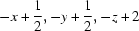
| Symmetry codes: (ii) x, −y, z−1/2; (iii) −x+1/2, −y+1/2, −z+2. |
Experimental details
| Crystal data | |
| Chemical formula | C6H10N22+·2NO3− |
| Mr | 234.18 |
| Crystal system, space group | Monoclinic, C2/c |
| Temperature (K) | 100 |
| a, b, c (Å) | 16.2548 (12), 9.6212 (8), 7.1070 (6) |
| β (°) | 115.506 (6) |
| V (Å3) | 1003.14 (14) |
| Z | 4 |
| Radiation type | Cu Kα |
| µ (mm−1) | 1.22 |
| Crystal size (mm) | 0.53 × 0.50 × 0.24 |
| Data collection | |
| Diffractometer | Bruker APEX CCD area-detector |
| Absorption correction | Multi-scan (SADABS; Sheldrick, 2007) |
| Tmin, Tmax | 0.562, 0.761 |
| No. of measured, independent and observed [I > 2σ(I)] reflections | 5278, 942, 882 |
| Rint | 0.036 |
| (sin θ/λ)max (Å−1) | 0.608 |
| Refinement | |
| R[F2 > 2σ(F2)], wR(F2), S | 0.033, 0.092, 1.01 |
| No. of reflections | 942 |
| No. of parameters | 84 |
| H-atom treatment | H atoms treated by a mixture of independent and constrained refinement |
| Δρmax, Δρmin (e Å−3) | 0.26, −0.20 |
Computer programs: SMART (Bruker, 1998), SAINT (Bruker, 1998), SHELXTL (Sheldrick, 2008).
| D—H···A | D—H | H···A | D···A | D—H···A |
| N5—H5A···O1A | 0.94 (2) | 1.87 (2) | 2.7955 (15) | 168 (2) |
| N5—H5B···O1Ai | 0.92 (2) | 1.95 (2) | 2.8416 (16) | 163 (2) |
| N5—H5C···O3Aii | 0.92 (2) | 1.96 (2) | 2.8626 (16) | 167 (2) |
| Symmetry codes: (i) x, −y, z−1/2; (ii) −x+1/2, −y+1/2, −z+2. |
Acknowledgements
This work was supported by the National Center for Research Resources (grant No. G12RR013459) and the National Institutes of Health (NIH) Science Education Partnership Award (SEPA) Program `Recovery Act Administrative Supplements Providing Summer Research Research Experiences for Students and Science Educators' under contract 5R25RR020405–04S1. Funds to purchase the diffractometer used in this study were provided in part by the National Science Foundation (grant No. CHE-0130835).
References
 Anderson, K. M., Goeta, K. M., Hancock, K. S. B. & Steed, J. W. (2006). Chem. Commun. pp. 2138–2140. Web of Science CSD CrossRef Google Scholar
Bianchi, A., García-España, E. & Bowman-James, K. (1997). Supramolecular Chemistry of Anions. New York: Wiley-VCH. Google Scholar
Bruker (1998). SMART and SAINT. Bruker AXS, Inc., Madison, Wisconsin, USA. Google Scholar
Gawlicka-Chruszcz, A. & Stadnicka, K. (2002). Acta Cryst. C58, o416–o420. Web of Science CSD CrossRef CAS IUCr Journals Google Scholar
Hossain, M. A. (2008). Curr. Org. Chem. 12, 1231–1256. Web of Science CrossRef CAS Google Scholar
Ilioudis, C. A., Georganopoulou, D. G. & Steed, J. W. (2002). CrystEngComm, 4, 26–36. Web of Science CSD CrossRef Google Scholar
Sheldrick, G. M. (2007). SADABS. University of Göttingen, Germany. Google Scholar
Sheldrick, G. M. (2008). Acta Cryst. A64, 112–122. Web of Science CrossRef CAS IUCr Journals Google Scholar
Soumhi, E. H. & Jouini, T. (1995). Acta Cryst. C51, 1457–1459. CSD CrossRef CAS Web of Science IUCr Journals Google Scholar
Wang, K.-W., Zhang, H. & Shen, L.-Q. (2007). Acta Cryst. E63, o126–o128. Web of Science CSD CrossRef IUCr Journals Google Scholar
This is an open-access article distributed under the terms of the Creative Commons Attribution (CC-BY) Licence, which permits unrestricted use, distribution, and reproduction in any medium, provided the original authors and source are cited.
| CRYSTALLOGRAPHIC COMMUNICATIONS |


Simple polyammonium ions are known as excellent hydrogen bond donors for a variety of anions in particular for oxoanions, forming supramolecular aggregates with hydrogen bonding networks (Ilioudis et al., 2002). Indeed, a difunctional or trifunctional polyamine is widely used as an essential building block for a macrocyclic based host, and acts as major binding components for a negatively charged anion (Bianchi et al., 1997; Hossain, 2008). In this study, we used a simple 1,3-phenylenediamine to prepare an adduct with nitric acid. We report, herein, the crystal structure of the title compound in which the nitrate anions are connected to the cationic units through hydrogen bonding interactions.
X-ray analysis of the nitrate salt reveals that both amino groups are protonated to form a dication and crystallized with two nitrate anions. In the crystal lattice, each diaction is surrounded by two symmetry related nitrate anions (Fig. 1). Each amino group is engaged in coordinating nitrate anions through N—H ···O bonds ranging from 2.7955 (15) to 2.8626 (16) Å (see Table 1). The crystal structure viewed along the b axis shows that the cations are arranged antiparallel to one another along the c axis in which two adjacent aromatic units are separated at 7.024 Å (Fig. 2). Therefore, there is no π-π stacking involved. The nitrates serve as linkers of the two adjacent aromatic units by hydrogen bonding networks along the b axis.