 | Acta Crystallographica Section E Acta Crystallographica Section E CRYSTALLOGRAPHIC COMMUNICATIONS |


 journal menu


metal-organic compounds
| CRYSTALLOGRAPHIC COMMUNICATIONS |
 access
[N-(2-Hydroxyethyl)ethylenediamine]oxalatocopper(II)

aDepartment of Physics, Faculty of Arts and Sciences, Ondokuz Mayıs University, Kurupelit TR-55139, Samsun, Turkey, and bDepartment of Chemistry, Faculty of Arts and Sciences, Eskişehir Osmangazi University, TR-26480 Eskişehir, Turkey
*Correspondence e-mail: [email protected]
In the title mononuclear copper(II) compound, [Cu(C2O4)(C4H12N2O)], the CuII ion has a slightly distorted square-pyramidal geometry, with a tridentate N-(2-hydroxyethyl)ethylenediamine (HydEt-en) and a bidentate oxalate (ox) ligand. The N atoms of the HydEt-en ligand and the O atoms of ox ligand form the basal plane, while the O atom of the ethanol group of the HydEt-en ligand is located in the axial position. The complex molecules participate in a supramolecular assembly through N—H⋯O and O—H⋯O hydrogen bonds between HydEt-en and ox ligands.
Related literature
For general background to the HydEt-en ligand, see: Karadağ et al. (2004![[Karadağ, A., Paşaoğlu, H., Kaştaş, G. & Büyükgüngör, O. (2004). Acta Cryst. C60, m581-m583.]](../../../../../../logos/arrows/e_arr.gif "Karadağ, A., Paşaoğlu, H., Kaştaş, G. & Büyükgüngör, O. (2004). Acta Cryst. C60, m581-m583.") , 2005); Paşaoğlu et al. (2005). For transition metal complexes of oxalate, see: Scott et al. (1973); Xia et al. (2004); Yılmaz et al. (2003); Youngme et al. (2003). For graph-set notation, see: Bernstein et al. (1995).
, 2005); Paşaoğlu et al. (2005). For transition metal complexes of oxalate, see: Scott et al. (1973); Xia et al. (2004); Yılmaz et al. (2003); Youngme et al. (2003). For graph-set notation, see: Bernstein et al. (1995).
![[Scheme 1]](ci2929scheme1.gif)
Experimental
Crystal data
|
| ||||||||||||||
|
 ; (ii)
  ; (iii)
  ; (iv)
  .
. Data collection: X-AREA (Stoe & Cie, 2002); cell refinement: X-AREA; data reduction: X-RED32 (Stoe & Cie, 2002); program(s) used to solve structure: SHELXS97 (Sheldrick, 2008); program(s) used to refine structure: SHELXL97 (Sheldrick, 2008); molecular graphics: ORTEP-3 (Farrugia, 1997); software used to prepare material for publication: WinGX (Farrugia, 1999).
Supporting information
contains datablocks global, I. DOI: https://doi.org/10.1107/S1600536809040264/ci2929sup1.cif
Structure factors: contains datablock I. DOI: https://doi.org/10.1107/S1600536809040264/ci2929Isup2.hkl
The HydEt-en ligand (0.12 g, 2 mmol) was added dropwise to a solution of Cu(ox).0.5H2O (0.48 g, 3.0 mmol) in pyridine-water (1:2, 30 ml) at 50° C. The resulting solution was stirred for 1 h at 50° C and then filtered. The reaction mixture was then slowly cooled to room temperature. Violet crystals suitable for X-ray were obtained after a few days and were washed with 5 ml of ethanol and dried in air.
All H atoms involved in hydrogen bondings were located in a difference Fourier map and their positional and Uiso parameters were refined. The remaining H atoms were placed in calculated positions and constrained to ride on their parents atoms, with C-H = 0.97 Å and Uiso(H) = 1.2Ueq(C).
As part of our ongoing research on the preparation and characterization of mixed ligand metal complexes of HydEt-en we report here the synthesis and X-ray analysis of a mononuclear copper(II) complex, [Cu(HydEt-en)(ox)]. This study is an example of the construction of a supramolecular assembly based on hydrogen bonds in mixed-ligand metal complexes.
In title compound, the HydEt-en ligand chelates through its two N atoms and the O atom of the hydroxyl group. The square-pyramidal coordination shell consists of three five-membered chelate rings (Fig. 1) viz. A (Cu1/O1/C1/C2/O4), B (Cu1/N1/C5/C6/N2) and C (Cu1/O5/C3/C4/N1). The mean plane through ring C is perpendicular to that through the ring A, with a dihedral angle of 89.27 (5)°. The bite angles of rings B and C are 86.36 (7)° and 78.65 (7)°, respectively.
The complex participates in a supramolecular assembly through N—H···O and O—H···O hydrogen bonds between HydEt-en and oxalate ligands. The HydEt-en ligand is involved in hydrogen bonds through its amino, imino and hydroxyl groups. In the (Fig. 2), N1—H1···O4i and N2—H2A···O1ii (Table 2) hydrogen bonds constitute a polymeric chain parallel to the [010], giving rise to C(4) chain and R22(8) (Bernstein et al., 1995) rings. These polymeric chains are inter-connected to each other by N2—H2B···O2iii and O5—H5···O3iv hydrogen bonds extending through the ac plane, resulting in a three-dimensional supramolecular network as illustrated in Fig. 3.
For general background to the HydEt-en ligand, see: Karadağ et al. (2004, 2005); Paşaoğlu et al. (2005). For the of oxalate, see: Scott et al. (1973); Xia et al. (2004); Yılmaz et al. (2003); Youngme et al. (2003). For graph-set notation, see: Bernstein et al. (1995).
Data collection: X-AREA (Stoe & Cie, 2002); cell X-AREA (Stoe & Cie, 2002); data reduction: X-RED32 (Stoe & Cie, 2002); program(s) used to solve structure: SHELXS97 (Sheldrick, 2008); program(s) used to refine structure: SHELXL97 (Sheldrick, 2008); molecular graphics: ORTEP-3 (Farrugia, 1997); software used to prepare material for publication: WinGX (Farrugia, 1999).
![[Figure 1]](./ci2929fig1thm.gif) | Fig. 1. The molecular structure of [Cu(HydEt-en)(ox)] with atom-labeling scheme. Displacement ellipsoids are drawn at the 30% probability level for the non hydrogen atoms. |
![[Figure 2]](./ci2929fig2thm.gif) | Fig. 2. The assembly of polymeric chains of [Cu(HydEt-en)(ox)] into a two-dimensional layer by N—H···O and O—H···O hydrogen bonds. H atoms not involved in hydrogen bondings have been omitted for clarity. Symmetry codes are as given in Table 2 |
![[Figure 3]](./ci2929fig3thm.gif) | Fig. 3. The supramolecular network of [Cu(HydEt-en)(ox)] projected onto (010). All H atoms except H2b and H5 have been omitted for clarity. Symmetry codes are as given in Table 2. |
| [Cu(C2O4)(C4H12N2O)] | F(000) = 524 |
| Mr = 255.72 | Dx = 1.874 Mg m−3 |
| Orthorhombic, P212121 | Mo Kα radiation, λ = 0.71073 Å |
| Hall symbol: P 2ac 2ab | Cell parameters from 10045 reflections |
| a = 7.9766 (5) Å | θ = 1.6–28.0° |
| b = 8.7263 (4) Å | µ = 2.41 mm−1 |
| c = 13.0191 (7) Å | T = 296 K |
| V = 906.21 (9) Å3 | Prism, violet |
| Z = 4 | 0.52 × 0.42 × 0.23 mm |
| Stoe IPDS-II diffractometer | 1868 independent reflections |
| Radiation source: fine-focus sealed tube | 1780 reflections with I > 2σ(I) |
| Plane graphite monochromator | Rint = 0.063 |
| Detector resolution: 6.67 pixels mm-1 | θmax = 26.5°, θmin = 2.8° |
| ω scans | h = −10→10 |
| Absorption correction: integration (X-RED32; Stoe & Cie, 2002) | k = −10→10 |
| Tmin = 0.570, Tmax = 0.781 | l = −15→16 |
| 10045 measured reflections |
| Refinement on F2 | Secondary atom site location: difference Fourier map |
| Least-squares matrix: full | Hydrogen site location: inferred from neighbouring sites |
| R[F2 > 2σ(F2)] = 0.029 | H atoms treated by a mixture of independent and constrained refinement |
| wR(F2) = 0.065 | w = 1/[σ2(Fo2) + (0.0427P)2] where P = (Fo2 + 2Fc2)/3 |
| S = 1.08 | (Δ/σ)max = 0.001 |
| 1868 reflections | Δρmax = 0.22 e Å−3 |
| 143 parameters | Δρmin = −1.30 e Å−3 |
| 0 restraints | Absolute structure: Flack (1983), 797 Friedel pairs |
| Primary atom site location: structure-invariant direct methods | Absolute structure parameter: 0.017 (17) |
| [Cu(C2O4)(C4H12N2O)] | V = 906.21 (9) Å3 |
| Mr = 255.72 | Z = 4 |
| Orthorhombic, P212121 | Mo Kα radiation |
| a = 7.9766 (5) Å | µ = 2.41 mm−1 |
| b = 8.7263 (4) Å | T = 296 K |
| c = 13.0191 (7) Å | 0.52 × 0.42 × 0.23 mm |
| Stoe IPDS-II diffractometer | 1868 independent reflections |
| Absorption correction: integration (X-RED32; Stoe & Cie, 2002) | 1780 reflections with I > 2σ(I) |
| Tmin = 0.570, Tmax = 0.781 | Rint = 0.063 |
| 10045 measured reflections |
| R[F2 > 2σ(F2)] = 0.029 | H atoms treated by a mixture of independent and constrained refinement |
| wR(F2) = 0.065 | Δρmax = 0.22 e Å−3 |
| S = 1.08 | Δρmin = −1.30 e Å−3 |
| 1868 reflections | Absolute structure: Flack (1983), 797 Friedel pairs |
| 143 parameters | Absolute structure parameter: 0.017 (17) |
| 0 restraints |
Geometry. All e.s.d.'s (except the e.s.d. in the dihedral angle between two l.s. planes) are estimated using the full covariance matrix. The cell e.s.d.'s are taken into account individually in the estimation of e.s.d.'s in distances, angles and torsion angles; correlations between e.s.d.'s in cell parameters are only used when they are defined by crystal symmetry. An approximate (isotropic) treatment of cell e.s.d.'s is used for estimating e.s.d.'s involving l.s. planes. |
Refinement. Refinement of F2 against ALL reflections. The weighted R-factor wR and goodness of fit S are based on F2, conventional R-factors R are based on F, with F set to zero for negative F2. The threshold expression of F2 > σ(F2) is used only for calculating R-factors(gt) etc. and is not relevant to the choice of reflections for refinement. R-factors based on F2 are statistically about twice as large as those based on F, and R- factors based on ALL data will be even larger. |
| x | y | z | Uiso*/Ueq | ||
| C1 | 0.6054 (2) | 0.4652 (2) | 0.44437 (15) | 0.0242 (4) | |
| C2 | 0.7217 (3) | 0.3322 (2) | 0.41059 (16) | 0.0274 (4) | |
| C3 | 0.1649 (3) | 0.2157 (3) | 0.28011 (18) | 0.0389 (5) | |
| H3A | 0.0821 | 0.1836 | 0.3302 | 0.047* | |
| H3B | 0.1451 | 0.1589 | 0.2172 | 0.047* | |
| C4 | 0.1448 (3) | 0.3853 (2) | 0.25922 (18) | 0.0374 (5) | |
| H4A | 0.0389 | 0.4029 | 0.2244 | 0.045* | |
| H4B | 0.1422 | 0.4404 | 0.3239 | 0.045* | |
| C5 | 0.2752 (3) | 0.3933 (3) | 0.08732 (16) | 0.0334 (4) | |
| H5A | 0.1974 | 0.4569 | 0.0492 | 0.040* | |
| H5B | 0.2357 | 0.2883 | 0.0845 | 0.040* | |
| C6 | 0.4476 (3) | 0.4039 (3) | 0.04004 (16) | 0.0339 (4) | |
| H6A | 0.4487 | 0.3530 | −0.0262 | 0.041* | |
| H6B | 0.4780 | 0.5105 | 0.0299 | 0.041* | |
| Cu1 | 0.50643 (3) | 0.38250 (2) | 0.252350 (16) | 0.02606 (11) | |
| N1 | 0.2830 (2) | 0.44501 (19) | 0.19527 (13) | 0.0271 (4) | |
| N2 | 0.5680 (2) | 0.3297 (2) | 0.11000 (14) | 0.0282 (4) | |
| O1 | 0.48949 (18) | 0.49776 (14) | 0.38029 (11) | 0.0288 (3) | |
| O2 | 0.6303 (2) | 0.53159 (18) | 0.52577 (12) | 0.0364 (4) | |
| O3 | 0.8216 (2) | 0.27578 (18) | 0.47136 (13) | 0.0408 (4) | |
| O4 | 0.70385 (19) | 0.28980 (16) | 0.31740 (11) | 0.0328 (3) | |
| O5 | 0.3275 (2) | 0.18117 (19) | 0.31756 (14) | 0.0351 (3) | |
| H1 | 0.280 (3) | 0.542 (3) | 0.1959 (18) | 0.028 (6)* | |
| H2A | 0.559 (3) | 0.223 (3) | 0.102 (2) | 0.038 (7)* | |
| H2B | 0.668 (4) | 0.371 (4) | 0.093 (2) | 0.052 (8)* | |
| H5 | 0.319 (3) | 0.186 (3) | 0.373 (2) | 0.030 (7)* |
| U11 | U22 | U33 | U12 | U13 | U23 | |
| C1 | 0.0248 (9) | 0.0247 (8) | 0.0231 (9) | −0.0019 (7) | −0.0017 (8) | −0.0006 (7) |
| C2 | 0.0259 (9) | 0.0240 (8) | 0.0323 (10) | 0.0001 (8) | −0.0045 (8) | 0.0010 (8) |
| C3 | 0.0350 (12) | 0.0418 (11) | 0.0400 (11) | −0.0101 (10) | −0.0008 (10) | 0.0076 (9) |
| C4 | 0.0307 (10) | 0.0416 (11) | 0.0399 (13) | 0.0025 (8) | 0.0031 (9) | 0.0028 (11) |
| C5 | 0.0340 (10) | 0.0397 (10) | 0.0266 (10) | −0.0020 (10) | −0.0076 (8) | 0.0005 (9) |
| C6 | 0.0419 (11) | 0.0360 (9) | 0.0238 (10) | −0.0051 (9) | −0.0019 (9) | 0.0035 (8) |
| Cu1 | 0.02695 (16) | 0.02892 (15) | 0.02230 (18) | 0.00454 (9) | −0.00390 (9) | −0.00309 (8) |
| N1 | 0.0286 (8) | 0.0228 (8) | 0.0299 (9) | 0.0020 (6) | −0.0050 (7) | −0.0012 (6) |
| N2 | 0.0280 (9) | 0.0289 (8) | 0.0276 (9) | −0.0039 (7) | 0.0030 (7) | −0.0019 (7) |
| O1 | 0.0315 (7) | 0.0291 (6) | 0.0258 (6) | 0.0055 (6) | −0.0055 (6) | −0.0039 (5) |
| O2 | 0.0366 (9) | 0.0409 (7) | 0.0316 (8) | 0.0008 (7) | −0.0068 (7) | −0.0103 (7) |
| O3 | 0.0415 (9) | 0.0449 (8) | 0.0359 (8) | 0.0151 (7) | −0.0119 (7) | −0.0018 (7) |
| O4 | 0.0321 (7) | 0.0363 (8) | 0.0299 (7) | 0.0109 (6) | −0.0046 (7) | −0.0068 (6) |
| O5 | 0.0370 (8) | 0.0366 (8) | 0.0318 (8) | −0.0002 (7) | 0.0049 (7) | 0.0061 (7) |
| C1—O2 | 1.224 (2) | C5—H5A | 0.97 |
| C1—O1 | 1.277 (2) | C5—H5B | 0.97 |
| C1—C2 | 1.549 (3) | C6—N2 | 1.473 (3) |
| C2—O3 | 1.226 (3) | C6—H6A | 0.97 |
| C2—O4 | 1.276 (3) | C6—H6B | 0.97 |
| C3—O5 | 1.418 (3) | Cu1—O1 | 1.9505 (13) |
| C3—C4 | 1.514 (3) | Cu1—O4 | 1.9625 (14) |
| C3—H3A | 0.97 | Cu1—N2 | 1.9717 (18) |
| C3—H3B | 0.97 | Cu1—N1 | 2.0066 (18) |
| C4—N1 | 1.477 (3) | Cu1—O5 | 2.4174 (16) |
| C4—H4A | 0.97 | N1—H1 | 0.85 (3) |
| C4—H4B | 0.97 | N2—H2A | 0.94 (3) |
| C5—N1 | 1.477 (3) | N2—H2B | 0.91 (3) |
| C5—C6 | 1.509 (3) | O5—H5 | 0.72 (3) |
| O2—C1—O1 | 125.27 (18) | H6A—C6—H6B | 108.4 |
| O2—C1—C2 | 120.22 (17) | O1—Cu1—O4 | 84.24 (6) |
| O1—C1—C2 | 114.50 (16) | O1—Cu1—N2 | 160.11 (7) |
| O3—C2—O4 | 124.72 (19) | O4—Cu1—N2 | 96.29 (7) |
| O3—C2—C1 | 120.44 (18) | O1—Cu1—N1 | 96.58 (6) |
| O4—C2—C1 | 114.83 (16) | O4—Cu1—N1 | 169.93 (7) |
| O5—C3—C4 | 111.52 (19) | N2—Cu1—N1 | 86.36 (7) |
| O5—C3—H3A | 109.3 | O1—Cu1—O5 | 91.94 (6) |
| C4—C3—H3A | 109.3 | O4—Cu1—O5 | 91.30 (6) |
| O5—C3—H3B | 109.3 | N2—Cu1—O5 | 107.90 (7) |
| C4—C3—H3B | 109.3 | N1—Cu1—O5 | 78.65 (7) |
| H3A—C3—H3B | 108.0 | C4—N1—C5 | 113.41 (17) |
| N1—C4—C3 | 111.52 (19) | C4—N1—Cu1 | 111.01 (13) |
| N1—C4—H4A | 109.3 | C5—N1—Cu1 | 107.84 (13) |
| C3—C4—H4A | 109.3 | C4—N1—H1 | 109.0 (17) |
| N1—C4—H4B | 109.3 | C5—N1—H1 | 108.3 (16) |
| C3—C4—H4B | 109.3 | Cu1—N1—H1 | 107.1 (16) |
| H4A—C4—H4B | 108.0 | C6—N2—Cu1 | 108.44 (13) |
| N1—C5—C6 | 109.33 (17) | C6—N2—H2A | 108.3 (16) |
| N1—C5—H5A | 109.8 | Cu1—N2—H2A | 108.5 (16) |
| C6—C5—H5A | 109.8 | C6—N2—H2B | 104 (2) |
| N1—C5—H5B | 109.8 | Cu1—N2—H2B | 111 (2) |
| C6—C5—H5B | 109.8 | H2A—N2—H2B | 116 (3) |
| H5A—C5—H5B | 108.3 | C1—O1—Cu1 | 113.13 (11) |
| N2—C6—C5 | 108.33 (17) | C2—O4—Cu1 | 112.35 (12) |
| N2—C6—H6A | 110.0 | C3—O5—Cu1 | 105.36 (12) |
| C5—C6—H6A | 110.0 | C3—O5—H5 | 104 (2) |
| N2—C6—H6B | 110.0 | Cu1—O5—H5 | 112 (2) |
| C5—C6—H6B | 110.0 | ||
| O2—C1—C2—O3 | 11.9 (3) | O4—Cu1—N2—C6 | −173.13 (13) |
| O1—C1—C2—O3 | −169.41 (19) | N1—Cu1—N2—C6 | 16.62 (13) |
| O2—C1—C2—O4 | −167.92 (19) | O5—Cu1—N2—C6 | 93.46 (14) |
| O1—C1—C2—O4 | 10.8 (2) | O2—C1—O1—Cu1 | 173.14 (16) |
| O5—C3—C4—N1 | 50.6 (3) | C2—C1—O1—Cu1 | −5.5 (2) |
| N1—C5—C6—N2 | 49.2 (2) | O4—Cu1—O1—C1 | 0.32 (13) |
| C3—C4—N1—C5 | 71.6 (2) | N2—Cu1—O1—C1 | −92.3 (2) |
| C3—C4—N1—Cu1 | −50.0 (2) | N1—Cu1—O1—C1 | 170.23 (14) |
| C6—C5—N1—C4 | −157.56 (17) | O5—Cu1—O1—C1 | 91.43 (13) |
| C6—C5—N1—Cu1 | −34.2 (2) | O3—C2—O4—Cu1 | 170.12 (18) |
| O1—Cu1—N1—C4 | −64.96 (14) | C1—C2—O4—Cu1 | −10.1 (2) |
| O4—Cu1—N1—C4 | 29.1 (4) | O1—Cu1—O4—C2 | 5.92 (14) |
| N2—Cu1—N1—C4 | 134.79 (14) | N2—Cu1—O4—C2 | 165.93 (14) |
| O5—Cu1—N1—C4 | 25.71 (13) | N1—Cu1—O4—C2 | −89.3 (4) |
| O1—Cu1—N1—C5 | 170.23 (13) | O5—Cu1—O4—C2 | −85.90 (14) |
| O4—Cu1—N1—C5 | −95.7 (4) | C4—C3—O5—Cu1 | −25.7 (2) |
| N2—Cu1—N1—C5 | 9.98 (14) | O1—Cu1—O5—C3 | 96.66 (14) |
| O5—Cu1—N1—C5 | −99.10 (14) | O4—Cu1—O5—C3 | −179.06 (14) |
| C5—C6—N2—Cu1 | −39.46 (19) | N2—Cu1—O5—C3 | −82.02 (15) |
| O1—Cu1—N2—C6 | −82.7 (2) | N1—Cu1—O5—C3 | 0.34 (14) |
| D—H···A | D—H | H···A | D···A | D—H···A |
| N1—H1···O4i | 0.85 (3) | 2.17 (3) | 3.015 (2) | 173 (2) |
| N2—H2A···O1ii | 0.94 (3) | 2.02 (3) | 2.936 (2) | 165 (2) |
| N2—H2B···O2iii | 0.91 (3) | 2.02 (3) | 2.909 (2) | 168 (3) |
| O5—H5···O3iv | 0.72 (3) | 2.06 (3) | 2.774 (3) | 171 (3) |
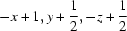
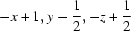
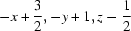
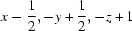
| Symmetry codes: (i) −x+1, y+1/2, −z+1/2; (ii) −x+1, y−1/2, −z+1/2; (iii) −x+3/2, −y+1, z−1/2; (iv) x−1/2, −y+1/2, −z+1. |
Experimental details
| Crystal data | |
| Chemical formula | [Cu(C2O4)(C4H12N2O)] |
| Mr | 255.72 |
| Crystal system, space group | Orthorhombic, P212121 |
| Temperature (K) | 296 |
| a, b, c (Å) | 7.9766 (5), 8.7263 (4), 13.0191 (7) |
| V (Å3) | 906.21 (9) |
| Z | 4 |
| Radiation type | Mo Kα |
| µ (mm−1) | 2.41 |
| Crystal size (mm) | 0.52 × 0.42 × 0.23 |
| Data collection | |
| Diffractometer | Stoe IPDS-II |
| Absorption correction | Integration (X-RED32; Stoe & Cie, 2002) |
| Tmin, Tmax | 0.570, 0.781 |
| No. of measured, independent and observed [I > 2σ(I)] reflections | 10045, 1868, 1780 |
| Rint | 0.063 |
| (sin θ/λ)max (Å−1) | 0.628 |
| Refinement | |
| R[F2 > 2σ(F2)], wR(F2), S | 0.029, 0.065, 1.08 |
| No. of reflections | 1868 |
| No. of parameters | 143 |
| H-atom treatment | H atoms treated by a mixture of independent and constrained refinement |
| Δρmax, Δρmin (e Å−3) | 0.22, −1.30 |
| Absolute structure | Flack (1983), 797 Friedel pairs |
| Absolute structure parameter | 0.017 (17) |
Computer programs: X-AREA (Stoe & Cie, 2002), X-RED32 (Stoe & Cie, 2002), SHELXS97 (Sheldrick, 2008), SHELXL97 (Sheldrick, 2008), ORTEP-3 (Farrugia, 1997), WinGX (Farrugia, 1999).
| Cu1—O1 | 1.9505 (13) | Cu1—N1 | 2.0066 (18) |
| Cu1—O4 | 1.9625 (14) | Cu1—O5 | 2.4174 (16) |
| Cu1—N2 | 1.9717 (18) |
| D—H···A | D—H | H···A | D···A | D—H···A |
| N1—H1···O4i | 0.85 (3) | 2.17 (3) | 3.015 (2) | 173 (2) |
| N2—H2A···O1ii | 0.94 (3) | 2.02 (3) | 2.936 (2) | 165 (2) |
| N2—H2B···O2iii | 0.91 (3) | 2.02 (3) | 2.909 (2) | 168 (3) |
| O5—H5···O3iv | 0.72 (3) | 2.06 (3) | 2.774 (3) | 171 (3) |
| Symmetry codes: (i) −x+1, y+1/2, −z+1/2; (ii) −x+1, y−1/2, −z+1/2; (iii) −x+3/2, −y+1, z−1/2; (iv) x−1/2, −y+1/2, −z+1. |
Acknowledgements
The authors thank Professor Orhan Büyükgüngör for his help with the data collection and acknowledge the Faculty of Arts and Sciences, Ondokuz Mayıs University, Turkey, for the use of the Stoe IPDS-II diffractometer (purchased under grant No. F279 of the University Research Fund).
References
 Bernstein, J., Davis, R. E., Shimoni, L. & Chang, N. L. (1995). Angew. Chem. Int. Ed. Engl. 34, 1555–1573. CrossRef CAS Web of Science Google Scholar
Farrugia, L. J. (1997). J. Appl. Cryst. 30, 565. CrossRef IUCr Journals Google Scholar
Farrugia, L. J. (1999). J. Appl. Cryst. 32, 837–838. CrossRef CAS IUCr Journals Google Scholar
Flack, H. D. (1983). Acta Cryst. A39, 876–881. CrossRef CAS Web of Science IUCr Journals Google Scholar
Karadağ, A., Paşaoğlu, H., Kaştaş, G. & Büyükgüngör, O. (2004). Acta Cryst. C60, m581–m583. Web of Science CSD CrossRef IUCr Journals Google Scholar
Karadağ, A., Paşaoğlu, H., Kaştaş, G. & Büyükgüngör, O. (2005). Z. Kristallogr. 220, 74–78. Google Scholar
Paşaoğlu, H., Karadağ, A., Tezcan, F. & Büyükgüngör, O. (2005). Acta Cryst. C61, m93–m94. Web of Science CSD CrossRef IUCr Journals Google Scholar
Scott, K. L., Wieghardt, K. & Sykes, A. G. (1973). Inorg. Chem. 12, 655–663. CrossRef CAS Web of Science Google Scholar
Sheldrick, G. M. (2008). Acta Cryst. A64, 112–122. Web of Science CrossRef CAS IUCr Journals Google Scholar
Stoe & Cie (2002). X-RED32 and X-AREA. Stoe & Cie, Darmstadt, Germany. Google Scholar
Xia, S. Q., Hu, S. M., Dai, J. C., Wu, X. T., Fu, Z. Y., Zhang, J. J. & Du, W. X. (2004). Polyhedron, 23, 1003–1009. Web of Science CSD CrossRef CAS Google Scholar
Yılmaz, V. T., Senel, E. & Thoene, C. (2003). J. Coord. Chem. 56, 1417–1423. Google Scholar
Youngme, S., Albada, G. A., Chaichit, N., Gunnasoot, P., Kongsaeree, P., Mutikainen, I., Roubeau, O., Reedijk, J. & Turpeinen, U. (2003). Inorg. Chim. Acta, 353, 119–128. Web of Science CSD CrossRef CAS Google Scholar
This is an open-access article distributed under the terms of the Creative Commons Attribution (CC-BY) Licence, which permits unrestricted use, distribution, and reproduction in any medium, provided the original authors and source are cited.
| CRYSTALLOGRAPHIC COMMUNICATIONS |
access


As part of our ongoing research on the preparation and characterization of mixed ligand metal complexes of HydEt-en we report here the synthesis and X-ray analysis of a mononuclear copper(II) complex, [Cu(HydEt-en)(ox)]. This study is an example of the construction of a supramolecular assembly based on hydrogen bonds in mixed-ligand metal complexes.
In title compound, the HydEt-en ligand chelates through its two N atoms and the O atom of the hydroxyl group. The square-pyramidal coordination shell consists of three five-membered chelate rings (Fig. 1) viz. A (Cu1/O1/C1/C2/O4), B (Cu1/N1/C5/C6/N2) and C (Cu1/O5/C3/C4/N1). The mean plane through ring C is perpendicular to that through the ring A, with a dihedral angle of 89.27 (5)°. The bite angles of rings B and C are 86.36 (7)° and 78.65 (7)°, respectively.
The complex participates in a supramolecular assembly through N—H···O and O—H···O hydrogen bonds between HydEt-en and oxalate ligands. The HydEt-en ligand is involved in hydrogen bonds through its amino, imino and hydroxyl groups. In the crystal structure (Fig. 2), N1—H1···O4i and N2—H2A···O1ii (Table 2) hydrogen bonds constitute a polymeric chain parallel to the [010], giving rise to C(4) chain and R22(8) (Bernstein et al., 1995) rings. These polymeric chains are inter-connected to each other by N2—H2B···O2iii and O5—H5···O3iv hydrogen bonds extending through the ac plane, resulting in a three-dimensional supramolecular network as illustrated in Fig. 3.