 | Acta Crystallographica Section E Acta Crystallographica Section E CRYSTALLOGRAPHIC COMMUNICATIONS |


 journal menu


metal-organic compounds
| CRYSTALLOGRAPHIC COMMUNICATIONS |
 access
Bis(1-carbamimidoyl-2-ethylisourea)copper(II) dinitrate

aDepartment of Chemistry and Center of Excellence for Innovation in Chemistry, Faculty of Science, Khon Kaen University, Khon Kaen 40002, Thailand, and bDepartment of Chemistry, Prince of Songkla University, Hatyai 90112, Thailand
*Correspondence e-mail: [email protected]
The copper(II) complex, [Cu(C4H10N4O)2](NO3)2 or [Cu(L1e)2](NO3)2, where L1e is 1-carbamimidoyl-2-ethylisourea, was obtained from a 1:2 molar ratio of copper(II) nitrate hemipentahydrate with 2-cyanoguanidine in ethanol. The consists of the centrosymmetric [Cu(L1e)2]2+ cation and two NO3− counter-anions. The cation exhibits four-coordinate bonding of the two N,N-bidentate ligands and the CuII atom through the N-donor atoms, yielding a square-planar CuN4 geometry. Intermolecular N—H⋯O hydrogen bonds link between the cation and and counter-anion, forming a two-dimentional layered structure extending parallel to ( 01).
01).
Related literature
For a copper(II) complex containg the same N,N-bidentate 1-carbamimidoyl-2-ethylisourea ligand but with the charge balance provided by two chloride and perchlorate anions, see: Begley et al. (1986![[Begley, M. J., Hubberstey, P. & Moore, C. H. M. (1986). J. Chem. Res. (S), pp. 172-173. ]](../../../../../../logos/arrows/e_arr.gif "Begley, M. J., Hubberstey, P. & Moore, C. H. M. (1986). J. Chem. Res. (S), pp. 172-173.") ); Meenongwa et al. (2009).
); Meenongwa et al. (2009).
![[Scheme 1]](ds2008scheme1.gif)
Experimental
Crystal data
|
Refinement
|
| |||||||||||||||||||||||||||
| ||||||||||||||||||||||||||||||||
 ; (iii)
  .
. Data collection: SMART (Bruker, 1998); cell refinement: SAINT (Bruker, 2003); data reduction: SAINT; program(s) used to solve structure: SHELXS97 (Sheldrick, 2008); program(s) used to refine structure: SHELXL97 (Sheldrick, 2008); molecular graphics: SHELXTL (Sheldrick, 2008); software used to prepare material for publication: enCIFer (Allen et al., 2004) and publCIF (Westrip, 2009).
Supporting information
contains datablocks global, I. DOI: https://doi.org/10.1107/S1600536809041932/ds2008sup1.cif
Structure factors: contains datablock I. DOI: https://doi.org/10.1107/S1600536809041932/ds2008Isup2.hkl
The initial product of the title complex was obtained from the reaction of 2-cyanoguanidine (0.1682 g, 2 mmol, Aldrich, 99%) with copper(II) nitrate hemipentahydrate (0.2325 g, 1 mmol, Sigma-Aldrich, 98%). The reaction was carried out in ethanol under refluxing condition for 24 h. The reddish-pink precipitate thus formed was isolated by filtration. The red block shaped single crystals were grown by slow vapor phase diffusion of methanol-ethanol solution of this products into toluene medium at room temperature for a week.
The was initially performed by direct method to locate the structural model. All non-hydrogen atoms were refined anisotropically. All hydrogen atoms were positioned geometrically and refined as riding atoms, with N—H = 0.86, C—H(methyl) = 0.96 and C—H(methylene) = 0.97 Å, and approximation with Uiso(H) = xUeq(C, N), where x = 1.5 for methyl H atoms and 1.2 for all others.
Herein, we report the structure of [Cu(L1e)2](NO3)2, which was obtained from the similar procedure as previously reported by Meenongwa et al. (2009), but using copper(II) nitrate hemipentahydrate. Structural determination on the title complex reveals a centrosymmetric [Cu(L1e)2]2+ cation and two NO3- counteranions. Fig. 1 shows the [Cu(L1e)2]2+ moiety. The square-planar CuN4 geometry is yielded by the coordination of the two N,N-bidentate ligands (Table 1) with Cu— N bond distances of 1.9313 (16) - 1.9650 (17) Å. Moreover, NO3- anions also contact to the neighboring cationic units by various hydrogen bonds of the type N—H···O (nitrate) to give a two dimentional layered structure (Fig. 2) as observed in the previuos [Cu(L1e)2](ClO4)2 complex.
For a copper(II) complex containg the same N,N-bidentate 1-carbamimidoyl-2-ethylisourea ligand but with the charge balance provided by two chloride and perchlorate anions, see: Begley et al. (1986); Meenongwa et al. (2009).
Data collection: SMART (Bruker, 1998); cell SAINT (Bruker, 2003); data reduction: SAINT (Bruker, 2003); program(s) used to solve structure: SHELXS97 (Sheldrick, 2008); program(s) used to refine structure: SHELXL97 (Sheldrick, 2008); molecular graphics: SHELXTL (Sheldrick, 2008); software used to prepare material for publication: enCIFer (Allen et al., 2004) and publCIF (Westrip, 2009).
![[Figure 1]](./ds2008fig1thm.gif) | Fig. 1. View of the title copper(II) complex, showing the atom numbering of the cationic [Cu(L1e)2]2+ moiety of [Cu(L1e)2](NO3)2. Displacement ellipsoids are drawn at the 50% probability level. |
![[Figure 2]](./ds2008fig2thm.gif) | Fig. 2. The crystal structure of [Cu(L1e)2](NO3)2 showing the linking of [Cu(L1e)2]2+ cation and NO3- counteranion along b axis. Hydrogen bonds are presented as a dashed lines. |
| [Cu(C4H10N4O)2](NO3)2 | F(000) = 462 |
| Mr = 447.89 | Dx = 1.675 Mg m−3 |
| Monoclinic, P21/n | Mo Kα radiation, λ = 0.71073 Å |
| Hall symbol: -P 2yn | Cell parameters from 4098 reflections |
| a = 5.2547 (6) Å | θ = 2.9–27.1° |
| b = 14.0087 (15) Å | µ = 1.29 mm−1 |
| c = 12.1511 (13) Å | T = 293 K |
| β = 96.982 (2)° | Block, red |
| V = 887.83 (17) Å3 | 0.26 × 0.16 × 0.11 mm |
| Z = 2 |
| Bruker SMART APEX CCD area detector diffractometer | 2206 independent reflections |
| Radiation source: fine-focus sealed tube | 1810 reflections with I > 2σ(I) |
| Graphite monochromator | Rint = 0.028 |
| Frames each covering 0.3 ° in ω scans | θmax = 28.3°, θmin = 2.2° |
| Absorption correction: multi-scan (SADABS; Bruker, 2003) | h = −7→7 |
| Tmin = 0.793, Tmax = 1.00 | k = −18→18 |
| 11998 measured reflections | l = −16→16 |
| Refinement on F2 | Primary atom site location: structure-invariant direct methods |
| Least-squares matrix: full | Secondary atom site location: difference Fourier map |
| R[F2 > 2σ(F2)] = 0.035 | Hydrogen site location: inferred from neighbouring sites |
| wR(F2) = 0.102 | H-atom parameters constrained |
| S = 1.05 | w = 1/[σ2(Fo2) + (0.0621P)2 + 0.2477P] where P = (Fo2 + 2Fc2)/3 |
| 2206 reflections | (Δ/σ)max < 0.001 |
| 125 parameters | Δρmax = 0.73 e Å−3 |
| 3 restraints | Δρmin = −0.27 e Å−3 |
| [Cu(C4H10N4O)2](NO3)2 | V = 887.83 (17) Å3 |
| Mr = 447.89 | Z = 2 |
| Monoclinic, P21/n | Mo Kα radiation |
| a = 5.2547 (6) Å | µ = 1.29 mm−1 |
| b = 14.0087 (15) Å | T = 293 K |
| c = 12.1511 (13) Å | 0.26 × 0.16 × 0.11 mm |
| β = 96.982 (2)° |
| Bruker SMART APEX CCD area detector diffractometer | 2206 independent reflections |
| Absorption correction: multi-scan (SADABS; Bruker, 2003) | 1810 reflections with I > 2σ(I) |
| Tmin = 0.793, Tmax = 1.00 | Rint = 0.028 |
| 11998 measured reflections |
| R[F2 > 2σ(F2)] = 0.035 | 3 restraints |
| wR(F2) = 0.102 | H-atom parameters constrained |
| S = 1.05 | Δρmax = 0.73 e Å−3 |
| 2206 reflections | Δρmin = −0.27 e Å−3 |
| 125 parameters |
Geometry. All e.s.d.'s (except the e.s.d. in the dihedral angle between two l.s. planes) are estimated using the full covariance matrix. The cell e.s.d.'s are taken into account individually in the estimation of e.s.d.'s in distances, angles and torsion angles; correlations between e.s.d.'s in cell parameters are only used when they are defined by crystal symmetry. An approximate (isotropic) treatment of cell e.s.d.'s is used for estimating e.s.d.'s involving l.s. planes. |
Refinement. Refinement of F2 against ALL reflections. The weighted R-factor wR and goodness of fit S are based on F2, conventional R-factors R are based on F, with F set to zero for negative F2. The threshold expression of F2 > σ(F2) is used only for calculating R-factors(gt) etc. and is not relevant to the choice of reflections for refinement. R-factors based on F2 are statistically about twice as large as those based on F, and R- factors based on ALL data will be even larger. |
| x | y | z | Uiso*/Ueq | ||
| Cu1 | 0.0000 | 0.5000 | 0.0000 | 0.0348 (3) | |
| N1 | 0.3075 (8) | 0.5323 (3) | 0.0966 (4) | 0.0406 (10) | |
| H1 | 0.3311 | 0.5925 | 0.1070 | 0.049* | |
| N2 | 0.0819 (9) | 0.3645 (3) | 0.0282 (4) | 0.0434 (11) | |
| H2 | −0.0240 | 0.3241 | −0.0050 | 0.052* | |
| N3 | 0.4651 (8) | 0.3829 (3) | 0.1454 (4) | 0.0408 (10) | |
| H3 | 0.5879 | 0.3520 | 0.1829 | 0.049* | |
| O1 | 0.3213 (8) | 0.2382 (3) | 0.1101 (4) | 0.0516 (11) | |
| N4 | 0.6968 (10) | 0.5138 (3) | 0.2062 (5) | 0.0541 (14) | |
| H44 | 0.7222 | 0.5744 | 0.2107 | 0.065* | |
| H45 | 0.8084 | 0.4751 | 0.2391 | 0.065* | |
| C1 | 0.4823 (10) | 0.4794 (4) | 0.1477 (5) | 0.0378 (11) | |
| C3 | 0.1450 (12) | 0.1670 (3) | 0.0590 (5) | 0.0506 (14) | |
| H31 | 0.1250 | 0.1730 | −0.0211 | 0.061* | |
| H32 | −0.0219 | 0.1733 | 0.0847 | 0.061* | |
| C2 | 0.2729 (9) | 0.3293 (4) | 0.0898 (4) | 0.0383 (11) | |
| N5 | 0.9978 (9) | 0.2854 (3) | 0.3317 (4) | 0.0479 (11) | |
| O2 | 1.1439 (11) | 0.2388 (4) | 0.3966 (5) | 0.090 (2) | |
| C4 | 0.2662 (17) | 0.0734 (4) | 0.0945 (7) | 0.075 (2) | |
| H41 | 0.4291 | 0.0681 | 0.0668 | 0.113* | |
| H43 | 0.1567 | 0.0222 | 0.0654 | 0.113* | |
| H42 | 0.2904 | 0.0700 | 0.1740 | 0.113* | |
| O4 | 0.8192 (10) | 0.2461 (4) | 0.2742 (4) | 0.0705 (14) | |
| O3 | 1.0295 (12) | 0.3715 (3) | 0.3254 (5) | 0.0863 (18) |
| U11 | U22 | U33 | U12 | U13 | U23 | |
| Cu1 | 0.0290 (5) | 0.0239 (5) | 0.0475 (6) | 0.0021 (3) | −0.0123 (3) | 0.0011 (3) |
| N1 | 0.034 (2) | 0.0256 (19) | 0.057 (3) | 0.0008 (17) | −0.0160 (19) | −0.0010 (18) |
| N2 | 0.038 (2) | 0.0252 (19) | 0.061 (3) | −0.0003 (17) | −0.0196 (19) | −0.0003 (18) |
| N3 | 0.032 (2) | 0.029 (2) | 0.055 (3) | 0.0029 (16) | −0.0159 (18) | 0.0043 (18) |
| O1 | 0.048 (2) | 0.0249 (17) | 0.075 (3) | 0.0016 (15) | −0.0226 (19) | 0.0038 (17) |
| N4 | 0.041 (3) | 0.035 (2) | 0.077 (4) | −0.0022 (18) | −0.029 (3) | 0.002 (2) |
| C1 | 0.032 (2) | 0.031 (2) | 0.047 (3) | −0.0008 (18) | −0.008 (2) | −0.0002 (19) |
| C3 | 0.053 (3) | 0.027 (2) | 0.066 (4) | −0.001 (2) | −0.017 (3) | −0.001 (2) |
| C2 | 0.035 (2) | 0.027 (2) | 0.050 (3) | 0.0019 (18) | −0.008 (2) | 0.0025 (19) |
| N5 | 0.049 (3) | 0.035 (2) | 0.056 (3) | 0.0082 (19) | −0.011 (2) | 0.005 (2) |
| O2 | 0.090 (4) | 0.043 (3) | 0.119 (5) | 0.006 (3) | −0.064 (3) | 0.012 (3) |
| C4 | 0.084 (5) | 0.031 (3) | 0.103 (6) | 0.004 (3) | −0.026 (4) | 0.002 (3) |
| O4 | 0.057 (3) | 0.059 (3) | 0.086 (3) | −0.001 (2) | −0.029 (2) | 0.000 (2) |
| O3 | 0.102 (4) | 0.032 (2) | 0.117 (5) | 0.004 (2) | −0.023 (3) | 0.015 (3) |
| Cu1—N1 | 1.932 (4) | N4—C1 | 1.347 (7) |
| Cu1—N1i | 1.932 (4) | N4—H44 | 0.8600 |
| Cu1—N2 | 1.967 (4) | N4—H45 | 0.8600 |
| Cu1—N2i | 1.967 (4) | C3—C4 | 1.498 (8) |
| N1—C1 | 1.281 (7) | C3—H31 | 0.9700 |
| N1—H1 | 0.8600 | C3—H32 | 0.9700 |
| N2—C2 | 1.276 (6) | N5—O3 | 1.221 (6) |
| N2—H2 | 0.8600 | N5—O2 | 1.221 (6) |
| N3—C1 | 1.355 (7) | N5—O4 | 1.230 (6) |
| N3—C2 | 1.369 (6) | C4—H41 | 0.9600 |
| N3—H3 | 0.8600 | C4—H43 | 0.9600 |
| O1—C2 | 1.319 (6) | C4—H42 | 0.9600 |
| O1—C3 | 1.449 (6) | ||
| N1—Cu1—N1i | 180.0 | N1—C1—N3 | 121.7 (5) |
| N1—Cu1—N2 | 88.33 (19) | N4—C1—N3 | 114.7 (5) |
| N1i—Cu1—N2 | 91.67 (19) | O1—C3—C4 | 104.6 (5) |
| N1—Cu1—N2i | 91.67 (19) | O1—C3—H31 | 110.8 |
| N1i—Cu1—N2i | 88.33 (19) | C4—C3—H31 | 110.8 |
| N2—Cu1—N2i | 179.999 (1) | O1—C3—H32 | 110.8 |
| C1—N1—Cu1 | 131.1 (4) | C4—C3—H32 | 110.8 |
| C1—N1—H1 | 114.5 | H31—C3—H32 | 108.9 |
| Cu1—N1—H1 | 114.5 | N2—C2—O1 | 127.1 (5) |
| C2—N2—Cu1 | 128.0 (4) | N2—C2—N3 | 123.9 (4) |
| C2—N2—H2 | 116.0 | O1—C2—N3 | 108.9 (4) |
| Cu1—N2—H2 | 116.0 | O3—N5—O2 | 119.3 (6) |
| C1—N3—C2 | 126.9 (4) | O3—N5—O4 | 120.5 (5) |
| C1—N3—H3 | 116.6 | O2—N5—O4 | 120.3 (5) |
| C2—N3—H3 | 116.6 | C3—C4—H41 | 109.5 |
| C2—O1—C3 | 119.2 (4) | C3—C4—H43 | 109.5 |
| C1—N4—H44 | 120.0 | H41—C4—H43 | 109.5 |
| C1—N4—H45 | 120.0 | C3—C4—H42 | 109.5 |
| H44—N4—H45 | 120.0 | H41—C4—H42 | 109.5 |
| N1—C1—N4 | 123.7 (5) | H43—C4—H42 | 109.5 |
| N2—Cu1—N1—C1 | 3.1 (6) | C2—O1—C3—C4 | 176.9 (6) |
| N2i—Cu1—N1—C1 | −176.9 (6) | Cu1—N2—C2—O1 | 178.1 (4) |
| N1—Cu1—N2—C2 | 0.4 (5) | Cu1—N2—C2—N3 | −2.6 (9) |
| N1i—Cu1—N2—C2 | −179.6 (5) | C3—O1—C2—N2 | 0.1 (9) |
| Cu1—N1—C1—N4 | 174.9 (5) | C3—O1—C2—N3 | −179.3 (5) |
| Cu1—N1—C1—N3 | −4.2 (9) | C1—N3—C2—N2 | 2.1 (10) |
| C2—N3—C1—N1 | 1.3 (10) | C1—N3—C2—O1 | −178.5 (5) |
| C2—N3—C1—N4 | −177.9 (6) |
| Symmetry code: (i) −x, −y+1, −z. |
| D—H···A | D—H | H···A | D···A | D—H···A |
| N1—H1···O2ii | 0.86 | 2.05 | 2.904 (7) | 170 |
| N2—H2···O2iii | 0.86 | 2.18 | 3.009 (6) | 163 |
| N3—H3···O4 | 0.86 | 2.14 | 2.979 (6) | 165 |
| N4—H45···O3 | 0.86 | 2.06 | 2.917 (7) | 171 |
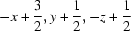
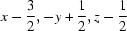
| Symmetry codes: (ii) −x+3/2, y+1/2, −z+1/2; (iii) x−3/2, −y+1/2, z−1/2. |
Experimental details
| Crystal data | |
| Chemical formula | [Cu(C4H10N4O)2](NO3)2 |
| Mr | 447.89 |
| Crystal system, space group | Monoclinic, P21/n |
| Temperature (K) | 293 |
| a, b, c (Å) | 5.2547 (6), 14.0087 (15), 12.1511 (13) |
| β (°) | 96.982 (2) |
| V (Å3) | 887.83 (17) |
| Z | 2 |
| Radiation type | Mo Kα |
| µ (mm−1) | 1.29 |
| Crystal size (mm) | 0.26 × 0.16 × 0.11 |
| Data collection | |
| Diffractometer | Bruker SMART APEX CCD area detector |
| Absorption correction | Multi-scan (SADABS; Bruker, 2003) |
| Tmin, Tmax | 0.793, 1.00 |
| No. of measured, independent and observed [I > 2σ(I)] reflections | 11998, 2206, 1810 |
| Rint | 0.028 |
| (sin θ/λ)max (Å−1) | 0.668 |
| Refinement | |
| R[F2 > 2σ(F2)], wR(F2), S | 0.035, 0.102, 1.05 |
| No. of reflections | 2206 |
| No. of parameters | 125 |
| No. of restraints | 3 |
| H-atom treatment | H-atom parameters constrained |
| Δρmax, Δρmin (e Å−3) | 0.73, −0.27 |
Computer programs: SMART (Bruker, 1998), SAINT (Bruker, 2003), SHELXS97 (Sheldrick, 2008), SHELXL97 (Sheldrick, 2008), SHELXTL (Sheldrick, 2008), enCIFer (Allen et al., 2004) and publCIF (Westrip, 2009).
| Cu1—N1 | 1.932 (4) | Cu1—N2 | 1.967 (4) |
| Cu1—N1i | 1.932 (4) | Cu1—N2i | 1.967 (4) |
| N1—Cu1—N1i | 180.0 | N1—Cu1—N2i | 91.67 (19) |
| N1—Cu1—N2 | 88.33 (19) | N1i—Cu1—N2i | 88.33 (19) |
| N1i—Cu1—N2 | 91.67 (19) | N2—Cu1—N2i | 179.999 (1) |
| Symmetry code: (i) −x, −y+1, −z. |
| D—H···A | D—H | H···A | D···A | D—H···A |
| N1—H1···O2ii | 0.86 | 2.05 | 2.904 (7) | 169.8 |
| N2—H2···O2iii | 0.86 | 2.18 | 3.009 (6) | 162.5 |
| N3—H3···O4 | 0.86 | 2.14 | 2.979 (6) | 164.9 |
| N4—H45···O3 | 0.86 | 2.06 | 2.917 (7) | 171.3 |
| Symmetry codes: (ii) −x+3/2, y+1/2, −z+1/2; (iii) x−3/2, −y+1/2, z−1/2. |
Acknowledgements
We gratefully thank the Thailand Research Fund (TRF), Khon Kaen University, the Center of Excellence for Innovation in Chemistry (PERCH-CIC) and the Development and Promotion of Science and Technology talent project (DPST) for financial support.
References
 Allen, F. H., Johnson, O., Shields, G. P., Smith, B. R. & Towler, M. (2004). J. Appl. Cryst. 37, 335–338. Web of Science CSD CrossRef CAS IUCr Journals Google Scholar
Begley, M. J., Hubberstey, P. & Moore, C. H. M. (1986). J. Chem. Res. (S), pp. 172–173. Google Scholar
Bruker (1998). SMART. Bruker AXS Inc., Madison, Wisconsin, USA. Google Scholar
Bruker (2003). SADABS and SAINT. Bruker AXS Inc., Madison, Wisconsin, USA. Google Scholar
Meenongwa, A., Chaveerach, U., Wilson, C. & Blake, A. J. (2009). Acta Cryst. E65, m1171. Web of Science CSD CrossRef IUCr Journals Google Scholar
Sheldrick, G. M. (2008). Acta Cryst. A64, 112–122. Web of Science CrossRef CAS IUCr Journals Google Scholar
Westrip, S. P. (2009). publCIF. In preparation. Google Scholar
This is an open-access article distributed under the terms of the Creative Commons Attribution (CC-BY) Licence, which permits unrestricted use, distribution, and reproduction in any medium, provided the original authors and source are cited.
| CRYSTALLOGRAPHIC COMMUNICATIONS |
access


Herein, we report the structure of [Cu(L1e)2](NO3)2, which was obtained from the similar procedure as previously reported by Meenongwa et al. (2009), but using copper(II) nitrate hemipentahydrate. Structural determination on the title complex reveals a centrosymmetric [Cu(L1e)2]2+ cation and two NO3- counteranions. Fig. 1 shows the [Cu(L1e)2]2+ moiety. The square-planar CuN4 geometry is yielded by the coordination of the two N,N-bidentate ligands (Table 1) with Cu— N bond distances of 1.9313 (16) - 1.9650 (17) Å. Moreover, NO3- anions also contact to the neighboring cationic units by various hydrogen bonds of the type N—H···O (nitrate) to give a two dimentional layered structure (Fig. 2) as observed in the previuos [Cu(L1e)2](ClO4)2 complex.