 | Acta Crystallographica Section E Acta Crystallographica Section E CRYSTALLOGRAPHIC COMMUNICATIONS |


 journal menu


organic compounds
| CRYSTALLOGRAPHIC COMMUNICATIONS |
 access
(4-Hydroxy-2,5-dimethylphenyl)phenylmethanone

aDepartamento de Química – Facultad de Ciencias, Universidad del Valle, Apartado 25360, Santiago de Cali, Colombia, bWestCHEM, Department of Pure and Applied Chemistry, University of Strathclyde, 295 Cathedral Street, Glasgow G1 1XL, Scotland, and cInstituto de Química de São Carlos, Universidade de São Paulo, USP, São Carlos, SP, Brazil
*Correspondence e-mail: [email protected]
The title compound, C15H14O2, was obtained by Friedel–Crafts acylation between 2,5-dimethylphenol and benzoyl chloride in the presence of aluminium chloride as a catalyst. The dihedral angle between the benzene rings is 61.95 (4)°. In the crystal, O—H⋯O hydrogen bonding and C—H⋯O weak interactions lead to polymeric C(6), C(8) and C(11) chains along the a, b and c-axis directions, respectively.
Related literature
For background information on the anti-fungal and anti-inflamatory biological activity of benzophenones, see: Naldoni et al. (2009![[Naldoni, F. J., Claudino, A. L. R., Cruz, J. W., Chavasco, J. K., Faria e Silva, P. M., Veloso, M. P. & Dos Santos, M. H. (2009). J. Med. Food, 12, 403-407.]](../../../../../../logos/arrows/e_arr.gif "Naldoni, F. J., Claudino, A. L. R., Cruz, J. W., Chavasco, J. K., Faria e Silva, P. M., Veloso, M. P. & Dos Santos, M. H. (2009). J. Med. Food, 12, 403-407.") ); Selvi et al. (2003); Naveen et al. (2006). For 104 benzophenone molecules, see: Cox et al. (2008). For hydrogen-bond motifs, see: Etter (1990).
); Selvi et al. (2003); Naveen et al. (2006). For 104 benzophenone molecules, see: Cox et al. (2008). For hydrogen-bond motifs, see: Etter (1990).
![[Scheme 1]](hg2568scheme1.gif)
Experimental
Crystal data
|
Refinement
|
| |||||||||||||||||||||||||||
 ; (ii)
  ; (iii)
  .
. Data collection: CrysAlis CCD (Oxford Diffraction, 2009); cell refinement: CrysAlis CCD; data reduction: CrysAlis RED (Oxford Diffraction, 2009); program(s) used to solve structure: SHELXS97 (Sheldrick, 2008); program(s) used to refine structure: SHELXL97 (Sheldrick, 2008); molecular graphics: ORTEP-3 for Windows (Farrugia, 1997) and Mercury (Macrae et al., 2006); software used to prepare material for publication: PARST95 (Nardelli, 1995).
Supporting information
contains datablocks I, global. DOI: https://doi.org/10.1107/S1600536809039488/hg2568sup1.cif
Structure factors: contains datablock I. DOI: https://doi.org/10.1107/S1600536809039488/hg2568Isup2.hkl
2,5-dimethylphenol (0.50 g, 4.10 mmol) was added to a solution of anhydrous aluminium chloride (0.40 g, 3.00 mmol) in dry dichloromethane (25 ml). The resulting solution was cooled and then a benzoyl chloride (0.80 g, 5.70 mmol) was slowly added at 0–5° C. After complete addition, the mixture was allowed to stir at room temperature for 0.5 h, and then it was heated up to 50° C for 1 h. The reaction mixture was poured onto ice (100 g) and conc. HCl (10 ml). The crude product was isolated by extraction with dichloromethane. The combined organic layers were washed with 10% aqueous NaOH, water, and then the solution was dried over Na2SO4 and it was evaporated at room temperature.
All H-atoms were located from difference maps and were positioned geometrically and refined using a riding model with C–H= 0.93–0.97 Å and Uiso(H)= 1.2Ueq(C).
The title compound, C15H14O2, (4-Hydroxy-2,5-dimethyl-phenyl)-phenyl-methanone), (I), is part of a series of studies on benzophenone, which have been made in our research group. Benzophenone analogue systems show various anti-fungal and anti-inflamatory biological activities (Naldoni et al., 2009 and Selvi et al., 2003). The presence of various substituents in the benzophenone nucleus is essential to determining the quantitative structure-activity relationships of these systems. Some studies were carried out to show that methyl-substituted benzophenones exhibit anti-fungal properties (Naveen et al., 2006). In order to present the of (I), to analyse the type of hydrogen-bonds formed in (I) and to study its supramolecular behavior, the title compound was synthesized. The molecular structure of the title compound is shown in Fig. 1. The bond lengths and bond angles of (I) are in good agreement with the standard values and correspond to those observed in (4-Hydroxy-3-methylphenyl)(4- methylphenyl)methanone (Naveen et al., 2006). The two aromatic rings in the title structure form a dihedral angle of 61.95 (4)°. This value is greater than the value presented in the stable, orthorhombic form of unsubstituted benzophenone (54°) and follows the standard behavior of the majority of benzophenone molecules [104 benzophenone molecules, Cox et al., 2008]. The title molecule is characterized by the formation of O—H···O hydrogen-bonds and other C—H···O weak interactions (Table 1, Nardelli, 1995). The strongest hydrogen bond O—H···O interaction is responsible for crystal growth in [100] direction. Indeed, in a first atom O2 in the molecule at (x, y, z) acts as hydrogen bond donor to carbonyl O1 atom in the molecule at (x - 1/2, -y + 1/2, -z + 1). The propagation of this interaction forms a C(8) (Etter, 1990) chain running along [100] direction (Fig. 2). In a second atom C15 in the molecule at (x, y, z) links with weak interaction to carbonyl O1 atom in the molecule at (-x + 3/2, y - 1/2, z). The propagation of this interaction forms C(6) continuous chains via C15—H15B···O1 and running along [010] direction (Fig. 3). Finally in a third sub-structure, atom C4 in the molecule at (x, y, z) links with weak interaction to hydroxyl O2 atom in the molecule at (x, -y + 3/2, z - 1/2). The propagation of this interaction forms C(11) continuous chains and running along [001] direction. All of these interactions in [100], [010] and [001] directions define the bulk structure of the crystal.
For background information on the anti-fungal and anti-inflamatory biological activity of benzophenones, see: Naldoni et al. (2009); Selvi et al. (2003); Naveen et al. (2006). For 104 benzophenone molecules, see: Cox et al. (2008). For hydrogen-bond motifs, see: Etter (1990).
Data collection: CrysAlis CCD (Oxford Diffraction, 2009); cell CrysAlis CCD (Oxford Diffraction, 2009); data reduction: CrysAlis RED (Oxford Diffraction, 2009); program(s) used to solve structure: SHELXS97 (Sheldrick, 2008); program(s) used to refine structure: SHELXL97 (Sheldrick, 2008); molecular graphics: ORTEP-3 for Windows (Farrugia, 1997) and Mercury (Macrae et al., 2006); software used to prepare material for publication: PARST95 (Nardelli, 1995).
![[Figure 1]](./hg2568fig1thm.gif) | Fig. 1. An ORTEP-3 (Farrugia, 1997) plot of the title (I) compound, with the atomic labelling scheme. The shapes of the ellipsoids correspond to 50% probability contours of atomic displacement and, for the sake of clarity, H atoms are shown as spheres of arbitrary radius. |
![[Figure 2]](./hg2568fig2thm.gif) | Fig. 2. Part of the crystal structure of (I), showing the formation of C(8) chains running along [100] direction. Symmetry code: (i) x + 1/2, -y + 1/2, -z + 1; (ii) x - 1/2, -y + 1/2, -z + 1 |
![[Figure 3]](./hg2568fig3thm.gif) | Fig. 3. Part of the crystal structure of (I), showing the formation of C(6) chain running along [010]. Symmetry code: (i) -x + 3/2, y - 1/2, z; (ii) -x + 3/2, y + 1/2, z. |
![[Figure 4]](./hg2568fig4thm.gif) | Fig. 4. Part of the crystal structure of (I), showing the formation of C(11) chain running along [001]. Symmetry code: (i) x, -y + 3/2, z - 1/2; (ii) x, -y + 3/2, z + 1/2 |
| C15H14O2 | Dx = 1.286 Mg m−3 |
| Mr = 226.26 | Melting point: 443.0(10) K |
| Orthorhombic, Pbca | Mo Kα radiation, λ = 0.71073 Å |
| Hall symbol: -P 2ac 2ab | Cell parameters from 1709 reflections |
| a = 12.1392 (10) Å | θ = 2.5–30.7° |
| b = 8.1386 (7) Å | µ = 0.08 mm−1 |
| c = 23.665 (2) Å | T = 123 K |
| V = 2338.0 (3) Å3 | Shard, colourless |
| Z = 8 | 0.25 × 0.12 × 0.05 mm |
| F(000) = 960 |
| Oxford Diffraction Gemini S diffractometer | 2059 independent reflections |
| Radiation source: fine-focus sealed tube | 1061 reflections with I > 2σ(I) |
| Graphite monochromator | Rint = 0.061 |
| ω scans | θmax = 25.0°, θmin = 3.1° |
| Absorption correction: multi-scan (CrysAlis CCD; Oxford Diffraction, 2009) | h = −12→14 |
| Tmin = 0.904, Tmax = 1.000 | k = −9→9 |
| 9067 measured reflections | l = −28→26 |
| Refinement on F2 | Secondary atom site location: difference Fourier map |
| Least-squares matrix: full | Hydrogen site location: inferred from neighbouring sites |
| R[F2 > 2σ(F2)] = 0.032 | H-atom parameters constrained |
| wR(F2) = 0.058 | w = 1/[σ2(Fo2) + (0.0224P)2] where P = (Fo2 + 2Fc2)/3 |
| S = 0.73 | (Δ/σ)max < 0.001 |
| 2059 reflections | Δρmax = 0.15 e Å−3 |
| 158 parameters | Δρmin = −0.14 e Å−3 |
| 0 restraints | Extinction correction: SHELXL97 (Sheldrick, 2008), Fc*=kFc[1+0.001xFc2λ3/sin(2θ)]-1/4 |
| Primary atom site location: structure-invariant direct methods | Extinction coefficient: 0.0019 (2) |
| C15H14O2 | V = 2338.0 (3) Å3 |
| Mr = 226.26 | Z = 8 |
| Orthorhombic, Pbca | Mo Kα radiation |
| a = 12.1392 (10) Å | µ = 0.08 mm−1 |
| b = 8.1386 (7) Å | T = 123 K |
| c = 23.665 (2) Å | 0.25 × 0.12 × 0.05 mm |
| Oxford Diffraction Gemini S diffractometer | 2059 independent reflections |
| Absorption correction: multi-scan (CrysAlis CCD; Oxford Diffraction, 2009) | 1061 reflections with I > 2σ(I) |
| Tmin = 0.904, Tmax = 1.000 | Rint = 0.061 |
| 9067 measured reflections |
| R[F2 > 2σ(F2)] = 0.032 | 0 restraints |
| wR(F2) = 0.058 | H-atom parameters constrained |
| S = 0.73 | Δρmax = 0.15 e Å−3 |
| 2059 reflections | Δρmin = −0.14 e Å−3 |
| 158 parameters |
Geometry. All e.s.d.'s (except the e.s.d. in the dihedral angle between two l.s. planes) are estimated using the full covariance matrix. The cell e.s.d.'s are taken into account individually in the estimation of e.s.d.'s in distances, angles and torsion angles; correlations between e.s.d.'s in cell parameters are only used when they are defined by crystal symmetry. An approximate (isotropic) treatment of cell e.s.d.'s is used for estimating e.s.d.'s involving l.s. planes. |
Refinement. Refinement of F2 against ALL reflections. The weighted R-factor wR and goodness of fit S are based on F2, conventional R-factors R are based on F, with F set to zero for negative F2. The threshold expression of F2 > σ(F2) is used only for calculating R-factors(gt) etc. and is not relevant to the choice of reflections for refinement. R-factors based on F2 are statistically about twice as large as those based on F, and R- factors based on ALL data will be even larger. |
| x | y | z | Uiso*/Ueq | ||
| O1 | 0.83004 (8) | 0.77322 (14) | 0.37654 (5) | 0.0301 (3) | |
| O2 | 0.51698 (9) | 0.86337 (14) | 0.58360 (5) | 0.0261 (3) | |
| H2 | 0.4559 | 0.8151 | 0.5849 | 0.039* | |
| C1 | 0.67652 (14) | 0.8006 (2) | 0.31719 (7) | 0.0211 (4) | |
| C2 | 0.73020 (14) | 0.7315 (2) | 0.27099 (7) | 0.0291 (5) | |
| H2A | 0.7986 | 0.6768 | 0.2761 | 0.035* | |
| C3 | 0.68450 (16) | 0.7422 (2) | 0.21789 (7) | 0.0370 (5) | |
| H3 | 0.7213 | 0.6946 | 0.1865 | 0.044* | |
| C4 | 0.58475 (16) | 0.8226 (2) | 0.21010 (8) | 0.0363 (5) | |
| H4 | 0.5527 | 0.8278 | 0.1735 | 0.044* | |
| C5 | 0.53206 (15) | 0.8948 (2) | 0.25549 (7) | 0.0306 (5) | |
| H5 | 0.4649 | 0.9524 | 0.2499 | 0.037* | |
| C6 | 0.57691 (14) | 0.8834 (2) | 0.30907 (7) | 0.0248 (5) | |
| H6 | 0.5400 | 0.9317 | 0.3403 | 0.030* | |
| C7 | 0.72879 (13) | 0.78937 (19) | 0.37381 (7) | 0.0210 (4) | |
| C8 | 0.66409 (13) | 0.80471 (19) | 0.42695 (7) | 0.0186 (4) | |
| C9 | 0.71040 (13) | 0.9034 (2) | 0.46920 (7) | 0.0209 (4) | |
| H9 | 0.7782 | 0.9572 | 0.4616 | 0.025* | |
| C10 | 0.66178 (13) | 0.9261 (2) | 0.52152 (7) | 0.0185 (4) | |
| C11 | 0.56262 (13) | 0.8428 (2) | 0.53126 (7) | 0.0195 (4) | |
| C12 | 0.51675 (13) | 0.74203 (19) | 0.49063 (7) | 0.0210 (4) | |
| H12 | 0.4505 | 0.6849 | 0.4990 | 0.025* | |
| C13 | 0.56518 (13) | 0.7218 (2) | 0.43752 (7) | 0.0189 (4) | |
| C14 | 0.71190 (13) | 1.0335 (2) | 0.56630 (7) | 0.0270 (5) | |
| H14A | 0.7342 | 0.9656 | 0.5986 | 0.040* | |
| H14B | 0.6577 | 1.1150 | 0.5787 | 0.040* | |
| H14C | 0.7766 | 1.0898 | 0.5509 | 0.040* | |
| C15 | 0.51105 (14) | 0.6050 (2) | 0.39635 (7) | 0.0266 (5) | |
| H15A | 0.4730 | 0.5180 | 0.4173 | 0.040* | |
| H15B | 0.5673 | 0.5560 | 0.3719 | 0.040* | |
| H15C | 0.4577 | 0.6653 | 0.3732 | 0.040* |
| U11 | U22 | U33 | U12 | U13 | U23 | |
| O1 | 0.0175 (6) | 0.0449 (8) | 0.0279 (7) | 0.0032 (7) | −0.0010 (6) | 0.0015 (7) |
| O2 | 0.0221 (7) | 0.0330 (8) | 0.0231 (7) | −0.0020 (6) | 0.0038 (6) | 0.0001 (6) |
| C1 | 0.0213 (10) | 0.0219 (10) | 0.0200 (10) | −0.0005 (9) | −0.0006 (9) | 0.0020 (9) |
| C2 | 0.0321 (10) | 0.0282 (12) | 0.0269 (11) | 0.0059 (9) | 0.0025 (10) | 0.0014 (9) |
| C3 | 0.0531 (13) | 0.0374 (13) | 0.0206 (11) | 0.0084 (11) | 0.0015 (11) | −0.0035 (9) |
| C4 | 0.0521 (14) | 0.0336 (13) | 0.0231 (12) | 0.0027 (11) | −0.0110 (11) | 0.0034 (10) |
| C5 | 0.0343 (12) | 0.0256 (12) | 0.0318 (12) | 0.0013 (9) | −0.0102 (10) | 0.0043 (10) |
| C6 | 0.0256 (10) | 0.0246 (11) | 0.0241 (11) | −0.0005 (9) | 0.0002 (10) | −0.0013 (9) |
| C7 | 0.0231 (9) | 0.0179 (10) | 0.0219 (10) | 0.0001 (8) | −0.0003 (9) | 0.0007 (9) |
| C8 | 0.0176 (9) | 0.0187 (10) | 0.0196 (10) | 0.0029 (8) | −0.0009 (9) | 0.0019 (9) |
| C9 | 0.0172 (9) | 0.0203 (10) | 0.0253 (11) | −0.0006 (8) | −0.0015 (9) | 0.0069 (9) |
| C10 | 0.0199 (10) | 0.0173 (10) | 0.0185 (10) | 0.0035 (8) | −0.0030 (9) | 0.0021 (8) |
| C11 | 0.0204 (10) | 0.0207 (10) | 0.0173 (10) | 0.0063 (8) | 0.0026 (9) | 0.0037 (9) |
| C12 | 0.0170 (9) | 0.0206 (11) | 0.0253 (10) | −0.0004 (9) | 0.0004 (8) | 0.0049 (9) |
| C13 | 0.0173 (9) | 0.0181 (10) | 0.0215 (10) | 0.0023 (8) | −0.0029 (8) | 0.0006 (8) |
| C14 | 0.0252 (10) | 0.0274 (11) | 0.0283 (11) | −0.0007 (9) | 0.0004 (9) | 0.0027 (9) |
| C15 | 0.0267 (10) | 0.0248 (11) | 0.0283 (11) | −0.0032 (9) | −0.0006 (9) | −0.0002 (9) |
| O1—C7 | 1.2377 (17) | C8—C13 | 1.400 (2) |
| O2—C11 | 1.3674 (18) | C8—C9 | 1.400 (2) |
| O2—H2 | 0.8400 | C9—C10 | 1.384 (2) |
| C1—C2 | 1.391 (2) | C9—H9 | 0.9500 |
| C1—C6 | 1.397 (2) | C10—C11 | 1.401 (2) |
| C1—C7 | 1.486 (2) | C10—C14 | 1.503 (2) |
| C2—C3 | 1.376 (2) | C11—C12 | 1.381 (2) |
| C2—H2A | 0.9500 | C12—C13 | 1.397 (2) |
| C3—C4 | 1.388 (2) | C12—H12 | 0.9500 |
| C3—H3 | 0.9500 | C13—C15 | 1.511 (2) |
| C4—C5 | 1.381 (2) | C14—H14A | 0.9800 |
| C4—H4 | 0.9500 | C14—H14B | 0.9800 |
| C5—C6 | 1.383 (2) | C14—H14C | 0.9800 |
| C5—H5 | 0.9500 | C15—H15A | 0.9800 |
| C6—H6 | 0.9500 | C15—H15B | 0.9800 |
| C7—C8 | 1.488 (2) | C15—H15C | 0.9800 |
| C11—O2—H2 | 109.5 | C10—C9—H9 | 118.5 |
| C2—C1—C6 | 119.48 (15) | C8—C9—H9 | 118.5 |
| C2—C1—C7 | 118.93 (15) | C9—C10—C11 | 116.70 (16) |
| C6—C1—C7 | 121.56 (15) | C9—C10—C14 | 122.40 (15) |
| C3—C2—C1 | 120.20 (16) | C11—C10—C14 | 120.90 (15) |
| C3—C2—H2A | 119.9 | O2—C11—C12 | 122.69 (15) |
| C1—C2—H2A | 119.9 | O2—C11—C10 | 115.98 (15) |
| C2—C3—C4 | 120.17 (17) | C12—C11—C10 | 121.29 (16) |
| C2—C3—H3 | 119.9 | C11—C12—C13 | 121.78 (16) |
| C4—C3—H3 | 119.9 | C11—C12—H12 | 119.1 |
| C5—C4—C3 | 120.07 (17) | C13—C12—H12 | 119.1 |
| C5—C4—H4 | 120.0 | C12—C13—C8 | 117.69 (15) |
| C3—C4—H4 | 120.0 | C12—C13—C15 | 118.11 (15) |
| C4—C5—C6 | 120.13 (17) | C8—C13—C15 | 124.11 (14) |
| C4—C5—H5 | 119.9 | C10—C14—H14A | 109.5 |
| C6—C5—H5 | 119.9 | C10—C14—H14B | 109.5 |
| C5—C6—C1 | 119.93 (16) | H14A—C14—H14B | 109.5 |
| C5—C6—H6 | 120.0 | C10—C14—H14C | 109.5 |
| C1—C6—H6 | 120.0 | H14A—C14—H14C | 109.5 |
| O1—C7—C1 | 118.54 (16) | H14B—C14—H14C | 109.5 |
| O1—C7—C8 | 119.27 (16) | C13—C15—H15A | 109.5 |
| C1—C7—C8 | 122.12 (14) | C13—C15—H15B | 109.5 |
| C13—C8—C9 | 119.56 (15) | H15A—C15—H15B | 109.5 |
| C13—C8—C7 | 124.28 (15) | C13—C15—H15C | 109.5 |
| C9—C8—C7 | 116.08 (15) | H15A—C15—H15C | 109.5 |
| C10—C9—C8 | 122.95 (16) | H15B—C15—H15C | 109.5 |
| C6—C1—C2—C3 | −1.1 (3) | C13—C8—C9—C10 | −1.2 (2) |
| C7—C1—C2—C3 | −179.02 (16) | C7—C8—C9—C10 | −178.15 (15) |
| C1—C2—C3—C4 | 0.2 (3) | C8—C9—C10—C11 | 0.8 (2) |
| C2—C3—C4—C5 | 1.3 (3) | C8—C9—C10—C14 | −179.48 (16) |
| C3—C4—C5—C6 | −1.8 (3) | C9—C10—C11—O2 | 178.50 (14) |
| C4—C5—C6—C1 | 0.9 (3) | C14—C10—C11—O2 | −1.2 (2) |
| C2—C1—C6—C5 | 0.5 (3) | C9—C10—C11—C12 | 0.6 (2) |
| C7—C1—C6—C5 | 178.40 (16) | C14—C10—C11—C12 | −179.08 (15) |
| C2—C1—C7—O1 | 24.8 (2) | O2—C11—C12—C13 | −179.51 (14) |
| C6—C1—C7—O1 | −153.09 (16) | C10—C11—C12—C13 | −1.8 (2) |
| C2—C1—C7—C8 | −158.14 (16) | C11—C12—C13—C8 | 1.4 (2) |
| C6—C1—C7—C8 | 24.0 (2) | C11—C12—C13—C15 | 178.17 (14) |
| O1—C7—C8—C13 | −135.69 (17) | C9—C8—C13—C12 | 0.0 (2) |
| C1—C7—C8—C13 | 47.3 (2) | C7—C8—C13—C12 | 176.75 (15) |
| O1—C7—C8—C9 | 41.1 (2) | C9—C8—C13—C15 | −176.54 (15) |
| C1—C7—C8—C9 | −135.91 (16) | C7—C8—C13—C15 | 0.2 (2) |
| D—H···A | D—H | H···A | D···A | D—H···A |
| O2—H2···O1i | 0.84 | 1.92 | 2.6973 (15) | 154 |
| C15—H15B···O1ii | 0.98 | 2.62 | 3.352 (2) | 132 |
| C4—H4···O2iii | 0.95 | 2.67 | 3.454 (2) | 140 |
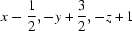
| Symmetry codes: (i) x−1/2, −y+3/2, −z+1; (ii) −x+3/2, y−1/2, z; (iii) x, −y+3/2, z−1/2. |
Experimental details
| Crystal data | |
| Chemical formula | C15H14O2 |
| Mr | 226.26 |
| Crystal system, space group | Orthorhombic, Pbca |
| Temperature (K) | 123 |
| a, b, c (Å) | 12.1392 (10), 8.1386 (7), 23.665 (2) |
| V (Å3) | 2338.0 (3) |
| Z | 8 |
| Radiation type | Mo Kα |
| µ (mm−1) | 0.08 |
| Crystal size (mm) | 0.25 × 0.12 × 0.05 |
| Data collection | |
| Diffractometer | Oxford Diffraction Gemini S |
| Absorption correction | Multi-scan (CrysAlis CCD; Oxford Diffraction, 2009) |
| Tmin, Tmax | 0.904, 1.000 |
| No. of measured, independent and observed [I > 2σ(I)] reflections | 9067, 2059, 1061 |
| Rint | 0.061 |
| (sin θ/λ)max (Å−1) | 0.595 |
| Refinement | |
| R[F2 > 2σ(F2)], wR(F2), S | 0.032, 0.058, 0.73 |
| No. of reflections | 2059 |
| No. of parameters | 158 |
| H-atom treatment | H-atom parameters constrained |
| Δρmax, Δρmin (e Å−3) | 0.15, −0.14 |
Computer programs: CrysAlis CCD (Oxford Diffraction, 2009), CrysAlis RED (Oxford Diffraction, 2009), SHELXS97 (Sheldrick, 2008), SHELXL97 (Sheldrick, 2008), ORTEP-3 for Windows (Farrugia, 1997) and Mercury (Macrae et al., 2006), PARST95 (Nardelli, 1995).
| D—H···A | D—H | H···A | D···A | D—H···A |
| O2—H2···O1i | 0.84 | 1.92 | 2.6973 (15) | 153.6 |
| C15—H15B···O1ii | 0.98 | 2.62 | 3.352 (2) | 131.6 |
| C4—H4···O2iii | 0.95 | 2.67 | 3.454 (2) | 140.0 |
| Symmetry codes: (i) x−1/2, −y+3/2, −z+1; (ii) −x+3/2, y−1/2, z; (iii) x, −y+3/2, z−1/2. |
Acknowledgements
RMF is grateful to the Spanish Research Council (CSIC) for the use of a free-of-charge licence to the Cambridge Structural Database (Allen, 2002). RMF also thanks the Universidad del Valle, Colombia, and the Instituto de Química de São Carlos, Brazil, for partial financial support.
References
 Allen, F. H. (2002). Acta Cryst. B58, 380–388. Web of Science CSD CrossRef CAS IUCr Journals Google Scholar
Cox, P. J., Kechagias, D. & Kelly, O. (2008). Acta Cryst. B64, 206–216. Web of Science CSD CrossRef IUCr Journals Google Scholar
Etter, M. (1990). Acc. Chem. Res. 23, 120–126. CrossRef CAS Web of Science Google Scholar
Farrugia, L. J. (1997). J. Appl. Cryst. 30, 565. CrossRef IUCr Journals Google Scholar
Macrae, C. F., Edgington, P. R., McCabe, P., Pidcock, E., Shields, G. P., Taylor, R., Towler, M. & van de Streek, J. (2006). J. Appl. Cryst. 39, 453–457. Web of Science CSD CrossRef CAS IUCr Journals Google Scholar
Naldoni, F. J., Claudino, A. L. R., Cruz, J. W., Chavasco, J. K., Faria e Silva, P. M., Veloso, M. P. & Dos Santos, M. H. (2009). J. Med. Food, 12, 403–407. Google Scholar
Nardelli, M. (1995). J. Appl. Cryst. 28, 659. CrossRef IUCr Journals Google Scholar
Naveen, S., Khanum, S. A., Devaiah, V. T., Shashikanth, S., Anandalwar, S. M. & Prasad, S. (2006). Anal. Sci. 22, 183–184. Web of Science PubMed Google Scholar
Oxford Diffraction (2009). CrysAlis CCD and CrysAlis RED. Oxford Diffraction Ltd, Yarnton, England. Google Scholar
Selvi, A. T., Joseph, G. S. & Jayaprakasha, G. K. (2003). Food Microbiol. 20, 455–460. Google Scholar
Sheldrick, G. M. (2008). Acta Cryst. A64, 112–122. Web of Science CrossRef CAS IUCr Journals Google Scholar
This is an open-access article distributed under the terms of the Creative Commons Attribution (CC-BY) Licence, which permits unrestricted use, distribution, and reproduction in any medium, provided the original authors and source are cited.
| CRYSTALLOGRAPHIC COMMUNICATIONS |


The title compound, C15H14O2, (4-Hydroxy-2,5-dimethyl-phenyl)-phenyl-methanone), (I), is part of a series of studies on benzophenone, which have been made in our research group. Benzophenone analogue systems show various anti-fungal and anti-inflamatory biological activities (Naldoni et al., 2009 and Selvi et al., 2003). The presence of various substituents in the benzophenone nucleus is essential to determining the quantitative structure-activity relationships of these systems. Some studies were carried out to show that methyl-substituted benzophenones exhibit anti-fungal properties (Naveen et al., 2006). In order to present the molecular conformation of (I), to analyse the type of hydrogen-bonds formed in (I) and to study its supramolecular behavior, the title compound was synthesized. The molecular structure of the title compound is shown in Fig. 1. The bond lengths and bond angles of (I) are in good agreement with the standard values and correspond to those observed in (4-Hydroxy-3-methylphenyl)(4- methylphenyl)methanone (Naveen et al., 2006). The two aromatic rings in the title structure form a dihedral angle of 61.95 (4)°. This value is greater than the value presented in the stable, orthorhombic form of unsubstituted benzophenone (54°) and follows the standard behavior of the majority of benzophenone molecules [104 benzophenone molecules, Cox et al., 2008]. The title molecule is characterized by the formation of O—H···O hydrogen-bonds and other C—H···O weak interactions (Table 1, Nardelli, 1995). The strongest hydrogen bond O—H···O interaction is responsible for crystal growth in [100] direction. Indeed, in a first substructure, atom O2 in the molecule at (x, y, z) acts as hydrogen bond donor to carbonyl O1 atom in the molecule at (x - 1/2, -y + 1/2, -z + 1). The propagation of this interaction forms a C(8) (Etter, 1990) chain running along [100] direction (Fig. 2). In a second substructure, atom C15 in the molecule at (x, y, z) links with weak interaction to carbonyl O1 atom in the molecule at (-x + 3/2, y - 1/2, z). The propagation of this interaction forms C(6) continuous chains via C15—H15B···O1 and running along [010] direction (Fig. 3). Finally in a third sub-structure, atom C4 in the molecule at (x, y, z) links with weak interaction to hydroxyl O2 atom in the molecule at (x, -y + 3/2, z - 1/2). The propagation of this interaction forms C(11) continuous chains and running along [001] direction. All of these interactions in [100], [010] and [001] directions define the bulk structure of the crystal.