 | Acta Crystallographica Section E Acta Crystallographica Section E CRYSTALLOGRAPHIC COMMUNICATIONS |


 journal menu


metal-organic compounds
| CRYSTALLOGRAPHIC COMMUNICATIONS |
 access
Poly[(μ5-5-carboxylatotetrahydrofuran-2,3,4-tricarboxylic acid)sodium]

aCollege of Materials Science and Engineering, China Jiliang University, Hangzhou 310018, People's Republic of China
*Correspondence e-mail: [email protected]
The search for the novel metal-organic frameworks (MOFs) materials using tetrahydrofuran-2,3,4,5-tetracarboxylic acid (THFTCA) as a versatile multi-carboxyl ligand, lead to the synthesis and the of the title compound, [Na(H3THFTCA)] or [Na(C8H7O9)]n, which was obtained by a solution reaction at room temperature. The ligand is mono-deprotonated, coordinating five sodium ions through one furan oxygen atom and six carboxyl oxygen atoms. The sodium ion exhibits a distorted pentagonal-bipyramidal NaO7 geometry consisting of seven O atoms derived from five surrounding ligands. Two adjacent pentagonal bipyramids share an O—O edge, forming a dinuclear sodium cluster. Finally, these clusters are effectively linked by the carboxyl groups of THFTCA ligands, forming a firm metal organic framework and O—H⋯O hydrogen bonds contribute to the crystal packing.
Related literature
For potential applications of metal-organic frameworks (MOFs), see: Moulton & Zaworotko (2001![[Moulton, B. & Zaworotko, M. J. (2001). Chem. Rev. 101, 1629-1658.]](../../../../../../logos/arrows/e_arr.gif "Moulton, B. & Zaworotko, M. J. (2001). Chem. Rev. 101, 1629-1658.") ); Bradshaw et al. (2007). Self-assembly of selected ligands around d-transition metal ions is a widespread method for obtaining novel MOF structures, see: Leininger et al. (2000). In contrast, the s-elements are more flexible of their coordination behaviour, and maybe present in more various structures, see: Lu et al. (2007). For related MOF materials constructed from the THFTCA ligand, see: Hanson et al. (2004); Thuéry et al. (2004); Ai et al. (2008); Wang & Sevov (2007); Wang et al. (2007); Lü (2008). For related s-elements and THFTCA ligand compound structures, see: Barnes & Paton (1984) for Cs+ and Ca2+; Barnes (2002) for Na+; Paul & Martin (1967) for Rb+.
); Bradshaw et al. (2007). Self-assembly of selected ligands around d-transition metal ions is a widespread method for obtaining novel MOF structures, see: Leininger et al. (2000). In contrast, the s-elements are more flexible of their coordination behaviour, and maybe present in more various structures, see: Lu et al. (2007). For related MOF materials constructed from the THFTCA ligand, see: Hanson et al. (2004); Thuéry et al. (2004); Ai et al. (2008); Wang & Sevov (2007); Wang et al. (2007); Lü (2008). For related s-elements and THFTCA ligand compound structures, see: Barnes & Paton (1984) for Cs+ and Ca2+; Barnes (2002) for Na+; Paul & Martin (1967) for Rb+.
![[Scheme 1]](kp2234scheme1.gif)
Experimental
Crystal data
|
Refinement
|
| |||||||||||||||||||||||||||
 .
. Data collection: PROCESS-AUTO (Rigaku, 1998); cell refinement: PROCESS-AUTO; data reduction: CrystalStructure (Rigaku/MSC, 2004); program(s) used to solve structure: SHELXS97 (Sheldrick, 2008); program(s) used to refine structure: SHELXL97 (Sheldrick, 2008); molecular graphics: SHELXTL (Sheldrick, 2008); software used to prepare material for publication: SHELXTL.
Supporting information
contains datablocks I, global. DOI: https://doi.org/10.1107/S160053680904269X/kp2234sup1.cif
Structure factors: contains datablock I. DOI: https://doi.org/10.1107/S160053680904269X/kp2234Isup2.hkl
All chemicals were obtained from commercial sources and were used as obtained. The title compound was handily synthesized by a solution reaction from H4THFTCA. H4THFTCA (154 mg, 0.6 mmol) and NaOH (25 mg, 0.6 mmol) was dissolved in 10 ml of water. To this solution was added a 5 ml aqueous solution of Nd(NO3)3. 6H2O (89 mg, 0.2 mmol) at room temperature. Amount of colourless crystals were obtained after the filtration was slowly evaporated at room temperature for several days.
The structure was solved using and refined by full-matrix least-squares techniques. All non-hydrogen atoms were assigned anisotropic displacement parameters in the All hydrogen atoms were added at calculated positions and refined using a riding model.(Sheldrick et al., 2008).
Metal organic frameworks (MOFs) have attracted a great deal of interest owing to the ability to tune their porosity and the functionalities that are incorporated within the framework scaffolds. As a result, numerous MOFs have been engineered for a number of potential applications, including gas storage, nonlinear optics, catalysis, and so on. (Moulton et al. 2001; Bradshaw et al. 2007) Usually, highly directional coordination bonds are adopted in the design of MOFs, and self-assembly of selected ligands around d-transition metal ions is now a widespread method for obtaining novel MOFs structure (Leininger et al. 2000). In contrast, the s-elements are more flexible of their coordination behaviour, and maybe present in more various structures (Lu et al. 2007). On the other hand, for the complex ligand with large numbers of potential binding sites, such as, tetrahydrofuran-2, 3, 4, 5-tetracarboxylic acid, it is difficult to predict the final structure. Therefore, the investigation of these complex ligands might provide novel MOFs with interesting structural topology. However, reports on THFTCA are rare (Hanson et al. 2004). Here, we report a three-dimensional MOFs compound Na(H3THFTCA) (I), which is assembled from THFTCA and sodium ion.
The title compound has a three-dimensional framework structure constructed by mono deprotonated THFTCA ligand; the contains one full chiral THFTCA ligand and one sodium atom (Fig. 1). The THFTCA ligand coordinates the sodium ion with its furan oxygen atom and two adjacent carboxyl oxygen atoms, while its four carboxyl groups also grasp the neighbouring four sodium ions (Scheme 1). Thus, the sodium ion is located in a distorted pentagonal bipyramid NaO7, coordinated by seven O atoms from the five ligands. The two pentagonal bipyramids are fused via a common eadge O2—O2, generating a dinuclear sodium cluster with an an inversion centre at the midpoint of eadge O2—O2 (Fig. 2). The title compound crystallizes in the centrosymmetric P21/c implying the presence of a racemate (1:1) in the crystal. The dinuclear sodium clusters are connected by carboxyl groups of THFTCA ligand. The crystal packing includes firm framework of multi-carboxyl ligand and sodium ion connected by hydrogen bonds of O—H···O (Table 1, Fig. 3).
For potential applications of metal-organic frameworks (MOFs), see: Moulton & Zaworotko (2001); Bradshaw et al. (2007). Self-assembly of selected ligands around d-transition metal ions is a widespread method for obtaining novel MOF structures, see: Leininger et al. (2000). In contrast, the s-elements are more flexible of their coordination behaviour, and maybe present in more various structures, see: Lu et al. (2007). For related MOF materials constructed from the THFTCA ligand, see: Hanson et al. (2004); Thuéry et al. (2004); Ai et al. (2008); Wang & Sevov (2007); Wang et al. (2007); Lü (2008). For related s-elements and THFTCA ligand compound structures, see: Barnes et al. (1984) for Cs+ and Ca2+; Barnes (2002) for Na+; Paul et al. (1967) for Rb+.
Data collection: PROCESS-AUTO (Rigaku, 1998); cell PROCESS-AUTO (Rigaku, 1998); data reduction: CrystalStructure (Rigaku/MSC, 2004); program(s) used to solve structure: SHELXS97 (Sheldrick, 2008); program(s) used to refine structure: SHELXL97 (Sheldrick, 2008); molecular graphics: SHELXTL (Sheldrick, 2008); software used to prepare material for publication: SHELXTL (Sheldrick, 2008).
![[Figure 1]](./kp2234fig1thm.gif) | Fig. 1. Structure and labeling of the title compound, with displacement ellipsoids drawn at the 30% probability level and H atoms shown as small spheres of arbitrary radii. |
![[Figure 2]](./kp2234fig2thm.gif) | Fig. 2. The distorted pentagonal bipyramid NaO7 with the common edge O2-O2 shows a dinuclear sodium unit. |
![[Figure 3]](./kp2234fig3thm.gif) | Fig. 3. The packing diagram viewed along the axis a, Na: blue diagonal; O: red inner dot; C: black circles; and H: small green circles. |
| [Na(C8H7O9)] | F(000) = 552 |
| Mr = 270.13 | Dx = 1.811 Mg m−3 |
| Monoclinic, P21/c | Mo Kα radiation, λ = 0.71075 Å |
| Hall symbol: -P 2ybc | Cell parameters from 8534 reflections |
| a = 8.0663 (16) Å | θ = 3.0–27.4° |
| b = 13.417 (3) Å | µ = 0.20 mm−1 |
| c = 9.7358 (19) Å | T = 296 K |
| β = 109.90 (3)° | Platelet, colorless |
| V = 990.7 (3) Å3 | 0.41 × 0.28 × 0.10 mm |
| Z = 4 |
| Rigaku R-AXIS RAPID diffractometer | 2263 independent reflections |
| Radiation source: fine-focus sealed tube | 2095 reflections with I > 2σ(I) |
| Graphite monochromator | Rint = 0.018 |
| Detector resolution: 14.6306 pixels mm-1 | θmax = 27.4°, θmin = 3.0° |
| CCD_Profile_fitting scans | h = −10→10 |
| Absorption correction: multi-scan (ABSCOR; Higashi, 1995) | k = −17→17 |
| Tmin = 0.921, Tmax = 0.980 | l = −12→12 |
| 9567 measured reflections |
| Refinement on F2 | Secondary atom site location: difference Fourier map |
| Least-squares matrix: full | Hydrogen site location: inferred from neighbouring sites |
| R[F2 > 2σ(F2)] = 0.032 | H-atom parameters constrained |
| wR(F2) = 0.090 | w = 1/[σ2(Fo2) + (0.0479P)2 + 0.4297P] where P = (Fo2 + 2Fc2)/3 |
| S = 1.09 | (Δ/σ)max < 0.001 |
| 2263 reflections | Δρmax = 0.39 e Å−3 |
| 164 parameters | Δρmin = −0.32 e Å−3 |
| 0 restraints | Extinction correction: SHELXL, Fc*=kFc[1+0.001xFc2λ3/sin(2θ)]-1/4 |
| Primary atom site location: structure-invariant direct methods | Extinction coefficient: 0.034 (3) |
| [Na(C8H7O9)] | V = 990.7 (3) Å3 |
| Mr = 270.13 | Z = 4 |
| Monoclinic, P21/c | Mo Kα radiation |
| a = 8.0663 (16) Å | µ = 0.20 mm−1 |
| b = 13.417 (3) Å | T = 296 K |
| c = 9.7358 (19) Å | 0.41 × 0.28 × 0.10 mm |
| β = 109.90 (3)° |
| Rigaku R-AXIS RAPID diffractometer | 2263 independent reflections |
| Absorption correction: multi-scan (ABSCOR; Higashi, 1995) | 2095 reflections with I > 2σ(I) |
| Tmin = 0.921, Tmax = 0.980 | Rint = 0.018 |
| 9567 measured reflections |
| R[F2 > 2σ(F2)] = 0.032 | 0 restraints |
| wR(F2) = 0.090 | H-atom parameters constrained |
| S = 1.09 | Δρmax = 0.39 e Å−3 |
| 2263 reflections | Δρmin = −0.32 e Å−3 |
| 164 parameters |
Geometry. All e.s.d.'s (except the e.s.d. in the dihedral angle between two l.s. planes) are estimated using the full covariance matrix. The cell e.s.d.'s are taken into account individually in the estimation of e.s.d.'s in distances, angles and torsion angles; correlations between e.s.d.'s in cell parameters are only used when they are defined by crystal symmetry. An approximate (isotropic) treatment of cell e.s.d.'s is used for estimating e.s.d.'s involving l.s. planes. |
Refinement. Refinement of F2 against ALL reflections. The weighted R-factor wR and goodness of fit S are based on F2, conventional R-factors R are based on F, with F set to zero for negative F2. The threshold expression of F2 > σ(F2) is used only for calculating R-factors(gt) etc. and is not relevant to the choice of reflections for refinement. R-factors based on F2 are statistically about twice as large as those based on F, and R- factors based on ALL data will be even larger. |
| x | y | z | Uiso*/Ueq | ||
| Na1 | 0.16477 (7) | 0.01271 (4) | 0.39826 (6) | 0.02678 (17) | |
| O1 | 0.19961 (11) | 0.20181 (7) | 0.39121 (9) | 0.0179 (2) | |
| O2 | −0.03876 (14) | 0.10910 (7) | 0.48915 (13) | 0.0313 (3) | |
| O3 | −0.17693 (14) | 0.25311 (8) | 0.49566 (13) | 0.0333 (3) | |
| H3 | −0.2454 | 0.2189 | 0.5252 | 0.033* | |
| O4 | 0.02774 (14) | 0.47842 (9) | 0.33101 (13) | 0.0362 (3) | |
| O5 | 0.31727 (15) | 0.46326 (10) | 0.42755 (16) | 0.0506 (4) | |
| H5 | 0.3204 | 0.5163 | 0.3827 | 0.051* | |
| O6 | 0.60941 (12) | 0.37079 (7) | 0.68721 (11) | 0.0251 (2) | |
| O7 | 0.39834 (13) | 0.43913 (7) | 0.75861 (11) | 0.0281 (2) | |
| H7 | 0.4778 | 0.4798 | 0.8028 | 0.028* | |
| O8 | 0.39053 (12) | 0.07324 (7) | 0.60685 (11) | 0.0234 (2) | |
| O9 | 0.63546 (12) | 0.13823 (7) | 0.58976 (12) | 0.0272 (2) | |
| C11 | 0.05765 (15) | 0.26035 (9) | 0.40594 (13) | 0.0167 (2) | |
| H11 | −0.0167 | 0.2819 | 0.3091 | 0.017* | |
| C22 | 0.14282 (15) | 0.34871 (9) | 0.50496 (13) | 0.0159 (2) | |
| H22 | 0.0684 | 0.3706 | 0.5593 | 0.016* | |
| C33 | 0.31740 (15) | 0.30122 (8) | 0.60199 (12) | 0.0147 (2) | |
| H33 | 0.2877 | 0.2598 | 0.6734 | 0.015* | |
| C44 | 0.36719 (15) | 0.23349 (8) | 0.49541 (12) | 0.0149 (2) | |
| H44 | 0.4337 | 0.2705 | 0.4470 | 0.015* | |
| C55 | −0.05776 (16) | 0.19811 (10) | 0.46899 (14) | 0.0202 (3) | |
| C66 | 0.15670 (16) | 0.43746 (9) | 0.41175 (14) | 0.0197 (3) | |
| C77 | 0.45783 (16) | 0.37456 (9) | 0.68641 (13) | 0.0178 (2) | |
| C88 | 0.47422 (15) | 0.14121 (9) | 0.56952 (13) | 0.0163 (2) |
| U11 | U22 | U33 | U12 | U13 | U23 | |
| Na1 | 0.0233 (3) | 0.0215 (3) | 0.0317 (3) | −0.0036 (2) | 0.0044 (2) | −0.0026 (2) |
| O1 | 0.0145 (4) | 0.0192 (4) | 0.0191 (4) | 0.0008 (3) | 0.0043 (3) | −0.0038 (3) |
| O2 | 0.0268 (5) | 0.0179 (5) | 0.0538 (7) | 0.0001 (4) | 0.0195 (5) | 0.0058 (4) |
| O3 | 0.0272 (5) | 0.0212 (5) | 0.0619 (7) | −0.0005 (4) | 0.0286 (5) | 0.0012 (5) |
| O4 | 0.0261 (5) | 0.0321 (6) | 0.0424 (6) | 0.0028 (4) | 0.0012 (5) | 0.0170 (5) |
| O5 | 0.0222 (6) | 0.0509 (7) | 0.0725 (9) | −0.0036 (5) | 0.0078 (6) | 0.0436 (7) |
| O6 | 0.0173 (5) | 0.0233 (5) | 0.0327 (5) | −0.0026 (4) | 0.0059 (4) | 0.0003 (4) |
| O7 | 0.0258 (5) | 0.0243 (5) | 0.0355 (5) | −0.0092 (4) | 0.0123 (4) | −0.0145 (4) |
| O8 | 0.0186 (4) | 0.0189 (4) | 0.0319 (5) | 0.0009 (4) | 0.0077 (4) | 0.0092 (4) |
| O9 | 0.0158 (4) | 0.0232 (5) | 0.0433 (6) | 0.0031 (4) | 0.0112 (4) | 0.0073 (4) |
| C11 | 0.0146 (5) | 0.0151 (5) | 0.0195 (5) | 0.0006 (4) | 0.0047 (4) | 0.0002 (4) |
| C22 | 0.0140 (5) | 0.0138 (5) | 0.0199 (5) | −0.0006 (4) | 0.0056 (4) | 0.0000 (4) |
| C33 | 0.0154 (5) | 0.0128 (5) | 0.0161 (5) | −0.0004 (4) | 0.0058 (4) | 0.0007 (4) |
| C44 | 0.0142 (5) | 0.0142 (5) | 0.0164 (5) | −0.0006 (4) | 0.0052 (4) | 0.0012 (4) |
| C55 | 0.0152 (5) | 0.0188 (6) | 0.0256 (6) | −0.0023 (5) | 0.0057 (5) | −0.0010 (5) |
| C66 | 0.0190 (6) | 0.0151 (5) | 0.0238 (6) | 0.0001 (4) | 0.0057 (5) | 0.0014 (4) |
| C77 | 0.0197 (6) | 0.0149 (5) | 0.0171 (5) | −0.0017 (4) | 0.0042 (4) | 0.0021 (4) |
| C88 | 0.0158 (5) | 0.0149 (5) | 0.0182 (5) | 0.0009 (4) | 0.0058 (4) | −0.0008 (4) |
| Na1—O4i | 2.2903 (14) | O7—C77 | 1.3056 (16) |
| Na1—O8 | 2.3626 (14) | O7—Na1vi | 2.7495 (13) |
| Na1—O2ii | 2.3800 (12) | O7—H7 | 0.8400 |
| Na1—O2 | 2.4778 (13) | O8—C88 | 1.2595 (15) |
| Na1—O1 | 2.5561 (12) | O9—C88 | 1.2480 (15) |
| Na1—O9iii | 2.5658 (12) | O9—Na1iii | 2.5658 (12) |
| Na1—O7iv | 2.7495 (13) | C11—C55 | 1.5264 (17) |
| O1—C11 | 1.4354 (14) | C11—C22 | 1.5349 (16) |
| O1—C44 | 1.4502 (14) | C11—H11 | 0.9734 |
| O2—C55 | 1.2114 (16) | C22—C66 | 1.5242 (17) |
| O2—Na1ii | 2.3800 (12) | C22—C33 | 1.5413 (16) |
| O3—C55 | 1.3061 (16) | C22—H22 | 0.9710 |
| O3—H3 | 0.8400 | C33—C77 | 1.5143 (16) |
| O4—C66 | 1.2021 (17) | C33—C44 | 1.5322 (16) |
| O4—Na1v | 2.2903 (14) | C33—H33 | 0.9811 |
| O5—C66 | 1.2982 (17) | C44—C88 | 1.5410 (16) |
| O5—H5 | 0.8402 | C44—H44 | 0.9638 |
| O6—C77 | 1.2210 (16) | ||
| O4i—Na1—O8 | 167.22 (5) | O1—C11—C22 | 106.48 (9) |
| O4i—Na1—O2ii | 93.25 (5) | C55—C11—C22 | 111.95 (10) |
| O8—Na1—O2ii | 99.51 (4) | O1—C11—H11 | 108.4 |
| O4i—Na1—O2 | 98.11 (5) | C55—C11—H11 | 107.0 |
| O8—Na1—O2 | 85.65 (4) | C22—C11—H11 | 112.0 |
| O2ii—Na1—O2 | 75.83 (4) | C66—C22—C11 | 109.71 (10) |
| O4i—Na1—O1 | 102.56 (4) | C66—C22—C33 | 116.80 (10) |
| O8—Na1—O1 | 67.81 (3) | C11—C22—C33 | 100.71 (9) |
| O2ii—Na1—O1 | 139.65 (4) | C66—C22—H22 | 105.8 |
| O2—Na1—O1 | 65.41 (3) | C11—C22—H22 | 110.4 |
| O4i—Na1—O9iii | 95.32 (5) | C33—C22—H22 | 113.4 |
| O8—Na1—O9iii | 86.78 (4) | C77—C33—C44 | 115.65 (10) |
| O2ii—Na1—O9iii | 78.30 (4) | C77—C33—C22 | 114.99 (10) |
| O2—Na1—O9iii | 151.39 (4) | C44—C33—C22 | 103.04 (9) |
| O1—Na1—O9iii | 135.36 (4) | C77—C33—H33 | 107.5 |
| O4i—Na1—O7iv | 85.22 (5) | C44—C33—H33 | 109.1 |
| O8—Na1—O7iv | 83.50 (4) | C22—C33—H33 | 106.0 |
| O2ii—Na1—O7iv | 149.44 (4) | O1—C44—C33 | 104.52 (9) |
| O2—Na1—O7iv | 134.65 (4) | O1—C44—C88 | 109.41 (9) |
| O1—Na1—O7iv | 69.72 (3) | C33—C44—C88 | 113.18 (9) |
| O9iii—Na1—O7iv | 71.49 (4) | O1—C44—H44 | 110.5 |
| C11—O1—C44 | 110.80 (9) | C33—C44—H44 | 110.1 |
| C11—O1—Na1 | 116.21 (7) | C88—C44—H44 | 109.1 |
| C44—O1—Na1 | 110.91 (6) | O2—C55—O3 | 125.86 (12) |
| C55—O2—Na1ii | 134.52 (9) | O2—C55—C11 | 122.93 (12) |
| C55—O2—Na1 | 121.28 (9) | O3—C55—C11 | 111.21 (11) |
| Na1ii—O2—Na1 | 104.17 (4) | O4—C66—O5 | 124.19 (13) |
| C55—O3—H3 | 111.9 | O4—C66—C22 | 121.59 (12) |
| C66—O4—Na1v | 151.37 (11) | O5—C66—C22 | 114.22 (11) |
| C66—O5—H5 | 111.7 | O6—C77—O7 | 125.09 (12) |
| C77—O7—Na1vi | 149.49 (8) | O6—C77—C33 | 122.61 (11) |
| C77—O7—H7 | 110.5 | O7—C77—C33 | 112.29 (11) |
| Na1vi—O7—H7 | 97.2 | O9—C88—O8 | 124.29 (11) |
| C88—O8—Na1 | 109.44 (8) | O9—C88—C44 | 119.16 (11) |
| C88—O9—Na1iii | 129.58 (8) | O8—C88—C44 | 116.55 (10) |
| O1—C11—C55 | 110.94 (10) | ||
| O4i—Na1—O1—C11 | 77.60 (8) | C11—C22—C33—C77 | 164.09 (10) |
| O8—Na1—O1—C11 | −111.21 (8) | C66—C22—C33—C44 | −81.34 (12) |
| O2ii—Na1—O1—C11 | −33.01 (10) | C11—C22—C33—C44 | 37.35 (11) |
| O2—Na1—O1—C11 | −15.66 (7) | C11—O1—C44—C33 | 12.61 (12) |
| O9iii—Na1—O1—C11 | −171.25 (7) | Na1—O1—C44—C33 | −117.99 (7) |
| O7iv—Na1—O1—C11 | 157.62 (8) | C11—O1—C44—C88 | 134.10 (10) |
| O4i—Na1—O1—C44 | −154.68 (7) | Na1—O1—C44—C88 | 3.50 (10) |
| O8—Na1—O1—C44 | 16.50 (7) | C77—C33—C44—O1 | −157.88 (9) |
| O2ii—Na1—O1—C44 | 94.70 (9) | C22—C33—C44—O1 | −31.56 (11) |
| O2—Na1—O1—C44 | 112.05 (8) | C77—C33—C44—C88 | 83.16 (12) |
| O9iii—Na1—O1—C44 | −43.54 (9) | C22—C33—C44—C88 | −150.52 (10) |
| O7iv—Na1—O1—C44 | −74.67 (7) | Na1ii—O2—C55—O3 | −7.4 (2) |
| O4i—Na1—O2—C55 | −87.32 (12) | Na1—O2—C55—O3 | 170.75 (11) |
| O8—Na1—O2—C55 | 80.39 (11) | Na1ii—O2—C55—C11 | 173.27 (9) |
| O2ii—Na1—O2—C55 | −178.65 (14) | Na1—O2—C55—C11 | −8.56 (18) |
| O1—Na1—O2—C55 | 12.84 (10) | O1—C11—C55—O2 | −6.66 (17) |
| O9iii—Na1—O2—C55 | 155.50 (10) | C22—C11—C55—O2 | −125.45 (14) |
| O7iv—Na1—O2—C55 | 3.96 (14) | O1—C11—C55—O3 | 173.94 (10) |
| O4i—Na1—O2—Na1ii | 91.33 (5) | C22—C11—C55—O3 | 55.15 (14) |
| O8—Na1—O2—Na1ii | −100.96 (5) | Na1v—O4—C66—O5 | 73.4 (3) |
| O2ii—Na1—O2—Na1ii | 0.0 | Na1v—O4—C66—C22 | −106.3 (2) |
| O1—Na1—O2—Na1ii | −168.51 (6) | C11—C22—C66—O4 | 65.15 (16) |
| O9iii—Na1—O2—Na1ii | −25.85 (10) | C33—C22—C66—O4 | 178.86 (12) |
| O7iv—Na1—O2—Na1ii | −177.39 (5) | C11—C22—C66—O5 | −114.57 (14) |
| O4i—Na1—O8—C88 | 3.2 (2) | C33—C22—C66—O5 | −0.86 (17) |
| O2ii—Na1—O8—C88 | −179.35 (8) | Na1vi—O7—C77—O6 | −151.33 (12) |
| O2—Na1—O8—C88 | −104.52 (9) | Na1vi—O7—C77—C33 | 27.3 (2) |
| O1—Na1—O8—C88 | −39.34 (8) | C44—C33—C77—O6 | −10.65 (16) |
| O9iii—Na1—O8—C88 | 103.09 (9) | C22—C33—C77—O6 | −130.65 (12) |
| O7iv—Na1—O8—C88 | 31.37 (8) | C44—C33—C77—O7 | 170.70 (10) |
| C44—O1—C11—C55 | −110.30 (11) | C22—C33—C77—O7 | 50.70 (14) |
| Na1—O1—C11—C55 | 17.46 (12) | Na1iii—O9—C88—O8 | 29.64 (19) |
| C44—O1—C11—C22 | 11.74 (12) | Na1iii—O9—C88—C44 | −150.88 (8) |
| Na1—O1—C11—C22 | 139.51 (7) | Na1—O8—C88—O9 | −120.38 (12) |
| O1—C11—C22—C66 | 93.14 (11) | Na1—O8—C88—C44 | 60.13 (12) |
| C55—C11—C22—C66 | −145.46 (10) | O1—C44—C88—O9 | 138.01 (11) |
| O1—C11—C22—C33 | −30.58 (11) | C33—C44—C88—O9 | −105.88 (13) |
| C55—C11—C22—C33 | 90.82 (11) | O1—C44—C88—O8 | −42.47 (14) |
| C66—C22—C33—C77 | 45.40 (14) | C33—C44—C88—O8 | 73.63 (13) |
| Symmetry codes: (i) −x, y−1/2, −z+1/2; (ii) −x, −y, −z+1; (iii) −x+1, −y, −z+1; (iv) x, −y+1/2, z−1/2; (v) −x, y+1/2, −z+1/2; (vi) x, −y+1/2, z+1/2. |
| D—H···A | D—H | H···A | D···A | D—H···A |
| O3—H3···O9vii | 0.84 | 1.70 | 2.5395 (15) | 173 |
| O5—H5···O6viii | 0.84 | 1.83 | 2.6468 (16) | 165 |
| O7—H7···O8ix | 0.84 | 1.68 | 2.5169 (14) | 171 |
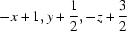
| Symmetry codes: (vii) x−1, y, z; (viii) −x+1, −y+1, −z+1; (ix) −x+1, y+1/2, −z+3/2. |
Experimental details
| Crystal data | |
| Chemical formula | [Na(C8H7O9)] |
| Mr | 270.13 |
| Crystal system, space group | Monoclinic, P21/c |
| Temperature (K) | 296 |
| a, b, c (Å) | 8.0663 (16), 13.417 (3), 9.7358 (19) |
| β (°) | 109.90 (3) |
| V (Å3) | 990.7 (3) |
| Z | 4 |
| Radiation type | Mo Kα |
| µ (mm−1) | 0.20 |
| Crystal size (mm) | 0.41 × 0.28 × 0.10 |
| Data collection | |
| Diffractometer | Rigaku R-AXIS RAPID |
| Absorption correction | Multi-scan (ABSCOR; Higashi, 1995) |
| Tmin, Tmax | 0.921, 0.980 |
| No. of measured, independent and observed [I > 2σ(I)] reflections | 9567, 2263, 2095 |
| Rint | 0.018 |
| (sin θ/λ)max (Å−1) | 0.648 |
| Refinement | |
| R[F2 > 2σ(F2)], wR(F2), S | 0.032, 0.090, 1.09 |
| No. of reflections | 2263 |
| No. of parameters | 164 |
| H-atom treatment | H-atom parameters constrained |
| Δρmax, Δρmin (e Å−3) | 0.39, −0.32 |
Computer programs: PROCESS-AUTO (Rigaku, 1998), CrystalStructure (Rigaku/MSC, 2004), SHELXS97 (Sheldrick, 2008), SHELXL97 (Sheldrick, 2008), SHELXTL (Sheldrick, 2008).
| D—H···A | D—H | H···A | D···A | D—H···A |
| O3—H3···O9i | 0.84 | 1.70 | 2.5395 (15) | 172.8 |
| O5—H5···O6ii | 0.84 | 1.83 | 2.6468 (16) | 164.6 |
| O7—H7···O8iii | 0.84 | 1.68 | 2.5169 (14) | 170.5 |
| Symmetry codes: (i) x−1, y, z; (ii) −x+1, −y+1, −z+1; (iii) −x+1, y+1/2, −z+3/2. |
Acknowledgements
We are grateful for financial support from the National Natural Science Foundation of China (projects 50702054 and 20803070) and the Analysis and Testing Foundation of Zhejiang Province (projects 2008 F70034 and 2008 F70053).
References
 Ai, W. T., He, H. Y., Liu, L. J., Liu, Q. J., Lv, X. L., Li, J. & Sun, D. F. (2008). CrystEngComm, 10, 1480–1486. Web of Science CSD CrossRef CAS Google Scholar
Barnes, J. C. (2002). Acta Cryst. E58, m378–m380. Web of Science CSD CrossRef IUCr Journals Google Scholar
Barnes, J. C. & Paton, J. D. (1984). Acta Cryst. C40, 1809–1812. CSD CrossRef CAS Web of Science IUCr Journals Google Scholar
Bradshaw, D., Warren, J. E. & Rosseinsky, M. J. (2007). Science, 315, 977–980. Web of Science CSD CrossRef PubMed CAS Google Scholar
Hanson, K., Calin, N., Bugaris, D., Scancella, M. & Sevov, S. C. (2004). J. Am. Chem. Soc. 126, 10502–10503. Web of Science CrossRef PubMed CAS Google Scholar
Higashi, T. (1995). ABSCOR. Rigaku Corporation, Tokyo, Japan. Google Scholar
Leininger, S., Olenyuk, B. & Stang, P. J. (2000). Chem. Rev. 100, 853–908. Web of Science CrossRef PubMed CAS Google Scholar
Lu, H., Fu, Y.-L., Yang, J.-Y. & Ng, S. W. (2007). Acta Cryst. E63, m319–m320. Web of Science CSD CrossRef IUCr Journals Google Scholar
Lü, Y. (2008). Acta Cryst. E64, m1245. Web of Science CrossRef IUCr Journals Google Scholar
Moulton, B. & Zaworotko, M. J. (2001). Chem. Rev. 101, 1629–1658. Web of Science CrossRef PubMed CAS Google Scholar
Paul, I. C. & Martin, L. L. (1967). Acta Cryst. 22, 559–567. CSD CrossRef CAS IUCr Journals Web of Science Google Scholar
Rigaku (1998). PROCESS-AUTO. Rigaku Corporation, Tokyo, Japan. Google Scholar
Rigaku/MSC (2004). CrystalStructure. Rigaku/MSC, The Woodlands, Texas, USA. Google Scholar
Sheldrick, G. M. (2008). Acta Cryst. A64, 112–122. Web of Science CrossRef CAS IUCr Journals Google Scholar
Thuéry, P., Villiers, C., Jaud, J., Ephritikhine, M. & Masci, B. (2004). J. Am. Chem. Soc. 126, 6838–6839. Web of Science CSD CrossRef PubMed CAS Google Scholar
Wang, X. Y., Scancella, M. & Sevov, S. C. (2007). Chem. Mater. 19, 4506–4513. Web of Science CSD CrossRef CAS Google Scholar
Wang, X. Y. & Sevov, S. C. (2007). Chem. Mater. 19, 3763–3766. Web of Science CSD CrossRef CAS Google Scholar
This is an open-access article distributed under the terms of the Creative Commons Attribution (CC-BY) Licence, which permits unrestricted use, distribution, and reproduction in any medium, provided the original authors and source are cited.
| CRYSTALLOGRAPHIC COMMUNICATIONS |
access


Metal organic frameworks (MOFs) have attracted a great deal of interest owing to the ability to tune their porosity and the functionalities that are incorporated within the framework scaffolds. As a result, numerous MOFs have been engineered for a number of potential applications, including gas storage, nonlinear optics, catalysis, and so on. (Moulton et al. 2001; Bradshaw et al. 2007) Usually, highly directional coordination bonds are adopted in the design of MOFs, and self-assembly of selected ligands around d-transition metal ions is now a widespread method for obtaining novel MOFs structure (Leininger et al. 2000). In contrast, the s-elements are more flexible of their coordination behaviour, and maybe present in more various structures (Lu et al. 2007). On the other hand, for the complex ligand with large numbers of potential binding sites, such as, tetrahydrofuran-2, 3, 4, 5-tetracarboxylic acid, it is difficult to predict the final structure. Therefore, the investigation of these complex ligands might provide novel MOFs with interesting structural topology. However, reports on THFTCA are rare (Hanson et al. 2004). Here, we report a three-dimensional MOFs compound Na(H3THFTCA) (I), which is assembled from THFTCA and sodium ion.
The title compound has a three-dimensional framework structure constructed by mono deprotonated THFTCA ligand; the asymmetric unit contains one full chiral THFTCA ligand and one sodium atom (Fig. 1). The THFTCA ligand coordinates the sodium ion with its furan oxygen atom and two adjacent carboxyl oxygen atoms, while its four carboxyl groups also grasp the neighbouring four sodium ions (Scheme 1). Thus, the sodium ion is located in a distorted pentagonal bipyramid NaO7, coordinated by seven O atoms from the five ligands. The two pentagonal bipyramids are fused via a common eadge O2—O2, generating a dinuclear sodium cluster with an an inversion centre at the midpoint of eadge O2—O2 (Fig. 2). The title compound crystallizes in the centrosymmetric space group P21/c implying the presence of a racemate (1:1) in the crystal. The dinuclear sodium clusters are connected by carboxyl groups of THFTCA ligand. The crystal packing includes firm framework of multi-carboxyl ligand and sodium ion connected by hydrogen bonds of O—H···O (Table 1, Fig. 3).