 | Acta Crystallographica Section E Acta Crystallographica Section E CRYSTALLOGRAPHIC COMMUNICATIONS |


 journal menu


metal-organic compounds
| CRYSTALLOGRAPHIC COMMUNICATIONS |
 access
Poly[(6-carboxypicolinato-κ3O2,N,O6)(μ3-pyridine-2,6-dicarboxylato-κ5O2,N,O6:O2′:O6′)dysprosium(III)]

aSchool of Chemistry and Environment, South China Normal University, Guangzhou 510006, People's Republic of China., and bSouth China Normal University, Key Laboratory of Technology of Electrochemical Energy Storage and Power Generation in Guangdong Universities, Guangzhou 510006, People's Republic of China
*Correspondence e-mail: [email protected]
In the title complex, [Dy(C7H3NO4)(C7H4NO4)]n, one of the ligands is fully deprotonated while the second has lost only one H atom. Each DyIII ion is coordinated by six O atoms and two N atoms from two pyridine-2,6-dicarboxylate and two 6-carboxypicolinate ligands, displaying a bicapped trigonal-prismatic geometry. The average Dy—O bond distance is 2.40 Å, some 0.1Å longer than the corresponding Ho—O distance in the isotypic holmium complex. Adjacent DyIII ions are linked by the pyridine-2,6-dicarboxylate ligands, forming a layer in (100). These layers are further connected by π–π stacking interactions between neighboring pyridyl rings [centroid–centroid distance = 3.827 (3) Å] and C—H⋯O hydrogen-bonding interactions, assembling a three-dimensional supramolecular network. Within each layer, there are other π–π stacking interactions between neighboring pyridyl rings [centroid–centroid distance = 3.501 (2) Å] and O—H⋯O and C—H⋯O hydrogen-bonding interactions, which further stabilize the structure.
Related literature
For the isotypic holmium analogue, see: Fernandes et al. (2001![[Fernandes, A., Jaud, J., Dexpert-Ghys, J. & Brouca-Cabarrecq, C. (2001). Polyhedron, 20, 2385-2391.]](../../../../../../logos/arrows/e_arr.gif "Fernandes, A., Jaud, J., Dexpert-Ghys, J. & Brouca-Cabarrecq, C. (2001). Polyhedron, 20, 2385-2391.") ). For other related structures, see: Hong (2007); Huang et al. (2008); Idrees et al. (2009); Rafizadeh & Amani (2006); Thallapally et al. (2008).
). For other related structures, see: Hong (2007); Huang et al. (2008); Idrees et al. (2009); Rafizadeh & Amani (2006); Thallapally et al. (2008).
![[Scheme 1]](sj2654scheme1.gif)
Experimental
Crystal data
|
Refinement
|
| ||||||||||||||||||||
 ; (ii)
  .
.
|
 ; (v)
; (v) Data collection: APEX2 (Bruker, 2004); cell refinement: SAINT (Bruker, 2004); data reduction: SAINT; program(s) used to solve structure: SHELXS97 (Sheldrick, 2008); program(s) used to refine structure: SHELXL97 (Sheldrick, 2008); molecular graphics: ORTEPIII (Burnett & Johnson, 1996) and PLATON (Spek, 2009); software used to prepare material for publication: SHELXL97.
Supporting information
contains datablocks I, global. DOI: https://doi.org/10.1107/S1600536809039075/sj2654sup1.cif
Structure factors: contains datablock I. DOI: https://doi.org/10.1107/S1600536809039075/sj2654Isup2.hkl
A mixture of Dy2O3 (0.375 g; 1 mmol), pyridine-2,6-dicarboxylic acid (0.167 g; 1 mmol), water (10 ml) and HNO3 (0.024 g; 0.385 mmol) was stirred vigorously for 20 min and then sealed in a Teflon-lined stainless-steel autoclave (20 ml, capacity). The autoclave was heated and maintained at 433 K for 3 days, and then cooled to room temperature at 5 K h-1 to yield colorless block-like crystals.
The H atom of the 6-carboxypicolinate ligand was located in a difference Fourier map and refined with a distance restraint of O–H = 0.82 Å, and with Uiso(H) = 1.5 Ueq(O). H atoms attached to C were placed at calculated positions and were treated as riding on their parent atoms with C—H = 0.93 Å, and with Uiso(H) = 1.2 Ueq(C).
Research on the design and synthesis of metal-organic frameworks (MOFs) in recent years has become an active area in the fields of crystal engineering and supramolecular chemistry, not only because of their tremendous potential applications in gas storage, chemical separations, ion exchange, microelectronics, nonlinear optics, and but also because of their intriguing variety of architectures and topologies (Hong, 2007; Thallapally et al., 2008). The synthesis of such species is often based on the self-assembly of suitable building blocks to give supramolecular networks constructed by coordination or/and hydrogen bonds or other weaker supromolecular interactions, such as π-π stacking interactions. As a building block, the pyridine-2,6-dicarboxylic acid is a good ligand with multifunctional coordination sites providing intriguing architectures and topologies (Fernandes et al., 2001; Rafizadeh & Amani, 2006; Huang et al., 2008; Idrees et al., 2009). Recently, we obtained the title coordination polymer, which was synthesized under hydrothermal conditions.
In the structure of the title compound (Fig. 1), one of the ligands is fully deprotonated while the second carries an OH group. Each DyIII centre is eight -coordinated by six oxygen atoms two N atoms from two pyridine-2,6-dicarboxylato and two 6-carboxypicolinato ligands, and can described as having a bicapped trigonal prismatic geometry with Dy—O distances and O—Dy—O angles ranging from 2.266 (2) Å to 2.513 (2) Å (Table 1) and 76.75.30 (8) %A to 153.60 (9) %A, respectively. It is of interest that the Dy···O and Dy···N distances are slightly longer than the corresponding values in the isostructural Ho complex (Fernandes et al., 2001). Indeed the average Dy—O bond distance is 2.396 Å, some 0.1 Å longer than the corresponding distance (Ho—O = 2.385Å) in the isomorphous holmium complex as anticipated due to the lanthanide contraction. The pyridine-2,6-dicarboxylato ligands act as bridges linking adjacent DyIII metal centres into a layer parallel to the (1 0 0) plane. Within the layer, the 6-carboxypicolinato ligands are both hydrogen bond donors and hydrogen bond acceptors with O—H···O and C—H···O hydrogen bonding interactions stabilizing the (Table 2). π-π stacking interactions (the centroid-centroid distance between neighboring pyridyl rings is 3.827 (3) Å) and C—H···O hydrogen bonding interactions connect those layers to produce a three-dimensional supramolecular motif (Fig. 2). Other π-π stacking interactions between neighboring pyridyl rings are also present in each layer, the centroid-centroid distance is 3.501 (2) Å.
For the isomorphous holmium analogue, see: Fernandes et al. (2001). For other related structures, see: Hong (2007); Huang et al. (2008); Idrees et al. (2009); Rafizadeh & Amani (2006); Thallapally et al. (2008).
Data collection: APEX2 (Bruker, 2004); cell SAINT (Bruker, 2004); data reduction: SAINT (Bruker, 2004); program(s) used to solve structure: SHELXS97 (Sheldrick, 2008); program(s) used to refine structure: SHELXL97 (Sheldrick, 2008); molecular graphics: ORTEPIII (Burnett & Johnson, 1996) and PLATON (Spek, 2009); software used to prepare material for publication: SHELXL97 (Sheldrick, 2008).
![[Figure 1]](./sj2654fig1thm.gif) | Fig. 1. The molecular structure showing the atomic-numbering scheme, with displacement ellipsoids drawn at the 30% probability level. Symmetry codes: (#1) x, 0.5-y, -0.5+z; (#2) -x, 0.5+y, 1.5-z. |
![[Figure 2]](./sj2654fig2thm.gif) | Fig. 2. A view of the three-dimensional supramolecular network. Hydrogen bonds are shown as dashed lines. |
| [Dy(C7H3NO4)(C7H4NO4)] | F(000) = 940 |
| Mr = 493.72 | Dx = 2.437 Mg m−3 |
| Monoclinic, P21/c | Mo Kα radiation, λ = 0.71073 Å |
| Hall symbol: -P 2ybc | Cell parameters from 5626 reflections |
| a = 12.2151 (14) Å | θ = 2.4–27.8° |
| b = 8.3703 (10) Å | µ = 5.61 mm−1 |
| c = 13.4698 (16) Å | T = 296 K |
| β = 102.332 (1)° | Block, colourless |
| V = 1345.4 (3) Å3 | 0.23 × 0.21 × 0.19 mm |
| Z = 4 |
| Bruker APEXII area-detector diffractometer | 2413 independent reflections |
| Radiation source: fine-focus sealed tube | 2305 reflections with I > 2σ(I) |
| Graphite monochromator | Rint = 0.024 |
| φ and ω scans | θmax = 25.2°, θmin = 1.7° |
| Absorption correction: multi-scan (SADABS; Bruker, 2004) | h = −14→12 |
| Tmin = 0.359, Tmax = 0.415 | k = −8→10 |
| 6670 measured reflections | l = −16→16 |
| Refinement on F2 | Primary atom site location: structure-invariant direct methods |
| Least-squares matrix: full | Secondary atom site location: difference Fourier map |
| R[F2 > 2σ(F2)] = 0.021 | Hydrogen site location: inferred from neighbouring sites |
| wR(F2) = 0.051 | H atoms treated by a mixture of independent and constrained refinement |
| S = 1.12 | w = 1/[σ2(Fo2) + (0.0241P)2 + 1.92P] where P = (Fo2 + 2Fc2)/3 |
| 2413 reflections | (Δ/σ)max = 0.002 |
| 229 parameters | Δρmax = 0.58 e Å−3 |
| 1 restraint | Δρmin = −1.43 e Å−3 |
| [Dy(C7H3NO4)(C7H4NO4)] | V = 1345.4 (3) Å3 |
| Mr = 493.72 | Z = 4 |
| Monoclinic, P21/c | Mo Kα radiation |
| a = 12.2151 (14) Å | µ = 5.61 mm−1 |
| b = 8.3703 (10) Å | T = 296 K |
| c = 13.4698 (16) Å | 0.23 × 0.21 × 0.19 mm |
| β = 102.332 (1)° |
| Bruker APEXII area-detector diffractometer | 2413 independent reflections |
| Absorption correction: multi-scan (SADABS; Bruker, 2004) | 2305 reflections with I > 2σ(I) |
| Tmin = 0.359, Tmax = 0.415 | Rint = 0.024 |
| 6670 measured reflections |
| R[F2 > 2σ(F2)] = 0.021 | 1 restraint |
| wR(F2) = 0.051 | H atoms treated by a mixture of independent and constrained refinement |
| S = 1.12 | Δρmax = 0.58 e Å−3 |
| 2413 reflections | Δρmin = −1.43 e Å−3 |
| 229 parameters |
Geometry. All esds (except the esd in the dihedral angle between two l.s. planes) are estimated using the full covariance matrix. The cell esds are taken into account individually in the estimation of esds in distances, angles and torsion angles; correlations between esds in cell parameters are only used when they are defined by crystal symmetry. An approximate (isotropic) treatment of cell esds is used for estimating esds involving l.s. planes. |
Refinement. Refinement of F2 against ALL reflections. The weighted R-factor wR and goodness of fit S are based on F2, conventional R-factors R are based on F, with F set to zero for negative F2. The threshold expression of F2 > 2sigma(F2) is used only for calculating R-factors(gt) etc. and is not relevant to the choice of reflections for R-factors based on F2 are statistically about twice as large as those based on F, and R- factors based on ALL data will be even larger. |
| x | y | z | Uiso*/Ueq | ||
| Dy1 | 0.197015 (13) | 0.232131 (18) | 0.818183 (11) | 0.00903 (7) | |
| C2 | 0.5158 (3) | 0.5574 (5) | 0.8746 (3) | 0.0243 (9) | |
| H2 | 0.5247 | 0.6677 | 0.8750 | 0.029* | |
| C3 | 0.4095 (3) | 0.4901 (4) | 0.8567 (3) | 0.0184 (8) | |
| C4 | 0.4836 (3) | 0.2361 (4) | 0.8735 (3) | 0.0187 (8) | |
| C1 | 0.6084 (3) | 0.4572 (5) | 0.8919 (3) | 0.0282 (9) | |
| H1 | 0.6805 | 0.4990 | 0.9030 | 0.034* | |
| C5 | 0.5912 (3) | 0.2933 (5) | 0.8922 (3) | 0.0274 (9) | |
| H5 | 0.6518 | 0.2233 | 0.9049 | 0.033* | |
| N1 | 0.3933 (2) | 0.3321 (3) | 0.8555 (2) | 0.0136 (6) | |
| C6 | 0.3019 (3) | 0.5872 (4) | 0.8367 (3) | 0.0201 (8) | |
| O1 | 0.2131 (2) | 0.5091 (3) | 0.82690 (18) | 0.0180 (6) | |
| O2 | 0.3085 (3) | 0.7328 (3) | 0.8293 (3) | 0.0452 (10) | |
| C7 | 0.4611 (3) | 0.0608 (4) | 0.8716 (3) | 0.0203 (8) | |
| O4 | 0.3508 (2) | 0.0270 (3) | 0.8468 (2) | 0.0202 (6) | |
| O3 | 0.5333 (2) | −0.0385 (3) | 0.8889 (3) | 0.0368 (8) | |
| C13 | 0.2072 (3) | 0.1845 (4) | 1.0625 (2) | 0.0128 (7) | |
| C8 | 0.1581 (3) | 0.0254 (4) | 1.0222 (2) | 0.0122 (7) | |
| O5 | 0.2310 (2) | 0.2782 (3) | 0.9969 (2) | 0.0200 (6) | |
| N2 | 0.1355 (2) | 0.0186 (3) | 0.9205 (2) | 0.0107 (6) | |
| C11 | 0.0664 (3) | −0.2478 (4) | 0.9275 (3) | 0.0171 (8) | |
| H11 | 0.0339 | −0.3386 | 0.8937 | 0.021* | |
| C12 | 0.0876 (3) | −0.1133 (4) | 0.8745 (2) | 0.0115 (7) | |
| O7 | 0.1092 (2) | 0.0071 (3) | 0.72203 (17) | 0.0148 (5) | |
| O6 | 0.2198 (2) | 0.2145 (3) | 1.15526 (19) | 0.0184 (6) | |
| C14 | 0.0590 (3) | −0.0988 (4) | 0.7607 (2) | 0.0115 (7) | |
| C9 | 0.1386 (3) | −0.1020 (4) | 1.0812 (3) | 0.0152 (7) | |
| H9 | 0.1539 | −0.0945 | 1.1517 | 0.018* | |
| C10 | 0.0953 (3) | −0.2420 (4) | 1.0324 (3) | 0.0183 (8) | |
| H10 | 0.0858 | −0.3317 | 1.0703 | 0.022* | |
| O8 | −0.0153 (2) | −0.1898 (3) | 0.71176 (18) | 0.0171 (5) | |
| H2A | 0.334 (3) | 0.822 (3) | 0.838 (3) | 0.026* |
| U11 | U22 | U33 | U12 | U13 | U23 | |
| Dy1 | 0.00974 (11) | 0.00762 (10) | 0.01008 (11) | −0.00032 (5) | 0.00291 (7) | 0.00052 (5) |
| C2 | 0.026 (2) | 0.0179 (19) | 0.030 (2) | −0.0111 (16) | 0.0069 (17) | −0.0045 (16) |
| C3 | 0.022 (2) | 0.0131 (17) | 0.0203 (19) | −0.0011 (15) | 0.0048 (15) | 0.0002 (14) |
| C4 | 0.015 (2) | 0.0168 (18) | 0.024 (2) | −0.0005 (14) | 0.0039 (16) | −0.0011 (14) |
| C1 | 0.019 (2) | 0.025 (2) | 0.040 (3) | −0.0099 (16) | 0.0056 (18) | −0.0064 (17) |
| C5 | 0.015 (2) | 0.023 (2) | 0.042 (3) | −0.0006 (16) | 0.0021 (18) | −0.0035 (18) |
| N1 | 0.0122 (15) | 0.0120 (14) | 0.0171 (15) | −0.0013 (12) | 0.0043 (12) | 0.0005 (11) |
| C6 | 0.025 (2) | 0.0145 (18) | 0.0207 (19) | 0.0017 (15) | 0.0048 (16) | 0.0005 (14) |
| O1 | 0.0183 (14) | 0.0111 (13) | 0.0251 (14) | −0.0001 (10) | 0.0057 (11) | 0.0010 (9) |
| O2 | 0.039 (2) | 0.0065 (14) | 0.088 (3) | −0.0048 (12) | 0.009 (2) | 0.0015 (15) |
| C7 | 0.016 (2) | 0.0165 (18) | 0.029 (2) | 0.0006 (15) | 0.0053 (16) | −0.0004 (15) |
| O4 | 0.0121 (13) | 0.0105 (12) | 0.0378 (16) | −0.0023 (10) | 0.0048 (11) | 0.0001 (10) |
| O3 | 0.0185 (15) | 0.0197 (15) | 0.070 (2) | 0.0055 (12) | 0.0043 (15) | 0.0011 (14) |
| C13 | 0.0114 (17) | 0.0152 (17) | 0.0122 (18) | 0.0025 (13) | 0.0031 (14) | 0.0011 (13) |
| C8 | 0.0097 (17) | 0.0157 (17) | 0.0124 (17) | 0.0037 (13) | 0.0049 (13) | −0.0021 (13) |
| O5 | 0.0295 (16) | 0.0178 (13) | 0.0137 (14) | −0.0094 (11) | 0.0066 (12) | −0.0016 (10) |
| N2 | 0.0102 (14) | 0.0123 (14) | 0.0102 (14) | −0.0009 (11) | 0.0036 (11) | −0.0004 (11) |
| C11 | 0.024 (2) | 0.0125 (17) | 0.017 (2) | −0.0039 (13) | 0.0096 (17) | −0.0024 (13) |
| C12 | 0.0103 (17) | 0.0112 (16) | 0.0143 (17) | −0.0011 (13) | 0.0053 (13) | 0.0000 (13) |
| O7 | 0.0177 (13) | 0.0146 (12) | 0.0131 (12) | −0.0036 (10) | 0.0054 (10) | −0.0004 (9) |
| O6 | 0.0262 (15) | 0.0182 (13) | 0.0119 (13) | −0.0017 (11) | 0.0064 (11) | −0.0037 (10) |
| C14 | 0.0093 (17) | 0.0120 (16) | 0.0139 (17) | 0.0019 (13) | 0.0043 (13) | −0.0033 (13) |
| C9 | 0.0166 (18) | 0.0191 (18) | 0.0107 (17) | 0.0001 (14) | 0.0044 (14) | 0.0015 (13) |
| C10 | 0.019 (2) | 0.0191 (18) | 0.018 (2) | −0.0012 (14) | 0.0068 (16) | 0.0061 (13) |
| O8 | 0.0159 (13) | 0.0198 (13) | 0.0163 (13) | −0.0061 (11) | 0.0052 (10) | −0.0045 (10) |
| Dy1—O8i | 2.266 (2) | O2—H2A | 0.811 (19) |
| Dy1—O6ii | 2.314 (3) | C7—O3 | 1.198 (5) |
| Dy1—O1 | 2.328 (2) | C7—O4 | 1.347 (4) |
| Dy1—O5 | 2.385 (3) | C13—O6 | 1.251 (4) |
| Dy1—O7 | 2.405 (2) | C13—O5 | 1.261 (4) |
| Dy1—N2 | 2.469 (3) | C13—C8 | 1.513 (5) |
| Dy1—N1 | 2.488 (3) | C8—N2 | 1.341 (4) |
| Dy1—O4 | 2.513 (2) | C8—C9 | 1.381 (5) |
| C2—C1 | 1.388 (6) | N2—C12 | 1.338 (4) |
| C2—C3 | 1.389 (6) | C11—C10 | 1.382 (6) |
| C2—H2 | 0.9300 | C11—C12 | 1.387 (5) |
| C3—N1 | 1.336 (4) | C11—H11 | 0.9300 |
| C3—C6 | 1.519 (5) | C12—C14 | 1.502 (5) |
| C4—N1 | 1.344 (5) | O7—C14 | 1.253 (4) |
| C4—C5 | 1.371 (6) | O6—Dy1iii | 2.314 (3) |
| C4—C7 | 1.492 (5) | C14—O8 | 1.257 (4) |
| C1—C5 | 1.388 (6) | C9—C10 | 1.392 (5) |
| C1—H1 | 0.9300 | C9—H9 | 0.9300 |
| C5—H5 | 0.9300 | C10—H10 | 0.9300 |
| C6—O2 | 1.226 (4) | O8—Dy1iv | 2.266 (2) |
| C6—O1 | 1.250 (5) | ||
| O8i—Dy1—O6ii | 95.01 (9) | C1—C5—H5 | 120.5 |
| O8i—Dy1—O1 | 77.91 (9) | C3—N1—C4 | 118.4 (3) |
| O6ii—Dy1—O1 | 80.18 (9) | C3—N1—Dy1 | 117.9 (2) |
| O8i—Dy1—O5 | 94.91 (9) | C4—N1—Dy1 | 123.6 (2) |
| O6ii—Dy1—O5 | 153.60 (9) | O2—C6—O1 | 125.5 (4) |
| O1—Dy1—O5 | 78.08 (8) | O2—C6—C3 | 118.5 (4) |
| O8i—Dy1—O7 | 79.79 (9) | O1—C6—C3 | 115.9 (3) |
| O6ii—Dy1—O7 | 76.74 (8) | C6—O1—Dy1 | 126.0 (2) |
| O1—Dy1—O7 | 146.15 (8) | C6—O2—H2A | 159 (3) |
| O5—Dy1—O7 | 129.18 (8) | O3—C7—O4 | 124.0 (3) |
| O8i—Dy1—N2 | 84.53 (9) | O3—C7—C4 | 123.6 (4) |
| O6ii—Dy1—N2 | 141.40 (9) | O4—C7—C4 | 112.4 (3) |
| O1—Dy1—N2 | 136.47 (9) | C7—O4—Dy1 | 124.8 (2) |
| O5—Dy1—N2 | 64.02 (8) | O6—C13—O5 | 125.3 (3) |
| O7—Dy1—N2 | 65.15 (8) | O6—C13—C8 | 119.3 (3) |
| O8i—Dy1—N1 | 143.55 (10) | O5—C13—C8 | 115.4 (3) |
| O6ii—Dy1—N1 | 79.66 (9) | N2—C8—C9 | 122.2 (3) |
| O1—Dy1—N1 | 65.64 (9) | N2—C8—C13 | 112.5 (3) |
| O5—Dy1—N1 | 77.84 (10) | C9—C8—C13 | 125.3 (3) |
| O7—Dy1—N1 | 132.22 (9) | C13—O5—Dy1 | 126.2 (2) |
| N2—Dy1—N1 | 121.72 (9) | C12—N2—C8 | 118.8 (3) |
| O8i—Dy1—O4 | 153.64 (9) | C12—N2—Dy1 | 119.6 (2) |
| O6ii—Dy1—O4 | 92.28 (9) | C8—N2—Dy1 | 121.3 (2) |
| O1—Dy1—O4 | 128.35 (8) | C10—C11—C12 | 117.6 (3) |
| O5—Dy1—O4 | 89.58 (9) | C10—C11—H11 | 121.2 |
| O7—Dy1—O4 | 77.30 (8) | C12—C11—H11 | 121.2 |
| N2—Dy1—O4 | 74.15 (9) | N2—C12—C11 | 122.9 (3) |
| N1—Dy1—O4 | 62.74 (8) | N2—C12—C14 | 112.9 (3) |
| C1—C2—C3 | 118.9 (3) | C11—C12—C14 | 124.2 (3) |
| C1—C2—H2 | 120.6 | C14—O7—Dy1 | 122.1 (2) |
| C3—C2—H2 | 120.6 | C13—O6—Dy1iii | 166.3 (2) |
| N1—C3—C2 | 122.2 (3) | O7—C14—O8 | 125.0 (3) |
| N1—C3—C6 | 114.1 (3) | O7—C14—C12 | 116.9 (3) |
| C2—C3—C6 | 123.7 (3) | O8—C14—C12 | 118.1 (3) |
| N1—C4—C5 | 122.8 (3) | C8—C9—C10 | 118.2 (3) |
| N1—C4—C7 | 116.3 (3) | C8—C9—H9 | 120.9 |
| C5—C4—C7 | 120.8 (3) | C10—C9—H9 | 120.9 |
| C2—C1—C5 | 118.7 (4) | C11—C10—C9 | 120.1 (3) |
| C2—C1—H1 | 120.7 | C11—C10—H10 | 120.0 |
| C5—C1—H1 | 120.7 | C9—C10—H10 | 120.0 |
| C4—C5—C1 | 119.0 (4) | C14—O8—Dy1iv | 146.8 (2) |
| C4—C5—H5 | 120.5 |
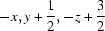
| Symmetry codes: (i) −x, y+1/2, −z+3/2; (ii) x, −y+1/2, z−1/2; (iii) x, −y+1/2, z+1/2; (iv) −x, y−1/2, −z+3/2. |
| D—H···A | D—H | H···A | D···A | D—H···A |
| O2—H2A···O4v | 0.81 (2) | 1.73 (2) | 2.518 (3) | 164 (5) |
| O2—H2A···O3v | 0.81 (2) | 2.65 (3) | 3.303 (4) | 139 (4) |
| C9—H9···O1iii | 0.93 | 2.42 | 3.332 (4) | 165 |
| C1—H1···O5vi | 0.93 | 2.42 | 3.123 (5) | 133 |
| C2—H2···O3v | 0.93 | 2.47 | 3.393 (5) | 174 |
| Symmetry codes: (iii) x, −y+1/2, z+1/2; (v) x, y+1, z; (vi) −x+1, −y+1, −z+2. |
Experimental details
| Crystal data | |
| Chemical formula | [Dy(C7H3NO4)(C7H4NO4)] |
| Mr | 493.72 |
| Crystal system, space group | Monoclinic, P21/c |
| Temperature (K) | 296 |
| a, b, c (Å) | 12.2151 (14), 8.3703 (10), 13.4698 (16) |
| β (°) | 102.332 (1) |
| V (Å3) | 1345.4 (3) |
| Z | 4 |
| Radiation type | Mo Kα |
| µ (mm−1) | 5.61 |
| Crystal size (mm) | 0.23 × 0.21 × 0.19 |
| Data collection | |
| Diffractometer | Bruker APEXII area-detector |
| Absorption correction | Multi-scan (SADABS; Bruker, 2004) |
| Tmin, Tmax | 0.359, 0.415 |
| No. of measured, independent and observed [I > 2σ(I)] reflections | 6670, 2413, 2305 |
| Rint | 0.024 |
| (sin θ/λ)max (Å−1) | 0.599 |
| Refinement | |
| R[F2 > 2σ(F2)], wR(F2), S | 0.021, 0.051, 1.12 |
| No. of reflections | 2413 |
| No. of parameters | 229 |
| No. of restraints | 1 |
| H-atom treatment | H atoms treated by a mixture of independent and constrained refinement |
| Δρmax, Δρmin (e Å−3) | 0.58, −1.43 |
Computer programs: APEX2 (Bruker, 2004), SAINT (Bruker, 2004), SHELXS97 (Sheldrick, 2008), SHELXL97 (Sheldrick, 2008), ORTEPIII (Burnett & Johnson, 1996) and PLATON (Spek, 2009).
| Dy1—O8i | 2.266 (2) | Dy1—O7 | 2.405 (2) |
| Dy1—O6ii | 2.314 (3) | Dy1—N2 | 2.469 (3) |
| Dy1—O1 | 2.328 (2) | Dy1—N1 | 2.488 (3) |
| Dy1—O5 | 2.385 (3) | Dy1—O4 | 2.513 (2) |
| Symmetry codes: (i) −x, y+1/2, −z+3/2; (ii) x, −y+1/2, z−1/2. |
| D—H···A | D—H | H···A | D···A | D—H···A |
| O2—H2A···O4iii | 0.811 (19) | 1.73 (2) | 2.518 (3) | 164 (5) |
| O2—H2A···O3iii | 0.811 (19) | 2.65 (3) | 3.303 (4) | 139 (4) |
| C9—H9···O1iv | 0.93 | 2.42 | 3.332 (4) | 165.3 |
| C1—H1···O5v | 0.93 | 2.42 | 3.123 (5) | 132.6 |
| C2—H2···O3iii | 0.93 | 2.47 | 3.393 (5) | 173.5 |
| Symmetry codes: (iii) x, y+1, z; (iv) x, −y+1/2, z+1/2; (v) −x+1, −y+1, −z+2. |
Acknowledgements
The authors acknowledge the Chan Xue Yan Cooperative Special Project of Guangdong Province and the Ministry of Science and Technology of the People's Republic of China (Project No, 2007A090302046), the Project of Science and Technology of Guangdong Province (Project No. 2007A020200002-4) and the Natural Science Foundation of Guangdong Province (No. 9151063101000037) for supporting this work.
References
 Bruker (2004). APEX2, SAINT and SADABS. Bruker AXS Inc., Madison, Wisconsin, USA. Google Scholar
Burnett, M. N. & Johnson, C. K. (1996). ORTEPIII. Report ORNL-6895. Oak Ridge National Laboratory, Tennessee, USA. Google Scholar
Fernandes, A., Jaud, J., Dexpert-Ghys, J. & Brouca-Cabarrecq, C. (2001). Polyhedron, 20, 2385–2391. Web of Science CSD CrossRef CAS Google Scholar
Hong, M. C. (2007). Cryst. Growth Des. 7, 10–14. Web of Science CrossRef CAS Google Scholar
Huang, Y.-G., Yuan, D.-Q., Gong, Y.-Q., Jiang, F.-L. & Hong, M.-C. (2008). J. Mol. Struct. 872, 99–104. Web of Science CSD CrossRef CAS Google Scholar
Idrees, M., Shadab, S. M. & Kumar, S. (2009). Acta Cryst. E65, o1492–o1493. Web of Science CSD CrossRef IUCr Journals Google Scholar
Rafizadeh, M. & Amani, V. (2006). Acta Cryst. E62, m90–m91. Web of Science CSD CrossRef CAS IUCr Journals Google Scholar
Sheldrick, G. M. (2008). Acta Cryst. A64, 112–122. Web of Science CrossRef CAS IUCr Journals Google Scholar
Spek, A. L. (2009). Acta Cryst. D65, 148–155. Web of Science CrossRef CAS IUCr Journals Google Scholar
Thallapally, P. K., Tian, J., Kishan, M. R., Fernandez, C. A., Dalgarno, S. J., McGrail, P. B., Warren, J. E. & Atwood, J. L. (2008). J. Am. Chem. Soc. 130, 16842–16843. Web of Science CSD CrossRef PubMed CAS Google Scholar
This is an open-access article distributed under the terms of the Creative Commons Attribution (CC-BY) Licence, which permits unrestricted use, distribution, and reproduction in any medium, provided the original authors and source are cited.
| CRYSTALLOGRAPHIC COMMUNICATIONS |
access


Research on the design and synthesis of metal-organic frameworks (MOFs) in recent years has become an active area in the fields of crystal engineering and supramolecular chemistry, not only because of their tremendous potential applications in gas storage, chemical separations, ion exchange, microelectronics, nonlinear optics, and heterogeneous catalysis, but also because of their intriguing variety of architectures and topologies (Hong, 2007; Thallapally et al., 2008). The synthesis of such species is often based on the self-assembly of suitable building blocks to give supramolecular networks constructed by coordination or/and hydrogen bonds or other weaker supromolecular interactions, such as π-π stacking interactions. As a building block, the pyridine-2,6-dicarboxylic acid is a good ligand with multifunctional coordination sites providing intriguing architectures and topologies (Fernandes et al., 2001; Rafizadeh & Amani, 2006; Huang et al., 2008; Idrees et al., 2009). Recently, we obtained the title coordination polymer, which was synthesized under hydrothermal conditions.
In the structure of the title compound (Fig. 1), one of the ligands is fully deprotonated while the second carries an OH group. Each DyIII centre is eight -coordinated by six oxygen atoms two N atoms from two pyridine-2,6-dicarboxylato and two 6-carboxypicolinato ligands, and can described as having a bicapped trigonal prismatic geometry with Dy—O distances and O—Dy—O angles ranging from 2.266 (2) Å to 2.513 (2) Å (Table 1) and 76.75.30 (8) %A to 153.60 (9) %A, respectively. It is of interest that the Dy···O and Dy···N distances are slightly longer than the corresponding values in the isostructural Ho complex (Fernandes et al., 2001). Indeed the average Dy—O bond distance is 2.396 Å, some 0.1 Å longer than the corresponding distance (Ho—O = 2.385Å) in the isomorphous holmium complex as anticipated due to the lanthanide contraction. The pyridine-2,6-dicarboxylato ligands act as bridges linking adjacent DyIII metal centres into a layer parallel to the (1 0 0) plane. Within the layer, the 6-carboxypicolinato ligands are both hydrogen bond donors and hydrogen bond acceptors with O—H···O and C—H···O hydrogen bonding interactions stabilizing the crystal structure (Table 2). π-π stacking interactions (the centroid-centroid distance between neighboring pyridyl rings is 3.827 (3) Å) and C—H···O hydrogen bonding interactions connect those layers to produce a three-dimensional supramolecular motif (Fig. 2). Other π-π stacking interactions between neighboring pyridyl rings are also present in each layer, the centroid-centroid distance is 3.501 (2) Å.