 | Acta Crystallographica Section E Acta Crystallographica Section E CRYSTALLOGRAPHIC COMMUNICATIONS |


 journal menu


inorganic compounds
| CRYSTALLOGRAPHIC COMMUNICATIONS |
 access
Synchrotron study of the garnet-type oxide Li6CaSm2Ta2O12

aDepartment of Chemistry, Division of Energy Systems Research, Ajou University, Suwon 443-749, Republic of Korea, and bInstitute of NT-IT Fusion Technology, Ajou University, Republic of Korea
*Correspondence e-mail: [email protected]
Hexalithium calcium disamarium(III) ditantalum(V) dodecaoxide, Li6CaSm2Ta2O12, crystallizes in a cubic garnet-type structure. In the crystal structure, disordered Li atoms occupy two crystallographic sites. One Li has a tetrahedral coordination environment in the oxide lattice, whereas the other Li atom occupies a significantly distorted octahedral site, with site occupancies for the two Li atoms of 0.26 (7) and 0.44 (2), respectively. Ca and Sm atoms are statistically distributed over the same crystallographic position with a occupancy of 2/3 for Sm and of 1/3 for Ca, and are eightfold coordinated by O atoms. The TaO6 octahedron is joined to six others via corner-sharing LiO4 tetrahedra. One Li and the O atoms lie on general positions, while the other atoms are situated on special positions. The Sm/Ca position has 222, Ta has  , and the tetrahedrally coordinated Li atom has
  site symmetry.
Related literature
For a general description of structures and physical properties of garnets, see: Geller (1967![[Geller, S. (1967). Z. Kristallogr. 125, 1-47.]](../../../../../../logos/arrows/e_arr.gif "Geller, S. (1967). Z. Kristallogr. 125, 1-47.") ). Recently, high Li-ion conductivity was discovered in garnet-related compounds such as Li5La3M2O12 (M = Nb, Ta), see: Thangadurai et al. (2003); Cussen (2006). For studies focused on the substitution of La3+ by divalent alkaline earth ions (Ca, Sr, Ba), see: Murugan et al. (2007); Thangadurai & Weppner (2005a,b); O'Callaghan & Cussen (2007); Percival & Slater (2007). For indexing the powder diffraction pattern, see: Boultif & Louër (2004).
). Recently, high Li-ion conductivity was discovered in garnet-related compounds such as Li5La3M2O12 (M = Nb, Ta), see: Thangadurai et al. (2003); Cussen (2006). For studies focused on the substitution of La3+ by divalent alkaline earth ions (Ca, Sr, Ba), see: Murugan et al. (2007); Thangadurai & Weppner (2005a,b); O'Callaghan & Cussen (2007); Percival & Slater (2007). For indexing the powder diffraction pattern, see: Boultif & Louër (2004).
Experimental
Crystal data
|

Data collection
|
Refinement
|
|
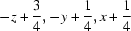 ; (ii)
  ; (iii)
 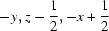 ; (iv)
 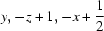 ; (v)
; (v) 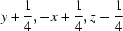 ; (vi)
 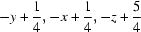 .
. Data collection: local software at 8C2 HRPD beamline; cell FULLPROF (Rodriguez-Carvajal, 2001); data reduction: FULLPROF; program(s) used to solve structure: SHELXS97 (Sheldrick, 2008); program(s) used to refine structure: FULLPROF; molecular graphics: DIAMOND (Brandenburg, 1999); software used to prepare material for publication: FULLPROF.
Supporting information
contains datablocks global, I. DOI: https://doi.org/10.1107/S1600536809040008/wm2261sup1.cif
Rietveld powder data: contains datablock I. DOI: https://doi.org/10.1107/S1600536809040008/wm2261Isup2.rtv
The polycrystalline sample of Li6Sm2CaTa2O12 was prepared by solid-state reaction of stoichiometric amounts of Sm2O3, Ta2O5, CaCO3 and 10% excess of Li2CO3. Sm2O3 was preheated at 1173 K for 24 h to remove absorbed water before using. The finely ground samples were heated at 1123 and 1173 K for 12 h and then 1223 K for 24 h, with intermediate regrindings. Synchrotron X-ray diffraction (sXRD) measurement was performed on beamline 8 C2-HRPD at Pohang Accelerator Laboratory, Pohang, Korea. The incident X-rays were vertically collimated by a mirror, and monochromated to the wavelength of 1.5490 Å by double-crystal Si (111) monochromator. The datasets were collected in the range of 10° ≤ 2θ ≤ 130° with a step size of 0.01° (2θ range).
All reflections could be indexed with a body centered cubic cell. Any additional peaks due to symmetry lowering or impurity phase were not detected. The unit-cell parameter was determined with the DICVOL program (Boultif & Louër, 2004). The figures of merit were M(20) = 175.8, F(20) = 134.8(0.0013, 114). The for (hkl): h + k + l = even, (0kl): k,l = even, (hhl): 2 h + l = 4n and l = even, (00 l): l = 4n suggested that the Li containing-garnet structure belonged to Ia3d The atomic positions of Ta, Sm, Ca and O atoms were determined employing using the synchrotron XRD data. The total amplitude factors (148, 'Fobs') were converted into structure factors and used as an input for the SHELXS97 program (Sheldrick, 2008). The positions of Li1 and Li2 were then determined by difference Fourier analysis in SHELXL97 program (Sheldrick, 2008). Structure refinements of atomic positions, occupancy and isotropic displacement parameters were carried out by the using the FULLPROF program with pseudo-Voigt peak shapes and manually selected backgrounds (Rodriguez-Carvajal, 2001). In the the SOFs of two Li sites were constrained in such a way that the total amount of Li atoms was constant to maintain the chemical composition. The isotropic displacement parameters for two Li atoms were set to the same refined value because there was a strong correlation between the isotropic displacement parameters and the SOFs for both Li1 and Li2 sites. The plot based on the synchrotron XRD data is shown in Fig. 3.
Conventional garnet-type oxides with general formula A3B3C2O12 contain tetrahedral, cubic and octahedral coordination environments filled with A, B, and C atoms, respectively. The garnet structure has attracted renewed interest since a Li+ was observed in the compound Li5La3Ta2O12, which contains an excess of Li beyond the usual garnet composition. The was enhanced through the increase of the Li content via partial substitution of trivalent La3+ by divalent alkaline earth ions (Murugan et al., 2007). The structure of the title compound is closely related to that of Li6SrLa2Ta2O12 (Percival & Slater, 2007). Li1 atoms are located at site 24d (tetrahedral), Li2 atoms at site 96h (distorted octahedral), Sm/Ca atoms are at site 24c (cubic), Ta atoms at site 16a (octahedral), and O atoms at general site 96h (Fig. 1). As shown in Fig. 2, the partially occupied Li2 site exhibits a significantly distorted [4 + 2] with Li—O bond lengths between 1.63 (6) - 2.69 (6) Å. The Li1 atoms at the tetrahedral sites and adjacent Li2 atoms at the octahedral sites are connected by common oxygen atoms via face-sharing. Considering the site occupation factors (SOF) for Li1 and Li2 sites, Li6CaSm2Ta2O12 can be described as Li2(3+x)[Li1(3-x)(Ca1/3Sm2/3)3Ta2O12] with x = 2.23.
For a general description of structures and physical properties of garnets, see: Geller (1967). High Li-ion conductivity was discovered in garnet-related compounds such as Li5La3M2O12, where M = Nb, Ta (Thangadurai et al., 2003; Cussen, 2006). For studies focused on the substitution of La3+ by divalent alkaline earth ions (Ca, Sr, Ba), see: Thangadurai & Weppner (2005a,b), O'Callaghan & Cussen (2007).
For a general description of structures and physical properties of garnets, see: Geller (1967). Recently, high Li-ion conductivity was discovered in garnet-related compounds such as Li5La3M2O12 (M = Nb, Ta), see: Thangadurai et al. (2003); Cussen (2006). For studies focused on the substitution of La3+ by divalent alkaline earth ions (Ca, Sr, Ba), see: Murugan et al. (2007); Thangadurai & Weppner (2005a,b); O'Callaghan & Cussen (2007); Percival & Slater (2007). For indexing the powder diffraction pattern, see: Boultif & Louër (2004).
Data collection: local software at 8C2 HRPD beamline; cell FULLPROF (Rodriguez-Carvajal, 2001); data reduction: FULLPROF (Rodriguez-Carvajal, 2001); program(s) used to solve structure: SHELXS97 (Sheldrick, 2008); program(s) used to refine structure: FULLPROF (Rodriguez-Carvajal, 2001); molecular graphics: DIAMOND (Brandenburg, 1999); software used to prepare material for publication: FULLPROF (Rodriguez-Carvajal, 2001).
![[Figure 1]](./wm2261fig1thm.gif) | Fig. 1. Schematic representation of the crystal structure of Li6CaSm2Ta2O12; the crossed spheres and the hollow spheres represent Li and Sm/Ca atoms, respectively. |
![[Figure 2]](./wm2261fig2thm.gif) | Fig. 2. (a) Local environment of Li2 site: The crossed spheres and the hollow spheres represent lithium and oxygen atoms, respectively. The relatively long Li—O bonds are dotted. (b) The Li1O4 tetrahedron shares each face with a Li2O6 octahedron. |
![[Figure 3]](./wm2261fig3thm.gif) | Fig. 3. Rietveld refinement plot of Li6CaSm2Ta2O12 based on synchrotron X-ray powder diffraction data. |
| Li6CaSm2Ta2O12 | Dx = 6.292 Mg m−3 |
| Mr = 936.45 | Synchrotron radiation, λ = 1.5490 Å |
| Cubic, Ia3d | T = 298 K |
| Hall symbol: -I 4bd 2c 3 | Particle morphology: particle |
| a = 12.55128 (7) Å | yellowish-white |
| V = 1977.26 (2) Å3 | flat sheet, 20 × 20 mm |
| Z = 8 | Specimen preparation: Prepared at 1223 K and 103 kPa, cooled at 5 K/min K min−1 |
| F(000) = 3200 |
| Pohang Light Source 8C2 HRPD Beamline diffractometer | Data collection mode: reflection |
| Radiation source: Synchrotron | Scan method: step |
| Si 111 monochromator | 2θmin = 10.000°, 2θmax = 131.000°, 2θstep = 0.010° |
| Specimen mounting: 'packed powder pellet' |
| Rp = 15.0 | Profile function: pseudo Voigt |
| Rwp = 22.0 | 20 parameters |
| Rexp = 13.1 | 0 restraints |
| RBragg = 6.62 | (Δ/σ)max < 0.001 |
| 12100 data points | Background function: manual background |
| Excluded region(s): None | Preferred orientation correction: 'None' |
| Li6CaSm2Ta2O12 | Z = 8 |
| Mr = 936.45 | Synchrotron radiation, λ = 1.5490 Å |
| Cubic, Ia3d | T = 298 K |
| a = 12.55128 (7) Å | flat sheet, 20 × 20 mm |
| V = 1977.26 (2) Å3 |
| Pohang Light Source 8C2 HRPD Beamline diffractometer | Scan method: step |
| Specimen mounting: 'packed powder pellet' | 2θmin = 10.000°, 2θmax = 131.000°, 2θstep = 0.010° |
| Data collection mode: reflection |
| Rp = 15.0 | 12100 data points |
| Rwp = 22.0 | 20 parameters |
| Rexp = 13.1 | 0 restraints |
| RBragg = 6.62 |
| x | y | z | Uiso*/Ueq | Occ. (<1) | |
| Sm1 | 0.00000 | 0.25000 | 0.62500 | 0.0089 (2)* | 0.6666 |
| Ca1 | 0.00000 | 0.25000 | 0.62500 | 0.0089 (2)* | 0.3333 |
| Ta1 | 0.00000 | 0.00000 | 0.50000 | 0.0071 (2)* | |
| Li1 | 0.12500 | 0.00000 | 0.75000 | 0.0278 (11)* | 0.26 (7) |
| Li2 | 0.101 (5) | 0.192 (5) | 0.412 (5) | 0.0278 (11)* | 0.44 (2) |
| O1 | 0.0323 (5) | 0.0521 (5) | 0.6488 (6) | 0.0079 (13)* |
| (Sm,Ca)—O1i | 2.441 (18) | Li1—O1xiv | 1.843 (7) |
| (Sm,Ca)—O1ii | 2.441 (18) | Li2—O1xv | 1.63 (6) |
| (Sm,Ca)—O1iii | 2.441 (18) | Li2—O1xi | 2.14 (6) |
| (Sm,Ca)—O1iv | 2.441 (18) | Li2—O1i | 2.12 (6) |
| (Sm,Ca)—O1v | 2.561 (17) | Li2—O1iii | 2.20 (6) |
| (Sm,Ca)—O1 | 2.561 (17) | Li2—O1xvi | 2.55 (6) |
| (Sm,Ca)—O1vi | 2.561 (17) | Li2—O1vii | 2.69 (6) |
| (Sm,Ca)—O1vii | 2.561 (17) | Li1—Li2viii | 1.53 (6) |
| Ta1—O1viii | 2.014 (6) | Li1—Li2xvii | 1.53 (6) |
| Ta1—O1 | 2.014 (6) | Li1—Li2xviii | 1.53 (6) |
| Ta1—O1ix | 2.014 (6) | Li1—Li2xix | 1.53 (6) |
| Ta1—O1x | 2.014 (6) | Li1—Li2xx | 2.33 (6) |
| Ta1—O1xi | 2.014 (6) | Li1—Li2ix | 2.33 (6) |
| Ta1—O1i | 2.014 (6) | Li1—Li2vii | 2.33 (6) |
| Li1—O1xii | 1.843 (7) | Li1—Li2xxi | 2.33 (6) |
| Li1—O1 | 1.843 (7) | Li2—Li2xxii | 2.27 (9) |
| Li1—O1xiii | 1.843 (7) | Li2—Li2xxiii | 2.27 (9) |
| O1i—(Sm,Ca)—O1ii | 158.8 (8) | O1—Ta1—O1x | 180.000 (1) |
| O1i—(Sm,Ca)—O1iii | 72.8 (2) | O1ix—Ta1—O1x | 87.2 (3) |
| O1ii—(Sm,Ca)—O1iii | 111.2 (2) | O1viii—Ta1—O1xi | 180.0 (4) |
| O1i—(Sm,Ca)—O1iv | 111.2 (2) | O1—Ta1—O1xi | 92.8 (3) |
| O1ii—(Sm,Ca)—O1iv | 72.8 (2) | O1ix—Ta1—O1xi | 87.2 (3) |
| O1iii—(Sm,Ca)—O1iv | 158.8 (8) | O1x—Ta1—O1xi | 87.2 (3) |
| O1i—(Sm,Ca)—O1v | 74.0 (2) | O1viii—Ta1—O1i | 87.2 (3) |
| O1ii—(Sm,Ca)—O1v | 124.5 (4) | O1—Ta1—O1i | 87.2 (3) |
| O1iii—(Sm,Ca)—O1v | 95.4 (2) | O1ix—Ta1—O1i | 180.000 (2) |
| O1iv—(Sm,Ca)—O1v | 67.2 (2) | O1x—Ta1—O1i | 92.8 (3) |
| O1i—(Sm,Ca)—O1 | 67.9 (8) | O1xi—Ta1—O1i | 92.8 (3) |
| O1ii—(Sm,Ca)—O1 | 95.4 (2) | O1xii—Li1—O1 | 113.7 (6) |
| O1iii—(Sm,Ca)—O1 | 124.5 (4) | O1xii—Li1—O1xiii | 101.7 (3) |
| O1iv—(Sm,Ca)—O1 | 74.0 (2) | O1—Li1—O1xiii | 113.7 (6) |
| O1v—(Sm,Ca)—O1 | 108.13 (16) | O1xii—Li1—O1xiv | 113.7 (6) |
| O1i—(Sm,Ca)—O1vi | 124.5 (4) | O1—Li1—O1xiv | 101.7 (3) |
| O1ii—(Sm,Ca)—O1vi | 74.0 (2) | O1xiii—Li1—O1xiv | 113.7 (6) |
| O1iii—(Sm,Ca)—O1vi | 67.2 (2) | O1xv—Li2—O1i | 110 (3) |
| O1iv—(Sm,Ca)—O1vi | 95.4 (2) | O1xi—Li2—O1i | 87 (2) |
| O1v—(Sm,Ca)—O1vi | 73.41 (16) | O1xv—Li2—O1iii | 106 (3) |
| O1—(Sm,Ca)—O1vi | 167.0 (2) | O1xi—Li2—O1iii | 150 (10) |
| O1i—(Sm,Ca)—O1vii | 95.4 (2) | O1i—Li2—O1iii | 83 (2) |
| O1ii—(Sm,Ca)—O1vii | 67.2 (2) | O1xv—Li2—O1xvi | 87 (10) |
| O1iii—(Sm,Ca)—O1vii | 74.0 (2) | O1xi—Li2—O1xvi | 82 (2) |
| O1iv—(Sm,Ca)—O1vii | 124.5 (4) | O1i—Li2—O1xvi | 165 (10) |
| O1v—(Sm,Ca)—O1vii | 167.0 (2) | O1iii—Li2—O1xvi | 101 (2) |
| O1—(Sm,Ca)—O1vii | 73.41 (16) | O1xv—Li2—O1vii | 148 (10) |
| O1vi—(Sm,Ca)—O1vii | 108.13 (16) | O1xi—Li2—O1vii | 78.4 (19) |
| O1viii—Ta1—O1 | 87.2 (3) | O1i—Li2—O1vii | 98 (10) |
| O1viii—Ta1—O1ix | 92.8 (3) | O1iii—Li2—O1vii | 74.8 (18) |
| O1—Ta1—O1ix | 92.8 (3) | O1xvi—Li2—O1vii | 67 (6) |
| O1viii—Ta1—O1x | 92.8 (3) |
| Symmetry codes: (i) −y, z−1/2, −x+1/2; (ii) −z+3/4, y+1/4, x+3/4; (iii) y, −z+1, −x+1/2; (iv) z−3/4, −y+1/4, x+3/4; (v) y−1/4, x+1/4, −z+5/4; (vi) −x, −y+1/2, z; (vii) −y+1/4, −x+1/4, −z+5/4; (viii) −z+1/2, −x, y+1/2; (ix) y, −z+1/2, x+1/2; (x) −x, −y, −z+1; (xi) z−1/2, x, −y+1/2; (xii) −x+1/4, −z+3/4, y+3/4; (xiii) −x+1/4, z−3/4, −y+3/4; (xiv) x, −y, −z+3/2; (xv) −z+3/4, −y+1/4, x+1/4; (xvi) y+1/4, −x+1/4, z−1/4; (xvii) z−1/4, y−1/4, x+3/4; (xviii) z−1/4, −y+1/4, −x+3/4; (xix) −z+1/2, x, −y+1; (xx) −y+1/4, x−1/4, z+1/4; (xxi) y, z−1/2, −x+1; (xxii) y−1/4, −x+1/4, −z+3/4; (xxiii) −y+1/4, x+1/4, −z+3/4. |
Experimental details
| Crystal data | |
| Chemical formula | Li6CaSm2Ta2O12 |
| Mr | 936.45 |
| Crystal system, space group | Cubic, Ia3d |
| Temperature (K) | 298 |
| a (Å) | 12.55128 (7) |
| V (Å3) | 1977.26 (2) |
| Z | 8 |
| Radiation type | Synchrotron, λ = 1.5490 Å |
| Specimen shape, size (mm) | Flat sheet, 20 × 20 |
| Data collection | |
| Diffractometer | Pohang Light Source 8C2 HRPD Beamline |
| Specimen mounting | 'packed powder pellet' |
| Data collection mode | Reflection |
| Scan method | Step |
| 2θ values (°) | 2θmin = 10.000 2θmax = 131.000 2θstep = 0.010 |
| Refinement | |
| R factors and goodness of fit | Rp = 15.0, Rwp = 22.0, Rexp = 13.1, Bragg = 6.62, χ2 = 2.789 |
| No. of parameters | 20 |
Computer programs: local software at 8C2 HRPD beamline, FULLPROF (Rodriguez-Carvajal, 2001), SHELXS97 (Sheldrick, 2008), DIAMOND (Brandenburg, 1999).
| (Sm,Ca)—O1 | 2.561 (17) | Li2—O1iii | 2.12 (6) |
| Ta1—O1 | 2.014 (6) | Li2—O1iv | 2.20 (6) |
| Li1—O1 | 1.843 (7) | Li2—O1v | 2.55 (6) |
| Li2—O1i | 1.63 (6) | Li2—O1vi | 2.69 (6) |
| Li2—O1ii | 2.14 (6) |
| Symmetry codes: (i) −z+3/4, −y+1/4, x+1/4; (ii) z−1/2, x, −y+1/2; (iii) −y, z−1/2, −x+1/2; (iv) y, −z+1, −x+1/2; (v) y+1/4, −x+1/4, z−1/4; (vi) −y+1/4, −x+1/4, −z+5/4. |
Acknowledgements
This work was supported by the Korea Research Foundation Grant funded by the Korean Government (MOEHRD) (KRF-2007- 412-J04001). The authors thank Dr Nam-Soo Shin for his help in performing the synchrotron XRD experiment at the Pohang light source.
References
 Boultif, A. & Louër, D. (2004). J. Appl. Cryst. 37, 724–731. Web of Science CrossRef CAS IUCr Journals Google Scholar
Brandenburg, K. (1999). DIAMOND. Crystal Impact GbR, Bonn, Germany. Google Scholar
Cussen, E. J. (2006). Chem. Commun. pp. 412–413. Web of Science CrossRef Google Scholar
Geller, S. (1967). Z. Kristallogr. 125, 1–47. CrossRef CAS Web of Science Google Scholar
Murugan, R., Thangadurai, V. & Weppner, W. (2007). Ionics, 13, 195–203. Web of Science CrossRef CAS Google Scholar
O'Callaghan, M. P. & Cussen, E. J. (2007). Chem. Commun. pp. 2048–2050. Web of Science CrossRef Google Scholar
Percival, J. & Slater, P. R. (2007). Solid State Commun. 142, 355–357. Web of Science CrossRef CAS Google Scholar
Rodriguez-Carvajal, J. (2001). FULLPROF. Commission on Powder Diffraction (IUCr), Newsletter 26, pp. 12–19. Google Scholar
Sheldrick, G. M. (2008). Acta Cryst. A64, 112–122. Web of Science CrossRef CAS IUCr Journals Google Scholar
Thangadurai, V., Kaack, H. & Weppner, W. (2003). J. Am. Ceram. Soc. 86, 437–440. Web of Science CrossRef CAS Google Scholar
Thangadurai, V. & Weppner, W. (2005a). Adv. Funct. Mater. 15, 107–112. Web of Science CrossRef CAS Google Scholar
Thangadurai, V. & Weppner, W. (2005b). J. Am. Ceram. Soc. 88, 411–418. Web of Science CrossRef CAS Google Scholar
This is an open-access article distributed under the terms of the Creative Commons Attribution (CC-BY) Licence, which permits unrestricted use, distribution, and reproduction in any medium, provided the original authors and source are cited.
| CRYSTALLOGRAPHIC COMMUNICATIONS |


Conventional garnet-type oxides with general formula A3B3C2O12 contain tetrahedral, cubic and octahedral coordination environments filled with A, B, and C atoms, respectively. The garnet structure has attracted renewed interest since a Li+ ionic conductivity was observed in the compound Li5La3Ta2O12, which contains an excess of Li beyond the usual garnet composition. The ionic conductivity was enhanced through the increase of the Li content via partial substitution of trivalent La3+ by divalent alkaline earth ions (Murugan et al., 2007). The structure of the title compound is closely related to that of Li6SrLa2Ta2O12 (Percival & Slater, 2007). Li1 atoms are located at site 24d (tetrahedral), Li2 atoms at site 96h (distorted octahedral), Sm/Ca atoms are at site 24c (cubic), Ta atoms at site 16a (octahedral), and O atoms at general site 96h (Fig. 1). As shown in Fig. 2, the partially occupied Li2 site exhibits a significantly distorted [4 + 2] coordination polyhedron with Li—O bond lengths between 1.63 (6) - 2.69 (6) Å. The Li1 atoms at the tetrahedral sites and adjacent Li2 atoms at the octahedral sites are connected by common oxygen atoms via face-sharing. Considering the site occupation factors (SOF) for Li1 and Li2 sites, Li6CaSm2Ta2O12 can be described as Li2(3+x)[Li1(3-x)(Ca1/3Sm2/3)3Ta2O12] with x = 2.23.
For a general description of structures and physical properties of garnets, see: Geller (1967). High Li-ion conductivity was discovered in garnet-related compounds such as Li5La3M2O12, where M = Nb, Ta (Thangadurai et al., 2003; Cussen, 2006). For studies focused on the substitution of La3+ by divalent alkaline earth ions (Ca, Sr, Ba), see: Thangadurai & Weppner (2005a,b), O'Callaghan & Cussen (2007).