 | Acta Crystallographica Section E Acta Crystallographica Section E CRYSTALLOGRAPHIC COMMUNICATIONS |


 journal menu


metal-organic compounds
| CRYSTALLOGRAPHIC COMMUNICATIONS |
 access
Bis(4-aminobenzenesulfonato-κO)bis(propane-1,3-diamine-κ2N,N′)copper(II) dihydrate

aSchool of Chemistry and Chemical Engineering, Xuzhou Normal University, Xuzhou, Jiangsu 221116, People's Republic of China, and bKey Laboratory of Pesticides & Chemical Biology, College of Chemistry, Central China Normal University, Wuhan, Hubei 430079, People's Republic of China
*Correspondence e-mail: [email protected]
In the title compound, [Cu(C3H10N2)2(C6H6NO3S)2]·2H2O, the CuII atom lies on an inversion center and is hexacoordinated by four N atoms from two 1,3-diaminopropane ligands and two O atoms from two 4-aminobenzenesulfonate ligands in a trans arrangement, displaying a distorted and axially elongated octahedral coordination geometry, with the O atoms at the axial positions. A three-dimensional network is formed in the through O—H⋯O, N—H⋯O and N—H⋯N hydrogen bonds.
Related literature
For general background to crystal engineering based on metal and organic building blocks, see: Evans & Lin (2002![[Evans, O. R. & Lin, W. (2002). Acc. Chem. Res. 35, 511-522.]](../../../../../../logos/arrows/e_arr.gif "Evans, O. R. & Lin, W. (2002). Acc. Chem. Res. 35, 511-522.") ); Li et al. (2003, 2004). For related structures, see: Kim & Lee (2002); Sundberg et al. (2001); Sundberg & Sillanpää (1993); Sundberg & Uggla (1997); Wang et al. (2002). For the synthesis, see: Gunderman et al. (1996).
); Li et al. (2003, 2004). For related structures, see: Kim & Lee (2002); Sundberg et al. (2001); Sundberg & Sillanpää (1993); Sundberg & Uggla (1997); Wang et al. (2002). For the synthesis, see: Gunderman et al. (1996).
![[Scheme 1]](hy2252scheme1.gif)
Experimental
Crystal data
|
Refinement
|
| ||||||||||
|
 ; (ii)
  ; (iii)
  ; (v)
; (v) 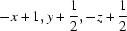 ; (vi)
  .
. Data collection: SMART (Siemens, 1996); cell refinement: SAINT (Siemens, 1996); data reduction: SAINT; program(s) used to solve structure: SHELXS97 (Sheldrick, 2008); program(s) used to refine structure: SHELXL97 (Sheldrick, 2008); molecular graphics: SHELXTL (Sheldrick, 2008); software used to prepare material for publication: SHELXTL.
Supporting information
contains datablocks I, global. DOI: 10.1107/S1600536809049769/hy2252sup1.cif
Structure factors: contains datablock I. DOI: 10.1107/S1600536809049769/hy2252Isup2.hkl
Diaquabis(4-aminobenzenesulfonato)copper(II) dihydrate was synthesized according to the literature (Gunderman et al., 1996). 1,3-Diaminopropane (0.35 g, 4.72 mmol) in 10 ml water was dropped slowly into the stirred diaquabis(4-aminobenzenesulfonato)copper(II) dihydrate (1.12 g, 2.33 mmol) solution in 20 ml water. The mixed solution was kept stirring at room temperature for 30 min. After filtration, the filtrate was left to evaporate in air. After a few days, blue crystals of the title compound suitable for X-ray study were obtained (yield 0.70 g, 51%).
H atoms bonded to C atoms or N atoms were positioned geometrically and refined as riding atoms, with C—H = 0.93 (aromatic) and 0.97 (CH2) Å and N—H = 0.90 and 0.86 Å and with Uiso(H) = 1.2Ueq(C,N). Water H atoms were located in a difference Fourier map and refined as riding, with O—H = 0.85 Å and with Uiso(H) =1.5Ueq(O).
Data collection: SMART (Siemens, 1996); cell SAINT (Siemens, 1996); data reduction: SAINT (Siemens, 1996); program(s) used to solve structure: SHELXS97 (Sheldrick, 2008); program(s) used to refine structure: SHELXL97 (Sheldrick, 2008); molecular graphics: SHELXTL (Sheldrick, 2008); software used to prepare material for publication: SHELXTL (Sheldrick, 2008).
![[Figure 1]](./hy2252fig1thm.gif) | Fig. 1. Molecular structure of the title compound. Displacement ellipsoids are drawn at the 30% probability level. Dashed lines denote hydrogen bonds. [Symmetry code: (i) 1 - x, -y, 1 - z.] |
![[Figure 2]](./hy2252fig2thm.gif) | Fig. 2. The packing diagram of the title compound viewed along the b axis. H atoms not involved in hydrogen bonds (dashed lines) are omitted for clarity. |
| [Cu(C3H10N2)2(C6H6NO3S)2]·2H2O | F(000) = 622 |
| Mr = 592.19 | Dx = 1.541 Mg m−3 |
| Monoclinic, P21/c | Mo Kα radiation, λ = 0.71073 Å |
| Hall symbol: -P 2ybc | Cell parameters from 2312 reflections |
| a = 9.5171 (1) Å | θ = 2.2–25.1° |
| b = 10.3875 (4) Å | µ = 1.07 mm−1 |
| c = 13.1646 (5) Å | T = 293 K |
| β = 101.256 (2)° | Prism, blue |
| V = 1276.40 (7) Å3 | 0.48 × 0.20 × 0.18 mm |
| Z = 2 |
| Siemens SMART 1000 CCD diffractometer | 2230 independent reflections |
| Radiation source: fine-focus sealed tube | 1889 reflections with I > 2σ(I) |
| Graphite monochromator | Rint = 0.024 |
| ϕ and ω scans | θmax = 25.1°, θmin = 2.2° |
| Absorption correction: multi-scan (SADABS; Sheldrick, 1996) | h = −9→11 |
| Tmin = 0.627, Tmax = 0.830 | k = −7→12 |
| 3629 measured reflections | l = −15→10 |
| Refinement on F2 | Secondary atom site location: difference Fourier map |
| Least-squares matrix: full | Hydrogen site location: inferred from neighbouring sites |
| R[F2 > 2σ(F2)] = 0.048 | H-atom parameters constrained |
| wR(F2) = 0.132 | w = 1/[σ2(Fo2) + (0.0669P)2 + 1.3129P] where P = (Fo2 + 2Fc2)/3 |
| S = 1.09 | (Δ/σ)max < 0.001 |
| 2230 reflections | Δρmax = 0.48 e Å−3 |
| 161 parameters | Δρmin = −0.41 e Å−3 |
| 3 restraints | Extinction correction: SHELXL97 (Sheldrick, 2008), Fc*=kFc[1+0.001xFc2λ3/sin(2θ)]-1/4 |
| Primary atom site location: structure-invariant direct methods | Extinction coefficient: 0.054 (4) |
| [Cu(C3H10N2)2(C6H6NO3S)2]·2H2O | V = 1276.40 (7) Å3 |
| Mr = 592.19 | Z = 2 |
| Monoclinic, P21/c | Mo Kα radiation |
| a = 9.5171 (1) Å | µ = 1.07 mm−1 |
| b = 10.3875 (4) Å | T = 293 K |
| c = 13.1646 (5) Å | 0.48 × 0.20 × 0.18 mm |
| β = 101.256 (2)° |
| Siemens SMART 1000 CCD diffractometer | 2230 independent reflections |
| Absorption correction: multi-scan (SADABS; Sheldrick, 1996) | 1889 reflections with I > 2σ(I) |
| Tmin = 0.627, Tmax = 0.830 | Rint = 0.024 |
| 3629 measured reflections |
| R[F2 > 2σ(F2)] = 0.048 | 3 restraints |
| wR(F2) = 0.132 | H-atom parameters constrained |
| S = 1.09 | Δρmax = 0.48 e Å−3 |
| 2230 reflections | Δρmin = −0.41 e Å−3 |
| 161 parameters |
| x | y | z | Uiso*/Ueq | ||
| Cu | 0.5000 | 0.0000 | 0.5000 | 0.0387 (3) | |
| N1 | 0.3723 (3) | −0.1305 (3) | 0.5539 (2) | 0.0470 (7) | |
| H1A | 0.3788 | −0.2043 | 0.5193 | 0.056* | |
| H1B | 0.4125 | −0.1457 | 0.6205 | 0.056* | |
| N2 | 0.3801 (3) | 0.1490 (3) | 0.5351 (2) | 0.0457 (7) | |
| H2A | 0.4171 | 0.1731 | 0.6005 | 0.055* | |
| H2B | 0.3929 | 0.2153 | 0.4938 | 0.055* | |
| C1 | 0.2183 (4) | −0.1079 (4) | 0.5506 (3) | 0.0565 (10) | |
| H1C | 0.1820 | −0.1742 | 0.5905 | 0.068* | |
| H1D | 0.1669 | −0.1143 | 0.4796 | 0.068* | |
| C2 | 0.1902 (4) | 0.0226 (4) | 0.5934 (3) | 0.0537 (10) | |
| H2C | 0.0902 | 0.0277 | 0.5990 | 0.064* | |
| H2D | 0.2476 | 0.0314 | 0.6625 | 0.064* | |
| C3 | 0.2240 (4) | 0.1327 (4) | 0.5273 (3) | 0.0519 (9) | |
| H3A | 0.1794 | 0.1169 | 0.4557 | 0.062* | |
| H3B | 0.1840 | 0.2116 | 0.5491 | 0.062* | |
| O1W | 0.5872 (4) | −0.1325 (5) | 0.1104 (5) | 0.147 (2) | |
| H1WA | 0.5115 | −0.0876 | 0.0934 | 0.221* | |
| H1WB | 0.5700 | −0.1840 | 0.1563 | 0.221* | |
| S | 0.31964 (10) | 0.04586 (13) | 0.21957 (7) | 0.0585 (4) | |
| O1 | 0.3474 (3) | −0.0243 (3) | 0.3153 (3) | 0.0735 (10) | |
| O2 | 0.3401 (4) | −0.0303 (6) | 0.1333 (3) | 0.156 (3) | |
| O3 | 0.4010 (3) | 0.1646 (4) | 0.2294 (3) | 0.0936 (13) | |
| C11 | 0.1360 (4) | 0.0876 (4) | 0.1932 (2) | 0.0435 (8) | |
| C12 | 0.0384 (4) | 0.0061 (4) | 0.1338 (3) | 0.0488 (9) | |
| H12A | 0.0702 | −0.0675 | 0.1050 | 0.059* | |
| C13 | −0.1068 (4) | 0.0337 (4) | 0.1168 (3) | 0.0527 (10) | |
| H13A | −0.1717 | −0.0220 | 0.0770 | 0.063* | |
| C14 | −0.1565 (4) | 0.1431 (4) | 0.1584 (3) | 0.0483 (9) | |
| C15 | −0.0568 (4) | 0.2261 (4) | 0.2159 (3) | 0.0523 (9) | |
| H15A | −0.0880 | 0.3016 | 0.2424 | 0.063* | |
| C16 | 0.0875 (4) | 0.1982 (4) | 0.2342 (3) | 0.0493 (9) | |
| H16A | 0.1525 | 0.2538 | 0.2741 | 0.059* | |
| N3 | −0.3017 (3) | 0.1723 (4) | 0.1411 (3) | 0.0680 (10) | |
| H3D | −0.3627 | 0.1219 | 0.1039 | 0.082* | |
| H3C | −0.3305 | 0.2407 | 0.1676 | 0.082* |
| U11 | U22 | U33 | U12 | U13 | U23 | |
| Cu | 0.0294 (4) | 0.0433 (4) | 0.0434 (4) | 0.0037 (2) | 0.0068 (2) | 0.0027 (2) |
| N1 | 0.0377 (16) | 0.0488 (17) | 0.0541 (18) | 0.0005 (13) | 0.0079 (13) | 0.0047 (14) |
| N2 | 0.0406 (16) | 0.0493 (17) | 0.0478 (17) | 0.0061 (13) | 0.0103 (13) | −0.0016 (14) |
| C1 | 0.0385 (19) | 0.064 (2) | 0.069 (3) | −0.0065 (18) | 0.0147 (18) | −0.005 (2) |
| C2 | 0.039 (2) | 0.076 (3) | 0.049 (2) | 0.0008 (18) | 0.0162 (17) | −0.0048 (19) |
| C3 | 0.0358 (19) | 0.068 (3) | 0.051 (2) | 0.0141 (17) | 0.0058 (16) | −0.0058 (19) |
| O1W | 0.061 (2) | 0.130 (4) | 0.254 (6) | −0.018 (2) | 0.038 (3) | −0.109 (4) |
| S | 0.0392 (5) | 0.0932 (8) | 0.0388 (5) | 0.0172 (5) | −0.0031 (4) | 0.0027 (5) |
| O1 | 0.0558 (18) | 0.081 (2) | 0.070 (2) | 0.0005 (15) | −0.0221 (15) | 0.0234 (16) |
| O2 | 0.067 (3) | 0.294 (7) | 0.091 (3) | 0.084 (3) | −0.025 (2) | −0.090 (4) |
| O3 | 0.0430 (16) | 0.125 (3) | 0.109 (3) | −0.0080 (18) | 0.0046 (17) | 0.051 (2) |
| C11 | 0.0385 (18) | 0.057 (2) | 0.0331 (17) | 0.0085 (16) | 0.0022 (13) | 0.0113 (15) |
| C12 | 0.049 (2) | 0.051 (2) | 0.042 (2) | 0.0118 (16) | 0.0005 (16) | 0.0030 (16) |
| C13 | 0.044 (2) | 0.053 (2) | 0.056 (2) | −0.0013 (17) | −0.0026 (17) | 0.0072 (18) |
| C14 | 0.0387 (19) | 0.058 (2) | 0.048 (2) | 0.0050 (17) | 0.0075 (15) | 0.0182 (17) |
| C15 | 0.054 (2) | 0.052 (2) | 0.052 (2) | 0.0129 (18) | 0.0123 (17) | 0.0032 (18) |
| C16 | 0.050 (2) | 0.055 (2) | 0.0408 (19) | 0.0000 (17) | 0.0035 (15) | 0.0011 (16) |
| N3 | 0.0404 (18) | 0.075 (2) | 0.087 (3) | 0.0107 (17) | 0.0085 (17) | 0.012 (2) |
| Cu—N1 | 2.038 (3) | O1W—H1WB | 0.85 |
| Cu—N2 | 2.029 (3) | S—O2 | 1.428 (4) |
| Cu—O1 | 2.589 (3) | S—O1 | 1.435 (3) |
| N1—C1 | 1.476 (4) | S—O3 | 1.448 (4) |
| N1—H1A | 0.9000 | S—C11 | 1.768 (3) |
| N1—H1B | 0.9000 | C11—C12 | 1.381 (5) |
| N2—C3 | 1.479 (4) | C11—C16 | 1.386 (5) |
| N2—H2A | 0.9000 | C12—C13 | 1.386 (6) |
| N2—H2B | 0.9000 | C12—H12A | 0.9300 |
| C1—C2 | 1.512 (5) | C13—C14 | 1.384 (6) |
| C1—H1C | 0.9700 | C13—H13A | 0.9300 |
| C1—H1D | 0.9700 | C14—N3 | 1.389 (5) |
| C2—C3 | 1.509 (6) | C14—C15 | 1.391 (6) |
| C2—H2C | 0.9700 | C15—C16 | 1.378 (5) |
| C2—H2D | 0.9700 | C15—H15A | 0.9300 |
| C3—H3A | 0.9700 | C16—H16A | 0.9300 |
| C3—H3B | 0.9700 | N3—H3D | 0.8600 |
| O1W—H1WA | 0.85 | N3—H3C | 0.8600 |
| N2—Cu—N2i | 180.0 | C1—C2—H2D | 109.0 |
| N2—Cu—N1 | 91.61 (13) | H2C—C2—H2D | 107.8 |
| N2i—Cu—N1 | 88.40 (13) | N2—C3—C2 | 111.8 (3) |
| N2—Cu—N1i | 88.40 (13) | N2—C3—H3A | 109.3 |
| N2i—Cu—N1i | 91.60 (13) | C2—C3—H3A | 109.3 |
| N1—Cu—N1i | 180.0 | N2—C3—H3B | 109.3 |
| N2—Cu—O1i | 87.08 (11) | C2—C3—H3B | 109.3 |
| N2i—Cu—O1i | 92.92 (11) | H3A—C3—H3B | 107.9 |
| N1—Cu—O1i | 90.08 (11) | H1WA—O1W—H1WB | 105.1 |
| N1i—Cu—O1i | 89.92 (11) | O2—S—O1 | 112.8 (3) |
| N2—Cu—O1 | 92.92 (11) | O2—S—O3 | 112.9 (3) |
| N2i—Cu—O1 | 87.08 (12) | O1—S—O3 | 110.5 (2) |
| N1—Cu—O1 | 89.92 (11) | O2—S—C11 | 105.22 (19) |
| N1i—Cu—O1 | 90.08 (11) | O1—S—C11 | 107.59 (18) |
| O1i—Cu—O1 | 180.0 | O3—S—C11 | 107.44 (19) |
| C1—N1—Cu | 122.7 (2) | S—O1—Cu | 138.47 (19) |
| C1—N1—H1A | 106.7 | C12—C11—C16 | 119.4 (3) |
| Cu—N1—H1A | 106.7 | C12—C11—S | 119.4 (3) |
| C1—N1—H1B | 106.7 | C16—C11—S | 121.2 (3) |
| Cu—N1—H1B | 106.7 | C11—C12—C13 | 120.2 (4) |
| H1A—N1—H1B | 106.6 | C11—C12—H12A | 119.9 |
| C3—N2—Cu | 119.9 (2) | C13—C12—H12A | 119.9 |
| C3—N2—H2A | 107.3 | C14—C13—C12 | 120.8 (4) |
| Cu—N2—H2A | 107.3 | C14—C13—H13A | 119.6 |
| C3—N2—H2B | 107.3 | C12—C13—H13A | 119.6 |
| Cu—N2—H2B | 107.3 | C13—C14—N3 | 121.3 (4) |
| H2A—N2—H2B | 106.9 | C13—C14—C15 | 118.3 (3) |
| N1—C1—C2 | 112.3 (3) | N3—C14—C15 | 120.3 (4) |
| N1—C1—H1C | 109.1 | C16—C15—C14 | 121.0 (4) |
| C2—C1—H1C | 109.1 | C16—C15—H15A | 119.5 |
| N1—C1—H1D | 109.1 | C14—C15—H15A | 119.5 |
| C2—C1—H1D | 109.1 | C15—C16—C11 | 120.1 (4) |
| H1C—C1—H1D | 107.9 | C15—C16—H16A | 119.9 |
| C3—C2—C1 | 113.1 (3) | C11—C16—H16A | 119.9 |
| C3—C2—H2C | 109.0 | C14—N3—H3D | 120.0 |
| C1—C2—H2C | 109.0 | C14—N3—H3C | 120.0 |
| C3—C2—H2D | 109.0 | H3D—N3—H3C | 120.0 |
| Symmetry code: (i) −x+1, −y, −z+1. |
| D—H···A | D—H | H···A | D···A | D—H···A |
| O1W—H1WA···O2 | 0.85 | 1.90 | 2.651 (5) | 146 |
| O1W—H1WB···O3ii | 0.85 | 2.16 | 2.969 (8) | 160 |
| N1—H1A···N3iii | 0.90 | 2.46 | 3.250 (5) | 147 |
| N1—H1B···O3i | 0.90 | 2.39 | 3.243 (4) | 158 |
| N2—H2A···O3iv | 0.90 | 2.42 | 3.183 (4) | 143 |
| N2—H2B···O1Wv | 0.90 | 2.13 | 3.025 (5) | 177 |
| N3—H3D···O1Wvi | 0.86 | 2.69 | 3.337 (6) | 133 |
| N3—H3C···O1vii | 0.86 | 2.46 | 3.248 (5) | 153 |
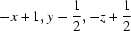
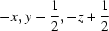
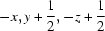
| Symmetry codes: (i) −x+1, −y, −z+1; (ii) −x+1, y−1/2, −z+1/2; (iii) −x, y−1/2, −z+1/2; (iv) x, −y+1/2, z+1/2; (v) −x+1, y+1/2, −z+1/2; (vi) x−1, y, z; (vii) −x, y+1/2, −z+1/2. |
Experimental details
| Crystal data | |
| Chemical formula | [Cu(C3H10N2)2(C6H6NO3S)2]·2H2O |
| Mr | 592.19 |
| Crystal system, space group | Monoclinic, P21/c |
| Temperature (K) | 293 |
| a, b, c (Å) | 9.5171 (1), 10.3875 (4), 13.1646 (5) |
| β (°) | 101.256 (2) |
| V (Å3) | 1276.40 (7) |
| Z | 2 |
| Radiation type | Mo Kα |
| µ (mm−1) | 1.07 |
| Crystal size (mm) | 0.48 × 0.20 × 0.18 |
| Data collection | |
| Diffractometer | Siemens SMART 1000 CCD diffractometer |
| Absorption correction | Multi-scan (SADABS; Sheldrick, 1996) |
| Tmin, Tmax | 0.627, 0.830 |
| No. of measured, independent and observed [I > 2σ(I)] reflections | 3629, 2230, 1889 |
| Rint | 0.024 |
| (sin θ/λ)max (Å−1) | 0.596 |
| Refinement | |
| R[F2 > 2σ(F2)], wR(F2), S | 0.048, 0.132, 1.09 |
| No. of reflections | 2230 |
| No. of parameters | 161 |
| No. of restraints | 3 |
| H-atom treatment | H-atom parameters constrained |
| Δρmax, Δρmin (e Å−3) | 0.48, −0.41 |
Computer programs: SMART (Siemens, 1996), SAINT (Siemens, 1996), SHELXS97 (Sheldrick, 2008), SHELXL97 (Sheldrick, 2008), SHELXTL (Sheldrick, 2008).
| D—H···A | D—H | H···A | D···A | D—H···A |
| O1W—H1WA···O2 | 0.85 | 1.90 | 2.651 (5) | 146 |
| O1W—H1WB···O3i | 0.85 | 2.16 | 2.969 (8) | 160 |
| N1—H1A···N3ii | 0.90 | 2.46 | 3.250 (5) | 147 |
| N1—H1B···O3iii | 0.90 | 2.39 | 3.243 (4) | 158 |
| N2—H2A···O3iv | 0.90 | 2.42 | 3.183 (4) | 143 |
| N2—H2B···O1Wv | 0.90 | 2.13 | 3.025 (5) | 177 |
| N3—H3D···O1Wvi | 0.86 | 2.69 | 3.337 (6) | 133 |
| N3—H3C···O1vii | 0.86 | 2.46 | 3.248 (5) | 153 |
| Symmetry codes: (i) −x+1, y−1/2, −z+1/2; (ii) −x, y−1/2, −z+1/2; (iii) −x+1, −y, −z+1; (iv) x, −y+1/2, z+1/2; (v) −x+1, y+1/2, −z+1/2; (vi) x−1, y, z; (vii) −x, y+1/2, −z+1/2. |
Acknowledgements
This work was supported financially by the NSFC (grant No. 20801047), the Foundation of Xuzhou Normal University (07XLA07, KY2007039 and XGG2007034) and the `Qing Lan' Project (08QLT001).
References
 Evans, O. R. & Lin, W. (2002). Acc. Chem. Res. 35, 511–522. Web of Science CrossRef PubMed CAS Google Scholar
Gunderman, B. J., Squattrito, P. J. & Dubey, S. N. (1996). Acta Cryst. C52, 1131–1134. CSD CrossRef CAS Web of Science IUCr Journals Google Scholar
Kim, C.-H. & Lee, S.-G. (2002). Acta Cryst. C58, m421–m423. Web of Science CSD CrossRef CAS IUCr Journals Google Scholar
Li, X. L., Chen, J. T., Niu, D. Z., Sheng, J. T. & Zhang, D. P. (2003). Chin. J. Struct. Chem. 22, 415–418. CAS Google Scholar
Li, X. L., Tong, M. L., Niu, D. Z. & Chen, J. T. (2004). Chin. J. Chem. 22, 64–68. CrossRef CAS Google Scholar
Sheldrick, G. M. (1996). SADABS. University of Göttingen, Germany. Google Scholar
Sheldrick, G. M. (2008). Acta Cryst. A64, 112–122. Web of Science CrossRef CAS IUCr Journals Google Scholar
Siemens (1996). SMART and SAINT. Siemens Analytical X-ray Instruments Inc., Madison, Wisconsin, USA. Google Scholar
Sundberg, M. R., Kivekäs, R., Huovilainen, R. & Uggla, R. (2001). Inorg. Chim. Acta, 324, 212–217. Web of Science CSD CrossRef CAS Google Scholar
Sundberg, M. R. & Sillanpää, R. (1993). Acta Chem. Scand. 47, 1173–1178. CrossRef CAS Web of Science Google Scholar
Sundberg, M. R. & Uggla, R. (1997). Inorg. Chim. Acta, 254, 259–265. CSD CrossRef CAS Web of Science Google Scholar
Wang, Y., Feng, L., Li, Y., Hu, C., Wang, E., Hu, N. & Jia, H. (2002). Inorg. Chem. 41, 6351–6357. Web of Science CSD CrossRef PubMed CAS Google Scholar
This is an open-access article distributed under the terms of the Creative Commons Attribution (CC-BY) Licence, which permits unrestricted use, distribution, and reproduction in any medium, provided the original authors and source are cited.
| CRYSTALLOGRAPHIC COMMUNICATIONS |


Crystal engineering based on metal and organic building blocks has been rapidly developed in recent years owing to their novel and diverse topologies and potential applications in catalysis and host–guest chemistry (Evans & Lin, 2002). Covalent bonds and hydrogen bonds have been demonstrated to be two important interactions in constructing metal-containing supramolecular frameworks, and they have brought forth a great variety of novel frameworks with fascinating structural motifs (Li et al., 2003, 2004). 1,3-Diaminopropane (tn) ligand behaves as a strong chelatator in its metal complexes due to the formation of a stable six-membered ring. At the same time, it is a good H-bond donor due to the existence of amino groups (Sundberg et al., 2001). The crystal egineering of tn and carboxylate ligands has been studied in detail (Sundberg et al., 2001), but supramolecular chemistry of tn and 4-aminobenzenesulfonate (4-ABS) ligand is still not explored to that extent (Wang et al., 2002). 4-ABS can act as a bridging or a terminal ligand in its metal complexes. On the other hand, studies on the coordination and supramolecular chemistry of 4-ABS have showed that it is a good H-bond acceptor and can form strong H-bonds due to its three O atoms and one N atom (Kim & Lee, 2002; Wang et al., 2002). In view of their excellent coordination capability and good H-bond donor or acceptor nature, we employed tn and 4-ABS as mixed organic building blocks to construct supramolecular networks in an expectation that these ligands may generate hydrogen bonding and/or covalent interactions with transition metal ions in the assembly process. Herein, we report the synthesis and structure of the title compound.
As shown in Fig. 1, the CuII atom lies on an inversion center and is octahedrally coordinated by four N atoms from two tn ligands and two O atoms from two 4-ABS ligands in a trans arrangement. The coordination polyhedron of the CuII ion can be described as axially elongated octahedral, with the O atoms at the axial positions. The tn ligand shows chelating coordination behavior and displays a chair conformation in the equatorial direction. This kind of coordination mode was also found in the similar complexes (Sundberg et al., 2001; Sundberg & Sillanpää, 1993; Sundberg & Uggla, 1997). The axial Cu—O distance is 2.589 (3) Å, indicating a weak coordination. The equatorial Cu—N1 and Cu—N2 bond lengths are 2.038 (3) and 2.029 (3) Å, respectively, which are much shorter than the axial Cu—O distance and very similar to those in the previously reported trans-bis(4-methylbenzenesulfonato)bis(1,3-diaminopropane)copper(II) (Sundberg & Sillanpää, 1993). The tn molecule forms a six-membered chelate ring with asymmetric Cu—N1—C1 and Cu—N2—C3 angles of 122.7 (2) and 119.9 (2)°. A plausible explanation for the deviations described above may be attributed to the asymmetric hydrogen bonding with respect to the chelate ring. The complex molecules are linked into a two-dimensional layer through hydrogen bonds between the uncoordinated water, the sulfonate group and the amino groups of the tn ligand. The layers are further connected into a three-dimensional network through hydrogen bonds between the amino groups and the sulfonate groups of neighboring 4-ABS ligands (Fig. 2).