 | Acta Crystallographica Section E Acta Crystallographica Section E CRYSTALLOGRAPHIC COMMUNICATIONS |


 journal menu


metal-organic compounds
| CRYSTALLOGRAPHIC COMMUNICATIONS |
 access
Bis(2-methylquinolin-8-olato-κ2N,O)lead(II)

aDepartment of Chemistry, General Campus, Shahid Beheshti University, Tehran 1983963113, Iran, and bDepartment of Chemistry, University of Malaya, 50603 Kuala Lumpur, Malaysia
*Correspondence e-mail: [email protected]
The PbII atom in the title compound, [Pb(C10H8NO)2], is chelated by two oxine (2-methylquinolin-8-olate) anions in a Ψ-trigonal–bipyramidal geometry; the N atoms occupy the axial sites. The molecule lies about a twofold rotation axis.
![[Scheme 1]](bt5241scheme1.gif)
Experimental
Crystal data
|
Refinement
|
| |||||||||||||||
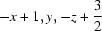 .
. Data collection: APEX2 (Bruker, 2009![[Bruker (2009). APEX2 and SAINT. Bruker AXS Inc., Madison, Wisconsin, USA.]](../../../../../../logos/arrows/e_arr.gif "Bruker (2009). APEX2 and SAINT. Bruker AXS Inc., Madison, Wisconsin, USA.") ); cell refinement: SAINT (Bruker, 2009); data reduction: SAINT; program(s) used to solve structure: SHELXS97 (Sheldrick, 2008); program(s) used to refine structure: SHELXL97 (Sheldrick, 2008); molecular graphics: X-SEED (Barbour, 2001); software used to prepare material for publication: publCIF (Westrip, 2010).
); cell refinement: SAINT (Bruker, 2009); data reduction: SAINT; program(s) used to solve structure: SHELXS97 (Sheldrick, 2008); program(s) used to refine structure: SHELXL97 (Sheldrick, 2008); molecular graphics: X-SEED (Barbour, 2001); software used to prepare material for publication: publCIF (Westrip, 2010).
Supporting information
contains datablocks global, I. DOI: https://doi.org/10.1107/S1600536810012742/bt5241sup1.cif
Structure factors: contains datablock I. DOI: https://doi.org/10.1107/S1600536810012742/bt5241Isup2.hkl
Lead (II) acetate trihydrate (1 mmol, 0.38 g), 2-methyl-8-hydroxyquinoline (1 mmol, 0.16 g) and sodium azide (1 mmol, 0.13 g) were loaded in to a convection tube; the tube was filled with 2:1 methanol/water and kept at 333 K. Crystals were collected after 1 week (m.p. > 543 K).
H-atoms were placed in calculated positions (C—H 0.94 Å) and were included in the in the riding model approximation, with U(H) set to 1.2U(C). The final difference Fourier map had a large peak/deep hole in the vicinity of the lead atom.
Bis(quinolin-8-olato)lead(II) exists as a centrosymmetric dinuclear entity in which one of the two oxygen atoms also functions as a bridge. As adjacent molecules are linked by a weaker Pb···O interaction to generate a chain motif, the metal atom is regarded as being six-coordinate in a Ψ-pentagonal bipyramidal geometry, the lone pair electrons occupying an axial site (Zhu et al., 2005). In the present methyl-substituted analogue, the substituent is able to block the approach of neighboring potentially coordinating atoms so that the compound is only four-coordinate (Scheme I, Fig. 1). The coordination polyhedron is a Ψ-trigonal bipyramid and the lone pair electrons occupy an equatorial site. The axial sites are occupied by the nitrogen atoms and the oxygen atoms occupy the other equatorial sites. The lone pair compresses the O–Pb–O angle (Table 1).
For the crystal structure of bis(quinolin-8-olato)lead(II), see: Zhu et al. (2005).
Data collection: APEX2 (Bruker, 2009); cell SAINT (Bruker, 2009); data reduction: SAINT (Bruker, 2009); program(s) used to solve structure: SHELXS97 (Sheldrick, 2008); program(s) used to refine structure: SHELXL97 (Sheldrick, 2008); molecular graphics: X-SEED (Barbour, 2001); software used to prepare material for publication: publCIF (Westrip, 2010).
![[Figure 1]](./bt5241fig1thm.gif) | Fig. 1. Anisotropic displacement ellipsoid plot (Barbour, 2001) of the title compound; ellipsoids are drawn at the 50% probability level and H atoms are of arbitrary radius. |
| [Pb(C10H8NO)2] | F(000) = 992 |
| Mr = 523.54 | Dx = 2.110 Mg m−3 |
| Monoclinic, C2/c | Mo Kα radiation, λ = 0.71073 Å |
| Hall symbol: -C 2yc | Cell parameters from 2952 reflections |
| a = 22.439 (2) Å | θ = 2.6–25.2° |
| b = 4.7636 (5) Å | µ = 10.25 mm−1 |
| c = 15.7139 (15) Å | T = 223 K |
| β = 101.167 (1)° | Prism, yellow |
| V = 1647.9 (3) Å3 | 0.30 × 0.06 × 0.04 mm |
| Z = 4 |
| Bruker SMART APEX diffractometer | 1890 independent reflections |
| Radiation source: fine-focus sealed tube | 1765 reflections with I > 2σ(I) |
| Graphite monochromator | Rint = 0.053 |
| ω scans | θmax = 27.5°, θmin = 1.9° |
| Absorption correction: multi-scan (SADABS; Sheldrick, 1996) | h = −28→28 |
| Tmin = 0.149, Tmax = 0.685 | k = −6→6 |
| 7405 measured reflections | l = −20→18 |
| Refinement on F2 | Primary atom site location: structure-invariant direct methods |
| Least-squares matrix: full | Secondary atom site location: difference Fourier map |
| R[F2 > 2σ(F2)] = 0.027 | Hydrogen site location: inferred from neighbouring sites |
| wR(F2) = 0.063 | H-atom parameters constrained |
| S = 1.02 | w = 1/[σ2(Fo2) + (0.030P)2] where P = (Fo2 + 2Fc2)/3 |
| 1890 reflections | (Δ/σ)max = 0.001 |
| 115 parameters | Δρmax = 1.69 e Å−3 |
| 0 restraints | Δρmin = −1.50 e Å−3 |
| [Pb(C10H8NO)2] | V = 1647.9 (3) Å3 |
| Mr = 523.54 | Z = 4 |
| Monoclinic, C2/c | Mo Kα radiation |
| a = 22.439 (2) Å | µ = 10.25 mm−1 |
| b = 4.7636 (5) Å | T = 223 K |
| c = 15.7139 (15) Å | 0.30 × 0.06 × 0.04 mm |
| β = 101.167 (1)° |
| Bruker SMART APEX diffractometer | 1890 independent reflections |
| Absorption correction: multi-scan (SADABS; Sheldrick, 1996) | 1765 reflections with I > 2σ(I) |
| Tmin = 0.149, Tmax = 0.685 | Rint = 0.053 |
| 7405 measured reflections |
| R[F2 > 2σ(F2)] = 0.027 | 0 restraints |
| wR(F2) = 0.063 | H-atom parameters constrained |
| S = 1.02 | Δρmax = 1.69 e Å−3 |
| 1890 reflections | Δρmin = −1.50 e Å−3 |
| 115 parameters |
| x | y | z | Uiso*/Ueq | ||
| Pb1 | 0.5000 | 0.67661 (5) | 0.7500 | 0.02578 (9) | |
| O1 | 0.55706 (16) | 0.3516 (7) | 0.6978 (2) | 0.0336 (8) | |
| N1 | 0.57862 (15) | 0.4778 (8) | 0.8701 (2) | 0.0226 (7) | |
| C1 | 0.6024 (2) | 0.2268 (10) | 0.7500 (3) | 0.0278 (10) | |
| C2 | 0.6392 (2) | 0.0290 (11) | 0.7206 (3) | 0.0344 (11) | |
| H2 | 0.6321 | −0.0169 | 0.6613 | 0.041* | |
| C3 | 0.6864 (2) | −0.1029 (11) | 0.7771 (4) | 0.0393 (13) | |
| H3 | 0.7104 | −0.2351 | 0.7547 | 0.047* | |
| C4 | 0.6991 (2) | −0.0466 (10) | 0.8640 (4) | 0.0355 (11) | |
| H4 | 0.7312 | −0.1388 | 0.9008 | 0.043* | |
| C5 | 0.6632 (2) | 0.1522 (9) | 0.8974 (3) | 0.0286 (10) | |
| C6 | 0.6149 (2) | 0.2861 (9) | 0.8407 (3) | 0.0237 (9) | |
| C7 | 0.6717 (2) | 0.2286 (11) | 0.9859 (3) | 0.0333 (11) | |
| H7 | 0.7027 | 0.1435 | 1.0266 | 0.040* | |
| C8 | 0.6349 (2) | 0.4264 (11) | 1.0127 (3) | 0.0326 (11) | |
| H8 | 0.6414 | 0.4803 | 1.0713 | 0.039* | |
| C9 | 0.5878 (2) | 0.5476 (10) | 0.9526 (3) | 0.0263 (9) | |
| C10 | 0.5462 (2) | 0.7635 (10) | 0.9794 (3) | 0.0317 (11) | |
| H10A | 0.5048 | 0.7267 | 0.9501 | 0.048* | |
| H10B | 0.5583 | 0.9490 | 0.9637 | 0.048* | |
| H10C | 0.5487 | 0.7542 | 1.0417 | 0.048* |
| U11 | U22 | U33 | U12 | U13 | U23 | |
| Pb1 | 0.02798 (15) | 0.02687 (14) | 0.02138 (14) | 0.000 | 0.00204 (10) | 0.000 |
| O1 | 0.0356 (19) | 0.0411 (19) | 0.0233 (18) | 0.0073 (15) | 0.0033 (15) | −0.0031 (14) |
| N1 | 0.0225 (18) | 0.0247 (18) | 0.0207 (18) | −0.0014 (15) | 0.0039 (14) | −0.0012 (15) |
| C1 | 0.030 (3) | 0.030 (2) | 0.025 (2) | −0.0004 (19) | 0.008 (2) | −0.0019 (19) |
| C2 | 0.034 (3) | 0.037 (3) | 0.034 (3) | −0.002 (2) | 0.012 (2) | −0.006 (2) |
| C3 | 0.032 (3) | 0.034 (3) | 0.056 (4) | 0.004 (2) | 0.019 (3) | −0.006 (2) |
| C4 | 0.025 (2) | 0.031 (2) | 0.050 (3) | 0.004 (2) | 0.007 (2) | 0.004 (2) |
| C5 | 0.021 (2) | 0.028 (2) | 0.035 (3) | −0.0044 (18) | 0.003 (2) | 0.0039 (19) |
| C6 | 0.020 (2) | 0.027 (2) | 0.025 (2) | −0.0052 (17) | 0.0053 (18) | −0.0028 (18) |
| C7 | 0.028 (3) | 0.039 (3) | 0.030 (3) | −0.004 (2) | −0.003 (2) | 0.010 (2) |
| C8 | 0.036 (3) | 0.040 (3) | 0.021 (2) | −0.005 (2) | 0.004 (2) | 0.000 (2) |
| C9 | 0.027 (2) | 0.028 (2) | 0.024 (2) | −0.0103 (19) | 0.0062 (18) | −0.0040 (19) |
| C10 | 0.036 (3) | 0.036 (2) | 0.026 (3) | −0.007 (2) | 0.012 (2) | −0.008 (2) |
| Pb1—O1i | 2.262 (3) | C4—C5 | 1.409 (7) |
| Pb1—O1 | 2.262 (3) | C4—H4 | 0.9400 |
| Pb1—N1i | 2.507 (3) | C5—C7 | 1.414 (8) |
| Pb1—N1 | 2.507 (3) | C5—C6 | 1.416 (7) |
| O1—C1 | 1.318 (6) | C7—C8 | 1.371 (8) |
| N1—C9 | 1.316 (5) | C7—H7 | 0.9400 |
| N1—C6 | 1.363 (6) | C8—C9 | 1.399 (7) |
| C1—C2 | 1.390 (7) | C8—H8 | 0.9400 |
| C1—C6 | 1.426 (7) | C9—C10 | 1.501 (7) |
| C2—C3 | 1.393 (8) | C10—H10A | 0.9700 |
| C2—H2 | 0.9400 | C10—H10B | 0.9700 |
| C3—C4 | 1.366 (8) | C10—H10C | 0.9700 |
| C3—H3 | 0.9400 | ||
| O1—Pb1—O1i | 93.6 (2) | C4—C5—C7 | 124.2 (5) |
| O1i—Pb1—N1i | 69.46 (12) | C4—C5—C6 | 119.4 (5) |
| O1—Pb1—N1i | 80.42 (12) | C7—C5—C6 | 116.4 (4) |
| O1i—Pb1—N1 | 80.42 (12) | N1—C6—C5 | 121.5 (4) |
| O1—Pb1—N1 | 69.46 (12) | N1—C6—C1 | 117.2 (4) |
| N1—Pb1—N1i | 135.6 (1) | C5—C6—C1 | 121.3 (4) |
| C1—O1—Pb1 | 120.4 (3) | C8—C7—C5 | 120.3 (5) |
| C9—N1—C6 | 121.0 (4) | C8—C7—H7 | 119.9 |
| C9—N1—Pb1 | 126.8 (3) | C5—C7—H7 | 119.9 |
| C6—N1—Pb1 | 112.1 (3) | C7—C8—C9 | 119.9 (4) |
| O1—C1—C2 | 122.4 (5) | C7—C8—H8 | 120.1 |
| O1—C1—C6 | 120.8 (4) | C9—C8—H8 | 120.1 |
| C2—C1—C6 | 116.8 (5) | N1—C9—C8 | 120.9 (4) |
| C1—C2—C3 | 121.5 (5) | N1—C9—C10 | 117.5 (4) |
| C1—C2—H2 | 119.3 | C8—C9—C10 | 121.6 (4) |
| C3—C2—H2 | 119.3 | C9—C10—H10A | 109.5 |
| C4—C3—C2 | 122.3 (5) | C9—C10—H10B | 109.5 |
| C4—C3—H3 | 118.9 | H10A—C10—H10B | 109.5 |
| C2—C3—H3 | 118.9 | C9—C10—H10C | 109.5 |
| C3—C4—C5 | 118.8 (5) | H10A—C10—H10C | 109.5 |
| C3—C4—H4 | 120.6 | H10B—C10—H10C | 109.5 |
| C5—C4—H4 | 120.6 | ||
| O1i—Pb1—O1—C1 | −80.4 (3) | C9—N1—C6—C1 | −178.9 (4) |
| N1i—Pb1—O1—C1 | −148.9 (4) | Pb1—N1—C6—C1 | −1.1 (5) |
| N1—Pb1—O1—C1 | −2.0 (3) | C4—C5—C6—N1 | 179.4 (4) |
| O1i—Pb1—N1—C9 | −83.2 (4) | C7—C5—C6—N1 | −0.1 (6) |
| O1—Pb1—N1—C9 | 179.2 (4) | C4—C5—C6—C1 | −0.9 (7) |
| N1i—Pb1—N1—C9 | −130.3 (4) | C7—C5—C6—C1 | 179.6 (4) |
| O1i—Pb1—N1—C6 | 99.1 (3) | O1—C1—C6—N1 | −0.7 (6) |
| O1—Pb1—N1—C6 | 1.6 (3) | C2—C1—C6—N1 | −179.4 (4) |
| N1i—Pb1—N1—C6 | 52.0 (3) | O1—C1—C6—C5 | 179.6 (4) |
| Pb1—O1—C1—C2 | −179.0 (4) | C2—C1—C6—C5 | 0.9 (7) |
| Pb1—O1—C1—C6 | 2.4 (6) | C4—C5—C7—C8 | 179.4 (5) |
| O1—C1—C2—C3 | −179.2 (5) | C6—C5—C7—C8 | −1.1 (7) |
| C6—C1—C2—C3 | −0.6 (7) | C5—C7—C8—C9 | 1.7 (7) |
| C1—C2—C3—C4 | 0.2 (8) | C6—N1—C9—C8 | −0.2 (6) |
| C2—C3—C4—C5 | −0.2 (8) | Pb1—N1—C9—C8 | −177.7 (3) |
| C3—C4—C5—C7 | 180.0 (5) | C6—N1—C9—C10 | 179.2 (4) |
| C3—C4—C5—C6 | 0.5 (7) | Pb1—N1—C9—C10 | 1.7 (6) |
| C9—N1—C6—C5 | 0.8 (6) | C7—C8—C9—N1 | −1.0 (7) |
| Pb1—N1—C6—C5 | 178.6 (3) | C7—C8—C9—C10 | 179.6 (5) |
| Symmetry code: (i) −x+1, y, −z+3/2. |
Experimental details
| Crystal data | |
| Chemical formula | [Pb(C10H8NO)2] |
| Mr | 523.54 |
| Crystal system, space group | Monoclinic, C2/c |
| Temperature (K) | 223 |
| a, b, c (Å) | 22.439 (2), 4.7636 (5), 15.7139 (15) |
| β (°) | 101.167 (1) |
| V (Å3) | 1647.9 (3) |
| Z | 4 |
| Radiation type | Mo Kα |
| µ (mm−1) | 10.25 |
| Crystal size (mm) | 0.30 × 0.06 × 0.04 |
| Data collection | |
| Diffractometer | Bruker SMART APEX diffractometer |
| Absorption correction | Multi-scan (SADABS; Sheldrick, 1996) |
| Tmin, Tmax | 0.149, 0.685 |
| No. of measured, independent and observed [I > 2σ(I)] reflections | 7405, 1890, 1765 |
| Rint | 0.053 |
| (sin θ/λ)max (Å−1) | 0.649 |
| Refinement | |
| R[F2 > 2σ(F2)], wR(F2), S | 0.027, 0.063, 1.02 |
| No. of reflections | 1890 |
| No. of parameters | 115 |
| H-atom treatment | H-atom parameters constrained |
| Δρmax, Δρmin (e Å−3) | 1.69, −1.50 |
Computer programs: APEX2 (Bruker, 2009), SAINT (Bruker, 2009), SHELXS97 (Sheldrick, 2008), SHELXL97 (Sheldrick, 2008), X-SEED (Barbour, 2001), publCIF (Westrip, 2010).
| Pb1—O1 | 2.262 (3) | Pb1—N1 | 2.507 (3) |
| O1—Pb1—O1i | 93.6 (2) | N1—Pb1—N1i | 135.6 (1) |
| Symmetry code: (i) −x+1, y, −z+3/2. |
Acknowledgements
We thank the Graduate Study Council of Shahid Beheshti University (project No. 600/2097) and the University of Malaya for supporting this study.
References
 Barbour, L. J. (2001). J. Supramol. Chem. 1, 189–191. CrossRef CAS Google Scholar
Bruker (2009). APEX2 and SAINT. Bruker AXS Inc., Madison, Wisconsin, USA. Google Scholar
Sheldrick, G. M. (1996). SADABS. University of Göttingen, Germany. Google Scholar
Sheldrick, G. M. (2008). Acta Cryst. A64, 112–122. Web of Science CrossRef CAS IUCr Journals Google Scholar
Westrip, S. P. (2010). publCIF. In preparation. Google Scholar
Zhu, L.-H., Zeng, M.-H. & Ng, S. W. (2005). Acta Cryst. E61, m1082–m1084. Web of Science CSD CrossRef IUCr Journals Google Scholar
This is an open-access article distributed under the terms of the Creative Commons Attribution (CC-BY) Licence, which permits unrestricted use, distribution, and reproduction in any medium, provided the original authors and source are cited.
| CRYSTALLOGRAPHIC COMMUNICATIONS |


Bis(quinolin-8-olato)lead(II) exists as a centrosymmetric dinuclear entity in which one of the two oxygen atoms also functions as a bridge. As adjacent molecules are linked by a weaker Pb···O interaction to generate a chain motif, the metal atom is regarded as being six-coordinate in a Ψ-pentagonal bipyramidal geometry, the lone pair electrons occupying an axial site (Zhu et al., 2005). In the present methyl-substituted analogue, the substituent is able to block the approach of neighboring potentially coordinating atoms so that the compound is only four-coordinate (Scheme I, Fig. 1). The coordination polyhedron is a Ψ-trigonal bipyramid and the lone pair electrons occupy an equatorial site. The axial sites are occupied by the nitrogen atoms and the oxygen atoms occupy the other equatorial sites. The lone pair compresses the O–Pb–O angle (Table 1).