 | Acta Crystallographica Section E Acta Crystallographica Section E CRYSTALLOGRAPHIC COMMUNICATIONS |


 journal menu


inorganic compounds
| CRYSTALLOGRAPHIC COMMUNICATIONS |
 access
Dilead(II) chromium(III) heptafluoride

aUniversité du Maine, Laboratoire des Oxydes et Fluorures, CNRS UMR 6010, Avenue O. Messiaen,72085 Le Mans, France
*Correspondence e-mail: [email protected]
Single crystals of the title compound, Pb2CrF7, were obtained by solid-state reaction. The monoclinic structure is isotypic with Pb2RhF7 and is built up of CrF63− octahedra isolated from each other, inserted in a fluorite-related matrix of PbF6 distorted octahedra, and PbF8 square antiprisms sharing edges and corners. The seventh F atom is `independent', connected only to three Pb atoms within FPb3 triangles, sharing an edge and building an almost planar Pb4F2 unit, so that the formula can alternatively be written as Pb2F(CrF6).
Related literature
For the Pb2RhF7 structure-type, see: Domesle & Hoppe (1983![[Domesle, R. & Hoppe, R. (1983). Z. Anorg. Allg. Chem. 501, 102-110.]](../../../../../../logos/arrows/e_arr.gif "Domesle, R. & Hoppe, R. (1983). Z. Anorg. Allg. Chem. 501, 102-110.") ), and for isostructural Sr2RhF7, see: Grosse & Hoppe (1987). For the indexed powder pattern of Pb2CrF7, see: de Kozak et al. (1999). For other compounds containing `independent' fluorine atoms coordinated to three cations (Ca or Sr) in a plane, see: Ca2AlF7 (Domesle & Hoppe, 1980); Sr5Zr3F22 (Le Bail, 1996); Sr5(VOF5)3F(H2O)3 (Le Bail et al., 2009). For fluorite-related lead-based compounds, see: Pb8MnFe2F24 (Le Bail & Mercier, 1992); Pb2ZrF8 (Le Bail & Laval, 1998). For the structure simulation of fluoride glasses containing lead by using crystalline models, see: Le Bail (1989, 2000). For details and parameters of the bond-valence model, see: Brown & Altermatt (1985); Brese & O'Keeffe (1991).
), and for isostructural Sr2RhF7, see: Grosse & Hoppe (1987). For the indexed powder pattern of Pb2CrF7, see: de Kozak et al. (1999). For other compounds containing `independent' fluorine atoms coordinated to three cations (Ca or Sr) in a plane, see: Ca2AlF7 (Domesle & Hoppe, 1980); Sr5Zr3F22 (Le Bail, 1996); Sr5(VOF5)3F(H2O)3 (Le Bail et al., 2009). For fluorite-related lead-based compounds, see: Pb8MnFe2F24 (Le Bail & Mercier, 1992); Pb2ZrF8 (Le Bail & Laval, 1998). For the structure simulation of fluoride glasses containing lead by using crystalline models, see: Le Bail (1989, 2000). For details and parameters of the bond-valence model, see: Brown & Altermatt (1985); Brese & O'Keeffe (1991).
Experimental
Crystal data
|
Refinement
|
|
 ; (ii)
  ; (v)
; (v)  .
.
| ||||||||||||||||||||||||||||||||||||||||||||||||||||||||||||||||||||||||||
|
Data collection: STADI4 (Stoe & Cie, 1998); cell refinement: STADI4; data reduction: X-RED (Stoe & Cie, 1998); program(s) used to solve structure: SHELXS97 (Sheldrick, 2008); program(s) used to refine structure: SHELXL97 (Sheldrick, 2008); molecular graphics: DIAMOND (Brandenburg, 2005) and ORTEP-3 (Farrugia, 1997); software used to prepare material for publication: publCIF (Westrip, 2010).
Supporting information
contains datablocks I, global. DOI: https://doi.org/10.1107/S1600536810011608/wm2317sup1.cif
Structure factors: contains datablock I. DOI: https://doi.org/10.1107/S1600536810011608/wm2317Isup2.hkl
Solid state reaction between 2PbF2 and CrF3 at 773 K for 96 hours in a platinum tube sealed under argon yieded single crystal of the title compound.
The highest residual peak and deepest hole in the final difference map were located respectively 0.67 Å and 0.83 Å from the Pb2 atom.
Continuing investigations of crystalline complex compounds of lead and 3d metal cation fluorides having chemical formulations similar to some fluoride glasses for structure modelling purposes (Le Bail, 2000), such as Pb8MnFe2F24 (Le Bail & Mercier, 1992) or NaPbFe2F9 (Le Bail, 1989), the title compound, Pb2CrF7, was synthesized and characterized from single crystal X-ray data. The results confirm that it is isostructural with Pb2RhF7 (Domesle & Hoppe, 1983), as mentioned previously by de Kozak et al. (1999). The monoclinic structure is built up of CrF63- octahedra (Fig. 1) isolated from each other, inserted in a fluorite-related matrix of PbF6 distorted octahedra and PbF8 square antiprisms sharing edges and corners. The seventh fluorine atom is "independent", connected only to 3 Pb atoms in FPb3 triangles, sharing an edge and building an almost planar Pb4F2 unit (Fig. 2), so that the formula can be alternatively written as Pb2F(CrF6). There are some differences observed with the Pb2RhF7 structure-type. The Pb1 atom appears to be six-coordinated in Pb2CrF7 with Pb—F distances ranging from 2.324 (5) to 2.899 (6) Å, there are then 5 next F atoms being between 3.067 (7) and 3.364 (6) Å whereas in Pb2RhF7, Pb1 looks eightfold coordinated (Pb—F distances between 2.375 and 2.744 Å), with two next F atoms at 3.105 and 3.219 Å. The bond valence calculations show that the first 6 F atoms around Pb1 cannot really satisfy the Pb2+ charge and that the 5 next F atoms contribute to the overall bond valence (Table 2). The behaviour of the cell parameters is surprising in the series of the three isostructural compounds. If all cell parameters are logically smaller in Sr2RhF7 (Grosse & Hoppe, 1987) than in Pb2RhF7, due to the smaller Sr2+ size, in Pb2CrF7 one observes that only a and b are smaller but that c is much larger, in spite of the Cr3+ cation being smaller than Rh3+ (Table 3). Finally, the cell volume of Pb2CrF7 is even slightly larger than that of Pb2RhF7.
Usually, such fluorinated phases with high AII/M ratio (AII = Ca, Pb, Sr ; M = 3d element or In, Nb, Zr, etc), are found to be related to the fluorite structure adopted by PbF2 or SrF2. The relation is in general easy to establish due to the presence of "independent" F atoms (not bonded to M) which are found to form characteristic FPb4 tetrahedra. But this is not obvious here (Fig. 3) since no such FPb4 tetrahedron is observed. Other compounds containing "independent" fluorine atoms coordinated to three cations (Ca or Sr) in a plane are Ca2AlF7 (Domesle & Hoppe, 1980), Sr5Zr3F22 (Le Bail, 1996) and Sr5(VOF5)3F(H2O)3 (Le Bail et al., 2009), the last two being strongly related to the fluorite structure in which the FSr3 triangles were found to interconnect the fluorite-related blocks. An examination of the Pb coordinates in Pb2CrF7 along the a axis (which is close to the PbF2 fluorite cell parameter) shows that they alternate at values x~1/4 and 3/4, forming fluorite-related strips corrugating in the ac plane where highly distorted PbF8 cubes as expected in the fluorite structure were obtained by small displacements of some of the F atoms as evidenced in Fig. 4 . Similar corrugated strips were observed for the Pb2ZrF8 structure (Le Bail & Laval, 1998), where the Zr4+ cations occupy bicapped trigonal prisms at positions similar to those of Cr3+ in the title compound. In Pb2ZrF8, the Pb2+ lone pair position was suggested by comparison of the Pb coordination with that of Ba in the isostructural α-Ba2ZrF8 structure, observing some strong distorsions, the stereochemichally active lone pair repelling clearly some F atoms. The same exercice is not so obvious here, even by comparing Sr2RhF7 with Pb2RhF7. However, there is a specific pattern of differences in the bond lengths (3 adjacent short Pb—F bonds and 3 adjacent long ones for Pb1; 4 short and 4 long for Pb2) which could be attributed to repulsion effects involving a somehow weak stereochemically active lone pair producing the longer Pb—F distances. The Pb1 lone pair is thus probably oriented towards the barycenter of the (F5—F6—F2) face of the Pb1F6 octahedron, a similar reasoning applying to the Pb2 lone pair.
For the Pb2RhF7 structure-type, see: Domesle & Hoppe (1983), and for the isostructural Sr2RhF7, see: Grosse & Hoppe (1987). For the indexed powder pattern of Pb2CrF7, see: de Kozak et al. (1999). For other sompounds containing `independent' fluorine atoms coordinated to three cations (Ca or Sr) in a plane, see: Ca2AlF7 (Domesle & Hoppe, 1980); Sr5Zr3F22 (Le Bail, 1996); Sr5(VOF5)3F(H2O)3 (Le Bail et al., 2009). For fluorite-related lead-based compounds, see: Pb8MnFe2F24 (Le Bail & Mercier, 1992); Pb2ZrF8 (Le Bail & Laval, 1998). For the structure simulation of fluoride glasses containing lead by using crystalline models, see: Le Bail (1989, 2000). For details and parameters of the bond-valence model, see: Brown & Altermatt (1985); Brese & O'Keeffe (1991).
Data collection: STADI4 (Stoe & Cie, 1998); cell STADI4 (Stoe & Cie, 1998); data reduction: X-RED (Stoe & Cie, 1998); program(s) used to solve structure: SHELXS97 (Sheldrick, 2008); program(s) used to refine structure: SHELXL97 (Sheldrick, 2008); molecular graphics: DIAMOND (Brandenburg, 2005) and ORTEP-3 (Farrugia, 1997); software used to prepare material for publication: publCIF (Westrip, 2010).
![[Figure 1]](./wm2317fig1thm.gif) | Fig. 1. ORTEP-3 view (Farrugia, 1997) of the regular [CrIIIF6]3- octahedron and of the "independent" fluoride ion F1 connected to Pb1 and Pb2 completing the Pb2F(CrF6) formula (ellipsoids at the 50% probability level). |
![[Figure 2]](./wm2317fig2thm.gif) | Fig. 2. Diamond (Brandenburg, 2005) view of the two F1Pb3 triangles sharing an edge in order to form the planar F2Pb4 unit with Pb1F6 distorted octahedra and Pb2F8 square antiprisms. |
![[Figure 3]](./wm2317fig3thm.gif) | Fig. 3. Diamond (Brandenburg, 2005) view of the crystal packing along [100] showing the isolated [CrF6] octahedra, |
![[Figure 4]](./wm2317fig4thm.gif) | Fig. 4. Idealized (with small displacement of some F atoms) view of the Pb atoms alternating positions close to x = 1/4 and 3/4, building corrugated strips with the PbF2 fluorite structure. Similar kinked blocks were observed for Pb2ZrF8 (Le Bail & Laval, 1998). |
| Pb2CrF7 | F(000) = 1004 |
| Mr = 599.40 | Dx = 6.793 Mg m−3 |
| Monoclinic, P21/c | Mo Kα radiation, λ = 0.71069 Å |
| Hall symbol: -P 2ybc | Cell parameters from 40 reflections |
| a = 5.4626 (7) Å | θ = 2.8–35° |
| b = 11.2085 (15) Å | µ = 59.61 mm−1 |
| c = 9.5738 (11) Å | T = 293 K |
| β = 91.197 (10)° | Platelet, green |
| V = 586.05 (13) Å3 | 0.12 × 0.07 × 0.01 mm |
| Z = 4 |
| Siemens AED2 diffractometer | 2082 reflections with I > 2σ(I) |
| Radiation source: fine-focus sealed tube | Rint = 0.041 |
| Graphite monochromator | θmax = 35.0°, θmin = 2.8° |
| 2θ/ω scans | h = −8→8 |
| Absorption correction: gaussian (SHELX76; Sheldrick, 2008) | k = 0→18 |
| Tmin = 0.011, Tmax = 0.321 | l = 0→15 |
| 6770 measured reflections | 3 standard reflections every 120 min |
| 2506 independent reflections | intensity decay: 15% |
| Refinement on F2 | Primary atom site location: structure-invariant direct methods |
| Least-squares matrix: full | Secondary atom site location: difference Fourier map |
| R[F2 > 2σ(F2)] = 0.036 | w = [exp(2.00(sinθ/λ)2)]/[σ2(Fo2) + (0.0528P)2] where P = 0.33333Fo2 + 0.66667Fc2 |
| wR(F2) = 0.084 | (Δ/σ)max < 0.001 |
| S = 1.64 | Δρmax = 3.17 e Å−3 |
| 2506 reflections | Δρmin = −2.20 e Å−3 |
| 93 parameters | Extinction correction: SHELXL97 (Sheldrick, 2008), Fc*=kFc[1+0.001xFc2λ3/sin(2θ)]-1/4 |
| 0 restraints | Extinction coefficient: 0.0171 (7) |
| 0 constraints |
| Pb2CrF7 | V = 586.05 (13) Å3 |
| Mr = 599.40 | Z = 4 |
| Monoclinic, P21/c | Mo Kα radiation |
| a = 5.4626 (7) Å | µ = 59.61 mm−1 |
| b = 11.2085 (15) Å | T = 293 K |
| c = 9.5738 (11) Å | 0.12 × 0.07 × 0.01 mm |
| β = 91.197 (10)° |
| Siemens AED2 diffractometer | 2082 reflections with I > 2σ(I) |
| Absorption correction: gaussian (SHELX76; Sheldrick, 2008) | Rint = 0.041 |
| Tmin = 0.011, Tmax = 0.321 | 3 standard reflections every 120 min |
| 6770 measured reflections | intensity decay: 15% |
| 2506 independent reflections |
| R[F2 > 2σ(F2)] = 0.036 | 93 parameters |
| wR(F2) = 0.084 | 0 restraints |
| S = 1.64 | Δρmax = 3.17 e Å−3 |
| 2506 reflections | Δρmin = −2.20 e Å−3 |
Geometry. All esds (except the esd in the dihedral angle between two l.s. planes) are estimated using the full covariance matrix. The cell esds are taken into account individually in the estimation of esds in distances, angles and torsion angles; correlations between esds in cell parameters are only used when they are defined by crystal symmetry. An approximate (isotropic) treatment of cell esds is used for estimating esds involving l.s. planes. |
Refinement. Refinement of F2 against ALL reflections. The weighted R-factor wR and goodness of fit S are based on F2, conventional R-factors R are based on F, with F set to zero for negative F2. The threshold expression of F2 > σ(F2) is used only for calculating R-factors(gt) etc. and is not relevant to the choice of reflections for refinement. R-factors based on F2 are statistically about twice as large as those based on F, and R- factors based on ALL data will be even larger. |
| x | y | z | Uiso*/Ueq | ||
| Pb1 | 0.21926 (4) | 0.81248 (3) | 0.05527 (3) | 0.01669 (9) | |
| Pb2 | 0.23992 (4) | 0.43908 (2) | 0.13531 (3) | 0.01410 (9) | |
| Cr | 0.30002 (17) | 0.13284 (9) | 0.20773 (11) | 0.01105 (17) | |
| F1 | 0.1204 (9) | 0.6150 (4) | 0.0059 (6) | 0.0212 (9) | |
| F2 | 0.5511 (9) | 0.0321 (5) | 0.1456 (6) | 0.0240 (10) | |
| F3 | 0.3978 (9) | 0.0941 (5) | 0.3938 (6) | 0.0233 (10) | |
| F4 | 0.2089 (10) | 0.1752 (6) | 0.0208 (6) | 0.0253 (10) | |
| F5 | 0.0826 (9) | −0.0003 (5) | 0.1978 (7) | 0.0251 (11) | |
| F6 | 0.5281 (10) | 0.2622 (6) | 0.2141 (8) | 0.0307 (13) | |
| F7 | 0.0430 (8) | 0.2415 (5) | 0.2594 (5) | 0.0190 (8) |
| U11 | U22 | U33 | U12 | U13 | U23 | |
| Pb1 | 0.01615 (12) | 0.01664 (12) | 0.01736 (14) | −0.00212 (8) | 0.00190 (8) | −0.00028 (8) |
| Pb2 | 0.01326 (11) | 0.01521 (11) | 0.01376 (12) | −0.00018 (7) | −0.00137 (7) | 0.00039 (8) |
| Cr | 0.0087 (3) | 0.0131 (4) | 0.0113 (4) | 0.0010 (3) | 0.0002 (3) | 0.0013 (3) |
| F1 | 0.0202 (18) | 0.0153 (17) | 0.028 (3) | −0.0008 (16) | −0.0086 (17) | 0.0004 (17) |
| F2 | 0.023 (2) | 0.032 (2) | 0.018 (2) | 0.0174 (19) | 0.0007 (17) | −0.0013 (18) |
| F3 | 0.023 (2) | 0.037 (3) | 0.010 (2) | 0.0123 (19) | −0.0022 (16) | 0.0025 (17) |
| F4 | 0.026 (2) | 0.039 (3) | 0.011 (2) | 0.010 (2) | 0.0022 (17) | 0.0067 (19) |
| F5 | 0.023 (2) | 0.0195 (19) | 0.033 (3) | −0.0058 (18) | 0.001 (2) | −0.0061 (19) |
| F6 | 0.019 (2) | 0.024 (2) | 0.049 (4) | −0.0056 (19) | 0.000 (2) | 0.002 (2) |
| F7 | 0.0140 (16) | 0.022 (2) | 0.021 (2) | 0.0084 (16) | 0.0022 (15) | −0.0009 (16) |
| Pb1—F1 | 2.324 (5) | Cr—F4 | 1.907 (5) |
| Pb1—F7i | 2.437 (5) | Cr—F5 | 1.909 (5) |
| Pb1—F4ii | 2.439 (5) | Cr—F6 | 1.912 (6) |
| Pb1—F5iii | 2.620 (6) | Cr—F7 | 1.931 (4) |
| Pb1—F6iv | 2.640 (7) | F2—F3 | 2.630 (8) |
| Pb1—F2v | 2.899 (6) | F2—F5 | 2.643 (8) |
| Pb1—F6v | 3.067 (7) | F2—F6 | 2.665 (9) |
| Pb2—F1 | 2.412 (5) | F2—F4 | 2.721 (7) |
| Pb2—F1ii | 2.441 (4) | F3—F6 | 2.659 (9) |
| Pb2—F5i | 2.497 (6) | F3—F5 | 2.734 (8) |
| Pb2—F3vi | 2.512 (6) | F3—F7 | 2.835 (6) |
| Pb2—F2iv | 2.586 (5) | F4—F7 | 2.584 (8) |
| Pb2—F6 | 2.632 (6) | F4—F5 | 2.696 (8) |
| Pb2—F3iv | 2.653 (5) | F4—F6 | 2.698 (9) |
| Pb2—F7 | 2.743 (6) | F5—F7 | 2.784 (8) |
| Cr—F2 | 1.883 (5) | F6—F7 | 2.704 (7) |
| Cr—F3 | 1.900 (5) | ||
| F2—Cr—F3 | 88.1 (2) | F4—Cr—F6 | 89.9 (3) |
| F2—Cr—F4 | 91.8 (2) | F5—Cr—F6 | 177.6 (3) |
| F3—Cr—F4 | 178.3 (3) | F2—Cr—F7 | 176.1 (2) |
| F2—Cr—F5 | 88.4 (3) | F3—Cr—F7 | 95.5 (2) |
| F3—Cr—F5 | 91.7 (3) | F4—Cr—F7 | 84.6 (2) |
| F4—Cr—F5 | 89.9 (3) | F5—Cr—F7 | 92.9 (2) |
| F2—Cr—F6 | 89.2 (3) | F6—Cr—F7 | 89.4 (3) |
| F3—Cr—F6 | 88.5 (3) |
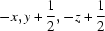
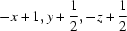
| Symmetry codes: (i) −x, y+1/2, −z+1/2; (ii) −x, −y+1, −z; (iii) x, y+1, z; (iv) −x+1, y+1/2, −z+1/2; (v) −x+1, −y+1, −z; (vi) x, −y+1/2, z−1/2. |
Experimental details
| Crystal data | |
| Chemical formula | Pb2CrF7 |
| Mr | 599.40 |
| Crystal system, space group | Monoclinic, P21/c |
| Temperature (K) | 293 |
| a, b, c (Å) | 5.4626 (7), 11.2085 (15), 9.5738 (11) |
| β (°) | 91.197 (10) |
| V (Å3) | 586.05 (13) |
| Z | 4 |
| Radiation type | Mo Kα |
| µ (mm−1) | 59.61 |
| Crystal size (mm) | 0.12 × 0.07 × 0.01 |
| Data collection | |
| Diffractometer | Siemens AED2 |
| Absorption correction | Gaussian (SHELX76; Sheldrick, 2008) |
| Tmin, Tmax | 0.011, 0.321 |
| No. of measured, independent and observed [I > 2σ(I)] reflections | 6770, 2506, 2082 |
| Rint | 0.041 |
| (sin θ/λ)max (Å−1) | 0.807 |
| Refinement | |
| R[F2 > 2σ(F2)], wR(F2), S | 0.036, 0.084, 1.64 |
| No. of reflections | 2506 |
| No. of parameters | 93 |
| Δρmax, Δρmin (e Å−3) | 3.17, −2.20 |
Computer programs: STADI4 (Stoe & Cie, 1998), X-RED (Stoe & Cie, 1998), SHELXS97 (Sheldrick, 2008), SHELXL97 (Sheldrick, 2008), DIAMOND (Brandenburg, 2005) and ORTEP-3 (Farrugia, 1997), publCIF (Westrip, 2010).
| Pb1—F1 | 2.324 (5) | Pb2—F2iv | 2.586 (5) |
| Pb1—F7i | 2.437 (5) | Pb2—F6 | 2.632 (6) |
| Pb1—F4ii | 2.439 (5) | Pb2—F3iv | 2.653 (5) |
| Pb1—F5iii | 2.620 (6) | Pb2—F7 | 2.743 (6) |
| Pb1—F6iv | 2.640 (7) | Cr—F2 | 1.883 (5) |
| Pb1—F2v | 2.899 (6) | Cr—F3 | 1.900 (5) |
| Pb1—F6v | 3.067 (7) | Cr—F4 | 1.907 (5) |
| Pb2—F1 | 2.412 (5) | Cr—F5 | 1.909 (5) |
| Pb2—F1ii | 2.441 (4) | Cr—F6 | 1.912 (6) |
| Pb2—F5i | 2.497 (6) | Cr—F7 | 1.931 (4) |
| Pb2—F3vi | 2.512 (6) |
| Symmetry codes: (i) −x, y+1/2, −z+1/2; (ii) −x, −y+1, −z; (iii) x, y+1, z; (iv) −x+1, y+1/2, −z+1/2; (v) −x+1, −y+1, −z; (vi) x, −y+1/2, z−1/2. |
| Cr | Pb1 | Pb2 | Σ | Σexpected | |
| F1 | 0.45 | 0.36+0.33 | 1.14 | 1 | |
| F2 | 0.52 | 0.10+0.05 | 0.22 | 0.89 | 1 |
| F3 | 0.50 | 0.04 | 0.27+0.19 | 1.00 | 1 |
| F4 | 0.49 | 0.33+0.04 | 0.05 | 0.91 | 1 |
| F5 | 0.48 | 0.20 | 0.28 | 0.96 | 1 |
| F6 | 0.48 | 0.19+0.06 | 0.20 | 0.93 | 1 |
| F7 | 0.46 | 0.33+0.03 | 0.15 | 0.97 | 1 |
| Σ | 2.93 | 1.60(VI) | 2.00(VIII) | ||
| or | 1.82(XI) | 2.05(IX) | |||
| Σexpected | 3 | 2 | 2 |
| Formula | a | b | c | β | V |
| Pb2RhF7a | 5.569 | 11.854 | 8.832 | 91.00 | 582.96 |
| Sr2RhF7b | 5.510 | 11.628 | 8.640 | 90.98 | 553.49 |
| Pb2CrF7c | 5.463 | 11.208 | 9.574 | 91.20 | 586.05 |
| Notes: (a) Domesle & Hoppe (1983); (b) Grosse & Hoppe (1987); (c) this work. |
Acknowledgements
Thanks are due to Professor M. Leblanc for the X-ray data recording and to A.-M. Mercier for the solid-state synthesis.
References
 Brandenburg, K. (2005). DIAMOND. Crystal Impact GbR, Bonn, Germany. Google Scholar
Brese, N. E. & O'Keeffe, M. (1991). Acta Cryst. B47, 192–197. CrossRef CAS Web of Science IUCr Journals Google Scholar
Brown, I. D. & Altermatt, D. (1985). Acta Cryst. B41, 244–247. CrossRef CAS Web of Science IUCr Journals Google Scholar
Domesle, R. & Hoppe, R. (1980). Z. Kristallogr. 153, 317–328. CrossRef CAS Web of Science Google Scholar
Domesle, R. & Hoppe, R. (1983). Z. Anorg. Allg. Chem. 501, 102–110. CrossRef CAS Web of Science Google Scholar
Farrugia, L. J. (1997). J. Appl. Cryst. 30, 565. CrossRef IUCr Journals Google Scholar
Grosse, L. & Hoppe, R. (1987). Z. Anorg. Allg. Chem. 552, 123–131. CrossRef CAS Web of Science Google Scholar
Kozak, A. de (1999). ICDD PDF card 00-051-0237. Google Scholar
Le Bail, A. (1989). J. Solid State Chem. 83, 267–271. CrossRef CAS Web of Science Google Scholar
Le Bail, A. (1996). Eur. J. Solid State Inorg. Chem. 33, 1211–1222. CAS Google Scholar
Le Bail, A. (2000). J. Non-Cryst. Solids 271, 249–259. Web of Science CrossRef CAS Google Scholar
Le Bail, A. & Laval, J.-P. (1998). Eur. J. Solid State Inorg. Chem. 35, 357–372. CrossRef CAS Google Scholar
Le Bail, A. & Mercier, A.-M. (1992). Eur. J. Solid State Inorg. Chem. 29, 183–190. CAS Google Scholar
Le Bail, A., Mercier, A.-M. & Dix, I. (2009). Acta Cryst. E65, i46–i47. Web of Science CrossRef IUCr Journals Google Scholar
Sheldrick, G. M. (2008). Acta Cryst. A64, 112–122. Web of Science CrossRef CAS IUCr Journals Google Scholar
Stoe & Cie (1998). STADI4 and X-RED. Stoe & Cie, Darmstadt, Germany. Google Scholar
Westrip, S. P. (2010). publCIF. In preparation. Google Scholar
This is an open-access article distributed under the terms of the Creative Commons Attribution (CC-BY) Licence, which permits unrestricted use, distribution, and reproduction in any medium, provided the original authors and source are cited.
| CRYSTALLOGRAPHIC COMMUNICATIONS |


Continuing investigations of crystalline complex compounds of lead and 3d metal cation fluorides having chemical formulations similar to some fluoride glasses for structure modelling purposes (Le Bail, 2000), such as Pb8MnFe2F24 (Le Bail & Mercier, 1992) or NaPbFe2F9 (Le Bail, 1989), the title compound, Pb2CrF7, was synthesized and characterized from single crystal X-ray data. The results confirm that it is isostructural with Pb2RhF7 (Domesle & Hoppe, 1983), as mentioned previously by de Kozak et al. (1999). The monoclinic structure is built up of CrF63- octahedra (Fig. 1) isolated from each other, inserted in a fluorite-related matrix of PbF6 distorted octahedra and PbF8 square antiprisms sharing edges and corners. The seventh fluorine atom is "independent", connected only to 3 Pb atoms in FPb3 triangles, sharing an edge and building an almost planar Pb4F2 unit (Fig. 2), so that the formula can be alternatively written as Pb2F(CrF6). There are some differences observed with the Pb2RhF7 structure-type. The Pb1 atom appears to be six-coordinated in Pb2CrF7 with Pb—F distances ranging from 2.324 (5) to 2.899 (6) Å, there are then 5 next F atoms being between 3.067 (7) and 3.364 (6) Å whereas in Pb2RhF7, Pb1 looks eightfold coordinated (Pb—F distances between 2.375 and 2.744 Å), with two next F atoms at 3.105 and 3.219 Å. The bond valence calculations show that the first 6 F atoms around Pb1 cannot really satisfy the Pb2+ charge and that the 5 next F atoms contribute to the overall bond valence (Table 2). The behaviour of the cell parameters is surprising in the series of the three isostructural compounds. If all cell parameters are logically smaller in Sr2RhF7 (Grosse & Hoppe, 1987) than in Pb2RhF7, due to the smaller Sr2+ size, in Pb2CrF7 one observes that only a and b are smaller but that c is much larger, in spite of the Cr3+ cation being smaller than Rh3+ (Table 3). Finally, the cell volume of Pb2CrF7 is even slightly larger than that of Pb2RhF7.
Usually, such fluorinated phases with high AII/M ratio (AII = Ca, Pb, Sr ; M = 3d element or In, Nb, Zr, etc), are found to be related to the fluorite structure adopted by PbF2 or SrF2. The relation is in general easy to establish due to the presence of "independent" F atoms (not bonded to M) which are found to form characteristic FPb4 tetrahedra. But this is not obvious here (Fig. 3) since no such FPb4 tetrahedron is observed. Other compounds containing "independent" fluorine atoms coordinated to three cations (Ca or Sr) in a plane are Ca2AlF7 (Domesle & Hoppe, 1980), Sr5Zr3F22 (Le Bail, 1996) and Sr5(VOF5)3F(H2O)3 (Le Bail et al., 2009), the last two being strongly related to the fluorite structure in which the FSr3 triangles were found to interconnect the fluorite-related blocks. An examination of the Pb coordinates in Pb2CrF7 along the a axis (which is close to the PbF2 fluorite cell parameter) shows that they alternate at values x~1/4 and 3/4, forming fluorite-related strips corrugating in the ac plane where highly distorted PbF8 cubes as expected in the fluorite structure were obtained by small displacements of some of the F atoms as evidenced in Fig. 4 . Similar corrugated strips were observed for the Pb2ZrF8 structure (Le Bail & Laval, 1998), where the Zr4+ cations occupy bicapped trigonal prisms at positions similar to those of Cr3+ in the title compound. In Pb2ZrF8, the Pb2+ lone pair position was suggested by comparison of the Pb coordination with that of Ba in the isostructural α-Ba2ZrF8 structure, observing some strong distorsions, the stereochemichally active lone pair repelling clearly some F atoms. The same exercice is not so obvious here, even by comparing Sr2RhF7 with Pb2RhF7. However, there is a specific pattern of differences in the bond lengths (3 adjacent short Pb—F bonds and 3 adjacent long ones for Pb1; 4 short and 4 long for Pb2) which could be attributed to repulsion effects involving a somehow weak stereochemically active lone pair producing the longer Pb—F distances. The Pb1 lone pair is thus probably oriented towards the barycenter of the (F5—F6—F2) face of the Pb1F6 octahedron, a similar reasoning applying to the Pb2 lone pair.