 | Acta Crystallographica Section E Acta Crystallographica Section E CRYSTALLOGRAPHIC COMMUNICATIONS |


 journal menu


organic compounds
| CRYSTALLOGRAPHIC COMMUNICATIONS |
 access
tert-Butyl 4-(2-diazoacetyl)piperazine-1-carboxylate

aDepartment of Chemistry, University of Oslo, PO Box 1033 Blindern, N-0315 Oslo, Norway
*Correspondence e-mail: [email protected]
The title C11H18N4O3, is the first diazoacetamide in which the diazoacetyl group is attached to an N atom. The piperazine ring is in a chair form and hence the molecule has an extended conformation. Both ring N atoms are bonded in an essentially planar configuration with the sum of the C—N—C angles being 359.8 (2) and 357.7 (2)°. In the crystal structure, the O atom of the diazoacetyl group accepts two H atoms from C—H donors, thus generating chains of weak hydrogen-bonded R21(7) rings.
Related literature
For the only other reported synthesis of a diazoacetamide in the Chemical Abstracts Service (CAS, American Chemical Society, 2008![[American Chemical Society (2008). Chemical Abstracts Service, American Chemical Society, Columbus, OH, USA; accessed Apr 27, 2010.]](../../../../../../logos/arrows/e_arr.gif "American Chemical Society (2008). Chemical Abstracts Service, American Chemical Society, Columbus, OH, USA; accessed Apr 27, 2010.") ) with a 1,4-diaza six-membered ring, see: Mickelson et al. (1996). For other diazoacetamides, see: Ouihia et al. (1993). For related structures, see: Fenlon et al. (2007); Wang et al. (2006); Miller et al. (1991). For synthetic details, see: Kaupang (2010); Toma et al. (2007). For hydrogen-bond graph-set notation, see: Bernstein et al. (1995). For a description of the Cambridge Structural Database, see: Allen (2002).
) with a 1,4-diaza six-membered ring, see: Mickelson et al. (1996). For other diazoacetamides, see: Ouihia et al. (1993). For related structures, see: Fenlon et al. (2007); Wang et al. (2006); Miller et al. (1991). For synthetic details, see: Kaupang (2010); Toma et al. (2007). For hydrogen-bond graph-set notation, see: Bernstein et al. (1995). For a description of the Cambridge Structural Database, see: Allen (2002).
![[Scheme 1]](lh5033scheme1.gif)
Experimental
Crystal data
|
Refinement
|
| ||||||||||||||||||||||
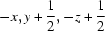 .
. Data collection: APEX2 (Bruker, 2007); cell refinement: SAINT-Plus (Bruker, 2007); data reduction: SAINT-Plus; program(s) used to solve structure: SHELXTL (Sheldrick, 2008); program(s) used to refine structure: SHELXTL; molecular graphics: SHELXTL; software used to prepare material for publication: SHELXTL.
Supporting information
contains datablocks I, global. DOI: https://doi.org/10.1107/S1600536810016211/lh5033sup1.cif
Structure factors: contains datablock I. DOI: https://doi.org/10.1107/S1600536810016211/lh5033Isup2.hkl
A 2.5 ml vial containing tert-butyl 4-(2-diazoacetyl)piperazine-1-carboxylate (10.8 mg) and dichloromethane (1000 ml) was capped and a pinhole (0.5 mm) was made in the cap to allow for vapour diffusion of solvents. This vial was placed inside a 25 ml vial containing n-pentane (8 ml) that was subsequently capped and stored in the dark at ambient temperature for approximately 48 hours, affording bright yellow plate-shaped crystals.
Coordinates were refined for H1 (bonded to C1), which is involved in the shortest intermolcular interaction. Other H atoms were positioned with idealized geometry and fixed C–H distances set to 0.98 Å (methyl) or 0.99 Å (methylene). was permitted for the methyl groups. Uiso values were 1.2Ueq of the or 1.5Ueq for methyl groups.
The tert-butyl 4-(2-diazoacetyl)piperazine-1-carboxylate (I) was prepared as part of a series of diazoacetamides, to be used in intramolecular C—H insertion reactions (Kaupang, 2010). It was synthesized from tert-butyl 4-(2-bromoacetyl)piperazine-1-carboxylate by a slight modification of the procedure reported by Toma et al. (2007), employing 1,1,3,3-tetramethylguanidine as the base instead of 1,8-diazabicyclo[5.4.0]undec-7-ene.
Diffraction data were first collected at ambient temperature, yielding a structure with a massively disordered six-membered ring. At 105 K the ring is completely ordered in a well defined chair conformation, Fig. 1.
The diazoacetyl moiety is not an uncommon in organic molecules, however only 15 occurrences were found in the Cambridge Structural Database (Version 5.31 of November 2009; Allen, 2002), and none where, as here, the group is attached to a N atom. In only two structures the group sits on a non-aromatic ring (Miller et al., 1991; Fenlon et al., 2007).
In a model molecule like trimethylamine the N atom is located about 0.45 Å above the plane defined by the three C atoms. In the structure of (I) N3 is 0.125 (2) Å above the plane defined by C2, C3 and C4, while N4 is only 0.039 (2) Å above the plane defined by C5, C6 and C7, which essentially shows a planar configuration (sum of C—N—C angles 359.8 (2) °). This is due to the double bond character of the amidic N3—C2 and N4—C7 bonds measuring 1.3515 (18) and 1.3483 (18) Å, respectively. An example of a related structure is 1,4-di(chloroacetyl)piperazine (Wang et al., 2006).
In the the O atom of the diazoacetyl group accepts two H atoms from C—H donors, thus generating chains of hydrogen-bonded R12(7) rings (Bernstein et al., 1995).
For the only other reported synthesis of a diazoacetamide in CAS with a 1,4-diaza six-membered ring, see: American Chemical Society (2008); Mickelson et al. (1996). For other diazoacetamides, see: Ouihia et al. (1993). For related structures, see: Fenlon et al. (2007); Wang et al. (2006); Miller et al. (1991). For synthetic details, see: Kaupang (2010); Toma et al. (2007). For hydrogen-bond graph-set notation, see: Bernstein et al. (1995). For a description of the Cambridge Structural Database, see: Allen (2002).
Data collection: APEX2 (Bruker, 2007); cell SAINT-Plus (Bruker, 2007); data reduction: SAINT-Plus (Bruker, 2007); program(s) used to solve structure: SHELXTL (Sheldrick, 2008); program(s) used to refine structure: SHELXTL (Sheldrick, 2008); molecular graphics: SHELXTL (Sheldrick, 2008); software used to prepare material for publication: SHELXTL (Sheldrick, 2008).
![[Figure 1]](./lh5033fig1thm.gif) | Fig. 1. The asymmetric unit of (I), with atomic numbering indicated, together with selected atoms of neighbouring molecules connected by weak hydrogen bonds shown as dotted lines (see Table 1, symmetry operations are -x,1/2+y,1/2-z for O', -x,-1/2+y,1/2-z for H1" and H32"). Displacement ellipsoids are shown at the 50% probability level with H atoms as spheres of arbitrary size. |
| C11H18N4O3 | F(000) = 544 |
| Mr = 254.29 | Dx = 1.278 Mg m−3 |
| Monoclinic, P21/c | Mo Kα radiation, λ = 0.71073 Å |
| a = 14.654 (10) Å | Cell parameters from 2404 reflections |
| b = 10.548 (7) Å | θ = 2.4–26.4° |
| c = 8.553 (6) Å | µ = 0.10 mm−1 |
| β = 91.122 (6)° | T = 105 K |
| V = 1321.8 (15) Å3 | Plate, yellow |
| Z = 4 | 0.55 × 0.42 × 0.08 mm |
| Bruker APEXII CCD diffractometer | 2692 independent reflections |
| Radiation source: fine-focus sealed tube | 2111 reflections with I > 2σ(I) |
| Graphite monochromator | Rint = 0.041 |
| Detector resolution: 8.3 pixels mm-1 | θmax = 26.4°, θmin = 2.4° |
| Three sets of frames each taken over 0.3° ω rotation with 20 s exposure time. Detector set at 2θ = 26°, crystal–to–detector distance 6.00 cm. scans | h = −17→18 |
| Absorption correction: multi-scan (SADABS; Bruker, 2007) | k = −10→13 |
| Tmin = 0.870, Tmax = 0.992 | l = −10→10 |
| 7308 measured reflections |
| Refinement on F2 | Primary atom site location: structure-invariant direct methods |
| Least-squares matrix: full | Secondary atom site location: difference Fourier map |
| R[F2 > 2σ(F2)] = 0.038 | Hydrogen site location: inferred from neighbouring sites |
| wR(F2) = 0.103 | H atoms treated by a mixture of independent and constrained refinement |
| S = 1.03 | w = 1/[σ2(Fo2) + (0.0463P)2 + 0.1671P] where P = (Fo2 + 2Fc2)/3 |
| 2692 reflections | (Δ/σ)max = 0.001 |
| 169 parameters | Δρmax = 0.17 e Å−3 |
| 0 restraints | Δρmin = −0.23 e Å−3 |
| C11H18N4O3 | V = 1321.8 (15) Å3 |
| Mr = 254.29 | Z = 4 |
| Monoclinic, P21/c | Mo Kα radiation |
| a = 14.654 (10) Å | µ = 0.10 mm−1 |
| b = 10.548 (7) Å | T = 105 K |
| c = 8.553 (6) Å | 0.55 × 0.42 × 0.08 mm |
| β = 91.122 (6)° |
| Bruker APEXII CCD diffractometer | 2692 independent reflections |
| Absorption correction: multi-scan (SADABS; Bruker, 2007) | 2111 reflections with I > 2σ(I) |
| Tmin = 0.870, Tmax = 0.992 | Rint = 0.041 |
| 7308 measured reflections |
| R[F2 > 2σ(F2)] = 0.038 | 0 restraints |
| wR(F2) = 0.103 | H atoms treated by a mixture of independent and constrained refinement |
| S = 1.03 | Δρmax = 0.17 e Å−3 |
| 2692 reflections | Δρmin = −0.23 e Å−3 |
| 169 parameters |
Experimental. Crystallized from dichloromethane and n-pentane. |
Geometry. All esds (except the esd in the dihedral angle between two l.s. planes) are estimated using the full covariance matrix. The cell esds are taken into account individually in the estimation of esds in distances, angles and torsion angles; correlations between esds in cell parameters are only used when they are defined by crystal symmetry. An approximate (isotropic) treatment of cell esds is used for estimating esds involving l.s. planes. |
Refinement. Refinement of F2 against ALL reflections. |
| x | y | z | Uiso*/Ueq | ||
| O1 | 0.02567 (7) | 0.20344 (9) | 0.19361 (12) | 0.0353 (3) | |
| O2 | 0.38950 (6) | 0.35633 (9) | 0.62995 (11) | 0.0296 (2) | |
| O3 | 0.33388 (6) | 0.55670 (8) | 0.64091 (11) | 0.0294 (2) | |
| N1 | −0.14125 (10) | 0.34028 (15) | −0.00383 (19) | 0.0562 (4) | |
| N2 | −0.08817 (8) | 0.37402 (12) | 0.08229 (16) | 0.0377 (3) | |
| N3 | 0.10933 (7) | 0.34931 (10) | 0.32642 (14) | 0.0293 (3) | |
| N4 | 0.27460 (8) | 0.42179 (11) | 0.46913 (15) | 0.0350 (3) | |
| C1 | −0.02502 (10) | 0.41229 (14) | 0.18201 (17) | 0.0324 (3) | |
| H1 | −0.0254 (10) | 0.4999 (17) | 0.2058 (19) | 0.039* | |
| C2 | 0.03721 (9) | 0.31392 (13) | 0.23569 (16) | 0.0276 (3) | |
| C3 | 0.11676 (9) | 0.47080 (12) | 0.40835 (18) | 0.0301 (3) | |
| H31 | 0.0971 | 0.4604 | 0.5177 | 0.036* | |
| H32 | 0.0760 | 0.5337 | 0.3568 | 0.036* | |
| C4 | 0.17261 (10) | 0.25284 (13) | 0.38538 (18) | 0.0317 (3) | |
| H41 | 0.1681 | 0.1763 | 0.3188 | 0.038* | |
| H42 | 0.1561 | 0.2287 | 0.4931 | 0.038* | |
| C5 | 0.21342 (9) | 0.51824 (13) | 0.40729 (18) | 0.0322 (3) | |
| H51 | 0.2304 | 0.5397 | 0.2990 | 0.039* | |
| H52 | 0.2188 | 0.5960 | 0.4717 | 0.039* | |
| C6 | 0.26896 (10) | 0.30251 (13) | 0.38538 (19) | 0.0349 (4) | |
| H61 | 0.3104 | 0.2399 | 0.4357 | 0.042* | |
| H62 | 0.2886 | 0.3150 | 0.2763 | 0.042* | |
| C7 | 0.33775 (9) | 0.43825 (12) | 0.58409 (16) | 0.0259 (3) | |
| C8 | 0.39795 (9) | 0.59837 (13) | 0.76528 (15) | 0.0275 (3) | |
| C9 | 0.36780 (11) | 0.73381 (14) | 0.79087 (18) | 0.0387 (4) | |
| H91 | 0.3721 | 0.7811 | 0.6927 | 0.058* | |
| H92 | 0.4073 | 0.7734 | 0.8707 | 0.058* | |
| H93 | 0.3045 | 0.7346 | 0.8258 | 0.058* | |
| C10 | 0.49473 (10) | 0.59327 (15) | 0.70952 (17) | 0.0354 (4) | |
| H101 | 0.4989 | 0.6386 | 0.6099 | 0.053* | |
| H102 | 0.5129 | 0.5047 | 0.6951 | 0.053* | |
| H103 | 0.5354 | 0.6333 | 0.7873 | 0.053* | |
| C11 | 0.38403 (10) | 0.52052 (14) | 0.91124 (17) | 0.0351 (4) | |
| H111 | 0.3190 | 0.5190 | 0.9358 | 0.053* | |
| H112 | 0.4186 | 0.5583 | 0.9987 | 0.053* | |
| H113 | 0.4055 | 0.4337 | 0.8939 | 0.053* |
| U11 | U22 | U33 | U12 | U13 | U23 | |
| O1 | 0.0331 (6) | 0.0239 (5) | 0.0487 (6) | −0.0044 (4) | −0.0025 (5) | −0.0072 (5) |
| O2 | 0.0298 (5) | 0.0242 (5) | 0.0348 (5) | 0.0047 (4) | −0.0017 (4) | 0.0004 (4) |
| O3 | 0.0326 (5) | 0.0217 (5) | 0.0336 (5) | 0.0019 (4) | −0.0074 (4) | −0.0042 (4) |
| N1 | 0.0446 (8) | 0.0565 (10) | 0.0665 (10) | −0.0058 (7) | −0.0207 (8) | −0.0054 (8) |
| N2 | 0.0320 (7) | 0.0341 (7) | 0.0469 (8) | −0.0010 (5) | −0.0060 (6) | −0.0007 (6) |
| N3 | 0.0279 (6) | 0.0200 (6) | 0.0398 (7) | 0.0018 (5) | −0.0042 (5) | −0.0041 (5) |
| N4 | 0.0304 (6) | 0.0239 (6) | 0.0503 (8) | 0.0057 (5) | −0.0125 (6) | −0.0096 (5) |
| C1 | 0.0297 (8) | 0.0281 (8) | 0.0390 (8) | −0.0023 (6) | −0.0063 (6) | −0.0020 (6) |
| C2 | 0.0257 (7) | 0.0241 (7) | 0.0332 (7) | −0.0038 (5) | 0.0042 (6) | −0.0018 (6) |
| C3 | 0.0324 (8) | 0.0204 (7) | 0.0373 (8) | 0.0039 (6) | −0.0050 (6) | −0.0041 (6) |
| C4 | 0.0342 (8) | 0.0202 (7) | 0.0406 (8) | 0.0031 (6) | −0.0035 (6) | −0.0040 (6) |
| C5 | 0.0341 (8) | 0.0224 (7) | 0.0396 (8) | −0.0002 (6) | −0.0089 (6) | −0.0014 (6) |
| C6 | 0.0325 (8) | 0.0264 (7) | 0.0455 (9) | 0.0053 (6) | −0.0054 (7) | −0.0121 (6) |
| C7 | 0.0241 (7) | 0.0237 (7) | 0.0300 (7) | −0.0013 (5) | 0.0030 (5) | −0.0008 (6) |
| C8 | 0.0314 (7) | 0.0259 (7) | 0.0249 (7) | −0.0041 (6) | −0.0037 (6) | −0.0013 (5) |
| C9 | 0.0523 (10) | 0.0268 (8) | 0.0367 (8) | −0.0006 (7) | −0.0048 (7) | −0.0049 (6) |
| C10 | 0.0346 (8) | 0.0390 (8) | 0.0325 (8) | −0.0078 (7) | −0.0006 (6) | 0.0005 (6) |
| C11 | 0.0398 (8) | 0.0354 (8) | 0.0302 (8) | −0.0032 (7) | 0.0025 (6) | 0.0019 (6) |
| O1—C2 | 1.2303 (17) | C4—H41 | 0.9900 |
| O2—C7 | 1.2099 (16) | C4—H42 | 0.9900 |
| O3—C7 | 1.3422 (17) | C5—H51 | 0.9900 |
| O3—C8 | 1.4722 (16) | C5—H52 | 0.9900 |
| N1—N2 | 1.1189 (18) | C6—H61 | 0.9900 |
| N2—C1 | 1.3099 (19) | C6—H62 | 0.9900 |
| N3—C2 | 1.3515 (18) | C8—C10 | 1.506 (2) |
| N3—C4 | 1.4600 (18) | C8—C11 | 1.511 (2) |
| N3—C3 | 1.4635 (18) | C8—C9 | 1.513 (2) |
| N4—C7 | 1.3483 (18) | C9—H91 | 0.9800 |
| N4—C5 | 1.4490 (18) | C9—H92 | 0.9800 |
| N4—C6 | 1.4494 (19) | C9—H93 | 0.9800 |
| C1—C2 | 1.450 (2) | C10—H101 | 0.9800 |
| C1—H1 | 0.946 (17) | C10—H102 | 0.9800 |
| C3—C5 | 1.503 (2) | C10—H103 | 0.9800 |
| C3—H31 | 0.9900 | C11—H111 | 0.9800 |
| C3—H32 | 0.9900 | C11—H112 | 0.9800 |
| C4—C6 | 1.506 (2) | C11—H113 | 0.9800 |
| C7—O3—C8 | 120.57 (10) | N4—C6—H61 | 109.6 |
| N1—N2—C1 | 179.04 (18) | C4—C6—H61 | 109.6 |
| C2—N3—C4 | 119.35 (12) | N4—C6—H62 | 109.6 |
| C2—N3—C3 | 124.53 (11) | C4—C6—H62 | 109.6 |
| C4—N3—C3 | 113.83 (11) | H61—C6—H62 | 108.1 |
| C7—N4—C5 | 125.93 (12) | O2—C7—O3 | 125.31 (12) |
| C7—N4—C6 | 120.26 (11) | O2—C7—N4 | 124.15 (13) |
| C5—N4—C6 | 113.59 (12) | O3—C7—N4 | 110.52 (11) |
| N2—C1—C2 | 114.68 (13) | O3—C8—C10 | 110.59 (12) |
| N2—C1—H1 | 115.7 (9) | O3—C8—C11 | 109.89 (11) |
| C2—C1—H1 | 129.6 (9) | C10—C8—C11 | 112.67 (12) |
| O1—C2—N3 | 122.08 (12) | O3—C8—C9 | 101.68 (11) |
| O1—C2—C1 | 120.21 (13) | C10—C8—C9 | 111.04 (12) |
| N3—C2—C1 | 117.64 (12) | C11—C8—C9 | 110.43 (13) |
| N3—C3—C5 | 110.49 (12) | C8—C9—H91 | 109.5 |
| N3—C3—H31 | 109.6 | C8—C9—H92 | 109.5 |
| C5—C3—H31 | 109.6 | H91—C9—H92 | 109.5 |
| N3—C3—H32 | 109.6 | C8—C9—H93 | 109.5 |
| C5—C3—H32 | 109.6 | H91—C9—H93 | 109.5 |
| H31—C3—H32 | 108.1 | H92—C9—H93 | 109.5 |
| N3—C4—C6 | 110.29 (12) | C8—C10—H101 | 109.5 |
| N3—C4—H41 | 109.6 | C8—C10—H102 | 109.5 |
| C6—C4—H41 | 109.6 | H101—C10—H102 | 109.5 |
| N3—C4—H42 | 109.6 | C8—C10—H103 | 109.5 |
| C6—C4—H42 | 109.6 | H101—C10—H103 | 109.5 |
| H41—C4—H42 | 108.1 | H102—C10—H103 | 109.5 |
| N4—C5—C3 | 109.92 (12) | C8—C11—H111 | 109.5 |
| N4—C5—H51 | 109.7 | C8—C11—H112 | 109.5 |
| C3—C5—H51 | 109.7 | H111—C11—H112 | 109.5 |
| N4—C5—H52 | 109.7 | C8—C11—H113 | 109.5 |
| C3—C5—H52 | 109.7 | H111—C11—H113 | 109.5 |
| H51—C5—H52 | 108.2 | H112—C11—H113 | 109.5 |
| N4—C6—C4 | 110.27 (12) | ||
| C4—N3—C2—O1 | −4.1 (2) | C7—N4—C6—C4 | 128.14 (15) |
| C3—N3—C2—O1 | −165.84 (14) | C5—N4—C6—C4 | −57.04 (17) |
| C4—N3—C2—C1 | 178.83 (13) | N3—C4—C6—N4 | 53.39 (17) |
| C3—N3—C2—C1 | 17.1 (2) | C8—O3—C7—O2 | 2.4 (2) |
| N2—C1—C2—O1 | −3.6 (2) | C8—O3—C7—N4 | −178.51 (11) |
| N2—C1—C2—N3 | 173.55 (13) | C5—N4—C7—O2 | −177.86 (14) |
| C2—N3—C3—C5 | −143.07 (14) | C6—N4—C7—O2 | −3.7 (2) |
| C4—N3—C3—C5 | 54.32 (16) | C5—N4—C7—O3 | 3.0 (2) |
| C2—N3—C4—C6 | 142.52 (13) | C6—N4—C7—O3 | 177.17 (13) |
| C3—N3—C4—C6 | −53.89 (17) | C7—O3—C8—C10 | 62.39 (16) |
| C7—N4—C5—C3 | −128.35 (15) | C7—O3—C8—C11 | −62.62 (16) |
| C6—N4—C5—C3 | 57.18 (17) | C7—O3—C8—C9 | −179.61 (12) |
| N3—C3—C5—N4 | −53.86 (17) |
| D—H···A | D—H | H···A | D···A | D—H···A |
| C1—H1···O1i | 0.946 (17) | 2.313 (18) | 3.250 (3) | 170.6 (14) |
| C3—H32···O1i | 0.99 | 2.36 | 3.327 (3) | 164 |
| Symmetry code: (i) −x, y+1/2, −z+1/2. |
Experimental details
| Crystal data | |
| Chemical formula | C11H18N4O3 |
| Mr | 254.29 |
| Crystal system, space group | Monoclinic, P21/c |
| Temperature (K) | 105 |
| a, b, c (Å) | 14.654 (10), 10.548 (7), 8.553 (6) |
| β (°) | 91.122 (6) |
| V (Å3) | 1321.8 (15) |
| Z | 4 |
| Radiation type | Mo Kα |
| µ (mm−1) | 0.10 |
| Crystal size (mm) | 0.55 × 0.42 × 0.08 |
| Data collection | |
| Diffractometer | Bruker APEXII CCD diffractometer |
| Absorption correction | Multi-scan (SADABS; Bruker, 2007) |
| Tmin, Tmax | 0.870, 0.992 |
| No. of measured, independent and observed [I > 2σ(I)] reflections | 7308, 2692, 2111 |
| Rint | 0.041 |
| (sin θ/λ)max (Å−1) | 0.625 |
| Refinement | |
| R[F2 > 2σ(F2)], wR(F2), S | 0.038, 0.103, 1.03 |
| No. of reflections | 2692 |
| No. of parameters | 169 |
| H-atom treatment | H atoms treated by a mixture of independent and constrained refinement |
| Δρmax, Δρmin (e Å−3) | 0.17, −0.23 |
Computer programs: APEX2 (Bruker, 2007), SAINT-Plus (Bruker, 2007), SHELXTL (Sheldrick, 2008).
| D—H···A | D—H | H···A | D···A | D—H···A |
| C1—H1···O1i | 0.946 (17) | 2.313 (18) | 3.250 (3) | 170.6 (14) |
| C3—H32···O1i | 0.990 | 2.363 | 3.327 (3) | 164.0 |
| Symmetry code: (i) −x, y+1/2, −z+1/2. |
References
 Allen, F. H. (2002). Acta Cryst. B58, 380–388. Web of Science CSD CrossRef CAS IUCr Journals Google Scholar
American Chemical Society (2008). Chemical Abstracts Service, American Chemical Society, Columbus, OH, USA; accessed Apr 27, 2010. Google Scholar
Bernstein, J., Davis, R. E., Shimoni, L. & Chang, N.-L. (1995). Angew. Chem. Int. Ed. Engl. 34, 1555–1573. CrossRef CAS Web of Science Google Scholar
Bruker (2007). APEX2, SAINT-Plus and SADABS. Bruker AXS Inc., Madison, Wisconsin, USA. Google Scholar
Fenlon, T. W., Schwaebisch, D., Mayweg, A. V. W., Lee, V., Adlington, R. M. & Baldwin, J. E. (2007). Synlett, pp. 2679–2682. Google Scholar
Kaupang, Å. (2010). Masters thesis, University of Oslo, Norway. Available at http://www.duo.uio.no/. Google Scholar
Mickelson, J. W., Jacobsen, E. J., Carter, D. B., Im, H. K., Im, W. B., Schreur, P. J. K. D., Sethy, V. H., Tang, A. H., McGee, J. E. & Petke, J. D. (1996). J. Med. Chem. 39, 4654—4666. CrossRef Web of Science Google Scholar
Miller, R. D., Theis, W., Heilig, G. & Kirchmeyer, S. (1991). J. Org. Chem. 56, 1453–1463. CSD CrossRef CAS Web of Science Google Scholar
Ouihia, A., Rene, L., Guilhem, J., Pascard, C. & Badet, B. (1993). J. Org. Chem. 58, 1641–1642. CSD CrossRef CAS Web of Science Google Scholar
Sheldrick, G. M. (2008). Acta Cryst. A64, 112–122. Web of Science CrossRef CAS IUCr Journals Google Scholar
Toma, T., Shimokawa, J. & Fukuyama, T. (2007). Org. Lett. 9, 3195–3197. Web of Science CrossRef PubMed CAS Google Scholar
Wang, J., Zeng, T., Li, M.-L., Duan, E.-H. & Li, J.-S. (2006). Acta Cryst. E62, o2912–o2913. Web of Science CSD CrossRef IUCr Journals Google Scholar
This is an open-access article distributed under the terms of the Creative Commons Attribution (CC-BY) Licence, which permits unrestricted use, distribution, and reproduction in any medium, provided the original authors and source are cited.
| CRYSTALLOGRAPHIC COMMUNICATIONS |


The tert-butyl 4-(2-diazoacetyl)piperazine-1-carboxylate (I) was prepared as part of a series of diazoacetamides, to be used in intramolecular C—H insertion reactions (Kaupang, 2010). It was synthesized from tert-butyl 4-(2-bromoacetyl)piperazine-1-carboxylate by a slight modification of the procedure reported by Toma et al. (2007), employing 1,1,3,3-tetramethylguanidine as the base instead of 1,8-diazabicyclo[5.4.0]undec-7-ene.
Diffraction data were first collected at ambient temperature, yielding a structure with a massively disordered six-membered ring. At 105 K the ring is completely ordered in a well defined chair conformation, Fig. 1.
The diazoacetyl moiety is not an uncommon functional group in organic molecules, however only 15 occurrences were found in the Cambridge Structural Database (Version 5.31 of November 2009; Allen, 2002), and none where, as here, the group is attached to a N atom. In only two structures the group sits on a non-aromatic ring (Miller et al., 1991; Fenlon et al., 2007).
In a model molecule like trimethylamine the N atom is located about 0.45 Å above the plane defined by the three C atoms. In the structure of (I) N3 is 0.125 (2) Å above the plane defined by C2, C3 and C4, while N4 is only 0.039 (2) Å above the plane defined by C5, C6 and C7, which essentially shows a planar configuration (sum of C—N—C angles 359.8 (2) °). This is due to the double bond character of the amidic N3—C2 and N4—C7 bonds measuring 1.3515 (18) and 1.3483 (18) Å, respectively. An example of a related structure is 1,4-di(chloroacetyl)piperazine (Wang et al., 2006).
In the crystal structure, the O atom of the diazoacetyl group accepts two H atoms from C—H donors, thus generating chains of hydrogen-bonded R12(7) rings (Bernstein et al., 1995).