 | Acta Crystallographica Section E Acta Crystallographica Section E CRYSTALLOGRAPHIC COMMUNICATIONS |


 journal menu


organic compounds
| CRYSTALLOGRAPHIC COMMUNICATIONS |
 access
Propane-1,3-diyl bis(4-aminobenzoate)

aH. E. J. Research Institute of Chemistry, International Center for Chemical and Biological Sciences, University of Karachi, Karachi 75270, Pakistan, and bDepartment of Chemistry, University of Malaya, 50603 Kuala Lumpur, Malaysia
*Correspondence e-mail: [email protected]
Molecules of the title compound, C17H18N2O4, lie on a twofold rotation axis that passes through the central methylene C atom. The molecules adopt a `V' shape and the trimethylene unit assumes a gauche–gauche conformation. The amino N atom shows a nonplanar coordination. Adjacent molecules are connected by N—H⋯O hydrogen bonds into chains running along [001]. Furthermore, N—H⋯N hydrogen bonds connect these chains into a three-dimensional network.
![[Scheme 1]](bt5289scheme1.gif)
Experimental
Crystal data
|
Data collection
|
Refinement
|
| ||||||||||||||||||||||
 .
. Data collection: APEX2 (Bruker, 2009![[Bruker (2009). APEX2 and SAINT. Bruker AXS Inc., Madison, Wisconsin, USA. ]](../../../../../../logos/arrows/e_arr.gif "Bruker (2009). APEX2 and SAINT. Bruker AXS Inc., Madison, Wisconsin, USA.") ); cell refinement: SAINT (Bruker, 2009); data reduction: SAINT; program(s) used to solve structure: SHELXS97 (Sheldrick, 2008); program(s) used to refine structure: SHELXL97 (Sheldrick, 2008); molecular graphics: X-SEED (Barbour, 2001); software used to prepare material for publication: publCIF (Westrip, 2010).
); cell refinement: SAINT (Bruker, 2009); data reduction: SAINT; program(s) used to solve structure: SHELXS97 (Sheldrick, 2008); program(s) used to refine structure: SHELXL97 (Sheldrick, 2008); molecular graphics: X-SEED (Barbour, 2001); software used to prepare material for publication: publCIF (Westrip, 2010).
Supporting information
contains datablocks global, I. DOI: https://doi.org/10.1107/S1600536810026024/bt5289sup1.cif
Structure factors: contains datablock I. DOI: https://doi.org/10.1107/S1600536810026024/bt5289Isup2.hkl
The compound was returned unchanged but in a crystalline form in an unsuccessful condensation with o-vanillin in ethanol medium.
Carbon-bound H-atoms were placed in calculated positions [C–H 0.95–0.99 Å, U(H) 1.2U(C)] and were included in the in the riding model approximation. The amino H-atoms were located in a difference Fourier map, and were refined isotropically with a distance restraint of N–H 0.86±0.01 Å. 822 Friedel pairs were merged.
The chemical is a commercially available chemical that should be compable of condensing with to yield Schff bases; its special feature is its trimethylene portion, which assumes a V shape. The C17H18N2O4 molecule (Scheme I) lies on a twofold rotation axis that passes through the central methylene carbon atom; this relates one 4-aminobenzoate unit to the other. The molecule assumes a V shape and the trimethylene portion assumes a gauche–gauche conformation. The amino nitrogen atom shows non-planar coordination (Fig. 1). Adjacent molecules are connected by N–H···O and N–H···N shydrogen bonds to form a three-dimensional network.
For the of 1,3-propandiyl-bis(benzoate), see: Pérez & Brisse (1977).
Data collection: APEX2 (Bruker, 2009); cell SAINT (Bruker, 2009); data reduction: SAINT (Bruker, 2009); program(s) used to solve structure: SHELXS97 (Sheldrick, 2008); program(s) used to refine structure: SHELXL97 (Sheldrick, 2008); molecular graphics: X-SEED (Barbour, 2001); software used to prepare material for publication: publCIF (Westrip, 2010).
![[Figure 1]](./bt5289fig1thm.gif) | Fig. 1. Anisotropic displacement ellipsoid plot (Barbour, 2001) of C17H18N2O4 at the 50% probability level; hydrogen atoms are drawn as spheres of arbitrary radius. |
| C17H18N2O4 | F(000) = 332 |
| Mr = 314.33 | Dx = 1.242 Mg m−3 |
| Monoclinic, C2 | Mo Kα radiation, λ = 0.71073 Å |
| Hall symbol: C 2y | Cell parameters from 915 reflections |
| a = 23.725 (5) Å | θ = 2.6–26.8° |
| b = 4.5109 (9) Å | µ = 0.09 mm−1 |
| c = 8.2171 (17) Å | T = 100 K |
| β = 107.173 (3)° | Plate, yellow |
| V = 840.2 (3) Å3 | 0.35 × 0.35 × 0.02 mm |
| Z = 2 |
| Bruker SMART APEX diffractometer | 788 reflections with I > 2σ(I) |
| Radiation source: fine-focus sealed tube | Rint = 0.090 |
| Graphite monochromator | θmax = 27.5°, θmin = 1.8° |
| ω scans | h = −30→29 |
| 3936 measured reflections | k = −5→5 |
| 1082 independent reflections | l = −10→10 |
| Refinement on F2 | Primary atom site location: structure-invariant direct methods |
| Least-squares matrix: full | Secondary atom site location: difference Fourier map |
| R[F2 > 2σ(F2)] = 0.043 | Hydrogen site location: inferred from neighbouring sites |
| wR(F2) = 0.109 | H atoms treated by a mixture of independent and constrained refinement |
| S = 0.96 | w = 1/[σ2(Fo2) + (0.0523P)2] where P = (Fo2 + 2Fc2)/3 |
| 1082 reflections | (Δ/σ)max = 0.001 |
| 113 parameters | Δρmax = 0.24 e Å−3 |
| 3 restraints | Δρmin = −0.24 e Å−3 |
| C17H18N2O4 | V = 840.2 (3) Å3 |
| Mr = 314.33 | Z = 2 |
| Monoclinic, C2 | Mo Kα radiation |
| a = 23.725 (5) Å | µ = 0.09 mm−1 |
| b = 4.5109 (9) Å | T = 100 K |
| c = 8.2171 (17) Å | 0.35 × 0.35 × 0.02 mm |
| β = 107.173 (3)° |
| Bruker SMART APEX diffractometer | 788 reflections with I > 2σ(I) |
| 3936 measured reflections | Rint = 0.090 |
| 1082 independent reflections |
| R[F2 > 2σ(F2)] = 0.043 | 3 restraints |
| wR(F2) = 0.109 | H atoms treated by a mixture of independent and constrained refinement |
| S = 0.96 | Δρmax = 0.24 e Å−3 |
| 1082 reflections | Δρmin = −0.24 e Å−3 |
| 113 parameters |
| x | y | z | Uiso*/Ueq | Occ. (<1) | |
| O1 | 0.42724 (7) | 0.4987 (4) | 0.0488 (2) | 0.0262 (5) | |
| O2 | 0.35969 (8) | 0.7580 (5) | −0.1476 (2) | 0.0304 (5) | |
| N1 | 0.29701 (11) | 1.0783 (6) | 0.5367 (3) | 0.0298 (6) | |
| C1 | 0.5000 | 0.1862 (10) | 0.0000 | 0.0279 (10) | |
| H1A | 0.5095 | 0.0569 | −0.0857 | 0.033* | 0.50 |
| H1B | 0.4905 | 0.0569 | 0.0857 | 0.033* | 0.50 |
| C2 | 0.44676 (11) | 0.3705 (7) | −0.0862 (3) | 0.0263 (7) | |
| H2A | 0.4572 | 0.5279 | −0.1562 | 0.032* | |
| H2B | 0.4153 | 0.2454 | −0.1609 | 0.032* | |
| C3 | 0.38135 (11) | 0.6876 (7) | 0.0010 (3) | 0.0244 (7) | |
| C4 | 0.36179 (11) | 0.7924 (7) | 0.1432 (3) | 0.0228 (6) | |
| C5 | 0.31600 (11) | 0.9969 (7) | 0.1134 (3) | 0.0260 (7) | |
| H5 | 0.2991 | 1.0721 | 0.0016 | 0.031* | |
| C6 | 0.29486 (12) | 1.0917 (7) | 0.2423 (3) | 0.0286 (7) | |
| H6 | 0.2631 | 1.2289 | 0.2187 | 0.034* | |
| C7 | 0.31969 (11) | 0.9879 (7) | 0.4094 (3) | 0.0252 (7) | |
| C8 | 0.36569 (11) | 0.7851 (8) | 0.4393 (3) | 0.0295 (7) | |
| H8 | 0.3830 | 0.7123 | 0.5514 | 0.035* | |
| C9 | 0.38646 (11) | 0.6885 (8) | 0.3103 (3) | 0.0282 (7) | |
| H9 | 0.4179 | 0.5495 | 0.3338 | 0.034* | |
| H11 | 0.3137 (17) | 1.032 (12) | 0.641 (2) | 0.098 (16)* | |
| H12 | 0.2748 (10) | 1.233 (4) | 0.519 (3) | 0.025 (8)* |
| U11 | U22 | U33 | U12 | U13 | U23 | |
| O1 | 0.0204 (9) | 0.0351 (12) | 0.0206 (9) | 0.0041 (10) | 0.0021 (7) | 0.0031 (9) |
| O2 | 0.0239 (10) | 0.0453 (13) | 0.0165 (9) | 0.0042 (10) | −0.0024 (7) | 0.0029 (10) |
| N1 | 0.0272 (14) | 0.0364 (17) | 0.0227 (13) | 0.0056 (12) | 0.0025 (11) | 0.0016 (12) |
| C1 | 0.021 (2) | 0.030 (3) | 0.029 (2) | 0.000 | 0.0034 (16) | 0.000 |
| C2 | 0.0205 (13) | 0.0329 (17) | 0.0243 (14) | −0.0040 (13) | 0.0046 (11) | −0.0024 (13) |
| C3 | 0.0172 (13) | 0.0302 (17) | 0.0224 (13) | −0.0048 (13) | 0.0005 (11) | 0.0009 (13) |
| C4 | 0.0163 (12) | 0.0304 (17) | 0.0183 (12) | −0.0025 (12) | −0.0001 (10) | 0.0023 (11) |
| C5 | 0.0190 (13) | 0.0322 (17) | 0.0193 (13) | −0.0007 (14) | −0.0058 (11) | 0.0043 (13) |
| C6 | 0.0191 (14) | 0.0368 (19) | 0.0236 (14) | 0.0029 (13) | −0.0031 (12) | 0.0038 (13) |
| C7 | 0.0186 (13) | 0.0335 (18) | 0.0202 (13) | −0.0060 (14) | 0.0006 (10) | 0.0005 (13) |
| C8 | 0.0218 (14) | 0.043 (2) | 0.0179 (13) | 0.0039 (14) | −0.0026 (11) | 0.0090 (14) |
| C9 | 0.0181 (14) | 0.0397 (19) | 0.0237 (14) | 0.0030 (14) | 0.0012 (11) | 0.0050 (14) |
| O1—C3 | 1.347 (3) | C3—C4 | 1.457 (4) |
| O1—C2 | 1.444 (3) | C4—C5 | 1.391 (4) |
| O2—C3 | 1.219 (3) | C4—C9 | 1.405 (3) |
| N1—C7 | 1.372 (3) | C5—C6 | 1.368 (4) |
| N1—H11 | 0.858 (10) | C5—H5 | 0.9500 |
| N1—H12 | 0.861 (10) | C6—C7 | 1.405 (4) |
| C1—C2 | 1.503 (4) | C6—H6 | 0.9500 |
| C1—C2i | 1.503 (4) | C7—C8 | 1.389 (4) |
| C1—H1A | 0.9900 | C8—C9 | 1.365 (4) |
| C1—H1B | 0.9900 | C8—H8 | 0.9500 |
| C2—H2A | 0.9900 | C9—H9 | 0.9500 |
| C2—H2B | 0.9900 | ||
| C3—O1—C2 | 116.39 (19) | C5—C4—C9 | 118.1 (2) |
| C7—N1—H11 | 121 (3) | C5—C4—C3 | 119.4 (2) |
| C7—N1—H12 | 118.1 (19) | C9—C4—C3 | 122.4 (2) |
| H11—N1—H12 | 116 (4) | C6—C5—C4 | 121.1 (2) |
| C2—C1—C2i | 112.9 (4) | C6—C5—H5 | 119.4 |
| C2—C1—H1A | 109.0 | C4—C5—H5 | 119.4 |
| C2i—C1—H1A | 109.0 | C5—C6—C7 | 120.6 (3) |
| C2—C1—H1B | 109.0 | C5—C6—H6 | 119.7 |
| C2i—C1—H1B | 109.0 | C7—C6—H6 | 119.7 |
| H1A—C1—H1B | 107.8 | N1—C7—C8 | 121.7 (2) |
| O1—C2—C1 | 105.94 (18) | N1—C7—C6 | 120.0 (3) |
| O1—C2—H2A | 110.5 | C8—C7—C6 | 118.2 (2) |
| C1—C2—H2A | 110.5 | C9—C8—C7 | 121.2 (3) |
| O1—C2—H2B | 110.5 | C9—C8—H8 | 119.4 |
| C1—C2—H2B | 110.5 | C7—C8—H8 | 119.4 |
| H2A—C2—H2B | 108.7 | C8—C9—C4 | 120.7 (3) |
| O2—C3—O1 | 121.5 (2) | C8—C9—H9 | 119.7 |
| O2—C3—C4 | 125.4 (3) | C4—C9—H9 | 119.7 |
| O1—C3—C4 | 113.1 (2) | ||
| C3—O1—C2—C1 | 176.5 (2) | C3—C4—C5—C6 | 177.4 (3) |
| C2i—C1—C2—O1 | −71.92 (18) | C4—C5—C6—C7 | 1.1 (4) |
| C2—O1—C3—O2 | −3.8 (4) | C5—C6—C7—N1 | −178.2 (3) |
| C2—O1—C3—C4 | 176.2 (2) | C5—C6—C7—C8 | −0.6 (4) |
| O2—C3—C4—C5 | −2.2 (4) | N1—C7—C8—C9 | 177.6 (3) |
| O1—C3—C4—C5 | 177.8 (3) | C6—C7—C8—C9 | 0.1 (5) |
| O2—C3—C4—C9 | 176.1 (3) | C7—C8—C9—C4 | 0.1 (5) |
| O1—C3—C4—C9 | −4.0 (4) | C5—C4—C9—C8 | 0.3 (4) |
| C9—C4—C5—C6 | −0.9 (4) | C3—C4—C9—C8 | −177.9 (3) |
| Symmetry code: (i) −x+1, y, −z. |
| D—H···A | D—H | H···A | D···A | D—H···A |
| N1—H11···O2ii | 0.86 (1) | 2.15 (2) | 2.958 (3) | 157 (5) |
| N1—H12···N1iii | 0.86 (1) | 2.25 (1) | 3.104 (3) | 169 (2) |
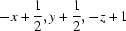
| Symmetry codes: (ii) x, y, z+1; (iii) −x+1/2, y+1/2, −z+1. |
Experimental details
| Crystal data | |
| Chemical formula | C17H18N2O4 |
| Mr | 314.33 |
| Crystal system, space group | Monoclinic, C2 |
| Temperature (K) | 100 |
| a, b, c (Å) | 23.725 (5), 4.5109 (9), 8.2171 (17) |
| β (°) | 107.173 (3) |
| V (Å3) | 840.2 (3) |
| Z | 2 |
| Radiation type | Mo Kα |
| µ (mm−1) | 0.09 |
| Crystal size (mm) | 0.35 × 0.35 × 0.02 |
| Data collection | |
| Diffractometer | Bruker SMART APEX diffractometer |
| Absorption correction | – |
| No. of measured, independent and observed [I > 2σ(I)] reflections | 3936, 1082, 788 |
| Rint | 0.090 |
| (sin θ/λ)max (Å−1) | 0.649 |
| Refinement | |
| R[F2 > 2σ(F2)], wR(F2), S | 0.043, 0.109, 0.96 |
| No. of reflections | 1082 |
| No. of parameters | 113 |
| No. of restraints | 3 |
| H-atom treatment | H atoms treated by a mixture of independent and constrained refinement |
| Δρmax, Δρmin (e Å−3) | 0.24, −0.24 |
Computer programs: APEX2 (Bruker, 2009), SAINT (Bruker, 2009), SHELXS97 (Sheldrick, 2008), SHELXL97 (Sheldrick, 2008), X-SEED (Barbour, 2001), publCIF (Westrip, 2010).
| D—H···A | D—H | H···A | D···A | D—H···A |
| N1—H11···O2i | 0.86 (1) | 2.15 (2) | 2.958 (3) | 157 (5) |
| N1—H12···N1ii | 0.86 (1) | 2.25 (1) | 3.104 (3) | 169 (2) |
| Symmetry codes: (i) x, y, z+1; (ii) −x+1/2, y+1/2, −z+1. |
Acknowledgements
The authors thank the Higher Education Commission of Pakistan and the University of Malaya for supporting this study.
References
 Barbour, L. J. (2001). J. Supramol. Chem. 1, 189–191. CrossRef CAS Google Scholar
Bruker (2009). APEX2 and SAINT. Bruker AXS Inc., Madison, Wisconsin, USA. Google Scholar
Pérez, S. & Brisse, F. (1977). Acta Cryst. B33, 3259–3262. CSD CrossRef IUCr Journals Web of Science Google Scholar
Sheldrick, G. M. (2008). Acta Cryst. A64, 112–122. Web of Science CrossRef CAS IUCr Journals Google Scholar
Westrip, S. P. (2010). J. Appl. Cryst. 43, 920–925. Web of Science CrossRef CAS IUCr Journals Google Scholar
This is an open-access article distributed under the terms of the Creative Commons Attribution (CC-BY) Licence, which permits unrestricted use, distribution, and reproduction in any medium, provided the original authors and source are cited.
| CRYSTALLOGRAPHIC COMMUNICATIONS |


The chemical is a commercially available chemical that should be compable of condensing with carbonyl compounds to yield Schff bases; its special feature is its trimethylene portion, which assumes a V shape. The C17H18N2O4 molecule (Scheme I) lies on a twofold rotation axis that passes through the central methylene carbon atom; this symmetry element relates one 4-aminobenzoate unit to the other. The molecule assumes a V shape and the trimethylene portion assumes a gauche–gauche conformation. The amino nitrogen atom shows non-planar coordination (Fig. 1). Adjacent molecules are connected by N–H···O and N–H···N shydrogen bonds to form a three-dimensional network.