 | Acta Crystallographica Section E Acta Crystallographica Section E CRYSTALLOGRAPHIC COMMUNICATIONS |


 journal menu


organic compounds
| CRYSTALLOGRAPHIC COMMUNICATIONS |
 access
1-[3,5-Bis(4-chlorophenyl)-4,5-dihydro-1H-pyrazol-1-yl]ethanone

aDepartment of Chemistry, Keene State College, 229 Main Street, Keene, NH 03435-2001, USA, bDepartment of Studies in Chemistry, Mangalore University, Mangalagangotri 574 199, India, and cDepartment of Studies in Chemistry, University of Mysore, Manasagangotri, Mysore 570 006, India
*Correspondence e-mail: [email protected]
In the title compound, C17H14Cl2N2O, the dihedral angles between the pyrazole ring and the mean planes of the benzene and chloro-substituted benzene rings are 75.97 (1) and 16.63 (1)° respectively. In the crystal, two weak C—H⋯O intermolecular hydrogen bonds and π–π stacking interactions [centroid–centroid distances = 3.774 (4) and 3.716 (7) Å] are observed.
Related literature
For the antitumor, antibacterial, antifungal, antiviral, antiparasitic, anti-tubercular and insecticidal properties of substituted pyrazolines, see: Hes et al. (1978![[Hes, R. V., Wellinga, K. & Grosscurt, A. C. (1978). J. Agric. Food Chem. 26, 915-918.]](../../../../../../logos/arrows/e_arr.gif "Hes, R. V., Wellinga, K. & Grosscurt, A. C. (1978). J. Agric. Food Chem. 26, 915-918.") ); Manna et al. (2005); Amir et al. (2008). For their anti-inflammatory, anti-diabetic, anaesthetic and analgesic properties, see: Regaila et al. (1979). For their use in organic synthesis, see: Klimova et al. (1999); Bhaskarreddy et al. (1997). For a continuation of the work on pyrazoline derivatives, see: Samshuddin et al. (2010); Fun et al. (2010); Yathirajan et al. (2007a,b); Butcher et al. (2007). For related structures, see: Jian & Wang (2006); Anuradha et al. (2008); Lu et al. (2008); Jian et al. (2006); Wang et al. (2005).
); Manna et al. (2005); Amir et al. (2008). For their anti-inflammatory, anti-diabetic, anaesthetic and analgesic properties, see: Regaila et al. (1979). For their use in organic synthesis, see: Klimova et al. (1999); Bhaskarreddy et al. (1997). For a continuation of the work on pyrazoline derivatives, see: Samshuddin et al. (2010); Fun et al. (2010); Yathirajan et al. (2007a,b); Butcher et al. (2007). For related structures, see: Jian & Wang (2006); Anuradha et al. (2008); Lu et al. (2008); Jian et al. (2006); Wang et al. (2005).
![[Scheme 1]](fj2320scheme1.gif)
Experimental
Crystal data
|
Refinement
|
| ||||||||||||||||||||||
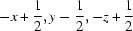 ; (ii)
 Data collection: APEX2 (Bruker, 2008); cell refinement: SAINT (Bruker, 2008); data reduction: SAINT; program(s) used to solve structure: SHELXTL (Sheldrick, 2008); program(s) used to refine structure: SHELXTL; molecular graphics: SHELXTL; software used to prepare material for publication: SHELXTL.
Supporting information
contains datablocks global, I. DOI: https://doi.org/10.1107/S1600536810025584/fj2320sup1.cif
Structure factors: contains datablock I. DOI: https://doi.org/10.1107/S1600536810025584/fj2320Isup2.hkl
A mixture of (2E)-1,3-bis(4-chlorophenyl)prop-2-en-1-one (2.77 g, 0.01 mol) and hydrazine hydrate (0.5 ml, 0.01 mol) in 25 ml e thanol in presence of 2 ml glacial acetic acid was refluxed for 5 h (Fig. 3). The reaction mixture was cooled and poured into 50 ml ice-cold water. The precipitate was collected by filtration and purified by recrystallization from ethanol. The single-crystal was grown from DMF by slow evaporation method and yield of the compound was 84%.(m.p. 376 K). Analytical data: Found (Calculated): C %: 61.21(61.28); H%: 4.25 (4.23); N%: 8.35(8.41).
All of the H atoms were placed in their calculated positions and then refined using the riding model with C—H = 0.93–0.98 Å, and with Uiso(H) = 1.17–1.49Ueq(C).
Due to the interesting activity of variously substituted pyrazolines as biological agents considerable attention has been focused on this class of compounds. They are used as antitumor, antibacterial, antifungal, antiviral, antiparasitic, anti-tubercular and insecticidal agents (Hes et al., 1978; Manna et al. 2005; Amir et al., 2008).Some of these compounds have also anti-inflammatory, anti-diabetic, anaesthetic and analgesic properties Regaila et al., 1979). Among the existing various pyrazoline type derivatives, 1-acetyl-pyrazolines have been identified as one of the most promising scaffolds. In the field of medicinal chemistry, 1-acetyl-pyrazoline derivatives were found to display anticancer and anti-inflammatory activities. In addition, pyrazolines have played a crucial part in the development of theory in heterocyclic chemistry and also used extensively in organic synthesis (Klimova et al., 1999 & Bhaskarreddy et al., 1997). In continuation of our work on pyrazoline derivatives (Samshuddin et al., 2010, Fun et al., 2010, Yathirajan et al., 2007a,b, Butcher et al., 2007) and in view of the importance of these derivatives, the title compound (I) is synthesized and its is reported here.
In (I), two chloro-substituted benzene rings are bonded to opposite ends of an acetyl substituted pyrazole ring in a slightly distorted (Fig. 1). The dihedral angle between the mean planes of the benzene (C4–C9) and chloro substituted benzene rings (C10–C15) with the pyrazole ring are 75.97 ° and 16.63 ° respectively. Two weak C—H···O intermolecular hydrogen bonds (Table 1) and π-π stacking interactions (Table 2) are observed which contribute to crystal packing stability (Fig. 2).
For the antitumor, antibacterial, antifungal, antiviral, antiparasitic, anti-tubercular and insecticidal properties of substituted pyrazolines, see: Hes et al. (1978); Manna et al. (2005); Amir et al. (2008). For their anti-inflammatory, anti-diabetic, anaesthetic and analgesic properties, see: Regaila et al. (1979). For their use in organic synthesis, see: Klimova et al. (1999); Bhaskarreddy et al. (1997). For a continuation of the work on pyrazoline derivatives, see: Samshuddin et al. (2010); Fun et al. (2010); Yathirajan et al. (2007a,b); Butcher et al. (2007). For related structures, see: Jian & Wang (2006); Anuradha et al. (2008); Lu et al. (2008); Jian et al. (2006); Wang et al. (2005).
Data collection: APEX2 (Bruker, 2008); cell SAINT (Bruker, 2008); data reduction: SAINT (Bruker, 2008); program(s) used to solve structure: SHELXTL (Sheldrick, 2008); program(s) used to refine structure: SHELXTL (Sheldrick, 2008); molecular graphics: SHELXTL (Sheldrick, 2008); software used to prepare material for publication: SHELXTL (Sheldrick, 2008).
![[Figure 1]](./fj2320fig1thm.gif) | Fig. 1. Molecular structure of (I), C17H14C12N2O, showing the atom labeling scheme and 50% probability displacement ellipsoids. |
![[Figure 2]](./fj2320fig2thm.gif) | Fig. 2. Packing diagram of the title compound, (I), viewed down the a axis. |
![[Figure 3]](./fj2320fig3thm.gif) | Fig. 3. Reaction scheme of (I). |
| C17H14Cl2N2O | F(000) = 688 |
| Mr = 333.20 | Dx = 1.415 Mg m−3 |
| Monoclinic, P21/n | Mo Kα radiation, λ = 0.71073 Å |
| Hall symbol: -P 2yn | Cell parameters from 6706 reflections |
| a = 6.0716 (9) Å | θ = 2.6–30.8° |
| b = 13.160 (2) Å | µ = 0.42 mm−1 |
| c = 19.782 (3) Å | T = 100 K |
| β = 98.412 (2)° | Block, colourless |
| V = 1563.6 (4) Å3 | 0.55 × 0.38 × 0.21 mm |
| Z = 4 |
| Bruker APEXII CCD diffractometer | 4809 independent reflections |
| Radiation source: fine-focus sealed tube | 4141 reflections with I > 2σ(I) |
| Graphite monochromator | Rint = 0.026 |
| ω scans | θmax = 31.3°, θmin = 1.9° |
| Absorption correction: multi-scan (APEX2; Bruker, 2008) | h = −8→8 |
| Tmin = 0.803, Tmax = 0.917 | k = −18→18 |
| 18906 measured reflections | l = −28→28 |
| Refinement on F2 | Primary atom site location: structure-invariant direct methods |
| Least-squares matrix: full | Secondary atom site location: difference Fourier map |
| R[F2 > 2σ(F2)] = 0.037 | Hydrogen site location: inferred from neighbouring sites |
| wR(F2) = 0.111 | H-atom parameters constrained |
| S = 1.44 | w = 1/[σ2(Fo2) + (0.0475P)2] where P = (Fo2 + 2Fc2)/3 |
| 4809 reflections | (Δ/σ)max = 0.001 |
| 200 parameters | Δρmax = 0.39 e Å−3 |
| 0 restraints | Δρmin = −0.26 e Å−3 |
| C17H14Cl2N2O | V = 1563.6 (4) Å3 |
| Mr = 333.20 | Z = 4 |
| Monoclinic, P21/n | Mo Kα radiation |
| a = 6.0716 (9) Å | µ = 0.42 mm−1 |
| b = 13.160 (2) Å | T = 100 K |
| c = 19.782 (3) Å | 0.55 × 0.38 × 0.21 mm |
| β = 98.412 (2)° |
| Bruker APEXII CCD diffractometer | 4809 independent reflections |
| Absorption correction: multi-scan (APEX2; Bruker, 2008) | 4141 reflections with I > 2σ(I) |
| Tmin = 0.803, Tmax = 0.917 | Rint = 0.026 |
| 18906 measured reflections |
| R[F2 > 2σ(F2)] = 0.037 | 0 restraints |
| wR(F2) = 0.111 | H-atom parameters constrained |
| S = 1.44 | Δρmax = 0.39 e Å−3 |
| 4809 reflections | Δρmin = −0.26 e Å−3 |
| 200 parameters |
Geometry. All e.s.d.'s (except the e.s.d. in the dihedral angle between two l.s. planes) are estimated using the full covariance matrix. The cell e.s.d.'s are taken into account individually in the estimation of e.s.d.'s in distances, angles and torsion angles; correlations between e.s.d.'s in cell parameters are only used when they are defined by crystal symmetry. An approximate (isotropic) treatment of cell e.s.d.'s is used for estimating e.s.d.'s involving l.s. planes. |
Refinement. Refinement of F2 against ALL reflections. The weighted R-factor wR and goodness of fit S are based on F2, conventional R-factors R are based on F, with F set to zero for negative F2. The threshold expression of F2 > σ(F2) is used only for calculating R-factors(gt) etc. and is not relevant to the choice of reflections for refinement. R-factors based on F2 are statistically about twice as large as those based on F, and R- factors based on ALL data will be even larger. |
| x | y | z | Uiso*/Ueq | ||
| Cl1 | −0.05600 (5) | 0.67498 (2) | 0.037299 (16) | 0.02593 (9) | |
| Cl2 | 1.07200 (6) | 0.31318 (3) | 0.545917 (17) | 0.03442 (10) | |
| O1 | 1.42292 (14) | 0.36398 (8) | 0.25597 (5) | 0.0284 (2) | |
| N1 | 1.10312 (16) | 0.44665 (8) | 0.22241 (5) | 0.0223 (2) | |
| N2 | 0.90756 (16) | 0.45866 (8) | 0.17716 (5) | 0.0215 (2) | |
| C1 | 0.80954 (19) | 0.53952 (9) | 0.19412 (6) | 0.0198 (2) | |
| C2 | 0.93583 (19) | 0.59546 (9) | 0.25404 (6) | 0.0227 (2) | |
| H2A | 0.8438 | 0.6066 | 0.2895 | 0.027* | |
| H2B | 0.9900 | 0.6604 | 0.2401 | 0.027* | |
| C3 | 1.13032 (19) | 0.52236 (9) | 0.27851 (6) | 0.0205 (2) | |
| H3 | 1.2730 | 0.5578 | 0.2802 | 0.025* | |
| C4 | 1.11491 (18) | 0.47227 (8) | 0.34639 (6) | 0.0185 (2) | |
| C5 | 1.29877 (19) | 0.46775 (9) | 0.39706 (6) | 0.0204 (2) | |
| H5 | 1.4322 | 0.4973 | 0.3895 | 0.024* | |
| C6 | 1.2861 (2) | 0.41974 (9) | 0.45879 (6) | 0.0226 (2) | |
| H6 | 1.4100 | 0.4164 | 0.4924 | 0.027* | |
| C7 | 1.0866 (2) | 0.37695 (9) | 0.46945 (6) | 0.0227 (2) | |
| C8 | 0.9003 (2) | 0.38125 (9) | 0.42023 (6) | 0.0239 (2) | |
| H8 | 0.7665 | 0.3528 | 0.4285 | 0.029* | |
| C9 | 0.91492 (19) | 0.42834 (9) | 0.35855 (6) | 0.0218 (2) | |
| H9 | 0.7908 | 0.4308 | 0.3249 | 0.026* | |
| C10 | 0.59722 (19) | 0.57204 (8) | 0.15606 (6) | 0.0189 (2) | |
| C11 | 0.4946 (2) | 0.51628 (9) | 0.10008 (6) | 0.0230 (2) | |
| H11 | 0.5614 | 0.4571 | 0.0874 | 0.028* | |
| C12 | 0.2948 (2) | 0.54783 (9) | 0.06325 (6) | 0.0236 (2) | |
| H12 | 0.2282 | 0.5108 | 0.0257 | 0.028* | |
| C13 | 0.19554 (19) | 0.63577 (9) | 0.08334 (6) | 0.0200 (2) | |
| C14 | 0.2917 (2) | 0.69243 (9) | 0.13857 (6) | 0.0214 (2) | |
| H14 | 0.2227 | 0.7510 | 0.1515 | 0.026* | |
| C15 | 0.4939 (2) | 0.66028 (9) | 0.17462 (6) | 0.0214 (2) | |
| H15 | 0.5610 | 0.6982 | 0.2116 | 0.026* | |
| C16 | 1.2506 (2) | 0.37105 (9) | 0.21546 (6) | 0.0233 (2) | |
| C17 | 1.1866 (2) | 0.29880 (10) | 0.15692 (6) | 0.0307 (3) | |
| H17A | 1.3052 | 0.2512 | 0.1549 | 0.046* | |
| H17B | 1.1597 | 0.3363 | 0.1149 | 0.046* | |
| H17C | 1.0539 | 0.2628 | 0.1636 | 0.046* |
| U11 | U22 | U33 | U12 | U13 | U23 | |
| Cl1 | 0.02224 (16) | 0.02398 (16) | 0.02988 (17) | 0.00321 (10) | −0.00184 (11) | −0.00217 (11) |
| Cl2 | 0.0471 (2) | 0.03506 (19) | 0.02341 (17) | −0.00037 (14) | 0.01295 (14) | 0.00586 (12) |
| O1 | 0.0234 (5) | 0.0361 (5) | 0.0260 (5) | 0.0063 (4) | 0.0045 (3) | 0.0069 (4) |
| N1 | 0.0212 (5) | 0.0270 (5) | 0.0184 (5) | 0.0046 (4) | 0.0016 (4) | −0.0002 (4) |
| N2 | 0.0211 (5) | 0.0251 (5) | 0.0181 (5) | 0.0027 (4) | 0.0023 (4) | 0.0016 (4) |
| C1 | 0.0212 (5) | 0.0202 (5) | 0.0181 (5) | −0.0008 (4) | 0.0034 (4) | 0.0016 (4) |
| C2 | 0.0245 (6) | 0.0202 (6) | 0.0229 (6) | 0.0004 (4) | 0.0010 (4) | 0.0009 (4) |
| C3 | 0.0194 (5) | 0.0212 (5) | 0.0203 (5) | −0.0013 (4) | 0.0011 (4) | 0.0014 (4) |
| C4 | 0.0183 (5) | 0.0175 (5) | 0.0194 (5) | −0.0005 (4) | 0.0020 (4) | 0.0000 (4) |
| C5 | 0.0171 (5) | 0.0214 (5) | 0.0223 (5) | −0.0033 (4) | 0.0015 (4) | −0.0019 (4) |
| C6 | 0.0246 (6) | 0.0223 (5) | 0.0201 (5) | −0.0008 (4) | 0.0004 (4) | −0.0023 (4) |
| C7 | 0.0301 (6) | 0.0200 (5) | 0.0194 (5) | 0.0003 (4) | 0.0087 (5) | −0.0005 (4) |
| C8 | 0.0205 (5) | 0.0227 (6) | 0.0300 (6) | −0.0016 (4) | 0.0085 (5) | 0.0010 (5) |
| C9 | 0.0168 (5) | 0.0218 (5) | 0.0266 (6) | −0.0009 (4) | 0.0021 (4) | −0.0002 (4) |
| C10 | 0.0200 (5) | 0.0183 (5) | 0.0188 (5) | −0.0001 (4) | 0.0046 (4) | 0.0024 (4) |
| C11 | 0.0228 (6) | 0.0209 (5) | 0.0255 (6) | 0.0024 (4) | 0.0044 (4) | −0.0043 (4) |
| C12 | 0.0227 (6) | 0.0218 (6) | 0.0259 (6) | 0.0000 (4) | 0.0018 (4) | −0.0053 (4) |
| C13 | 0.0188 (5) | 0.0195 (5) | 0.0219 (6) | 0.0003 (4) | 0.0037 (4) | 0.0019 (4) |
| C14 | 0.0257 (6) | 0.0173 (5) | 0.0215 (6) | 0.0034 (4) | 0.0043 (4) | 0.0011 (4) |
| C15 | 0.0273 (6) | 0.0187 (5) | 0.0177 (5) | 0.0009 (4) | 0.0018 (4) | 0.0010 (4) |
| C16 | 0.0240 (6) | 0.0272 (6) | 0.0202 (6) | 0.0055 (5) | 0.0083 (4) | 0.0064 (4) |
| C17 | 0.0373 (7) | 0.0318 (7) | 0.0239 (6) | 0.0122 (6) | 0.0069 (5) | 0.0006 (5) |
| Cl1—C13 | 1.7382 (12) | C6—H6 | 0.9300 |
| Cl2—C7 | 1.7435 (12) | C7—C8 | 1.3817 (17) |
| O1—C16 | 1.2249 (15) | C8—C9 | 1.3829 (17) |
| N1—C16 | 1.3588 (15) | C8—H8 | 0.9300 |
| N1—N2 | 1.3875 (14) | C9—H9 | 0.9300 |
| N1—C3 | 1.4826 (15) | C10—C15 | 1.3946 (16) |
| N2—C1 | 1.2875 (14) | C10—C11 | 1.3968 (16) |
| C1—C10 | 1.4587 (16) | C11—C12 | 1.3842 (17) |
| C1—C2 | 1.5063 (16) | C11—H11 | 0.9300 |
| C2—C3 | 1.5449 (16) | C12—C13 | 1.3895 (16) |
| C2—H2A | 0.9700 | C12—H12 | 0.9300 |
| C2—H2B | 0.9700 | C13—C14 | 1.3799 (17) |
| C3—C4 | 1.5110 (16) | C14—C15 | 1.3923 (17) |
| C3—H3 | 0.9800 | C14—H14 | 0.9300 |
| C4—C5 | 1.3881 (16) | C15—H15 | 0.9300 |
| C4—C9 | 1.3972 (16) | C16—C17 | 1.5049 (18) |
| C5—C6 | 1.3871 (16) | C17—H17A | 0.9600 |
| C5—H5 | 0.9300 | C17—H17B | 0.9600 |
| C6—C7 | 1.3795 (17) | C17—H17C | 0.9600 |
| C16—N1—N2 | 122.18 (10) | C7—C8—H8 | 120.4 |
| C16—N1—C3 | 124.39 (10) | C9—C8—H8 | 120.4 |
| N2—N1—C3 | 113.42 (9) | C8—C9—C4 | 120.47 (11) |
| C1—N2—N1 | 108.10 (10) | C8—C9—H9 | 119.8 |
| N2—C1—C10 | 121.01 (11) | C4—C9—H9 | 119.8 |
| N2—C1—C2 | 114.05 (10) | C15—C10—C11 | 118.71 (11) |
| C10—C1—C2 | 124.93 (10) | C15—C10—C1 | 120.40 (11) |
| C1—C2—C3 | 102.71 (9) | C11—C10—C1 | 120.88 (10) |
| C1—C2—H2A | 111.2 | C12—C11—C10 | 120.98 (11) |
| C3—C2—H2A | 111.2 | C12—C11—H11 | 119.5 |
| C1—C2—H2B | 111.2 | C10—C11—H11 | 119.5 |
| C3—C2—H2B | 111.2 | C11—C12—C13 | 118.86 (11) |
| H2A—C2—H2B | 109.1 | C11—C12—H12 | 120.6 |
| N1—C3—C4 | 110.94 (9) | C13—C12—H12 | 120.6 |
| N1—C3—C2 | 100.81 (9) | C14—C13—C12 | 121.71 (11) |
| C4—C3—C2 | 113.97 (9) | C14—C13—Cl1 | 119.46 (9) |
| N1—C3—H3 | 110.3 | C12—C13—Cl1 | 118.82 (9) |
| C4—C3—H3 | 110.3 | C13—C14—C15 | 118.71 (11) |
| C2—C3—H3 | 110.3 | C13—C14—H14 | 120.6 |
| C5—C4—C9 | 119.03 (10) | C15—C14—H14 | 120.6 |
| C5—C4—C3 | 120.83 (10) | C14—C15—C10 | 121.01 (11) |
| C9—C4—C3 | 120.13 (10) | C14—C15—H15 | 119.5 |
| C6—C5—C4 | 120.86 (11) | C10—C15—H15 | 119.5 |
| C6—C5—H5 | 119.6 | O1—C16—N1 | 120.13 (12) |
| C4—C5—H5 | 119.6 | O1—C16—C17 | 123.72 (11) |
| C7—C6—C5 | 118.91 (11) | N1—C16—C17 | 116.14 (11) |
| C7—C6—H6 | 120.5 | C16—C17—H17A | 109.5 |
| C5—C6—H6 | 120.5 | C16—C17—H17B | 109.5 |
| C6—C7—C8 | 121.49 (11) | H17A—C17—H17B | 109.5 |
| C6—C7—Cl2 | 119.10 (10) | C16—C17—H17C | 109.5 |
| C8—C7—Cl2 | 119.39 (9) | H17A—C17—H17C | 109.5 |
| C7—C8—C9 | 119.23 (11) | H17B—C17—H17C | 109.5 |
| C16—N1—N2—C1 | −176.08 (10) | Cl2—C7—C8—C9 | −177.42 (9) |
| C3—N1—N2—C1 | 5.01 (13) | C7—C8—C9—C4 | −0.83 (18) |
| N1—N2—C1—C10 | −179.54 (10) | C5—C4—C9—C8 | 0.14 (17) |
| N1—N2—C1—C2 | 1.70 (13) | C3—C4—C9—C8 | 179.19 (11) |
| N2—C1—C2—C3 | −7.14 (13) | N2—C1—C10—C15 | −179.43 (11) |
| C10—C1—C2—C3 | 174.16 (10) | C2—C1—C10—C15 | −0.81 (17) |
| C16—N1—C3—C4 | −66.76 (14) | N2—C1—C10—C11 | −0.06 (17) |
| N2—N1—C3—C4 | 112.11 (10) | C2—C1—C10—C11 | 178.56 (11) |
| C16—N1—C3—C2 | 172.18 (11) | C15—C10—C11—C12 | 0.38 (18) |
| N2—N1—C3—C2 | −8.95 (12) | C1—C10—C11—C12 | −179.00 (11) |
| C1—C2—C3—N1 | 8.80 (11) | C10—C11—C12—C13 | −0.77 (18) |
| C1—C2—C3—C4 | −110.09 (11) | C11—C12—C13—C14 | 0.43 (18) |
| N1—C3—C4—C5 | 113.38 (12) | C11—C12—C13—Cl1 | −179.69 (9) |
| C2—C3—C4—C5 | −133.67 (11) | C12—C13—C14—C15 | 0.28 (18) |
| N1—C3—C4—C9 | −65.65 (13) | Cl1—C13—C14—C15 | −179.60 (9) |
| C2—C3—C4—C9 | 47.30 (15) | C13—C14—C15—C10 | −0.67 (18) |
| C9—C4—C5—C6 | 0.53 (17) | C11—C10—C15—C14 | 0.35 (17) |
| C3—C4—C5—C6 | −178.51 (11) | C1—C10—C15—C14 | 179.73 (11) |
| C4—C5—C6—C7 | −0.50 (17) | N2—N1—C16—O1 | 178.94 (10) |
| C5—C6—C7—C8 | −0.21 (18) | C3—N1—C16—O1 | −2.28 (18) |
| C5—C6—C7—Cl2 | 178.08 (9) | N2—N1—C16—C17 | −1.78 (16) |
| C6—C7—C8—C9 | 0.87 (18) | C3—N1—C16—C17 | 177.00 (11) |
| D—H···A | D—H | H···A | D···A | D—H···A |
| C8—H8···Cl1i | 0.93 | 2.80 | 3.5996 (13) | 145 |
| C9—H9···O1ii | 0.93 | 2.59 | 3.4620 (15) | 156 |
| Symmetry codes: (i) −x+1/2, y−1/2, −z+1/2; (ii) x−1, y, z. |
Experimental details
| Crystal data | |
| Chemical formula | C17H14Cl2N2O |
| Mr | 333.20 |
| Crystal system, space group | Monoclinic, P21/n |
| Temperature (K) | 100 |
| a, b, c (Å) | 6.0716 (9), 13.160 (2), 19.782 (3) |
| β (°) | 98.412 (2) |
| V (Å3) | 1563.6 (4) |
| Z | 4 |
| Radiation type | Mo Kα |
| µ (mm−1) | 0.42 |
| Crystal size (mm) | 0.55 × 0.38 × 0.21 |
| Data collection | |
| Diffractometer | Bruker APEXII CCD |
| Absorption correction | Multi-scan (APEX2; Bruker, 2008) |
| Tmin, Tmax | 0.803, 0.917 |
| No. of measured, independent and observed [I > 2σ(I)] reflections | 18906, 4809, 4141 |
| Rint | 0.026 |
| (sin θ/λ)max (Å−1) | 0.731 |
| Refinement | |
| R[F2 > 2σ(F2)], wR(F2), S | 0.037, 0.111, 1.44 |
| No. of reflections | 4809 |
| No. of parameters | 200 |
| H-atom treatment | H-atom parameters constrained |
| Δρmax, Δρmin (e Å−3) | 0.39, −0.26 |
Computer programs: APEX2 (Bruker, 2008), SAINT (Bruker, 2008), SHELXTL (Sheldrick, 2008).
| D—H···A | D—H | H···A | D···A | D—H···A |
| C8—H8···Cl1i | 0.93 | 2.80 | 3.5996 (13) | 145 |
| C9—H9···O1ii | 0.93 | 2.59 | 3.4620 (15) | 156 |
| Symmetry codes: (i) −x+1/2, y−1/2, −z+1/2; (ii) x−1, y, z. |
| Cg1 is the centroid of the ring N1/N2/C1/C2/C3, Cg2 is the centroid of the ring C4–C9 and Cg3 is the centroid of the ring C10–C125. |
| CgX···CgY (Å) | Cg1···Perp (Å) | Cg2···Perp (Å) | Cg3···Perp (Å) | |
| Cg1···Cg2i | 3.774 (4) | -0.283 (8) | -2.559 (6) | |
| Cg1···Cg3ii | 3.716 (7) | -3.572 (2) | -3.594 (1) |
| Symmetry codes: (i) x, y, z; (ii) 1 + x, y, z. |
Acknowledgements
JPJ thanks Dr Matthias Zeller and the YSU Department of Chemistry for their assistance with the data collection. The diffractometer was funded by NSF grant 0087210, by Ohio Board of Regents grant CAP-491, and by YSU. CSC thanks the University of Mysore for research facilities and HSY thanks University of Mysore for sabbatical leave.
References
 Amir, M., Kumar, H. & Khan, S. A. (2008). Bioorg. Med. Chem. Lett. 18, 918–922. Web of Science CrossRef PubMed CAS Google Scholar
Anuradha, N., Thiruvalluvar, A., Mahalinga, M. & Butcher, R. J. (2008). Acta Cryst. E64, o2160. Web of Science CSD CrossRef IUCr Journals Google Scholar
Bhaskarreddy, D., Chandrasekhar, B. N., Padmavathi, V. & Sumathi, R. P. (1997). Synthesis, 3, 491–494. Google Scholar
Bruker (2008). APEX2 and SAINT. Bruker AXS Inc., Madison, Wisconsin, USA Google Scholar
Butcher, R. J., Jasinski, J. P., Prasad, D. J., Narayana, B. & Yathirajan, H. S. (2007). Acta Cryst. E63, o4005–o4006. Web of Science CSD CrossRef IUCr Journals Google Scholar
Fun, H.-K., Hemamalini, M., Samshuddin, S., Narayana, B. & Yathirajan, H. S. (2010). Acta Cryst. E66, o582–o583. Web of Science CSD CrossRef CAS IUCr Journals Google Scholar
Hes, R. V., Wellinga, K. & Grosscurt, A. C. (1978). J. Agric. Food Chem. 26, 915–918. Google Scholar
Jian, F.-F. & Wang, J. (2006). Acta Cryst. E62, o5303–o5304. Web of Science CSD CrossRef IUCr Journals Google Scholar
Jian, F.-F., Wang, J. & Xiao, H.-L. (2006). Acta Cryst. E62, o4771–o4772. Web of Science CSD CrossRef IUCr Journals Google Scholar
Klimova, E. I., Marcos, M., Klimova, T. B., Cecilio, A. T., Ruben, A. T. & Lena, R. R. (1999). J. Organomet. Chem. 585, 106–111. Web of Science CSD CrossRef CAS Google Scholar
Lu, Z.-K., Diao, H.-L., Li, S. & He, B. (2008). Acta Cryst. E64, o1638. Web of Science CSD CrossRef IUCr Journals Google Scholar
Manna, F., Chimenti, F., Fioravanti, R., Bolasco, A., Secci, D., Chimenti, P., Ferlini, C. & Scambia, G. (2005). Bioorg. Med. Chem. Lett. 15, 4632–4635. Web of Science CrossRef PubMed CAS Google Scholar
Regaila, H. A., El-Bayonk, A. K. & Hammad, M. (1979). Egypt. J. Chem. 20, 197–202. Google Scholar
Samshuddin, S., Narayana, B., Yathirajan, H. S., Safwan, A. P. & Tiekink, E. R. T. (2010). Acta Cryst. E66, o1279–o1280. Web of Science CSD CrossRef CAS IUCr Journals Google Scholar
Sheldrick, G. M. (2008). Acta Cryst. A64, 112–122. Web of Science CrossRef CAS IUCr Journals Google Scholar
Wang, S.-F., Zhu, W., Yang, X. & Zhou, L.-J. (2005). Acta Cryst. E61, o3985–o3986. Web of Science CSD CrossRef IUCr Journals Google Scholar
Yathirajan, H. S., Bindya, S., Sarojini, B. K., Narayana, B. & Bolte, M. (2007a). Acta Cryst. E63, o2718. Web of Science CSD CrossRef IUCr Journals Google Scholar
Yathirajan, H. S., Bindya, S., Sarojini, B. K., Narayana, B. & Bolte, M. (2007b). Acta Cryst. E63, o2566. Web of Science CSD CrossRef IUCr Journals Google Scholar
This is an open-access article distributed under the terms of the Creative Commons Attribution (CC-BY) Licence, which permits unrestricted use, distribution, and reproduction in any medium, provided the original authors and source are cited.
| CRYSTALLOGRAPHIC COMMUNICATIONS |
access


Due to the interesting activity of variously substituted pyrazolines as biological agents considerable attention has been focused on this class of compounds. They are used as antitumor, antibacterial, antifungal, antiviral, antiparasitic, anti-tubercular and insecticidal agents (Hes et al., 1978; Manna et al. 2005; Amir et al., 2008).Some of these compounds have also anti-inflammatory, anti-diabetic, anaesthetic and analgesic properties Regaila et al., 1979). Among the existing various pyrazoline type derivatives, 1-acetyl-pyrazolines have been identified as one of the most promising scaffolds. In the field of medicinal chemistry, 1-acetyl-pyrazoline derivatives were found to display anticancer and anti-inflammatory activities. In addition, pyrazolines have played a crucial part in the development of theory in heterocyclic chemistry and also used extensively in organic synthesis (Klimova et al., 1999 & Bhaskarreddy et al., 1997). In continuation of our work on pyrazoline derivatives (Samshuddin et al., 2010, Fun et al., 2010, Yathirajan et al., 2007a,b, Butcher et al., 2007) and in view of the importance of these derivatives, the title compound (I) is synthesized and its crystal structure is reported here.
In (I), two chloro-substituted benzene rings are bonded to opposite ends of an acetyl substituted pyrazole ring in a slightly distorted envelope conformation (Fig. 1). The dihedral angle between the mean planes of the benzene (C4–C9) and chloro substituted benzene rings (C10–C15) with the pyrazole ring are 75.97 ° and 16.63 ° respectively. Two weak C—H···O intermolecular hydrogen bonds (Table 1) and π-π stacking interactions (Table 2) are observed which contribute to crystal packing stability (Fig. 2).