 | Acta Crystallographica Section E Acta Crystallographica Section E CRYSTALLOGRAPHIC COMMUNICATIONS |


 journal menu


metal-organic compounds
| CRYSTALLOGRAPHIC COMMUNICATIONS |
 access
catena-Poly[[cobalt(II)-μ-aqua-μ-propanoato-κ2O:O′-μ-propanoato-κ2O:O] monohydrate]

aSt Petersburg State Institute of Technology, Moskovsky Prospekt 26, 190013 St Petersburg, Russian Federation, and bSt Petersburg State University, Universitetskaya Naberezhnaya 7/9, 199034 St Petersburg, Russian Federation
*Correspondence e-mail: [email protected]
The title compound, {[Co(C2H5COO)2(H2O)]·H2O}n, was synthesized by the reaction of cobalt(II) carbonate hydrate with aqueous propionic acid. The structure consists of polymeric infinite linear chains with composition [Co(C2H5COO)4/2(H2O)2/2]∞ running along [010]. The chains are formed by Co2+ ions linked with bridging propionate groups and water molecules, with a Co⋯Co distance along the chains of 3.2587 (9) Å. The Co2+ ion is six-coordinated in a strongly distorted octahedral geometry. The chains are connected to each other by a network of O—H⋯O hydrogen bonds involving solvent water molecules.
Related literature
For the related cobalt(II) acetate dihydrate, see: Jiao et al. (2000![[Jiao, X.-D., Guzei, I. A. & Espenson, J. H. (2000). Z. Kristallogr. New Cryst. Struct. 215, 173-174.]](../../../../../../logos/arrows/e_arr.gif "Jiao, X.-D., Guzei, I. A. & Espenson, J. H. (2000). Z. Kristallogr. New Cryst. Struct. 215, 173-174.") ). For the structure of a hydrated cobalt(II) acetate which has been isolated in similar conditions, see: Sobolev et al. (2003). For properties and applications of cobalt carboxylates, see: Eremenko et al. (2009); Gates (1992); Parshall & Ittel (1992); Partenheimer (1995).
). For the structure of a hydrated cobalt(II) acetate which has been isolated in similar conditions, see: Sobolev et al. (2003). For properties and applications of cobalt carboxylates, see: Eremenko et al. (2009); Gates (1992); Parshall & Ittel (1992); Partenheimer (1995).
![[Scheme 1]](fj2358scheme1.gif)
Experimental
Crystal data
|
Refinement
|
|
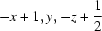 ; (iii)
 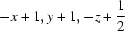 .
. Data collection: APEX2 (Bruker, 2009); cell refinement: SAINT (Bruker, 2009); data reduction: SAINT; program(s) used to solve structure: SHELXS97 (Sheldrick, 2008); program(s) used to refine structure: SHELXL97 (Sheldrick, 2008); molecular graphics: DIAMOND (Brandenburg, 2008); software used to prepare material for publication: publCIF (Westrip, 2010).
Supporting information
contains datablocks global, I. DOI: https://doi.org/10.1107/S1600536810043540/fj2358sup1.cif
Structure factors: contains datablock I. DOI: https://doi.org/10.1107/S1600536810043540/fj2358Isup2.hkl
To a solution of propionic acid (7.4 g, 100 mmol) in water (15 ml), an excess of fresh cobalt(II) carbonate hydrate, CoCO3.xH2O, (8.0 g, approximately 60 mmol) was added. The reaction mixture was stirred for 8 h at room temperature, followed by filtrating the unreacted CoCO3.xH2O out. The filtrate was allowed to stand at room temperature for slow evaporation. The red single crystals of (I) suitable for X-ray diffraction studies were obtained after several days. Yield 85%.
For a single-crystal X-ray diffraction experiment, a red transparent crystal of (I) was mounted on the Bruker Smart APEX II diffractometer. The experiment was performed at 170 K. The structure was solved by the direct method and refined using SHELXL-97 program (Sheldrick, 2008). The positions of hydrogen atoms of water molecules were localized from the differential Fourier synthesis and H atoms of the CH2 and CH3 groups were calculated by the algorithm incorporated in the SHELXL program complex. Hydrogen atoms kept fixed with Uiso(H) = 1.5Ueq(C).
Cobalt carboxylates are of great importance because of their application in homogeneous oxidation catalysis (Gates, 1992; Parshall & Ittel, 1992; Partenheimer, 1995), and their interesting magnetic properties (Eremenko et al., 2009). Carboxylate ligands coordinated to transition metal ions can adopt different binding modes and form a great number of various cage complexes and a variety of different one-dimensional, two-dimensional and three-dimensional structures.
The title compound, [Co(C2H5COO)2(H2O)]n.nH2O (I), actually named as cobalt(II) propionate dihydrate, is attracting our attention as the starting substance for the synthesis of mixed-valence cobalt carboxylates. This salt was synthesized and its is reported herein.
The of (I) contains one symmetrically independent Co2+ cation coordinated to four O atoms of four bridging propionates and two O atoms of bridging water molecules in a strongly distorted octahedral coordination (Fig. 1). The cis-angles about the Co atom range from 77.35 (4) to 109.40 (5)°, the Co—O bond length ranges from 2.0406 (12) to 2.2460 (12) Å; this is in agreement with the angles and the distances in isostructural cobalt(II) acetate dihydrate (Jiao et al., 2000). The structure of (I) consists of polymeric infinite linear chains with composition ∞[Co(C2H5COO)4/2(H2O)2/2] running along [010]. The Co···Co separation is 3.2587 (9) Å. The bridging carboxylate groups adopt two coordination modes, monodentate and syn-syn bidentate. The bidentate carboxylate group has C—O bonds of equal length, 1.267 (2) Å, whereas monodentate carboxylate group has different C—O bond lengths, 1.235 (2) and 1.305 (2) Å. The chains are connected to each other by a network of hydrogen bonds to solvate water molecules (Fig. 2).
It is rather interesting that the use of acetic acid instead of propionic acid in the synthesis of (I) result in the formation of monomeric cobalt(II) acetate tetrahydrate (Sobolev et al., 2003), and the polymeric cobalt(II) acetate dihydrate is formed by recrystallization of cobalt(II) acetate tetrahydrate from acetic acid (Jiao et al., 2000).
For the isostructural cobalt(II) acetate dihydrate, see: Jiao et al. (2000). For the structure of a hydrated cobalt(II) acetate which has been isolated in similar conditions, see: Sobolev et al. (2003). For properties and applications of cobalt carboxylates, see: Eremenko et al. (2009); Gates (1992); Parshall & Ittel (1992); Partenheimer (1995).
Data collection: APEX2 (Bruker, 2009); cell SAINT (Bruker, 2009); data reduction: SAINT (Bruker, 2009); program(s) used to solve structure: SHELXS97 (Sheldrick, 2008); program(s) used to refine structure: SHELXL97 (Sheldrick, 2008); molecular graphics: DIAMOND (Brandenburg, 2008); software used to prepare material for publication: publCIF (Westrip, 2010).
![[Figure 1]](./fj2358fig1thm.gif) | Fig. 1. The coordinated mode and linkage of the complex (I). Displacement ellipsoids of non-H atoms are drawn at the 40% probability level. Hydrogen atoms are drawn as spheres of arbitrary radius. Symmetry codes: i = –x + 1/2, y + 1/2,–z + 1/2; ii = –x + 1/2, y–1/2, –z + 1/2.] |
![[Figure 2]](./fj2358fig2thm.gif) | Fig. 2. Sticks representation of the crystal structure of (I) showing hydrogen bonds as green dashed lines. Only the H atoms involved in hydrogen bonds are shown. Co atoms are blue, O atoms are red, C atoms are grey, and selected H atoms are green colored.] |
| [Co(C3H5O2)2(H2O)]·H2O | F(000) = 1000 |
| Mr = 241.10 | Dx = 1.687 Mg m−3 |
| Monoclinic, C2/c | Mo Kα radiation, λ = 0.71073 Å |
| Hall symbol: -C 2yc | Cell parameters from 7703 reflections |
| a = 13.997 (4) Å | θ = 2.9–35.9° |
| b = 6.4987 (18) Å | µ = 1.81 mm−1 |
| c = 21.440 (6) Å | T = 170 K |
| β = 103.216 (5)° | Prism, red |
| V = 1898.6 (9) Å3 | 0.5 × 0.3 × 0.2 mm |
| Z = 8 |
| Bruker APEXII CCD diffractometer | 2762 independent reflections |
| Radiation source: fine-focus sealed tube | 2542 reflections with I > 2σ(I) |
| Graphite monochromator | Rint = 0.032 |
| φ and ω scans | θmax = 30.0°, θmin = 2.0° |
| Absorption correction: multi-scan (SADABS; Bruker, 2007) | h = −19→19 |
| Tmin = 0.276, Tmax = 0.332 | k = −9→9 |
| 11986 measured reflections | l = −30→30 |
| Refinement on F2 | Primary atom site location: structure-invariant direct methods |
| Least-squares matrix: full | Secondary atom site location: difference Fourier map |
| R[F2 > 2σ(F2)] = 0.026 | Hydrogen site location: inferred from neighbouring sites |
| wR(F2) = 0.067 | H atoms treated by a mixture of independent and constrained refinement |
| S = 1.09 | w = 1/[σ2(Fo2) + (0.0329P)2 + 1.4667P] where P = (Fo2 + 2Fc2)/3 |
| 2762 reflections | (Δ/σ)max < 0.001 |
| 130 parameters | Δρmax = 0.41 e Å−3 |
| 5 restraints | Δρmin = −0.57 e Å−3 |
| [Co(C3H5O2)2(H2O)]·H2O | V = 1898.6 (9) Å3 |
| Mr = 241.10 | Z = 8 |
| Monoclinic, C2/c | Mo Kα radiation |
| a = 13.997 (4) Å | µ = 1.81 mm−1 |
| b = 6.4987 (18) Å | T = 170 K |
| c = 21.440 (6) Å | 0.5 × 0.3 × 0.2 mm |
| β = 103.216 (5)° |
| Bruker APEXII CCD diffractometer | 2762 independent reflections |
| Absorption correction: multi-scan (SADABS; Bruker, 2007) | 2542 reflections with I > 2σ(I) |
| Tmin = 0.276, Tmax = 0.332 | Rint = 0.032 |
| 11986 measured reflections |
| R[F2 > 2σ(F2)] = 0.026 | 5 restraints |
| wR(F2) = 0.067 | H atoms treated by a mixture of independent and constrained refinement |
| S = 1.09 | Δρmax = 0.41 e Å−3 |
| 2762 reflections | Δρmin = −0.57 e Å−3 |
| 130 parameters |
Geometry. All e.s.d.'s (except the e.s.d. in the dihedral angle between two l.s. planes) are estimated using the full covariance matrix. The cell e.s.d.'s are taken into account individually in the estimation of e.s.d.'s in distances, angles and torsion angles; correlations between e.s.d.'s in cell parameters are only used when they are defined by crystal symmetry. An approximate (isotropic) treatment of cell e.s.d.'s is used for estimating e.s.d.'s involving l.s. planes. |
Refinement. Refinement of F2 against ALL reflections. The weighted R- factor wR and goodness of fit S are based on F2, conventional R-factors R are based on F, with F set to zero for negative F2. The threshold expression of F2 > 2σ(F2) is used only for calculating R-factors(gt) etc. and is not relevant to the choice of reflections for refinement. R-factors based on F2 are statistically about twice as large as those based on F, and R- factors based on ALL data will be even larger. |
| x | y | z | Uiso*/Ueq | ||
| Co1 | 0.248706 (13) | 0.18331 (3) | 0.244111 (9) | 0.01830 (7) | |
| O1 | 0.29927 (8) | 0.44228 (16) | 0.19444 (5) | 0.0231 (2) | |
| H11 | 0.267 (2) | 0.511 (5) | 0.1580 (14) | 0.080* | |
| H12 | 0.362 (2) | 0.441 (5) | 0.1918 (16) | 0.080* | |
| O2 | 0.39246 (8) | −0.23440 (17) | 0.29662 (6) | 0.0262 (2) | |
| O3 | 0.23831 (8) | −0.08151 (15) | 0.18689 (5) | 0.0217 (2) | |
| O4 | 0.39309 (8) | 0.10838 (17) | 0.28586 (5) | 0.0246 (2) | |
| O5 | 0.47910 (10) | 0.4367 (2) | 0.17307 (8) | 0.0391 (3) | |
| H51 | 0.516 (2) | 0.328 (5) | 0.1935 (15) | 0.080* | |
| H52 | 0.517 (2) | 0.543 (4) | 0.1846 (16) | 0.080* | |
| O6 | 0.21765 (10) | −0.29849 (19) | 0.10436 (6) | 0.0338 (3) | |
| C1 | 0.53359 (12) | −0.0526 (3) | 0.35261 (9) | 0.0304 (3) | |
| H1A | 0.5732 | 0.0598 | 0.3390 | 0.046* | |
| H1B | 0.5683 | −0.1860 | 0.3505 | 0.046* | |
| C2 | 0.21658 (11) | −0.1222 (2) | 0.12565 (7) | 0.0229 (3) | |
| C3 | 0.1606 (2) | 0.0073 (4) | 0.01094 (10) | 0.0580 (7) | |
| H3A | 0.1450 | 0.1368 | −0.0146 | 0.087* | |
| H3B | 0.1013 | −0.0834 | 0.0029 | 0.087* | |
| H3C | 0.2157 | −0.0660 | −0.0021 | 0.087* | |
| C4 | 0.52401 (19) | −0.0140 (5) | 0.42103 (11) | 0.0600 (7) | |
| H4A | 0.5908 | −0.0101 | 0.4503 | 0.090* | |
| H4B | 0.4847 | −0.1272 | 0.4346 | 0.090* | |
| H4C | 0.4902 | 0.1206 | 0.4231 | 0.090* | |
| C5 | 0.43274 (11) | −0.0596 (2) | 0.30805 (7) | 0.0208 (3) | |
| C6 | 0.19027 (18) | 0.0594 (3) | 0.08116 (9) | 0.0418 (5) | |
| H6A | 0.1351 | 0.1358 | 0.0932 | 0.063* | |
| H6B | 0.2480 | 0.1544 | 0.0881 | 0.063* |
| U11 | U22 | U33 | U12 | U13 | U23 | |
| Co1 | 0.01681 (10) | 0.01335 (10) | 0.02365 (11) | 0.00019 (7) | 0.00237 (7) | 0.00019 (7) |
| O1 | 0.0216 (5) | 0.0199 (5) | 0.0281 (5) | 0.0003 (4) | 0.0061 (4) | 0.0025 (4) |
| O2 | 0.0192 (5) | 0.0173 (5) | 0.0387 (6) | −0.0008 (4) | −0.0006 (4) | 0.0004 (4) |
| O3 | 0.0247 (5) | 0.0170 (5) | 0.0221 (5) | 0.0004 (4) | 0.0026 (4) | 0.0003 (4) |
| O4 | 0.0185 (5) | 0.0181 (5) | 0.0347 (6) | 0.0001 (4) | 0.0010 (4) | 0.0004 (4) |
| O5 | 0.0241 (6) | 0.0228 (6) | 0.0687 (10) | 0.0001 (5) | 0.0068 (6) | 0.0011 (6) |
| O6 | 0.0486 (8) | 0.0254 (6) | 0.0255 (5) | 0.0056 (5) | 0.0044 (5) | −0.0032 (4) |
| C1 | 0.0188 (7) | 0.0231 (8) | 0.0443 (9) | 0.0001 (6) | −0.0034 (6) | 0.0012 (6) |
| C2 | 0.0225 (7) | 0.0225 (7) | 0.0234 (6) | 0.0027 (6) | 0.0043 (5) | 0.0012 (5) |
| C3 | 0.089 (2) | 0.0507 (13) | 0.0271 (9) | 0.0158 (13) | −0.0012 (10) | 0.0075 (9) |
| C4 | 0.0477 (13) | 0.0883 (19) | 0.0351 (10) | −0.0161 (13) | −0.0093 (9) | 0.0042 (12) |
| C5 | 0.0170 (6) | 0.0199 (7) | 0.0253 (6) | 0.0002 (5) | 0.0044 (5) | −0.0005 (5) |
| C6 | 0.0667 (14) | 0.0300 (9) | 0.0270 (8) | 0.0139 (9) | 0.0069 (8) | 0.0065 (7) |
| Co1—O2i | 2.0406 (12) | C1—C5 | 1.514 (2) |
| Co1—O4 | 2.0726 (12) | C1—C4 | 1.524 (3) |
| Co1—O3 | 2.0991 (11) | C1—H1A | 1.0000 |
| Co1—O3i | 2.1058 (11) | C1—H1B | 1.0000 |
| Co1—O1 | 2.1936 (12) | C2—C6 | 1.509 (2) |
| Co1—O1ii | 2.2460 (12) | C3—C6 | 1.506 (3) |
| O1—H11 | 0.92 (3) | C3—H3A | 1.0000 |
| O1—H12 | 0.89 (3) | C3—H3B | 1.0000 |
| O2—C5 | 1.2669 (18) | C3—H3C | 1.0000 |
| O3—C2 | 1.3053 (18) | C4—H4A | 1.0000 |
| O4—C5 | 1.2670 (18) | C4—H4B | 1.0000 |
| O5—H51 | 0.92 (3) | C4—H4C | 1.0000 |
| O5—H52 | 0.87 (3) | C6—H6A | 1.0000 |
| O6—C2 | 1.2346 (19) | C6—H6B | 1.0000 |
| O2i—Co1—O4 | 178.40 (4) | C4—C1—H1A | 109.7 |
| O2i—Co1—O3 | 91.94 (5) | C5—C1—H1B | 109.7 |
| O4—Co1—O3 | 89.44 (4) | C4—C1—H1B | 109.7 |
| O2i—Co1—O3i | 91.72 (5) | H1A—C1—H1B | 108.2 |
| O4—Co1—O3i | 87.03 (4) | O6—C2—O3 | 122.70 (14) |
| O3—Co1—O3i | 171.46 (4) | O6—C2—C6 | 120.92 (14) |
| O2i—Co1—O1 | 88.83 (5) | O3—C2—C6 | 116.38 (14) |
| O4—Co1—O1 | 89.94 (5) | C6—C3—H3A | 109.5 |
| O3—Co1—O1 | 109.40 (5) | C6—C3—H3B | 109.5 |
| O3i—Co1—O1 | 78.38 (5) | H3A—C3—H3B | 109.5 |
| O2i—Co1—O1ii | 92.50 (5) | C6—C3—H3C | 109.5 |
| O4—Co1—O1ii | 88.60 (5) | H3A—C3—H3C | 109.5 |
| O3—Co1—O1ii | 77.35 (4) | H3B—C3—H3C | 109.5 |
| O3i—Co1—O1ii | 94.79 (5) | C1—C4—H4A | 109.5 |
| O1—Co1—O1ii | 173.08 (3) | C1—C4—H4B | 109.5 |
| Co1—O1—Co1i | 94.44 (5) | H4A—C4—H4B | 109.5 |
| Co1—O1—H11 | 129 (2) | C1—C4—H4C | 109.5 |
| Co1i—O1—H11 | 90 (2) | H4A—C4—H4C | 109.5 |
| Co1—O1—H12 | 117 (2) | H4B—C4—H4C | 109.5 |
| Co1i—O1—H12 | 118 (2) | O2—C5—O4 | 124.23 (14) |
| H11—O1—H12 | 104 (3) | O2—C5—C1 | 117.31 (13) |
| C5—O2—Co1ii | 131.47 (10) | O4—C5—C1 | 118.44 (13) |
| C2—O3—Co1 | 136.31 (10) | C3—C6—C2 | 115.31 (17) |
| C2—O3—Co1ii | 121.50 (10) | C3—C6—H6A | 108.4 |
| Co1—O3—Co1ii | 101.60 (5) | C2—C6—H6A | 108.4 |
| C5—O4—Co1 | 131.66 (10) | C3—C6—H6B | 108.4 |
| H51—O5—H52 | 104 (3) | C2—C6—H6B | 108.4 |
| C5—C1—C4 | 109.75 (16) | H6A—C6—H6B | 107.5 |
| C5—C1—H1A | 109.7 |
| Symmetry codes: (i) −x+1/2, y+1/2, −z+1/2; (ii) −x+1/2, y−1/2, −z+1/2. |
| D—H···A | D—H | H···A | D···A | D—H···A |
| O1—H11···O6iii | 0.92 (3) | 1.72 (3) | 2.620 (2) | 163 (3) |
| O1—H12···O5 | 0.89 (3) | 1.78 (3) | 2.660 (2) | 171 (3) |
| O5—H51···O4iv | 0.92 (3) | 1.90 (3) | 2.794 (2) | 163 (3) |
| O5—H52···O2v | 0.87 (3) | 1.91 (3) | 2.773 (2) | 174 (3) |
| Symmetry codes: (iii) x, y+1, z; (iv) −x+1, y, −z+1/2; (v) −x+1, y+1, −z+1/2. |
Experimental details
| Crystal data | |
| Chemical formula | [Co(C3H5O2)2(H2O)]·H2O |
| Mr | 241.10 |
| Crystal system, space group | Monoclinic, C2/c |
| Temperature (K) | 170 |
| a, b, c (Å) | 13.997 (4), 6.4987 (18), 21.440 (6) |
| β (°) | 103.216 (5) |
| V (Å3) | 1898.6 (9) |
| Z | 8 |
| Radiation type | Mo Kα |
| µ (mm−1) | 1.81 |
| Crystal size (mm) | 0.5 × 0.3 × 0.2 |
| Data collection | |
| Diffractometer | Bruker APEXII CCD |
| Absorption correction | Multi-scan (SADABS; Bruker, 2007) |
| Tmin, Tmax | 0.276, 0.332 |
| No. of measured, independent and observed [I > 2σ(I)] reflections | 11986, 2762, 2542 |
| Rint | 0.032 |
| (sin θ/λ)max (Å−1) | 0.703 |
| Refinement | |
| R[F2 > 2σ(F2)], wR(F2), S | 0.026, 0.067, 1.09 |
| No. of reflections | 2762 |
| No. of parameters | 130 |
| No. of restraints | 5 |
| H-atom treatment | H atoms treated by a mixture of independent and constrained refinement |
| Δρmax, Δρmin (e Å−3) | 0.41, −0.57 |
Computer programs: APEX2 (Bruker, 2009), SAINT (Bruker, 2009), SHELXS97 (Sheldrick, 2008), SHELXL97 (Sheldrick, 2008), DIAMOND (Brandenburg, 2008), publCIF (Westrip, 2010).
| D—H···A | D—H | H···A | D···A | D—H···A |
| O1—H11···O6i | 0.923 (28) | 1.723 (30) | 2.620 (2) | 163 (3) |
| O1—H12···O5 | 0.893 (30) | 1.775 (31) | 2.660 (2) | 171 (3) |
| O5—H51···O4ii | 0.924 (30) | 1.896 (30) | 2.794 (2) | 163 (3) |
| O5—H52···O2iii | 0.872 (26) | 1.905 (26) | 2.773 (2) | 174 (3) |
| Symmetry codes: (i) x, y+1, z; (ii) −x+1, y, −z+1/2; (iii) −x+1, y+1, −z+1/2. |
Footnotes
‡Additional correspondence author, e-mail: [email protected].
References
 Brandenburg, K. (2008). DIAMOND. Crystal Impact GbR, Bonn, Germany. Google Scholar
Bruker (2007). SADABS. Bruker AXS Inc., Madison, Wisconsin, USA. Google Scholar
Bruker, (2009). APEX2 and SAINT. Bruker AXS Inc., Madison, Wisconsin, USA. Google Scholar
Eremenko, I. L., Sidorov, A. A. & Kiskin, M. A. (2009). Magnetic Nanoparticles, edited by S. P. Gubin, pp. 349–391. Weinheim: Wiley-VCH. Google Scholar
Gates, B. C. (1992). Catalytic Chemistry. New York: Wiley-Interscience. Google Scholar
Jiao, X.-D., Guzei, I. A. & Espenson, J. H. (2000). Z. Kristallogr. New Cryst. Struct. 215, 173–174. CAS Google Scholar
Parshall, G. W. & Ittel, S. D. (1992). Homogenous Catalysis. New York: Wiley-Interscience. Google Scholar
Partenheimer, W. (1995). Catal. Today, 23, 69–158. CrossRef CAS Web of Science Google Scholar
Sheldrick, G. M. (2008). Acta Cryst. A64, 112–122. Web of Science CrossRef CAS IUCr Journals Google Scholar
Sobolev, A. N., Miminoshvili, E. B., Miminoshvili, K. E. & Sakvarelidze, T. N. (2003). Acta Cryst. E59, m836–m837. Web of Science CSD CrossRef IUCr Journals Google Scholar
Westrip, S. P. (2010). J. Appl. Cryst. 43, 920–925. Web of Science CrossRef CAS IUCr Journals Google Scholar
This is an open-access article distributed under the terms of the Creative Commons Attribution (CC-BY) Licence, which permits unrestricted use, distribution, and reproduction in any medium, provided the original authors and source are cited.
| CRYSTALLOGRAPHIC COMMUNICATIONS |


Cobalt carboxylates are of great importance because of their application in homogeneous oxidation catalysis (Gates, 1992; Parshall & Ittel, 1992; Partenheimer, 1995), and their interesting magnetic properties (Eremenko et al., 2009). Carboxylate ligands coordinated to transition metal ions can adopt different binding modes and form a great number of various cage complexes and a variety of different one-dimensional, two-dimensional and three-dimensional structures.
The title compound, [Co(C2H5COO)2(H2O)]n.nH2O (I), actually named as cobalt(II) propionate dihydrate, is attracting our attention as the starting substance for the synthesis of mixed-valence cobalt carboxylates. This salt was synthesized and its crystal structure is reported herein.
The crystal structure of (I) contains one symmetrically independent Co2+ cation coordinated to four O atoms of four bridging propionates and two O atoms of bridging water molecules in a strongly distorted octahedral coordination (Fig. 1). The cis-angles about the Co atom range from 77.35 (4) to 109.40 (5)°, the Co—O bond length ranges from 2.0406 (12) to 2.2460 (12) Å; this is in agreement with the angles and the distances in isostructural cobalt(II) acetate dihydrate (Jiao et al., 2000). The structure of (I) consists of polymeric infinite linear chains with composition ∞[Co(C2H5COO)4/2(H2O)2/2] running along [010]. The Co···Co separation is 3.2587 (9) Å. The bridging carboxylate groups adopt two coordination modes, monodentate and syn-syn bidentate. The bidentate carboxylate group has C—O bonds of equal length, 1.267 (2) Å, whereas monodentate carboxylate group has different C—O bond lengths, 1.235 (2) and 1.305 (2) Å. The chains are connected to each other by a network of hydrogen bonds to solvate water molecules (Fig. 2).
It is rather interesting that the use of acetic acid instead of propionic acid in the synthesis of (I) result in the formation of monomeric cobalt(II) acetate tetrahydrate (Sobolev et al., 2003), and the polymeric cobalt(II) acetate dihydrate is formed by recrystallization of cobalt(II) acetate tetrahydrate from acetic acid (Jiao et al., 2000).